




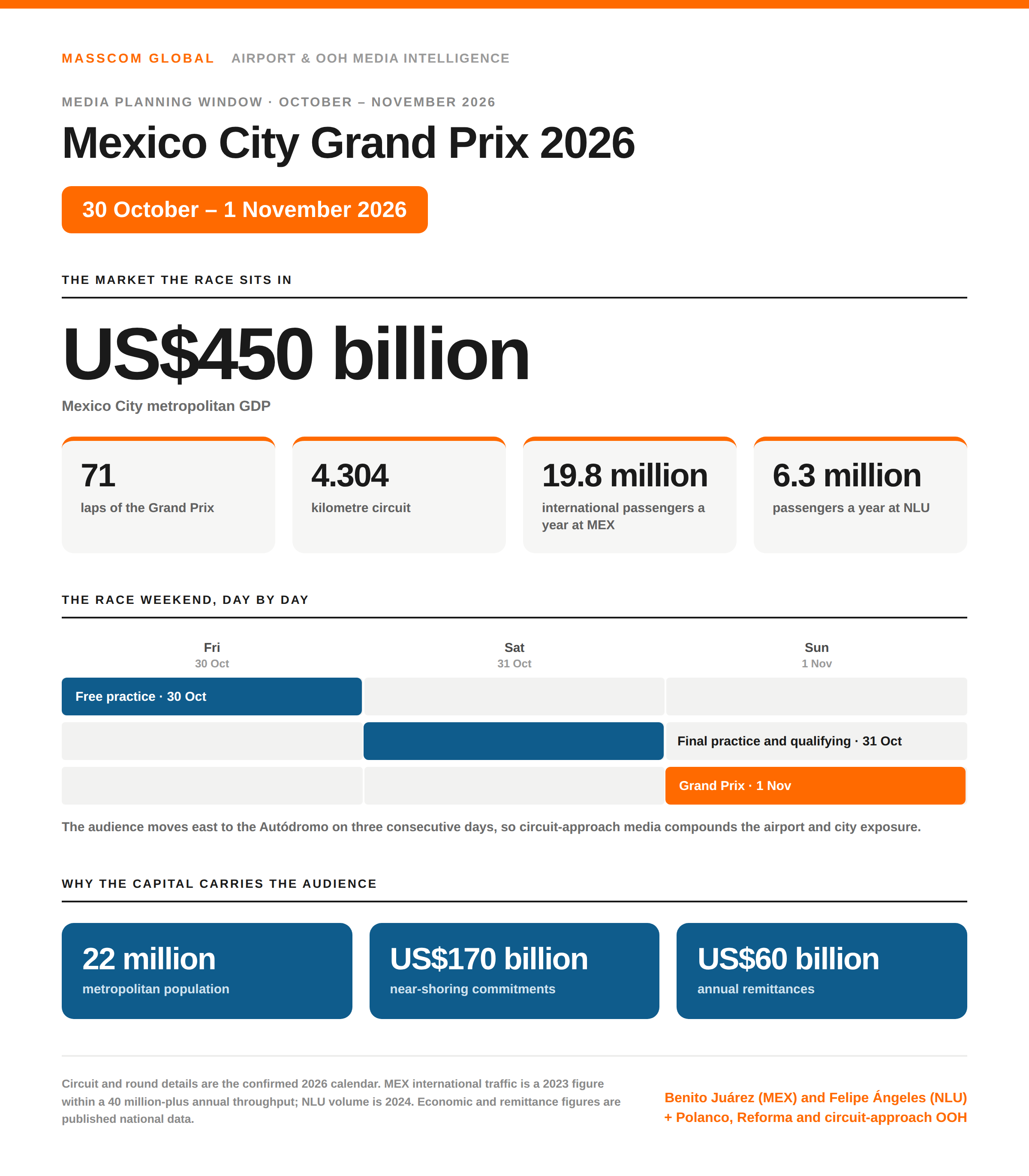
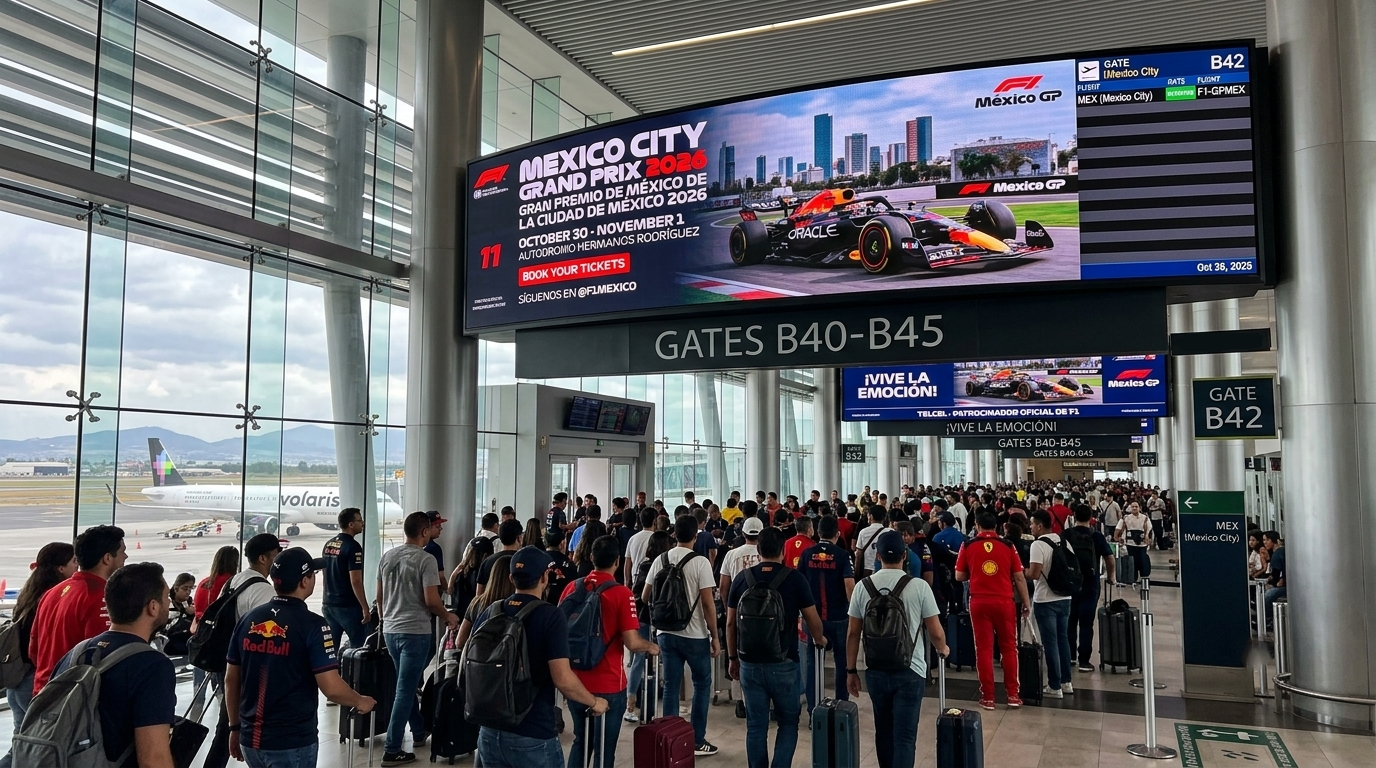
Mexico City is Latin America's largest advertising market by a considerable margin, anchoring a metropolitan economy of roughly US$450 billion, about 17% of Mexico's entire national output. The Formula 1 Mexico City Grand Prix returns to the Autódromo Hermanos Rodríguez from 30 October to 1 November 2026, the 20th round of the 2026 championship, and it traditionally follows the United States Grand Prix, which means a large share of the paddock, the sponsor delegations and the travelling premium audience arrive directly from Austin.
For media planners, the commercial value of this weekend is not the three days of track action. It is the seven-to-ten day window around it, when a high-spend international audience funnels through Mexico City's two airports, concentrates in Polanco, Reforma, Santa Fe and Condesa, and then moves as a single mass toward one venue in the east of the city. Few weekends in Latin America deliver a comparable density of qualified affluent attention inside one metropolitan area.
Destination Mexico City: Full Visitor Journey Coverage
Mexico City's race weekend has a legible geography, and that is what makes it plannable. Visitors arrive at MEX or NLU, stay in Polanco, Reforma, Santa Fe or Condesa, eat and shop along Presidente Masaryk and Avenida Álvaro Obregón, and travel east to the Autódromo Hermanos Rodríguez on three consecutive days. The same audience passes the same corridors repeatedly, which turns a sequenced buy into genuine frequency rather than duplicated waste.
An Airport → City → Circuit sequence works as follows: own the arrivals moment at both gateways; sustain presence through digital and large-format OOH across the Reforma corridor, the Polanco luxury retail district, Santa Fe's corporate cluster and premium hotel environments; then convert on the circuit approach, along the Viaducto and Zaragoza arteries and the Metro and transit routes feeding the Autódromo. Each layer reaches the same people at a different point in their intent.
Three effects follow from sequencing rather than scattering budget:
- Increased brand recall: repeated exposure at arrival, in the hotel and retail districts, and on the approach to the venue
- Consistent presence: the brand becomes part of the weekend's visual environment rather than an interruption to it
- Enhanced campaign effectiveness: coordinated placements across one metropolitan area outperform the same spend split across disconnected markets
Why Airport & City Advertising Works During the Mexico City Grand Prix
Mexico City is Latin America's largest advertising market by a considerable margin, and the Grand Prix sits on top of an already substantial resident wealth base. The metropolitan area holds around 22 million people and generates a metropolitan GDP of approximately US$450 billion: roughly 17% of Mexico's entire national output within a national economy of about US$1.3 trillion. The corporate headquarters, private banking desks, family offices and developer principals that matter to a premium brief are almost all inside that footprint.
Two structural flows compound the opportunity. First, Mexico's near-shoring cycle has attracted more than US$170 billion in confirmed investment commitments, drawing a continuous stream of industrial, logistics and financial decision-makers into the capital. Second, the cross-border relationship with the United States is exceptionally deep: roughly 11 million Mexicans live in the United States, and Mexico receives around US$60 billion a year in remittances: second globally only to India. That combination produces an inbound traveller mix that is unusually affluent, unusually frequent and unusually US-connected.
Race weekend layers international motorsport travellers, hospitality and paddock-club ticket holders, team and sponsor delegations from automotive, watch, spirits, aviation and financial services, and a heavy volume of business-aviation arrivals on top of that base. The audience is not imported for a weekend and then lost; a well-sequenced campaign reaches the visiting HNWI traveller and the resident principal they have flown in to meet.
Key Benefits of Airport & City Advertising During the Mexico City Grand Prix
Reach a qualified, high-spend audience
Grand Prix arrivals skew strongly toward premium-cabin and business-aviation travellers: precisely the audience that is expensive and fragmented to reach through conventional channels. Airport and city media place a brand in front of them during unavoidable, high-dwell moments: immigration approach, baggage reclaim, hotel districts, and the arterial routes toward the circuit.
Elevate your brand positioning
Formula 1 confers a prestige register by default, and Mexico City's race is among the most atmospheric on the calendar. Appearing consistently across the arrival journey and the city core associates a brand with the same tier of visibility occupied by global title partners, without the commitment of a team or circuit sponsorship.
Generate real business opportunity
Race week functions as a regional deal calendar. Wealth managers, real-estate developers, private-aviation operators, jewellery and watch houses, tequila and mezcal houses and investment-migration advisors all use the window for client entertaining and new-business meetings. Sustained visibility across the week keeps a brand present in those conversations rather than adjacent to them.
Get Free Expert Assistance from Our Global Media Planning Team
Receive strategic recommendations, media planning support, campaign monitoring and reporting to maximise your visibility throughout Mexican F1 Grand Prix.
Book Expert ConsultationMexico City Benito Juárez International Airport (MEX): The Primary Gateway
Benito Juárez remains the dominant gateway to the Mexican capital and one of the highest-volume airports in Latin America. It handles approximately 19.8 million international passengers annually (2023) within a combined domestic and international throughput of more than 40 million passengers a year. It operates two terminal buildings (Terminal 1 and Terminal 2, connected by a shuttle system) and sits on the eastern edge of the city, inside the urban footprint rather than out on the periphery. That location matters for race-weekend planning: the Autódromo Hermanos Rodríguez is in the same eastern quadrant, so arrivals and circuit traffic share the same corridors.
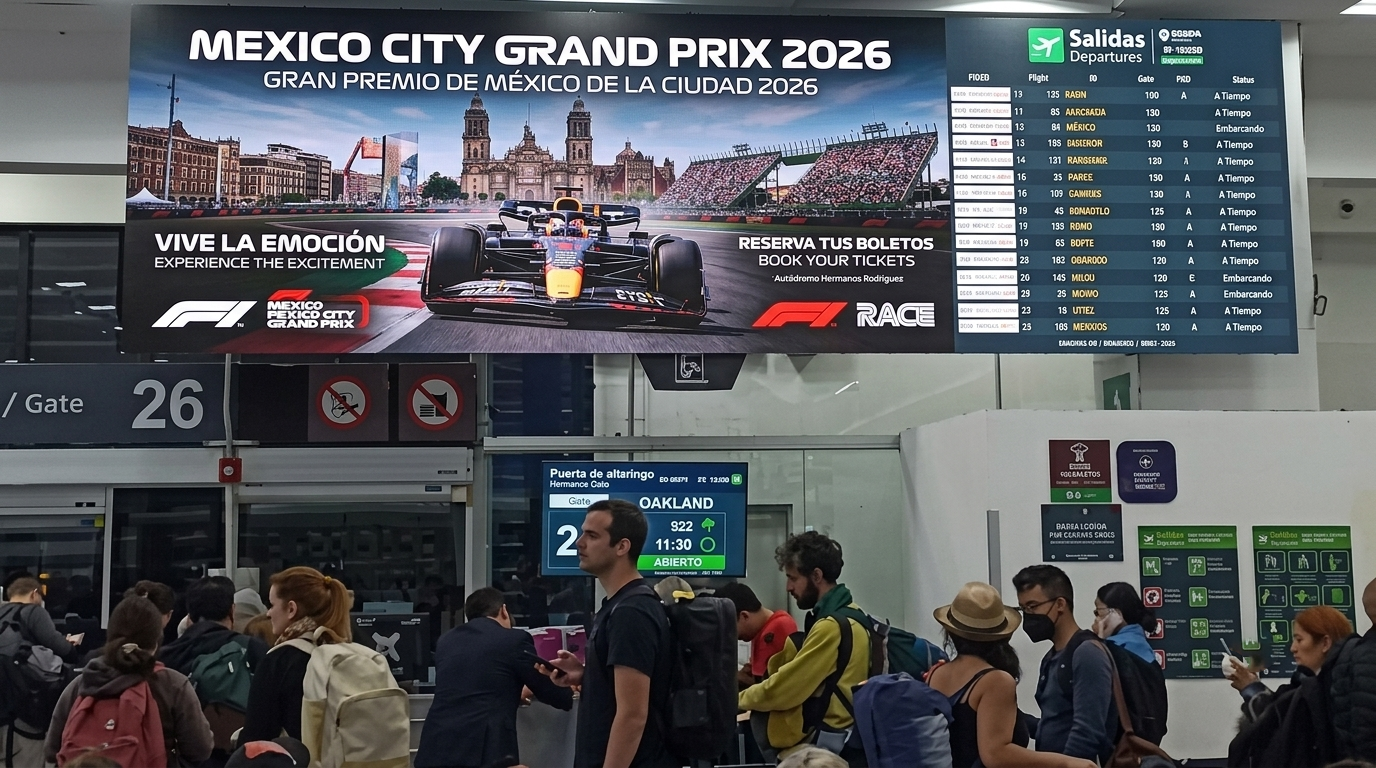
Inventory Highlights
- Arrivals and immigration approach positions across both terminals: the first branded surface an inbound race visitor encounters
- Baggage reclaim and arrivals hall placements offering extended, effectively captive dwell time
- Departure concourse and premium check-in environments, reaching premium-cabin and business travellers on the outbound leg
- Terminal-specific buys aligned to the carrier mix: Terminal 1 and Terminal 2 serve different alliance and airline groupings, allowing a campaign to be weighted toward long-haul international or domestic feeder traffic
- Positions along the routes that matter most for this audience: Los Angeles, New York JFK, Houston, Miami, Madrid, Dubai, Frankfurt, Tokyo Narita and Seoul Incheon all connect into MEX
Advantages for Advertisers
- Unavoidable exposure: effectively every inbound commercial race visitor passes through an arrivals sequence a brand can own
- Scale without waste: the audience is self-selecting affluent international travellers, not a general population sample
- Dual-terminal coverage captures both the US and European premium inbound flow and the domestic Monterrey, Guadalajara and Cancún feeder traffic
- Proximity to the eastern city quadrant allows an airport buy to be sequenced directly into circuit-approach media
 Wealth in motion intelligence.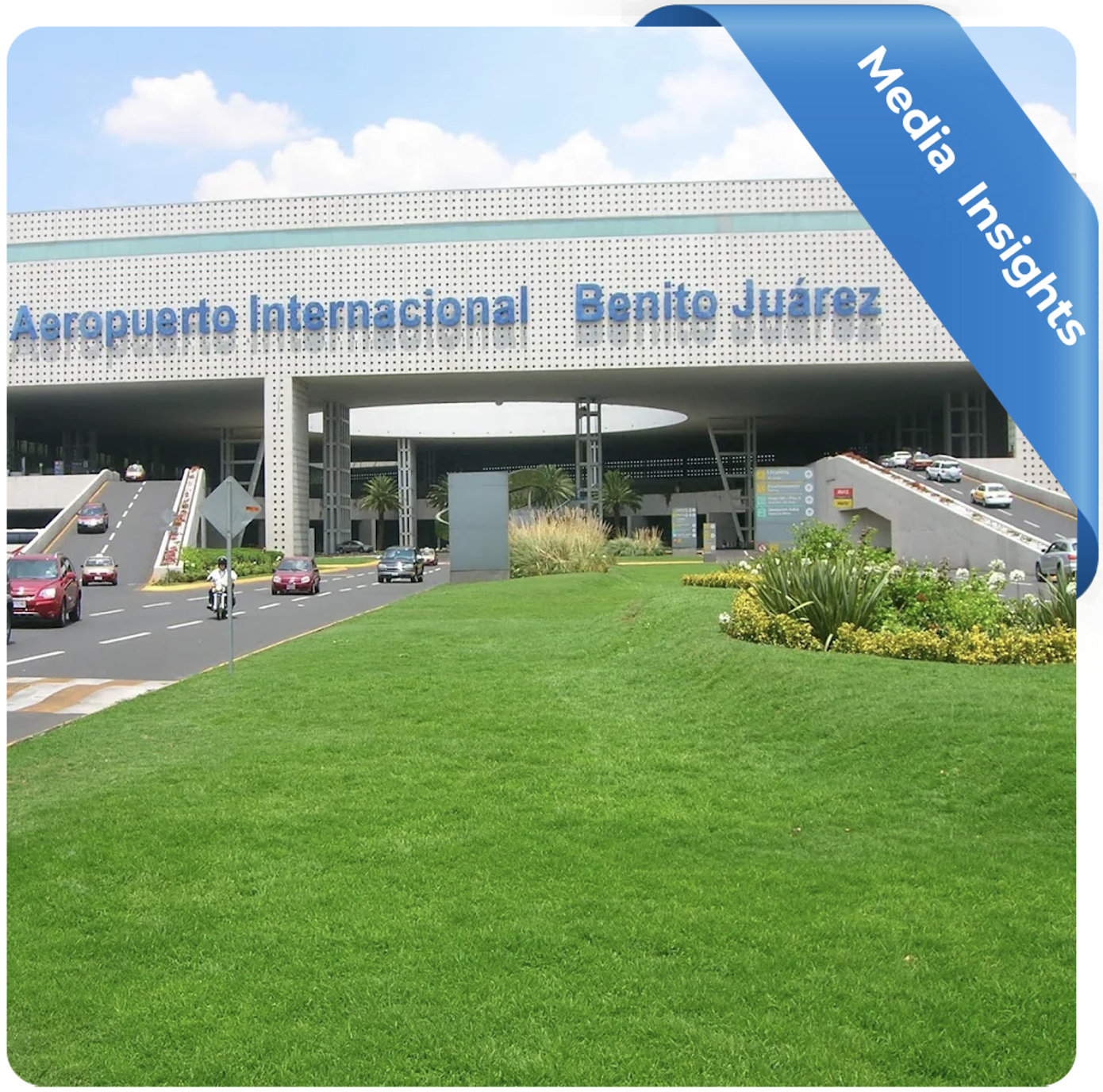
Felipe Ángeles International Airport (NLU / AIFA): The Second Gateway
Felipe Ángeles opened in 2022 at Zumpango, in the State of México, approximately 35 kilometres north of Mexico City. It handles around 6.3 million passengers annually across two terminals (A and B), against a design capacity of up to 20 million passengers a year, and ranked as the eighth-busiest airport in Mexico by passenger traffic in 2024 after growth of 140% between 2023 and 2024. It also functions as a leading national cargo hub, with throughput reported at 160,000 cargo units.
Inventory Highlights
- Arrival and departure positions inside a modern, purpose-built terminal environment with comparatively low media clutter
- Landside and forecourt placements catching the ground-transfer moment on a long inbound drive into the city
- Cargo and business-aviation adjacent environments relevant to industrial, logistics and near-shoring briefs
Advantages for Advertisers
- Low clutter means a single well-placed execution carries a disproportionate share of attention
- Overflow and price-sensitive capacity from MEX increasingly routes here, so a two-airport buy closes the gap on total inbound coverage
- Strong fit for B2B, industrial, logistics and financial-services messaging aligned to Mexico's near-shoring investment cycle
 Wealth in motion intelligence.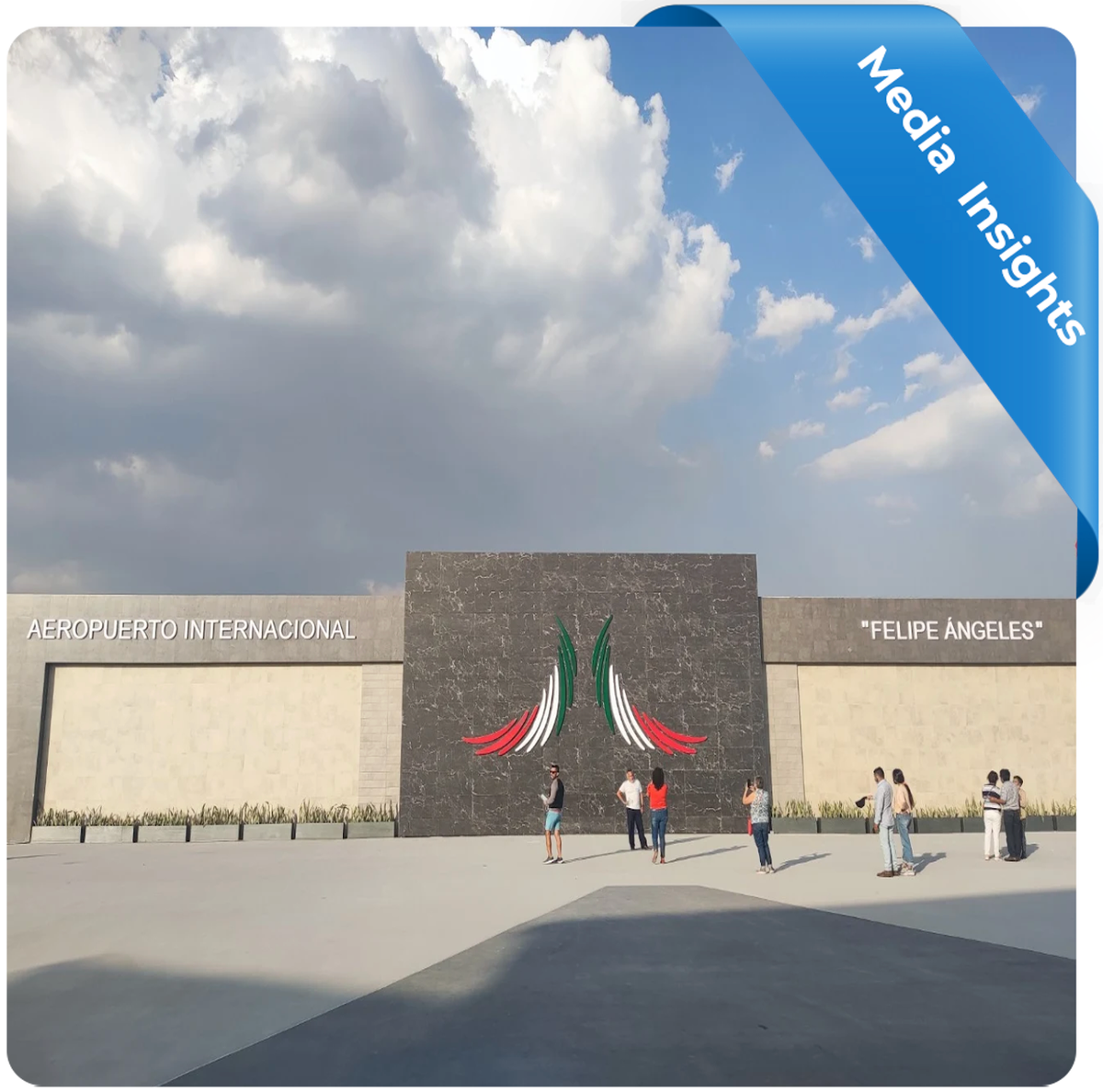
Why Brands Choose Airport & City Advertising for Mexico City Grand Prix
Exclusive audience access. Few windows in Latin America concentrate this volume of premium-cabin arrivals, business-aviation traffic, sponsor delegations and resident corporate leadership into one city across one week.
A prestigious environment. The Autódromo Hermanos Rodríguez weekend is one of the most recognisable events on the global sporting calendar. Brands visible in that environment inherit its register without negotiating a sponsorship.
End-to-end campaign support. Masscom Global plans, negotiates and executes across airport and city inventory from a single brief, with one point of accountability from availability check to proof of posting.
Strategic planning assistance. Our planners advise on terminal selection, format mix and flight timing so that budget lands where the specific audience actually moves: not simply where inventory happens to be available.
The Masscom Global Standard Behind Every Mexico City Grand Prix Placement
- Verified inventory and audience data: screen counts and terminal data for MEX and NLU come from live operator data at proposal stage, not published estimates.
- Transparent delivery reporting: campaign monitoring and reporting across both airports and the Polanco, Reforma and Santa Fe city inventory, so you see exactly where your creative ran.
- Benchmarked recommendations: terminal selection and format mix set against comparable race-weekend campaigns across our network.
- We absorb the complexity: one point of accountability from availability check to proof of posting across airport and city inventory.
Request Your Customised Mexican F1 Grand Prix Advertising Plan
Tell us your audience, category and budget. Our planners will return a costed plan across airport and prime city inventory, with availability confirmed.
Book NowFrequently Asked Questions
When exactly is the 2026 Mexico City Grand Prix?
The race weekend runs 30 October to 1 November 2026 at the Autódromo Hermanos Rodríguez, with practice on Friday 30 October, qualifying on Saturday 31 October and the Grand Prix on Sunday 1 November. It is round 20 of the season, over 71 laps of the 4.304-kilometre circuit.
Who attends the Mexico City Grand Prix?
International motorsport travellers, premium and hospitality ticket holders, team and sponsor delegations, regional and global executives using the weekend as a business-calendar anchor, and a significant volume of business-aviation arrivals: alongside Mexico City's own resident corporate and high-net-worth community.
Can I reach visitors across their whole journey, not just at the circuit?
Yes. A combined MEX, NLU and city campaign covers arrival, the hotel and luxury retail districts of Polanco and Reforma, the Santa Fe corporate cluster and the eastern approach corridors to the Autódromo, so the same audience encounters the brand several times across the week.
How far in advance should a race-weekend campaign be booked?
Premium airport positions and high-impact city sites for the Grand Prix window are among Mexico City's most contested inventory, and the preceding Austin race weekend pulls regional demand forward. We recommend confirming availability several months ahead; later requests can often still be served, but with reduced format choice.
Which brand categories perform best in this window?
Luxury automotive, watches and jewellery, premium tequila and mezcal, private aviation, wealth management and private banking, residential real estate and residency advisory, technology and industrial B2B tied to near-shoring, and international hospitality.
Related Airport Advertising Guides
Detailed inventory, audience and planning notes for the airports covered above:
Wealth in motion intelligence.Wealth in motion intelligence.Mexico City Grand Prix Won't Wait. Neither Should You.
- Fixed race-week capacity: premium airport positions and high-impact city sites for the 30 October to 1 November window are among Mexico City's most contested inventory.
- Competitors are already moving, pulled forward by Austin: the preceding United States Grand Prix weekend pulls regional demand ahead of Mexico City's own window, so positions clear earlier than the race date suggests.
- The window is exact, not approximate: confirming availability several months ahead keeps full format choice; later requests can often still be served, but with reduced choice.
- The alternative is largely closed: trackside sponsorship at the Autódromo carries a commitment airport and city media don't require, and they remain the route to sponsor delegations and resident wealth alike.
Get Free Expert Assistance Now
Tell us your audience, category and budget, and our planners will return a costed Mexico City Grand Prix media plan across airport and city inventory.
Request Availability
MEX, NLU and prime Mexico City positions for the 30 October – 1 November 2026 window move quickly. Ask us what is still open.
The Mexico City Grand Prix concentrates a week of qualified affluent attention onto one metropolitan area already generating roughly US$450 billion in GDP, then funnels it through two airports, a handful of luxury districts and a single circuit. Sequenced correctly across MEX, NLU, Polanco, Reforma and Santa Fe, a brand meets that same audience several times before the lights go out on Sunday, at a fraction of what trackside sponsorship demands. With the preceding Austin weekend already pulling regional demand forward, the positions that make that sequence work are the ones to secure first.







