


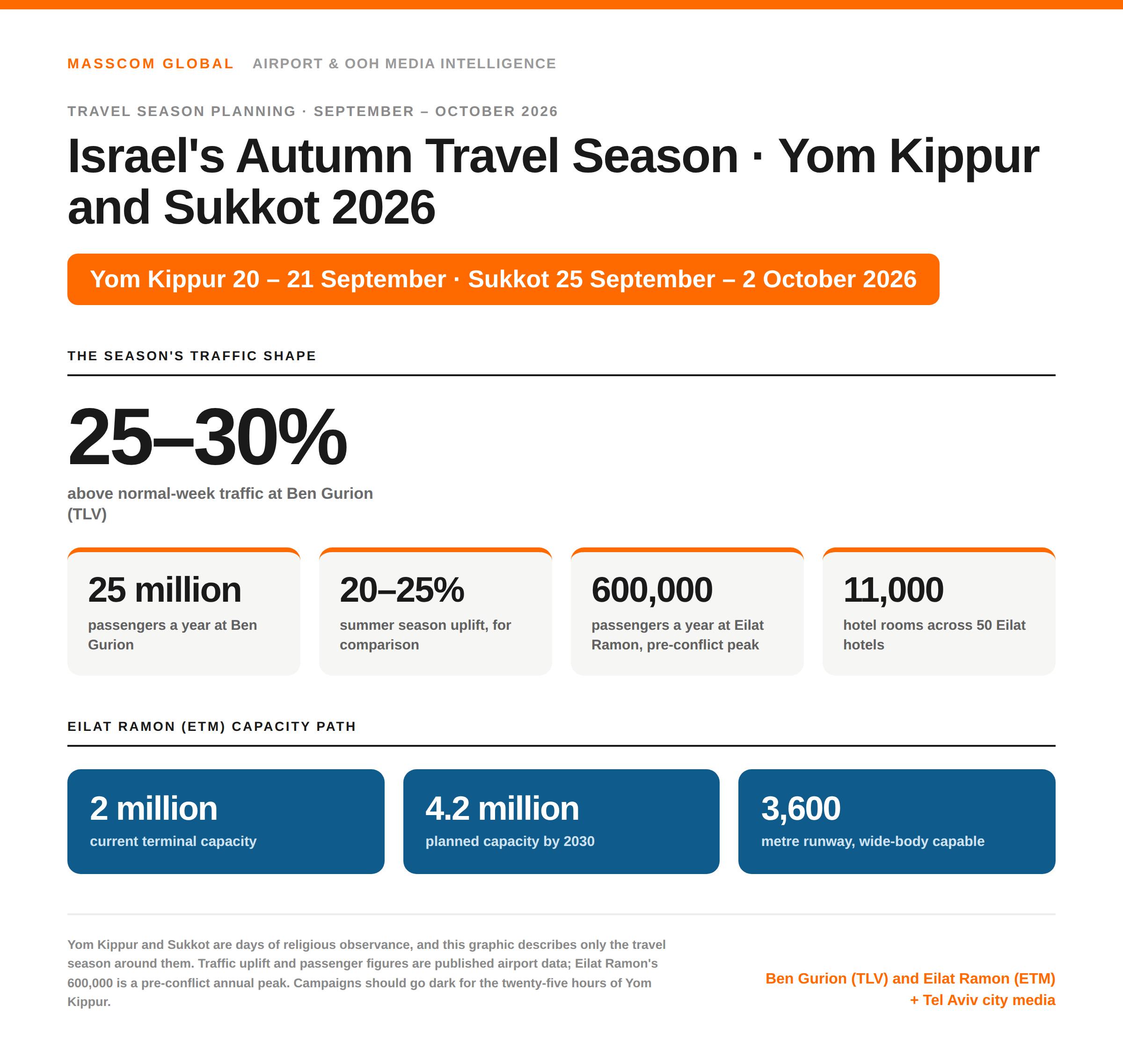
Ben Gurion's passenger traffic runs 25–30% above normal travel weeks during this period, the strongest proportional uplift in the airport's year. A word on framing first: Yom Kippur is the most solemn day in the Jewish calendar, and Sukkot is a festival of religious observance and family gathering. Neither is a marketing occasion, and this post does not treat them as one. What it addresses is separate: the travel season that forms around them, from the second week of September to the first week of October 2026, when Israel's two principal gateways carry one of the densest concentrations of inbound diaspora, family and returning-business travel in their annual cycle.
The operational shape matters as much as the dates. Yom Kippur is a national pause: commercial activity, broadcast and transport effectively stop for twenty-five hours, and no campaign should run against it. What surrounds that pause is heavy movement: arrivals building through mid-September, a distinctive second phase during Sukkot, and a compressed return wave from 2 to 4 October.
Why Advertise During the Yom Kippur and Sukkot Travel Season?
Ben Gurion handles approximately 25 million passengers annually, and during the Jewish High Holiday period traffic runs 25–30% above normal travel weeks: a larger proportional uplift than the summer tourism season's 20–25%. It is the strongest proportional traffic window in the airport's year. Audience composition is what makes it commercially interesting rather than merely busy. Ben Gurion's mix spans technology executives and venture capital investors, business travellers, diaspora travellers on the Israel–Europe and Israel–North America routes, luxury brand consumers, and government officials and diplomats. During this window the diaspora share rises sharply, and that cohort skews affluent and long-staying: multi-generational family groups, second-home owners, and investors who combine the visit with business.
Sukkot then produces a domestic movement the High Holidays do not. Its intermediate days, 25 September to 2 October, are one of the two great domestic travel weeks in the Israeli year, and Eilat is the primary destination. That flow is the specific opportunity here, and it is reached at a different airport from the inbound diaspora traffic.
Key Benefits of Advertising During the Sukkot Travel Window
Reach a qualified, high-spend audience
A 25–30% uplift at Ben Gurion concentrates affluent diaspora and returning-business travellers into a defined three-week period. Placements reach them during arrival, immigration and reclaim: unavoidable, extended-dwell moments at the start of a long stay, before spending decisions are made.
Elevate your brand positioning
Terminal 3 is the country's principal international gateway and a controlled premium environment. Presence there places a brand in front of the diaspora, diplomatic and technology-investor audiences simultaneously, in a setting carrying institutional credibility.
Generate real business opportunity
The season functions as an informal business calendar. Diaspora investors, family offices and executives schedule meetings around family visits. Visibility across arrival, the Sukkot travel week and the October return wave keeps a brand present throughout.

Get Free Expert Assistance from Our Global Media Planning Team
Receive strategic recommendations, media planning support, campaign monitoring and reporting to maximise your visibility throughout Yom Kippur / Sukkot.
Book Expert ConsultationBen Gurion International Airport (TLV): The Inbound Gateway
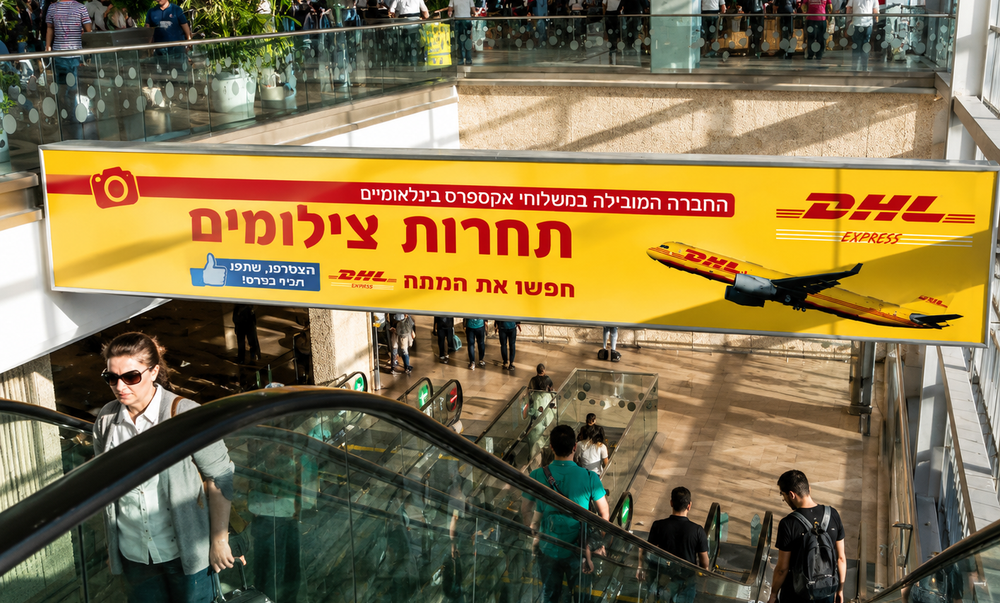
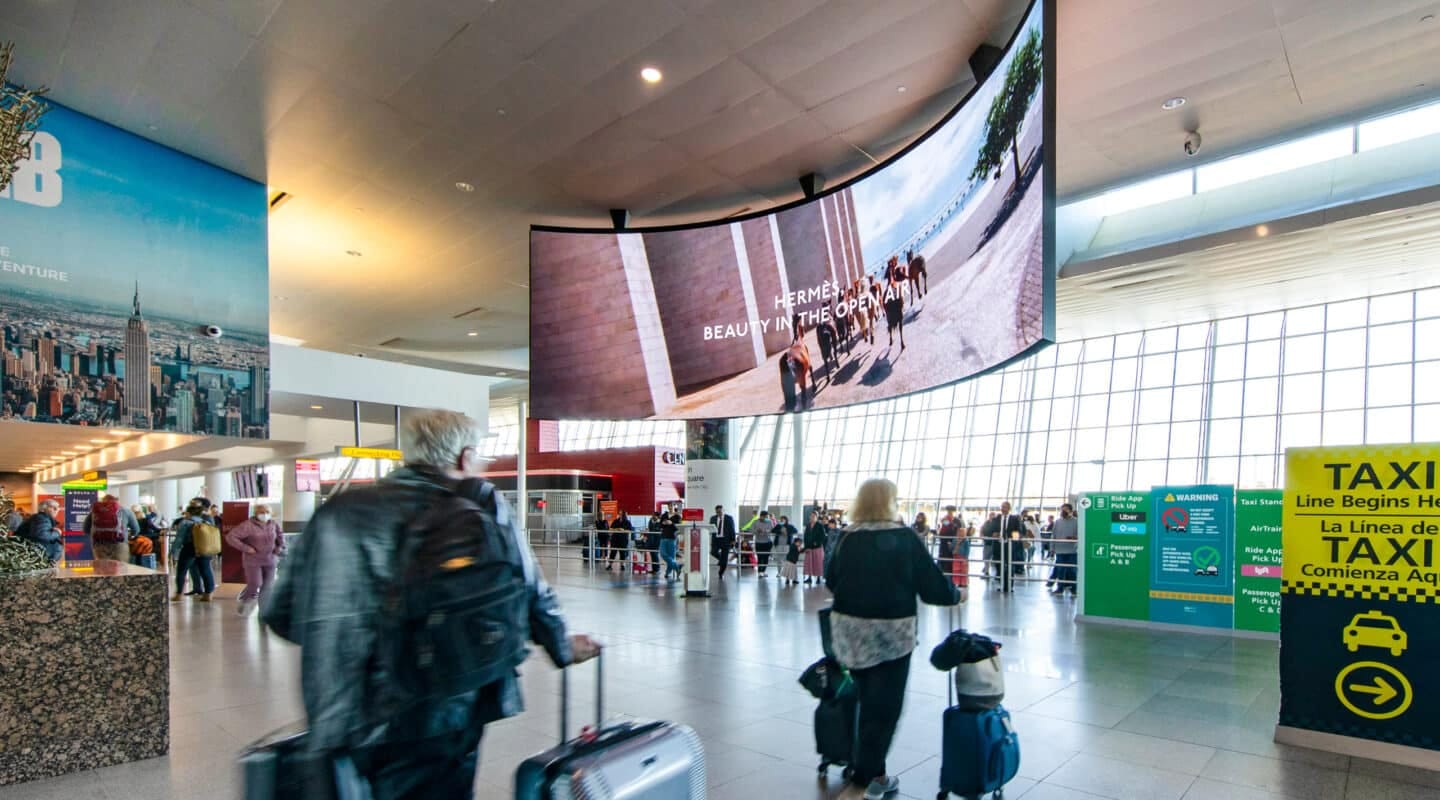
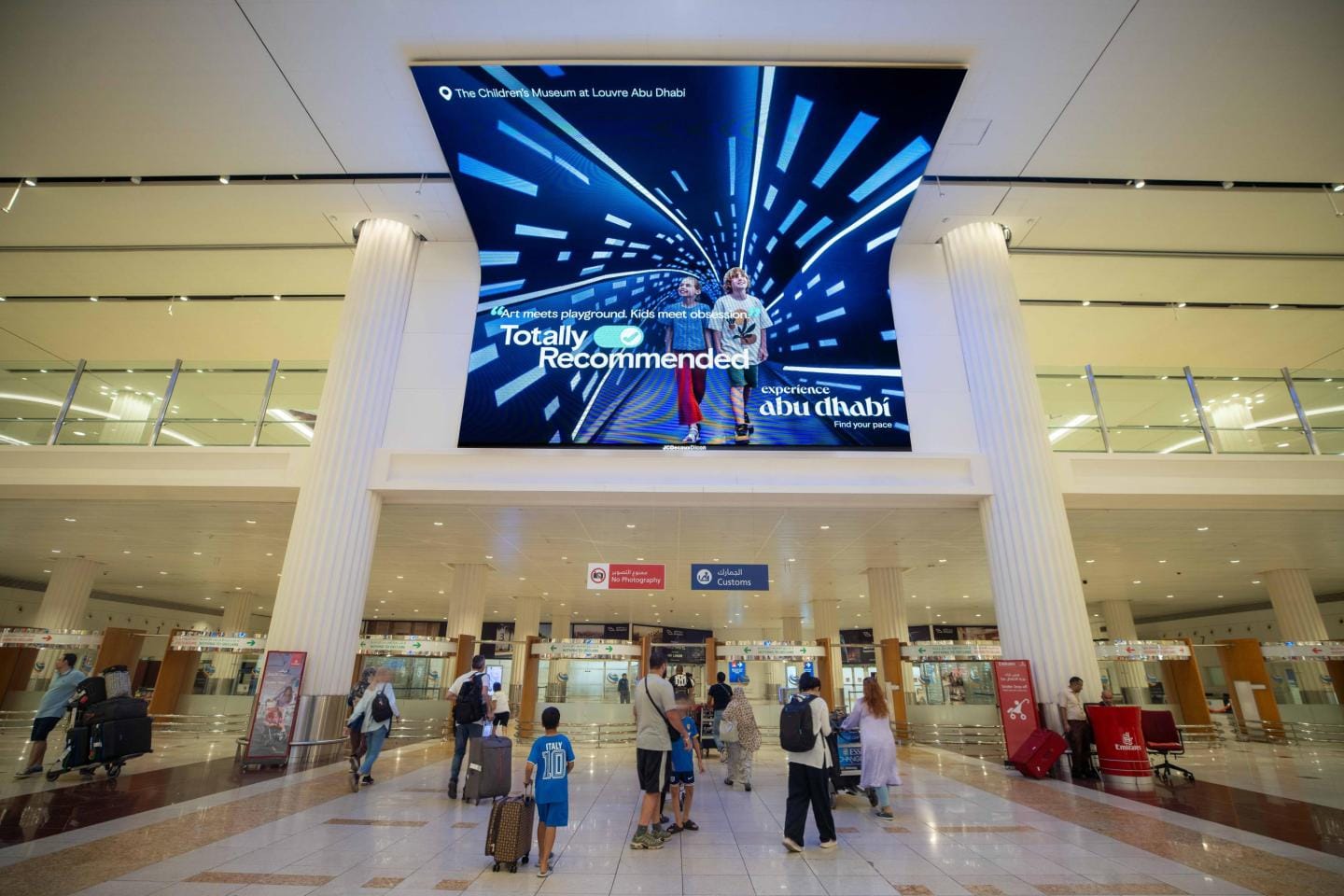
Ben Gurion operates two primary passenger terminals, Terminal 3 and Terminal 1. Beyond the High Holiday uplift, the winter travel season runs 15–20% above average and the summer holiday period 15–20% above standard levels. Available formats include wall panels, LED screens, banners, hoardings and digital placements.
Inventory Highlights
- Terminal 3 arrivals and immigration approach positions: first contact with inbound diaspora and international traffic across the September build-up
- LED and digital placements suited to day-parted scheduling, so creative can be paused entirely across Yom Kippur and resumed for Sukkot week
- Departures and check-in environments covering the compressed 2–4 October return wave
Advantages for Advertisers
- Audience spans technology executives and venture capital investors, business travellers, diaspora travellers on the Europe and North America routes, luxury consumers, and officials and diplomats
- Digital formats allow respectful scheduling: going dark for the twenty-five hours of Yom Kippur without losing the surrounding flight
- Long-stay visitors are exposed on arrival and again at departure two or three weeks later: two touchpoints from one buy
 Wealth in motion intelligence.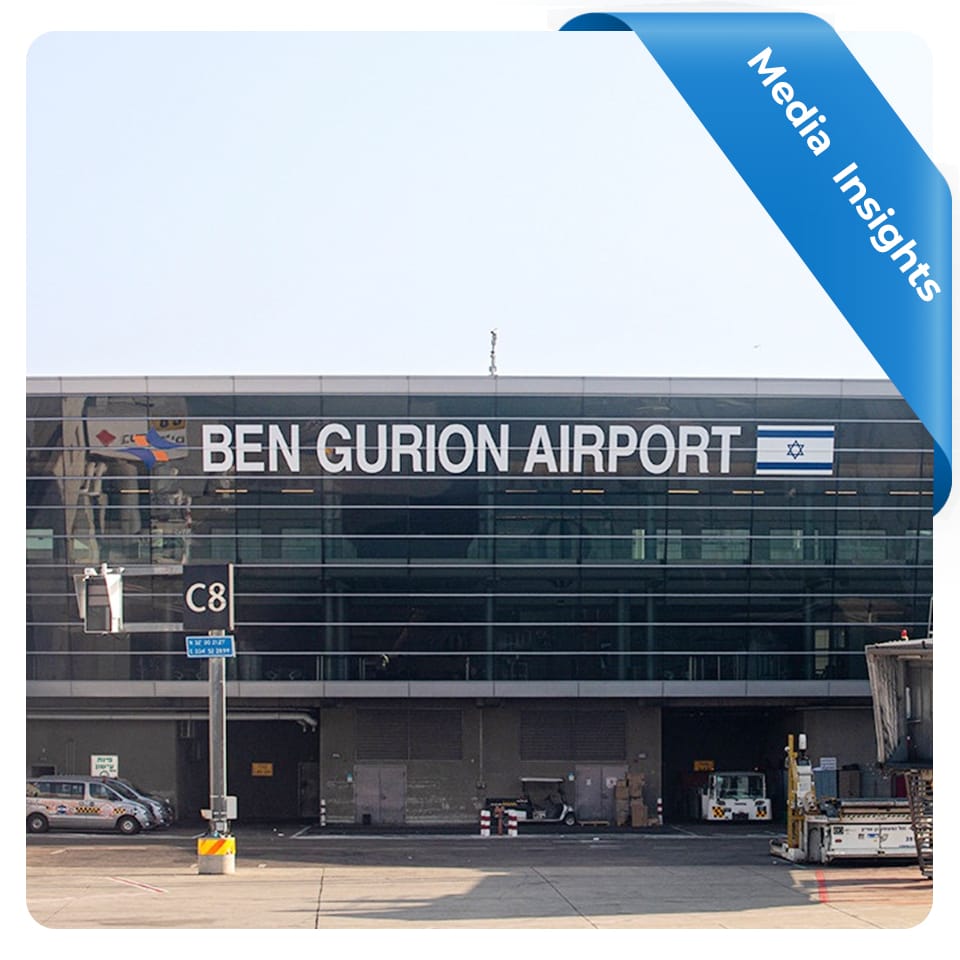
Eilat Ramon Airport (ETM): The Sukkot Domestic Destination
Eilat Ramon opened in January 2019 and handled approximately 600,000 passengers annually at its pre-conflict peak, a level it is recovering toward. Its Stage 1 terminal is built for up to 2 million passengers annually, with planned expansion to 4.2 million by 2030, and its 3,600-metre runway takes wide-body aircraft. Eilat carries 50 hotels with 11,000 rooms, and roughly 250,000 dives are performed annually in its waters.
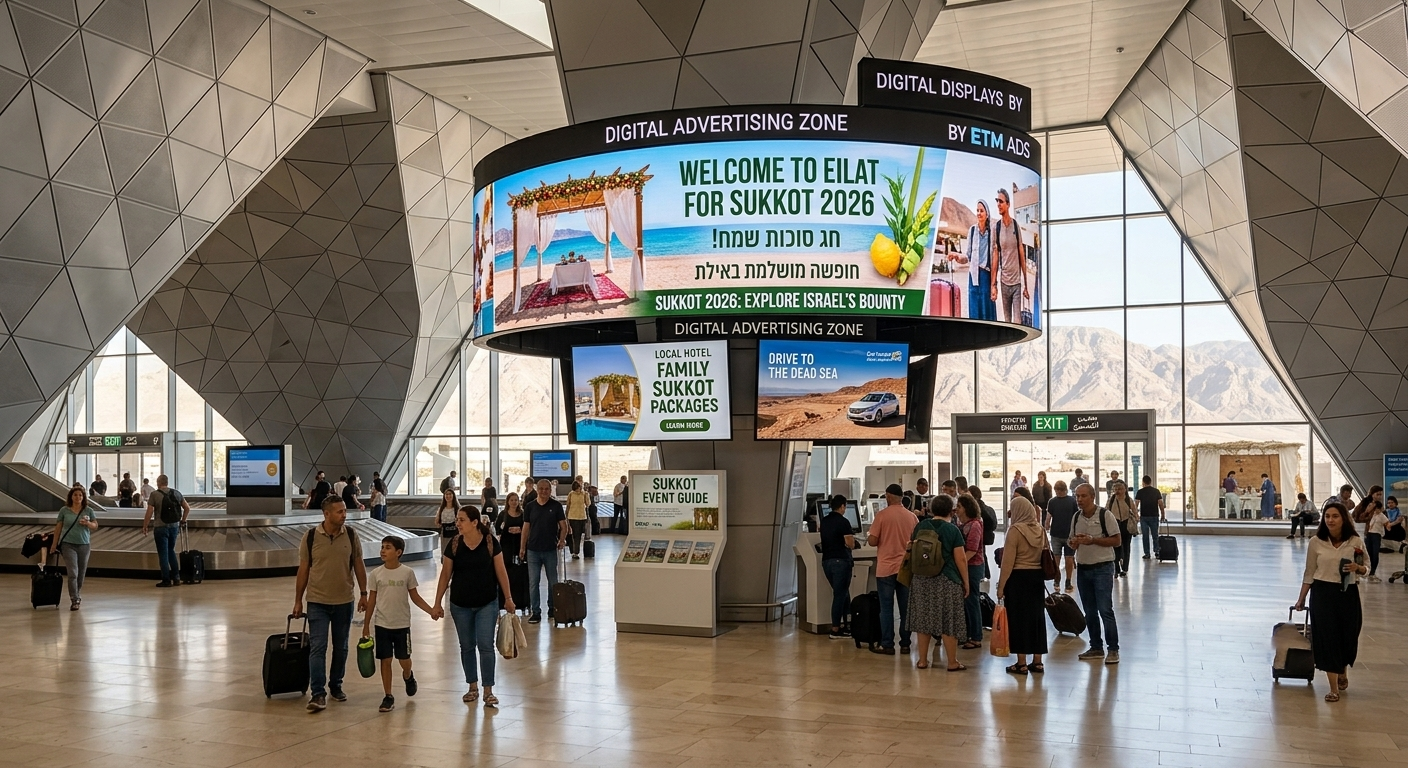
Critically, its peak season runs October to April and its listed seasonal peaks include Sukkot alongside Passover, Hanukkah and the summer holidays. Domestic services run with Arkia Israeli Airlines and Israir, daily to Tel Aviv and Haifa; Arkia also flies Eilat–Paris Charles de Gaulle. From October a European charter programme adds Ryanair, Finnair, Transavia, SAS, Wizz Air and Smartwings from Amsterdam, Berlin, Helsinki, Prague, Vienna, Warsaw and Kraków. Israel's national tourism grew 16.7% year on year in H1 2025, and the Ministry of Tourism has allocated over USD 60 million to tourism infrastructure and flight subsidies.
Inventory Highlights
- Arrivals and departures positions in a modern single-terminal environment with minimal clutter
- Placements on the daily Arkia and Israir Tel Aviv and Haifa sectors, carrying the Sukkot domestic family flow
- Positions reaching the Eilat–Paris CDG service and the October–April European charter programme as it opens during Sukkot week
- Terminal retail and waiting environments (duty-free and food and beverage outlets) where dwell is unhurried
Advantages for Advertisers
- Sukkot is a named peak in this airport's seasonality, and the intermediate days from 25 September to 2 October are its concentrated domestic window
- The audience is Israeli domestic HNWI leisure travellers from Tel Aviv, Haifa and Jerusalem plus European and American Jewish diaspora visitors: a family-group profile with high per-trip spend
- A terminal running well below its 2 million capacity means low clutter and high effective share of voice
- The 4.2 million by 2030 path means early presence establishes tenure ahead of the growth curve
 Wealth in motion intelligence.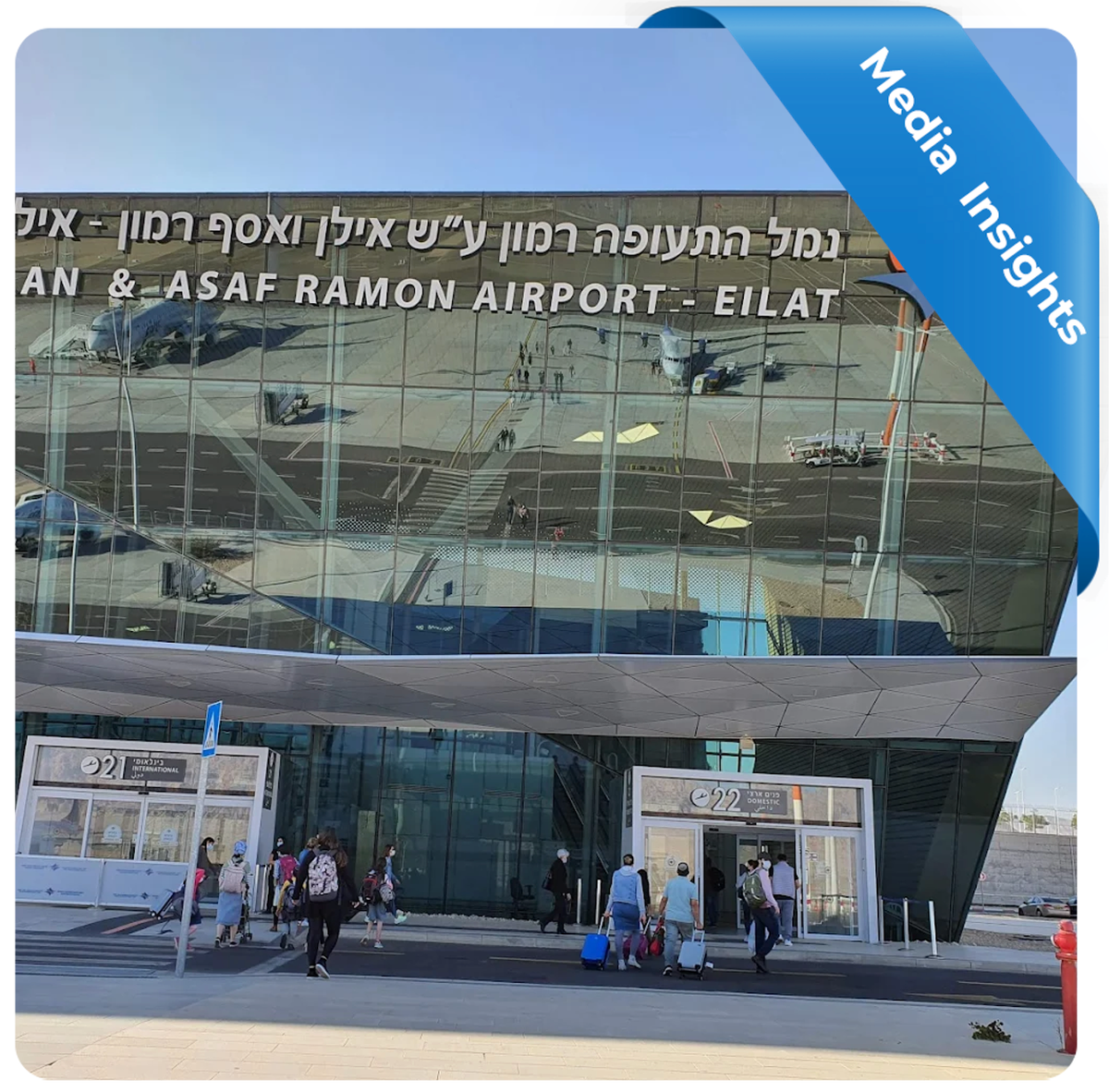
Destination Israel: Full Visitor Journey Coverage
Airport. First contact at Terminal 3 arrivals through the September build-up, when the visitor has three weeks ahead and no plans yet fixed.
City. OOH and DOOH across Tel Aviv (the Rothschild and central business corridors, the coastal hotel strip, the transit approaches) carries the message through the working days between the holy days. This is where frequency accumulates, and where the technology, venture and luxury audiences are resident rather than visiting. Ben Gurion is where the international audience enters; Eilat Ramon is where a large share of them travel next.
Destination. Eilat Ramon arrivals and the Eilat resort strip, with its 50 hotels and 11,000 rooms, close the sequence during the intermediate days of Sukkot: reaching the same families again, in a leisure mindset, hundreds of kilometres from where they first saw the brand.
Run in that order, the programme delivers increased brand recall, because the audience meets the brand at entry, in Tel Aviv and again in Eilat on one trip; consistent presence, because coverage spans the season rather than a single week; and enhanced campaign effectiveness, because each placement lands against an audience primed at arrival.
Why Brands Choose Airport & City Advertising for Israeli Travel-Season
Exclusive audience access. Two airports deliver the inbound affluent diaspora, Israel's technology and venture investor base, the diplomatic community and the domestic HNWI leisure market in one three-week buying window.
A prestigious environment. Ben Gurion Terminal 3 and Eilat Ramon's modern single terminal are controlled, low-clutter settings where a well-sited execution carries real presence rather than competing for attention.
End-to-end campaign support. Masscom Global plans, negotiates and runs airport and city programmes across 1,000+ airports in 180+ countries, coordinating one creative set across Ben Gurion, Tel Aviv and Eilat Ramon.
Strategic planning assistance. We advise on flighting around the holy days (including going dark for Yom Kippur) on weighting between the inbound and domestic legs, and on creative appropriate to a season of religious observance.
The Masscom Global Standard Behind Every Israeli travel season Placement
- Verified inventory and audience data: screen counts and terminal data for Ben Gurion and Eilat Ramon come from live operator data at proposal stage, not published estimates.
- Transparent delivery reporting: campaign monitoring and reporting across both airports and Tel Aviv city inventory, so you see exactly where your creative ran.
- Benchmarked recommendations: flighting around the holy days and weighting between the inbound and domestic legs set against comparable campaigns across our airport network.
- We absorb the complexity: one point of accountability from negotiation through execution, including scheduling that pauses across Yom Kippur and resumes for Sukkot without renegotiating the buy.

Request Your Customised Yom Kippur / Sukkot Advertising Plan
Tell us your audience, category and budget. Our planners will return a costed plan across airport and prime city inventory, with availability confirmed.
Book NowFrequently Asked Questions
What are the exact 2026 dates?
Yom Kippur begins at sunset on Sunday 20 September and ends at nightfall on Monday 21 September 2026. Sukkot begins at sunset on Friday 25 September and ends at nightfall on Friday 2 October, with Shmini Atzeret and Simchat Torah following from 2 to 4 October in diaspora observance.
Who travels during this period?
Two groups. Inbound at Ben Gurion: affluent diaspora travellers on the Europe and North America routes, returning business travellers, technology executives and venture capital investors, luxury consumers, officials and diplomats: arriving into a period running 25–30% above normal weeks. Domestically during Sukkot week: Israeli HNWI leisure travellers from Tel Aviv, Haifa and Jerusalem heading to Eilat, joined by European charter visitors as the season opens.
How does whole-journey reach work in practice?
Reached at Ben Gurion on arrival, across Tel Aviv city media during the working days between the holy days, at Eilat Ramon and the resort strip during the intermediate days of Sukkot, and once more at Ben Gurion departures in the 2–4 October return wave. One creative set, four separated exposures.
How far in advance should a campaign be booked?
This is the strongest proportional traffic window in Ben Gurion's year, so premium fixed positions (wall panels, banners, hoardings) should be secured well before the September build-up. LED and digital inventory accepts shorter lead times and allows scheduling to be paused across Yom Kippur and resumed for Sukkot week without renegotiating the buy.
Which brand categories perform best?
Private banking and wealth management, real estate and residency advisory serving diaspora second-home buyers, business aviation, premium hospitality and resort brands, watches and fine jewellery, and B2B technology aimed at Israel's venture community. Creative should be restrained; overt festival-themed executions are the wrong register for this window.
Related Airport Advertising Guides
Detailed inventory, audience and planning notes for the airports covered above:
Wealth in motion intelligence.Wealth in motion intelligence.Israeli travel season Won't Wait. Neither Should You.
- A fixed, once a year traffic surge: Ben Gurion's inbound flow runs 25 to 30 percent above normal weeks during this three-week period, and that surge does not repeat until next year.
- The airport itself sets the boundary: Ben Gurion pauses for the duration of Yom Kippur, which fixes the campaign into two separated exposure windows either side of it, not one continuous run.
- Premium fixed positions move early: wall panels, banners and hoardings should be secured well before the September build up; only LED and digital inventory accepts shorter lead times.
- The alternative can't separate the audiences: broadcast and generic domestic advertising can't isolate the inbound diaspora and investor arrivals at Ben Gurion from the resident population the way airport and city media can.
Get Free Expert Assistance Now
Our planners will map Ben Gurion and Eilat Ramon against your audience and budget, and advise on flighting that respects the holy days while covering the travel weeks around them. No charge for the planning conversation.
Request Availability
Premium fixed positions at Ben Gurion are contested during the highest-uplift weeks of the year, and Eilat Ramon inventory tightens as the October charter season opens. Ask for availability and indicative rates across both and we will return a costed plan.
The travel weeks around Yom Kippur and Sukkot bring Ben Gurion its strongest proportional uplift of the year and send a distinct domestic flow to Eilat Ramon, all inside a three-week window that will not repeat until next year. A programme built around it, paused respectfully across the twenty-five hours of Yom Kippur and resumed for Sukkot, reaches affluent diaspora arrivals, returning business travellers and Israeli leisure travellers without ever competing with the holy days themselves. For brands in wealth management, real estate, hospitality and premium categories, that is a defined and finite opportunity, not an open-ended one.