

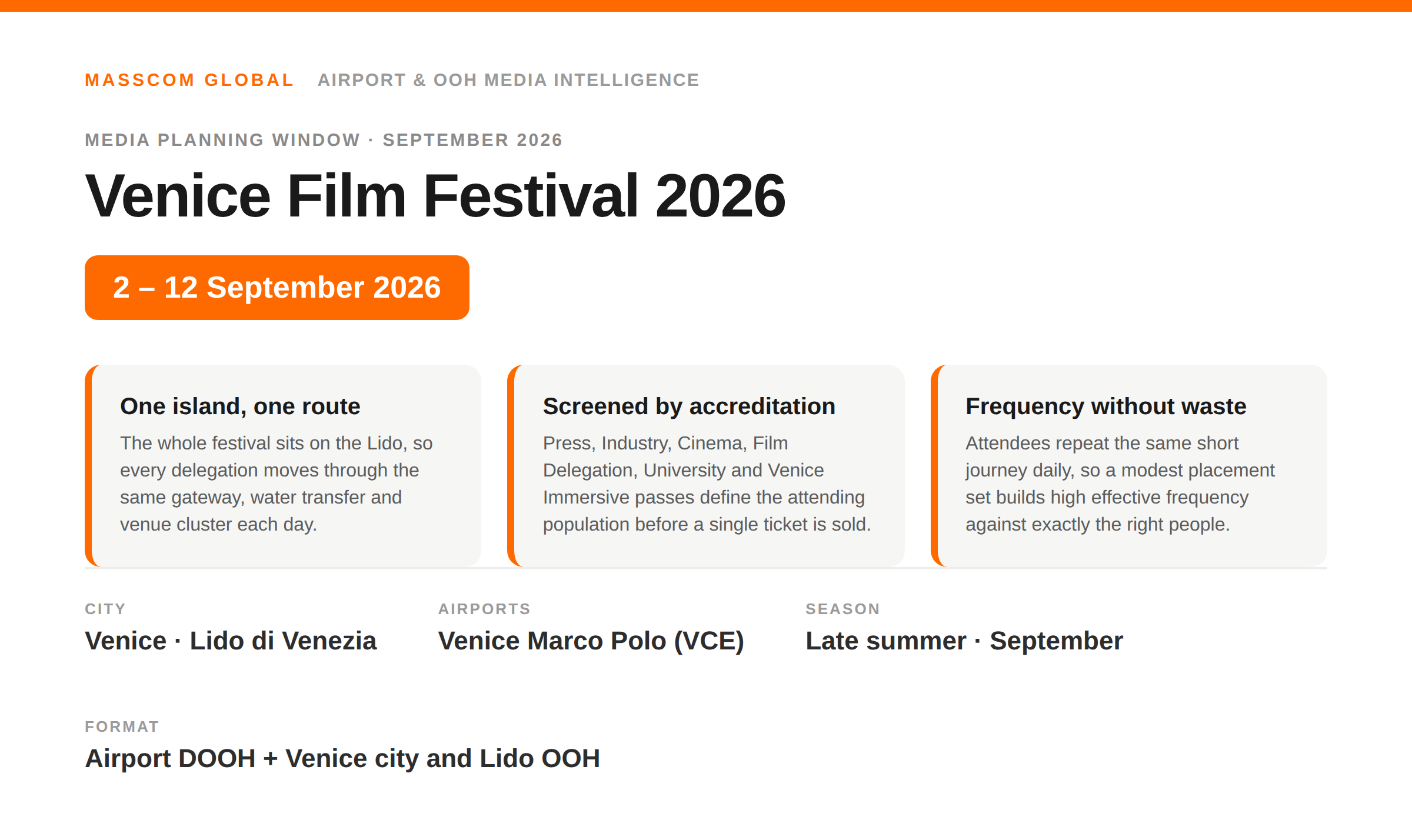
Venice is the oldest film festival in the world and, in commercial terms, the most concentrated: eleven days confined to a single island with a single air gateway. The 83rd Venice International Film Festival runs on the Lido di Venezia from 2 to 12 September 2026, under artistic director Alberto Barbera. The 2026 edition awards Golden Lions for Lifetime Achievement to George Clooney and Ellen Burstyn, with Laura Dern speaking in Clooney's honour at the opening ceremony on 2 September.
The entire event happens on a single narrow island, across a cluster of adjacent venues: the Sala Grande, Palabiennale, Sala Darsena, Sala Giardino, Sala Perla, Sala Casinò, Sala Volpi, Sala Corinto and the Astra screens: served by six professional accreditation categories: Press, Industry, Cinema, Film Delegation, University Students and Venice Immersive. Press badge collection opens on 31 August, with other categories from 1 September.
For a media planner, that geography is the entire proposition. There is no sprawling metropolitan festival footprint to buy. There is one air gateway, one water-transfer system, one historic centre and one island, and every talent delegation, studio executive, luxury sponsor, financier and accredited journalist attending the 83rd edition moves through all four.
Why Airport & City Advertising Works During the Venice Film Festival
Venice's audience composition is unusually favourable. Ticket pricing itself signals the tier: Sala Grande seats run from €18 to €50 at full price, with smaller venues at €10 to €15. But paying audiences are not the target. The target is the accredited layer (the industry, press and delegation passes) plus the sponsor and private-client hospitality that attaches to a festival held in one of the most photographed cities in the world.
Venice also carries a resident and visiting wealth base that exists independently of the festival. Marco Polo serves what is described as the world's highest average daily rate urban hotel market. Getting from the airport to the Lido or the historic centre routinely involves a private water taxi at €100-plus: a transfer economy that filters the arriving population by willingness to spend before a single festival ticket is sold.
Layer the two and the September window becomes one of Europe's cleanest HNWI concentrations: an eleven-day event whose attendees are professionally screened by accreditation, geographically confined to an island, and financially self-selected by the cost of simply being there.
Key Benefits of Airport & City Advertising During the Venice Film Festival
Reach a qualified, high-spend audience
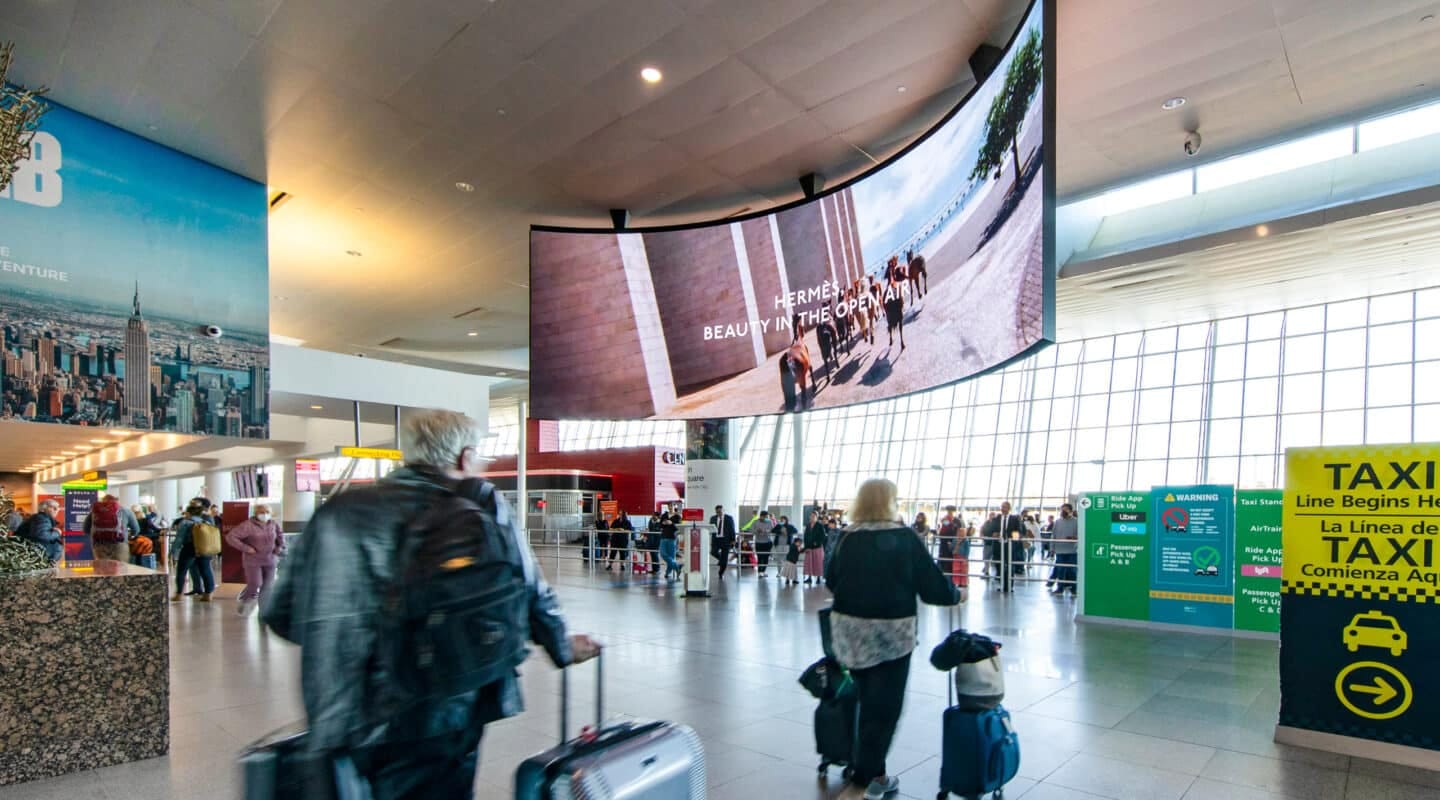
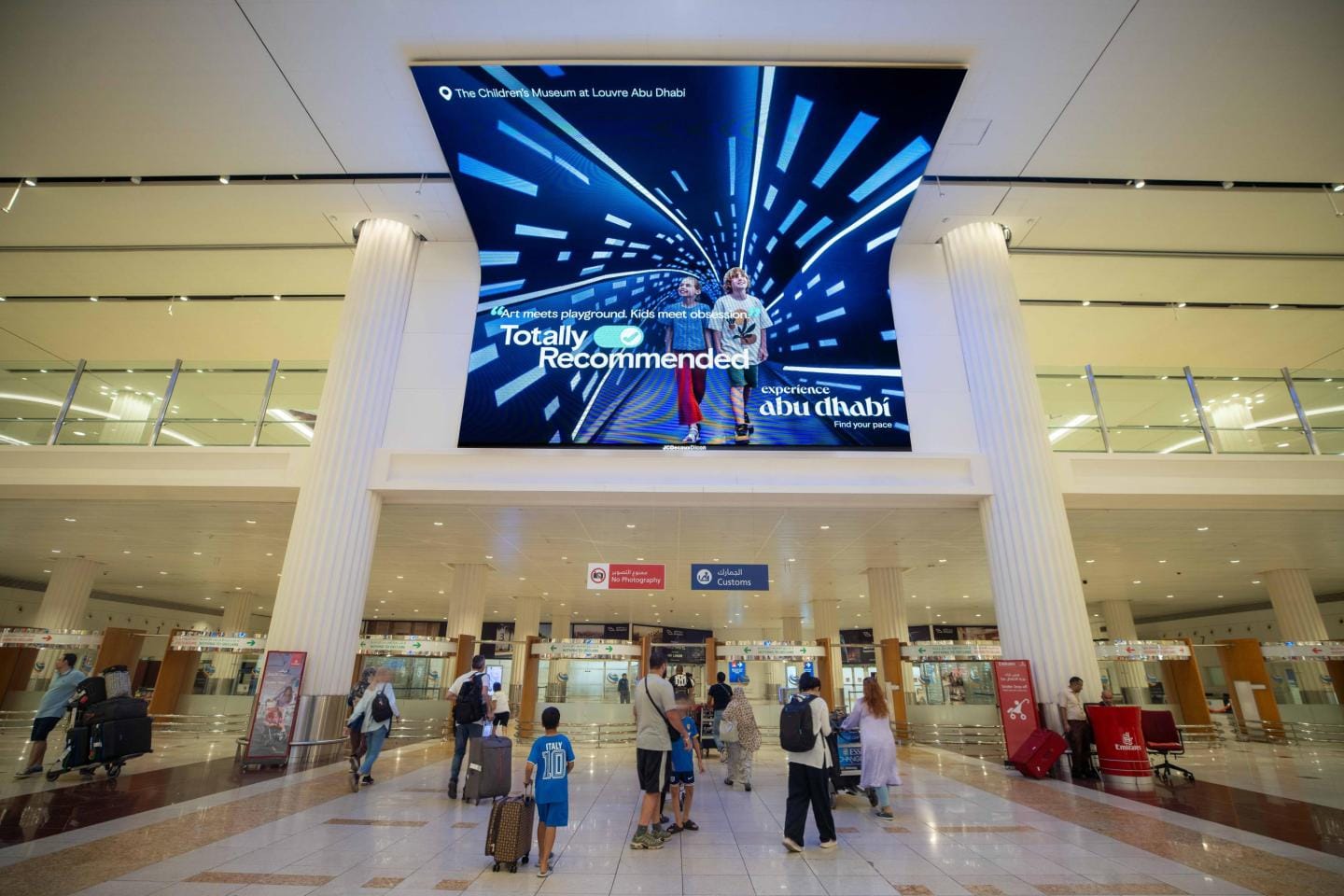
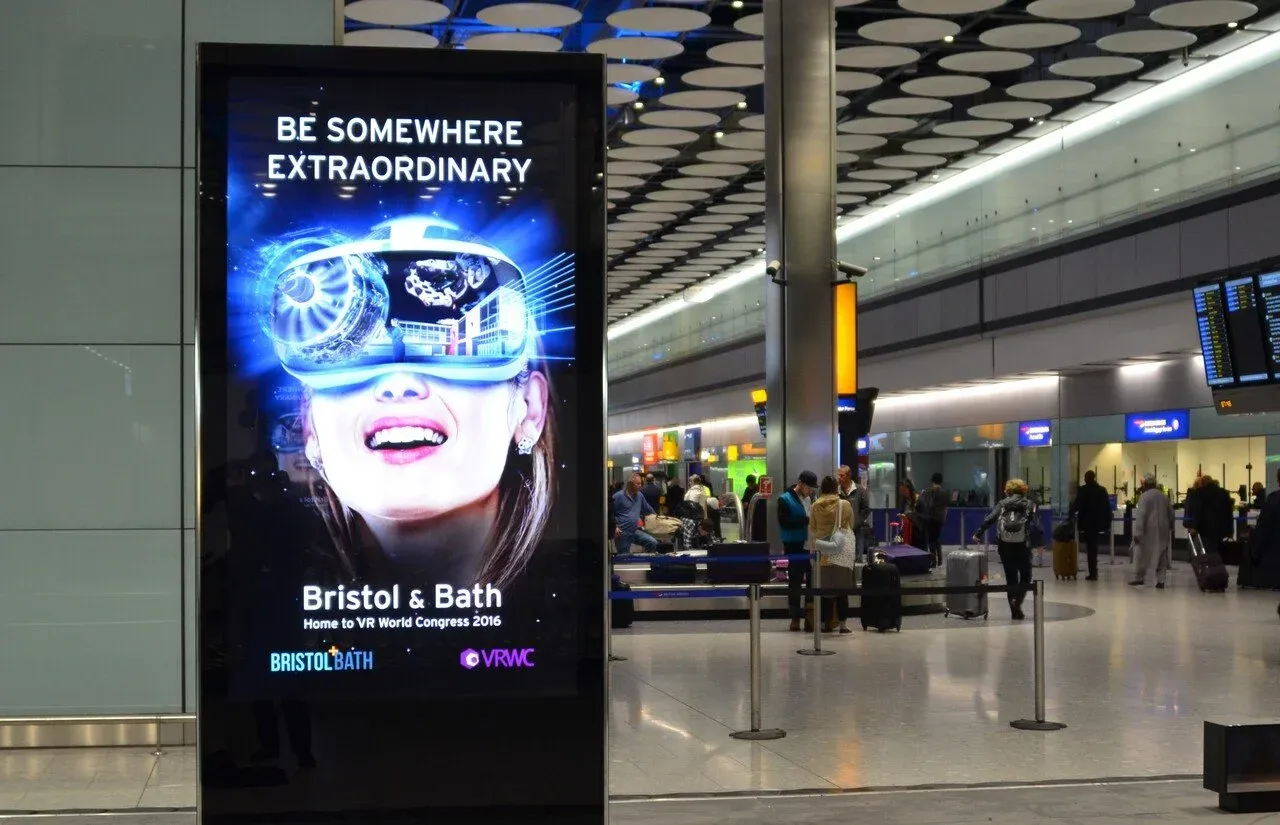
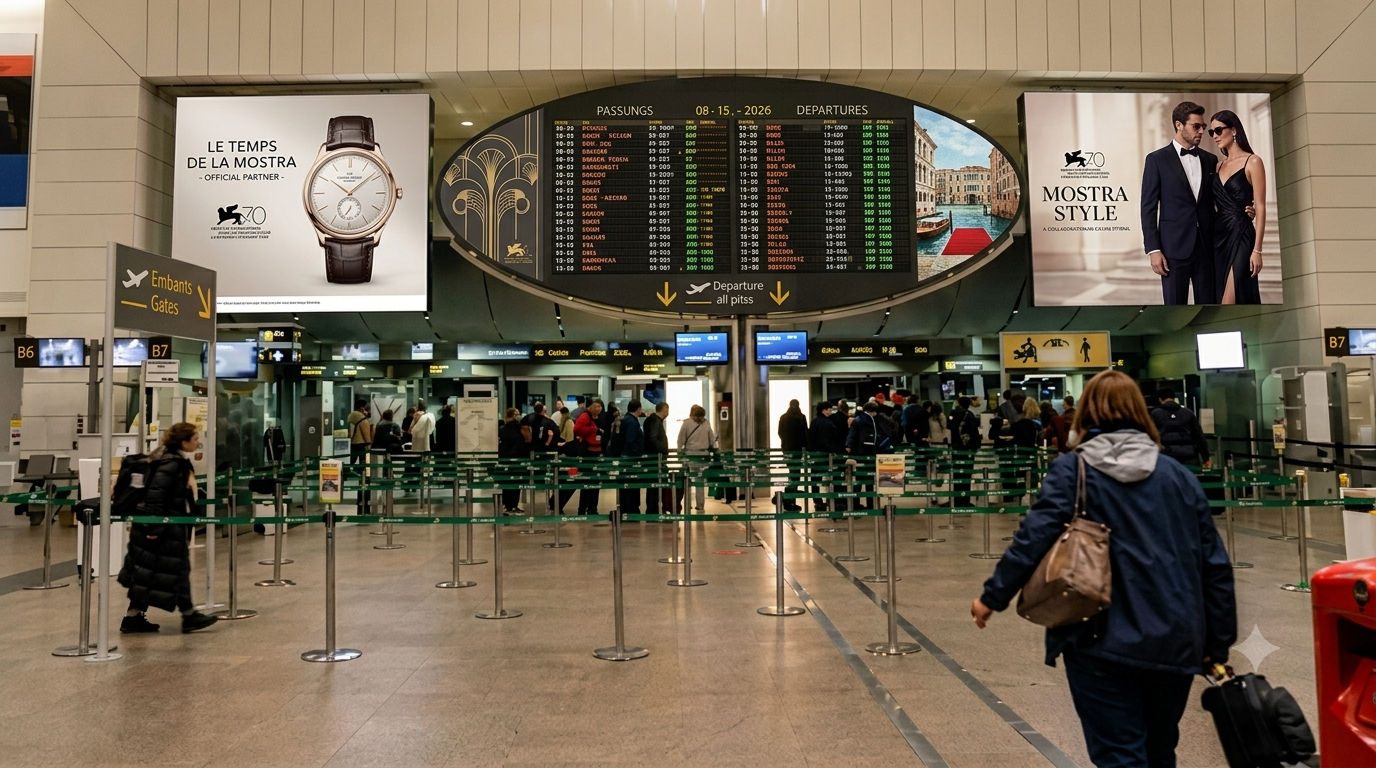
Festival arrivals skew toward premium-cabin and private-aviation travellers, studio and production executives, luxury sponsor delegations and international press. Airport and city media reach them during unavoidable, high-dwell moments: arrival, transfer, and the daily movement between hotel and screening venue.
Elevate your brand positioning
Venice is the most visually prestigious festival environment in cinema, and the register carries. Appearing consistently across the arrival journey and the Venetian core associates a brand with the same tier of visibility occupied by the festival's own luxury partners, without a sponsorship commitment or an official partner fee.
Generate real business opportunity
The eleven days function as an industry market as much as a screening programme. Financing conversations, distribution deals, talent representation, luxury brand ambassadorships and private-client entertainment all compress into the same window. Sustained visibility keeps a brand present across those meetings rather than adjacent to them.
Get Free Expert Assistance from Our Global Media Planning Team
Receive strategic recommendations, media planning support, campaign monitoring and reporting to maximise your visibility throughout Venice Film Festival.
Book Expert ConsultationVenice Marco Polo Airport (VCE): The Only Real Gateway
Marco Polo handles approximately 9 million passengers annually (2023, on a confirmed recovery trajectory) and is the practical single air entry point for the festival. Its catchment reaches far beyond the lagoon: Treviso approximately 30 km northwest, Padova approximately 40 km southwest, Vicenza approximately 70 km west, Pordenone and Friuli approximately 85 km northeast, Ferrara approximately 100 km south, Belluno and the Dolomites approximately 100 km north, Verona approximately 120 km west, and Cortina d'Ampezzo approximately 130 km north. The airport is served by a broad international carrier set including Emirates, Lufthansa, Air France, KLM, Swiss, Turkish, British Airways, American and Delta, alongside easyJet and Ryanair.
That carrier mix is the planning point. Long-haul premium traffic from the Gulf and North America and short-haul European business and leisure traffic arrive into the same terminal environment, so a single airport buy covers both the transatlantic industry delegation and the intra-European luxury visitor.
Inventory Highlights
- Arrivals and immigration approach positions: the first branded surface every inbound festival attendee encounters, before any Venetian competition for attention exists
- Digital and large-format placements along departure concourses and premium check-in zones, reaching the outbound leg across the full eleven days
- Baggage reclaim and arrivals hall positions, where dwell time is extended and captive
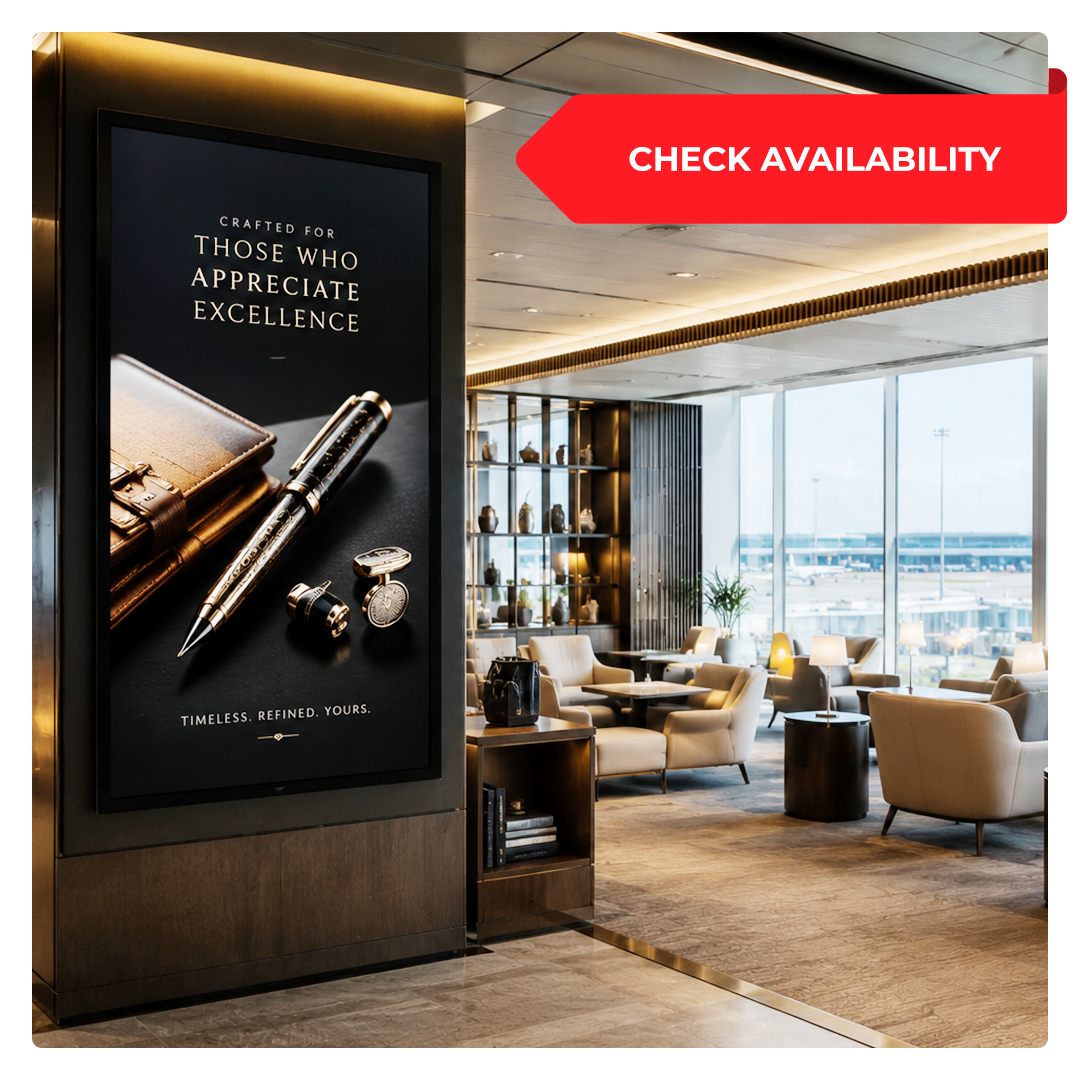
- Transfer-decision environments on the water-taxi, Alilaguna and ground-transport approaches: a genuinely distinctive Venetian touchpoint with no equivalent at other European gateways
- Long-haul gate and lounge-adjacent environments serving the Emirates, North American and Northern European premium routes
- Positions addressing the wider Veneto catchment, from Verona and Padova through to the Dolomites resort corridor
Advantages for Advertisers
- Effective single-gateway capture, with no realistic alternative air entry to the Lido, exposure is close to unavoidable for inbound attendees
- Audience purity by economics: a market whose onward transfer starts at €100-plus by private water taxi pre-filters for spending capacity
- A catchment radius of 30 to 130 km delivers reach into Verona, Padova, Treviso, Vicenza and Cortina d'Ampezzo from one buy
- Mixed long-haul and short-haul carrier base captures both international industry travel and European luxury leisure in one environment
- Comparatively contained scale at approximately 9 million annual passengers means lower clutter than a 50-million-passenger hub, and a higher share of attention per placement
- An eleven-day flight can be bought precisely against 2 – 12 September with lead-in weight from 31 August, when press accreditation collection begins
 Wealth in motion intelligence.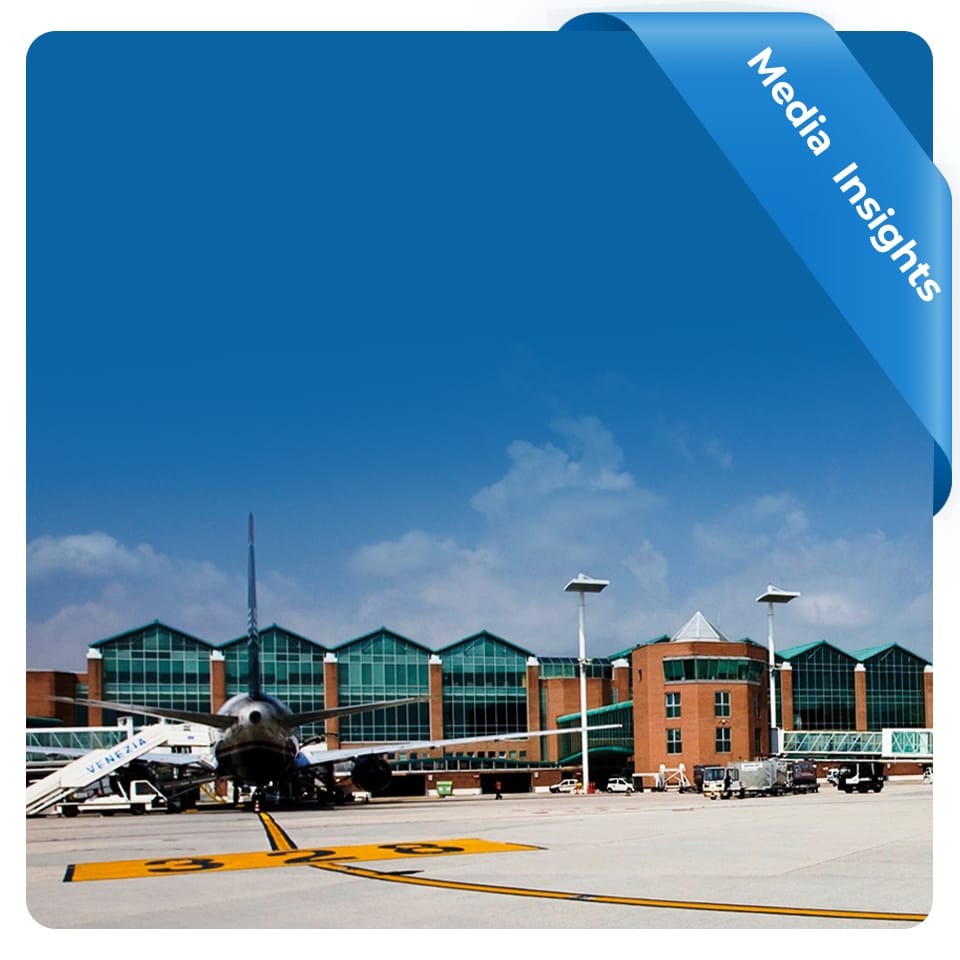
Destination Venice: Full Visitor Journey Coverage
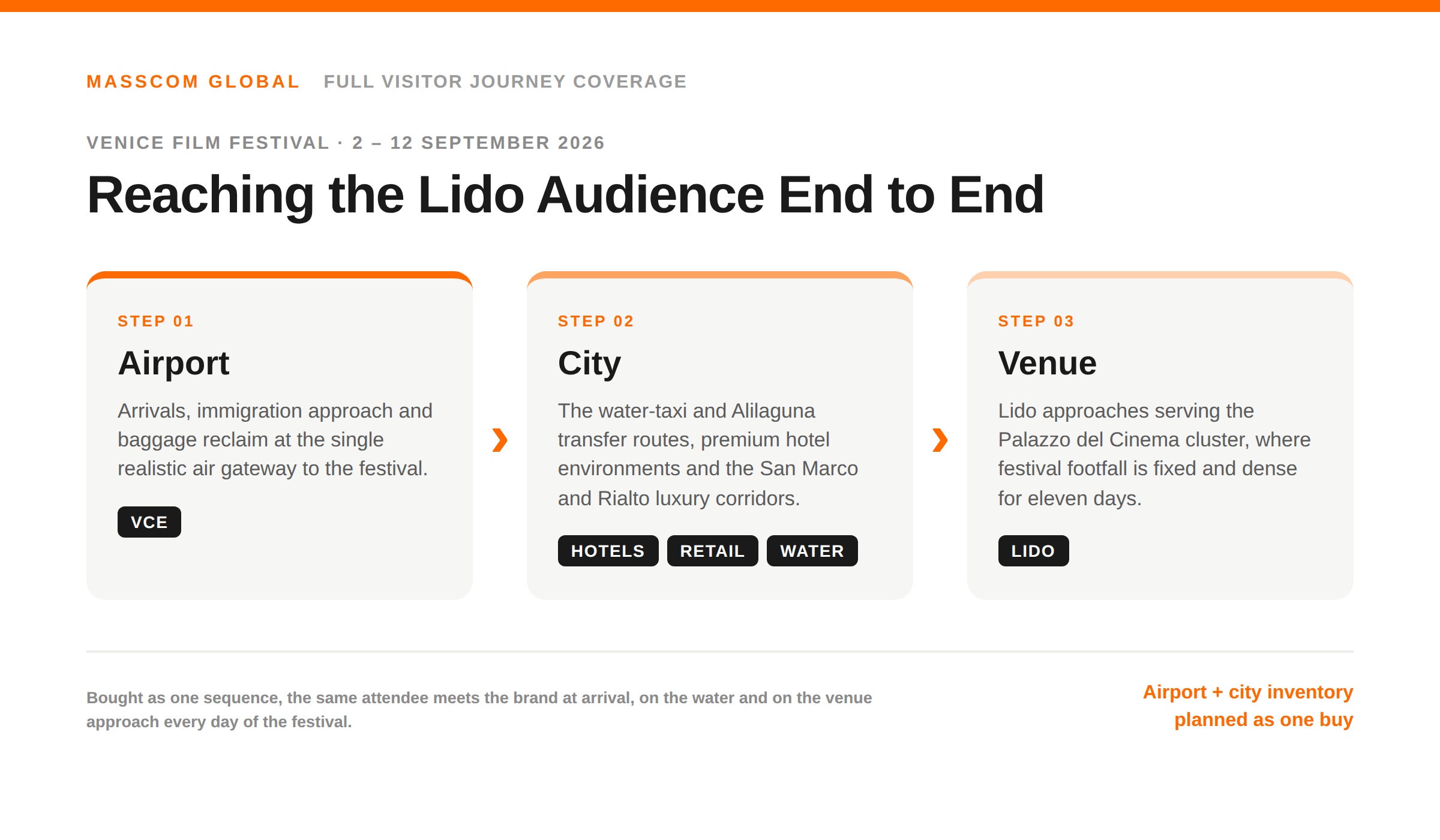
Venice imposes a route on its visitors. From Marco Polo, an attendee reaches the Lido or the historic centre by water (private taxi, Alilaguna line or the bridge and bus route to Piazzale Roma) and then moves on foot and by vaporetto for the rest of the stay. There is no dispersal into suburbs, no car-based fragmentation and no parallel commercial district. Every one of the festival's venues sits within walking distance of the others on the Lido.
An Airport → City → Lido media sequence therefore maps directly onto behaviour rather than approximating it. Arrival is captured at VCE. The transfer phase is captured across the water-transport and Piazzale Roma approaches. The city phase is captured through premium hotel environments, the San Marco and Rialto luxury retail corridors and the vaporetto network the entire island population uses daily. The venue phase is captured on the Lido approaches serving the Palazzo del Cinema cluster, where footfall for eleven days is fixed, dense and entirely composed of the target audience.
The additional advantage is repetition without waste. Because attendees repeat the same short journey each day of the festival, a modest placement set delivers high effective frequency against exactly the right people: a pattern that is expensive to reproduce in any larger, more diffuse host city.
Three effects follow from sequencing rather than scattering:
- Increased brand recall: repeated exposure at arrival, across the transfer and city phases, and on the venue approaches
- Consistent presence: the brand becomes part of the festival's visual environment rather than an interruption to it
- Enhanced campaign effectiveness: coordinated Venice placements outperform the same budget split across disconnected Italian markets
Why Brands Choose Airport & City Advertising for Venice Film Festival
Exclusive audience access. Eleven days in which studio executives, talent delegations, international press, luxury sponsors and UHNWI visitors are confined to one island and one repeated daily route.
A prestigious environment. The oldest film festival in the world, in a city that requires no explanation. Brands present across the 83rd edition inherit both the cinematic and the Venetian register.
End-to-end campaign support. Masscom Global plans, negotiates and executes across Marco Polo airport and Venice city inventory under a single brief, with one point of accountability.
Strategic planning assistance. Our planners advise on format mix, terminal positioning, transfer-route selection and flight timing against the festival's own rhythm: the 2 September opening ceremony, the mid-festival premiere density and the closing awards weekend.
The Masscom Global Standard Behind Every Venice Film Festival Placement
- Verified inventory and audience data: screen counts and passenger figures at Marco Polo come from live operator data at proposal stage, not published estimates.
- Transparent delivery reporting: campaign monitoring and reporting across airport and city inventory, so you see exactly where your creative ran.
- Benchmarked recommendations: format mix set against comparable campaigns across our network.
- We absorb the complexity: one point of accountability from negotiation through execution.
Request Your Customised Venice Film Festival Advertising Plan
Tell us your audience, category and budget. Our planners will return a costed plan across airport and prime city inventory, with availability confirmed.
Book NowFrequently Asked Questions
When exactly is the 2026 Venice Film Festival?
The 83rd Venice International Film Festival runs from 2 to 12 September 2026 on the Lido di Venezia, under artistic director Alberto Barbera. The opening ceremony is on 2 September, when George Clooney receives a Golden Lion for Lifetime Achievement, with a second lifetime Golden Lion awarded to Ellen Burstyn. Press badge collection opens on 31 August, with the other accreditation categories opening from 1 September.
Who attends the Venice Film Festival?
Six professional accreditation categories define the core attending population: Press, Industry, Cinema, Film Delegation, University Students and Venice Immersive. Around that sit talent and studio delegations, luxury sponsor teams, financiers and distributors, and a substantial international visitor base drawn by the festival into a city already serving the world's highest average daily rate urban hotel market.
Can I reach attendees across their whole journey, not just at the venues?
Yes, and in Venice it is unusually efficient. A combined Marco Polo and Venice city campaign covers arrival, the water-transfer phase, the hotel and luxury retail districts, the vaporetto network and the Lido venue approaches, so the same attendee encounters the brand repeatedly across the eleven days.
How far in advance should a Venice campaign be booked?
Marco Polo and central Venice positions for the festival window are contested, and the airport's comparatively contained scale means the premium inventory pool is finite rather than deep. Confirm availability several months ahead where possible; short-notice requests can often still be served, but with reduced format and location choice.
Which brand categories perform best in this window?
Luxury watches and jewellery, fashion and beauty, premium spirits and champagne, private aviation and yachting, wealth management and private banking, luxury hospitality and residential real estate, and premium automotive.
Related Airport Advertising Guides
Detailed inventory, audience and planning notes for the airports covered above:
Wealth in motion intelligence.Venice Film Festival Won't Wait. Neither Should You.
- Once a year, genuinely finite: Marco Polo's comparatively contained scale means the premium inventory pool for festival week is finite rather than deep.
- Competitors are already moving: every week without a plan is a week a watch, spirits or hospitality brand gets closer to locking the same positions.
- The window is exact, not approximate: a campaign that isn't live for the festival misses the delegation and press who define its ten days.
- The alternative can't buy this credibility: straight commercial media cannot purchase the cultural authority the Lido's festival environment confers.
Get Free Expert Assistance Now
Tell us your audience, your category and your budget, and our planners will return a costed Venice Film Festival media plan across Marco Polo airport and Venice city inventory.
Request Availability
The 2 – 12 September window is immediate. Ask us what is still open at Marco Polo and in central Venice, and what can be activated at short notice.
Venice's advantage for advertisers is structural, not seasonal: one air gateway, one island and eleven days across which studio executives, press, sponsors and UHNWI visitors repeat the same short daily route. That concentration, filtered further by the cost of the water-taxi transfer, delivers an audience quality a larger, more sprawling festival city cannot match. Masscom Global plans and executes across Marco Polo airport and Venice city inventory under a single point of accountability, so the brand is present across the arrival, transfer and venue phases of the festival.