




TIFF is the most commercially significant film festival in North America outside the awards season itself, and 2026's addition of a formal market changes its planning profile materially. The 51st Toronto International Film Festival runs from 10 to 20 September 2026, across the Princess of Wales Theatre, Roy Thomson Hall, the Royal Alexandra Theatre, TIFF Lightbox, Scotiabank Theatre Toronto and (new for this edition) the Metro Toronto Convention Centre, which hosts a formal film market for the first time.
Eleven days that were already dense with talent, press, distribution and sponsor activity now also carry a trading floor: acquisitions executives, sales agents, financiers and rights buyers arriving with transactional intent and expense budgets. The 2026 festival also hosts the Student Academy Awards, with Gala and Special Presentations programmes announced in early July and the full schedule released on 11 August.
For advertisers, the value sits in the length and shape of the window. Unlike a three-day sporting event, TIFF sustains elevated arrival volumes and elevated downtown footfall for a week and a half: long enough for a media campaign to build genuine frequency against the same audience.
Why Airport & City Advertising Works During the Toronto International Film Festival
The TIFF audience is a layered one, and each layer is commercially useful. At the top sit talent, directors and producers with their agents, publicists and stylists: the cohort that drives the luxury, watch, jewellery and private-aviation categories. Beneath that sit studio and streaming executives, international distributors, sales agents and, from 2026, market-accredited buyers and financiers: a corporate travel population moving in premium cabins on company accounts. Around both sits the international entertainment press corps, and a very large public audience drawn from Toronto and the wider Greater Toronto Area, which is one of North America's most affluent and most internationally connected metropolitan markets.
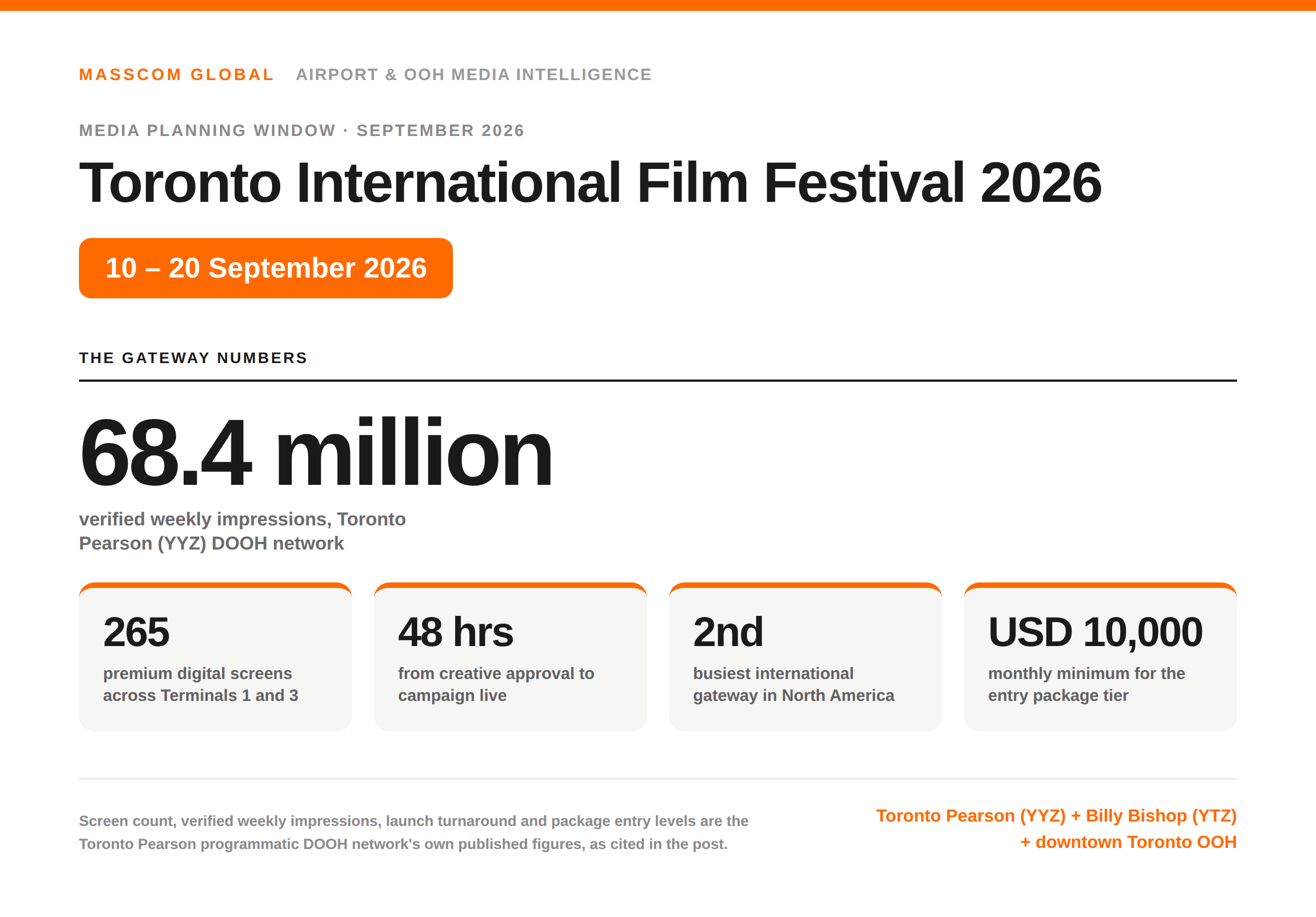
Toronto Pearson is North America's second-busiest international gateway, which means the visiting cohort concentrates itself through a single, highly ownable arrival point. The programmatic DOOH network at Pearson delivers 68.4 million verified weekly impressions across 265 premium digital screens spanning Terminal 1 and Terminal 3: a scale of reach that allows a festival-window campaign to achieve meaningful frequency inside the eleven days rather than settling for single-exposure coverage.
Crucially, the network launches campaigns within 48 hours of creative approval. For an event calendar as fluid as a film festival (where premiere dates shift, talent confirmations land late and news breaks daily) that turnaround allows a brand to react rather than merely pre-book.
Key Benefits of Airport & City Advertising During the Toronto International Film Festival
Reach a qualified, high-spend audience
Festival arrivals skew heavily toward premium-cabin, corporate-account and private-aviation travellers. Pearson's 265-screen digital network places a brand in front of them at arrival and departure, when attention is high and alternatives are few, and the 68.4 million weekly impression base gives the plan room to repeat.
Elevate your brand positioning
TIFF carries genuine cultural authority and is covered by the international entertainment and lifestyle press for eleven consecutive days. A brand present across the arrival journey and the downtown core sits inside that coverage environment without needing an official festival sponsorship.
Generate real business opportunity
With a formal film market added at the Metro Toronto Convention Centre, the 2026 edition is explicitly a deal calendar. Distribution, financing, co-production and rights conversations run in parallel with the screenings. For financial services, private aviation, hospitality, legal and advisory brands, sustained visibility across the window reaches decision-makers in a transactional frame of mind.
Get Free Expert Assistance from Our Global Media Planning Team
Receive strategic recommendations, media planning support, campaign monitoring and reporting to maximise your visibility throughout Toronto International Film Festival.
Book Expert ConsultationToronto Pearson International Airport (YYZ)
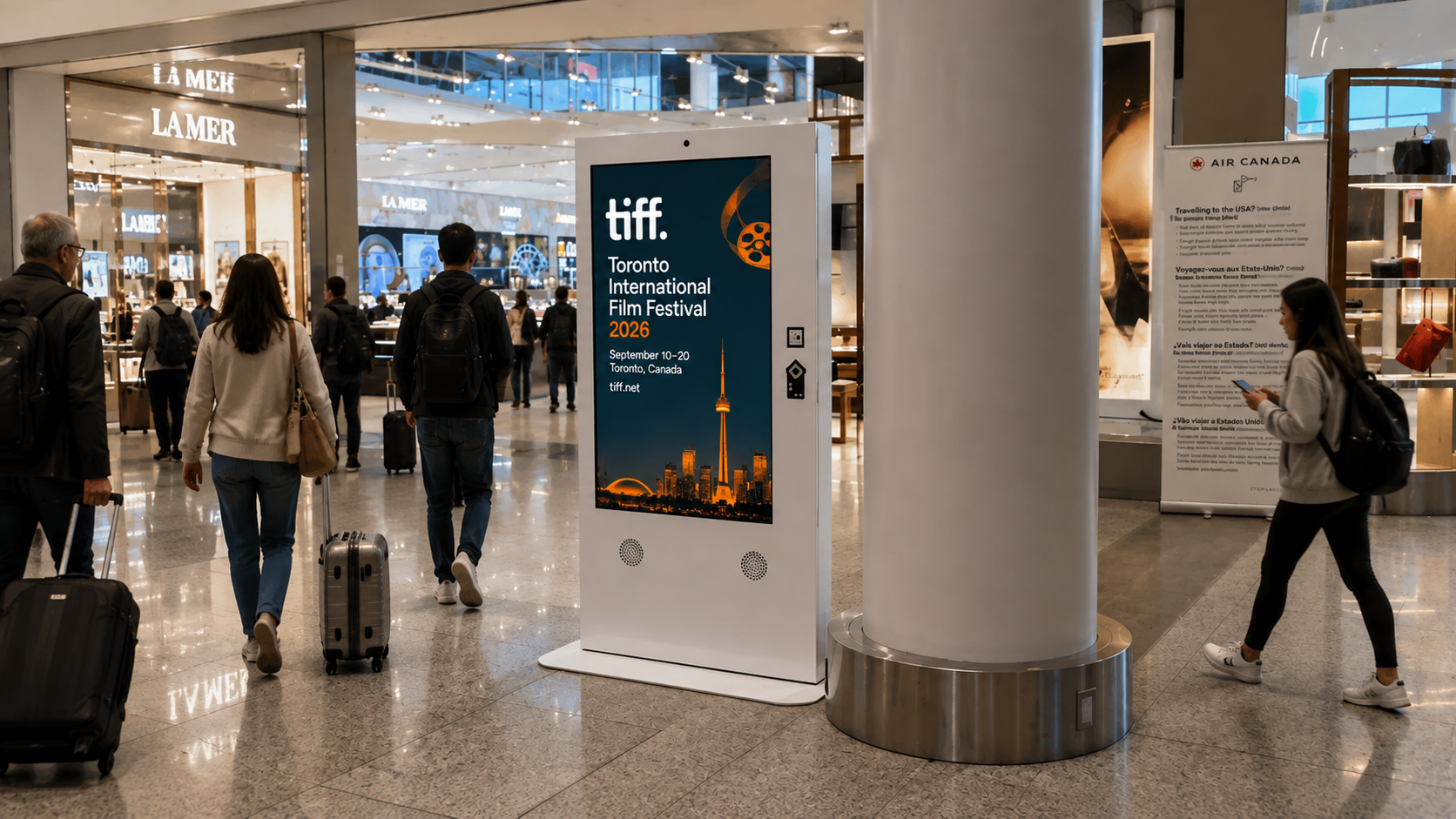
Pearson is the primary gateway for the festival and the centre of any serious TIFF media plan. As North America's second-busiest international gateway, it carries the long-haul European, Asian and Latin American arrivals as well as the heavy US cross-border traffic that brings studio, streaming and agency personnel from Los Angeles and New York. Its advertising environment is a fully programmatic digital network: 265 premium digital screens across Terminals 1 and 3, delivering 68.4 million verified weekly impressions, with campaigns live within 48 hours of creative approval and support for dynamic messaging and real-time audience targeting.
Package entry points are structured to suit different campaign weights, from a Silver package at a US$10,000 monthly minimum, through Gold at US$15,000, to Diamond at US$50,000 for brands seeking dominant share of the network during a peak window such as the festival.
Inventory Highlights
- 265 premium digital screens across Terminal 1 and Terminal 3, bookable programmatically
- 68.4 million verified weekly impressions, allowing genuine frequency build across an eleven-day event
- Dynamic creative and real-time audience targeting, so messaging can shift by daypart, flight profile or festival day
- 48-hour launch from creative approval, supporting reactive and news-led executions during the festival
- Tiered investment levels from a US$10,000 monthly minimum to US$50,000 for network-dominant share
Advantages for Advertisers
- Single-point capture of the international festival cohort at North America's second-busiest international gateway
- Programmatic buying means no long production lead times and no wasted flighting outside the festival window
- Verified impression measurement gives planners defensible delivery reporting rather than estimated reach
- Dual-terminal coverage reaches both long-haul international and heavy cross-border US arrivals
- Dynamic messaging supports day-by-day sequencing across the eleven days: arrival, mid-festival, awards weekend
 Wealth in motion intelligence.
Billy Bishop Toronto City Airport (YTZ)
Billy Bishop sits on the Toronto Islands, minutes from the downtown core and effectively inside the festival footprint. It is the city's short-haul and business-aviation gateway, serving regional Canadian and US north-east routes alongside general and private aviation movements. For a festival concentrated in the entertainment district, its geographic advantage is unusual: passengers walk or take a short shuttle from the terminal into the same district that hosts the screenings.
That produces an audience of high purity and low volume (regional executives, agency and publicity teams commuting in for specific days, and private-aviation arrivals) inside a compact terminal with correspondingly low media clutter.
Inventory Highlights
- Arrival and departure touchpoints along a short, controlled passenger path
- Premium lounge and waiting-area environments serving business and private aviation passengers
- Terminal and pedestrian tunnel positions connecting the airport directly to the downtown waterfront
- Ground-transport and shuttle interchange environments feeding the entertainment district
Advantages for Advertisers
- Audience purity: predominantly business, executive and private-aviation travellers rather than leisure volume
- Very low media clutter means a single placement carries a disproportionate share of attention
- Immediate proximity to the festival venues creates a natural bridge from airport media into city media
- Captures day-trip and short-stay festival attendees who never pass through Pearson
 Prathish Cherian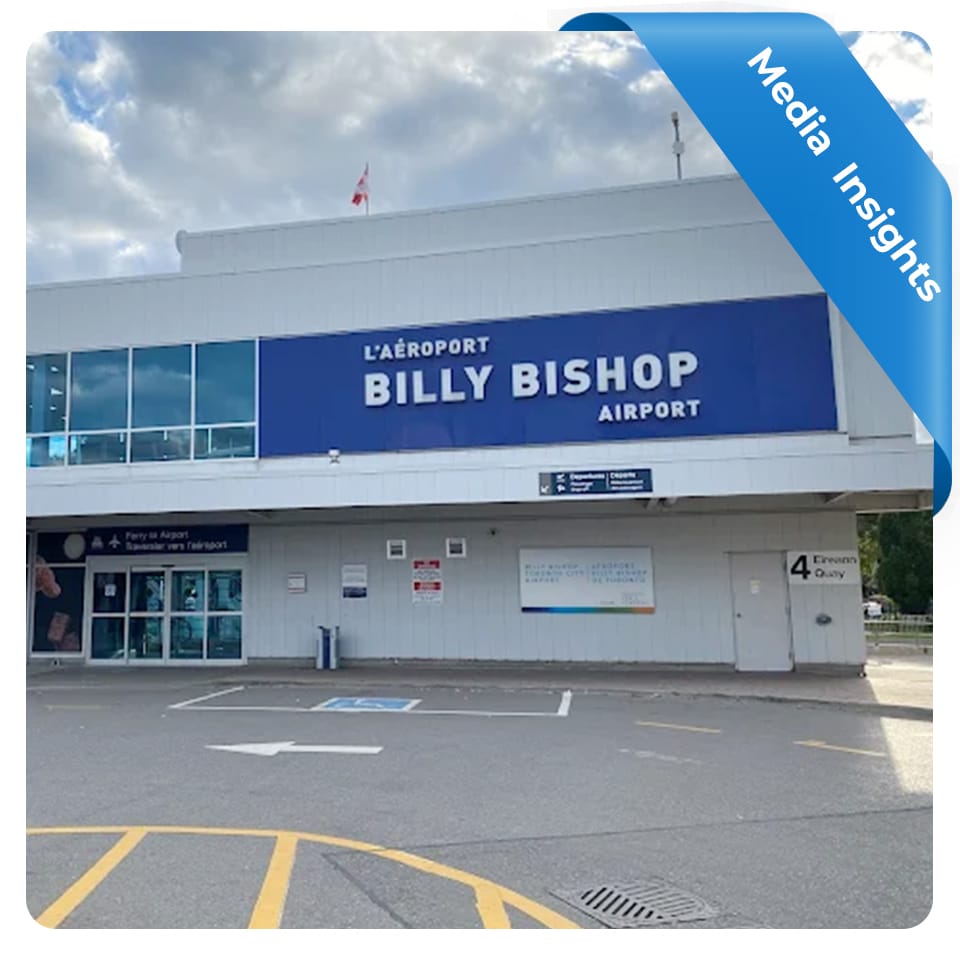
Destination Toronto: Full Visitor Journey Coverage
TIFF's geography is exceptionally concentrated. Roy Thomson Hall, the Princess of Wales and Royal Alexandra theatres, TIFF Lightbox and Scotiabank Theatre sit within a few blocks of one another along King Street West and the surrounding entertainment district; the Metro Toronto Convention Centre market venue is immediately south; the hotels, restaurants and party venues that absorb the same audience occupy the same grid. An attendee's eleven days happen inside roughly one square kilometre of downtown Toronto.
That makes an Airport → City → Venue media sequence efficient in a way few festival cities allow. A campaign can meet an arriving distributor at Pearson arrivals, appear again on digital and large-format OOH along the Bloor–Yorkville luxury retail corridor, in the Financial District, across premium hotel environments and along the Gardiner and airport-corridor approaches, and a third time on the streets immediately surrounding the King Street venues, with almost no impressions spent on geographies the festival audience does not enter.
Three effects follow from sequencing rather than scattering:
- Increased brand recall: repeated exposure at arrival, in the city and near the venue, compounded across eleven days rather than three
- Consistent presence: the brand becomes part of the festival's visual environment rather than an interruption to it
- Enhanced campaign effectiveness: coordinated placements across a single audience journey outperform equivalent spend split across disconnected markets
Why Brands Choose Airport & City Advertising for Toronto International Film Festival
Exclusive audience access. Eleven days concentrate international talent, studio and streaming leadership, accredited market buyers and the global entertainment press into one downtown core served by one dominant airport.
A prestigious environment. TIFF is among the most credible cultural platforms in North America. Brands visible in and around it are read in that register.
End-to-end campaign support. Masscom Global plans, negotiates and executes across Pearson's programmatic network, Billy Bishop and Toronto city inventory from a single brief, with one point of accountability.
Strategic planning assistance. Our planners advise on terminal selection, package tier, daypart weighting and creative sequencing across the eleven days, so that spend lands against the festival audience rather than general airport traffic.
The Masscom Global Standard Behind Every Toronto International Film Festival Placement
- Verified inventory and audience data: screen counts and network data at Pearson come from live operator data at proposal stage, not published estimates.
- Transparent delivery reporting: campaign monitoring and reporting across airport and city inventory, so you see exactly where your creative ran.
- Benchmarked recommendations: format mix and package tier set against comparable festival campaigns across our network.
- We absorb the complexity: one point of accountability from negotiation through execution.
Request Your Customised Toronto International Film Festival Advertising Plan
Tell us your audience, category and budget. Our planners will return a costed plan across airport and prime city inventory, with availability confirmed.
Book NowFrequently Asked Questions
When exactly is the 2026 Toronto International Film Festival?
The 51st edition runs 10 to 20 September 2026, across the Princess of Wales Theatre, Roy Thomson Hall, the Royal Alexandra Theatre, TIFF Lightbox, Scotiabank Theatre Toronto and the Metro Toronto Convention Centre, which hosts the festival's new formal film market.
Who attends TIFF?
International talent, directors and producers with their agents and publicists; studio, streaming and distribution executives; sales agents, financiers and (from 2026) accredited film-market buyers; the international entertainment press corps; and a very large public audience from Toronto and the wider Greater Toronto Area, one of North America's most affluent and most internationally connected metropolitan markets.
Can I reach visitors across their whole journey, not just at the venues?
Yes. A combined Pearson, Billy Bishop and downtown Toronto campaign covers international and cross-border arrival, the Yorkville and Financial District cores, hotel and transit environments, and the King Street West blocks containing the venues themselves.
How far in advance should a festival campaign be booked?
Pearson's network launches campaigns within 48 hours of creative approval, so reactive activity is possible late. However, September is a peak demand month and the strongest screen positions and package tiers commit early: we recommend securing share several months ahead and holding some budget back for reactive festival-week messaging.
Which brand categories perform best in this window?
Luxury fashion, watches and jewellery, premium beauty, private aviation, wealth management and private banking, hospitality and hotel groups, premium spirits, automotive, and media, technology and professional services brands targeting the entertainment industry.
Related Airport Advertising Guides
Detailed inventory, audience and planning notes for the airports covered above:
Wealth in motion intelligence.Toronto International Film Festival Won't Wait. Neither Should You.
- Once a year, then gone: Pearson's strongest screen positions and package tiers commit early, even though the network itself can activate within 48 hours.
- Competitors are already moving: every week without a plan is a week a luxury, spirits or automotive brand gets closer to locking the same positions.
- The window is exact, not approximate: a campaign that isn't live for the festival's ten days misses the industry delegation and press entirely.
- The alternative can't buy this credibility: straight commercial media cannot purchase the cultural authority a major film festival confers.
Get Free Expert Assistance Now
Tell us your audience, your category and your budget, and our planners will return a costed TIFF media plan across Pearson, Billy Bishop and downtown Toronto inventory.
Request Availability
Pearson screen share and downtown positions for the 10–20 September 2026 window move quickly. Ask us what is still open.
TIFF's eleven days combine an internationally accredited film market with elevated downtown footfall long enough to build genuine campaign frequency, arriving through Pearson's 68.4-million-weekly-impression programmatic network and Billy Bishop's low-clutter, festival-adjacent terminal. An Airport → City → Venue plan meets that audience at arrival, again across the Yorkville and Financial District cores, and a third time on the King Street West blocks the venues occupy. Pearson's strongest screen positions and package tiers commit early, even though the network itself can activate within 48 hours.







