




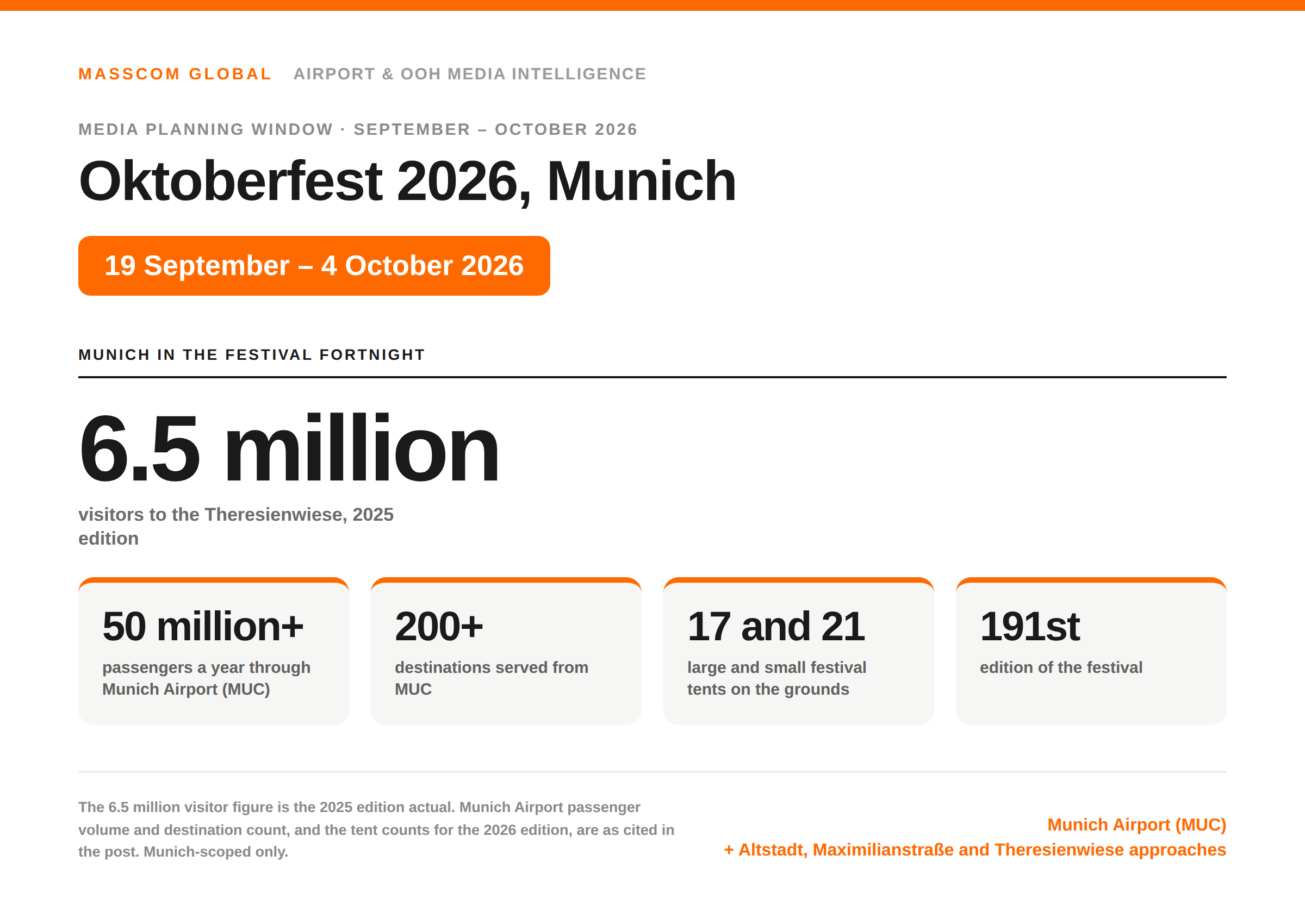
Oktoberfest is the largest public festival in the world, drawing more than six million guests a year, with 6.5 million visitors in 2025; but for a media planner, that crowd figure is the least interesting number on the page. The 191st Oktoberfest runs on Munich's Theresienwiese from 19 September to 4 October 2026, keeping its traditional frame (held annually from the Saturday after 15 September to the first Sunday in October) and opening with the grand entry of the Oktoberfest landlords and breweries and the ceremonial tapping of the first barrel, followed by the traditional costume parade on the opening Sunday. The grounds carry 17 large and 21 small festival tents.
What matters is the layer sitting on top of the crowd figure: the sixteen days of Oktoberfest are also Munich's densest corporate hospitality season of the year, when boxes and reserved tables inside the large tents are held by German industrial groups, private banks, professional services firms, automotive suppliers and international corporates who fly clients in specifically for the window.
That is the audience this post is about. Not the six million. The tens of thousands of executives, principals and invited guests who arrive by air into Munich Airport, stay in the city's premium hotel stock, move through Maximilianstraße and Bogenhausen, and spend a concentrated fortnight inside one walkable, screen-rich European capital of capital goods.
Why Airport & City Advertising Works During Oktoberfest


Munich in late September is not a leisure market with a business fringe. It is a business market with a leisure surface. The city is the headquarters base for a substantial share of Germany's listed industrial and insurance sector, and Oktoberfest functions as the annual anchor in that calendar: the fixed point around which client entertainment, supplier relationship management, board dinners and deal conversations are scheduled.
The wealth context is national and material. Germany's luxury market is projected to generate €17.41 billion in revenue in 2025, growing at 1.90% annually, supported by over one million high-net-worth consumers. Munich is one of the three cities where that spend actually lands: Maximilianstraße is the city's luxury retail spine, and Bogenhausen its established affluent and financial residential district.
Oktoberfest concentrates and augments that resident base rather than importing a temporary one. A campaign timed to the 19 September – 4 October window reaches inbound corporate guests, the German principals hosting them, and the permanent Munich HNWI population at the same time: the three groups a luxury, wealth or premium-mobility brand most wants in one room.
The second argument is competitive clarity. Advertising inside the tents is effectively closed: brewery relationships are historic and exclusive. The open ground is the journey: the airport, the city, the approach to Theresienwiese. Brands that cannot buy into the venue can still own everything around it.
Key Benefits of Airport & City Advertising During Oktoberfest
Reach a qualified, high-spend audience
Corporate-hosted Oktoberfest guests arrive predominantly in premium cabins or by private aviation, stay in five-star inventory, and are travelling on someone else's invitation rather than on price. Airport and city media place your brand in front of them during unavoidable, high-dwell moments that no ticketing or hospitality relationship is required to access.
Elevate your brand positioning
Munich carries a specific register: engineering credibility, discretion, old money rather than new noise. Appearing consistently across the arrival journey and the city core during the festival's sixteen days associates a brand with that register, and with the most visible fortnight in the German events calendar, without a sponsorship commitment.
Generate real business opportunity
Oktoberfest is a deal window as much as a beer festival. Private banking, wealth management, corporate aviation, real estate advisory, watches and premium automotive all use the fortnight for client contact. Sustained visibility across the sixteen days keeps a brand present through every meeting the season produces.
Get Free Expert Assistance from Our Global Media Planning Team
Receive strategic recommendations, media planning support, campaign monitoring and reporting to maximise your visibility throughout Oktoberfest VIP corporate season.
Book Expert ConsultationMunich Airport (MUC): The Gateway to the Wiesn
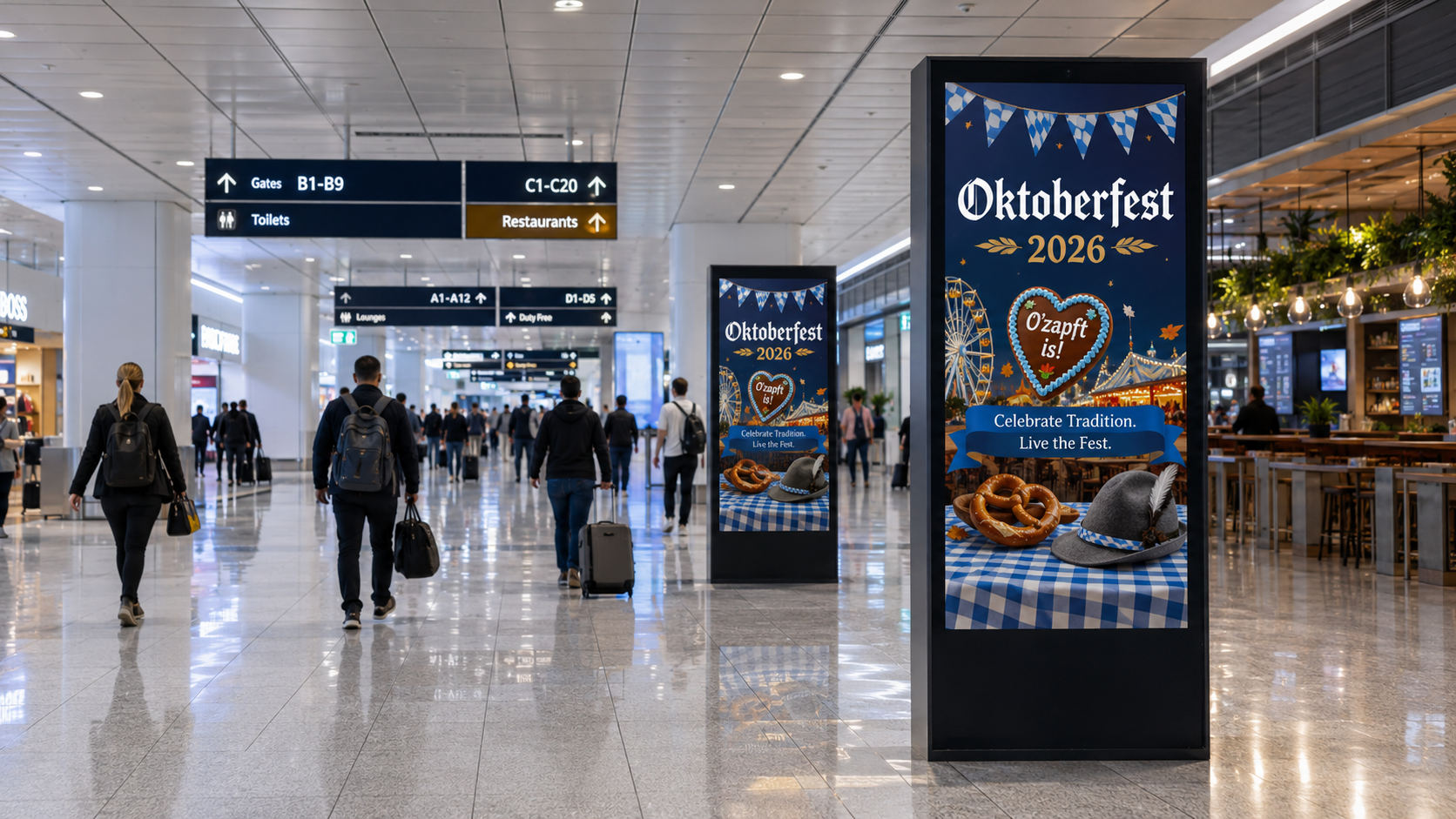
Munich Airport handles over 50 million passengers annually and connects the city to over 200 destinations. It is the single unavoidable filter through which almost every inbound Oktoberfest visitor of commercial value passes: international corporate guests, sponsor and partner delegations, and the private-aviation traffic the season generates. The airport also operates private jet terminals, which matter disproportionately in a window when the UHNWI share of arrivals rises sharply.
Its commercial environment is already positioned for this audience. Luxury houses including Bvlgari, Hermès and Montblanc trade inside the airport, which tells a planner two useful things: the passenger mix supports luxury conversion, and the surrounding media environment is one in which premium creative reads as native rather than aspirational.
Inventory Highlights
- Arrivals and immigration approach positions: the first branded surface an inbound Oktoberfest guest encounters, at the point of highest attention and lowest distraction
- Digital networks along departure concourses and premium check-in zones, reaching business and first-class travellers on both the inbound and outbound legs of the festival fortnight
- Baggage reclaim and arrivals hall placements, where dwell time is extended and captive, supporting longer, more considered brand messages
- Premium retail-adjacent environments alongside the airport's luxury tenancy, including Bvlgari, Hermès and Montblanc
- Private aviation terminal environments serving the UHNWI and corporate-jet arrivals that peak during the Oktoberfest window
- Transfer and ground-transport touchpoints on the airport-to-city axis
Advantages for Advertisers
- Unavoidable exposure: the arrival sequence is a compulsory corridor for every inbound guest, with no ad-avoidance behaviour available
- Audience concentration without waste: over 50 million annual passengers, but a festival-window mix skewed heavily toward corporate and premium travel
- Over 200 destinations means a single airport buy delivers genuinely international reach: inbound guests from across Europe, North America, the Gulf and Asia are captured in one environment
- The airport's own luxury tenancy validates the environment for premium categories and reduces the risk of tonal mismatch
- Private aviation positions offer very low media clutter, so a single placement carries a disproportionate share of attention among the highest-value arrivals
- Bookable as a defined sixteen-day flight aligned exactly to 19 September – 4 October
 Wealth in motion intelligence.
Destination Munich: Full Visitor Journey Coverage
Munich's advantage for this kind of campaign is geometry. Theresienwiese sits inside the city, not on its outskirts. The Altstadt, the premium hotel stock, Maximilianstraße's luxury retail and the affluent Bogenhausen district all sit within a short and largely repeated set of movements. A corporate guest's fortnight happens inside a small, legible footprint, and that makes sequencing, rather than scattering, the correct planning discipline.
An Airport → City → Theresienwiese media sequence follows the actual behaviour. Arrival is captured at MUC. The city phase is captured through digital and large-format OOH and DOOH across the Altstadt and Maximilianstraße luxury corridor, premium hotel environments, the Bogenhausen and financial-district approaches, transit and U-Bahn networks, and the arterial road and ring-road approaches that carry every taxi and chauffeured transfer of the season. The venue phase is captured on the pedestrian and transit approaches to Theresienwiese itself, where footfall for sixteen days is both enormous and geographically fixed.
Because DOOH is dayparted, the same inventory can carry different messages within a day: a business-hours message on the financial and hotel approaches, an evening message on the transit and Theresienwiese approaches. That is the difference between buying Munich as a market and buying Oktoberfest as an event.
Three effects follow from sequencing:
- Increased brand recall: repeated exposure at arrival, across the city and near the venue, to the same individual over a fortnight
- Consistent presence: the brand becomes part of the season's visual environment rather than an interruption to it
- Enhanced campaign effectiveness: coordinated Munich placements outperform the same budget split across disconnected German markets
Why Brands Choose Airport & City Advertising for Oktoberfest
Exclusive audience access. Few European windows concentrate this volume of corporate-hosted premium travellers, private-aviation arrivals and resident high-net-worth consumers into one city across sixteen consecutive days.
A prestigious environment. Oktoberfest is the most recognised civic festival in the world and Munich the most prestigious German business address. Brands present across that fortnight inherit both associations.
End-to-end campaign support. Masscom Global plans, negotiates and executes across Munich Airport and Munich city inventory under a single brief, with one point of accountability from strategy to proof of posting.
Strategic planning assistance. Our planners advise on format mix, terminal selection, daypart weighting and flight timing against the festival's own rhythm (opening weekend, the first Sunday parade, the two mid-festival weekends and the closing days) so that budget lands where the specific audience actually moves.
The Masscom Global Standard Behind Every Oktoberfest Placement
- Verified inventory and audience data: screen counts and passenger figures at Munich Airport come from live operator data at proposal stage, not published estimates.
- Transparent delivery reporting: campaign monitoring and reporting across airport and city inventory, so you see exactly where your creative ran.
- Benchmarked recommendations: format mix set against comparable campaigns across our network.
- We absorb the complexity: one point of accountability from negotiation through execution.
Request Your Customised Oktoberfest VIP corporate season Advertising Plan
Tell us your audience, category and budget. Our planners will return a costed plan across airport and prime city inventory, with availability confirmed.
Book NowFrequently Asked Questions
When exactly is Oktoberfest 2026?
The 191st Oktoberfest runs from 19 September to 4 October 2026 on the Theresienwiese in Munich. The festival is always held from the Saturday after 15 September to the first Sunday in October, and the grounds carry 17 large and 21 small festival tents.
Who attends Oktoberfest, and who should a brand actually be targeting?
The festival draws more than six million guests a year (6.5 million in 2025) but the commercially relevant segment is narrower: internationally inbound corporate hospitality guests, the German executives and principals hosting them, sponsor and partner delegations, private-aviation arrivals, and Munich's permanent affluent population. Airport and premium city inventory reach that segment with far less waste than mass festival-ground media.
Can I reach visitors across their whole journey, not just at the venue?
Yes, and it is the stronger buy. A combined Munich Airport and Munich city campaign covers arrival, the hotel and luxury retail districts, the financial and affluent quarters, transit, and the approaches to Theresienwiese, so the same guest encounters the brand several times across the sixteen days rather than once.
How far in advance should an Oktoberfest campaign be booked?
Premium Munich Airport and Munich city positions for the festival window are among Germany's most contested inventory, and the fortnight is fixed and predictable, so demand builds early. We recommend confirming availability several months ahead. Later requests can often still be served, but with reduced format and location choice.
Which brand categories perform best in this window?
Luxury automotive, watches and jewellery, private aviation, wealth management and private banking, real estate and residency advisory, premium spirits, business services and international hospitality: categories whose buyers are disproportionately represented in Munich's corporate hospitality season.
Related Airport Advertising Guides
Detailed inventory, audience and planning notes for the airports covered above:
Wealth in motion intelligence.Oktoberfest Won't Wait. Neither Should You.
- Once a year, then gone: premium Munich Airport and city positions for the festival window are already among Germany's most contested inventory.
- Competitors are already moving: every week without a plan is a week an automotive, spirits or wealth management brand gets closer to locking the same positions.
- The window is exact, not approximate: the fortnight is fixed and predictable, so a campaign that isn't live for it misses the corporate hospitality season entirely.
- The alternative reaches the wrong tier: broadcast and programmatic can't isolate the corporate hospitality audience the way airport and city media can.
Get Free Expert Assistance Now
Tell us your audience, your category and your budget, and our planners will return a costed Oktoberfest media plan across Munich Airport and Munich city inventory for the 19 September – 4 October window.
Request Availability
Munich Airport and Munich city positions for the 2026 festival fortnight move quickly. Ask us what is still open.
Oktoberfest's sixteen days are Munich's densest corporate hospitality season, and while the tent boxes are already spoken for, the airport, the city and the approach to Theresienwiese remain open ground. An Airport → City → Theresienwiese plan reaches the corporate guests, their hosts and Munich's resident HNWI population at MUC arrival, again across Maximilianstraße and Bogenhausen, and a third time on the approaches to the grounds. Premium Munich Airport and city positions for the festival window are already among Germany's most contested inventory.







