


Israel's High Holiday period is not a ticketed event. It is the country's most significant religious season and its largest annual movement of people: a three-week span in which Rosh Hashanah, Yom Kippur and Sukkot follow one another, families reunite, the diaspora travels home, and the business calendar reshapes itself around observance.
In 2026 the season falls entirely within September and the first days of October. Rosh Hashanah, the Jewish New Year, runs from sunset on Friday 11 September to nightfall on Sunday 13 September. Yom Kippur, the Day of Atonement (during which the country effectively stops, with Ben Gurion Airport closed) runs from sunset on Sunday 20 September to nightfall on Monday 21 September. Sukkot follows from sunset on Friday 25 September to nightfall on Friday 2 October, and is the most travel-intensive stretch of the three.
This post concerns the travel season surrounding those holy days, not the observances themselves. The commercial opportunity lies in the arrival and departure shoulders either side of them, and in the extended domestic leisure travel Sukkot generates. Media planning here requires respecting that distinction.
Why Advertise During Israel's High Holiday Travel Season?
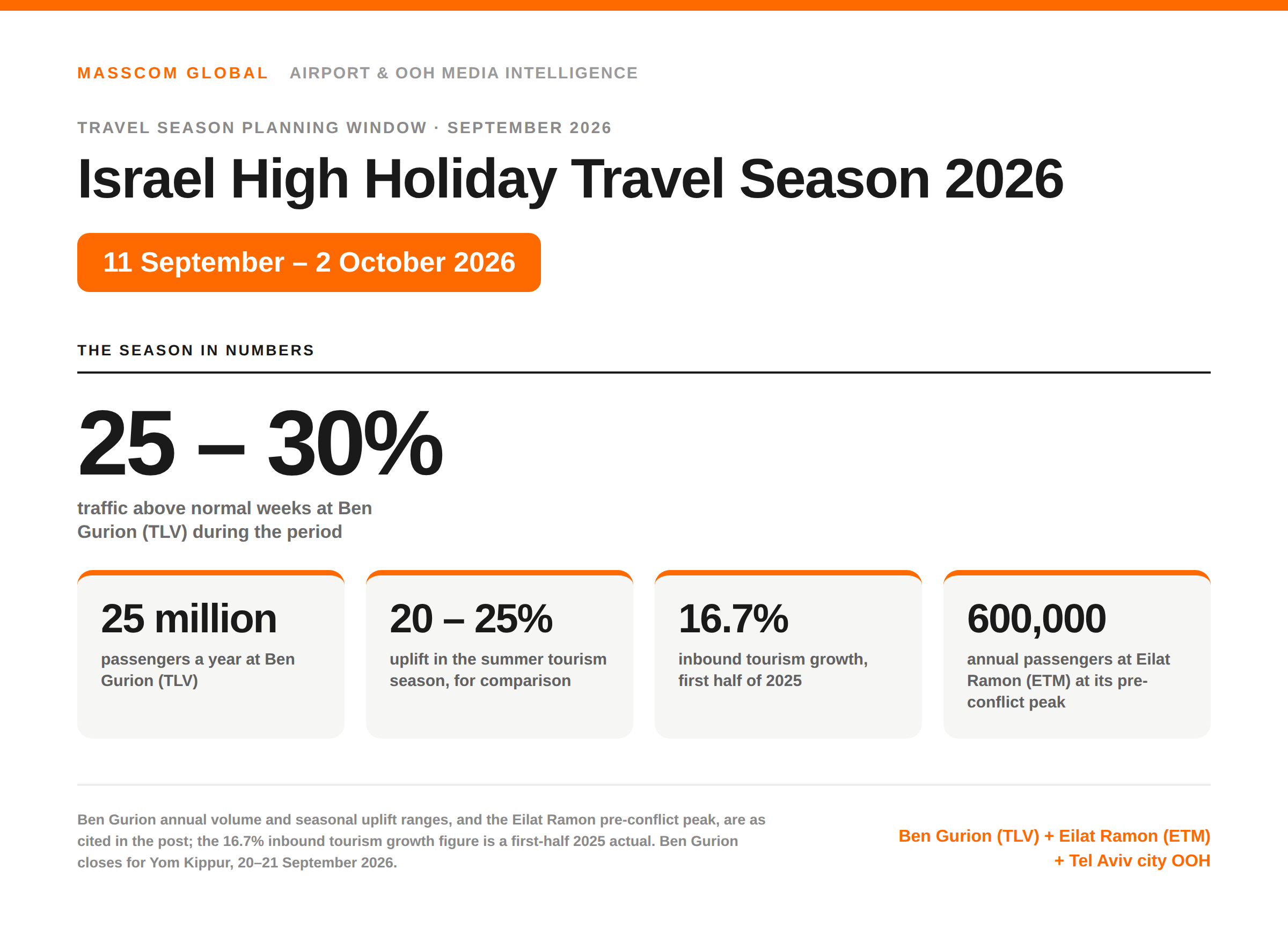
Ben Gurion International Airport handles approximately 25 million passengers annually, and traffic during the Jewish High Holiday period runs 25 to 30% above normal travel weeks: a larger uplift than the summer tourism season at 20 to 25%, peak summer vacation weeks at 15 to 20%, or the winter season at 15 to 20%. The High Holidays are the single largest annual demand peak at Israel's principal gateway.
The composition of that peak makes it commercially interesting: inbound diaspora travellers, many from North America, Western Europe and the former Soviet states, travelling as families and staying two to three weeks; returning Israeli expatriates weighted toward technology, finance and professional services; religious and cultural tourism; and heavy domestic leisure travel during Sukkot, when Israeli families move south to the Red Sea.
Layered over this is a business pattern planners should not overlook. Israeli commercial life slows sharply during the holy days and intervening half-holidays, then resumes with concentrated intensity in mid-October. Brands targeting Israeli decision-makers therefore have a natural sequence: build recognition through the travel peak, land the commercial message as the business calendar restarts. Inbound tourism grew 16.7% year on year in the first half of 2025, and the Ministry of Tourism allocated over USD 60 million to tourism infrastructure in 2025.
Key Benefits of Advertising During Israel's High Holiday Season
Reach a qualified, high-spend audience
The inbound diaspora traveller is a long-stay, high-expenditure visitor with strong family and property ties to Israel: a profile suiting real estate, financial services, private banking, healthcare, insurance and premium retail. Airport media reaches them at the one unavoidable, undistracted moment in the journey.
Elevate your brand positioning
Terminal 3 is the first and last impression of the country for essentially every international arrival. A brand present there across a 25 to 30% uplift is seen by a defined national and diaspora audience at scale, in a premium, uncluttered setting.
Generate real business opportunity
Diaspora and expatriate travellers routinely combine the visit with family, property and financial business. Advisory, banking, residency, healthcare and real estate brands reach people physically in the market and actively transacting: a condition remote digital targeting cannot reproduce.

Get Free Expert Assistance from Our Global Media Planning Team
Receive strategic recommendations, media planning support, campaign monitoring and reporting to maximise your visibility throughout Rosh Hashanah / High Holidays.
Book Expert ConsultationBen Gurion International Airport (TLV), Tel Aviv
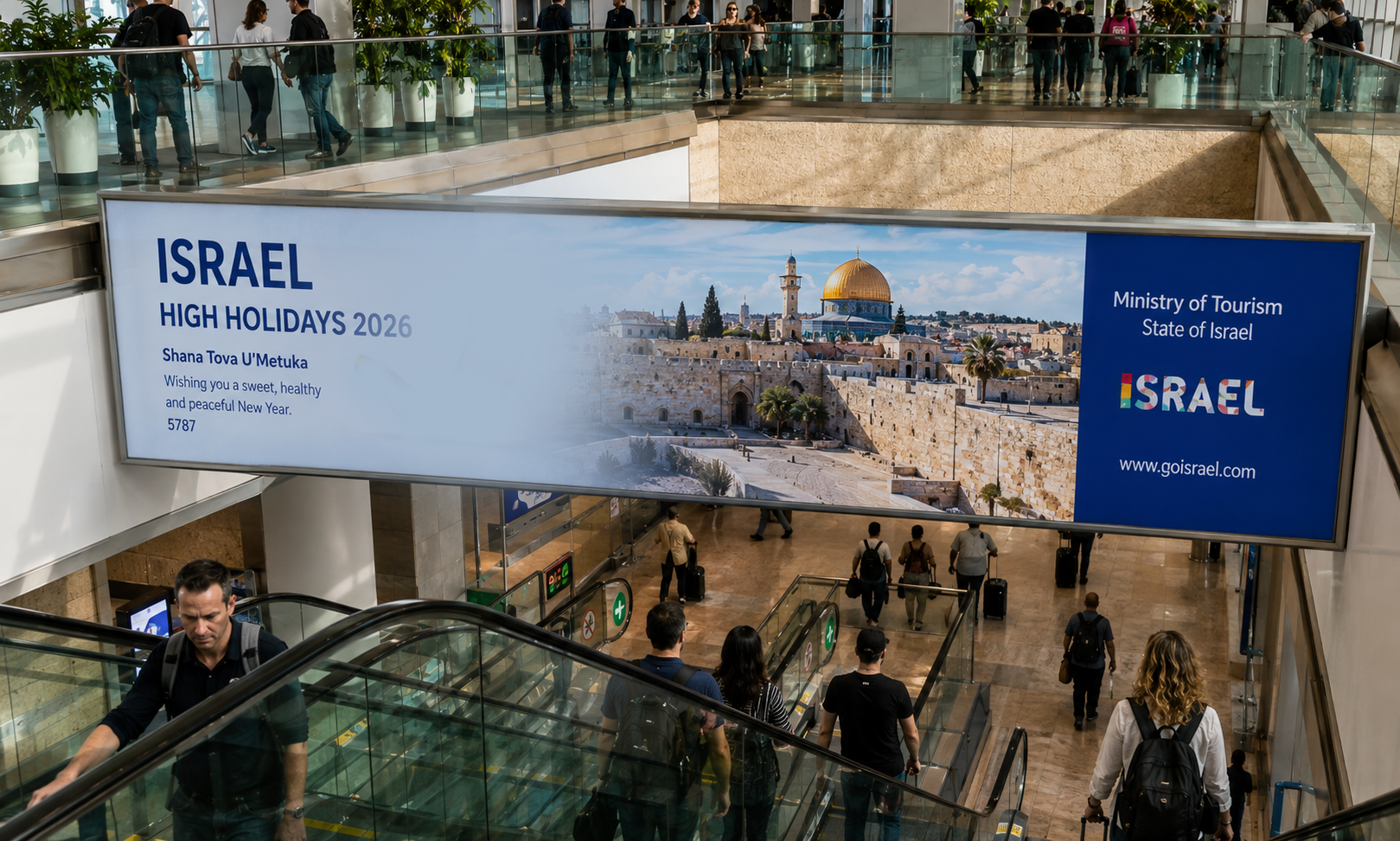
Ben Gurion is Israel's principal international gateway, handling roughly 25 million passengers a year across two primary passenger terminals: Terminal 3, the main international terminal, and Terminal 1, handling domestic and European low-cost operations. Practically all inbound High Holiday diaspora and tourism traffic passes through Terminal 3.
A campaign flighted from early September through the first week of October captures the arrival wave before Rosh Hashanah, movement between the holidays, the Sukkot peak and the heavy early-October departure wave. Note that Ben Gurion closes for Yom Kippur, so 20–21 September should be a deliberate gap in the flight plan, with impressions weighted into the surrounding shoulders.
Inventory Highlights
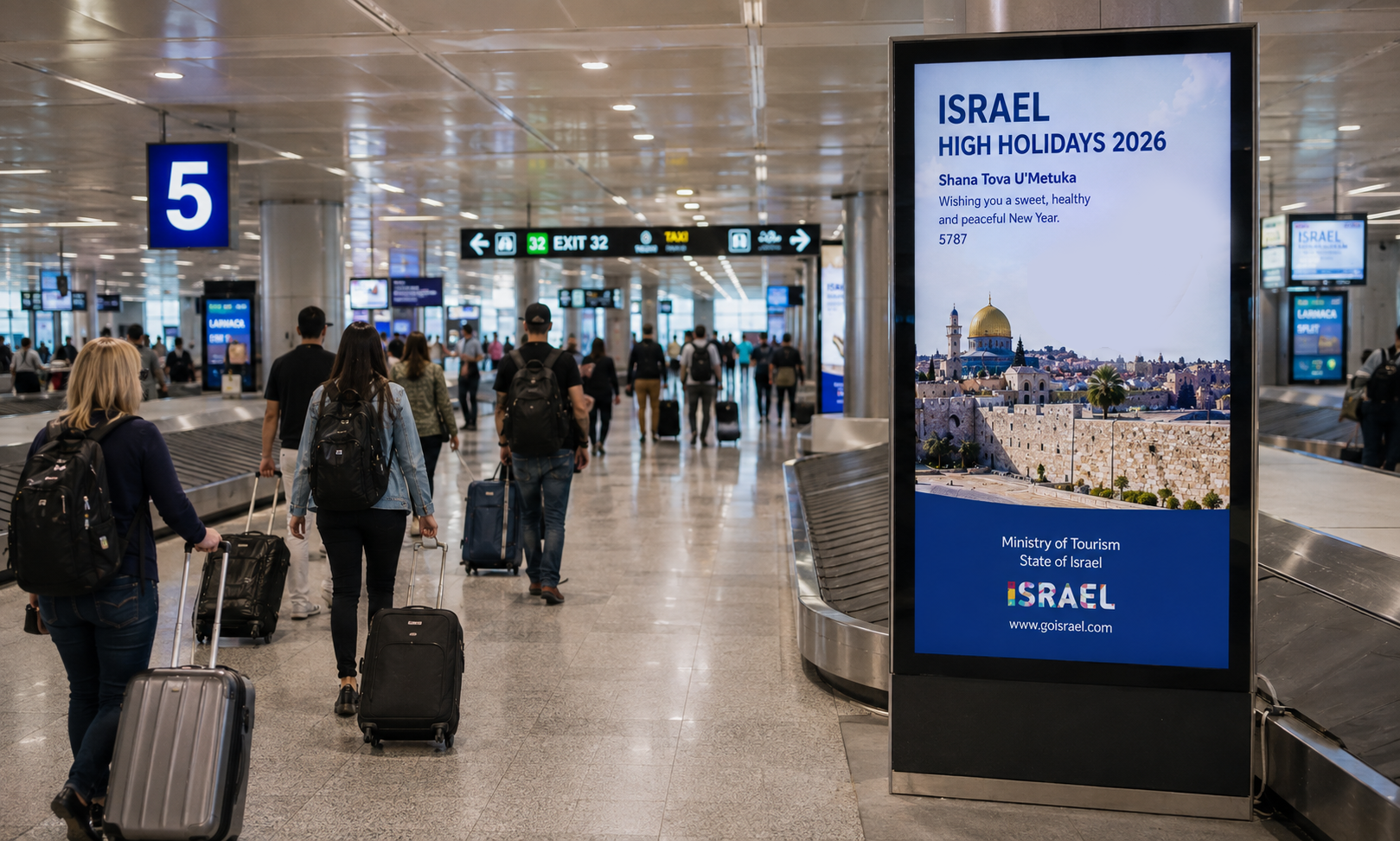
- Terminal 3 arrivals, passport control approach and baggage reclaim: the first branded surfaces every arrival encounters
- Terminal 3 departure concourse and duty-free environments, reaching long-stay visitors at trip's end
- Premium check-in and lounge approach positions serving business and premium-cabin travellers
- Terminal 1 environments covering domestic and European low-cost traffic, including Sukkot movements
Advantages for Advertisers
- The 25–30% uplift is the largest and most predictable annual traffic peak at the country's dominant gateway
- Terminal 3 concentrates virtually all inbound diaspora and tourism traffic into one ownable environment
- Arrivals-side placement reaches long-stay visitors at the start of a two- to three-week spending window
- A single national gateway gives near-complete inbound coverage without multi-airport fragmentation
 Wealth in motion intelligence.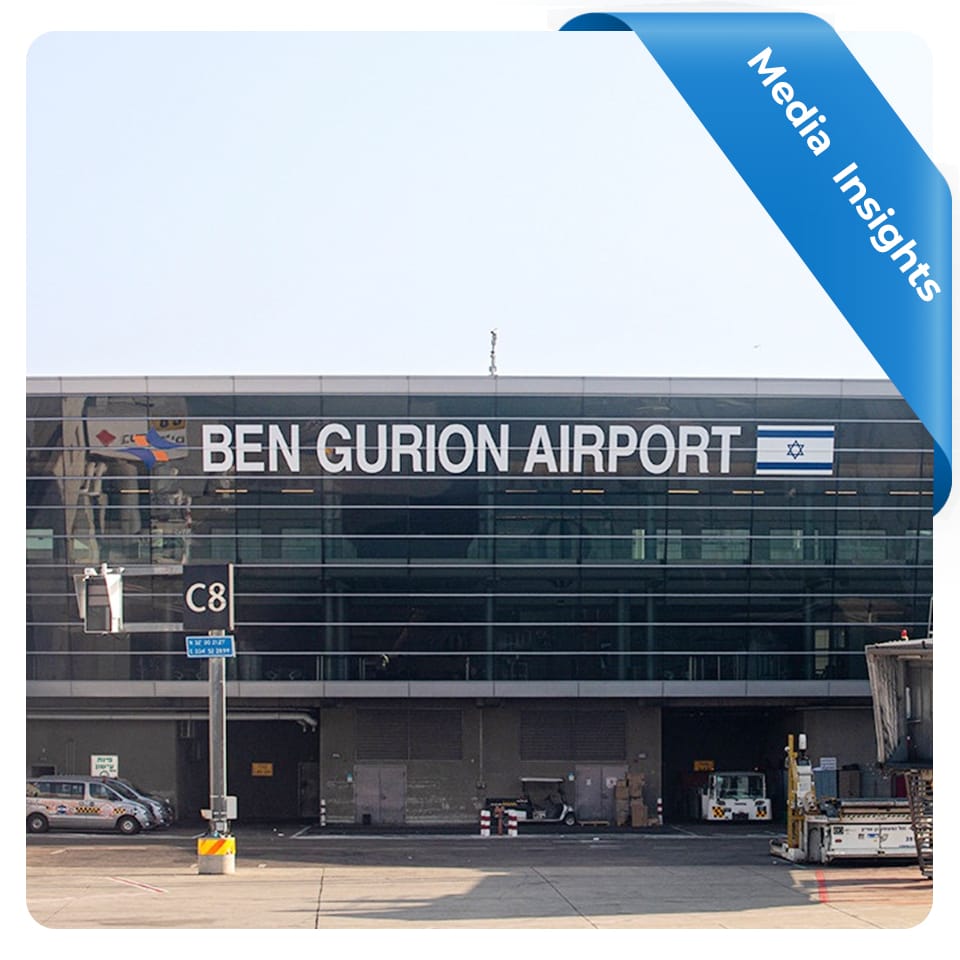
Eilat Ramon Airport (ETM), Eilat
Eilat Ramon is Israel's southern gateway and the airport of the Sukkot domestic leisure peak. It handled roughly 600,000 annual passengers at its pre-conflict peak and is recovering. Its infrastructure is built well ahead of current demand: a 3,600-metre runway capable of handling wide-body aircraft, and a modern terminal designed for up to 2 million passengers annually in its first stage, expanding to 4.2 million by 2030. It operates 12 hours per day, with duty-free retail, three cafés, banking and ATM facilities, self-service check-in kiosks and four parking lots serving passengers, taxis, employees and car rental.
Eilat runs daily domestic services to Tel Aviv and Haifa via Arkia and Israir, with European charter traffic across the October to April peak season; the longest current non-stop route is Eilat to Paris Charles de Gaulle, roughly five hours. Sukkot sits at the hinge between the domestic autumn peak and the opening of that charter season.
Inventory Highlights
- Arrival and departure positions along a compact, modern terminal path with low media clutter
- Car rental and parking interchange environments: most Eilat visitors continue by road along the coast
Advantages for Advertisers
- Audience concentration: nearly every arrival is a leisure visitor beginning a multi-day, high-expenditure stay
- Sukkot coincides with both the domestic leisure peak and the start of the European charter season
- Direct alignment with a resort market of 50 hotels and 11,000 rooms along an 11-kilometre coastline, with a still-growing luxury tier: the adults-only, 168-room Roxon Red Sea Eilat opened in December 2024
- Pairing ETM with TLV covers both the inbound international and domestic leisure halves of the season
 Wealth in motion intelligence.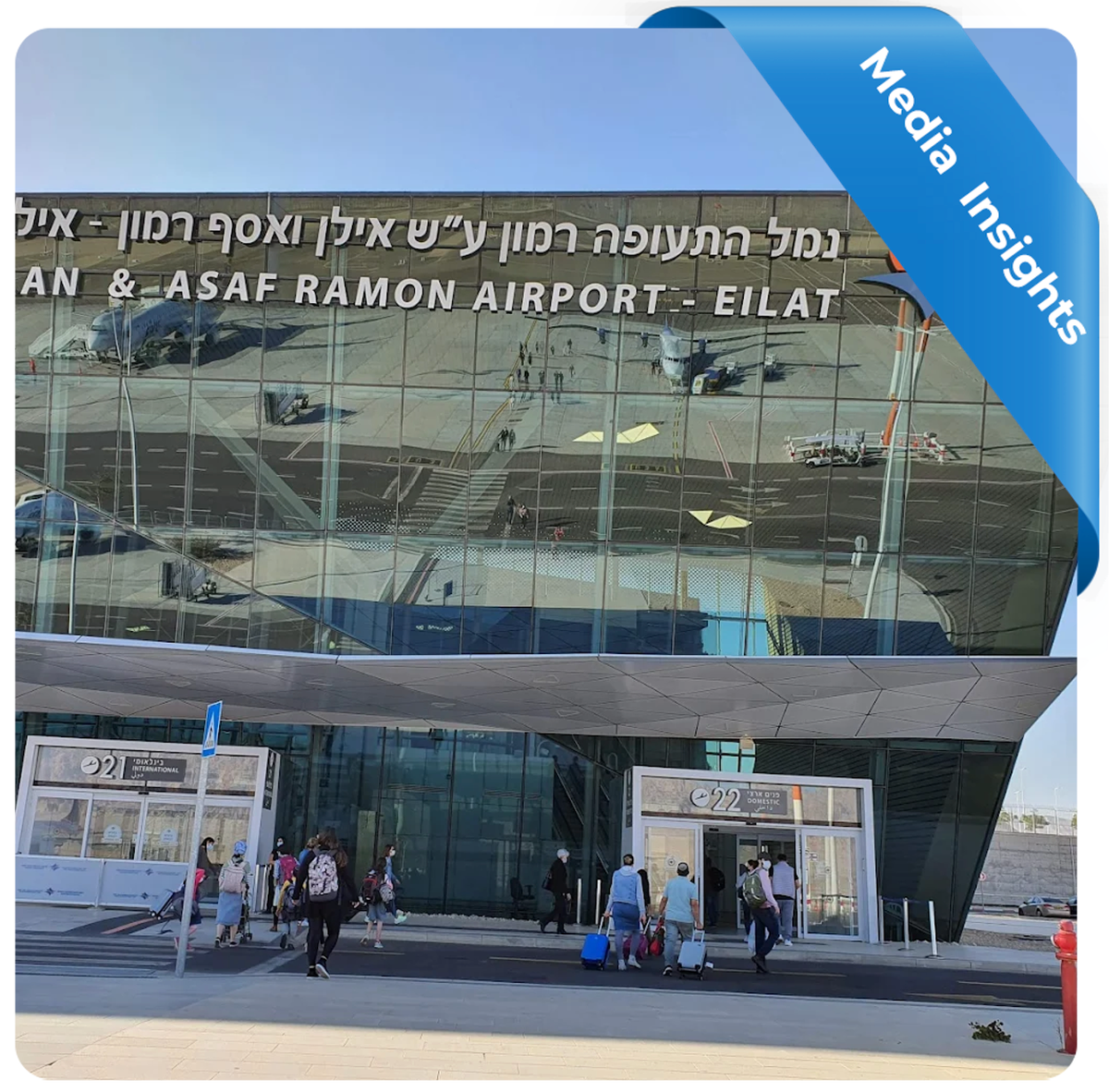
Destination Israel: Full Visitor Journey Coverage
The geography of this season has two nodes, each compact. Inbound diaspora and tourism traffic lands at Ben Gurion and disperses into Tel Aviv's coastal and commercial core, the Rothschild and Dizengoff axis, Jerusalem and family destinations across the centre and north. Domestic Sukkot traffic moves south to Eilat, where the entire visitor experience sits along an 11-kilometre coastline carrying 50 hotels.
That structure makes an Airport → City → Destination media sequence highly efficient. A campaign meets an arriving family at Ben Gurion passport control, appears again on digital and large-format OOH in the Tel Aviv business and retail core, on coastal approaches and in premium hotel environments, and a third time at Eilat Ramon and along the resort strip.
Three effects follow from sequencing rather than scattering:
- Increased brand recall: repeated exposure at arrival, in the city and at the destination, across a stay long enough for frequency to register
- Consistent presence: the brand becomes part of the season's visual environment rather than an interruption to it
- Enhanced campaign effectiveness: coordinated placements across a single audience journey outperform equivalent spend split across disconnected markets
Why Brands Choose Airport & City Advertising for Israel High Holiday Season
Exclusive audience access. No other window concentrates the inbound diaspora, returning Israeli expatriates and the domestic leisure market into one three-week period served by two ownable airports.
A prestigious environment. Terminal 3 and Eilat Ramon's modern terminal are premium, low-clutter settings where a brand is seen clearly rather than competing for attention.
End-to-end campaign support. Masscom Global plans, negotiates and executes across Ben Gurion, Eilat Ramon and Israeli city inventory from one brief, with one point of accountability.
Strategic planning assistance. Our planners advise on flighting around the days of observance, terminal selection and format mix: including how to weight impressions into the shoulders either side of Yom Kippur and time commercial messaging for the October business restart.
The Masscom Global Standard Behind Every Israel's High Holiday Season Placement
- Verified inventory and audience data: screen counts and traffic figures for Ben Gurion and Eilat Ramon come from live operator data at proposal stage, not published estimates.
- Transparent delivery reporting: campaign monitoring and reporting across both airports and city inventory.
- Benchmarked recommendations: format mix and timing set against comparable campaigns across our network.
- We absorb the complexity: one point of accountability from negotiation through execution.

Request Your Customised Rosh Hashanah / High Holidays Advertising Plan
Tell us your audience, category and budget. Our planners will return a costed plan across airport and prime city inventory, with availability confirmed.
Book NowFrequently Asked Questions
When exactly do the 2026 High Holidays fall?
Rosh Hashanah: sunset Friday 11 September to nightfall Sunday 13 September 2026. Yom Kippur: sunset Sunday 20 September to nightfall Monday 21 September. Sukkot: sunset Friday 25 September to nightfall Friday 2 October, with Shmini Atzeret and Simchat Torah immediately after.
Who travels during this period?
Inbound diaspora travellers visiting family, largely from North America, Western Europe and the former Soviet states; returning Israeli expatriates in technology, finance and professional services; religious and cultural tourism; and heavy Israeli domestic leisure travel during Sukkot, much of it southbound to Eilat. Inbound tourism to Israel grew 16.7% year on year in the first half of 2025, and much of that growth funnels through this exact three-week window.
Can I reach visitors across their whole journey, not just at the airport?
Yes. A combined Ben Gurion, Eilat Ramon and city campaign covers international arrival, the Tel Aviv commercial and retail core, coastal approaches, hotel environments and the Eilat resort strip, so the same households encounter the brand several times across a two- to three-week stay.
How should a campaign be scheduled around the days of observance?
Advertising into the holy days themselves is neither effective nor appropriate: commercial activity largely stops, and Ben Gurion closes entirely for Yom Kippur. Flight impressions into the early-September arrival shoulder, the half-holiday travel days, the Sukkot leisure peak and the early-October departure wave, then land direct commercial messaging as the business calendar restarts in mid-October. Confirm availability several months ahead: this is the year's highest-demand window at Ben Gurion.
Which brand categories perform best in this window?
Real estate and residency advisory, wealth management and private banking, insurance and healthcare, telecommunications, premium retail and duty-free, hospitality, airlines and travel services, and technology brands selling into the Israeli market.
Related Airport Advertising Guides
Detailed inventory, audience and planning notes for the airports covered above:
Wealth in motion intelligence.Wealth in motion intelligence.Israel's High Holiday Season Won't Wait. Neither Should You.
- Once a year, then gone: the three-week season is fixed by the Hebrew calendar, and Ben Gurion itself closes entirely for Yom Kippur, compressing the usable window further.
- Competitors are already moving: every week without a plan is a week a real estate, wealth management or insurance brand gets closer to locking the same positions.
- The window is exact, not approximate: a campaign that isn't live before Rosh Hashanah misses the diaspora travel surge that defines the entire season.
- The alternative reaches the wrong audience: generic advertising can't isolate a diaspora returning home for three specific weeks the way airport and city media can.
Get Free Expert Assistance Now
Tell us your audience, category and budget, and our planners will return a costed High Holiday season media plan across Ben Gurion, Eilat Ramon and Israeli city inventory.
Request Availability
Terminal 3 positions for the September 2026 window sit in the airport's highest-demand period of the year. Ask us what is still open.
Israel's High Holiday season is a three-week peak fixed by the Hebrew calendar, when Ben Gurion runs 25 to 30% above normal traffic, its largest uplift of the year, while domestic leisure travel moves south toward Eilat's 11-kilometre resort coastline. An Airport → City → Destination plan across Ben Gurion, Tel Aviv and Eilat Ramon reaches the same diaspora households and holiday travellers across a stay long enough for real frequency to build. This is the year's highest-demand window at Israel's principal gateway, so confirming placement early matters more here than in most other markets.