




The San Francisco Bay Area holds roughly US$1.1 trillion in billionaire wealth and absorbed US$90 billion in venture capital in 2024 alone, and Dreamforce lands squarely inside that market every September. The 2026 edition runs from 15 to 17 September 2026 at the Moscone Center in San Francisco, occupying Moscone North, South and West, with a parallel broadcast on Salesforce+. It is Salesforce's flagship global conference, established in 2003, and carries 1,600+ breakout sessions, 50+ visionary and product keynotes and 240+ community roundtables across beginner, intermediate and advanced tracks.
A note on the calendar before anything else: this is a September event, not an October one. The conference pass is priced at US$2,299 individually, with groups of three or more at US$999 per pass, and it covers keynotes, sessions, workshops, networking, the Welcome Reception, Dreamfest and daily meals. Attendance is restricted to those aged 18 and over. Any media programme built around Dreamforce needs to be live in the first fortnight of September to catch inbound arrivals: by the last week of September the audience has already gone home.
For advertisers, Dreamforce is not a technology conference so much as the densest concentration of enterprise software buying power that assembles anywhere in the calendar year. Delegates are Salesforce customers, partners, administrators, developers and the business leaders who sign their budgets. They arrive predominantly through one airport, stay in one compact downtown district, and walk the same two or three blocks for three consecutive days.
Why Airport & City Advertising Works During Dreamforce
The event's commercial value is amplified by where it happens. The San Francisco Bay Area holds roughly US$1.1 trillion in billionaire wealth, hosts 312 unicorn companies (approximately half of all US unicorns) and 27 decacorns. In 2024 the region absorbed US$90 billion of venture capital, 57% of all US startup funding. The top 10% of households hold 75% of all liquid wealth in the market. Median home price reached US$1.98 million in 2025, and the average technology worker salary stands at US$252,788 annually.
Dreamforce week layers an inbound global delegation on top of that permanent base. The audience an advertiser reaches in mid-September is therefore doubled in a specific way: visiting enterprise decision-makers from Europe, Asia-Pacific and Latin America, and the resident Silicon Valley technology HNWI, AI and venture capital principals, and unicorn founders and executives who live in the market and use SFO continuously.
That combination is difficult to buy any other way. Trade media reaches the job function but not the wealth tier. Airport and downtown OOH reaches both simultaneously, in an environment where the delegate is between commitments rather than mid-meeting.
Key Benefits of Airport & City Advertising During Dreamforce
Reach a qualified, high-spend audience
Dreamforce delegates pay US$2,299 for a pass before flights and hotels, which filters the attendee list to people with budget authority or a direct line to it. Reaching them at SFO arrivals or across the Moscone district means reaching a pre-qualified enterprise audience without the wastage of broadcast or programmatic display.
Elevate your brand positioning
SFO's four terminals and the downtown San Francisco core are premium, low-clutter environments. A presence there during Dreamforce places a brand alongside the global technology names occupying the same three days, without the cost or contractual commitment of official conference sponsorship.
Generate real business opportunity
Dreamforce week doubles as the enterprise software sector's most concentrated meeting calendar: partner briefings, investor conversations, customer dinners and recruiting all compress into 72 hours. Visibility across arrival, hotel district and venue approach keeps a brand in mind through every one of those conversations.
Get Free Expert Assistance from Our Global Media Planning Team
Receive strategic recommendations, media planning support, campaign monitoring and reporting to maximise your visibility throughout Dreamforce premium track.
Book Expert ConsultationSan Francisco International Airport (SFO): The Single Gateway
SFO handled 54.53 million passengers in 2025, up 4.3% year on year from 52.29 million in 2024. International traffic accounted for 15.91 million passengers in 2025 (29.3% of total traffic) with 7.95 million internationally enplaned. Asia-Pacific traffic reached 6.8 million passengers in 2024, up 21.4% year on year.
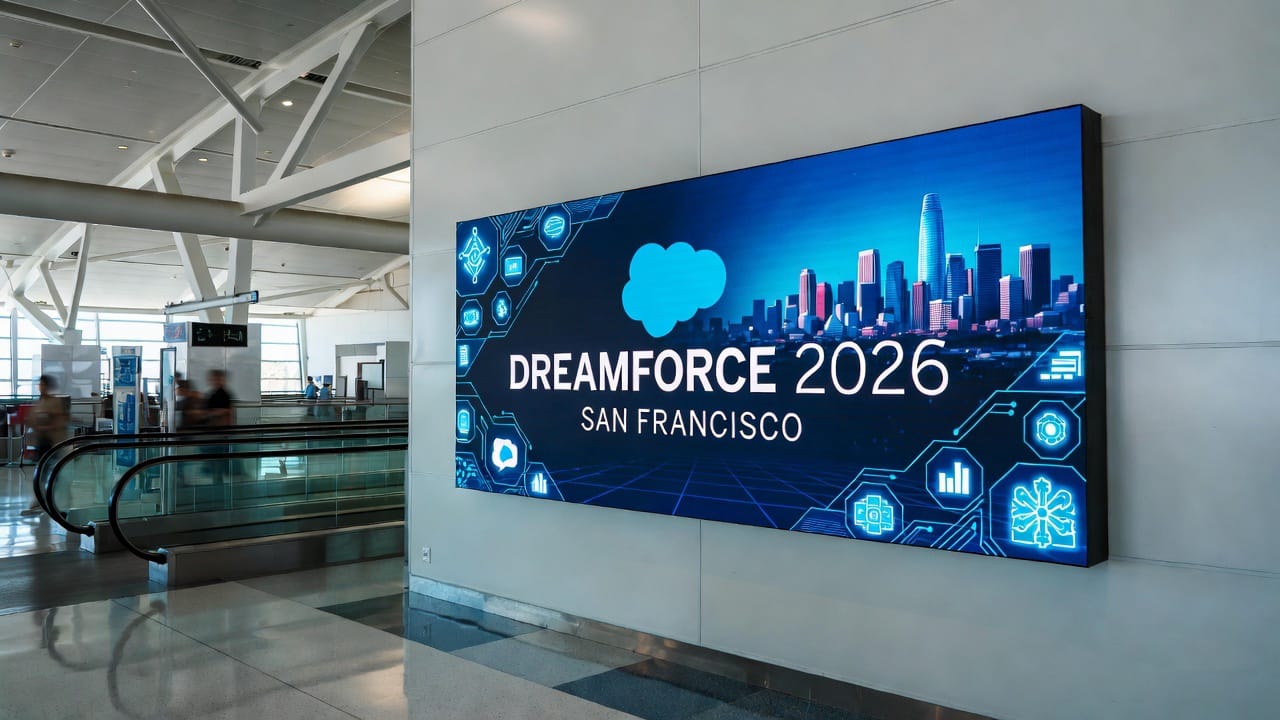
The airport operates four terminals: Harvey Milk Terminal 1 (Boarding Areas B and C), Terminal 2 (Boarding Area D), Terminal 3 (Boarding Areas E and F) and the Dianne Feinstein International Terminal (Boarding Areas A and G). It has four runways and no expansion capacity: a structural fact with direct media consequence, since passenger growth concentrates into a fixed physical footprint and existing placements gain audience rather than being diluted by new terminal build.
Its leading international routes in 2024 were Taipei (1.36 million passengers), London Heathrow (1.08 million), Seoul Incheon (700,297) and Frankfurt (636,217), with Vancouver, Tokyo and Singapore also among the principal international services. Those four routes alone describe the Dreamforce inbound map: the European enterprise delegation arrives via Heathrow and Frankfurt, the Asia-Pacific delegation via Taipei, Incheon, Tokyo and Singapore.
Inventory Highlights
- Dianne Feinstein International Terminal arrival and immigration approach positions: the first branded surface an inbound international delegate encounters, covering Boarding Areas A and G
- Harvey Milk Terminal 1 placements across Boarding Areas B and C, reaching the domestic premium-cabin flow that carries most US-based delegates
- Terminal 3 positions on Boarding Areas E and F, covering the transcontinental business routes
- Baggage reclaim and arrivals hall placements with extended, captive dwell during the peak arrival days of 13–15 September
- Departures and gate environments across all four terminals for the compressed 17–18 September return wave
Advantages for Advertisers
- A single-gateway event: unlike multi-airport destinations, essentially the whole international delegation passes through one airport, so one buy delivers near-complete inbound coverage
- 29.3% international share means the terminal mix can be weighted precisely between global delegates and the domestic-arriving majority
- Fixed four-runway, four-terminal footprint with rising passenger volume means placement audiences compound year on year
- Resident Silicon Valley technology HNWI, AI and venture capital principals and unicorn founders use SFO continuously, so the buy retains value beyond the three conference days
- Asia-Pacific growth of 21.4% in 2024 makes the international terminal the strongest position for brands targeting APAC enterprise buyers
 Wealth in motion intelligence.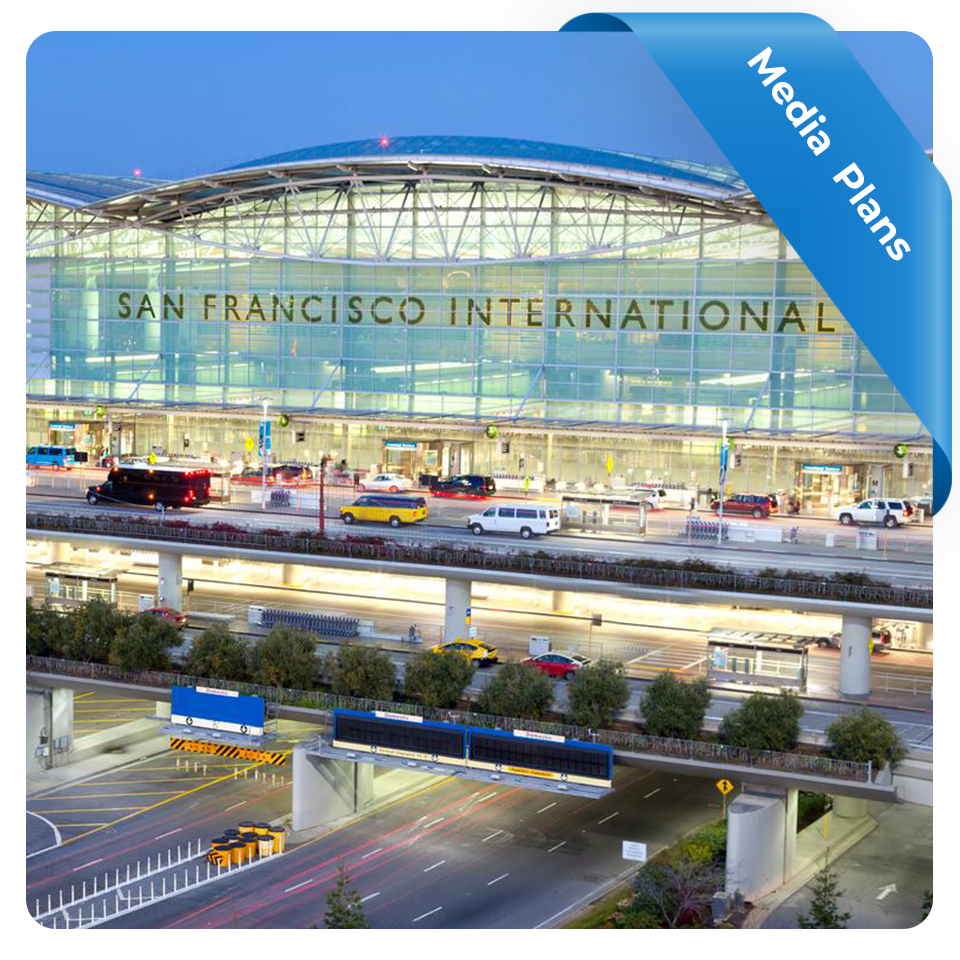
Destination San Francisco: Full Visitor Journey Coverage
San Francisco is unusually well suited to sequenced OOH because the delegate journey is short and repetitive. Moscone North, South and West sit within a few blocks of one another in SoMa, surrounded by the hotels that absorb the overwhelming majority of Dreamforce accommodation. A delegate walks the same corridor between hotel, keynote hall and evening venue six or eight times over three days.
Airport. First contact at SFO arrivals (international terminal for the global delegation, Terminals 1 and 3 for domestic) during immigration and baggage reclaim, when attention is undivided and the trip has not yet begun.
City. DOOH and large-format OOH across the SoMa and Financial District core, the Market Street corridor, Union Square and the transit approaches carries the message through the working day. This is where frequency is built: the same delegate passes the same positions repeatedly, which is exactly the pattern that converts recognition into recall.
Venue. The immediate Moscone approach (Howard Street, Third and Fourth Street, the hotel frontages) closes the sequence in the minutes before each keynote and session block.
Run in that order, the programme produces increased brand recall, because the delegate meets the brand at arrival and then repeatedly across three days; consistent presence, because coverage never lapses between the gateway and the hall; and enhanced campaign effectiveness, because each city and venue exposure lands against an audience already primed at the airport.
Why Brands Choose Airport & City Advertising for Dreamforce
Exclusive audience access. One airport and roughly ten square blocks deliver the global Salesforce customer, partner and executive base plus the resident Bay Area technology wealth tier: a combination that no single trade channel reaches.
A prestigious environment. SFO's four terminals and downtown San Francisco's premium DOOH estate are controlled settings where placement itself carries a scale signal to an audience that reads brand seriousness closely.
End-to-end campaign support. Masscom Global plans, negotiates and runs airport and city programmes across 1,000+ airports in 180+ countries, coordinating a single creative set across SFO terminals and the SoMa venue district.
Strategic planning assistance. We advise on the split between international and domestic terminals, the weighting of arrival versus departure positions, and the timing of city media against the 15–17 September session schedule.
The Masscom Global Standard Behind Every Dreamforce Placement
- Verified inventory and audience data: every terminal, screen count and passenger figure in your plan is checked against current operator data, not published estimates.
- Transparent delivery reporting: proof of play, placement documentation and post-campaign reporting so you see exactly where and when your creative ran.
- Benchmarked recommendations: terminal mix and city weighting set against comparable campaigns across our 1,000+ airport network, not guesswork.
- We absorb the complexity: negotiation, trafficking, creative specs and delivery are on us; you approve the plan and see the results.
Request Your Customised Dreamforce premium track Advertising Plan
Tell us your audience, category and budget. Our planners will return a costed plan across airport and prime city inventory, with availability confirmed.
Book NowFrequently Asked Questions
When exactly is Dreamforce 2026?
15 to 17 September 2026, at Moscone Center (North, South and West) in San Francisco, with an accompanying broadcast on Salesforce+. Passes run US$2,299 individually, or US$999 per person for groups of three or more. It is a September event; media flighting should start in the first week of September, and a campaign launched in late September would miss the audience entirely.
Who attends?
Salesforce customers, community members, partners and professionals, alongside the business leaders, developers and administrators who make and influence enterprise software decisions. The programme spans 1,600+ breakout sessions and 240+ community roundtables. Attendance is 18-plus only. Layered on top is the resident Bay Area audience: technology HNWI, AI and venture capital principals, and unicorn founders and executives.
How does whole-journey reach work in practice?
The delegate is reached at SFO on arrival, repeatedly across the SoMa and Financial District corridor during the working day, and on the immediate Moscone approach before each session block, then once more at SFO departures on the return leg. One creative set, four distinct exposure points.
How far in advance should a campaign be booked?
SFO has four terminals, four runways and no expansion capacity, so premium fixed positions are genuinely finite and Dreamforce week is the most contested media week in the San Francisco calendar. Fixed large-format inventory should be secured well ahead; digital and programmatic positions can accept shorter lead times and support in-flight optimisation across the three days.
Which brand categories perform best?
Enterprise software and B2B technology, cloud and data infrastructure, professional services and systems integrators, business aviation, premium hospitality, private banking and wealth management, and luxury real estate and residency advisory: the last three reaching a delegate base in a market where the median home price is US$1.98 million and average technology salaries run US$252,788.
Related Airport Advertising Guides
Detailed inventory, audience and planning notes for the airports covered above:
Wealth in motion intelligence.Dreamforce Won't Wait. Neither Should You.
- Fixed capacity, once a year: SFO's four-terminal footprint has no expansion capacity, and the positions open today won't still be open in August.
- Competitors are already moving: every week without a plan is a week another enterprise software or hospitality brand gets closer to locking the same inventory.
- The window is exact, not approximate: a campaign launched after the first week of September misses a delegate audience that has already gone home.
- The alternative costs more for less: broadcast and programmatic reach can't tell a Dreamforce delegate from anyone else online.
Get Free Expert Assistance Now
Our planners will map SFO's four terminals and the downtown San Francisco estate against your target audience and budget, and tell you which terminal mix carries your buyers. No charge for the conversation.
Request Availability
Premium fixed positions at SFO and across the SoMa venue district are finite and the September window is contested. Ask for current availability and indicative rates and we will return a costed plan covering airport and city.
Dreamforce compresses a global enterprise software delegation into three days, one airport and roughly ten blocks of SoMa, on top of a resident Bay Area market already holding US$1.1 trillion in billionaire wealth and 312 unicorn companies. A programme sequenced across SFO arrivals, the SoMa corridor and the Moscone approach reaches that audience up to four times on a single trip, at a fraction of what official conference sponsorship would cost. For enterprise software, professional services and wealth-tier brands, the three-day window is short, but the market underneath it is permanent.







