


Airport at a Glance
| Field | Detail |
|---|---|
| Airport | Gisborne Airport |
| IATA Code | GIS |
| Country | New Zealand |
| City | Gisborne, Tairāwhiti |
| Annual Passengers | Approximately 150,000, with more than 60 scheduled domestic flights weekly |
| Primary Audience | Forestry and horticulture owners and executives, regional business and government travellers, festival and wine tourism visitors |
| Peak Advertising Season | Late December to January, plus February and school holiday periods |
| Audience Tier | Tier 3 by volume, Tier 2 by category dominance value |
| Best Fit Categories | Forestry and agricultural equipment, rural banking and insurance, four wheel drive automotive, regional tourism and hospitality |
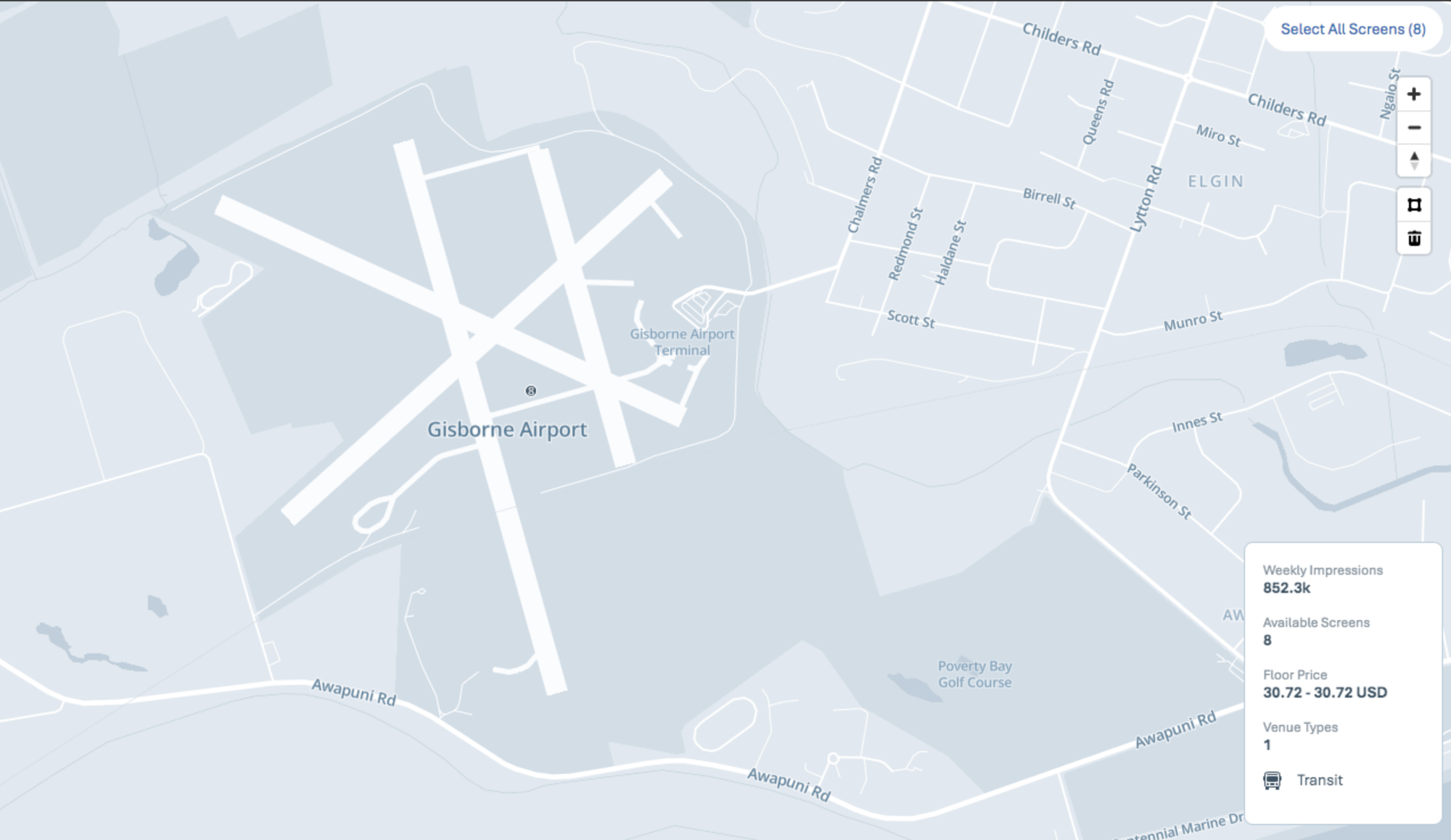
Gisborne Airport handles roughly 150,000 passengers a year through a single terminal with four gates, on a 1,310 metre sealed runway famously crossed by an active railway line, the only such arrangement still operating anywhere in the world. The numbers are small. The strategic position is not. Gisborne sits behind a mountain range with no motorway access and a road journey of around six hours to Auckland, which means air travel is not a convenience for this catchment but a necessity, and this terminal is the only place to buy it.
The economy behind the terminal is asset-heavy rather than income-heavy. Tairāwhiti's agriculture, forestry and fishing sectors contributed 470.3 million dollars in value added in 2024, roughly 17 percent of regional GDP, with exotic forest covering over 160,000 hectares and log exports through the regional port having grown from 350,000 tonnes in 2005 to around three million tonnes. Add New Zealand's fourth largest grape growing region, a nationally significant fresh produce operation, and a New Year festival economy that transforms passenger volumes for two weeks, and a 150,000 passenger airport delivers a substantially better advertiser proposition than the raw figure implies.
Advertising Value Snapshot
- Passenger scale: Approximately 150,000 passengers annually across more than 60 scheduled domestic flights each week, through a single four-gate terminal with no competing air gateway within practical reach
- Traveller type: Forestry, horticulture and pastoral owner-operators, regional business, health and government travellers, festival and wine tourism visitors
- Airport classification: Tier 3 by passenger volume, Tier 2 by category dominance value. The isolation of the catchment makes this a captive rather than a contested audience
- Commercial positioning: New Zealand's easternmost gateway, the first commercial airport in the world to see the sun each day, and the sole air link for the Tairāwhiti region
- Wealth corridor signal: Sits on the forestry and horticulture export corridor feeding Asian and European markets through the regional port, and on the Auckland and Wellington corridors that carry all regional capital and policy traffic
- Advertising opportunity: Masscom Global treats Gisborne as a dominance buy at low absolute cost. In a four-gate terminal with a single departure area, a very small number of positions delivers effectively total audience coverage. Because national advertisers concentrate on Auckland, Wellington and Christchurch, brands here face almost no category competition, and Masscom concentrates weight into the late December and January festival window where volumes and international share both rise sharply against fixed inventory.
Airport Advertising is Complex to Get Right
We help you execute faster, with proven results and local insight most planners lack starting now.
Talk to an ExpertCatchment Area and Economic Drivers
Top 10 Cities and Towns within 150 km, Marketer Intelligence:
- Gisborne: The region's only city and its entire commercial, retail, health and professional services centre. Delivers the whole catchment's business, government and consumer audience in one place, with no competing urban centre to fragment it.
- Wairoa: Pastoral farming and forestry service town to the south, with a significant Māori landholding base and horticulture expansion supported by recent government water and resilience investment.
- Ōpōtiki: Eastern Bay of Plenty coastal town with kiwifruit, aquaculture and marine development activity, producing an emerging horticultural and marine investment audience.
- Tolaga Bay: Coastal farming settlement with the region's landmark historic wharf, contributing pastoral landowners and a growing coastal lifestyle property segment.
- Ruatoria: The commercial centre of the northern East Coast, anchored by substantial Māori collective landholdings and forestry, with high relevance to iwi asset managers and rural service providers.
- Te Karaka: Inland farming and forestry service settlement on the main inland route, delivering pastoral and forestry contractor audiences.
- Matawai: Forestry and hill country farming, small in population but sitting at the centre of significant harvest and haulage activity.
- Tokomaru Bay: Coastal community with tourism, fishing and small-scale horticulture, contributing lifestyle and visitor traffic.
- Manutuke and the Poverty Bay plains: The concentrated viticulture and horticulture belt, home to the region's wineries and its major fresh produce operations. This is where the catchment's highest-value agricultural assets sit.
- Te Puia Springs and the northern coast settlements: Small dispersed communities where the airport is the only realistic connection to specialist healthcare, education and government services in the main centres.
HNI and Wealth Concentration Intelligence:
Tairāwhiti does not present as a wealthy region on income measures, and advertisers who stop there will misread it. The wealth here sits in land and forest. Multi-generational pastoral and horticultural families hold substantial hill country and plains assets, forestry investors hold long-rotation radiata estates across more than 160,000 hectares, and vineyard and produce operations control high-value plains land. Alongside this sits one of New Zealand's most significant Māori collective asset bases, with 54.8 percent of the regional population identifying as Māori and post-settlement iwi entities managing substantial forestry, land, fisheries and investment portfolios. For advertisers this is a genuine institutional and asset-owner audience that no metropolitan campaign reaches.
Economic Importance:
The catchment runs on four engines. Forestry dominates by land area and export volume, with harvest, haulage, port handling and processing all generating business travel. Horticulture and viticulture drive the plains economy through wine, sweetcorn, squash, kiwifruit, salad crops and maize milling. Pastoral farming holds the hill country. Tourism contributed 160.6 million dollars in expenditure in 2025, up 2.0 percent, with international visitors accounting for 21.4 percent of spending. Each produces a distinct traveller through the same four gates.

Business and Industrial Ecosystem
- Forestry and wood processing: The region's largest primary sector by land area, generating owner-investors, harvest and haulage contractors, port operators and processing management, all with substantial equipment, machinery and finance requirements
- Horticulture, viticulture and fresh produce: New Zealand's fourth largest grape growing region alongside a nationally significant salad and vegetable operation running thousands of hectares, producing owner-principals with major irrigation, packhouse and agrichemical spending
- Pastoral farming across hill country: Sheep, beef and dairy support operations producing landholding families with long asset horizons and cyclical capital expenditure
- Māori collective enterprise and iwi asset management: A substantial and growing institutional investment base across forestry, land, fisheries, horticulture and property, with professional governance and real procurement authority
Passenger Intent, Business Segment:
Business travellers at Gisborne are travelling because they have no alternative. The Auckland and Wellington corridors carry farm and forest principals meeting banks, brokers and buyers, iwi and trust boards attending governance and investment meetings, council and government staff, and health professionals and patients accessing specialist services unavailable locally. Journeys are compressed and repeated many times a year by the same individuals, which builds frequency naturally. Agricultural and forestry machinery, rural banking and insurance, professional services, logistics and telecommunications intercept this pattern with high efficiency.
Strategic Insight:
The commercial case here rests on absence of competition rather than scale of audience. National advertisers building New Zealand airport campaigns almost universally stop at Auckland, Wellington, Christchurch and Queenstown, which means the forestry investor and the horticultural principal see no category messaging at their own gateway. For a forestry equipment manufacturer, a rural lender, an agrichemical supplier or an insurer, Gisborne offers something close to uncontested share of voice with a decision-maker audience, at a fraction of metropolitan cost.
Tourism and Premium Travel Drivers
- Rhythm and Vines: A three-day New Year music festival held among the region's wineries and one of New Zealand's most established annual events, drawing a large domestic and international young adult audience specifically to be first in the world to greet the new year. The defining seasonal spike in the airport calendar
- Gisborne wine country: New Zealand's fourth largest grape growing region and the first wine region in the world to see each sunrise, with Chardonnay as its international signature alongside gewürztraminer, viognier, pinot gris, merlot and malbec. Drives cellar door, vineyard stay and culinary tourism
- Surf coast and beaches: Wainui and the surrounding breaks give the region a genuine international surf reputation, drawing a repeat visitor segment with strong outdoor apparel and equipment spending
- Cultural and historical significance: The first landing site for both early Māori and European arrivals, with Māori cultural experience now a core visitor proposition and a nationally distinctive one
Passenger Intent, Tourism Segment:
The festival visitor arrives with tickets, accommodation and transport already paid, in a committed spending posture, and skews young with high discretionary willingness across food, beverage, apparel and experience categories. The wine and culinary visitor is older, higher spending per head, and receptive to hospitality, premium beverage, accommodation and touring propositions. The surf and outdoor visitor is a repeat traveller with equipment and apparel spending concentrated at trip start. All three arrive through the same four gates, which means creative must flex by season rather than by placement.
Travel Patterns and Seasonality
Peak seasons:
- Late December to mid January: The single dominant window. New Year festival traffic combines with the New Zealand summer holiday period to produce the year's steepest volume spike and the highest international share
- February: Post-holiday summer travel plus the start of the harvest and wine season, sustaining elevated visitor volumes
- March to May: Harvest and log export peak activity, driving concentrated agribusiness and forestry business travel
- School holiday periods, April, July and late September: Predictable family and boarding school travel across a catchment where children frequently study away from the region
- Winter trough, June to August: The weakest visitor window, though business travel on the Auckland and Wellington corridors remains steady
Event-Driven Movement:
- Rhythm and Vines and the New Year period (late December to early January): The region's largest annual influx, drawing a national and international audience to the wineries. Priority booking window for beverage, apparel, telecommunications, travel and experience advertisers.
- Matariki, the Māori New Year public holiday (June or July): A nationally significant and growing observance with particular resonance in Tairāwhiti, driving cultural travel, family gathering and a distinct retail and hospitality spending pattern.
- Waitangi Day and the February commemorative period: National observance with strong local significance given the region's status as a first landing site, lifting domestic cultural tourism.
- Harvest and log export cycles (March to June): Concentrated forestry, viticulture and horticulture business travel aligned to income realisation and capital purchasing.
- Regional agricultural and wine trade events: Periodic industry gatherings drawing growers, buyers and suppliers through the terminal.

It’s Not Just Where You Advertise - It’s How Fast You Execute
We combine local insight with fast rollout to deliver results for you, now.
Talk to an ExpertAudience and Cultural Intelligence
Top 2 Languages:
- English: The transactional and commercial language for all business, agricultural and visitor communication. Creative should be written in a plain, direct New Zealand regional register, because this catchment reads metropolitan advertising conventions as external and unearned.
- Te reo Māori: With 54.8 percent of the regional population identifying as Māori, Tairāwhiti has one of the strongest te reo presences in New Zealand. This is not a translation exercise. Authentic and correctly used te reo signals genuine local relationship and materially improves brand reception, while token or incorrect usage damages it badly. Advertisers in this market should treat language partnership as a requirement rather than an option.
Major Traveller Nationalities:
The passenger base is overwhelmingly New Zealand domestic, drawn from the Tairāwhiti catchment and from Auckland and Wellington on the inbound leg. International presence concentrates in the summer and New Year window, led by Australia, the United Kingdom, Germany, the United States and the Netherlands, reflecting the region's surf, wine and cultural tourism appeal. International visitors accounted for 21.4 percent of regional tourism spending in 2025, a meaningful share given total expenditure of 160.6 million dollars. Creative should default to a New Zealand domestic register year-round with an international overlay for December through February.
Religion, Advertiser Intelligence:
- No religion, approximately 50 percent nationally and comparable regionally: The largest single category in New Zealand. This audience is not festival-driven and responds to practical, community and value-based positioning rather than seasonal religious messaging.
- Christianity, approximately 30 to 35 percent: Includes mainline denominations alongside the Māori Christian churches, with Ringatū having been founded in this region and Rātana holding significant regional membership. Christmas and Easter drive family travel and gathering, and the Māori church calendars create additional community gathering and travel patterns that matter to transport, telecommunications and retail advertisers.
- Māori spiritual and cultural observance, practised widely across the catchment: Matariki, now a national public holiday, has become a major cultural and commercial moment with particular depth in Tairāwhiti. It drives family gathering, gifting, food and travel spending, and represents a growing and still under-served advertising window.
Behavioral Insight:
This audience makes decisions on relationship and durability, and it has a long memory. In a small, geographically isolated community where the same people meet repeatedly across business, iwi and social settings, a brand's reputation is established collectively rather than individually, and a supplier who fails once loses the whole region. Purchase cycles follow harvest, log price and stock cycles rather than calendar quarters, so advertising functions as sustained presence building trust ahead of the buying window. Brands that demonstrate genuine local commitment, correct cultural fluency and reliable service backup outperform brands with larger budgets and no local grounding.
Outbound Wealth and Investment Intelligence
The outbound passenger at Gisborne is asset-rich in land and forest, and increasingly deliberate about diversifying beyond a single geography. Two cyclones in 2023 caused widespread damage across Tairāwhiti and sharpened that thinking considerably. Capital is moving out of pure regional land concentration and into managed investments, domestic property in the main centres, and offshore holdings, while iwi and trust entities pursue increasingly sophisticated diversified portfolios.
Outbound Real Estate Investment:
This catchment's wealth buys domestically first, in Auckland, Tauranga, Hawke's Bay and increasingly Queenstown, as succession, retirement and risk-diversification assets. Offshore, Australia is the dominant destination for both investment and family relocation, particularly Queensland and New South Wales. The Pacific Islands including Fiji and Rarotonga draw holiday property interest, and the United Kingdom and United States attract families with children already settled abroad. Southeast Asian markets including Thailand and Bali are growing for lifestyle and yield. International developers advertising here reach owners whose liquidity arrives in lumps from land, forest or stock sales, and who act decisively when it does.
Outbound Education Investment:
Education is the most reliable high-value spending category in this catchment. Geographic isolation means a large proportion of families send children away for secondary and tertiary study, generating predictable term-boundary traffic through the terminal. Destinations run domestically to Auckland, Hawke's Bay, Wellington and Palmerston North boarding schools and universities, and internationally to Australia, the United Kingdom and the United States. Agricultural, forestry and viticulture science pathways carry particular weight given the regional economy. Boarding schools, universities, scholarship programmes and education advisory firms reach a committed parent audience here with effectively zero competing messaging.
Outbound Wealth Migration and Residency:
Demand for citizenship by investment is limited because the New Zealand passport already delivers strong mobility. The commercially relevant movement is different: outbound relocation to Australia under trans-Tasman arrangements, which is a persistent pattern for skilled workers and families from regional New Zealand, and inbound investment migration into New Zealand under the country's active investor visa pathway, which brings foreign capital seeking land, forestry and coastal assets of exactly the type this region holds. Advisory firms, wealth managers and land agents on both sides of that movement find their audience in this terminal.
Strategic Implication for Advertisers:
International education providers, Australian property developers, wealth managers and land investment advisers should treat Gisborne as an extremely low-cost, high-qualification entry point into New Zealand regional asset wealth that metropolitan buys entirely miss. The audience is small but it is landholding, decisive, and reached nowhere else. Masscom Global activates Gisborne alongside the Auckland, Wellington and Australian gateways these travellers connect through, so a single brand narrative follows them across the whole journey rather than appearing once and vanishing.
Airport Infrastructure and Premium Indicators
Terminals:
- A single terminal with four tarmac gates on a 160 hectare site, redeveloped with support from a 5.5 million dollar investment programme designed to reflect the cultural and navigation heritage of the region. The single-terminal, single-departure-area structure means near-total audience coverage is achievable with very few positions
- A 1,310 metre sealed and night-capable main runway, supported by three grass runways for light aircraft, sized for regional turboprop operations rather than jet service
Premium Indicators:
- The airport is the only active commercial airport in the world where a working railway line crosses the main runway, with train movements requiring air traffic clearance. This is a genuinely globally unique asset that generates recurring international media coverage and gives the terminal a distinctive brand identity
- Culturally themed terminal design tied to the region's status as the first landing site for both Māori and European arrivals, creating an environment of authenticity that transfers to associated brands
- Terminal amenities including on-site café with regional wine service, connectivity throughout, and full rental car provision, with the city centre reachable in five to six minutes, producing an unusually relaxed and unhurried passenger environment
- Positioned as the first commercial airport in the world to see the sun each day, a positioning asset that premium and lifestyle brands can align with directly
Forward-Looking Signal:
Log export volumes through the regional port have grown roughly eightfold since 2005 and harvest volumes continue to rise, sustaining forestry business travel. Substantial government investment is flowing into Tairāwhiti horticulture through water storage, flood resilience and Māori land development programmes, which will expand the high-value plains economy and its associated business travel. Regional tourism expenditure grew 2.0 percent in 2025 with international spending share holding above one fifth. Because the terminal has only four gates, advertising inventory cannot expand to match this growth. Masscom Global advises clients to secure position now, while rates reflect a small airport rather than a growing one.
Airline and Route Intelligence
Top Airlines:
Air New Zealand is the dominant carrier, operating more than 60 scheduled domestic flights weekly with 50-seat turboprop aircraft. Regional third-level operators provide additional connections to smaller North Island centres, alongside charter, air ambulance, agricultural aviation and flight training activity across the main and grass runways.
Key International Routes:
No scheduled international services operate from Gisborne. All international travel from this catchment connects through Auckland or Wellington, which means outbound international passengers are captured at Gisborne on the first leg of a journey they have already committed to and budgeted for. This is a valuable and consistently overlooked intercept point for international education, travel, property and financial services advertisers.
Domestic Connectivity:
Auckland is the backbone route, carrying the majority of passenger volume and functioning as the connection to the national and international network. Wellington serves government, policy, legal and corporate traffic, which matters disproportionately in a region where central government funding and regulation shape the forestry and horticulture economy. Regional connections to smaller North Island centres serve business and health travel.
Wealth Corridor Signal:
The route network reveals an audience travelling from necessity, not choice. Because road access is genuinely difficult and the journey to Auckland by land takes around six hours, the Auckland route is a business, finance, medical, education and connection route rather than a leisure one. The Wellington route is a policy and capital route. There is almost no discretionary leisure traffic outbound, and inbound leisure concentrates into a narrow summer window. Advertisers therefore reach a passenger base that the route structure has already qualified.
Media Environment at the Airport
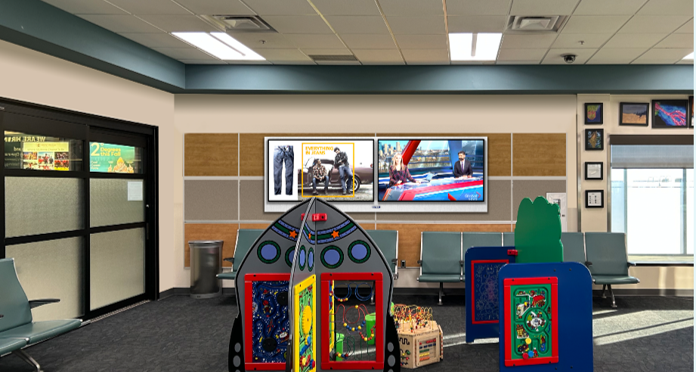
- Four-gate single-terminal environment with minimal advertising clutter, meaning a very small number of positions achieves dominance rather than a fractional share of attention
- Dwell is long relative to airport size because regional flying encourages early arrival, weather disruption is common on the East Coast, and the terminal environment with its café and seating actively encourages passengers to settle rather than rush
- The globally unique runway and railway configuration, the culturally themed terminal, and the first-to-see-the-sun positioning create an environment of genuine distinctiveness that lends character to brands placed within it
- Masscom Global provides inventory access, position selection and seasonal flighting built around the December and January festival peak and the harvest and school term cycles, ensuring budget concentrates where audience multiplies
Strategic Advertising Fit
Best Fit:
- Forestry equipment, harvesting machinery and haulage: The strongest category at this airport. Buyers and payers are the same people, and no competing brand is present at their gateway
- Agricultural and horticultural machinery, irrigation and inputs: Reaching viticulture, produce and pastoral principals with major annual capital and input budgets
- Rural banking, agribusiness finance and insurance: Seasonal cash flow, forestry rotation lending, succession planning and post-cyclone risk cover make this a permanently active category here
- Four wheel drive utilities and premium SUVs: Necessity purchases in a region of difficult terrain and long distances, with high replacement frequency and deep brand loyalty
- Boarding schools, universities and education services: Geographic isolation makes away-from-home education standard, generating predictable, well-funded demand
- Regional tourism, wine, hospitality and accommodation: Capturing inbound visitors at arrival and returning visitors at the repeat-purchase moment
- Telecommunications, connectivity and rural technology: High relevance in a dispersed catchment where coverage and reliability are genuine commercial issues
- Outdoor apparel, surf and equipment brands: Aligned to the region's authentic surf and outdoor identity and to the summer visitor influx
Brand Alignment at a Glance:
| Category | Fit |
|---|---|
| Forestry equipment and haulage | Exceptional |
| Agricultural and horticultural machinery | Exceptional |
| Rural banking, finance and insurance | Strong |
| Four wheel drive and utility automotive | Strong |
| Boarding and tertiary education | Strong |
| Regional tourism, wine and hospitality | Moderate |
| Outdoor and surf apparel | Moderate |