




Airport at a Glance
| Field | Detail |
|---|---|
| Airport | Whangārei Airport, also known as Onerahi Airport |
| IATA Code | WRE |
| Country | New Zealand |
| City | Whangārei, Northland |
| Annual Passengers | Data not available. Annual passenger capacity is approximately 135,000, against a historic peak of around 140,000 movements |
| Primary Audience | Northland business, council and health sector travellers, iwi and Māori commercial governance, marine and forestry industry professionals |
| Peak Advertising Season | November to April, with a February Waitangi commemoration peak |
| Audience Tier | Tier 3 |
| Best Fit Categories | Professional and B2B services, health and trades workforce recruitment, trans-Tasman travel and telecom, regional banking and insurance |
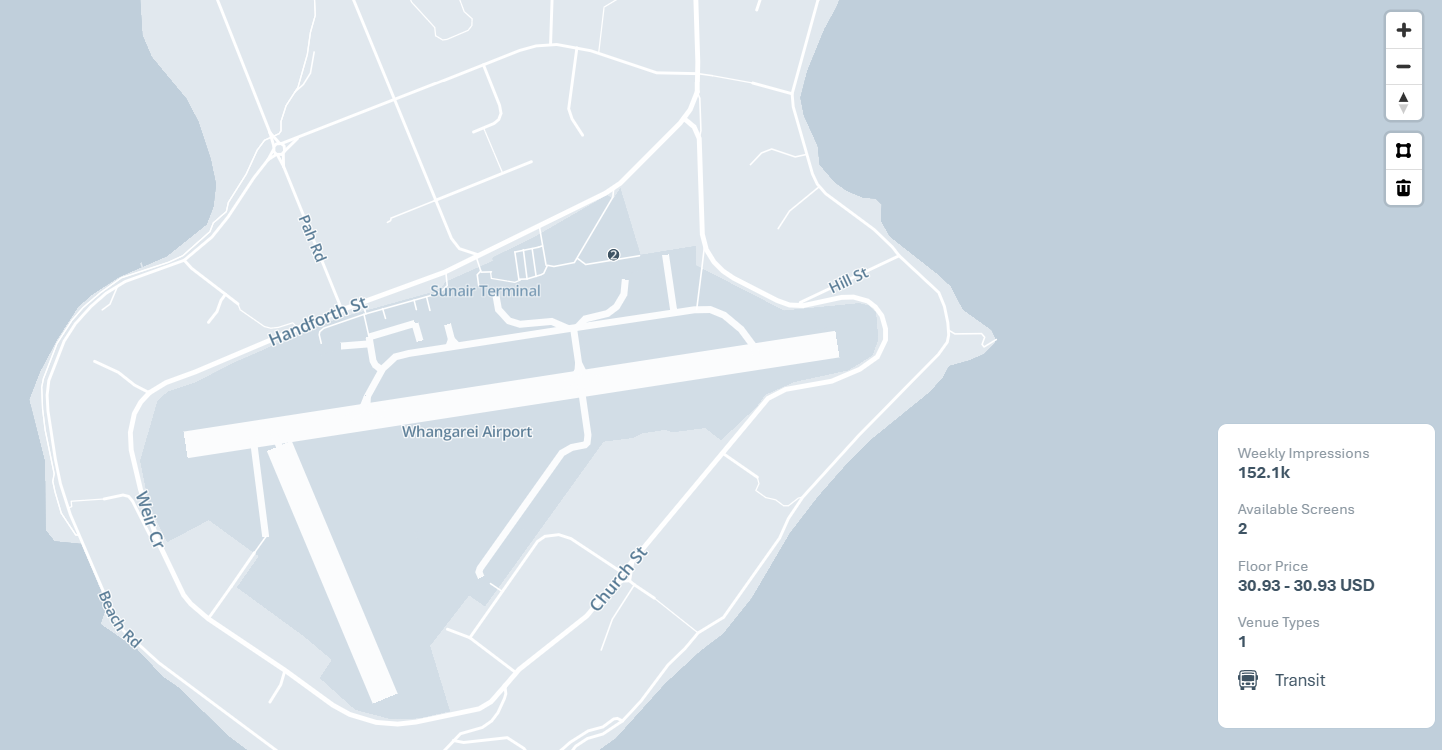
Whangārei Airport sits at Onerahi, approximately eight kilometres southeast of Whangārei, on a peninsula in the harbour. It has one main asphalt runway of 1,097 metres plus a 475-metre grass strip, two gates, and a single scheduled route: Air New Zealand to Auckland, seven days a week, operated on 50-seat Dash 8 Q300 turboprops on a flight of roughly 40 minutes. Annual passenger capacity currently stands at around 135,000, against a historic peak of approximately 140,000 passenger movements reached around 2009 when the schedule ran to ten daily return Auckland services plus a weekday Wellington link. That growth stalled with the global downturn and with improved road links to Auckland. Aircraft movements have run at roughly 19,000 annually. Verified current annual passenger figures are not available.
Masscom Global will not overstate this airport, and advertisers should not be sold scale it does not have. What WRE offers is different and, for the right categories, genuinely useful. First, near-total capture: every scheduled air passenger in the Whangārei District passes through one compact terminal with two gates and minimal queuing, which means full-journey coverage costs a fraction of anything comparable. Second, self-selection: at 50 seats against a two-and-a-half-hour drive, people fly this route when time has commercial value, which skews the passenger base heavily toward council and government officials, health sector staff, lawyers, engineers, corporate visitors and iwi commercial leadership. Third, this is the gateway to a region with a distinctive economy and one of the highest Māori population concentrations in New Zealand, including the country's largest iwi. Advertisers who want Northland decision-makers will find them here. Advertisers who want reach will not.
Advertising Value Snapshot
- Passenger scale: Approximately 135,000 annual capacity against a historic peak of around 140,000 movements. Roughly 19,000 aircraft movements per year. Verified current passenger totals are not available.
- Traveller type: Northland business, council and health sector travellers, iwi and Māori commercial governance, marine, forestry and port industry professionals.
- Airport classification: Tier 3. Single-route, single-carrier, turboprop-only operation serving a region with high deprivation alongside pockets of coastal wealth.
- Commercial positioning: The principal air gateway to Northland, New Zealand's northernmost and subtropical region, and the region's only scheduled link to the national and international network at Auckland.
- Wealth corridor signal: The Auckland lifestyle and retirement migration corridor into Northland, alongside iwi settlement asset management and the trans-Tasman working migration channel.
Advertising opportunity: Coverage here is close to absolute for the money involved. A two-gate terminal with a single route means one campaign reaches essentially the entire Northland air travel market, and because passengers are paying for time rather than price, the mix is unusually weighted toward people with commercial and institutional authority. Masscom Global can activate WRE as a precision Northland layer within a wider New Zealand plan anchored on Auckland.

Airport Advertising is Complex to Get Right
We help you execute faster, with proven results and local insight most planners lack starting now.
Talk to an ExpertCatchment Area and Economic Drivers
Top 10 Cities within 150 km, Marketer Intelligence:
- Whangārei: Northland's only city and the region's commercial, health, legal and local government centre, ten to fifteen minutes from the terminal. Produces professional, council, health sector and marine industry audiences, and hosts the region's base hospital and a nationally distinctive art centre that anchors cultural tourism.
- Ruakākā and Marsden Point: The region's principal industrial and port cluster, encompassing bulk port operations, fuel import terminals and proposed dry dock and marine engineering development. Produces industrial, logistics and engineering procurement audiences and represents Northland's most significant infrastructure investment focus.
- Whangārei Heads and Tutukākā Coast: High-value coastal residential and holiday markets, with Tutukākā serving as the departure point for world-class diving at the Poor Knights Islands. Delivers affluent Auckland second-home owners and an internationally sourced diving and marine tourism audience.
- Mangawhai and Waipū: Northland's fastest-growing and most affluent coastal communities, populated heavily by relocated and semi-retired Aucklanders. This is the strongest premium consumer concentration in the catchment, relevant to wealth advisory, insurance, premium automotive and home services, though most of these households arrive by road rather than by air.
- Kerikeri and the Bay of Islands, including Paihia and Russell: Northland's premium tourism and horticultural centre roughly 90 kilometres north, with its own regional airport, superyacht anchorage and the national Treaty commemoration site. Delivers luxury hospitality, marine and horticultural audiences, and hosts the country's most politically significant annual gathering.
- Dargaville and the Kaipara: Agricultural and horticultural district to the west, centred on dairy, kūmara and root crop production. Produces landowner and agribusiness principals whose asset wealth substantially exceeds visible income.
- Kaitāia and the Far North: The region's northernmost service centre, with high deprivation alongside significant iwi landholdings, forestry and horticulture. Relevant to public sector, health, telecom and value consumer advertisers rather than premium categories.
- Kaikohe and Mid North: Inland service centre with substantial Māori landholding, forestry and dairy activity, and a strong iwi institutional presence. Relevant to forestry, agricultural, banking and institutional investment advertisers.
- Warkworth and the northern Auckland fringe: Rapidly growing corridor at the southern edge of the catchment, benefiting from the expressway programme progressively linking Auckland toward Whangārei. Delivers affluent commuter and lifestyle households.
- Northern Auckland metropolitan fringe: Within the catchment's outer reach by road, and commercially relevant because the Auckland connection defines this airport's entire proposition. Auckland capital, buyers, visitors and corporate travellers are the region's principal external commercial input.
NRI and Diaspora Intelligence:
Northland does not have a significant international diaspora in the conventional sense, and advertisers should not be sold one. Two population dynamics matter far more and both are commercially actionable.
The first is Māori demographic and institutional weight. Northland has one of the highest proportions of Māori residents of any New Zealand region and is the home of the country's largest iwi. Treaty settlement entities, iwi trusts, incorporated Māori land blocks and Māori commercial organisations across the region collectively manage substantial assets in forestry, fisheries quota, farmland, commercial property and carbon. Their governance, investment and commercial leadership travel between Northland, Auckland and Wellington regularly, which places a genuinely significant institutional audience on this route. Advertisers in institutional investment, funds management, forestry, carbon markets, professional services and infrastructure have real demand here, provided they engage with cultural competence rather than as an afterthought.
The second is trans-Tasman working migration. Northland has among the lower household incomes in New Zealand, and sustained outward movement of working-age New Zealanders to Australia is a long-standing feature. This produces recurring family travel, remittance flow and heavy demand for trans-Tasman airfares, mobile roaming and low-cost money transfer, all routed via Auckland. Modest Filipino, Indian and Chinese communities are present through dairy, healthcare and hospitality employment. Precise migration and remittance volumes for this catchment are not available.
Economic Importance:
Five engines drive this catchment. Marine services, including a genuinely internationally recognised superyacht refit capability at the Whangārei Town Basin and Port Whangārei, alongside boatbuilding and marine engineering. Port, fuel import and heavy industry at Marsden Point and Northport, which is the focus of Northland's largest infrastructure ambitions. Primary production spanning dairy, forestry, avocado and kiwifruit horticulture, and kūmara. Public sector employment across health, education and local government, with the region's base hospital in Whangārei. And tourism centred on the Bay of Islands, the Tutukākā coast, the Poor Knights Islands and the kauri forests. Iwi commercial entities are significant asset holders across several of these sectors simultaneously.
Business and Industrial Ecosystem
- Marine services, superyacht refit and boatbuilding: Whangārei has established a genuine Southern Hemisphere refit capability, drawing large yachts during the Pacific season for hull, engineering and interior work. Produces yard principals, project managers, captains and specialist trades, a very small audience with high per-project values.
- Port, fuel import and heavy industry: Bulk port operations, fuel terminal activity and proposed marine engineering and dry dock development at Marsden Point. Produces industrial, logistics and engineering procurement decision-makers, and represents the region's most substantial capital project pipeline.
- Forestry, dairy and horticulture: Extensive plantation forestry, dairy conversion, and avocado and kiwifruit production across the region, with substantial iwi and Māori land block involvement. Produces landowner, agribusiness and forestry principals with equipment, land finance and carbon market interests.
- Health, education and local government: The regional base hospital, district health services, a regional polytechnic and district and regional councils. Produces clinical, executive and public sector travellers, and generates one of the region's most persistent commercial needs in workforce recruitment.
- Iwi and Māori commercial entities: Post-settlement governance organisations and land trusts managing forestry, fisheries, farmland and property portfolios. Produces a governance and investment audience of genuine institutional weight, disproportionate to the region's population.
Passenger Intent, Business Segment:
Business travellers on this route are travelling to Auckland for meetings, professional services, hospital specialist appointments, government and regulatory business, and onward domestic and international connections. Because the alternative is a two-and-a-half-hour drive, the people who fly are those whose time carries commercial cost, which is the single most useful filtering mechanism at this airport. Categories that intercept them effectively are professional and legal services, accounting and audit, engineering consultancy, banking and insurance, business technology, and recruitment. Iwi governance and Māori commercial travel adds an institutional investment and advisory dimension unusual at this scale.
Strategic Insight:
The commercial logic at WRE is filtration rather than volume. A two-gate terminal with a single route removes almost all leisure and price-driven traffic, leaving a passenger mix in which a high proportion of individuals hold professional, clinical, governance or commercial authority in a region of roughly 200,000 people. For advertisers whose market is Northland specifically, that is close to a complete institutional intercept for a very small outlay. For any advertiser whose market is national, this airport cannot carry the plan and should be treated as a targeted layer beneath Auckland. Masscom Global is explicit with clients about which of those two situations applies before recommending spend.
Tourism and Premium Travel Drivers
- Bay of Islands and the northern coast: New Zealand's premier northern tourism region, combining historic settlements, superyacht anchorage, sailing and marine charter, and the national Treaty commemoration site. Draws affluent domestic and international visitation, though much of it arrives via Kerikeri or by road from Auckland.
- Poor Knights Islands and the Tutukākā Coast: An internationally ranked marine reserve and dive destination, drawing a specialist, well-travelled and high-spending international visitor. Genuinely niche but among the most premium inbound audiences in the region.
- Kauri forests, Tāne Mahuta and the west coast: Ancient forest reserves and the Kaipara coast supporting nature and cultural tourism, appealing to an older, higher-income and environmentally engaged visitor.
- Whangārei's cultural quarter and Town Basin: A nationally distinctive art centre, the only building of its designer's work in the Southern Hemisphere, alongside a marina and dining precinct that has materially improved the city's visitor proposition since 2022.
Passenger Intent, Tourism Segment:
Inbound leisure passengers at WRE are a minority of a small total, and most Northland visitors arrive by road from Auckland, which is the honest position advertisers need. Those who do fly are typically international or long-distance domestic visitors on tight itineraries, heading for diving, sailing, the Bay of Islands or cultural tourism, and they arrive with accommodation committed and remaining budget in dining, retail, vehicle rental and activities. Outbound leisure is the larger flow, comprising Northland residents connecting through Auckland for trans-Tasman, Pacific and long-haul travel. Advertisers should treat WRE as a leisure origin point and address travel, telecom, insurance and financial propositions to departures.
Travel Patterns and Seasonality
Peak seasons:
- November to April: The Southern Hemisphere summer, carrying peak tourism, the superyacht refit and Pacific cruising season, and the strongest general activity in the region.
- Late January to February: The concentrated peak, combining the New Zealand summer holiday period, the Bay of Islands sailing calendar and the national Waitangi commemoration in early February.
- February to April: Agricultural and horticultural harvest and field day season, plus the strongest diving conditions of the year at the Poor Knights.
- August to October: Business and public sector travel resumes fully after winter, alongside the provincial rugby season and the local government and health planning cycle.
Traffic volume data:
Annual passenger capacity stands at approximately 135,000, against a historic peak of around 140,000 passenger movements reached around 2009 when the schedule carried ten daily Auckland returns plus a weekday Wellington service. Aircraft movements have run at roughly 19,000 annually. Verified current annual passenger totals and monthly distributions are not available.
Event-Driven Movement:
- Waitangi Day commemorations (6 February, Bay of Islands): New Zealand's founding national commemoration, drawing the Prime Minister, cabinet ministers, the diplomatic corps, national media and iwi leadership from across the country. The single most significant annual event in this catchment, though a share of arrivals use Kerikeri. Relevant to institutional, government, professional services and telecom advertisers.
- Bay of Islands sailing and regatta season (January): Established international sailing week and associated marine calendar, drawing yacht owners, crew and marine trade. Prime timing for marine services, insurance, premium hospitality and watch categories, at genuinely small volume.
- Superyacht refit and Pacific season (roughly November to April): Large yachts arriving for refit and engineering work at Whangārei's yards bring captains, owners' representatives, project managers and specialist trades into the region. The highest-value B2B window at this airport for marine services, engineering and insurance advertisers.
- New Zealand summer holidays (late December to late January): The Northland coast functions as Auckland's holiday coastline, producing very high regional activity, though predominantly by road rather than by air.
- Northland agricultural field days and harvest season (February to April): Regional agricultural events reaching landowner, forestry and agribusiness audiences, relevant to equipment, land finance, carbon and insurance advertisers.
- Provincial rugby season (August to October): The regional side's home fixtures at Whangārei's stadium generate community engagement and modest visiting travel, relevant to consumer, beverage, automotive and telecom brands seeking local credibility.
Note that November to April is the South Pacific cyclone season, which introduces genuine schedule disruption risk on a single-route, turboprop-only operation, and makes property, business continuity and travel insurance contextually relevant categories.

It’s Not Just Where You Advertise - It’s How Fast You Execute
We combine local insight with fast rollout to deliver results for you, now.
Talk to an ExpertAudience and Cultural Intelligence
Top 2 Languages:
- English: The dominant working language across business, government, health and tourism audiences. New Zealand commercial culture is understated and sceptical of overstatement, and Northland more so than most. Creative should be plain, specific and free of superlatives, with practical benefit stated directly. Claims of scale or prestige that would work in Dubai or Miami actively damage credibility here.
- Te reo Māori: Northland has among the highest concentrations of te reo speakers and Māori residents in New Zealand, and bilingual English and te reo creative is both culturally appropriate and commercially effective in this region in ways it would not be in every New Zealand market. This requires genuine competence rather than decorative use: incorrect or token te reo is noticed immediately and is commercially costly. Advertisers should engage Māori creative and cultural expertise rather than translating existing copy.
No third language reaches commercially meaningful scale, though modest Tagalog, Hindi and Mandarin-speaking communities are present through dairy, healthcare and hospitality employment.
Major Traveller Nationalities:
The passenger base is overwhelmingly New Zealand domestic, drawn from the Whangārei District and the wider Northland region. International visitors reach Northland principally via Auckland and largely by road, with the specialist diving, sailing and cultural tourism segments the most likely to fly. The trans-Tasman relationship is the most commercially significant external tie, given sustained New Zealander movement to and from Australia. Campaign creative should be built for a New Zealand domestic audience with genuine bilingual English and te reo capability, and should not be constructed for an international transit audience.
Religion, Advertiser Intelligence:
Figures below are directional approximations for Northland and New Zealand rather than airport-level survey data.
- No religion (approximately 50 percent or higher): New Zealand is among the most secular developed countries and Northland is no exception. This is the defining characteristic of the catchment and it has a direct commercial consequence: creative built on religious or traditional framing underperforms markedly here, while environmental credentials, practicality, fairness and community benefit carry substantially more weight.
- Christian denominations, principally Anglican, Catholic and Presbyterian (approximately 30 to 35 percent combined): Present across the region with active community and charitable networks. Drives Christmas and Easter family travel and charitable giving cycles, at more moderate intensity than in most markets Masscom covers.
- Rātana and Ringatū, the distinctly Māori Christian churches (a small share of the total but of genuine cultural and institutional significance in Northland): Their calendars and gatherings carry real community and political weight, and advertisers engaging Māori audiences should be aware of them rather than treating the Māori audience as religiously undifferentiated.
- Hindu, Buddhist, Muslim and Sikh communities (small combined share): Present through recent migration into healthcare, dairy and hospitality. Support remittance, telecom and family travel categories at modest scale.
Behavioral Insight:
Three characteristics should shape creative here. First, understatement is compulsory. New Zealand consumers, and Northlanders in particular, respond to modest, specific, evidence-based claims and react against promotional inflation. The vocabulary that works in most airport advertising markets is counterproductive in this one. Second, this is a genuinely bicultural commercial environment. Iwi institutions are significant asset holders and commercial counterparties, Māori cultural protocol shapes how business relationships form, and advertisers who engage authentically and consistently build durable position while those who engage superficially are quickly discounted. Third, income distribution is wide. Northland contains both real deprivation and genuine coastal affluence, frequently within short distances, so advertisers must choose a segment deliberately rather than addressing an average that does not exist. Value, instalment and payment-flexibility messaging works for one part of this catchment and is irrelevant to another.
Outbound Wealth and Investment Intelligence
The wealth analysis at WRE requires inversion, because Northland is a net receiver of capital rather than a source. Regional household incomes sit below the New Zealand average, and the wealth present in the catchment arrives from three directions: Auckland lifestyle and retirement migration, iwi settlement asset portfolios, and international capital entering New Zealand through its residency and investment pathways. The honest commercial reading is that this airport reaches asset holders and institutional decision-makers rather than a broad affluent consumer base.
Outbound Real Estate Investment:
Inbound to this catchment, Auckland capital is the dominant force, buying coastal and lifestyle property across Mangawhai, Waipū, Whangārei Heads, the Tutukākā coast and the Bay of Islands, frequently as a retirement or semi-retirement move. That flow is the region's principal source of new residential wealth and it arrives largely by road. Outbound from the catchment, property capital is modest and moves toward Auckland itself, Queenstown and Wanaka within New Zealand, and Queensland and the Australian eastern seaboard internationally, with Pacific destinations including Fiji and the Cook Islands attracting smaller interest. For international developers, the realistic proposition here is Australian and Pacific inventory rather than long-haul European or Gulf product, and Masscom would generally recommend addressing New Zealand property demand at Auckland rather than at WRE.
Outbound Education Investment:
Families here fund New Zealand universities, principally in Auckland, Waikato and Palmerston North, alongside the regional polytechnic for vocational training. Australian universities attract a meaningful share. International education outflow beyond Australia is limited relative to the markets Masscom covers elsewhere, and inbound international student volume to Northland specifically is small. Education advertisers should weight spend toward domestic tertiary, vocational and trades training propositions, and toward health and trades workforce recruitment, which is one of the region's most persistent and well-funded advertising needs.
Outbound Wealth Migration and Residency:
The direction here runs opposite to most catchments Masscom covers. New Zealand levies no general capital gains tax on most property and no estate tax, and operates an active investor residency pathway that draws international wealth inward. Demand among Northland residents for foreign golden visa or citizenship-by-investment products is minimal and should not be a planning assumption. What does exist in volume is working migration to Australia under the trans-Tasman arrangement, which is a labour and family movement rather than a wealth product, and which creates real demand for airfares, mobile roaming, money transfer and cross-border banking. Advertisers should address that need rather than a residency-investment proposition that has no market here.
Strategic Implication for Advertisers:
Two propositions genuinely fit. Institutional investment, funds management, forestry, carbon market and professional advisory services can address iwi commercial entities and land trusts that hold substantial regional assets and travel this route regularly. Trans-Tasman airline, telecom, money transfer and cross-border banking services can address a large working-migration audience. Masscom Global can activate WRE as a Northland layer alongside Auckland, and alongside the Australian eastern seaboard airports where this catchment's family and employment ties concentrate.
Airport Infrastructure and Premium Indicators
Terminals:
- A single compact passenger terminal with two gates, located on a harbour peninsula at Onerahi approximately eight kilometres from the city centre, a drive of ten to fifteen minutes. Single-terminal configuration with two gates means coverage is close to absolute from a very small media footprint.
- One main asphalt runway of 1,097 metres plus a 475-metre grass strip at an elevation of 133 feet. Runway length restricts operations to turboprop aircraft, and the peninsula location prevents meaningful extension, which is the central constraint on the airport's future.
- Progressive upgrades have been delivered over two decades. A 1.5 million dollar project completed in April 2009 added a 30-metre takeoff extension and resealed the runway, enabling Q300 operations. A 1.02 million dollar programme completed by mid-2016 widened the taxiway, added a second airport entrance, expanded the car park, and improved terminal seating, amenities and baggage claim. In 2025 the eastern taxiway was sealed with additional apron space, leaving all three main taxiways paved.
Premium Indicators:
- Passenger amenities comprise a café, complimentary wireless connectivity, rental car counters from the major international operators, and taxi and shuttle access. This is a functional rather than premium environment, and advertisers should expect a clean, uncluttered setting rather than an aspirational one.
- Processing is exceptionally fast. Passengers are advised that thirty to forty-five minutes before departure is sufficient, and queues are rare, which shortens dwell relative to almost any airport Masscom covers. Placement must therefore work at a glance rather than rely on extended exposure.
- General aviation is substantial relative to scheduled service, encompassing charter, scenic and skydiving operations, flight training and helicopter activity. The regional emergency helicopter service is based at the airport, giving the facility genuine institutional importance beyond passenger numbers.
- Ownership is shared between the Whangārei District Council and the Crown on an even basis, and the airport has faced documented financial pressure, with cash reserves projected to deplete and stepped landing fee increases intended to reach approximately 1.02 million New Zealand dollars annually by 2025/26.
Forward-Looking Signal:
The airport's future location is the defining strategic question. The Onerahi site is constrained by its peninsula geography and has been assessed as too small to serve a district approaching 100,000 people, and the district council has identified Ruatangata as its preferred site for a replacement facility costed at over 150 million New Zealand dollars. Several years of work on ownership, Crown funding and designation would follow any confirmed decision, and the existing site has been discussed as a substantial mixed-use redevelopment opportunity. Separately, the expressway programme progressively improving the road corridor between Auckland and Whangārei is a genuine competitive pressure on the air route, since better roads have already been identified as a factor in the airport's historic traffic decline. Advertisers should read this as a stable but not expanding environment, and should treat multi-year commitments accordingly. Masscom Global advises clients honestly on that point rather than projecting growth the evidence does not support.
Airline and Route Intelligence
Top Airlines:
Air New Zealand, the sole scheduled operator, alongside charter, scenic, skydiving and general aviation operators and the regional emergency helicopter service.
Key International Routes:
WRE operates no international service. All international travel from this catchment connects through Auckland, which serves over sixty destinations with more than twenty-five airlines. Advertisers targeting internationally bound travellers reach them here at the origin stage, on a route where they are captive for forty minutes with no competing messages.
Domestic Connectivity:
A single scheduled route to Auckland, operated seven days a week on 50-seat Dash 8 Q300 aircraft with a flight time of approximately forty minutes and strong on-time performance. Historically the airport also carried a weekday Wellington service and seasonal Great Barrier Island flights; current schedules should be confirmed at the time of planning. Verified current daily frequencies are not available.
Wealth Corridor Signal:
With one route, the corridor analysis is simple and therefore unusually reliable. Every passenger is travelling to or from Auckland, and Auckland is where Northland's capital, professional services, specialist healthcare, government business and international connectivity all sit. That makes this route a pure Northland-to-Auckland institutional and professional channel. It carries council and health sector officials, lawyers and consultants, engineers, iwi governance and commercial leadership, and residents connecting to trans-Tasman and long-haul travel. It carries very little price-driven leisure traffic, because anyone travelling on price drives. For advertisers, this means the route's audience quality is considerably higher than its passenger count implies, and the message competition is close to nil.
Media Environment at the Airport
- A two-gate single-terminal configuration means coverage of the entire Northland scheduled air market is achievable from a handful of positions, at a cost that is negligible relative to any airport of consequence.
- Advertising clutter is effectively absent. A single well-placed campaign here can own the environment outright, which is a level of share of voice unattainable at Auckland at any budget.
- Dwell time is short and this is the airport's principal media limitation. Passengers are advised that thirty to forty-five minutes is sufficient and queues are rare, so creative must communicate at a glance. Single-message, high-contrast executions outperform anything requiring reading time, and repeat exposure across a long flight matters more here than impact within one visit.
- Masscom Global provides advertisers with inventory access and honest counsel on whether this airport suits the objective. We recommend WRE as a Northland precision layer within a New Zealand plan anchored on Auckland, and we will say so plainly when a client's objective requires scale this airport cannot deliver.
Strategic Advertising Fit
Best Fit:
- Professional, legal, accounting and engineering consultancy services: The route's self-selecting passenger mix delivers a high proportion of the region's professional and institutional decision-makers.
- Health, clinical and trades workforce recruitment: Northland faces persistent recruitment challenges across health and skilled trades, and this is one of the region's most consistently funded advertising needs.
- Regional banking, business lending and insurance: Farm, forestry, marine and small business finance demand across a region with substantial asset-based rather than income-based wealth.
- Institutional investment, funds management, forestry and carbon markets: Iwi commercial entities and land trusts hold significant regional assets and their governance travels this route regularly.
- Trans-Tasman airline, telecom roaming and money transfer: Sustained New Zealander movement to and from Australia creates real, recurring demand.
- Marine services, boatbuilding, marine engineering and insurance: A genuine Southern Hemisphere superyacht refit capability with owners' representatives, captains and specialist trades travelling into the region.
- Agricultural and forestry equipment, land finance and rural services: Dairy, forestry, avocado and kūmara production across the region with landowner principals holding real asset value.
- Tourism operators, activity and hospitality businesses targeting arriving visitors: Small volume but high intent among diving, sailing and cultural tourism arrivals.
Brand Alignment at a Glance:
| Category | Fit |
|---|---|
| Professional, legal and engineering services | Strong |
| Health and trades workforce recruitment | Strong |
| Regional banking, lending and insurance | Strong |
| Institutional investment and forestry advisory | Strong |
| Trans-Tasman travel, telecom and money transfer | Strong |
| Marine services and marine engineering | Moderate |
| Agricultural equipment and rural services | Moderate |
| Ultra-luxury fashion, haute joaillerie and international real estate | Poor fit |
Who Should Not Advertise Here:
- Ultra-luxury fashion, haute joaillerie and international property: Volume is far too small, there is no international transit flow, and New Zealand's understated commercial culture penalises status-led creative. These budgets belong at Auckland or Queenstown, which the dataset rates Very High and Ultra respectively.
- Any campaign requiring national or international reach: At approximately 135,000 annual capacity on a single route, WRE cannot carry a reach-dependent plan. It is a precision layer, and Masscom will recommend Auckland as the anchor for any brief where scale matters.
- Long-copy or detail-dependent creative: With processing times of thirty to forty-five minutes and negligible queuing, dwell is too short for executions that require reading. Advertisers should either simplify the message or place the detailed version elsewhere.
Event and Seasonality Analysis
- Event Strength: Low to Medium
- Seasonality Strength: Medium
- Traffic Pattern: Stable business base with a summer tourism overlay
Strategic Implication:
Because the passenger base is business and institutional rather than seasonal, annual commitments are the right structure here, and they are inexpensive enough at this scale to be easy to justify. The value comes from accumulated frequency against a small, repeat-travelling professional audience rather than from bursts. Within that annual base, November to April carries the tourism, sailing and superyacht refit season and warrants any consumer or marine weight, with late January and early February the concentrated peak around the summer holidays and the national Waitangi commemoration. August to October suits recruitment, professional services and institutional messaging as the public sector and business planning cycle resumes. Masscom structures this airport as a twelve-month Northland presence rather than as a campaign, and recommends pairing it with Auckland for any brief with national ambition.

Poor Placement and Delays Affect Airport Campaigns
We help you move faster, access better inventory, and get it right now.
Talk to an ExpertFinal Strategic Verdict
Whangārei Airport is a small buy and Masscom Global will not pretend otherwise, but for a specific set of advertisers it is an efficient one. Approximately 135,000 annual capacity on a single 50-seat turboprop route to Auckland, through a two-gate terminal, means one campaign achieves near-total coverage of Northland's scheduled air travel market at a cost that would not register on an Auckland media plan. Crucially, the route filters itself: with a two-and-a-half-hour drive as the alternative, the people who fly are those whose time carries commercial value, which loads the passenger base with council and health sector officials, professional advisers, engineers, marine industry principals and the commercial leadership of the country's largest iwi. Professional services firms, health and trades recruiters, regional lenders and insurers, institutional investment and forestry advisers, trans-Tasman travel and telecom brands and marine engineering suppliers will find their Northland audience here and almost no competition for its attention. Luxury categories and any reach-dependent brief should spend at Auckland or Queenstown. With the airport's long-term relocation unresolved and road improvements progressively competing with the route, this is a stable rather than expanding environment, and Masscom Global will tell clients that plainly while securing the position and pricing that make a Northland presence worth holding.
About Masscom Global
Masscom Global is a premium international airport advertising and media buying agency operating across 140 countries. With deep expertise in airport OOH, premium publications, and high-net-worth audience targeting, Masscom helps brands reach the world's most valuable travellers at the moments that matter most. For advertising packages, media rates, and campaign planning at Whangārei Airport and airports across the globe, contact Masscom Global today.
Frequently Asked Questions
How much does airport advertising cost at Whangārei Airport?
Cost at WRE varies by format, position and duration, but at this scale the absolute figures are modest by any standard, which is the airport's core advantage. Because the terminal has two gates and a single route, a small number of positions delivers close to complete coverage of the Northland air travel market, and annual commitments are generally the most sensible structure. Contact Masscom Global for current rates and availability.
Who are the passengers at Whangārei Airport?
Predominantly Northland business, professional and public sector travellers heading to Auckland for meetings, specialist healthcare, government business and onward connections. The mix skews toward council and health sector staff, lawyers, accountants, engineers and consultants, marine and forestry industry principals, and the governance and commercial leadership of Northland's iwi entities. Leisure traffic is a minority, because most Northland holiday visitors drive from Auckland rather than fly.
Is Whangārei Airport good for luxury brand advertising?
No, and Masscom would advise against it. Volume is too small, there is no international transit flow, and New Zealand's understated commercial culture actively penalises status-led luxury creative. There is genuine coastal wealth at Mangawhai, Waipū and the Bay of Islands, but those households arrive by road. Luxury spend belongs at Auckland or Queenstown, and Masscom can structure a New Zealand plan that reaches this wealth where it actually travels.
What is the best airport in New Zealand to reach HNWI audiences?
Queenstown and Wanaka sit at the top tier for ultra-high-net-worth leisure and residential audiences, and Auckland delivers the greatest volume of wealth, corporate and international traffic in the country. Whangārei delivers something much narrower: efficient, near-complete access to Northland's professional and institutional decision-makers. Masscom recommends Auckland as the anchor, Queenstown for ultra-premium, and WRE only as a Northland precision layer.
What is the best time to advertise at Whangārei Airport?
Because the passenger base is business rather than seasonal, annual presence is the right structure and the value comes from accumulated frequency. Within that, November to April carries the tourism, sailing and superyacht refit season, with late January and early February the concentrated peak around the New Zealand summer holidays and the national Waitangi commemoration. August to October suits recruitment, professional services and institutional messaging as the planning cycle resumes.
Can international real estate developers advertise at Whangārei Airport?
Masscom would generally recommend against it. Northland is a receiver of Auckland capital rather than a source of outbound property investment, outbound interest is modest and confined largely to Australia and the Pacific, and New Zealand's own tax settings mean residents have little incentive to move capital offshore. Developers seeking New Zealand buyers should address Auckland, where both domestic and international wealth concentrates.
Which brands should not advertise at Whangārei Airport?
Ultra-luxury fashion, fine jewellery and international property, because volume is too small and the cultural register works against status-led creative. Citizenship-by-investment and foreign residency programmes, because demand is close to absent. Any reach-dependent national campaign, which this airport cannot carry. And any creative requiring reading time, since processing here takes thirty to forty-five minutes with minimal queuing.
How does Masscom Global help brands advertise at Whangārei Airport?
Masscom Global delivers the full sequence: audience and catchment intelligence specific to Northland's marine, forestry, port, health and iwi commercial sectors, inventory access and placement precision within a two-gate terminal where coverage can be close to absolute, creative counsel on the short-dwell and bicultural requirements this market imposes, and execution management through to performance reporting. Operating across 140 countries, we can position WRE correctly as a Northland layer within a New Zealand plan anchored on Auckland, and alongside the Australian airports where this catchment's family and employment ties concentrate. Book a fifteen-minute planning call to review current availability and rates.







