China's National Day Golden Week runs 1 to 7 October 2026: a seven-day public holiday and the longest uninterrupted break in the mainland calendar outside Spring Festival. It is not a gifting festival and not a single-day observance: it is a week in which the whole country is free to move at once, and the airport system absorbs the consequences, outbound international departures, long-haul domestic leisure trips, and heavy return flows compressed into the final two days.
The distinction matters: a Golden Week campaign is a mobility campaign, not a retail-calendar campaign. The same traveller can be reached at a tier-one hub on 1 October, a resort gateway on 3 October, and that hub again on 7 October, repeat contact with a self-selecting affluent audience across a fixed, publicly known week.

Why Advertise During Golden Week?
Golden Week concentrates discretionary travel spending into one week across dozens of cities at once, and the people who fly during it are the segment with the budget to do so: dual-income urban professional families, entrepreneurs, and the outbound premium cohort bound for Southeast Asia, Japan and Europe. The scale is set by the hubs. Beijing's dual-hub system handled 117 million passengers in 2024, up 26.2% and 12.9% above pre-pandemic 2019. Shanghai Pudong became China's busiest airport at 76.8 million, a 41% rise that moved it from 21st to 10th globally.
What makes the week distinctive is directionality. Tier-one hubs are net senders in the first two days and net receivers in the last two; resort gateways are the reverse. Ignore that and seven days become one flat buy; use it and creative and spend follow the direction of travel.
Key Benefits of Advertising During Golden Week
Reach affluent audiences at national scale
A single buy places one message in front of premium travellers across the tier-one hubs, provincial capitals and high-end resort gateways within the same seven days, a footprint no other Chinese media window delivers so quickly.
Elevate your brand positioning
Chinese airport environments carry strong prestige signals, and Golden Week is when the widest cross-section of the country's affluent population passes through them. Presence there reads as a fixture of the national travel experience rather than a seasonal intrusion.
Generate real business opportunity
Holiday travel is when discretionary decisions get made: outbound property viewings, residency and education enquiries, duty-free watch and jewellery purchases, travel bookings for the year ahead. Visibility at the point of travel reaches them while they are open.
Beijing Capital International Airport (PEK)
Capital handled 67.4 million passengers in 2024, up 27.4%, with international and regional traffic surging 130% year-on-year through September 2024, which makes it the strongest single position for outbound Golden Week departures. It connects 217 destinations across 54 countries and regions via 127 domestic and 90 international routes, and Terminal 3 covers approximately 986,000 square metres, the world's second-largest airport terminal building.

Inventory Highlights
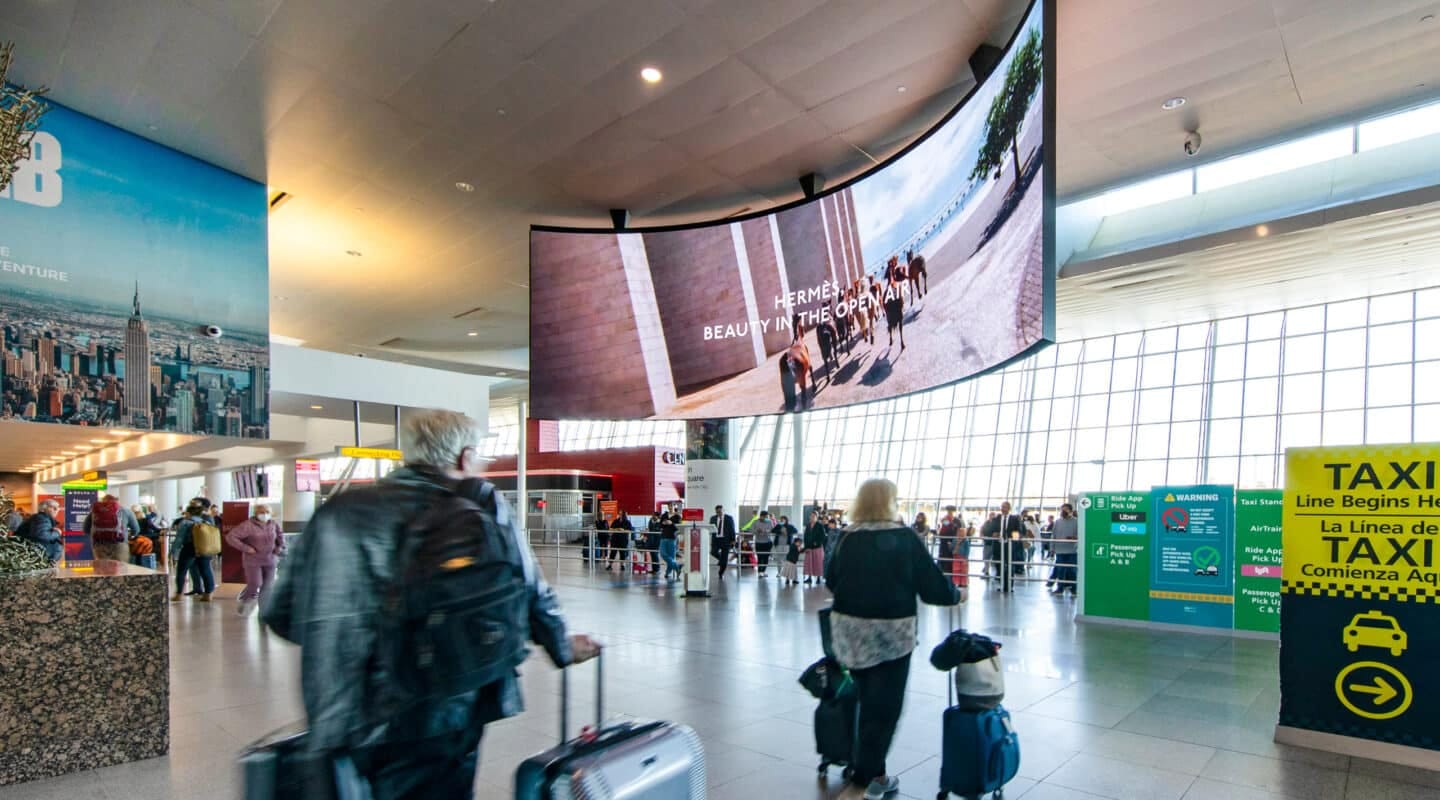
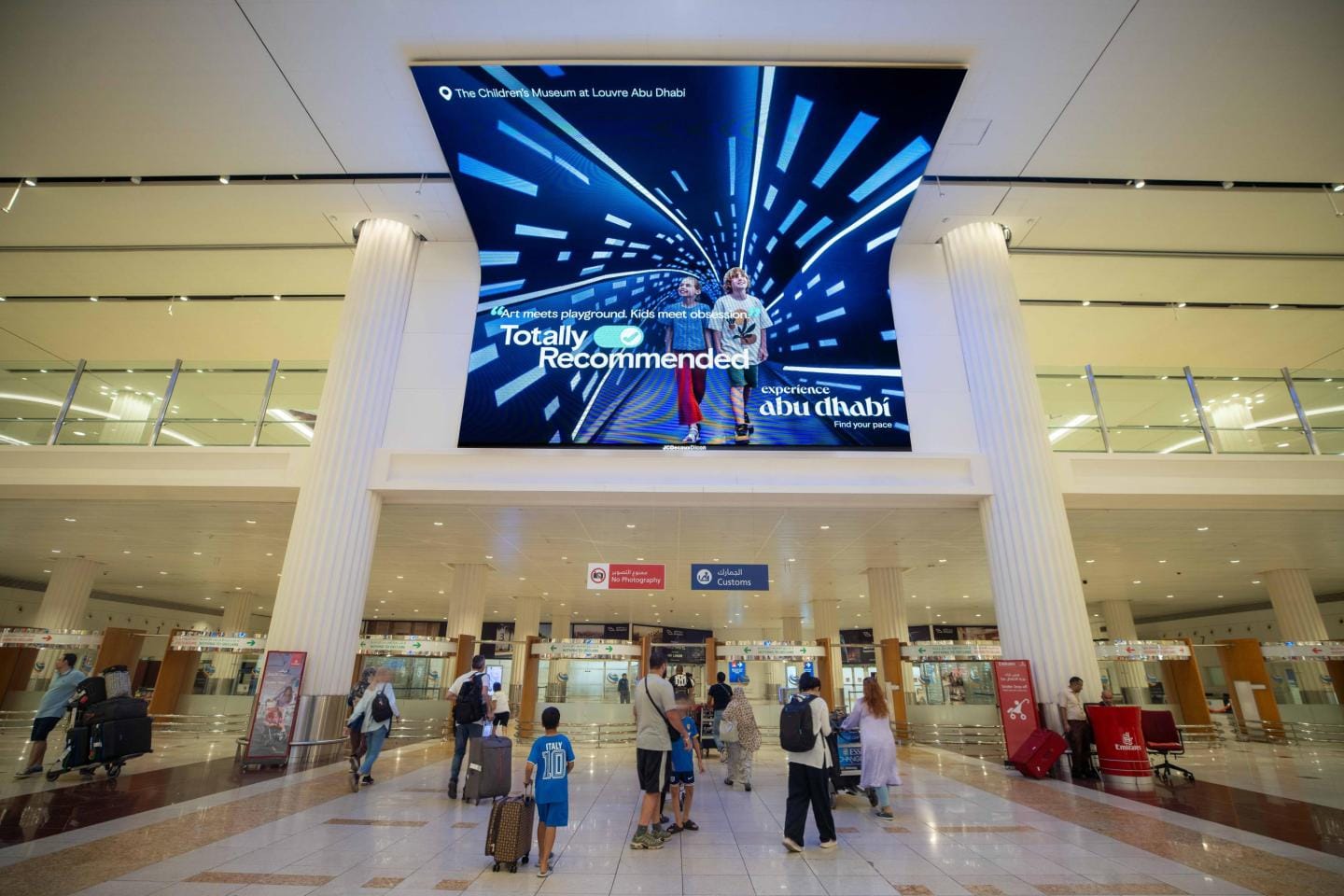
- Lightboxes, digital LED networks and VIP lounge screens across Terminal 2 and Terminal 3, plus arrivals, immigration approach and baggage reclaim positions on the international sequence
- Departure concourse placements along the 3D and 3E satellite walkways, plus premium check-in and lounge environments serving Air China's long-haul operation
Advantages for Advertisers
- Exceptional dwell by geometry. Some Terminal 3E gate areas require 30 to 45 minutes of walking from check-in, a media environment measured in tens of minutes.
- Access to a city with 125,600 millionaires, 54 Fortune Global 500 headquarters and 46 central state-owned enterprises.
Shanghai Pudong International Airport (PVG)

Pudong is China's busiest airport: 76.8 million passengers in 2024, including 35.25 million international: the highest of any mainland airport, and 3.78 million metric tonnes of cargo, second globally. Its transfer rate hit a record 15.7%, and its busiest day, 11 August 2024, moved 254,000 passengers. Terminal 3 adds over 1.7 million square metres and 90 contact stands by 2028, against a goal of 130 million passengers by 2030.
Inventory Highlights
- Programmatic DOOH across Terminal 1 and Terminal 2 delivering 14.7 million weekly impressions, with screens in arrivals and baggage claim, departure check-in zones, luxury retail corridors, security and lounge entrances, and passenger walkways
- International arrivals and departures positions serving 250+ cities in 50+ countries
Advantages for Advertisers
- Programmatic day-weighting. Campaigns go live within 48 hours of approval and support dayparting and creative rotation, so outbound messaging runs 1 to 2 October and return messaging 6–7 October within one buy.
- Shanghai holds 123,400 millionaires (84% growth over the past decade) and 998 multinational headquarters.
Guangzhou Baiyun International Airport (CAN)

Baiyun handles approximately 63.1 million passengers annually (2023–24), with Terminal 2 the primary international facility for China Southern's long-haul network and a Terminal 3 expansion due by 2030 adding roughly 45 million of capacity. Guangdong province generates approximately USD 1.9 trillion a year, 11–12% of national output: from 130 million residents.
Inventory Highlights
- Terminal 2 international arrivals and departures positions across the long-haul network
- Placements against the Singapore, Bangkok, Dubai, London and Sydney corridors served by China Southern, Emirates, Qatar Airways and twenty-plus other operators
Advantages for Advertisers
- Outbound strength. Baiyun is the natural departure point for the Golden Week leisure surge into Southeast Asia.
- A trade audience that travels year-round: the Canton Fair alone brings 200,000+ international buyers from over 200 countries twice a year.
Shenzhen Bao'an International Airport (SZX)

Bao'an handles approximately 50 million passengers (2023) against a pre-pandemic peak of 53 million. Its Fuksas-designed Terminal 3, opened 2013, spans 1.5 kilometres. The Greater Bay Area catchment holds over 80 million people producing around 11% of China's GDP from roughly 5% of its population; Shenzhen city alone has 18 million residents.
Inventory Highlights
- Terminal 3 concourse and central hall positions along the 1.5 km spine
- Placements on the Beijing, Shanghai, Chengdu and Hangzhou trunk routes and the Singapore, Bangkok, Tokyo, Seoul and London corridors
Advantages for Advertisers
- A younger affluent audience. Shenzhen's technology and manufacturing wealth base skews younger and more entrepreneurial than Beijing's or Shanghai's, with higher receptivity to newer luxury brands.
- Dense domestic trunk-route coverage reaches the domestic leisure traveller as well as the outbound cohort.
National Network Coverage
Golden Week is not a tier-one event: provincial capitals send travellers, resort gateways receive them, and the network covers both sides across more than fifty airports. Beijing Daxing (approximately 18.5 million passengers in 2023–24 inside the world's largest single-terminal building, 700,000 square metres engineered for 100 million a year) and Shanghai Hongqiao (approximately 40 million, whose operator names Golden Week among its own peak windows) complete the dual-hub systems. Beyond them: Changsha Huanghua at 30.3 million in 2025, Central China's busiest, Dalian Zhoushuizi at 19.8 million, Zhuhai at 12.97 million and Jinan Yaoqiang above 20 million.
The sending network also includes Chengdu Tianfu and Shuangliu, Hangzhou Xiaoshan, Xi'an Xianyang, Chongqing Jiangbei, Wuhan Tianhe, Nanjing Lukou, Qingdao Jiaodong, Xiamen Gaoqi, Kunming Changshui, Tianjin Binhai, Zhengzhou Xinzheng, Harbin Taiping, Shenyang Taoxian, Urumqi Diwopu, Fuzhou Changle, Guiyang Longdongbao, Nanning Wuxu, Wenzhou Longwan, Ningbo Lishe, Hefei Xinqiao, Nanchang Changbei, Lanzhou Zhongchuan, Taiyuan Wusu, Hohhot Baita, Changchun Longjia, Wuxi Sunan Shuofang, Quanzhou Jinjiang, Xuzhou Guanyin, Yantai Penglai and Yichang Three Gorges.
The receiving gateways are Sanya Phoenix and Haikou Meilan in Hainan, Lhasa Gonggar, Guilin Liangjiang, Lijiang Sanyi, Dali, Xishuangbanna Gasa, Zhangjiajie Hehua, Dunhuang and Qinhuangdao Shanhaiguan, small terminals with disproportionately affluent audiences, low clutter, high dwell and a holiday mindset. For premium travel, hospitality, automotive and lifestyle categories they are often the most efficient positions in the network.
Destination China: Prime City-Location Coverage
Airport media opens the journey; city media closes it. The prime-location network sits where returning travellers spend the second half of the week: Chaoyang CBD and Guomao, Sanlitun Taikoo Li and Wangfujing in Beijing; Lujiazui, Plaza 66 and Xintiandi and the Bund in Shanghai; Futian CBD with The MixC and UpperHills in Shenzhen; and Zhujiang New Town with Taikoo Hui and Parc Central in Guangzhou.
Sequencing an Airport → City → Retail path across the week produces three compounding effects:
- Increased brand recall: the traveller is reached on departure, at destination and on return
- Consistent presence: the brand holds position across the whole holiday
- Enhanced campaign effectiveness: a directional, sequenced buy outperforms the same budget spread flat
Why Brands Choose Golden Week Advertising
Exclusive audience access. One national buy reaches premium travellers across more than fifty Chinese cities within a fixed, publicly known seven-day window.
A prestigious environment. China's airport and prime city media carry the quality signals premium categories require.
End-to-end campaign support. Masscom Global handles planning, negotiation, artwork compliance and execution across the network under one brief.
Strategic planning assistance. Our planners advise on the sending-versus-receiving hub split, tier-one versus resort weighting, and how to phase creative across the outbound, destination and return stages.
Frequently Asked Questions
When is Golden Week in 2026?
1 to 7 October 2026, a seven-day national holiday. Volumes build in late September and peak on 1 to 2 October outbound and 6–7 October on return.
Who is the audience during this period?
Affluent urban families and professionals taking their longest annual break, the outbound premium cohort travelling to Southeast Asia, Japan and Europe, and domestic premium travellers heading for resort and heritage destinations such as Sanya, Lhasa, Lijiang and Guilin.
How many airports can a single campaign cover?
More than fifty. A campaign can be a full national footprint, or concentrated on selected tiers or one travel direction.
How far in advance should a Golden Week campaign be booked?
This is the most contested airport inventory in the Chinese calendar and it commits well ahead of October; early confirmation secures position quality and better rates. Programmatic DOOH at Pudong is a genuine late option, live within 48 hours of approval, but with narrower format choice.
Which categories perform best during Golden Week?
International hospitality and airlines, luxury travel and cruise, duty-free goods and watches, premium automotive, wealth management, overseas real estate and residency advisory, and consumer electronics.
Related Airport Advertising Guides
Detailed inventory, audience and planning notes for the airports covered above:


Get Free Expert Assistance Now
Share your target cities, category and budget, and our China planners will return a costed Golden Week plan across airport and prime city inventory.
Request Availability
Holiday positions across China's major hubs commit early. Ask what remains open for 1 – 7 October 2026.
Launch Your Golden Week Campaign with Confidence
Book a 15-minute call with a Masscom Global media strategist: