

Airport at a Glance
| Field | Detail |
|---|---|
| Airport | Leipzig/Halle Airport |
| IATA Code | LEJ |
| Country | Germany |
| City | Leipzig / Halle (Schkeuditz, Saxony) |
| Annual Passengers | Approximately 2.12 million (2025) |
| Primary Audience | Logistics and supply chain executives, automotive and chemical industry professionals, VFR and diaspora travellers, European leisure travellers |
| Peak Advertising Season | March to April, June to September, December |
| Audience Tier | Tier 2 |
| Best Fit Categories | Logistics and supply chain, industrial and B2B technology, banking and business finance, international education |
Leipzig/Halle is a commercially misread airport. Planners screen it on passenger volume alone, see roughly 2.12 million travellers, and move on. That reading misses what the number actually contains: a passenger base drawn from Germany's most industrially active eastern corridor, travelling for work, investment, and family reasons rather than for sightseeing. Masscom Global classifies LEJ as a high-intent, low-clutter environment, where audience quality far outweighs audience quantity. For advertisers, this is the difference between reaching two million people and reaching two million relevant people.
The airport's second identity is what makes it strategically valuable. It handles approximately 1.4 million tonnes of freight annually, ranking second in Germany and among the top four in Europe, and operates 24 hours for cargo. That freight engine has pulled global logistics, e-commerce, aviation services, and manufacturing employers into the immediate catchment, creating a permanent population of senior operational and commercial staff who fly frequently and hold real procurement authority. The wealth here is corporate and industrial rather than displayed, which changes how brands should speak to it.
Advertising Value Snapshot
- Passenger scale: Approximately 2.12 million passengers in 2025, down around 3.9 percent year on year, against 74,411 aircraft movements. The passenger softening reflects national cost pressure on German short-haul aviation, not weakening catchment wealth.
- Traveller type: Logistics and industrial business travellers, Central German professionals and academics, European and Mediterranean leisure travellers.
- Airport classification: Tier 2. Moderate passenger scale paired with Tier 1 economic weight in its catchment and Tier 1 freight significance in Europe.
- Commercial positioning: Europe's express and e-commerce air freight capital, and the aviation gateway to Central Germany's automotive and chemical belt.
- Wealth corridor signal: LEJ sits on the Central German industrial corridor connecting Leipzig, Halle, Chemnitz, Jena, and Erfurt, an economy rebuilt around advanced manufacturing, semiconductors, chemicals, and logistics capital.
Advertising opportunity: Masscom Global provides advertisers direct access to premium positions across the terminal journey at LEJ, with placement precision that matches format to intent rather than filling available space. Because the terminal footprint is compact, a well-placed campaign here achieves share of attention that would require far heavier spend at a Tier 1 hub. Masscom builds these buys around the business travel rhythm, not the tourist calendar.
Airport Advertising is Complex to Get Right
We help you execute faster, with proven results and local insight most planners lack starting now.
Talk to an Expert
Catchment Area and Economic Drivers
Top 10 Cities within 150 km — Marketer Intelligence:
- Leipzig: The catchment's income and consumption engine. A young, in-migrating professional population with rising disposable income, strong automotive and e-commerce employment, and Germany's fastest-shifting property market in the east. Receptive to finance, property, and premium mobility messaging.
- Halle (Saale): Academic, medical, and public-sector professional base. Household spending skews toward education, healthcare, and long-horizon savings rather than luxury display. High relevance for education, insurance, and health brands.
- Chemnitz: Machine tooling and precision engineering employers producing an audience of technical buyers and plant managers. The most valuable B2B industrial audience in the catchment for equipment, components, and enterprise software.
- Jena: Optics, photonics, and life sciences cluster generating high-salary R&D professionals and international scientific travel. Strong fit for technology, medical device, and premium travel categories.
- Erfurt: Administrative and logistics centre with a stable middle-income and public-sector household base. Suited to mass-premium retail, banking, and family travel offers.
- Dessau-Roßlau: Chemical and materials workforce with a defined industrial supplier ecosystem. Relevant to industrial services and B2B insurance categories.
- Merseburg and the Leuna corridor: Chemical and energy processing employment concentrated in a small footprint, producing high-frequency technical business travel on European routes.
- Zwickau: Automotive manufacturing base including electric vehicle production. Audience of manufacturing engineers and supply chain managers with stable, well-indexed household incomes.
- Gera: Cost-sensitive but stable consumer market. Value-led financial products, telecoms, and outbound leisure travel perform better here than premium positioning.
- Lutherstadt Wittenberg and Bitterfeld-Wolfen: Cultural tourism inflow combined with chemical park employment. A dual audience of visiting international travellers and resident industrial staff.
NRI and Diaspora Intelligence: LEJ does not carry a large South Asian diaspora, so the commercially relevant movement is different in shape. The dominant non-German audience streams are Central and Eastern European workers and families, Turkish-origin German households, and a substantial international student and researcher population drawn to Leipzig, Halle, and Jena universities. These groups travel on defined seasonal cycles, remit money home regularly, and are heavy users of money transfer, telecoms, and low-cost carrier ancillary services. Their airport dwell behaviour is longer than that of business travellers, making them highly reachable.
Economic Importance: Central Germany rebuilt its economy around four pillars: automotive and electric vehicle assembly, chemicals and materials processing, logistics and express freight, and research-driven optics and life sciences. Each pillar generates a distinct advertiser audience. Automotive and chemicals produce technical B2B buyers. Logistics produces frequent-flying operational managers. Research clusters produce internationally mobile, high-education households with strong outbound investment and education intent. Advertisers who segment by pillar rather than by broad demographics extract far more value from this airport.
Business and Industrial Ecosystem
- Express air freight and e-commerce logistics: The airport is the anchor of Europe's largest express network activity, producing a resident and visiting population of supply chain directors, aviation services staff, and procurement leads who fly constantly.
- Automotive and electric vehicle manufacturing: Regional assembly and component plants generate senior engineering and supplier travel, an audience with direct budget influence over industrial purchases.
- Chemicals, materials, and energy processing: The Leuna and Bitterfeld chemical parks sustain continuous technical and commercial travel across European industrial routes.
- Optics, photonics, semiconductors, and life sciences: Jena and Dresden-adjacent research capacity produces high-income scientific and executive travellers with international conference patterns.
Passenger Intent — Business Segment: Business travellers at LEJ are overwhelmingly operational and technical rather than financial-services corporate. They travel to plants, suppliers, trade fairs, and European hubs, often on early morning departures with tight schedules. Because they move fast and repeat the same route weekly, high-frequency, high-visibility placements outperform long-copy formats. Categories that intercept them most effectively are B2B logistics and enterprise technology, business banking and trade finance, industrial insurance, premium mobility, and airline and hotel loyalty programmes.
Strategic Insight: The business audience at LEJ is commercially valuable because it is unusually concentrated and unusually senior relative to airport size. In large hubs, B2B messaging is diluted across millions of leisure travellers. Here, a significant share of weekday morning traffic is decision-making industrial and logistics personnel from a defined set of employers. That makes LEJ one of Europe's most efficient environments for account-based and sector-specific B2B advertising, and Masscom Global structures buys to hit exactly those weekday windows.
Tourism and Premium Travel Drivers
- Leipzig's classical music and cultural heritage: Bach, the Gewandhaus, and opera tourism attract older, high-income German and international visitors with strong pre-committed travel budgets. Ideal for premium travel, jewellery, and cultural sponsorship.
- Leipzig Trade Fair and congress calendar: Book Fair, industrial exhibitions, and gaming conventions deliver dense, dated inflows of professional visitors. The highest-value advertising windows at this airport are event-anchored.
- Lutherstadt Wittenberg and the Reformation route: Draws international heritage and faith-based travel groups, including significant North American and Nordic inflow.
- Saxon lake district, Dresden, and Thuringian Forest access: Regional leisure and wellness travel supporting hospitality, automotive rental, and outdoor retail categories.
- RB Leipzig and stadium event traffic: Match-driven inbound movement generating a young, high-engagement male audience concentrated in short windows.
Passenger Intent — Tourism Segment: Leisure travellers here split into two commercially distinct groups. Outbound Germans heading to Mediterranean, Egyptian, Turkish, and Canary destinations have already committed to the trip and are in accessory-purchase mode, receptive to currency, travel insurance, telecoms roaming, duty free, and destination-side hospitality offers. Inbound cultural and trade fair visitors arrive with higher per-day spend and are receptive to premium retail, hotel, and financial services messaging. Both groups are best reached in arrivals and check-in zones rather than in gate areas.
Travel Patterns and Seasonality
- Peak seasons:
- March to April: Trade fair season plus Easter holiday travel produces the year's strongest dual-audience window, combining professional and family traffic.
- June to September: Summer holiday outbound peak to Mediterranean, Turkish, Egyptian, and Greek destinations. Highest raw passenger volume of the year.
- October: Autumn business travel and Unity Day holiday movement, historically the airport's strongest single month for total traffic.
- December: Christmas market inbound tourism, VFR travel, and winter sun outbound departures.
- Traffic volume data: Monthly passenger volumes typically range from a winter trough near 80,000 to 115,000 in February and March to summer highs several times that level. Freight volume, by contrast, is stable year-round with a Q4 e-commerce surge.
Event-Driven Movement:
- Leipzig Book Fair (March): Publishing, media, and education professionals plus a large young cultural audience. The single best window for education, media, and technology brands.
- Easter and spring holidays (March to April): Family outbound leisure. Timing opportunity for travel insurance, roaming, and family financial products.
- Wave-Gotik-Treffen (May to June): Large international subculture festival delivering concentrated inbound European and North American traffic with high discretionary spend.
- Bach Festival (June): Affluent, older international classical music audience. Premium and luxury alignment is at its strongest in this window.
- German Unity Day and autumn holidays (October): Peak domestic and regional movement combined with the autumn business travel cycle.
- Christmas market season and Q4 freight peak (November to December): Inbound tourism plus the highest cargo and e-commerce activity of the year, ideal for logistics, retail, and payments brands.
It’s Not Just Where You Advertise - It’s How Fast You Execute
We combine local insight with fast rollout to deliver results for you, now.
Talk to an ExpertAudience and Cultural Intelligence
Top 2 Languages:
- German: The primary language of the resident catchment and of nearly all business travellers. Creative in German signals local legitimacy and materially improves recall among the industrial and professional audience that defines this airport.
- English: The working language of the logistics, aviation, research, and international student segments, and of all inbound cultural and trade fair visitors. Dual-language execution is the correct default, with English carrying the premium and international-facing messaging.
Major Traveller Nationalities: The dominant nationality is German, drawn from Saxony, Saxony-Anhalt, and Thuringia. The most significant international streams are Turkish, Polish, Czech, Romanian, Bulgarian, Spanish, Italian, and Greek travellers, reflecting both outbound leisure routes and the region's labour and student mobility. North American and Nordic visitors appear in defined cultural and heritage windows. For creative planning this means restrained, information-dense German messaging for the core audience, and clearly internationalised English creative for the event and student flows, with no reliance on culturally narrow visual references.
Religion — Advertiser Intelligence:
- No religious affiliation (approximately 75 to 80 percent): This is the defining and most commercially important feature of the catchment. Saxony and Saxony-Anhalt have among the highest non-affiliation rates in Europe. Purchase behaviour is driven by state holiday calendars, school terms, and salary cycles rather than by religious festivals. Advertisers should build seasonal campaigns around Easter, Unity Day, and Christmas as secular holiday windows, and avoid faith-framed creative entirely.
- Protestant Christianity (approximately 15 percent): Concentrated in older, higher-savings households and strongly linked to Reformation heritage tourism around Wittenberg and Eisleben. Drives inbound international faith-heritage travel in spring and autumn, benefiting premium travel, hospitality, and cultural sponsorship categories.
- Catholicism and Islam (each low single digits): Catholic presence is small and largely in-migrant. The Muslim community, largely Turkish-origin and more recent arrivals, drives defined VFR and Eid travel peaks with elevated remittance, gifting, and telecoms spending in those windows.
Behavioral Insight: This audience is analytical, price-aware, and resistant to status-led persuasion. Household wealth in Central Germany was built recently and cautiously, so financial decisions favour verifiable returns, warranties, and institutional credibility over aspiration. Messaging that leads with specification, guarantee, yield, or engineering credibility converts far better than messaging that leads with prestige. This is a market where a proof point outperforms a promise, and where advertisers who respect that discipline see disproportionate response.
Outbound Wealth and Investment Intelligence
The outbound passenger at LEJ is not a conspicuous luxury consumer. They are a business owner, senior engineer, logistics executive, or professional-class household deploying capital deliberately into yield, education, and mobility. Their destinations follow function: Southern Europe for property and lifestyle, Central and Eastern Europe for manufacturing and supplier investment, the Gulf and Asia for trade and logistics interests, and North America and the United Kingdom for education. This is a corridor of quiet capital, which makes it underpriced relative to the wealth it actually moves.
Outbound Real Estate Investment: The catchment's higher-income households are active buyers in Spain, particularly the Costa Blanca, Costa del Sol, and Mallorca, and increasingly in Portugal's Algarve and Lisbon corridor, where German buyers pursue rental yield and climate lifestyle. Turkey and Greece attract both investment and diaspora-linked purchase. Dubai has emerged as a serious alternative for this audience because of zero personal income tax, higher net rental yields than German metro property, and residency-linked purchase options that German domestic real estate cannot match. International developers marketing to a yield-literate, documentation-focused German buyer will find LEJ a precise and efficient channel, and Masscom Global positions those campaigns where the outbound decision-maker actually dwells.
Outbound Education Investment: Students from Leipzig, Halle, Jena, and Chemnitz move primarily to the United Kingdom, the Netherlands, the United States, Canada, and increasingly Switzerland and Singapore for postgraduate business, engineering, and life sciences programmes. Family spending profiles here are savings-funded rather than debt-funded, meaning decisions are made early, researched heavily, and involve both parents. International universities, pathway programmes, and education consultancies gain more from a sustained presence at this airport across the March to April and August to September windows than from short bursts, because the decision cycle is long.
Outbound Wealth Migration and Residency: Demand from this catchment centres on tax-efficient and business-linked residency rather than passport acquisition. The most relevant programmes are the UAE Golden Visa, Portugal's investment and residency routes, Greek and Spanish residency-by-property options, and Swiss and Austrian lump-sum arrangements for business owners exiting German tax exposure. Caribbean citizenship-by-investment plays a smaller role. Advisory firms, private banks, and residency consultancies find a receptive and financially literate audience here.
Strategic Implication for Advertisers: Brands on both sides of this corridor should treat LEJ as a priority efficiency buy rather than a prestige buy. Outbound German capital is being deployed into Iberian, Gulf, and Southeast European markets, while inbound logistics and manufacturing capital flows toward Central Germany, and both audiences pass through the same compact terminal. Masscom Global activates campaigns simultaneously at LEJ and at the destination-side airports where this capital lands, closing the loop on a single audience across two geographies.
Airport Infrastructure and Premium Indicators
Terminals:
- A single integrated terminal complex with connected concourses handling all commercial passenger traffic, designed for capacity well above current throughput. The practical advertising consequence is a compact, high-footfall path with minimal audience dispersion, so a single strong position can reach a very high share of total passengers.
- Dedicated non-Schengen processing and a central check-in hall built around the airport's landmark glass concourse and integrated long-distance rail station, which channels arriving and departing passengers through predictable, high-dwell zones.
- Extensive separate cargo terminals, aircraft maintenance facilities, and airline crew infrastructure operating 24 hours, sustaining a large resident professional population on the airport campus itself.
Premium Indicators:
- Business and premium lounge provision serving both scheduled premium travellers and the airport's substantial crew and corporate contract population, signalling a consistent, non-seasonal premium audience.
- Significant general and business aviation activity alongside major freight operator hub bases, indicating private and corporate aviation movement above what the passenger figure alone suggests.
- Hotel capacity directly at and adjacent to the airport campus, driven by crew rotation, logistics staff, and trade fair demand, creating overnight dwell that extends brand exposure beyond the terminal.
- Direct long-distance and regional rail integration under the terminal, plus notable architectural scale in the central concourse, giving campaigns an unusually high-quality physical environment for brand association.
Forward-Looking Signal: Ongoing freight capacity expansion, continued investment in the airport's logistics and aviation maintenance ecosystem, and Central Germany's semiconductor and battery industrialisation all point to rising business travel demand and rising resident professional wealth in this catchment over the coming years. Route recovery on European business corridors will follow that industrial growth. Masscom Global advises advertisers to secure premium positions at LEJ at current rate levels now, because commercial value here is being repriced upward by the region's industrial expansion, not by passenger growth alone.
Airline and Route Intelligence
Top Airlines: Lufthansa, Eurowings, Ryanair, Wizz Air, Turkish Airlines, Condor, SunExpress, Corendon, and seasonal charter carriers on Mediterranean routes. On the freight side, the airport functions as a global hub base for major express and e-commerce operators, with over 45 cargo airlines serving more than 160 destinations worldwide.
Key International Routes: Frankfurt and Munich as the primary intercontinental feeder corridors with multiple daily frequencies. High-frequency leisure and VFR routes to Istanbul and Antalya, Palma de Mallorca, Hurghada, the Canary Islands, Greek islands, and Bulgarian coastal destinations. Business-relevant European links to Vienna, Zurich, and London, plus strong Central and Eastern European connectivity to Poland, Czechia, and the Baltics.
Domestic Connectivity: Frankfurt and Munich dominate domestic movement and function as gateway rather than point-to-point traffic, meaning a large share of LEJ passengers are actually intercontinental travellers at the first leg of a long journey. Additional domestic links serve western and northern German business centres.
Wealth Corridor Signal: The route map splits cleanly into three commercial layers. The Frankfurt and Munich feeder routes are the true wealth transfer corridor, carrying intercontinental business and investment travellers who never appear in international passenger counts at LEJ but pass through its terminal in both directions. The Turkish, Greek, Spanish, and Egyptian routes are the leisure and diaspora layer, with high volume and high accessory spend. The Central and Eastern European routes are the industrial layer, carrying supplier and manufacturing travel. Advertisers who target the feeder layer capture a long-haul audience at Tier 2 rates, and Masscom Global builds placement strategy around exactly that arbitrage.
Media Environment at the Airport
- Terminal scale is compact relative to comparable European hubs, and advertising clutter is materially lower than at Frankfurt, Munich, or Berlin. Standout potential per placement is therefore among the highest in Germany, and a single dominant position can define the passenger's visual memory of the airport.
- Dwell time is driven by early morning business departure waves, holiday charter check-in queues, and rail-to-terminal transfer flows, producing sustained, repeated exposure in check-in, security exit, and gate lounge zones rather than fleeting passage.
- The premium environment is reinforced by the airport's architectural central concourse, integrated rail station, lounge provision, and the visible presence of global logistics and aviation brands, which elevates brand association for advertisers placed there.
- Masscom Global holds direct access to premium inventory across the full passenger journey at LEJ, with the local intelligence to match format to audience segment by day part, and the execution capability to move from brief to live campaign faster than planners working without on-ground partners.
Strategic Advertising Fit
Best Fit:
- Logistics, supply chain, and freight forwarding brands: No airport in Europe delivers a denser concentration of freight and supply chain decision-makers relative to its size.
- Industrial and B2B technology, automation, and enterprise software: The catchment's manufacturing, chemicals, and engineering base produces technical buyers with direct procurement authority.
- Business banking, trade finance, and corporate insurance: Mittelstand business owners and industrial executives are a core weekday audience with active financing needs.
- International real estate developers in Dubai, Spain, Portugal, and Greece: A yield-focused, financially literate outbound buyer audience with proven purchase activity in these markets.
- International universities and education consultancies: High-education households in Leipzig, Halle, and Jena with sustained postgraduate migration to the UK, Netherlands, North America, and Switzerland.
- Residency, second-passport, and wealth advisory services: Business owners actively evaluating tax-efficient residency options.
- Airlines, hotel groups, and loyalty programmes: High-frequency business travellers on repetitive routes are the most efficient loyalty acquisition audience available.
- Telecoms, roaming, currency, and travel insurance: Large outbound leisure and diaspora volume in a committed, accessory-purchase mindset.
Brand Alignment at a Glance:
| Category | Fit |
|---|---|
| Logistics and supply chain | Exceptional |
| Industrial and B2B technology | Exceptional |
| Business banking and trade finance | Strong |
| International real estate and residency | Strong |
| International education | Strong |
| Telecoms, currency, and travel services | Strong |
| Ultra-luxury fashion and high jewellery | Moderate |
| Mass-market fast food and impulse retail | Poor fit |
Who Should Not Advertise Here:
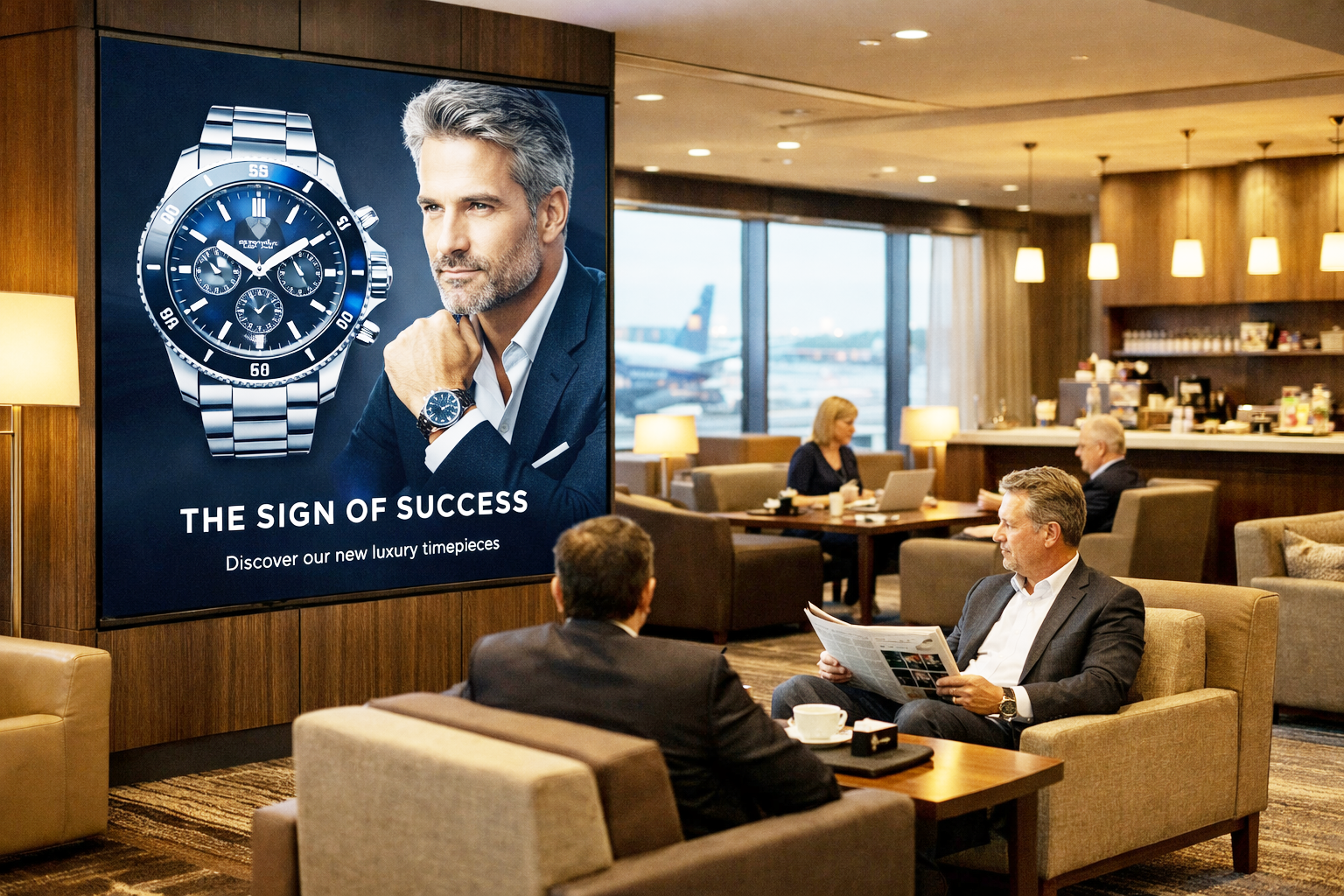
- Ultra-luxury fashion, watches, and high jewellery at full brand weight: The audience is wealthy but culturally resistant to status display, and premium duty free scale here does not support conversion at Tier 1 pricing.
- Mass-market fast food, discount retail, and impulse FMCG: Passenger volume is too low for reach-based buying models to deliver efficient cost per thousand.
- Domestic consumer services with no travel or international relevance: Local utilities, regional retail chains, and hyper-local services waste a high-intent international environment on a message the audience can receive far more cheaply elsewhere.
Event and Seasonality Analysis
- Event Strength: High
- Seasonality Strength: High
- Traffic Pattern: Dual-Peak
Strategic Implication: Advertisers should split budget rather than spread it, concentrating B2B and financial messaging into the March to April trade fair window and the October autumn business cycle, and concentrating consumer, travel services, and telecoms messaging into June to September and December. Attempting even coverage across twelve months dilutes both audiences and wastes the airport's sharpest advantage, which is the predictability of its peaks. Masscom Global structures LEJ campaigns around this dual-peak rhythm, front-loading premium positions into the highest-yield windows and using shoulder months for lower-cost frequency building.
Poor Placement and Delays Affect Airport Campaigns
We help you move faster, access better inventory, and get it right now.
Talk to an ExpertFinal Strategic Verdict
Leipzig/Halle is the most undervalued advertising environment in Germany. Roughly 2.12 million passengers and approximately 1.4 million tonnes of annual freight combine to produce something no large hub can offer: a compact, low-clutter terminal where a high proportion of weekday traffic consists of logistics, manufacturing, and engineering decision-makers from Central Germany's fastest-industrialising corridor, layered with a high-volume outbound leisure and diaspora audience in defined seasonal windows. B2B logistics and industrial technology brands, business finance providers, international property developers targeting Dubai and Iberian buyers, and international education institutions will extract more value per euro here than at any comparable German airport. The Frankfurt and Munich feeder routes mean advertisers reach intercontinental long-haul travellers at Tier 2 rates, an arbitrage that will narrow as the region's semiconductor and battery investment matures. Masscom Global holds the inventory access, the catchment intelligence, and the execution speed to convert that window into measurable results before the repricing happens.
About Masscom Global
Masscom Global is a premium international airport advertising and media buying agency operating across 140 countries. With deep expertise in airport OOH, premium publications, and high-net-worth audience targeting, Masscom helps brands reach the world's most valuable travellers at the moments that matter most. For advertising packages, media rates, and campaign planning at Leipzig/Halle Airport and airports across the globe, contact Masscom Global today.
Frequently Asked Questions
How much does airport advertising cost at Leipzig/Halle Airport? Cost at LEJ varies by format, terminal position, campaign duration, and seasonal demand. Premium check-in hall and central concourse positions during the March to April trade fair window and the June to September summer peak carry the highest rates, while shoulder months offer materially better value for frequency-led campaigns. Because LEJ is a Tier 2 airport with Tier 1 audience quality, effective cost per relevant impression is often lower than at larger German hubs. Contact Masscom Global for current rates and availability.
Who are the passengers at Leipzig/Halle Airport? The core audience is Central German professionals from Leipzig, Halle, Chemnitz, Jena, and Erfurt, weighted heavily toward logistics, automotive, chemicals, engineering, and research employment. Weekday morning traffic is dominated by business travellers using Frankfurt and Munich as intercontinental gateways. Summer and holiday traffic shifts to family and diaspora leisure travellers on Turkish, Spanish, Greek, and Egyptian routes. The airport also carries a large resident population of aviation, cargo, and crew professionals.
Is Leipzig/Halle Airport good for luxury brand advertising? Selectively. The catchment holds real wealth in business ownership and industrial income, but it is culturally resistant to status-led messaging, so ultra-luxury fashion and high jewellery underperform relative to spend. Luxury categories that succeed here are those framed around engineering credibility, investment value, or long-term ownership, including premium automotive, private banking, high-value property, and wealth advisory. Brands willing to adapt creative from prestige to proof see strong results.
What is the best airport in Germany to reach HNWI audiences? Frankfurt and Munich lead on absolute HNWI volume, and Düsseldorf leads on luxury retail conversion. Leipzig/Halle occupies a different and complementary position: it is the most efficient German airport for reaching industrial business owners, Mittelstand decision-makers, and supply chain executives, and the primary aviation gateway to Central Germany's wealth corridor. Advertisers seeking B2B and investment-oriented affluence rather than luxury display should treat LEJ as a priority buy alongside the major hubs.
What is the best time to advertise at Leipzig/Halle Airport? March to April is the strongest overall window, combining the Leipzig Book Fair and trade fair season with Easter family travel. October delivers the year's peak combined business and domestic movement. June to September carries the highest raw passenger volume for consumer and travel services categories, and November to December combines Christmas market inbound tourism with the annual freight and e-commerce peak. B2B campaigns should target spring and autumn, consumer campaigns summer and December.
Can international real estate developers advertise at Leipzig/Halle Airport? Yes, and it is one of the airport's strongest commercial cases. This catchment's higher-income households are active property buyers in Spain, Portugal, Greece, Turkey, and increasingly Dubai, drawn by rental yields above German metro levels, tax efficiency, and residency-linked purchase routes. The audience is analytical and documentation-focused, so campaigns built around yield data, tax treatment, and developer credentials outperform lifestyle imagery. Masscom Global places these campaigns in the outbound zones where the decision-maker dwells longest.
Which brands should not advertise at Leipzig/Halle Airport? Mass-market fast food, discount retail, and impulse FMCG brands should avoid LEJ because passenger volume is too low for reach-based models to work efficiently. Ultra-luxury fashion and high jewellery at full brand weight misread the audience's cultural relationship with status. Purely domestic consumer services with no travel or international dimension waste a high-intent environment on a message better delivered through local media.
How does Masscom Global help brands advertise at Leipzig/Halle Airport? Masscom Global delivers the full chain: catchment and audience intelligence specific to Central Germany's industrial corridor, direct access to premium terminal inventory, placement precision matched to day part and passenger segment, creative guidance for German and English dual-language execution, and campaign performance tracking against defined objectives. Masscom also activates the destination side of this airport's outbound wealth corridor, so brands reach the same audience in both geographies.