

Airport at a Glance
| Field | Detail |
|---|---|
| Airport | Hévíz-Balaton Airport |
| IATA Code | SOB |
| Country | Hungary |
| City | Sármellék (serving Hévíz and Keszthely) |
| Annual Passengers | Historical peak close to 120,000 arriving and departing passengers; terminal now rated to 200,000 annually |
| Primary Audience | German and Austrian medical-wellness travellers, Israeli spa and health tourists, Hungarian and cross-border V4 leisure outbound |
| Peak Advertising Season | May to September, with a secondary year-round spa window October to April |
| Audience Tier | Tier 3 by volume, Tier 1 by audience quality |
| Best Fit Categories | Private healthcare and wellness, second-home and resort real estate, premium automotive, wealth and residency advisory |
Hungary's only dedicated thermal-wellness air gateway, delivering low volume and unusually high spend per passenger.
Hévíz-Balaton Airport is not a volume play. It is a filtered-audience play. Almost every arriving passenger is travelling for one reason, which is thermal medical wellness at Hévíz, Zalakaros, or the Balaton western shore. That single-purpose traffic profile is rare and commercially valuable, because it removes the guesswork that dilutes advertising at large mixed-purpose hubs. An advertiser at SOB is not buying impressions against a general population. They are buying near-total coverage of a self-selected health-and-leisure spending cohort.
The airport sits west of Lake Balaton in Zala County, roughly one kilometre from Sármellék and close to Keszthely, and derives its commercial relevance from proximity to Hungary's most important holiday lake and the thermal spas of Hévíz and Zalakaros. The wealth corridor here runs from German-speaking Central Europe into western Hungary, driven by a price arbitrage that has persisted for three decades. German and Austrian patients access dental, orthopaedic, and rheumatological treatment at a fraction of home-market cost, then convert the saving into extended stays, property, and repeat visits. Masscom Global reads this corridor as a two-way commercial channel rather than a one-way tourist flow.
Advertising Value Snapshot
- Passenger scale: The airport's strongest year saw close to 120,000 arriving and departing passengers, and recent terminal upgrades allow it to handle up to 200,000 passengers annually. Cargo throughput has moved from a former 30 to 50 tonnes to roughly 3,700 tonnes in the last recorded year.
- Traveller type: German and Austrian medical-wellness visitors, Israeli health and leisure tourists, Hungarian and cross-border outbound holidaymakers.
- Airport classification: Tier 3 by throughput, Tier 1 by audience quality. Small footprint, high-intent passengers, negligible transit noise.
- Commercial positioning: Hungary's spa and thermal-treatment gateway, the only airport in the country whose entire reason for existing is wellness tourism.
- Wealth corridor signal: The Munich-Vienna-Graz to Balaton medical arbitrage corridor, layered with a Tel Aviv health-tourism route and a growing Antalya outbound leisure line.
- Advertising opportunity: A single-terminal environment with almost no advertising clutter means one well-placed brand can dominate the arrival and departure experience outright. The rebuilt terminal now serves 400 people at one time, concentrating that audience into a compact, high-dwell space. Masscom Global secures placement precision here that is impossible at scale hubs, and can lock rates before scheduled-service growth resets the market.
Airport Advertising is Complex to Get Right
We help you execute faster, with proven results and local insight most planners lack starting now.
Talk to an ExpertCatchment Area and Economic Drivers
Top 10 Cities within 150 km, Marketer Intelligence:
- Hévíz: The commercial engine of this airport. A resident population under 5,000 that hosts hundreds of thousands of annual spa guests, with a large German-speaking property-owning cohort. Highest concentration of foreign-currency discretionary spend per square kilometre in Hungary. Prime for private healthcare, luxury hospitality, and second-home developers.
- Keszthely: University town and cultural anchor with Festetics Palace driving heritage visitation. Mixes a young student segment with affluent lakefront homeowners. Useful for education services, premium retail, and financial products aimed at asset-holding families.
- Zalakaros: Second thermal spa cluster, skewing toward Hungarian and V4 domestic wellness families rather than Western European patients. Value-conscious but high-frequency repeat visitors. Suits family wellness brands, insurance, and mid-premium consumer goods.
- Zalaegerszeg: County seat with a serious automotive engineering base, including a proving-ground ecosystem drawing German OEM engineers and suppliers. Produces a genuine technical B2B audience, unusual for a region this size. Strong for industrial, mobility, and B2B technology advertisers.
- Nagykanizsa: Historic oil, gas, and glass manufacturing centre sitting on the Croatian and Slovenian transit axis. Delivers logistics operators, plant managers, and cross-border traders. Relevant for freight, energy services, and commercial vehicle brands.
- Siófok: The Balaton south-shore volume resort, driving nightlife, festival, and mass-leisure traffic in high summer. Younger, high-velocity, lower-ticket spend. Fits beverage, telecom, mobile-first fintech, and event-linked campaigns.
- Balatonfüred: The lake's established old-money resort with cardiology and heart-treatment heritage, yacht clubs, and long-tenured Hungarian elite families. Quiet wealth rather than display wealth. Strong for private banking, health insurance, and marine or automotive luxury.
- Veszprém: Regional administrative and cultural capital with a European Capital of Culture legacy, producing professional services and public-sector decision-makers. Steady year-round urban audience. Suits corporate, cultural sponsorship, and premium services.
- Szombathely: Western manufacturing hub with substantial German and Austrian industrial investment and heavy commuter flow into Austria. Households earn abroad and spend at home, a classic dual-currency audience. Excellent for automotive, home improvement, and cross-border banking.
- Maribor, Slovenia: Cross-border catchment within comfortable drive range, adding a Slovenian and Styrian Euro-earning audience to the airport's outbound charter base. Broadens creative reach beyond Hungary. Relevant for pan-regional retail, travel, and residency products.
NRI and Diaspora Intelligence:
There is no traditional expatriate diaspora driving this airport. The equivalent commercial force is a resident foreign homeowner population, concentrated in Hévíz and along the western Balaton shore, dominated by German, Austrian, and previously Russian buyers who acquired property during successive spa-driven investment waves. These owners behave like diaspora in every commercially useful sense, travelling on repeat multi-week cycles, maintaining two households, importing purchasing standards from higher-cost home markets, and making financial decisions on both sides of a border. The reverse flow matters too. Hungarian households across Zala, Vas, and Somogy counties earn in Austrian and German wages while spending in Hungary, producing a cross-border income profile that lifts consumption well above local salary benchmarks. Masscom Global treats this dual-currency population as the airport's true premium audience.
Economic Importance:
The catchment economy runs on three engines that each produce a distinct advertising audience. Thermal and medical tourism generates high-spend inbound health travellers with committed budgets. Automotive engineering and precision manufacturing across Zalaegerszeg, Szombathely, and Nagykanizsa generates technical B2B travellers and well-paid engineering households. Agriculture, viticulture, and lakefront hospitality generate landowner and small-business-owner wealth, which is asset-heavy and locally invested. For advertisers, this means one airport reaching a wellness consumer, an industrial decision-maker, and a property-owning family without changing placement.
Business and Industrial Ecosystem
- Automotive testing and engineering, Zalaegerszeg: Produces visiting German and Austrian OEM engineers, supplier executives, and validation teams. A rare, high-value technical B2B audience for mobility, software, and industrial brands.
- Precision manufacturing and electronics, Szombathely and Vas County: Produces plant leadership and multinational management travelling on Central European rotation. Fits B2B logistics, industrial services, and executive financial products.
- Energy, chemicals, and glass, Nagykanizsa: Produces procurement and operations decision-makers with recurring cross-border movement. Relevant for energy services, commercial fleet, and equipment brands.
- Medical and dental clinic ecosystem, Hévíz and Keszthely: Produces clinic owners, specialist practitioners, and inbound patient volume simultaneously. Rare environment where the buyer and the service provider both pass the same terminal.
Passenger Intent, Business Segment:
Business travellers at SOB are not commuting to headquarters. They are engineers, suppliers, clinic operators, hospitality investors, and property managers travelling with a specific project purpose and a defined stay window. They arrive rested rather than harried, which raises message receptivity above typical business-hub conditions. Categories that intercept them most effectively are B2B technology, industrial services, commercial banking, executive mobility, and professional advisory.
Strategic Insight:
The business audience here is small in absolute number but almost impossible to reach efficiently anywhere else. These are decision-makers for Central European automotive validation, western Hungarian manufacturing, and the Balaton hospitality investment cycle, and they do not concentrate at Budapest in the same density. A B2B advertiser at SOB is buying a narrow, senior, project-motivated audience with no wastage against holiday crowds outside the summer window. That combination of low volume and high seniority is exactly the profile that rewards precision buying over reach buying.
Tourism and Premium Travel Drivers
- Hévíz Thermal Lake: The world's largest biologically active natural thermal lake and the single reason most passengers arrive. Visitors book multi-week treatment courses, meaning long dwell in the region and high cumulative spend. Prime for healthcare, pharma, supplements, and wellness retail.
- Lake Balaton western shore and Keszthely Bay: Central Europe's largest lake, driving second-home ownership, yacht and marina activity, and premium lakefront hospitality. Signals asset-holding audiences rather than package tourists.
- Zalakaros spa complex and Kis-Balaton nature reserve: Adds family wellness and eco-tourism volume, extending the season either side of high summer. Suits family brands, insurance, and outdoor and automotive categories.
- Festetics Palace, Keszthely, and the Balaton wine districts: Heritage and viticulture tourism drawing culturally motivated, higher-income visitors. Strong fit for premium beverage, luxury goods, and cultural sponsorship.
Passenger Intent, Tourism Segment:
Tourists arriving at SOB have already committed significant money before boarding, typically a treatment package, a multi-week accommodation booking, or a spa-hotel programme. They are past the price-comparison stage and into the enhancement stage, which is precisely when airport messaging performs. On departure they carry unspent budget and a strong emotional association with health improvement, making them receptive to follow-on treatment plans, product subscriptions, property enquiry, and return-visit offers. Healthcare, wellness products, real estate, premium retail, and insurance benefit most from this state of mind.
Travel Patterns and Seasonality
Peak seasons:
- May to September: The dominant window. Charter and seasonal scheduled services concentrate here, driven by Balaton summer season and warm-weather spa demand. Dresden services run weekly through May and June, and a weekly Antalya charter operates every Saturday from 13 June to 12 September 2026 on 168-seat aircraft, carrying more than 2,300 passengers across the season.
- October to April secondary window: Thermal treatment demand does not follow beach seasonality. Medical wellness guests from German-speaking markets travel deliberately in shoulder and winter months for lower rates and quieter facilities. This is the underpriced advertising window.
- Advent and New Year: Hévíz and Keszthely operate Christmas market and winter spa programming, producing a short high-spend December spike.
Monthly traffic volume data not available.
Event-Driven Movement:
- Balaton summer festival season (June to August): High-volume leisure and music tourism concentrated on the south shore. Brings younger, mobile-first, high-frequency spenders. Best window for beverage, telecom, and app-based categories.
- Hévíz spa season opening and wellness programming (April to May): Signals the start of treatment-course bookings. Advertiser timing opportunity for healthcare, pharma, and insurance ahead of the decision point.
- Balaton wine harvest and gastronomy events (September to October): Draws affluent culturally motivated visitors as summer volume drops. Ideal for premium beverage, luxury goods, and hospitality brands seeking a quality-over-quantity window.
- Antalya charter season (13 June to 12 September): A defined outbound leisure block with a fixed weekly rhythm. Predictable Saturday departure surges make tactical, day-specific campaign planning possible.
- Advent and thermal Christmas programming (December): Short, dense, high-spend domestic and Austrian visitation. Strong for gifting, retail, and premium food and beverage.
It’s Not Just Where You Advertise - It’s How Fast You Execute
We combine local insight with fast rollout to deliver results for you, now.
Talk to an ExpertAudience and Cultural Intelligence
Top 2 Languages:
- Hungarian: The language of the resident catchment, the outbound charter audience, and the regional business community. Essential for property, financial, automotive, and retail messaging aimed at asset-holding local households and cross-border commuters.
- German: The commercial language of this airport. It covers the German and Austrian medical-wellness inbound flow, the resident foreign homeowner population, and the visiting industrial and engineering audience. Any premium campaign at SOB that is not executed in German is leaving its highest-spending segment unaddressed.
Major Traveller Nationalities:
The dominant inbound nationalities are German and Austrian, travelling for thermal and dental treatment, extended spa stays, and second-home use. The current passenger service is a German charter operation flying from Dresden, and forward plans centre on Germany, Israel, and the Visegrád Group states of Poland, the Czech Republic, and Slovakia. A Tel Aviv service operated in 2025, reflecting sustained Israeli demand for Hungarian medical and spa tourism. Historically the airport also carried scheduled traffic from London, Frankfurt, Düsseldorf, and Moscow alongside German and Russian charters. For advertisers this means creative must default to German first, Hungarian second, with English and Hebrew adaptations for the health-tourism corridor rather than generic pan-European treatments.
Religion, Advertiser Intelligence:
- Roman Catholicism (largest declared affiliation in Zala and the western counties): Drives Easter, Assumption in August, All Saints in November, and Advent travel and gifting cycles. Assumption and Advent create the sharpest domestic spending triggers. Benefits gifting, premium food and beverage, retail, and family automotive.
- Reformed and Lutheran Protestant communities (significant minority across western Hungary): Drive quieter, family-centred Easter and Christmas movement with a conservative savings orientation. Messaging built on security and long-term value outperforms aspiration-led creative. Benefits insurance, pensions, and private banking.
- Judaism (small resident presence, disproportionate travel relevance): The Israeli inbound health-tourism corridor makes Jewish holiday calendars commercially material, particularly Passover in spring and the Tishrei cluster of Rosh Hashanah, Yom Kippur, and Sukkot in autumn. These windows shift booking patterns and create concentrated arrival blocks. Benefits medical tourism, kosher-certified hospitality, and residency advisory. Precise catchment percentages: Data not available.
Behavioral Insight:
This audience is value-rational rather than status-driven. The core German-speaking spa visitor arrives because they calculated that treatment plus travel plus accommodation in Hungary costs less than treatment alone at home, which means they respond to substantiated comparison, credentials, and outcome evidence rather than lifestyle imagery. The local Hungarian and cross-border segment is asset-focused, preferring land, property, and durable goods over financial products they cannot see. Messaging that quantifies a benefit, names a credential, or demonstrates a saving converts here. Messaging built on aspiration alone does not.
Outbound Wealth and Investment Intelligence
The outbound passenger at SOB is commercially distinctive because they are not primarily an emigrant or a corporate traveller. They are a Central European property owner, a cross-border earner, or a treatment-cycle repeat visitor moving between two economies. Capital here is deployed into tangible assets, second homes, agricultural and lakefront land, and Euro-denominated savings rather than volatile instruments. The outbound leisure line to the Turkish Riviera adds a discretionary-spend layer on top of that asset behaviour.
Outbound Real Estate Investment:
Hungarian and western-county HNI buyers concentrate on Austrian and Croatian coastal and Alpine property, Spanish and Portuguese Mediterranean holdings for climate and residency reasons, and Dubai residential product for yield and zero personal income tax. Croatian Adriatic property is the natural first step given drive-time proximity and Euro adoption. Portugal remains attractive for its residency-linked investment framework, and Dubai continues to draw Central European capital on rental-yield differentials against low-yield domestic markets. Simultaneously, inbound German and Austrian buyers keep acquiring in Hévíz, Keszthely, and the Balaton western shore. International real estate developers advertising at SOB reach both directions of that trade in one placement, and Masscom Global can structure creative to speak to each side without splitting the buy.
Outbound Education Investment:
Students from Zala, Vas, Veszprém, and Somogy counties migrate predominantly to Austria and Germany for higher education, with the United Kingdom, the Netherlands, and Switzerland forming the premium tier. Proximity, language capability, and low or no tuition in the German-speaking systems make Vienna, Graz, and Munich the default. Families in this catchment fund education from property equity and cross-border wages rather than debt, which makes them cash-strong and receptive to full-package propositions. International universities, boarding schools, and education consultancies reach parents and students together at SOB during the May to September family travel window, when enrolment decisions are actively forming.
Outbound Wealth Migration and Residency:
Demand centres on European residency-by-investment structures, with Portugal, Greece, and Malta the most frequently considered routes, alongside UAE long-term residency for business owners seeking tax efficiency and Gulf market access. Hungarian nationals hold EU mobility already, so the driver is not access to Europe but asset diversification, currency hedging outside the forint, and optionality for the next generation. For the inbound German, Austrian, and Israeli passengers using this airport, Hungarian and wider Central European residency and property structures function as the reciprocal opportunity. Second-passport and citizenship-by-investment interest skews toward Caribbean programmes among business owners seeking travel and banking flexibility.
Strategic Implication for Advertisers:
SOB is one of very few airports where both ends of a wealth corridor pass through a single small terminal, the German-speaking buyer coming in and the Hungarian asset-holder going out. That makes it disproportionately efficient for international real estate, residency advisory, private healthcare, and cross-border banking relative to its passenger count. Masscom Global activates both sides of this corridor simultaneously, aligning creative, language, and seasonal timing so one placement works in two directions.
Airport Infrastructure and Premium Indicators
Terminals:
- A single passenger terminal serving all traffic, which eliminates the audience-splitting problem that weakens campaigns at multi-terminal airports. Following the recent government-funded programme, terminal capacity was expanded to serve 400 people at one time, and upgrades support annual handling of up to 200,000 passengers.
- A single concrete runway of 2,500 by 60 metres accommodates medium-sized aircraft, and the upgraded airport can handle aircraft in the 150 to 220 seat range suited to low-cost and charter operators. The terminal provides arrivals, departures, baggage claim, and customs processing in one compact flow.
Premium Indicators:
- No traditional multi-lounge programme. The commercial equivalent here is the concentration of a treatment-committed audience into a single controlled space, which delivers coverage a lounge network cannot match at this scale.
- The terminal includes duty-free retail, a café area, complimentary Wi-Fi, and car rental desks, with general aviation and charter handling supported by the airport's operator.
- Premium accommodation is not on-airport but is dense within a fifteen-minute drive, with Hévíz's spa-hotel cluster forming one of Central Europe's largest concentrations of medical-wellness hospitality. That proximity means airport messaging lands minutes before high-value hotel and clinic spend begins.
- The recent development added a new control tower and an on-site solar park, giving the airport a credible sustainability credential that supports ESG-aligned brand association.
Forward-Looking Signal:
The Hungarian government allocated close to HUF 3 billion, roughly EUR 7.4 million, to renovate the airport, with HUF 2.8 billion directed at infrastructure including runway, taxiway, apron lighting, and navigation systems. From 2026 the airport plans services to Germany, Israel, and the Visegrád Four countries, and the operator is in active discussion with airlines to introduce scheduled passenger services. The first phase delivered a rebuilt runway, expanded terminal, new tower, and solar installation, with the initial Dresden service arriving carrying 85 passengers, and the incoming Antalya charter is positioned as a significant milestone with further destinations possible if it performs. Every one of those signals points the same direction, which is a step change in passenger volume against advertising rates set for a much smaller airport. Masscom Global advises clients to secure position and pricing in the current cycle, before scheduled service growth resets the commercial baseline.
Airline and Route Intelligence
Top Airlines:
Sundair, the German charter carrier, operating Airbus A319 aircraft on seasonal services, and Tailwind Airlines operating the ITAKA Antalya charter on 168-seat equipment. Additional carriers pending the scheduled-service programme.
Key International Routes:
- Dresden to Sármellék: Weekly direct seasonal charter, running April through October. The core German wellness-inbound route.
- Sármellék to Antalya: Weekly Saturday charter from 13 June to 12 September 2026. The primary outbound leisure line.
- Tel Aviv: Operated in 2025, with continuation unconfirmed. The Israeli medical-tourism corridor.
- Planned German, Israeli, and V4 scheduled services: Targeted from 2026.
Domestic Connectivity:
No scheduled domestic network. The catchment is served entirely by road from Zala, Vas, Veszprém, Somogy, and cross-border Slovenian and Croatian areas.
Wealth Corridor Signal:
The route map at SOB is unusually legible for advertisers because it contains no transfer noise. German-speaking routes are inbound wealth and health-expenditure corridors, carrying passengers who will spend heavily in-market over multi-week stays. The Tel Aviv link is a specialised medical-tourism corridor with high ticket value per patient. The Antalya line is a pure outbound leisure corridor carrying local discretionary spend outward. Each route corresponds to one clean audience with one clean motive, which means campaign targeting can be built around flight schedules rather than broad demographic assumptions.
Media Environment at the Airport
- Single-terminal footprint with minimal advertising density compared with Budapest or Vienna, which means share of voice at SOB is achievable at a level simply unavailable at major hubs. A brand here is not competing for attention, it is defining the environment.
- Dwell time is structurally long. Small regional airports with limited flight frequency produce early arrivals, extended security and boarding waits, and unhurried passengers, and a terminal designed to hold 400 people at once concentrates that dwell into a confined space.
- The premium signal comes from audience quality rather than architecture. Association with a medical-wellness and thermal-treatment gateway carries credibility for healthcare, insurance, and wellness brands that a general leisure airport cannot supply.
- Masscom Global provides inventory access, placement precision, and multilingual execution at SOB, positioning brands across arrivals, departures, and circulation zones with the speed required to capture the current growth phase before competition intensifies.
Strategic Advertising Fit
Best Fit:
- Private healthcare, dental, and orthopaedic clinics: The entire passenger base is travelling for treatment or wellness, making this the most intent-aligned audience in Hungarian aviation.
- Wellness, pharma, supplements, and medical devices: Passengers are mid-treatment-cycle and actively purchasing health products, with high repeat-visit frequency.
- International and second-home real estate developers: Both the inbound German-speaking buyer and the outbound Hungarian asset-holder pass through the same terminal.
- Health and travel insurance: A cross-border, treatment-focused, older-skewing audience with direct product relevance and demonstrated willingness to pay.
- Premium automotive: A drive-to catchment with strong Austrian and German brand affinity and dual-currency household income across Zala, Vas, and Veszprém.
- Residency, immigration, and wealth advisory: Active demand for European and UAE residency structures among business owners and property holders on both sides of the corridor.
- Premium beverage, wine, and gastronomy: Balaton wine districts and heritage tourism create a receptive, culturally motivated affluent segment, particularly in the September and October window.
- Luxury hospitality and spa resort groups: Direct capture of guests minutes before they arrive at competing properties, with strong cross-sell potential on departure.
Brand Alignment at a Glance:
| Category | Fit |
|---|---|
| Private healthcare and dental | Exceptional |
| Wellness, pharma, and supplements | Exceptional |
| International and second-home real estate | Strong |
| Health and travel insurance | Strong |
| Premium automotive | Strong |
| Residency and wealth advisory | Moderate |
| Premium beverage and gastronomy | Moderate |
| Mass-market FMCG and youth fashion | Poor fit |
Who Should Not Advertise Here:
- Mass-market fast fashion and youth-oriented apparel: The dominant audience skews older, treatment-motivated, and value-rational, with no interest in trend-led impulse purchase.
- High-frequency business services and corporate travel products: There is no daily commuting business flow, no transfer traffic, and no scheduled early-morning corporate pattern to intercept.
- Duty-free-dependent impulse luxury such as fashion accessories and cosmetics volume plays: Retail scale in the terminal is limited and the passenger mindset is health outcome rather than indulgence, so conversion economics do not hold.
Event and Seasonality Analysis
- Event Strength: Medium
- Seasonality Strength: High
- Traffic Pattern: Dual-Peak. A dominant May to September leisure and charter peak, and a secondary October to April thermal treatment peak driven by German-speaking medical wellness demand.
Strategic Implication:
Advertisers should weight roughly two thirds of budget into the April to September window when charter frequency and total volume are at maximum, and hold the remainder for the October to April thermal season when audience quality is highest and competition for space is lowest. The single highest-ROI window is April to June, when treatment-course bookings are being decided and the German inbound service is ramping. Masscom Global structures campaigns around this dual rhythm rather than a flat annual spread, so spend lands when decisions are actually made.
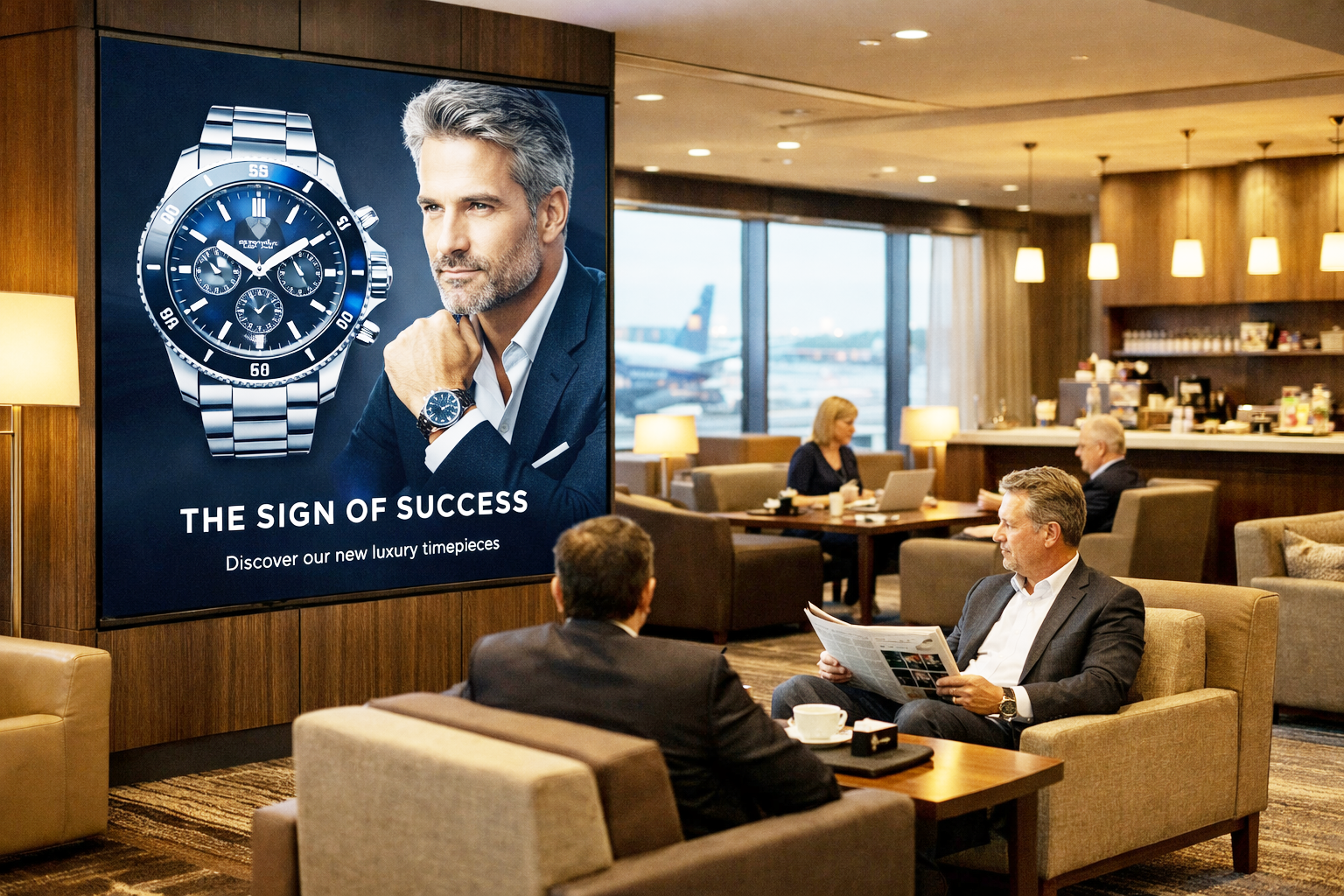
Poor Placement and Delays Affect Airport Campaigns
We help you move faster, access better inventory, and get it right now.
Talk to an ExpertFinal Strategic Verdict
Hévíz-Balaton Airport is the most intent-concentrated advertising environment in Hungarian aviation, and it is currently priced as a small regional airfield while being rebuilt into a scheduled-service gateway. A brand buying here reaches a German-speaking medical-wellness audience with committed treatment budgets, an Israeli health-tourism corridor with high per-patient value, and a Hungarian asset-holding population moving capital across borders, all inside one terminal with almost no competing advertising presence. Private healthcare, wellness, international real estate, insurance, and premium automotive brands stand to gain most, because every structural feature of this airport, from single-purpose traffic to long dwell to a treatment-focused mindset, works in their favour. The window is defined by the infrastructure programme now completing and the scheduled routes being negotiated, which means position secured today is position secured at pre-growth rates. Masscom Global has the inventory access, multilingual execution capability, and corridor intelligence to place brands correctly at SOB and on the German, Israeli, and Turkish ends of its route network at the same time.
About Masscom Global
Masscom Global is a premium international airport advertising and media buying agency operating across 140 countries. With deep expertise in airport OOH, premium publications, and high-net-worth audience targeting, Masscom helps brands reach the world's most valuable travellers at the moments that matter most. For advertising packages, media rates, and campaign planning at Hévíz-Balaton Airport and airports across the globe, contact Masscom Global today.
Frequently Asked Questions
How much does airport advertising cost at Hévíz-Balaton Airport? Cost at SOB varies by format, placement position, campaign duration, and seasonal demand. Arrival-zone and high-dwell departure positions carry premium pricing, and the April to September charter season prices differently from the October to April thermal season. Because the airport is currently transitioning toward scheduled services, rates reflect a smaller passenger base than the airport is projected to carry. Contact Masscom Global for current rates and availability.
Who are the passengers at Hévíz-Balaton Airport? Predominantly German and Austrian travellers arriving for thermal, dental, and orthopaedic treatment at Hévíz and Zalakaros, alongside Israeli health-tourism visitors and Hungarian and cross-border V4 outbound holidaymakers. The audience skews older, higher-spending, and treatment-motivated, with multi-week stays and strong repeat frequency. A secondary segment comprises automotive and manufacturing professionals travelling to Zalaegerszeg and Szombathely, plus foreign homeowners with property on the Balaton western shore.
Is Hévíz-Balaton Airport good for luxury brand advertising? It is excellent for credential-led premium categories and weaker for display-led luxury. Private healthcare, wellness, high-end real estate, premium automotive, and wealth advisory perform strongly because the audience is affluent, asset-holding, and evidence-driven. Fashion and impulse luxury perform less well, because terminal retail scale is limited and the passenger mindset is health outcome rather than indulgence. Luxury positioning at SOB should lead with substantiation, not spectacle.
What is the best airport in Hungary to reach HNWI audiences? Budapest Ferenc Liszt carries the largest absolute HNWI volume and remains the primary national buy. Hévíz-Balaton is the specialist complement, delivering the highest concentration of German-speaking medical-wellness and property-owning wealth in the country with minimal advertising competition. Planners seeking scale should buy Budapest. Planners seeking a defined premium health and second-home audience at efficient cost should buy SOB, and the two work best purchased together through Masscom Global.
What is the best time to advertise at Hévíz-Balaton Airport? April to June is the highest-ROI window, capturing the German inbound service ramp-up and the period when treatment-course bookings are decided. June to September delivers peak volume through the Antalya charter and Balaton summer season. September and October offer an affluent culturally motivated audience during wine harvest programming, and December brings a short Advent spike. The October to April thermal window is the underpriced opportunity, with the highest audience quality and the least competition for space.
Can international real estate developers advertise at Hévíz-Balaton Airport? Yes, and it is among the strongest categories at this airport. Inbound German and Austrian buyers actively purchase in Hévíz, Keszthely, and the Balaton western shore, while outbound Hungarian HNI buyers pursue Croatian Adriatic, Austrian, Spanish, Portuguese, and Dubai property. Both audiences use the same single terminal, which makes one placement effective in two directions. Masscom Global builds dual-facing creative to capture both flows in a single buy.
Which brands should not advertise at Hévíz-Balaton Airport? Mass-market fast fashion and youth apparel have no audience alignment, since the dominant passenger is older and treatment-motivated rather than trend-led. High-frequency corporate travel services and business-commuter products lack a base, because there is no daily scheduled business pattern or transfer traffic. Volume-dependent duty-free impulse categories struggle because terminal retail scale is limited and passenger intent is health rather than indulgence.
How does Masscom Global help brands advertise at Hévíz-Balaton Airport? Masscom Global delivers the full chain, from catchment and corridor intelligence to inventory access, multilingual creative execution in German, Hungarian, English, and Hebrew, seasonal campaign structuring around the airport's dual-peak rhythm, and performance measurement. We identify which routes carry which audience, place brands where dwell and intent intersect, and secure position before the scheduled-service expansion resets pricing. We also activate the corresponding German, Israeli, and Turkish ends of the corridor so campaigns work on both sides.