


Airport at a Glance
| Field | Detail |
|---|---|
| Airport | Wilmington International Airport |
| IATA Code | ILM |
| Country | United States |
| City | Wilmington, New Hanover County, North Carolina |
| Annual Passengers | Over 1.8 million (2025), a record, with 907,000+ enplanements |
| Primary Audience | Northeast and Midwest retiree relocators and second-home buyers, coastal leisure travellers, life sciences, nuclear and fintech professionals |
| Peak Advertising Season | March to May, June to August, September to October |
| Audience Tier | Tier 2 |
| Best Fit Categories | Coastal real estate and active-adult communities, retirement and estate financial products, property and coastal insurance, premium cruise and escorted travel |
Wilmington International Airport served over 1.8 million passengers in 2025, a 24 percent increase and a record, with more than 907,000 enplanements representing 67 percent growth over 2019. Between July 2022 and June 2025 the airport recorded a 66 percent increase in seat capacity, the largest three-year growth of any major airport in the United States, sustained across 39 consecutive months of record activity. Nonstop routes reached 29 across seven airlines. Airport activity generates roughly 2.5 billion dollars in annual economic impact for southeastern North Carolina.
Advertisers should understand two things that define this airport. First, the passenger mix has inverted: roughly 65 percent of traffic is now leisure, against approximately 80 percent business in 2018 and 2019, because Wilmington has become one of the most sought-after relocation and retirement destinations in the country. Neighbouring Brunswick County is among the fastest-growing counties in the United States, absorbing households from New York, New Jersey, Pennsylvania, New England and the Midwest who have sold high-value northern property and bought coastal Carolina. This makes ILM the mirror image of the airports those people left, and it puts a specific, wealthy, life-stage-defined audience through one terminal. Second, 2026 will not repeat 2025: a low-cost carrier closed its Wilmington base in January 2026 and cut nine nonstop routes, and the airport itself forecasts traffic flat to 6 percent lower for the year. Masscom Global treats that as a favourable negotiating window rather than a reason for caution, because the multi-year trajectory and a 130 million dollar expansion completing in March 2027 point firmly upward.
Advertising Value Snapshot
- Passenger scale: Over 1.8 million passengers in 2025, up 24 percent, with 907,000-plus enplanements, up 67 percent on 2019. Seat capacity up 66 percent from July 2022 to June 2025, the strongest three-year growth among major US airports. 2026 forecast flat to down 6 percent following a carrier base closure.
- Traveller type: Northeast and Midwest retiree relocators and second-home buyers, coastal leisure travellers, and life sciences, nuclear engineering and fintech professionals.
- Airport classification: Tier 2. Catchment affluence is genuine and retiree asset wealth substantial, but the passenger mix is value-carrier leisure with no ultra-premium transit flow.
- Commercial positioning: The commercial gateway to the Cape Fear coast, deliberately operated as a low-cost airport with a cost per enplanement of roughly 3.82 dollars against about 8.53 dollars at comparable facilities.
- Wealth corridor signal: The receiving end of the Northeast and Midwest to coastal Carolina retirement and tax-migration corridor.
Advertising opportunity: This terminal delivers an audience at a defined life stage, in the middle of a relocation, property purchase and retirement financial decision, at a concentration few American airports match. Masscom Global provides inventory access and placement precision that lets coastal developers, retirement community operators, financial product providers and insurers intercept that decision while it is live, with message competition far below Charlotte or Raleigh levels.
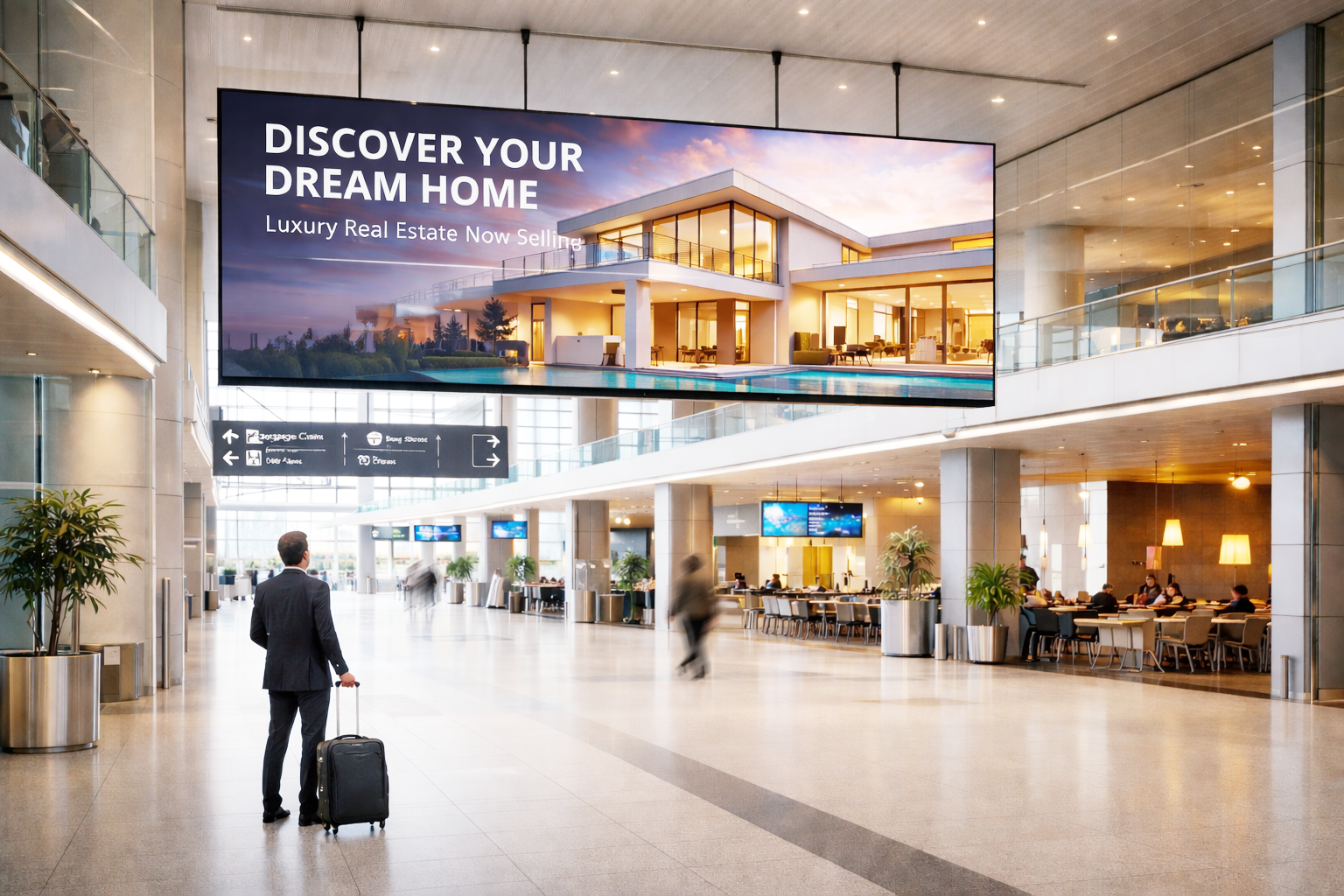
Airport Advertising is Complex to Get Right
We help you execute faster, with proven results and local insight most planners lack starting now.
Talk to an ExpertCatchment Area and Economic Drivers
Top 10 Cities within 150 km, Marketer Intelligence:
- Wilmington, North Carolina: The commercial, medical and technology core roughly 10 kilometres from the terminal, hosting a global clinical research organisation, a nuclear energy engineering and fuel manufacturing operation, a listed banking software company and a national commercial lender. Produces scientific, engineering and executive audiences alongside a substantial professional resident base.
- Wrightsville Beach and Figure Eight Island: The catchment's highest-value residential nodes, with Figure Eight a private bridge-access island holding a tightly held and extremely expensive property market. Audience is discreet, established and privacy-seeking, responding to legacy planning, private banking and understated quality rather than to visible status.
- Landfall, Porters Neck and the gated golf communities: Large master-planned golf and country club developments populated heavily by relocated Northeast and Midwest executives and professionals. This is the single most addressable concentration of retirement-stage wealth in the catchment, and the natural target for estate, annuity, insurance and premium consumer propositions.
- Bald Head Island and Southport: Car-free private island and adjacent historic waterfront town forming an exclusive second-home market, alongside a major military ocean terminal. High-value property, marine and premium hospitality relevance with a distinctly low-profile audience.
- Brunswick County, including Leland, St. James, Ocean Isle Beach, Sunset Beach and Calabash: Among the fastest-growing counties in the United States, driven almost entirely by inbound retiree and pre-retiree relocation. This is the volume engine of the catchment's relocation economy and the prime market for active-adult communities, home services, healthcare and financial products.
- Topsail Island, Surf City and Hampstead: Rapidly developing coastal residential corridor drawing both retirees and younger affluent families priced out of Wrightsville. Actively purchasing property, boats and home improvement services, making this the strongest real estate consumer segment in the northern catchment.
- Jacksonville and Camp Lejeune: Major Marine Corps installation and air station approximately 80 kilometres north. Produces a large, young, geographically mobile military and military-family audience with distinctive travel patterns around deployment, graduation and relocation cycles, plus significant automotive, insurance and financial services demand.
- The northern Grand Strand and Little River, South Carolina: Cross-border overlap with the Myrtle Beach market roughly 110 kilometres south, adding golf, resort and retirement community audiences and a second-state regulatory dimension for insurance and financial advertisers.
- Whiteville, Elizabethtown and the Cape Fear interior: Agricultural belt centred on tobacco, sweet potato, poultry and hog production with substantial associated processing employment. Produces landowner and agribusiness principals plus a large Hispanic workforce audience.
- Fayetteville and Fort Liberty, at the catchment's outer edge: One of the largest military installations in the world approximately 150 kilometres northwest. A secondary but genuinely significant audience for automotive, financial services, insurance and value travel categories.

NRI and Diaspora Intelligence:
This catchment is considerably less diverse than the Northeastern airports, and advertisers should plan accordingly rather than assume a comparable diaspora opportunity. The principal non-Anglophone community is Hispanic, concentrated in Wilmington itself and much more heavily in the agricultural and food-processing interior across Sampson, Duplin and Columbus counties, where poultry and hog processing employ large Mexican, Guatemalan and Honduran workforces. This community generates consistent cross-border family travel, remittance flow and heavy prepaid telecom usage, and is addressable through Spanish-language value creative, though it connects internationally via Charlotte and Atlanta rather than through ILM directly.
The far more commercially significant migration story at this airport is internal and inbound. Wilmington and Brunswick County are receiving sustained relocation from New York, New Jersey, Pennsylvania, Connecticut, Massachusetts, Ohio and Michigan, and those households retain strong family ties to their origin regions. This produces a large, predictable and repeat visiting-friends-and-relatives flow in both directions on the Northeast routes, and it means a substantial share of the terminal's passengers hold assets, family and financial relationships in two states simultaneously. That dual-jurisdiction position is itself a commercial proposition for wealth, insurance and tax advisers. Precise migration and remittance volumes for this catchment are not available.
Economic Importance:
Five engines drive this catchment. Life sciences and clinical research, anchored by a globally significant contract research organisation headquartered in Wilmington, supply high-value scientific and professional employment. Nuclear energy engineering and fuel manufacturing, alongside a nearby operating nuclear station, provide a technically sophisticated industrial base now benefiting from renewed sector investment. Financial technology and commercial banking form a genuine and growing cluster with two nationally relevant companies headquartered locally. Film and television production, supported by the largest full-service studio facility east of California, delivers episodic but high-spend activity. Underpinning all of it is the relocation economy: healthcare, construction, home services, hospitality and retail expanding continuously to serve inbound population growth, alongside a container port, regional healthcare system, state university and major military installations.
Business and Industrial Ecosystem
- Clinical research and life sciences: A globally significant contract research organisation headquartered in Wilmington, alongside pharmaceutical manufacturing and laboratory services. Produces scientific, regulatory, clinical operations and executive travellers with recurring national and international conference business.
- Nuclear energy engineering and fuel manufacturing: Reactor design and nuclear fuel production operations in Wilmington plus an operating nuclear station in Brunswick County. Produces engineering leadership and long-cycle industrial procurement audiences, in a sector attracting renewed capital as small modular reactor programmes advance.
- Financial technology and commercial banking: A listed cloud banking software company and a national small business lender both headquartered locally, forming an unusually strong technology and finance cluster for a market of this size. Produces technology, sales and executive travellers with heavy national travel patterns.
- Film, television and content production: The largest full-service studio facility on the East Coast, supporting periodic large-scale production with associated crew, cast and vendor travel. Produces a distinctive and high-spend episodic audience.
- Port, logistics and coastal construction: North Carolina's international container port, cold chain and export activity, alongside a construction and home services sector expanding continuously to meet relocation demand. Produces logistics, building products and contractor decision-makers.
Passenger Intent, Business Segment:
Business travel here has become the minority share of a growing airport, which is an important nuance. Roughly 35 percent of traffic is business or non-leisure, down from approximately 80 percent before 2020, but the absolute volume has held because total passengers have grown so sharply. These travellers move to Charlotte, Atlanta, Washington, New York, Philadelphia, Chicago and Dallas for clinical research, nuclear engineering, technology sales, port and logistics business. Categories that intercept them effectively are business technology, professional services, commercial banking, industrial equipment and premium automotive. The clinical research and nuclear engineering segments in particular are technically sophisticated, internationally connected and worth targeting with substantive rather than aspirational creative.
Strategic Insight:
The most valuable insight at ILM is that the airport now carries two audiences whose interests overlap almost perfectly. Business travellers are frequently the same professionals who relocated here, and leisure travellers are frequently retirees who did the same thing a few years earlier. Both are dual-jurisdiction households with property, family and financial relationships split between coastal Carolina and the Northeast or Midwest. That makes the terminal an unusually effective channel for anything touching relocation, property, insurance, tax and estate structuring, and it explains why a market of this size supports two nationally relevant financial companies. Masscom Global builds campaigns here around that shared life-stage position rather than around conventional business or leisure segmentation.
Tourism and Premium Travel Drivers
- Wrightsville Beach, Topsail and the Cape Fear coast: Extended beach season from May through September drawing regional and Northeastern visitation, with a premium residential overlay at Wrightsville and Figure Eight. Relevant to hospitality, marine, real estate and premium consumer advertisers.
- Golf and gated community leisure: A dense concentration of resort and private golf communities across New Hanover and Brunswick counties, extending into the northern Grand Strand. Produces an affluent, travel-active, retirement-stage audience with strong automotive, apparel, financial services and travel alignment.
- Bald Head Island and the Brunswick Islands: A graduated premium coastline from car-free private island to family resort beaches, drawing repeat annual visitors who frequently convert into property buyers.
- Historic Wilmington, the Riverwalk and film tourism: A well-preserved historic district, riverfront, gardens, a battleship memorial and a substantial screen-production heritage supporting year-round city visitation that skews older and more affluent than the beach segment.
Passenger Intent, Tourism Segment:
Leisure passengers here divide into two commercially distinct groups. Inbound visitors arrive with accommodation committed for beach, golf or family visits, and a meaningful proportion are prospecting: this is a market where holiday visits convert into relocation decisions at unusually high rates, which makes arrivals placement a genuine consideration-stage intercept for property, community and financial advertisers. Outbound passengers are principally residents departing for Northeast family visits, Florida, and cruise and escorted tour departures via Charlotte, Atlanta and the Southeastern ports. Advertisers should build for both directions, with property and relocation creative on arrivals and travel, insurance and financial creative on departures.
Travel Patterns and Seasonality
Peak seasons:
- March to May: The strongest inbound window, combining golf season, spring break, the major April festival and the arrival of relocation prospecting traffic ahead of the summer buying season.
- June to August: The beach and family leisure peak, with the highest volume of the year and the broadest consumer audience.
- September and October: A high-value shoulder window carrying golf, coastal events and retiree travel at lower cost, with weather still favourable and crowds reduced.
- November and December: Thanksgiving and Christmas visiting-friends-and-relatives travel in both directions on the Northeast routes, reflecting the catchment's dual-jurisdiction households.
Traffic volume data:
Total passengers exceeded 1.8 million in 2025 with more than 907,000 enplanements, against a record 1,086,245 passengers in 2022 and approximately 1 million in 2019. Seat capacity rose 66 percent between July 2022 and June 2025, and the airport recorded 39 consecutive months of record activity as of July 2025. Net operating income for 2025 was just over 6 million dollars. Full monthly distributions are not available, and 2026 is forecast flat to 6 percent lower following a carrier base closure.
Event-Driven Movement:
- North Carolina Azalea Festival (April): One of the largest festivals in the Southeast, held in Wilmington and drawing very substantial regional and out-of-state attendance. The single strongest consumer window of the spring for automotive, beverage, retail, hospitality and financial services advertisers.
- Golf season, spring and autumn: Sustained inbound golf travel across the catchment's resort and private courses, extending into the northern Grand Strand. Prime timing for automotive, apparel, wealth advisory, insurance and property messaging aimed at a retirement-stage audience.
- Coastal fishing tournaments and the marine calendar (May to September): Established king mackerel and offshore tournament activity out of Wrightsville Beach and the Brunswick ports. Strong for marine, outdoor, automotive and beverage categories.
- University arrival, graduation and parents' weekends (August and May): The state university in Wilmington generates compressed family travel surges with high receptivity to financial services, insurance, automotive and hospitality messaging.
- Military graduation, deployment and relocation cycles at Camp Lejeune: Recurring, predictable family travel throughout the year, distinct from civilian seasonality and highly responsive to automotive, insurance, banking and value travel propositions.
- Autumn coastal events including the October oyster festival and November flotilla: Regional celebrations extending visitation into the shoulder season and drawing an affluent, repeat-visiting audience.
Note that June through November is Atlantic hurricane season, which introduces genuine schedule disruption risk and, separately, makes property and coastal insurance among the most contextually relevant advertiser categories at this airport.

It’s Not Just Where You Advertise - It’s How Fast You Execute
We combine local insight with fast rollout to deliver results for you, now.
Talk to an ExpertAudience and Cultural Intelligence
Top 2 Languages:
- English: Overwhelmingly dominant across resident, professional and leisure audiences. Creative should be warm, specific and evidence-led. This catchment combines Southern communication norms with a large transplanted Northeastern population, which produces an audience that values courtesy in tone but expects directness on substance, particularly around cost, terms and guarantees.
- Spanish: The clear second language, concentrated in Wilmington and much more heavily across the agricultural and food-processing interior. Spanish-language creative is commercially warranted for automotive, telecom, remittance, insurance and value travel categories, though this segment is smaller relative to total traffic than at comparable Northeastern airports.
Other languages are present at levels that do not warrant dedicated creative, and advertisers should not plan this catchment as a multilingual environment.
Major Traveller Nationalities:
The passenger base is almost entirely domestic American. The commercially defining characteristic is not nationality but origin state: substantial and growing populations relocated from New York, New Jersey, Pennsylvania, Connecticut, Massachusetts, Ohio and Michigan, who retain family and financial ties to those markets. Mexican, Guatemalan and Honduran communities represent the principal non-domestic ties through the agricultural interior. International travel from this catchment connects via Charlotte and Atlanta. Campaign creative should be built for a domestic American audience with a strong Northeastern-transplant sensibility and a Spanish-language secondary layer.
Religion, Advertiser Intelligence:
Figures below are directional approximations for southeastern North Carolina rather than airport-level survey data.
- Evangelical and mainline Protestant Christianity (approximately 45 to 50 percent): The historic religious foundation of the region, spanning Baptist, Methodist, Presbyterian and non-denominational traditions. Drives Christmas and Easter family travel, church-organised group and mission travel, and charitable giving cycles. Purchase behaviour responds to family framing, community endorsement and trust signals, and advertisers should avoid creative that reads as irreverent.
- Roman Catholicism (approximately 12 to 15 percent and rising): Growing quickly through both Northeastern in-migration and the Hispanic population, which is materially shifting the region's religious profile. Drives Christmas, Easter and cross-border family travel plus confirmation and communion gifting cycles. Relevant to gifting, travel and family financial products, with Spanish-language creative essential in the interior.
- Religiously unaffiliated (approximately 20 to 25 percent and rising): Concentrated among the university population, the technology and life sciences workforce, and a portion of the Northeastern transplant community. Higher receptivity to experience, wellness, sustainability and technology positioning.
- Judaism and other faiths (approximately 2 to 4 percent combined): Small but growing through Northeastern relocation, particularly into the coastal gated communities. Supports cultural travel, philanthropy and legacy propositions at modest scale.
Behavioral Insight:
This is a life-stage audience more than an income audience, and that should drive every creative decision. A large share of passengers are within a few years either side of retirement, have recently executed or are actively contemplating a major relocation, and are consequently making a cluster of decisions simultaneously: property purchase, insurance, healthcare provider, income planning, estate structuring and vehicle replacement. They are cash-rich from northern property sales, unusually receptive to advice, and actively seeking local providers because they have no established relationships in the market. Very few airport audiences are so openly in-market across so many categories at once. Two cautions apply. Coastal insurance and construction claims experience has made this audience sceptical about weather and warranty language, so vagueness on coverage is costly. And the transplanted Northeastern segment is considerably more direct and comparison-driven than local Southern norms would suggest, so soft creative without substantiation underperforms.
Outbound Wealth and Investment Intelligence
The passenger profile at ILM requires the standard framing to be inverted, because this catchment is a net importer of wealth rather than an exporter. North Carolina levies a comparatively low flat income tax and no estate tax, and coastal Carolina property remains a fraction of Northeastern equivalents. Households arriving here have typically already realised substantial gains on northern real estate and are redeploying that capital locally. The commercially relevant intelligence therefore runs in three directions: inbound relocation capital, in-market property and financial deployment, and modest outbound travel and second-home activity.
Outbound Real Estate Investment:
Inbound to this catchment, capital from New York, New Jersey, Pennsylvania, New England and the Midwest is actively purchasing across Landfall, Porters Neck, Wrightsville Beach, Figure Eight Island, Bald Head Island, St. James, Ocean Isle Beach, Sunset Beach, Leland and the Topsail corridor. This is the most immediately actionable property proposition at this airport and it should be addressed to arrivals. Outbound from the catchment, residents purchase mountain second homes in western North Carolina around Asheville, Blowing Rock and the Highlands and Cashiers area, alongside Florida for those seeking warmer winters and, at smaller scale, the northern Grand Strand and coastal Georgia. International property interest is limited and clusters on Caribbean and Mexican resort markets, with modest heritage-driven interest in Ireland, Italy and the United Kingdom.
Outbound Education Investment:
Families here fund the University of North Carolina system, the state university in Wilmington, and Southeastern private institutions including strong regional loyalties, while transplanted Northeastern families frequently maintain ties to universities in their origin states. Independent school participation is meaningful but well below Northeastern levels. The more distinctive education audiences are inbound: university parent and student travel, and continuing professional education in clinical research and nuclear engineering. International universities and boarding schools will find this a thinner market than the Northeastern airports and should weight spend accordingly.
Outbound Wealth Migration and Residency:
Advertisers must invert the standard proposition. There is minimal demand here for citizenship-by-investment, golden visa or international residency programmes, and comparatively little demand for domestic tax-domicile relocation, because this catchment is the destination rather than the origin. The active demand is for the arrival side of that transaction: coastal property, active-adult communities, healthcare provider selection, retirement income planning, annuities, long-term care and Medicare supplement products, coastal property and flood insurance, estate and trust structuring across two state jurisdictions, and vehicle and home service providers. Advertisers who understand that this audience is completing a migration rather than starting one will substantially outperform those who do not.
Strategic Implication for Advertisers:
There is a direct and exploitable pairing here. The households arriving at ILM are, in many cases, the same households departing from airports like Long Island MacArthur, Manchester-Boston, Philadelphia and the Ohio and Michigan markets. Coastal developers, active-adult community operators, retirement financial product providers and insurers can address the identical decision at both ends of the journey. Masscom Global can activate simultaneously at ILM and at the Northeastern and Midwestern origin airports that feed it, reaching the same household while it is deciding and again after it has arrived.
Airport Infrastructure and Premium Indicators
Terminals:
- A single consolidated passenger terminal that completed a 69 million dollar expansion in September 2023, funded with 40 million dollars federal, 16 million dollars state and 13 million dollars local and other contributions. That project added an outbound bag room and screening equipment, expanded the ticket lobby and counters, added gate space and seating, and delivered new restrooms and concession space.
- A further 130 million dollar expansion and renovation programme is underway with completion expected in March 2027, forming part of 243 million dollars in planned capital projects. Including anticipated private investment in the adjacent business park, total expected investment at the airport exceeds 490 million dollars. Planned works include three additional gates and four aircraft bays, expanded baggage areas and airfield improvements.
- Roadway, curb front and parking capacity have been expanded, with new roads, additional parking and a cell phone lot opened to manage growth, and further curb realignment planned to separate passenger and commercial traffic.
Premium Indicators:
- The airport's operating model is a genuine competitive asset. Cost per enplanement of roughly 3.82 dollars against about 8.53 dollars at comparable airports, minimal debt with the balance sheet expected to be debt-free by 2028, and positive net operating income give ILM unusual latitude to attract and retain carriers.
- A destination marketing partnership with the regional visitors bureau provides an incentive budget of around 125,000 dollars to promote new routes, with 250,000 dollars budgeted across recent years for new destination airline marketing. Airport leadership has noted that no other small airport operates a comparable programme.
- The terminal environment has been deliberately invested in as a first and last impression, including three commissioned works of public art from regional artists: a large terrazzo floor design in the lobby depicting the carnivorous plant native only to within roughly 100 miles of Wilmington, a post-security installation reflecting coastal wildlife, and a metal sculpture of a laurel oak creating an open park-like space. This is a materially better-considered environment than passenger volume alone would predict, and it lifts the standing of brand messaging placed within it.
- General aviation activity serves the Figure Eight Island, Bald Head Island and gated community wealth base, and the adjacent business park is attracting private aviation and commercial development investment.
Forward-Looking Signal:
The multi-year picture is strong and the near-term picture requires honesty. Between July 2022 and June 2025 ILM posted the largest seat capacity growth of any major American airport at 66 percent, across 39 consecutive record months, reaching 29 nonstop routes and 1.8 million passengers. Breeze Airways and JetBlue both launched service during 2025. Against that, a low-cost carrier closed its Wilmington base in January 2026 and removed nine nonstop routes, and the airport forecasts 2026 traffic flat to 6 percent lower, noting that most withdrawn routes are served by other carriers and some traffic should shift across. Airport leadership has publicly indicated that 2026 will not be a strong growth year but that 2027 through 2029 should be, with the 130 million dollar expansion completing in March 2027 and a stated expectation that traffic will double again over the coming decade. Masscom Global reads this as the most favourable negotiating window this airport is likely to offer, and advises securing multi-year positions before the expansion completes and growth resumes.
Airline and Route Intelligence
Top Airlines:
American Airlines, Delta Air Lines and United Airlines forming the legacy core, alongside Avelo Airlines, Breeze Airways, JetBlue Airways and Sun Country Airlines. Three low-cost carriers joined within the last four years, and American, Delta and United have all grown capacity with larger aircraft and added frequencies.
Key International Routes:
ILM operates no scheduled international passenger service. International travel from this catchment connects via Charlotte, Atlanta, Washington, New York and Philadelphia. Advertisers targeting internationally bound travellers, including the cruise and escorted tour segment that is significant among this retirement-stage audience, reach them here at origin before hub-level competition begins.
Domestic Connectivity:
Twenty-nine nonstop routes at the 2025 peak, since reduced by the January 2026 carrier withdrawal. Core markets include Charlotte, Atlanta, Washington, New York LaGuardia, Philadelphia, Chicago, Dallas, Boston, Hartford, Orlando, Fort Lauderdale, Fort Myers, Tampa and Minneapolis-St. Paul. Verified current frequencies by route are not available and advertisers should confirm the post-withdrawal schedule when planning.
Wealth Corridor Signal:
The route map tells the relocation story directly. New York, Philadelphia, Boston, Hartford, Washington and the Midwest connections are not conventional business corridors here: they are the family, property and financial ties of a population that moved from those places and did not sever its connections. Charlotte and Atlanta are the hub and connection corridors carrying business travel and onward international itineraries. Florida in its several destinations serves both leisure and the secondary migration of residents seeking warmer winters still. The pattern to note is that the Northeastern routes carry the highest-value audience at this airport, in both directions, and they are where relocation, property, insurance and wealth advisory spend belongs.
Media Environment at the Airport
- Single-terminal configuration means full-journey coverage across 1.8 million passengers is achievable from one compact footprint, at a fraction of Charlotte or Raleigh pricing while reaching a more sharply defined and more in-market audience.
- Advertising clutter is materially lower than at the Carolina hub airports. A well-placed campaign at ILM achieves standout and recall that would demand premium spectacular positioning at Charlotte Douglas.
- Dwell time is supported by the terminal's recently expanded gate and concession areas, deliberate investment in a comfortable environment, and the early-arrival behaviour typical of an older leisure-weighted passenger base. Retirees and second-home owners also travel repeatedly, delivering accumulated frequency well beyond what raw passenger counts imply.
- Masscom Global provides advertisers with inventory access, placement precision mapped to individual route flows, and execution capability at an airport where local relationship depth determines availability. We separate the Northeastern arrival positions, where relocation, property and financial propositions belong, from the Florida and regional leisure departure flows, so each creative reaches its intended audience rather than a blended average.
Strategic Advertising Fit
Best Fit:
- Coastal residential real estate and active-adult communities: This is the defining category at this airport. Inbound relocation from the Northeast and Midwest is the region's primary growth engine and arrivals frequently include active prospects.
- Retirement income planning, annuities and estate structuring: A life-stage audience, cash-rich from northern property sales, actively seeking local providers because it has no established relationships in the market.
- Property, flood and coastal insurance: Hurricane exposure from June to November makes this among the most contextually relevant categories at the airport, with an audience that has direct claims experience and rewards specificity on coverage.
- Healthcare systems, specialist medical services and long-term care: Provider selection is one of the first decisions relocating retirees make, and regional health systems compete directly for it.
- Premium cruise, river cruise and escorted tour travel: Exceptionally well matched to this audience's age, income and travel preferences, with departures routing through Charlotte and Atlanta.
- Premium automotive, golf and marine: High vehicle replacement rates among relocating households, dense golf community participation and substantial coastal boat ownership.
- Home services, building products and renovation: Sustained construction and improvement activity across one of the fastest-growing counties in the United States.
- Life sciences, nuclear engineering and fintech B2B: A genuine technical cluster producing sophisticated, internationally connected professional audiences worth targeting with substantive creative.
Brand Alignment at a Glance:
| Category | Fit |
|---|---|
| Coastal real estate and active-adult communities | Exceptional |
| Retirement income, annuities and estate planning | Exceptional |
| Property, flood and coastal insurance | Strong |
| Healthcare systems and long-term care | Strong |
| Premium cruise and escorted tour travel | Strong |
| Premium automotive, golf and marine | Strong |
| Life sciences, nuclear and fintech B2B | Moderate |
| Ultra-luxury fashion, haute joaillerie and superyacht brokerage | Poor fit |
Who Should Not Advertise Here:
- Ultra-luxury fashion, haute joaillerie and superyacht brokerage: The catchment contains real coastal wealth at Figure Eight and Bald Head, but volume is far too thin and the audience too discreet to support these categories, and there is no international luxury transit flow. Spend belongs at Charlotte, Charleston or the Florida gateways.
- International residency and citizenship-by-investment programmes: This catchment is the receiving end of a migration, not the origin. North Carolina's low flat income tax and absence of estate tax mean these households have already solved the problem these programmes address.
- Youth-led fashion, nightlife and streetwear: The catchment's age profile is skewing older through sustained retiree in-migration, and while the university supplies a younger cohort, it is too small to justify airport spend. These budgets perform better at Raleigh or Charlotte.
Event and Seasonality Analysis
- Event Strength: Medium
- Seasonality Strength: Medium to High
- Traffic Pattern: Broad spring-to-autumn season with a stable relocation base
Strategic Implication:
This airport rewards long flights rather than short bursts, because the relocation and retirement audience is making decisions over months rather than days and travels repeatedly while doing so. Advertisers should commit to annual positions and then add weight in three windows: March to May for golf, spring break, the April festival and the start of the property prospecting season; June to August for peak beach and family volume; and September to October for the high-value shoulder window when retiree travel concentrates. Property, insurance and financial creative should sit on arrivals from the Northeastern routes throughout. Given that 2026 is forecast flat to 6 percent lower and the major expansion completes in March 2027, this is the most favourable window in years to lock multi-year rates. Masscom structures campaigns around exactly that timing.

Poor Placement and Delays Affect Airport Campaigns
We help you move faster, access better inventory, and get it right now.
Talk to an ExpertFinal Strategic Verdict
Wilmington International is the clearest life-stage advertising channel in the American Southeast, and it is currently priced at a discount to its trajectory. It served over 1.8 million passengers in 2025, a 24 percent increase and a record, having posted the largest three-year seat capacity growth of any major United States airport at 66 percent across 39 consecutive record months. More importantly, its passengers are a defined and openly in-market audience: households from New York, New Jersey, Pennsylvania, New England and the Midwest arriving at, or already inside, a relocation that involves property, insurance, healthcare, income planning and vehicle decisions all at once. Coastal developers, active-adult community operators, retirement financial product providers, insurers, health systems, cruise and escorted tour operators and premium automotive brands will find that audience here at a fraction of Charlotte pricing. Ultra-luxury fashion, superyacht brokerage and international residency programmes should look elsewhere. With 2026 forecast flat after a carrier base closure and a 130 million dollar expansion completing in March 2027 ahead of expected renewed growth, this is the most favourable negotiating window this airport will offer, and Masscom Global is the partner positioned to secure inventory, timing and placement precision before it closes.
About Masscom Global
Masscom Global is a premium international airport advertising and media buying agency operating across 140 countries. With deep expertise in airport OOH, premium publications, and high-net-worth audience targeting, Masscom helps brands reach the world's most valuable travellers at the moments that matter most. For advertising packages, media rates, and campaign planning at Wilmington International Airport and airports across the globe, contact Masscom Global today.
Frequently Asked Questions
How much does airport advertising cost at Wilmington International Airport?
Cost at ILM varies by format, terminal position, campaign duration and seasonal demand. Positions covering the arrivals environment on the Northeastern route flows carry premiums during the March to October prospecting and leisure season, while winter months are considerably more efficient. Because 2026 traffic is forecast flat to slightly lower ahead of a major expansion completing in March 2027, current pricing is unusually favourable relative to the airport's multi-year trajectory. Contact Masscom Global for current rates and availability.
Who are the passengers at Wilmington International Airport?
Roughly 65 percent leisure and 35 percent business, an inversion of the approximately 80 percent business mix of 2018 and 2019. The dominant groups are retirees and pre-retirees who have relocated from New York, New Jersey, Pennsylvania, New England and the Midwest, second-home owners and property prospects across the Cape Fear coast, beach and golf leisure visitors, and professionals from the region's clinical research, nuclear engineering and financial technology employers. A large military and military-family audience sits at the catchment's northern and western edges.
Is Wilmington International Airport good for luxury brand advertising?
For premium categories aligned to this audience, yes. Premium automotive, golf, marine, cruise travel and private wealth advisory all convert well with an affluent, retirement-stage population holding substantial realised gains from northern property sales. For ultra-luxury fashion, haute joaillerie and superyacht brokerage, no. Volume is too thin, the coastal wealth at Figure Eight and Bald Head is deliberately discreet, and there is no international luxury transit flow to support those categories.
What is the best airport in North Carolina to reach HNWI audiences?
Charlotte Douglas delivers the greatest volume of wealth and business traffic in the state and remains the anchor buy, with Raleigh-Durham strong for the Research Triangle pharmaceutical and technology audience. Wilmington delivers something narrower and highly specific: the coastal retirement and relocation audience, in-market across property, insurance and financial categories, at a fraction of hub pricing. Masscom recommends Charlotte for reach and ILM for life-stage precision, and can structure a coordinated Carolina plan across both.
What is the best time to advertise at Wilmington International Airport?
Because the audience decides over months rather than days, annual positions outperform short bursts. Within that, March to May is strongest for golf, spring break, the April Azalea Festival and the opening of the property prospecting season. June to August delivers peak beach and family volume. September and October provide a high-value shoulder window when retiree travel concentrates. November and December carry Northeastern family travel in both directions.
Can international real estate developers advertise at Wilmington International Airport?
The stronger proposition here is inbound rather than outbound. Northeastern and Midwestern capital is actively buying across Landfall, Wrightsville Beach, Figure Eight Island, Bald Head Island, St. James, Ocean Isle Beach and the Topsail corridor, and arrivals frequently include live prospects. Outbound, residents buy western North Carolina mountain property and Florida, with limited international interest confined largely to Caribbean and Mexican resort markets. Developers with coastal Carolina or Southeastern inventory will find the strongest intent.
Which brands should not advertise at Wilmington International Airport?
Ultra-luxury fashion, haute joaillerie and superyacht brokerage, because volume is too thin and the local wealth too discreet. International residency and citizenship-by-investment programmes, because this catchment is the destination of a migration rather than its origin. And youth-led fashion, nightlife and streetwear, because the population profile is skewing older through sustained retiree in-migration.
How does Masscom Global help brands advertise at Wilmington International Airport?
Masscom Global delivers the full sequence: audience and catchment intelligence specific to the Cape Fear relocation economy and its life-stage decision cluster, inventory access and placement precision mapped to individual route flows, campaign timing structured around the spring prospecting season and the autumn shoulder window, and execution management through to performance reporting. Operating across 140 countries, we can activate ILM alongside the Northeastern and Midwestern origin airports that feed this migration, reaching the same household while it is deciding to move and again after it has arrived. Book a fifteen-minute planning call to review current availability and rates.