


Airport at a Glance
| Field | Detail |
|---|---|
| Airport | Sudbury Airport (Greater Sudbury Airport) |
| IATA Code | YSB |
| Country | Canada |
| City | Greater Sudbury, Ontario |
| Annual Passengers | 129,033 (2023) |
| Primary Audience | Mining and resource executives, healthcare and academic professionals, outbound sun-charter leisure travellers |
| Peak Advertising Season | January to March, June to September |
| Audience Tier | Tier 3 by volume, Tier 2 by audience quality |
| Best Fit Categories | Mining technology and industrial equipment, financial services and wealth management, automotive and pickup trucks, sun-destination real estate and residency |
Sudbury Airport is a low-volume, high-concentration environment. It handled 129,033 passengers in 2023, but the composition of that traffic is what matters commercially. Greater Sudbury is the operational and technical centre of one of the world's most significant nickel and copper basins, and the people flying in and out of YSB are disproportionately mining executives, engineering consultants, equipment principals, physicians, and university leadership. There is very little transit noise. Almost every passenger has a reason to be here that is tied to industry, health, education, or high-value leisure.
This airport sits on a resource wealth corridor rather than a tourism corridor. Capital flows into Sudbury from global mining majors and flows out through a local supplier base of several hundred mining technology and services firms that sell into Chile, Peru, Australia, South Africa, and Central Asia. The household wealth profile in the catchment is built on skilled trades, mining management, and professional services, all of which produce discretionary spending in vehicles, recreational property, sun-destination real estate, and retirement planning. For advertisers who want to reach a specific industrial decision-maker rather than a broad consumer crowd, this is a precision buy.
Advertising Value Snapshot
- Passenger scale: 129,033 passengers in 2023, up from 111,792 in 2022, a year-on-year increase of roughly 15 percent. The 2019 baseline was 245,722, so the market is still in recovery and current rate environments reflect that.
- Traveller type: Mining and industrial executives, healthcare and academic professionals, outbound leisure charter travellers.
- Airport classification: Tier 3 by volume, Tier 2 by audience quality. Volume is modest, but passenger seniority and purchase authority are high.
- Commercial positioning: The corporate air gateway to Canada's nickel basin and its mining technology export cluster.
- Wealth corridor signal: Sudbury to Toronto is a capital and corporate governance corridor. Mining capital is raised and administered in Toronto and deployed operationally in Sudbury.
- Advertising opportunity: A single terminal with one screening point and one departure hold room means near-total audience capture for a small number of placements. Masscom Global structures YSB campaigns to dominate rather than share, delivering repeat exposure to the same executive audience across a travel cycle. This is one of the few Canadian airports where a modest budget can achieve effective saturation.
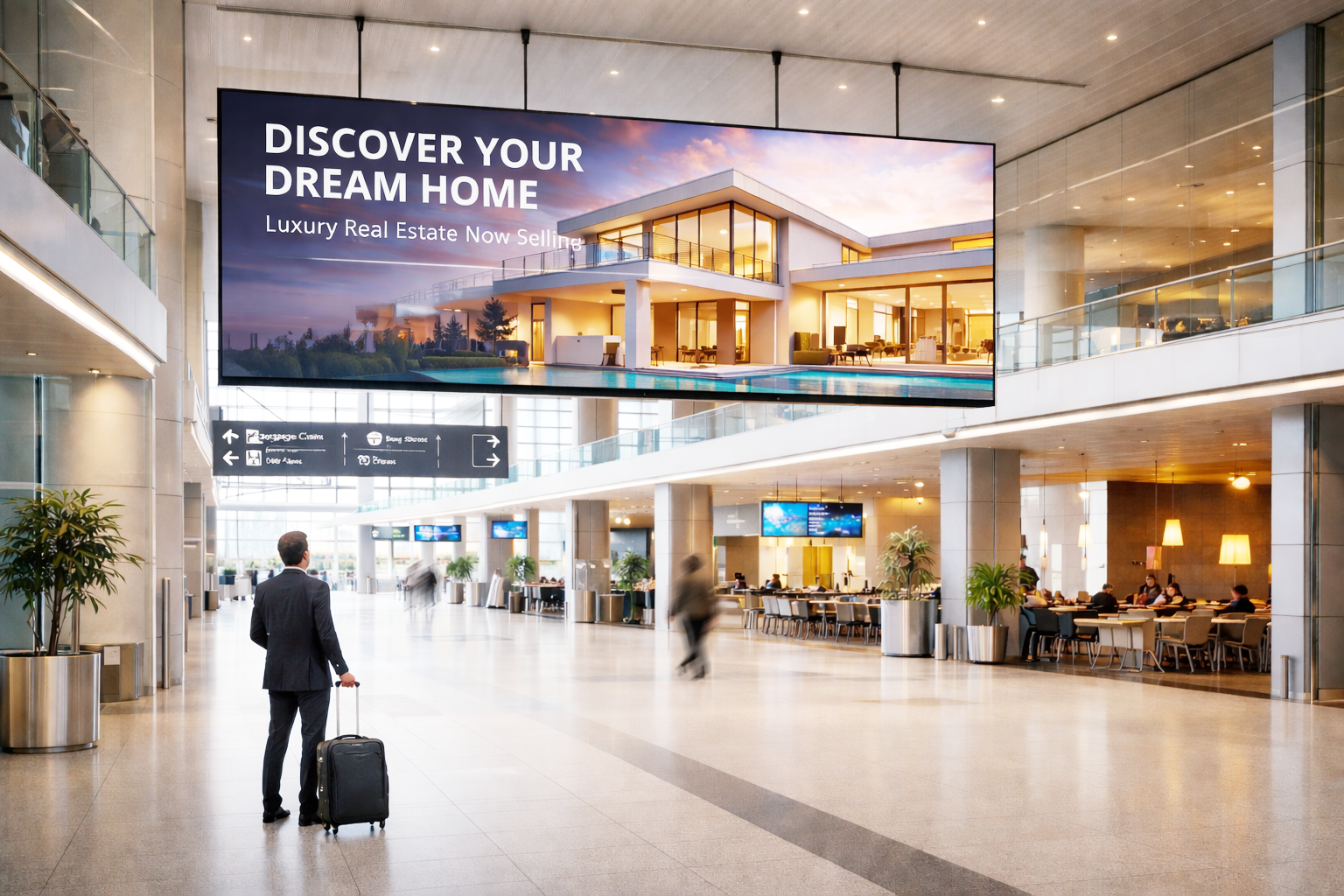
Airport Advertising is Complex to Get Right
We help you execute faster, with proven results and local insight most planners lack starting now.
Talk to an ExpertCatchment Area and Economic Drivers
Top 10 Cities within 150 km, Marketer Intelligence:
- Greater Sudbury (core): The primary source of passengers. Mining management, healthcare, and post-secondary employment create a stable professional income base with high vehicle ownership and strong recreational property demand.
- Val Caron and Hanmer (Valley East): Family-heavy suburban corridor with skilled trades and mining workforce households. Responsive to automotive, home improvement, and family travel offers.
- Chelmsford and Rayside-Balfour: Concentrated francophone community with high homeownership. Bilingual creative outperforms English-only for this segment.
- Lively and Walden: Adjacent to active mining operations. Households here include shift supervisors and technical staff with strong disposable income and predictable earnings.
- Garson and Falconbridge: The airport's immediate community, built around smelting and refining operations. Direct catchment for industrial employer and trades recruitment advertising.
- Capreol: Rail and logistics workforce base. Transport, insurance, and financial services messaging aligns with this audience.
- Espanola (70 km): Forestry and pulp production town. Small but reliable industrial audience with regional travel dependence on YSB.
- Sturgeon Falls and West Nipissing (85 km): Strongly francophone commercial centre servicing agriculture and small manufacturing. Bilingual creative is essential here.
- North Bay (125 km): Regional administrative and defence-linked centre. Overlaps with its own airport, but spillover business travel into YSB occurs for Toronto and Ottawa connectivity.
- Little Current and Manitoulin Island (150 km): Seasonal cottage and marine tourism economy. Home to a significant Anishinaabe population and a summer influx of high-income Ontario and US cottage owners.
NRI and Diaspora Intelligence:
Sudbury does not have a large South Asian diaspora corridor, so the relevant movement pattern is different. The catchment holds long-established Italian, Finnish, Ukrainian, and Polish communities formed through mining migration, and these families maintain multi-generational European travel and property ties routed through Toronto. More commercially significant is the newer international student and healthcare professional inflow to Laurentian University, Cambrian College, Collège Boréal, and the Northern Ontario School of Medicine University, drawing from India, Nigeria, the Philippines, and China. This population travels home seasonally, sends remittances, and sponsors family visits, creating a consistent long-haul connecting audience that departs through YSB.
Economic Importance:
The catchment economy rests on four pillars. Nickel and copper mining and processing generate the executive and technical audience. The mining supply and services cluster, several hundred firms exporting equipment, software, and engineering worldwide, generates outbound business travel with international purchase authority. Health Sciences North anchors a regional healthcare economy with high-earning clinical staff. Post-secondary education adds administrative leadership and an international student flow. Each pillar produces a distinct, addressable audience segment inside a single small terminal.
Business and Industrial Ecosystem
- Nickel, copper, and platinum group metals mining and processing: Produces senior operational executives, geologists, and visiting corporate delegations from global mining majors. High-value audience for industrial equipment, engineering services, and B2B technology advertisers.
- Mining technology, supply, and services export cluster: Produces owner-operators and sales leadership travelling to Latin America, Africa, and Australia. Strong fit for trade finance, logistics, international insurance, and business banking.
- Research and innovation infrastructure, including deep underground science facilities and mining innovation centres: Produces academic and scientific visitors, government delegations, and international research partners. Relevant to institutional, technology, and government advertisers.
- Regional healthcare and medical education: Produces physicians, specialists, and administrators with high income and low price sensitivity. Prime audience for wealth management, private banking, luxury automotive, and premium travel.
Passenger Intent, Business Segment:
Business travellers at YSB are almost always travelling for operational or commercial purpose, not discretionary meetings. They connect through Toronto Pearson for global travel or fly point to point to Ottawa and Montreal for regulatory, government, and corporate business. Their trips are short, repeated, and scheduled, which means the same faces pass the same placements multiple times a month. Advertiser categories that intercept them most effectively are industrial technology, commercial vehicles and fleet, business banking and trade finance, professional insurance, and executive recruitment.
Strategic Insight:
The B2B value at YSB is unusually high relative to its size because the audience is homogeneous and senior. In a large hub, a mining equipment advertiser reaches a fraction of a percent of passengers who are relevant. At Sudbury, a meaningful share of the departure hold room on a weekday morning has direct or indirect procurement influence within the mining and industrial sector. Few airports in North America offer that density of a single commercially valuable vertical.
Tourism and Premium Travel Drivers
- Science North and Dynamic Earth: Northern Ontario's leading visitor attractions, drawing family and school travel from across the province and generating inbound weekend and holiday traffic.
- Killarney Provincial Park and the La Cloche range: A premium wilderness destination attracting affluent Ontario and US visitors for backcountry, canoe, and photography travel. Fit for outdoor apparel, premium SUV, and travel insurance advertisers.
- Manitoulin Island, the French River, and Lake Nipissing: High-value cottage, fishing, and marine tourism corridor with strong US visitor participation. Relevant to boating, recreational vehicle, and property advertisers.
- Snowmobiling, ice fishing, and winter lodge tourism: A winter economy that sustains high-spend recreational travel and drives January to March visitor movement.
Passenger Intent, Tourism Segment:
Two distinct tourism flows pass through YSB. Inbound visitors have already committed to lodge, cottage, or outfitter spending and are receptive to equipment, insurance, rental vehicle, and financial messaging at the point of arrival. Outbound leisure travellers are largely local residents heading to sun destinations on seasonal charters or connecting through Toronto, and they have committed to a package holiday and are in an active spending mindset. Sun-destination real estate, currency and travel banking, duty-free equivalent retail, and resort residency programmes perform best against this second group.
Travel Patterns and Seasonality
- Peak seasons: January to March is driven by outbound sun charters and by the winter mining conference and trade cycle. June to September is driven by inbound tourism, cottage traffic, festival movement, and summer seasonal western Canada service. September specifically carries the film festival and mining event calendar.
Event-Driven Movement:
- Winter mining and exploration conference cycle (January to March): Draws executives, investors, and technical delegations moving between Sudbury and Toronto. The single strongest B2B advertising window of the year.
- Modern Mining and Technology Sudbury (Spring): Brings international mining technology buyers and supplier delegations into the city. High-authority procurement audience with a short, concentrated arrival window.
- Northern Lights Festival Boréal (July): A long-running music festival that drives francophone and regional cultural travel. Relevant to consumer brands targeting the bilingual audience.
- Up Here Urban Art and Music Festival (August): Attracts a younger creative and design audience from Toronto and Ottawa, useful for lifestyle and technology advertisers seeking a different demographic slice.
- Cinéfest Sudbury International Film Festival (September): Brings industry professionals, distributors, and media guests into the city, creating a short window of elevated inbound arrivals with above-average spending profile.

It’s Not Just Where You Advertise - It’s How Fast You Execute
We combine local insight with fast rollout to deliver results for you, now.
Talk to an ExpertAudience and Cultural Intelligence
Top 2 Languages:
- English: The dominant language of business, mining operations, and healthcare. Default for all corporate and B2B creative at this airport.
- French: Greater Sudbury holds one of the largest francophone populations outside Quebec, and French is not a minority courtesy language here, it is a primary commercial language for a substantial share of the catchment. Bilingual creative measurably improves recall and trust with local consumer audiences, particularly in the Chelmsford, Sturgeon Falls, and Valley East corridors.
Major Traveller Nationalities:
The passenger base is overwhelmingly Canadian, with American visitors forming the largest foreign group, drawn by fishing, hunting, cottage, and business connections into the Great Lakes corridor. Beyond that, the airport sees international mining delegations from Australia, Chile, Peru, South Africa, and Finland tied to the technology and equipment sector, and a growing student and healthcare professional population originating in India, Nigeria, the Philippines, and China. Creative should be built primarily for a Canadian audience with English and French versions, with B2B mining messaging written for an internationally experienced professional reader.
Religion, Advertiser Intelligence:
- Christianity (Catholic and Protestant, approximately 60 to 65 percent): Christmas and Easter are the dominant family travel triggers, producing December and spring passenger peaks and a gifting and family-reunion spending pattern. Catholic affiliation is elevated among the francophone, Italian, and Polish communities. Retail, jewellery, travel, and family financial products align to these windows.
- No religious affiliation (approximately 30 percent): A large and growing secular segment. Purchase triggers here are seasonal and experiential rather than calendar-religious, tied to summer cottage season, winter escape travel, and outdoor recreation. Advertisers should time against travel seasons, not festivals, for this group.
- Other faiths including Islam, Hinduism, and Sikhism (small but growing): Concentrated in the student and healthcare professional population. Eid and Diwali generate outbound long-haul connecting travel through Toronto. Relevant to remittance, telecom, international education, and travel advertisers.
Behavioural Insight:
This is a pragmatic, value-conscious audience with real money. Mining and trades incomes are high but cyclical, which produces a financial mindset built around asset ownership, debt discipline, and hedging against downturns. People here buy trucks, boats, snowmobiles, cottages, and retirement property rather than status luxury goods. Messaging that emphasises durability, total cost of ownership, long-term security, and demonstrable performance outperforms aspirational or fashion-led creative. Trust signals and clear numbers matter more than lifestyle imagery at this airport.
Outbound Wealth and Investment Intelligence
The outbound passenger at Sudbury is defined by two profiles. The first is the mining and industrial principal travelling internationally to sell technology, negotiate contracts, or inspect operations, carrying purchase authority far larger than their personal net worth. The second is the accumulated-wealth resident, a mining professional, physician, or business owner approaching or in retirement, deploying capital into warm-climate property and structured retirement income. Both leave Canada through this terminal, and both are underserved by advertisers who assume that Northern Ontario means low value.
Outbound Real Estate Investment:
Ontario capital of this profile moves consistently into Florida, particularly the Gulf Coast and Central Florida, and into Arizona around Phoenix and Scottsdale, driven by climate, direct seasonal access, and familiarity. Mexico is the fastest-growing alternative, with Puerto Vallarta, the Riviera Maya, and Los Cabos absorbing buyers deterred by US pricing and cross-border tax complexity. Caribbean second-home demand centres on Barbados, the Dominican Republic, and Turks and Caicos, frequently seeded by charter holiday exposure. Portugal, Spain, and Costa Rica attract the more internationally minded buyer seeking yield alongside lifestyle. International developers targeting Canadian snowbird capital have a clean, uncontested channel here.
Outbound Education Investment:
Sudbury families send students primarily to southern Ontario institutions, with a secondary flow to the United States, the United Kingdom, and Australia for specialist programmes not offered regionally, particularly in engineering, medicine, and business. Mining and healthcare household incomes support full international tuition without financial aid dependence, and parental decision-making is typically completed a full academic year in advance. International universities, boarding schools, and education consultancies should treat the September to January window as the decision period and advertise into it. The reverse flow also matters, with international students arriving for local institutions, creating a dual-direction education audience.
Outbound Wealth Migration and Residency:
Canadian passport holders do not pursue residency programmes for mobility, so demand here is tax and lifestyle driven rather than access driven. The relevant products are Portugal and Greece residency by investment, Caribbean citizenship by investment in St Kitts and Nevis, Antigua, and Dominica, and Mexican and Costa Rican residency for retirees. Snowbird-specific structures addressing US day-count and cross-border tax exposure attract strong interest from this audience. Advisory firms and programme operators positioning around retirement climate and tax efficiency will find a receptive and financially capable audience at YSB.
Strategic Implication for Advertisers:
Brands on both sides of this corridor should treat Sudbury as an efficiency play rather than a scale play. The cost of reaching a Canadian resource-wealth household here is a fraction of what it costs in Toronto, and the audience is less saturated and more attentive. Masscom Global activates both directions of the corridor simultaneously, placing outbound investment and residency messaging at YSB while running destination-market activity for the same client, so that a single campaign captures the audience at departure and at arrival.
Airport Infrastructure and Premium Indicators
Terminals:
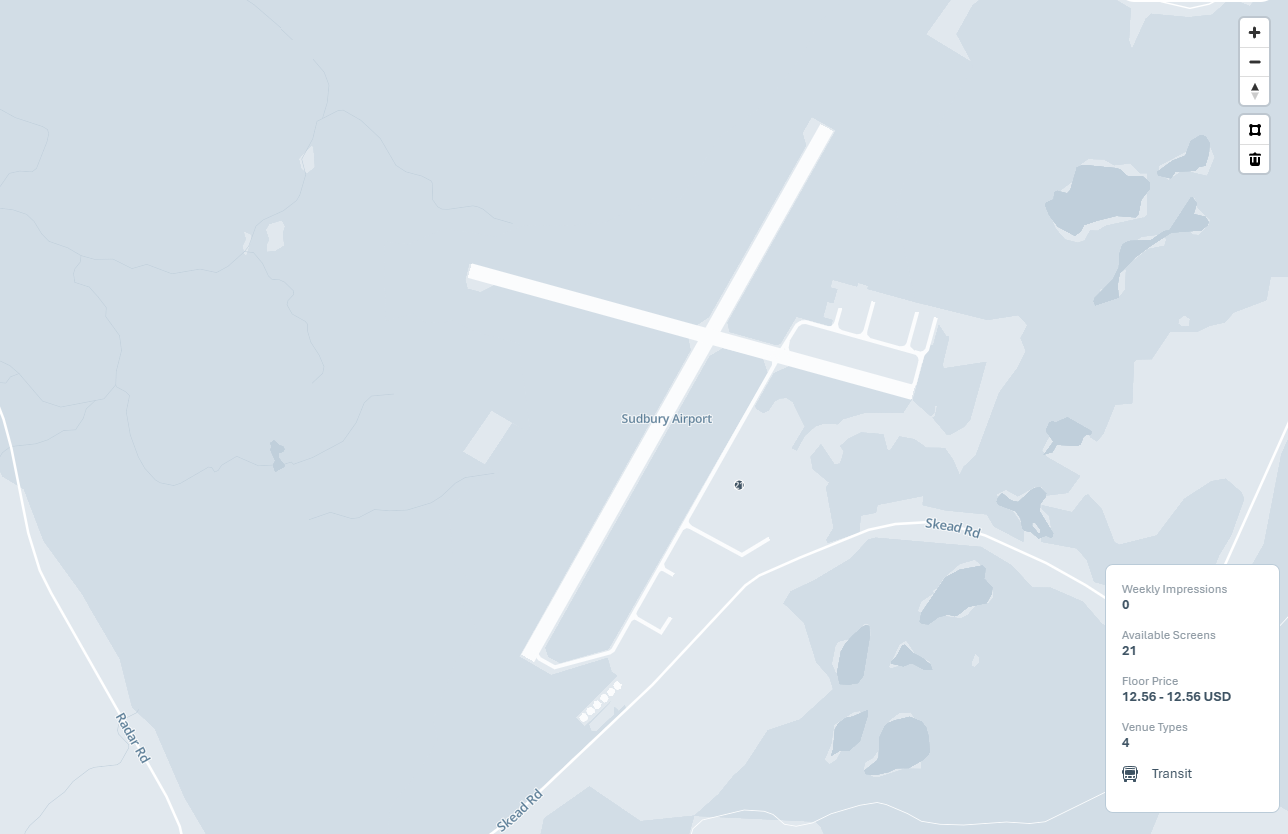
- A single passenger terminal building serving all commercial traffic, with one security screening point and a consolidated departure hold area. Every departing passenger passes through the same physical sequence, which produces guaranteed audience capture for correctly placed inventory.
- Separate general aviation and fixed base operations infrastructure handles corporate, charter, and government aircraft, serving the mining executive and medical transport traffic that does not appear in commercial passenger statistics.
Premium Indicators:
- No branded commercial lounge network is present. Premium audience contact occurs in the general hold room and at check-in rather than in a segregated lounge, which raises the value of main terminal placements.
- Meaningful corporate and private aviation activity supported by fixed base operations, hangarage, and maintenance capability. Aircraft movements totalled 26,402 in 2023 against 129,033 commercial passengers, a ratio that confirms substantial non-scheduled and corporate flying.
- Airport of entry status with customs clearance available on a call-out basis for general aviation, enabling direct international corporate arrivals.
- A primary runway of 6,600 feet capable of handling narrow-body charter equipment, which underpins the seasonal sun-destination programme and mining charter capability.
- No on-airport luxury hotel. Premium accommodation is located in the city, approximately 20 km from the terminal.
Forward-Looking Signal:
The airport authority is actively repositioning YSB as an economic development platform rather than a passenger facility alone, with airport land development, cargo and logistics capability, terminal modernisation, and a large-scale on-site solar generation project under consideration. Air service development activity is targeting additional scheduled and charter capacity. Each of these signals increases future passenger volume and future advertising rates. Advertisers who establish position now secure preferential terms before that repricing occurs, and Masscom Global advises clients to lock multi-period placements at current rates while the market is still in recovery.
Airline and Route Intelligence
Top Airlines:
Air Canada and Air Canada Express, Porter Airlines, Bearskin Airlines, Propair, WestJet on a seasonal basis, and seasonal leisure charter operators serving sun destinations.
Key International Routes:
Seasonal charter service to Caribbean and Mexican leisure destinations operates during the winter season.
Domestic Connectivity:
Toronto Pearson is the anchor route, operated daily by Air Canada and providing the airport's global connectivity. Ottawa is served by Porter and Propair, supporting government and regulatory travel. Montreal is served by Propair. Bearskin connects Sudbury to Thunder Bay, Sault Ste. Marie, and North Bay across Northern Ontario, with onward network reach into Manitoba. WestJet operates a summer seasonal link to Calgary, connecting Sudbury directly to Western Canada's energy and resource economy.
Wealth Corridor Signal:
The route map tells the commercial story precisely. Toronto is the capital and corporate governance corridor, carrying the highest-value business traffic and feeding every international journey. Ottawa and Montreal are the regulatory, government, and institutional corridor. Calgary is a resource-sector peer corridor linking two mining and energy economies and carrying senior industry travellers in both directions. The Northern Ontario network is an operational corridor moving technical and project staff. The sun charters are the consumer wealth corridor, carrying discretionary spending and property intent. Advertisers should map creative directly onto these four distinct corridors rather than treating the terminal as one audience.
Media Environment at the Airport
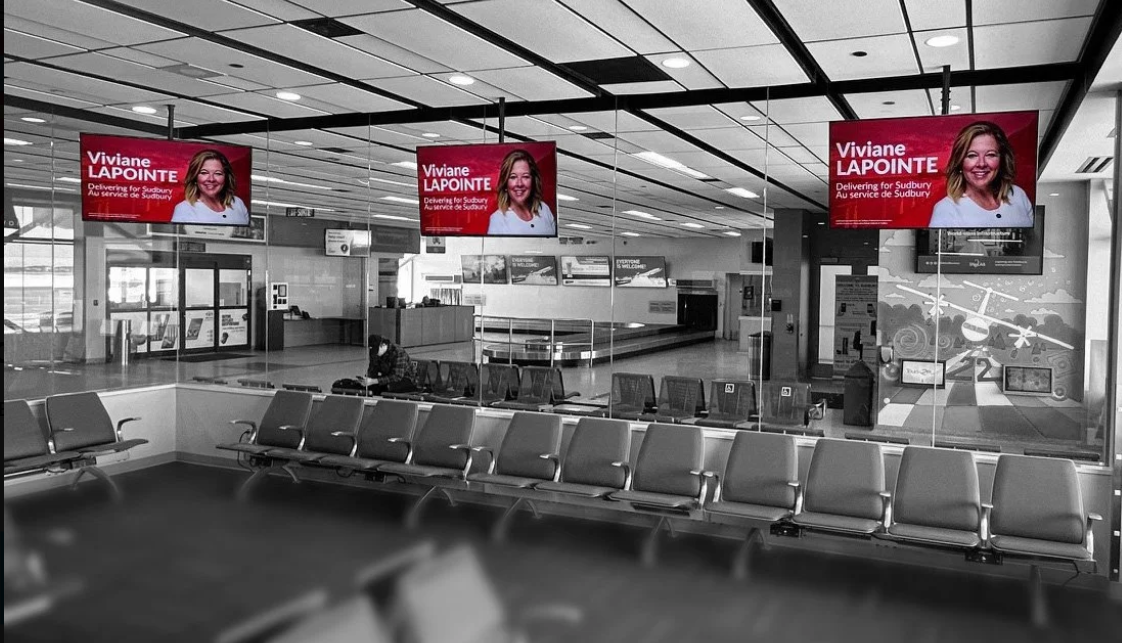
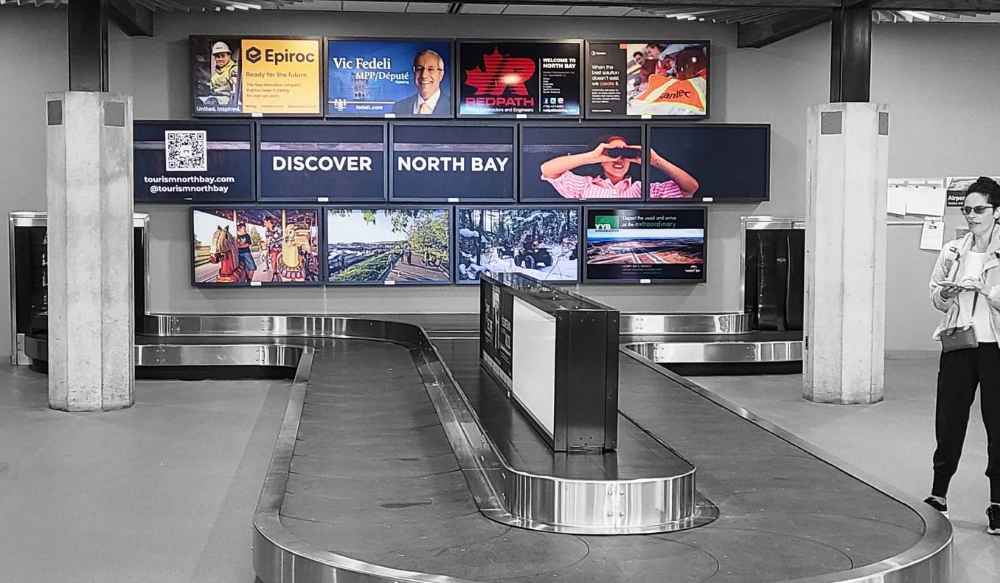
- Single terminal, single screening point, single primary hold room. Advertising clutter is minimal compared with any major Canadian hub, which means individual placements carry far higher share of voice and standout potential than the same investment would deliver in Toronto or Montreal.
- Dwell time is extended by regional aviation realities. Passengers arrive early for limited daily departures, weather-related delays are common in winter, and connecting itineraries through Toronto encourage conservative arrival timing. Longer, less distracted dwell produces genuine reading time rather than passing glance exposure.
- The environment is professional and calm rather than chaotic. Brand association here reads as credible and community-connected, which suits financial services, industrial, healthcare, and institutional advertisers seeking trust rather than spectacle.
- Masscom Global provides inventory access, placement precision, and execution management at YSB alongside the wider Canadian regional airport network, allowing advertisers to build a Northern Ontario or national regional package from a single point of contact with unified reporting and consistent creative deployment.
Strategic Advertising Fit
Best Fit:
- Mining technology, industrial equipment, and engineering services: The single most aligned category. Nowhere else in Canada is the buyer density this high.
- Commercial vehicles, pickup trucks, and fleet leasing: A trades and resource audience with the highest per-capita truck ownership profile in the region.
- Business banking, trade finance, and commercial insurance: Serves an export-oriented supplier cluster selling into high-risk international markets.
- Wealth management, retirement planning, and private banking: Targets mining professionals, physicians, and business owners at the accumulation and decumulation stages.
- Sun-destination real estate and second-home developments: Florida, Arizona, Mexico, and Caribbean developers reaching committed snowbird buyers at the moment of departure.
- Residency, citizenship, and cross-border tax advisory: Aligned to retirement-driven relocation intent rather than mobility need.
- Outdoor recreation, powersports, marine, and recreational vehicles: Matches the dominant discretionary spending pattern of the catchment.
- International education, universities, and study-abroad advisory: Reaches both outbound student families and the inbound international student flow.
Brand Alignment at a Glance:
| Category | Fit |
|---|---|
| Mining technology and industrial equipment | Exceptional |
| Commercial vehicles and fleet | Exceptional |
| Business banking and trade finance | Strong |
| Wealth management and retirement planning | Strong |
| Sun-destination real estate and residency | Strong |
| Outdoor recreation and powersports | Strong |
| International education | Moderate |
| High-fashion luxury and couture retail | Poor fit |
Who Should Not Advertise Here:
- High-fashion, couture, and designer luxury retail: The wealth here is asset-based and pragmatic, not display-oriented. There is no receptive audience and no supporting retail environment.
- Mass-market inbound tourism campaigns for competing global destinations: Passenger volume is too low and the outbound leisure audience is already committed to booked packages.
- Youth-led fast fashion, streetwear, and app-first consumer brands: The passenger age and income profile skews older and professional, with limited alignment outside the small festival-driven windows.
Event and Seasonality Analysis
- Event Strength: Medium
- Seasonality Strength: High
- Traffic Pattern: Dual-Peak
Strategic Implication:
Budget should be concentrated into two windows rather than spread evenly across the year. January to March delivers the outbound sun-charter consumer audience alongside the mining conference and investment cycle, making it the strongest combined B2B and consumer window. June to September delivers inbound tourism, cottage traffic, and the September mining and film event cluster. Masscom Global structures YSB campaigns around this rhythm, weighting inventory into the two peaks and using the shoulder months for lower-cost brand maintenance, which typically improves effective cost per relevant impression across a twelve-month plan.

Poor Placement and Delays Affect Airport Campaigns
We help you move faster, access better inventory, and get it right now.
Talk to an ExpertFinal Strategic Verdict
Sudbury Airport is a specialist buy, and specialists are exactly who should buy it. With 129,033 passengers in 2023 and a single terminal funnel, YSB delivers something large hubs cannot: near-complete capture of a concentrated, senior, industrially specific audience at a fraction of metropolitan cost. Mining technology firms, commercial vehicle brands, business banks, wealth managers, and sun-destination developers reach a buyer here who has real purchase authority and very little competing advertising demanding their attention. The market is still below its 2019 baseline, the airport authority is actively expanding capacity and infrastructure, and current rates reflect a recovery position that will not hold. Advertisers who move now secure position and pricing ahead of that shift, and Masscom Global has the inventory access, audience intelligence, and execution capability to place them correctly the first time.
About Masscom Global
Masscom Global is a premium international airport advertising and media buying agency operating across 140 countries. With deep expertise in airport OOH, premium publications, and high-net-worth audience targeting, Masscom helps brands reach the world's most valuable travellers at the moments that matter most. For advertising packages, media rates, and campaign planning at Sudbury Airport and airports across the globe, contact Masscom Global today.
Frequently Asked Questions
How much does airport advertising cost at Sudbury Airport? Cost varies by format, terminal position, campaign duration, and seasonal demand. Winter charter season and the spring mining event cycle carry premium pricing, while shoulder months offer lower entry points. Because YSB is a single-terminal environment, a smaller budget achieves higher share of voice than at a major hub. Contact Masscom Global for current rates and availability.
Who are the passengers at Sudbury Airport? Predominantly Canadian business and professional travellers. The core segments are mining and industrial executives, engineering and technical staff from the regional mining supply cluster, healthcare professionals connected to the regional hospital and medical school, university and college staff and students, and outbound leisure travellers on seasonal sun charters. American visitors form the largest foreign group, drawn by fishing, hunting, and cottage tourism.
Is Sudbury Airport good for luxury brand advertising? It depends on the definition of luxury. Fashion-led and couture luxury has no audience here. Asset-based premium categories perform well, including premium pickup trucks and SUVs, private banking and wealth management, marine and powersports, second-home real estate, and executive travel services. The wealth in this catchment is real but expressed through ownership rather than display.
What is the best airport in Northern Ontario to reach HNWI audiences? Sudbury Airport is the strongest option for reaching resource-sector wealth and professional income in Northern Ontario, because Greater Sudbury is the region's largest city and the operational centre of its mining economy. Thunder Bay and Sault Ste. Marie serve smaller and less executive-weighted catchments. For pan-Canadian HNWI reach, YSB works best as a targeted addition to a Toronto-anchored plan rather than as a standalone buy.
What is the best time to advertise at Sudbury Airport? January to March captures the outbound sun-charter audience and the winter mining conference and investment cycle at the same time, making it the highest-value window. June to September captures inbound tourism, cottage season, and the September mining and film event cluster. Advertisers with a single-season budget should choose the first quarter.
Can international real estate developers advertise at Sudbury Airport? Yes, and it is one of the better-aligned categories. This catchment sends consistent snowbird and retirement capital into Florida, Arizona, Mexico, the Caribbean, and increasingly Portugal and Costa Rica. Reaching these buyers at the departure gate, as they leave for a warm-climate holiday, captures intent at its highest point and at a cost far below southern Ontario airports.
Which brands should not advertise at Sudbury Airport? High-fashion and designer luxury retail, because the audience is pragmatic and asset-focused rather than display-driven. Mass-market destination tourism campaigns, because volume is too low and the leisure audience has already booked. Youth-led fast fashion and app-first consumer brands, because the passenger profile skews older, professional, and family-oriented.
How does Masscom Global help brands advertise at Sudbury Airport? Masscom Global provides the full chain: audience intelligence specific to the Northern Ontario mining and professional catchment, inventory access and placement recommendation, creative guidance including bilingual English and French adaptation, campaign execution and installation management, and performance reporting. We also build multi-airport Canadian regional packages so a single plan can cover YSB alongside comparable markets with unified reporting. Book a fifteen-minute call to review availability and rates.