

Airport at a Glance
| Field | Detail |
|---|---|
| Airport | Rochester International Airport |
| IATA Code | RST |
| Country | United States of America |
| City | Rochester, Minnesota |
| Annual Passengers | Approximately 206,000 (2025), up 6 percent year on year |
| Primary Audience | International and domestic medical travellers, Mayo Clinic executives, physicians and donors, regional corporate travellers |
| Peak Advertising Season | June to August, plus December to March |
| Audience Tier | Tier 1 |
| Best Fit Categories | Private aviation and air medical, wealth management and family offices, luxury and extended-stay hospitality, medical technology B2B |
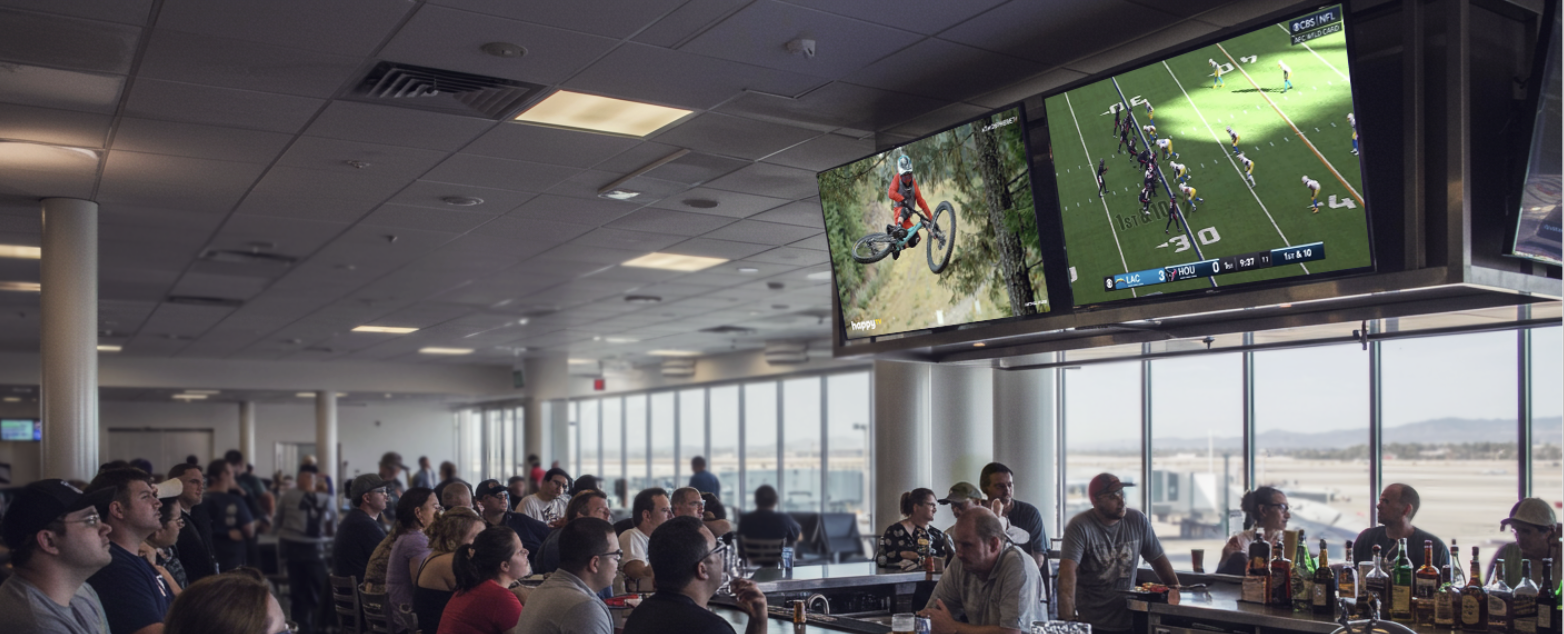
Rochester International Airport handles roughly 206,000 passengers a year, a figure that would place it in the bottom quartile of American commercial airports on scale alone. Judged on audience, it sits in a category with almost no peers. RST is owned by the City of Rochester and operated by the Rochester Airport Company, a wholly owned subsidiary of Mayo Clinic, making it the only significant US commercial airport operated by a hospital. Its sole fixed base operator is also a Mayo Clinic subsidiary. Every operational decision at this airport is oriented toward moving patients, and those patients include corporate chairmen, government ministers, royal families, and religious leaders from around the world.
The commercial logic here inverts the usual airport media calculation. Mayo Clinic treats more than 1.4 million people each year from all 50 states and 140 countries, and its Minnesota campus alone sees close to one million patients annually. A US Customs and Immigration facility was added at RST in 1995 specifically to serve Mayo Clinic's international clientele. Mayo Clinic is also mid-way through Bold. Forward. Unbound., a five billion dollar, six-year transformation of the Rochester campus, the largest single investment in the institution's 160-year history and the largest public or private investment in Minnesota's history. Advertisers who buy RST are not buying impressions. They are buying proximity to the highest-stakes decision-making population in American healthcare travel.
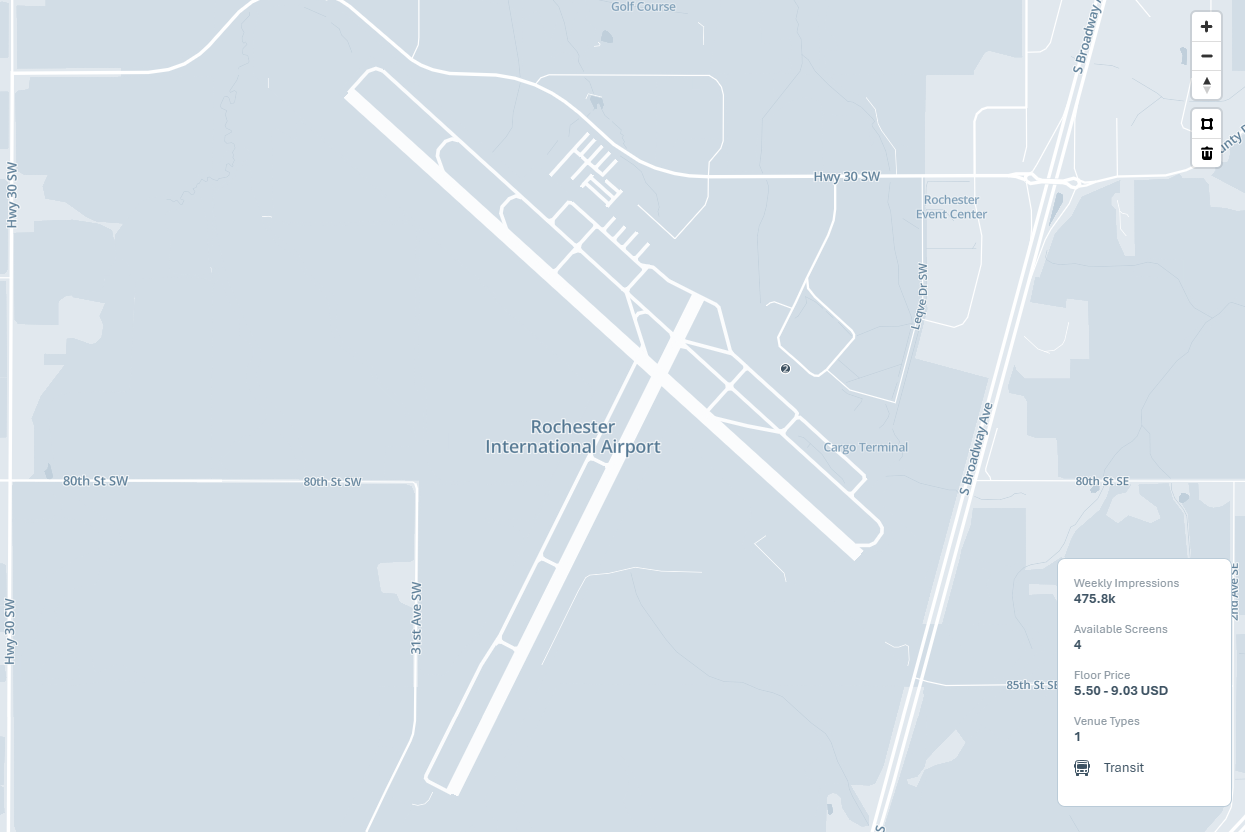
Advertising Value Snapshot
- Passenger scale: Approximately 206,000 total passengers in 2025, an increase of about 6 percent and 11,679 passengers on 2024. The 2019 pre-pandemic peak was 359,470, indicating meaningful headroom as capacity returns.
- Traveller type: International and domestic medical travellers with accompanying family, Mayo Clinic senior staff and specialist physicians, regional corporate and manufacturing executives.
- Airport classification: Tier 1 on audience quality, not on scale. Decision-maker density per thousand passengers at RST exceeds most airports handling twenty times its volume.
- Commercial positioning: The gateway to the world's most recognised medical institution, and one of the busiest air ambulance airports in the United States, operating around the clock.
- Wealth corridor signal: RST sits on an inbound global health-wealth corridor, drawing sponsored Gulf patients, Latin American and Canadian private-pay families, and American philanthropic wealth into a city of only 125,000 people.
- Advertising opportunity: Masscom Global's position is built on precision rather than volume. In a single compact terminal with minimal advertising clutter, a brand can achieve near-total share of voice against an audience that is affluent, emotionally engaged, unhurried, and highly receptive to services relating to health, wealth protection, mobility, and family security. Masscom structures RST as a concentration buy, not a reach buy, and pairs it with larger network airports to build corridor campaigns on both sides of the patient journey.
Airport Advertising is Complex to Get Right
We help you execute faster, with proven results and local insight most planners lack starting now.
Talk to an ExpertCatchment Area and Economic Drivers
RST serves a catchment of more than 800,000 people across southeastern Minnesota and the border regions of Iowa and Wisconsin, with the Twin Cities metro sitting at the outer edge of the 150 km radius.
Top 10 Cities within 150 km, Marketer Intelligence:
- Rochester (MN): A city of 125,000 supporting a global medical institution. Professional-class household incomes, an unusually high concentration of physicians, researchers and clinical executives, and a transient population of patients and companions who are spending on lodging, dining and services for weeks at a time. The single most valuable postcode in the catchment for premium services advertising.
- Minneapolis and Saint Paul (MN): Corporate headquarters wealth from finance, retail and industrial groups sits roughly 115 to 145 km north. This audience routinely drives to Rochester for Mayo appointments and increasingly flies RST for hub connections, delivering metropolitan-grade spending power into a regional terminal.
- Winona (MN): Headquarters of a major industrial distribution group and a manufacturing base with national export exposure. Produces procurement directors and operations executives, the core audience for B2B industrial, logistics and fleet advertising.
- La Crosse (WI): A regional corporate centre with headquarters-level employment in climate technology and convenience retail, plus a competing health system. Delivers mid-senior management travellers with company-funded travel budgets.
- Austin (MN): Headquarters of a Fortune-listed food processing group. Combines corporate executive travel with a substantial Hispanic manufacturing workforce, creating a dual-audience market for remittance services, telecom, and value-led retail alongside premium B2B.
- Owatonna (MN): Insurance and manufacturing headquarters town. Produces underwriting, actuarial and sales management travellers, an audience with above-average financial literacy and receptiveness to wealth and insurance messaging.
- Northfield (MN): Two nationally ranked private liberal arts colleges create a concentrated flow of high-income parent travel, plus a pre-medical student population that is a primary target for international medical schools and education finance brands.
- Red Wing (MN): Home of a globally recognised heritage footwear brand and a Mississippi River manufacturing base. Delivers brand-conscious, quality-oriented consumers and family-business ownership wealth.
- Mankato (MN): A regional commercial hub with a large private printing and communications group headquartered locally, plus a state university. Produces both corporate and education-linked travel.
- Albert Lea (MN): An agricultural and food processing centre on the Iowa corridor. Farm ownership wealth here is asset-rich and land-heavy, a distinct and often overlooked audience for succession planning, agricultural finance and land investment advertising.
Diaspora and International Audience Intelligence:
Rochester's resident diaspora profile is modest by American standards, with roughly 13 percent foreign-born residents, a Somali community accounting for close to 4 percent of city ancestry, and a Hispanic population of about 6 percent concentrated more heavily in Austin and Albert Lea. The commercially significant international movement at RST is not resident diaspora, it is patient inflow. Mayo Clinic's Minnesota campus draws patients from more than 130 countries, with historically strong volumes from the Gulf states, Canada, Mexico, Brazil, Colombia, and increasingly India and East Asia. Gulf patient travel is frequently government-sponsored, meaning treatment costs are underwritten by the state while discretionary family spending on accommodation, retail, dining and services remains entirely private.
Economic Importance:
The catchment economy has three engines: healthcare and life sciences centred on Mayo Clinic, advanced computing and industrial manufacturing spread across the regional headquarters towns, and large-scale agriculture and food processing. Each produces a different audience. Healthcare produces high-income professionals and inbound global wealth. Manufacturing headquarters produce corporate B2B travellers. Agriculture produces asset-rich family owners with significant unrealised land value. RST is the single point where all three converge, and the airport itself generates an estimated 190 million dollars in annual regional economic activity, 1,624 jobs and 63 million dollars in payroll.
Business and Industrial Ecosystem
- Healthcare and life sciences: Mayo Clinic is Minnesota's largest employer with a global workforce of roughly 73,000 and around 4,700 specialists. Produces physicians, clinical executives, medical device buyers, and research principals. The single strongest B2B medtech advertising audience in the American Midwest.
- Biotechnology and health innovation: Discovery Square, a 16-block innovation district developed under the Destination Medical Center initiative, is attracting biotech, diagnostics and health-tech ventures. Produces founders, venture investors and licensing executives travelling for partnership meetings.
- Advanced computing and technology: A long-established major computing campus in Rochester anchors enterprise systems and quantum research work. Produces engineering leadership and enterprise IT decision-makers.
- Industrial manufacturing and distribution headquarters: Winona, Owatonna, Red Wing, La Crosse and Mankato collectively host headquarters in industrial distribution, insurance, climate technology, heritage footwear, scholastic products and commercial printing. Produces a steady, recession-resistant flow of mid-senior corporate travel.
- Agriculture and food processing: Corn, soy, pork and dairy production feed nationally significant processing operations. Produces owner-operator wealth, agri-finance demand, and a large seasonal workforce.
Passenger Intent, Business Segment:
Business travellers at RST split into two profiles. The first is inbound: medical device representatives, pharmaceutical executives, biotech partners, healthcare consultants and institutional donors travelling to Mayo Clinic. This group is high-value, repeat-visiting, and arrives with defined procurement or investment intent. The second is outbound: regional corporate management connecting through Minneapolis or Chicago to national and international destinations. The first group is intercepted most effectively on arrival, the second on departure, and Masscom plans placement around that directional split.
Strategic Insight:
RST offers something almost no other airport can: a physical environment where the buying committee for medical technology, hospital systems, clinical software and life sciences services passes through a single small terminal. Where a major hub dilutes a B2B message across hundreds of thousands of irrelevant impressions, RST concentrates it. For any brand selling into healthcare, this airport delivers audience purity that cannot be replicated by buying scale elsewhere.
Tourism and Premium Travel Drivers
- Mayo Clinic as a destination in itself: Rochester attracts more than two million annual visitors, the overwhelming majority tied to medical care. These are not tourists, they are extended-stay visitors with committed budgets for lodging, dining, transport and companion services. The highest-value non-leisure visitor economy in the American Midwest.
- Bluff Country and the Root River corridor: State parks, long-distance trails, and an established Amish community at Harmony draw premium domestic touring traffic through the summer and autumn. Relevant to outdoor apparel, automotive and premium travel services.
- The Mississippi River and Great River Road corridor: River towns from Red Wing through Wabasha to Winona support heritage tourism, an eagle conservation centre, a nationally respected marine art collection, and a summer classical theatre festival. Draws culturally engaged, higher-income domestic travellers.
- Twin Cities regional spillover: Metropolitan retail, sport and entertainment assets sit within driving distance, extending the leisure proposition for visiting families accompanying patients.
Passenger Intent, Tourism Segment:
The leisure traveller at RST is secondary to the medical traveller, and advertisers should plan accordingly. The commercially important behaviour is companion travel: family members accompanying a patient, staying multiple days or weeks, and making decisions about hotels, restaurants, transport, financial protection and, frequently, long-term family planning. This audience is emotionally primed and attentive, with unusually high dwell time and low competing stimulus. Categories that perform are hospitality, insurance and wealth protection, private aviation and medical transport, telecommunications and connectivity, and premium comfort retail.
Travel Patterns and Seasonality
- Peak seasons: June to August is the strongest window, combining domestic leisure travel, the traditional Gulf and Middle Eastern summer medical travel season, and college commencement and family visitation. December to March delivers a second peak driven by year-end insurance-cycle procedure scheduling and warm-weather leisure departures.
- Structural stability: Unlike resort or event-driven airports, RST's baseline traffic is medically motivated and therefore close to non-seasonal. Patient appointments do not respond to weather, economic sentiment, or holiday calendars. This is the airport's most underrated advertising characteristic: a floor of high-value audience that does not disappear in the shoulder months.
- Monthly traffic detail: Data not available at monthly granularity.
Event-Driven Movement:
- Mayo Clinic continuing medical education and conference calendar (year-round): A rolling programme of specialist courses and symposia brings physicians and healthcare executives into Rochester in defined clusters. The most valuable B2B interception windows in the calendar for medtech, diagnostics and clinical software brands.
- Gulf and Middle Eastern summer medical season (June to August): Historically the highest-value international arrival window, with sponsored patients travelling with extended family and multi-week stays. Prime timing for luxury hospitality, private banking, real estate and citizenship advisory messaging.
- Rochesterfest (June): The city's principal community festival, drawing regional visitation and lifting inbound family travel. Useful for consumer and retail activation timing.
- Thursdays Downtown (June to September): A weekly downtown street market that extends visitor dwell in the city centre through the summer. Supports sustained rather than burst campaign weighting.
- SocialICE and winter programming (February): Downtown winter activation that softens the seasonal trough and coincides with the snowbird departure cycle.
- College commencement season (May): Graduations at the catchment's private colleges and state universities produce a concentrated inbound spike of affluent parent travel.
It’s Not Just Where You Advertise - It’s How Fast You Execute
We combine local insight with fast rollout to deliver results for you, now.
Talk to an ExpertAudience and Cultural Intelligence
Top 2 Languages:
- English: Approximately 82 percent of Rochester households speak English only. English-first creative is the default and will reach the professional, corporate and domestic medical audience without loss. Message sophistication matters more than translation here, given the education level of the physician and executive segment.
- Spanish: Roughly 4 to 6 percent of the catchment population, concentrated in the food processing towns of Austin and Albert Lea and growing within Rochester's service economy. Commercially relevant for remittance, telecom, value retail and financial inclusion advertisers, and increasingly for Latin American private-pay patient families arriving from Mexico, Colombia and Brazil.
Major Traveller Nationalities:
Domestic American travellers dominate volume, drawn from all 50 states because Mayo Clinic operates as a national referral centre rather than a regional hospital. The internationally significant flows are Gulf nationals from Saudi Arabia, the UAE, Kuwait and Qatar, frequently travelling under government medical sponsorship with large family entourages; Canadian private-pay patients from Ontario and the prairie provinces; Latin American families from Mexico, Brazil and Colombia; and a growing South Asian and East Asian segment. Arabic is therefore materially over-represented in the airport's actual audience relative to the resident population, and bilingual English and Arabic creative in the summer window is a specific opportunity Masscom can execute.
Religion, Advertiser Intelligence:
- Christianity (approximately 70 to 75 percent of the catchment): Lutheran and Catholic traditions dominate, reflecting German and Norwegian settlement heritage. Key spend triggers are Christmas and Easter, plus the Thanksgiving travel peak. Drives gifting, family reunion travel, and end-of-year charitable giving, the last being significant in a city where major medical philanthropy is a normal social activity.
- Islam (locally elevated, roughly 2 to 4 percent resident but far higher within the international patient segment): Ramadan reliably suppresses elective Gulf medical travel, and the post-Eid al-Fitr period through Eid al-Adha and the summer months produces the sharpest inbound surge of the year. Spend triggers include halal-certified hospitality, modest luxury retail, family accommodation, and Sharia-compliant wealth and property products. Rochester supports mosques within walking distance of the medical campus, an infrastructure signal that sustains repeat family visitation.
- Hindu, Sikh, Buddhist and Jewish communities (small resident share, over-represented among physicians and researchers): Rochester supports temples, gurdwaras and synagogues serving the medical professional community. Diwali is a defined spend trigger for the Indian physician and research population, a group with high disposable income, strong outbound family travel patterns, and active property interest in both India and the Gulf.
Behavioural Insight:
The RST audience is in a heightened decision-making state. Medical travel forces people to confront mortality, family security, succession and asset protection at exactly the moment they are sitting in a terminal with time to think. That produces receptiveness to categories that would be ignored in a leisure environment: life and health insurance, estate and succession planning, family office services, second residency, private banking, and long-term care. Messaging that performs is calm, credible, institutional and reassurance-led. Aggressive urgency, discount framing and aspirational lifestyle imagery underperform badly with this audience. Masscom builds RST creative briefs around trust signals rather than excitement.
Outbound Wealth and Investment Intelligence
The outbound passenger at RST is commercially unusual because the airport handles two distinct wealth flows in opposite directions. Outbound are American professionals, physicians, Midwest family-business owners and Mayo Clinic donors, a group that is asset-rich, conservatively invested, and increasingly interested in international diversification. Inbound and then returning are Gulf, Latin American and Asian private patients whose home-market capital is already internationally mobile. Both are addressable in the same terminal within the same campaign flight, which is the single most valuable structural fact about this airport for international brands.
Outbound Real Estate Investment:
The domestic HNWI audience in this catchment buys second property in Scottsdale and Paradise Valley in Arizona, Naples, Sarasota and Fort Myers in Florida, and increasingly Palm Springs and coastal Texas, driven by winter escape and state tax considerations. Internationally, American buyers have become a visible force in Dubai residential property, attracted by zero personal income tax, freehold ownership and yields that materially exceed Midwest rental returns. Southern European demand centres on Portugal, Italy and Greece, with Greece still offering a property-linked residency route while Portugal's programme has shifted toward fund-based qualification. Mexico's Baja and Riviera Maya corridors and Costa Rica capture the lifestyle-relocation segment. International developers targeting American capital have a rare, uncontested channel here.
Outbound Education Investment:
This catchment produces an exceptional concentration of pre-medical and health sciences students, driven by proximity to Mayo Clinic and by two nationally ranked liberal arts colleges within 80 km. Because US medical school admission is severely capacity-constrained, a meaningful share of these families actively research Irish medical schools in Dublin and Galway, Caribbean medical programmes in Grenada, Sint Maarten and Barbados, and UK universities in Scotland and London. Household spending capacity is high and decision-making is parent-led with multi-year planning horizons. International universities, medical schools and education consultancies will not find a better-qualified audience per thousand impressions anywhere in the American Midwest.
Outbound Wealth Migration and Residency:
American demand for second residency and citizenship has risen sharply, and the RST profile of physicians, business owners and retirement-stage wealth maps directly onto it. The most relevant programmes are the UAE Golden Visa, increasingly attractive to US professionals with Gulf clinical or commercial ties; Caribbean citizenship-by-investment programmes in St Kitts and Nevis, Antigua and Barbuda, Grenada, Dominica and St Lucia, valued for speed and mobility; Italy's elective residence route for retirement-stage capital; and Greece's residency-by-investment programme. Separately, the inbound Gulf and Latin American patient audience is itself a live prospect for UK, UAE and European residency products while physically present in the terminal.
Strategic Implication for Advertisers:
International real estate developers, private banks, family offices, residency advisories and medical schools should treat RST as a low-cost, high-precision test-and-scale environment rather than a volume buy. The cost per qualified affluent impression here is favourable precisely because the airport is small and the audience is not. Masscom Global can activate both directions of this corridor simultaneously, pairing RST with Gulf, London and Latin American airport inventory so a brand meets the same household at origin, at Rochester, and on the return leg.
Airport Infrastructure and Premium Indicators
Terminals:
- A single main terminal serves all scheduled commercial traffic, with a compact layout, free wireless internet, skycap assistance, and dedicated private rooms with beds or recliners for medical travellers, nursing mothers and passengers needing a quiet space before departure. These facilities exist because the airport's operator is a hospital, and they signal exactly which audience the terminal is designed around.
- The general aviation area operates as a functionally separate premium terminal, handling private jet arrivals, air ambulance operations and international customs clearance. In practical terms RST has a mass-market terminal and a private terminal, and the private side carries the highest-value passengers.
Premium Indicators:
- Lounge infrastructure: RST does not operate airline club lounges at scale. The premium environment is delivered through the general aviation terminal and through the medical-traveller quiet rooms rather than through conventional lounge inventory.
- Private aviation: One of the busiest air ambulance airports in the United States, running around the clock. The primary 9,034 foot runway accommodates all business jet types, ILS approaches maintain access through Minnesota winters, and on-site hangars of 18,000 and 20,000 square feet handle large-cabin aircraft. The sole fixed base operator is a Mayo Clinic subsidiary, an institutional arrangement no other American FBO can match. Mayo Clinic's own fixed-wing air ambulance programme is based here.
- International arrivals: The on-site US Customs facility primarily serves general aviation. In 2024 it processed 214 flights carrying 1,081 international passengers, an average of 18 international flights a month. Small in absolute terms, and among the most valuable thousand passengers arriving at any US airport.
- Cargo and logistics: A dedicated wide-body freighter operation serves the airport, with the majority of cargo tied directly to medical care, reinforcing the airport's single-purpose commercial identity.
- Hospitality: Downtown Rochester's hotel stock has expanded substantially under the Destination Medical Center initiative, with new upper-upscale and extended-stay inventory built specifically for long-stay patient families.
Forward-Looking Signal:
Three forces are converging on RST at once. Mayo Clinic's five billion dollar Bold. Forward. Unbound. programme will add five new buildings and roughly 2.4 million square feet to the Rochester campus by 2030. The Destination Medical Center initiative continues to deploy 585 million dollars of public infrastructure funding within a 5.6 billion dollar overall development plan, the largest public infrastructure commitment in Minnesota history. And the airport itself is completing a multi-phase runway programme with a runway extension enabling a wider range of aircraft, while a third major carrier returned to RST with three daily Chicago O'Hare services from April 2026, restoring connectivity toward the 2019 peak of 359,470 passengers. Every one of these signals points to rising patient volume, rising international arrivals and rising media value. Masscom Global's advice to clients is to secure position now, while rates reflect a 206,000-passenger airport rather than the audience it is about to carry.
Airline and Route Intelligence
Top Airlines:
Delta Air Lines, American Airlines and United Airlines operate scheduled service. Sun Country Airlines has operated seasonal winter leisure service to Phoenix and Fort Myers in recent years.
Key International Routes:
RST operates no scheduled international passenger service. International traffic arrives through the on-site customs facility, predominantly by private and air ambulance aircraft: 214 flights carrying 1,081 international passengers in 2024. This is the most important line in this section for advertisers, because it means the international audience at RST is almost entirely private-jet arriving.
Domestic Connectivity:
- Minneapolis and Saint Paul (MSP), Delta, multiple daily
- Chicago O'Hare (ORD), American Airlines, up to four daily
- Chicago O'Hare (ORD), United Airlines, three daily from April 2026
- Atlanta (ATL) and Denver (DEN) have been served in prior schedule cycles
Wealth Corridor Signal:
The route map tells a clear story: RST is a feeder airport whose scheduled network exists to connect patients into three global hubs, while its genuinely premium traffic bypasses scheduled service entirely and arrives on the general aviation ramp. For advertisers, that means the terminal audience and the FBO audience are different populations requiring different placement strategies, and that Gulf, European and Asian wealth reaches Rochester via Chicago, Minneapolis, New York and private aircraft. Masscom builds RST into multi-airport corridor plans for exactly this reason: reaching this audience efficiently requires intercepting it at the hub and again at the destination.
Media Environment at the Airport
- Terminal scale and clutter: A single compact terminal with a limited advertising footprint means share of voice at RST is dramatically higher than at any comparable-value audience environment. A brand with a modest budget can achieve environmental dominance that would cost a hundred times more at a major hub.
- Dwell time drivers: Airlines advise arrival 90 minutes before departure, medical travellers habitually arrive earlier still, and companion travellers frequently wait through delayed or connecting itineraries. Dwell is long, competing stimulus is low, and attention quality is exceptional. Rare among US airports of this size.
- Premium environment signals: The airport is operated by a Mayo Clinic subsidiary and functions as the front door to the world's most highly ranked hospital. Brand association here carries an implicit credibility transfer that no commercial airport environment can manufacture. For health, wealth, insurance and family-security categories, the context does part of the selling.
- Masscom capability: Masscom Global provides inventory access, placement precision by terminal zone and passenger direction, arrival-versus-departure weighting, seasonal flighting tuned to the summer international window, and coordinated execution across the general aviation and main terminal audiences. Campaigns are planned, negotiated and delivered without the delays that undermine small-airport buys.
Strategic Advertising Fit
Best Fit:
- Private aviation, air charter and medical evacuation services: The audience is already using or considering exactly this service, and the airport is one of the busiest air ambulance facilities in the country. No environment converts better for this category.
- Wealth management, private banking and family offices: A population of physicians, business owners and asset-rich agricultural families, encountered at a moment of heightened thinking about succession and protection.
- Health, life and long-term care insurance: Medical travel is the strongest possible priming context for protection products.
- Luxury and extended-stay hospitality: Patient families book multi-week stays. Hotel and serviced residence brands should be visible at the point of arrival, not after the booking is made.
- Medical technology, diagnostics and clinical software B2B: The Mayo Clinic buying committee and visiting healthcare executives pass through one terminal. Unmatched audience purity for healthcare B2B.
- International real estate developers: Dubai, London, Portugal, Italy, Greece and Mexico developers reach American capital and Gulf capital in the same environment.
- Residency and citizenship-by-investment advisory: Both the outbound American segment and the inbound Gulf and Latin American segment are live prospects.
- International medical schools, universities and education consultancies: An unusually dense pre-medical and health sciences family audience with committed multi-year budgets.
Brand Alignment at a Glance:
| Category | Fit |
|---|---|
| Private aviation and air medical services | Exceptional |
| Wealth management and family offices | Exceptional |
| Health, life and long-term care insurance | Exceptional |
| Medical technology and clinical B2B | Strong |
| Luxury and extended-stay hospitality | Strong |
| International real estate and residency programmes | Strong |
| Premium watches and fine jewellery | Moderate |
| Mass-market FMCG and fast fashion | Poor fit |
Who Should Not Advertise Here:
- Gambling, casino and betting brands: Fundamentally misaligned with a medical destination audience and with the institutional environment of a hospital-operated airport. Reputational risk outweighs any reach benefit.
- Alcohol, tobacco and vaping: A significant share of this audience is travelling for treatment of conditions these categories are associated with. The context works against the message.
- Mass-market fast fashion, impulse FMCG and high-frequency reach campaigns: With roughly 206,000 annual passengers, RST cannot deliver the impression volume these models require. Budget is better deployed at hub airports.
- Party tourism, nightlife and mass-market cruise leisure: No meaningful audience alignment. The leisure component at RST is family and companion travel, not discretionary escapism.
Event and Seasonality Analysis
- Event Strength: Medium. The commercially important calendar is Mayo Clinic's continuing medical education programme and the Gulf summer medical season rather than public festivals.
- Seasonality Strength: Low to Medium. Medically driven baseline traffic is close to non-seasonal, with a summer peak and a secondary winter peak layered on top.
- Traffic Pattern: Stable with dual-peak overlay.
Strategic Implication:
RST rewards long-flight, always-on campaigns rather than burst activation, because the high-value audience is present every month of the year and no other airport of this size can say that. Masscom recommends a twelve-month base weighting with uplift in June to August to capture the international medical window and December to March to capture procedure-cycle and warm-weather traffic. Brands targeting healthcare B2B should additionally weight around Mayo Clinic's conference calendar, and Masscom structures campaigns around that rhythm so budget lands when the buying committee is physically in the terminal.
Poor Placement and Delays Affect Airport Campaigns
We help you move faster, access better inventory, and get it right now.
Talk to an ExpertFinal Strategic Verdict
Rochester International Airport is the clearest example in North America of why passenger volume is the wrong metric for airport media. Roughly 206,000 passengers a year pass through a single compact terminal, and among them are the patients, families, physicians, executives and benefactors of an institution that treats 1.4 million people annually from 140 countries and is spending five billion dollars to expand the campus twelve minutes away. The airport is operated by a hospital, its sole FBO is operated by that same hospital, its customs facility was built for that hospital's international patients, and it is one of the busiest air ambulance airports in the United States. Private aviation brands, wealth managers, insurers, medical technology firms, international developers, residency advisories and medical schools will not find a more concentrated or more receptive audience anywhere in the American Midwest, and they will not find it at this cost for much longer, with a third carrier returned, a runway extension complete and campus expansion running through 2030. Masscom Global has the inventory access, the corridor intelligence to activate both the outbound American and inbound international sides of this audience, and the execution speed to secure position while rates still reflect the airport's size rather than its audience.
About Masscom Global
Masscom Global is a premium international airport advertising and media buying agency operating across 140 countries. With deep expertise in airport OOH, premium publications, and high-net-worth audience targeting, Masscom helps brands reach the world's most valuable travellers at the moments that matter most. For advertising packages, media rates, and campaign planning at Rochester International Airport and airports across the globe, contact Masscom Global today.
Frequently Asked Questions
How much does airport advertising cost at Rochester International Airport?
Cost at RST varies by format, terminal position, campaign duration and seasonal demand, and the airport's small inventory footprint means pricing behaves differently from major hub airports. Arrival-facing positions and general aviation adjacency command premiums because of who uses them. Because share of voice at RST is achievable at a fraction of hub cost, entry budgets are far lower than most planners expect for a Tier 1 audience. Contact Masscom Global for current rates and availability.
Who are the passengers at Rochester International Airport?
RST passengers are overwhelmingly medically motivated. They include domestic patients travelling to Mayo Clinic from all 50 states, international patients and sponsored families from more than 130 countries, accompanying family members on multi-week stays, Mayo Clinic physicians, executives and donors, and regional corporate travellers from manufacturing and insurance headquarters across southeastern Minnesota, northern Iowa and western Wisconsin. Household income, education level and decision-making authority all run well above the national airport average.
Is Rochester International Airport good for luxury brand advertising?
For service-led luxury, yes: private aviation, private banking, family offices, luxury hospitality, residency advisory and international real estate all perform because the audience profile and mindset match. For product-led luxury such as watches, jewellery and fashion, RST works as a brand-presence and credibility buy rather than a transactional one, since the terminal has limited premium retail and the audience is not in a shopping mindset. Masscom advises product luxury clients to pair RST with hub inventory.
What is the best airport in the American Midwest to reach HNWI audiences?
For volume, Chicago and Minneapolis dominate. For concentration, RST is the strongest HNWI proposition in the Midwest per thousand passengers, because it is the arrival point for globally sourced medical wealth including Gulf sponsored patients, Latin American private-pay families and American philanthropic wealth. The correct answer for most brands is a corridor buy: reach the audience at the hub, then again at Rochester where intent is highest and clutter is lowest.
What is the best time to advertise at Rochester International Airport?
June to August is the strongest single window, combining domestic leisure travel, college commencement visitation and the traditional Gulf summer medical travel season. December to March delivers a secondary peak driven by insurance-cycle procedure scheduling and warm-weather departures. Because medical traffic is close to non-seasonal, RST also supports year-round always-on campaigns better than resort or event-driven airports. Healthcare B2B advertisers should weight around Mayo Clinic's continuing medical education calendar.
Can international real estate developers advertise at Rochester International Airport?
Yes, and the fit is stronger than the passenger count suggests. The outbound American audience here includes physicians, business owners and agricultural land wealth actively researching Dubai, Portugal, Italy, Greece and Mexico property. The inbound international patient audience arrives with capital that is already globally mobile. Both sides of that corridor are addressable in the same terminal, and Masscom can extend the campaign to Gulf, London and Latin American airports so the same household is reached at origin and destination.
Which brands should not advertise at Rochester International Airport?
Gambling, casino and betting brands, along with alcohol, tobacco and vaping, are misaligned with a medical destination audience and with a hospital-operated airport environment. Mass-market fast fashion, impulse FMCG and any campaign requiring high impression volume will underdeliver against roughly 206,000 annual passengers. Party tourism, nightlife and mass-market cruise leisure have no audience alignment. Budget in those categories belongs at hub airports.
How does Masscom Global help brands advertise at Rochester International Airport?
Masscom Global provides the full chain: audience and corridor intelligence specific to RST's medical travel profile, inventory access and negotiation, placement precision by terminal zone and passenger direction, creative guidance calibrated to a trust-led rather than urgency-led audience, seasonal flighting around the summer international window and the clinical conference calendar, and multi-airport corridor planning that reaches the same household on both sides of the journey. Book a 15-minute planning call and we will build the RST case for your category.