


Airport at a Glance
| Field | Detail |
|---|---|
| Airport | Monroe Regional Airport |
| IATA Code | MLU |
| Country | United States |
| City | Monroe, Ouachita Parish, Louisiana |
| Annual Passengers | Data not available. The airport generates $147 million in annual regional output and sustains 988 jobs |
| Primary Audience | Paper and packaging, telecommunications and healthcare professionals, Delta farmland and timberland owners, university and HBCU-connected travellers |
| Peak Advertising Season | November to January, September to November, plus February and June |
| Audience Tier | Tier 3 |
| Best Fit Categories | Agricultural and timberland finance, hunting and outdoor brands, healthcare workforce recruitment, regional banking and crop insurance |

Monroe Regional Airport occupies a genuinely unusual position in aviation history. Huff Daland Dusters, a crop-dusting operation, moved to Monroe in 1925, and in 1928 C.E. Woolman and local investors incorporated Delta Air Service from that business, keeping the headquarters in Monroe until it moved to Atlanta in 1941. The airport markets itself as the birthplace of Delta Airlines, and in July 2025 local institutions joined a Delta Flight Museum archivist to commemorate the centenary of the Huff Daland move. The site was originally established as Selman Field, a First World War pilot training centre, and during the Second World War it served as the largest navigation training centre in the United States.
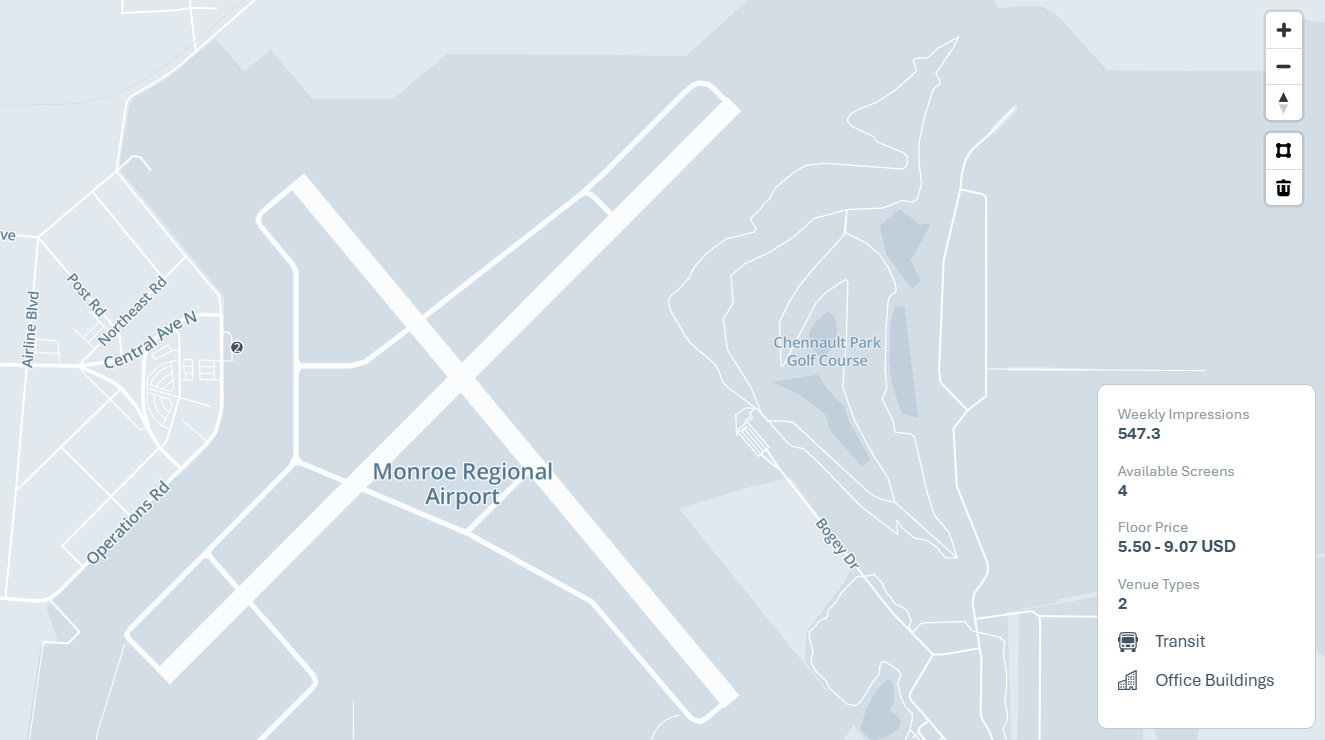
Masscom Global will be direct about the present-day scale, because that honesty is what makes this assessment useful. The airport is served by two carriers on two routes: Delta to Atlanta and American to Dallas/Fort Worth, both daily and direct. Third-party listings sometimes show additional carriers and destinations, and advertisers should verify the current schedule at the time of planning. There are no low-cost carriers, no leisure nonstops and no international service. Verified annual passenger figures are not available, though the 2025 Louisiana Aviation and Aerospace Economic Impact Study puts the airport's contribution at 988 jobs and 147 million dollars in annual output for Northeast Louisiana on a direct payroll of 46.9 million dollars. What MLU does deliver is a wide regional monopoly, covering Ouachita Parish and a surrounding 13-parish region extending into Arkansas and Mississippi, and a passenger base that is almost entirely business, institutional or family-purpose because anyone travelling on price drives to Shreveport, Jackson or Little Rock. This is a small, precise, inexpensive buy for a specific set of advertisers.
Advertising Value Snapshot
- Passenger scale: Verified annual passenger totals are not available. Two carriers operate daily direct service on two routes, with the airport contributing 988 jobs and 147 million dollars in annual regional output.
- Traveller type: Paper and packaging, telecommunications and healthcare professionals, Delta farmland and timberland owners, university and HBCU-connected travellers, and outbound family and relocation traffic.
- Airport classification: Tier 3. Two carriers, two destinations, and a catchment among the lower-income regions in the United States. Advertisers should treat this as a precision layer, never as an anchor buy.
- Commercial positioning: The birthplace of Delta Air Lines and the sole commercial gateway for northeast Louisiana, serving thirteen parishes plus parts of Arkansas and Mississippi.
- Wealth corridor signal: The Delta farmland and north Louisiana timberland asset corridor, alongside sustained outbound migration toward Atlanta, Dallas and Houston.
Advertising opportunity: With only two hub routes and no leisure or low-cost service, essentially every passenger here has a business, institutional or family reason to fly, which produces an unusually filtered audience for a very small outlay. Coverage across a single terminal is close to absolute, and message competition is negligible. Masscom Global positions MLU as a targeted northeast Louisiana layer within a wider Gulf South plan.
Airport Advertising is Complex to Get Right
We help you execute faster, with proven results and local insight most planners lack starting now.
Talk to an ExpertCatchment Area and Economic Drivers
Top 10 Cities within 150 km, Marketer Intelligence:
- Monroe: The commercial, healthcare and education core of northeast Louisiana, hosting a substantial telecommunications operational campus, competing hospital systems, a state university and the region's principal retail market. Produces professional, clinical, technology and public sector audiences alongside genuine urban deprivation that advertisers must account for honestly.
- West Monroe: Home to a very large paper and packaging manufacturing operation and to the outdoor and hunting businesses that made this area a national destination for that culture. Produces industrial procurement and plant management audiences plus the strongest outdoor and hunting brand affinity in the catchment.
- Ruston: University town roughly 50 kilometres west, hosting a technological university with strong engineering and athletics programmes, plus peach and diversified agriculture. Produces academic, engineering and student-family audiences with above-average education levels for the region.
- Bastrop and Morehouse Parish: Former mill town roughly 40 kilometres north with substantial row-crop agriculture. Produces landowner and agribusiness principals whose land assets exceed visible income, in a parish that has faced sustained industrial contraction.
- Rayville, Delhi and Richland Parish: Mississippi alluvial plain row-crop agriculture producing cotton, soybeans, corn and rice. Produces farm owner-operators with genuine capital equipment and land finance authority.
- Winnsboro and Franklin Parish: Agricultural district roughly 70 kilometres south, notable for sweet potato and row-crop production. Produces landowner principals and agricultural processing audiences.
- Columbia, Jonesboro and the north Louisiana timber belt: Extensive commercial pine plantation and timber processing across Caldwell, Jackson and surrounding parishes. Produces forestry, land management and mill audiences, and a landowner base holding a genuinely institutional asset class.
- Tallulah, Lake Providence and the Louisiana Delta parishes: Mississippi River Delta agriculture across Madison, East Carroll and Tensas parishes, among the most economically distressed areas in the United States alongside some of its most productive farmland. Advertisers should address the landowner and agricultural business audience here and be realistic about consumer purchasing power.
- El Dorado and Crossett, Arkansas: Chemical manufacturing, bromine extraction, timber processing and an oil industry heritage roughly 90 to 110 kilometres north. Produces industrial and chemical procurement audiences, and residents who use MLU for network access.
- Vicksburg and Greenville, Mississippi: Mississippi River port cities roughly 130 to 150 kilometres east with agriculture, river logistics and gaming. Extend the catchment across a second state line and add logistics and hospitality audiences.
NRI and Diaspora Intelligence:
This catchment has no significant international diaspora and advertisers should not be sold one. The Hispanic population is present through agriculture, construction and poultry processing but at modest scale relative to the southern and border markets Masscom covers. What matters commercially is a different kind of population movement, and it is substantial.
Northeast Louisiana has experienced sustained population loss for decades, and the principal receiving markets are Atlanta, Dallas, Houston and, increasingly, Nashville. The airport's two routes go to Atlanta and Dallas/Fort Worth, which is not a coincidence: those are the two metropolitan areas absorbing the largest share of this region's out-migration. This produces a large, recurring and highly predictable visiting-friends-and-relatives flow in both directions, and it means a substantial share of passengers maintain family, property and financial ties across two states simultaneously.
Within that, the movement of Black professionals and families from northeast Louisiana to Atlanta, Dallas and Houston is particularly significant. Monroe has a large and long-established Black population and a nearby historically Black university with a nationally recognised alumni network, and the Atlanta corridor in particular carries family, professional, alumni and church-connected travel of real commercial value. This audience is well-defined, brand-loyal and materially under-served by advertisers, and it rewards sustained authentic engagement while discounting tokenism immediately.
Economic Importance:
Five engines drive this catchment. Paper, packaging and timber, anchored by a very large manufacturing operation in West Monroe and by extensive commercial pine plantation across north Louisiana. Delta agriculture across the Mississippi alluvial plain, producing cotton, soybeans, corn, rice and sweet potatoes, alongside catfish aquaculture. Telecommunications, with a substantial operational campus in Monroe remaining a major regional employer. Healthcare and higher education, with competing hospital systems, a state university, a technological university and a historically Black university within the catchment. And the outdoor and hunting economy, which northeast Louisiana's waterfowl reputation and its nationally known local businesses have made a genuine regional industry.
Business and Industrial Ecosystem
- Paper, packaging and timber processing: A very large paper and packaging manufacturing operation in West Monroe alongside extensive commercial pine plantation and sawmill activity across the northern parishes. Produces plant management, engineering and industrial procurement decision-makers, plus forestry and land management audiences.
- Delta row-crop agriculture and aquaculture: Cotton, soybean, corn, rice and sweet potato production across the Mississippi alluvial plain, alongside catfish farming. Produces farm owner-operators, cooperative leadership and processing management with equipment, input, irrigation and financing authority.
- Telecommunications and technology operations: A substantial telecommunications operational campus in Monroe remains a significant regional employer and one of the few large white-collar concentrations in northeast Louisiana. Produces technology, network operations and professional services travellers.
- Healthcare, higher education and public sector: Competing hospital systems in Monroe, a state university, a technological university at Ruston and a historically Black university nearby, plus parish and state agency employment. Produces clinical, academic and administrative travellers and a persistent workforce recruitment need.
- Outdoor, hunting and firearms-adjacent industry: Nationally known outdoor and hunting businesses based in West Monroe, supported by northeast Louisiana's standing as a premier waterfowl destination. Produces both a consumer audience and a genuine small-industry supplier base.
Passenger Intent, Business Segment:
Business travellers at MLU move to Atlanta and Dallas/Fort Worth for corporate, supplier, financing, regulatory and healthcare system business, and onward to national and international destinations through both hubs. A meaningful proportion are owner-operators in agriculture, timber, contracting or professional practice rather than salaried employees, which means the person in the terminal signs rather than recommends. Categories that intercept them effectively are agricultural and forestry equipment, land and crop finance, commercial banking, insurance and risk, industrial and mill supply, and professional services.
Strategic Insight:
The commercial logic here is filtration at very low cost. With two carriers, two destinations, no low-cost service and no leisure nonstops, the airport screens out almost all price-driven travel, because anyone flying on price drives to Shreveport, Jackson, Little Rock or Alexandria. What remains is a filtered mix of business owners, landowners, clinicians, academics and family travellers with a defined purpose. For advertisers whose market is genuinely northeast Louisiana, that is an efficient institutional intercept for a small outlay. For any advertiser whose market is regional or national, this airport cannot carry the plan, and Masscom Global will say so before recommending spend.
Tourism and Premium Travel Drivers
Tourism is not the commercial case for MLU and advertisers should not be sold one. Inbound leisure volume is limited and most regional visitation arrives by road. The genuine drivers worth naming are the following.
- Waterfowl and deer hunting: Northeast Louisiana sits on the Mississippi flyway and is a premier North American duck hunting destination, amplified nationally by the prominence of local outdoor businesses. Guided hunts, leases and lodges draw out-of-state hunters from November through January, and this is the catchment's most travel-active and best-funded inbound audience.
- Aviation heritage: The birthplace of Delta Air Lines, alongside a local aviation and military museum honouring a Louisiana-born general associated with the Flying Tigers, and the site's history as the nation's largest wartime navigation training centre. A genuine and ownable heritage context.
- University athletics and HBCU tradition: A technological university at Ruston with strong football and baseball programmes, a state university in Monroe, and a nearby historically Black university with a nationally famous marching band and a major annual rivalry game. Homecoming and alumni travel generate real volume.
- River, bayou and outdoor recreation: The Ouachita River, Bayou DeSiard, Black Bayou Lake and surrounding wildlife refuges support fishing, boating and birding, alongside historic homes and gardens in Monroe including the residence of an early Coca-Cola bottler.
Passenger Intent, Tourism Segment:
Inbound leisure passengers are predominantly visiting friends and relatives, attending university and homecoming events, or arriving for guided hunting, and they arrive with accommodation committed and remaining budget in dining, vehicle rental, equipment and event spending. The hunting segment is disproportionately valuable: out-of-state hunters travelling for guided duck and deer hunts have high discretionary capacity and strong receptivity to outdoor equipment, apparel, vehicle, firearms-adjacent and hospitality messaging. Outbound leisure is dominated by residents connecting through Atlanta and Dallas for Gulf Coast, Florida, Caribbean and cruise travel.
Travel Patterns and Seasonality
Peak seasons:
- November to January: Waterfowl and deer hunting season combined with Thanksgiving and Christmas visiting-friends-and-relatives travel on the Atlanta and Dallas corridors. The strongest window of the year in both volume and audience value.
- September to November: University football season including homecoming weekends across three institutions, harvest-period agricultural business travel, and fiscal-year corporate activity.
- February: Regional carnival celebrations, with Monroe running its own parade calendar distinct from south Louisiana's.
- April to June: Spring planting and crop-input business travel, university graduations, and the regional festival calendar including a well-established June peach festival at Ruston.
Traffic volume data:
Verified annual passenger totals and monthly distributions are not available. The airport operates daily direct service on two routes with two carriers. The 2025 Louisiana Aviation and Aerospace Economic Impact Study attributes 988 jobs and 147 million dollars in annual regional output to the airport, on a direct payroll of 46.9 million dollars. A rehabilitation of Runway 14-32 is planned for 2026, with disadvantaged business enterprise participation goals of 7.43 percent set for fiscal years 2025 to 2027.
Event-Driven Movement:
- Duck and deer hunting season (November to January): Northeast Louisiana's position on the Mississippi flyway and its national profile in outdoor culture draw guided-hunt travellers from across the United States. The single most valuable inbound window at this airport, and the natural buy for outdoor, apparel, vehicle, optics and hospitality advertisers.
- University football and homecoming season (September to November): Three institutions within the catchment, including a historically Black university with a nationally recognised band and a major annual rivalry fixture. Generates alumni travel from across the country, particularly on the Atlanta corridor.
- Harvest and planting seasons (April to May and September to November): Agricultural business travel concentrates around the crop calendar, and this is when Delta landowning principals and agricultural buyers travel most.
- Delta Air Lines heritage milestones: The centenary of the Huff Daland move to Monroe was commemorated in July 2025, and the incorporation of Delta Air Service in 1928 means an airline centenary falls in 2028. A genuinely distinctive and time-bound brand heritage window for aviation, travel, insurance and legacy-positioned advertisers.
- Regional carnival calendar (February): Monroe operates its own parade and krewe season, culturally distinct from the south Louisiana celebration, generating short concentrated local activity with beverage, retail and hospitality relevance.
- Ruston peach festival and the summer regional calendar (June): Long-established community events reaching family and agricultural audiences across the northern parishes.
Advertisers should note two environmental factors. Spring severe weather including tornado risk affects the region, and while Monroe is inland, it functions as an evacuation receiving city during south Louisiana hurricane events between June and November. Both make property and business continuity insurance contextually relevant categories.
It’s Not Just Where You Advertise - It’s How Fast You Execute
We combine local insight with fast rollout to deliver results for you, now.
Talk to an ExpertAudience and Cultural Intelligence
Top 2 Languages:
- English: Overwhelmingly dominant across all audiences. Creative should be plain, warm, specific and locally grounded. North Louisiana business culture places heavy weight on personal relationship, local presence and demonstrated service history, and national scale claims underperform against evidence of local capability and response time.
- Spanish: The second language, present through agriculture, construction and poultry processing employment, though at considerably smaller scale than in south Louisiana or the border markets. Spanish-language creative is warranted for automotive, telecom, remittance and value categories but should not be the planning assumption.
There is one creative caution that matters more than language here and advertisers get it wrong constantly. Northeast Louisiana is culturally Anglo-Protestant and closer to Mississippi and Arkansas than to Acadiana or New Orleans. Cajun imagery, French phrasing, crawfish and jazz iconography read as generic Louisiana branding imported from elsewhere and actively signal that the advertiser does not know the market. Creative for this catchment should draw on Delta agriculture, timber, river, hunting and gospel traditions instead.
Major Traveller Nationalities:
The passenger base is almost entirely domestic American, drawn from thirteen Louisiana parishes plus southern Arkansas and western Mississippi. International travel from this catchment connects through Atlanta and Dallas/Fort Worth, both of which provide extensive global access. There is no meaningful international inbound flow. Campaign creative should be built for a domestic American audience with a strong regional identity, a substantial African American segment, and a modest Spanish-language layer.
Religion, Advertiser Intelligence:
Figures below are directional approximations for northeast Louisiana rather than airport-level survey data.
- Baptist and evangelical Protestant traditions (approximately 50 to 55 percent): The dominant religious culture of north Louisiana, spanning Southern Baptist, non-denominational and Pentecostal congregations. Drives Christmas and Easter family travel, church-organised group and mission travel, revival and association meetings, and charitable giving. Purchase behaviour responds strongly to family framing, community endorsement and trust signals, and advertisers should avoid creative that reads as irreverent.
- Historically Black Protestant churches (a significant share within the above and a distinct commercial audience): Monroe has a large and long-established Black population, and church networks function as central channels for community information, endorsement and word of mouth. Church convention, revival and HBCU homecoming travel generate genuine volume on the Atlanta corridor. Gospel radio and church-adjacent media carry disproportionate influence, and this audience rewards sustained authentic engagement.
- Roman Catholicism (approximately 8 to 12 percent): Considerably smaller here than in south Louisiana, which is one of the clearest markers of how different north Louisiana is culturally. Drives Christmas and Easter family travel and gifting cycles at more modest intensity.
- Religiously unaffiliated (approximately 15 percent): Concentrated among the university populations at Monroe and Ruston. Higher receptivity to value, technology and experience positioning.
Behavioral Insight:
Three characteristics should shape creative here. First, income and asset wealth diverge sharply. Household income across northeast Louisiana is among the lower ranges in the United States, and several Delta parishes rank among the most economically distressed in the country, yet the same parishes contain productive alluvial farmland and commercial timberland held by families for generations. Advertisers must select the segment deliberately: value, instalment credit and payment flexibility for the broad consumer audience, and land, succession and asset propositions for the landowner audience, and never blend the two. Second, this is a relationship and trust market where personal referral, church network endorsement and long local presence outweigh brand advertising weight, which means airport creative works best as trust-building and shortlist entry rather than as direct conversion. Third, the region carries long institutional memory of industrial closure and population loss, which makes optimistic or growth-led messaging land poorly and durability, service continuity and commitment-to-the-region framing land well.
Outbound Wealth and Investment Intelligence
The wealth analysis at MLU requires honesty above all, because headline income statistics and actual asset holdings point in different directions. Northeast Louisiana has low median household incomes and several of the most economically distressed parishes in the United States. It also contains highly productive Mississippi alluvial farmland and extensive commercial timberland, both held in significant part by families across generations, alongside natural gas royalty interests from the region's long production history. The genuine wealth at this airport is land-based, illiquid and quietly held, and it sits alongside a broad consumer audience with limited discretionary capacity.
Outbound Real Estate Investment:
The dominant destinations for property capital are the Alabama and Florida panhandle coast, principally Gulf Shores, Orange Beach, Destin and the Highway 30A corridor, alongside Texas, particularly the Dallas area and the Hill Country, and Tennessee, including Nashville and the Smoky Mountains. Arkansas destinations including Hot Springs and Lake Ouachita attract closer-range second-home activity, as does Toledo Bend and the north Louisiana lake corridor. Within the region, capital rotates persistently into additional farmland and timberland, which function as both operating assets and long-term stores of value. International property interest is minimal and advertisers should not plan for it.
Outbound Education Investment:
Families here fund the Louisiana public universities including the state university in Monroe, the technological university at Ruston, the nearby historically Black university, and the state flagship institutions, with Texas, Mississippi and Arkansas institutions also drawing students. The historically Black university's national alumni network is a distinctive and commercially valuable connection, generating recurring travel and strong institutional loyalty. International education demand is limited. Education advertisers should weight spend toward regional universities, HBCU-connected propositions, community college and vocational credentials, and healthcare and trades training rather than toward international institutions.
Outbound Wealth Migration and Residency:
The migration story here is domestic and it is substantial. Northeast Louisiana has lost population for decades, with Atlanta, Dallas, Houston and Nashville the principal receiving markets, and the airport's two routes point directly at the first two. This movement is driven by employment opportunity and services rather than primarily by taxation, and Louisiana's move to a flat 3 percent personal income tax from 2025 is a counter-signal worth noting. Demand for citizenship-by-investment, golden visa and international residency programmes is effectively absent and should not be a planning assumption. What exists instead, in genuine volume, is farm and timberland succession planning, mineral and royalty interest management, estate structuring across state lines for families now split between Louisiana and Georgia or Texas, and land and crop finance.
Strategic Implication for Advertisers:
The propositions that fit are land, succession and cross-state family finance rather than luxury or international. Farm and timberland succession specialists, land and timber investment managers, agricultural and forestry lenders, crop insurers, mineral and royalty managers, and Gulf Coast and Tennessee second-home developers are addressing a real audience at a defined convergence of land transfer and family dispersal. Masscom Global can activate simultaneously at MLU and at the Atlanta, Dallas, Houston and Nashville airports where this region's families and business relationships have relocated, reaching the same household at both ends of the corridor.
Airport Infrastructure and Premium Indicators
Terminals:
- A single terminal building with two concourses, Concourse A with six gates and Concourse B with four gates, ticket counters and security screening on the upper level and two baggage claim areas on the lower level. Single-terminal configuration means every passenger passes through the same circulation spine, and with current service concentrated on two routes, coverage is close to absolute from very few positions.
- Amenities include a restaurant and cocktail lounge, a coffee shop, a fast food outlet, a gift shop and newsstand, complimentary wireless connectivity throughout, information desks and car rental counters inside the terminal building. Processing is fast given the compact layout and modest traffic.
- Located at Operations Road, the airfield holds substantial historic infrastructure from its wartime training role. A rehabilitation of Runway 14-32 is planned for 2026 to improve safety and operational capacity.
Premium Indicators:
- Aviation heritage is this airport's most genuinely distinctive asset. Delta Air Lines was born here, its predecessor arrived in 1925, the airline was incorporated in Monroe in 1928 and headquartered there until 1941, and the airport uses that heritage in its own positioning. For aviation, travel, insurance and heritage-positioned advertisers, no other airport of this size offers comparable contextual authority.
- Both carriers operate mainline-network regional service with premium cabins available, which is a meaningful quality distinction relative to a value-carrier terminal of similar volume, and both connect to hubs with extensive global reach.
- Gate capacity of ten across two concourses substantially exceeds current scheduled service requirements, which means an uncrowded environment and inventory that is not capacity-constrained.
- Cargo service operates alongside passenger traffic, serving the region's agricultural, timber and manufacturing sectors, and adding a logistics dimension to the airport's institutional role.
Forward-Looking Signal:
Advertisers should read this as a stable rather than expanding environment, and Masscom Global will not project growth the evidence does not support. Verified passenger trend data is not available, the route network has narrowed to two carriers and two destinations, and the region has experienced long-term population decline. What is positive and concrete is this: the airport contributes 988 jobs and 147 million dollars in annual regional output, a runway rehabilitation is scheduled for 2026 with associated contracting opportunity, Louisiana's tax reform has improved the state's competitive position, and the Delta Air Lines centenary in 2028 offers a genuinely time-bound heritage opportunity that a well-positioned brand could own. Masscom Global advises securing multi-year positions at current pricing and building toward that 2028 window.
Airline and Route Intelligence
Top Airlines:
Delta Air Lines and American Airlines, operating through their regional networks. There are no low-cost or ultra-low-cost carriers. Third-party listings sometimes reference additional carriers and destinations, and advertisers should verify the current schedule when planning.
Key International Routes:
MLU operates no international passenger service. International travel from this catchment connects through Atlanta and Dallas/Fort Worth, both of which offer extensive worldwide access across two global alliances. Advertisers targeting internationally bound travellers reach them here at origin, before hub-level competition for attention begins.
Domestic Connectivity:
Two daily direct routes: Atlanta on Delta and Dallas/Fort Worth on American. The airport provides commercial and cargo service for Ouachita Parish, a surrounding 13-parish region, and extends into Arkansas and Mississippi. Verified current frequencies are not available.
Wealth Corridor Signal:
With two routes, the corridor analysis is simple and unusually revealing. Atlanta and Dallas/Fort Worth are simultaneously the region's business and connection corridors and its out-migration corridors, carrying corporate and agricultural business travel, onward international itineraries, and the family, alumni and professional traffic of a region whose people have moved to those two metros in large numbers over decades. That dual function is the key planning insight: a single placement here reaches both the business decision-maker and the household with property, family and financial interests split across two states. The complete absence of leisure and low-cost service confirms that this is an institutional and family-purpose terminal, not a consumer volume market.
Media Environment at the Airport
- A ten-gate single terminal serving two routes means coverage of the entire catchment's scheduled air market is achievable from a very small number of positions, in an uncrowded environment, at costs that are negligible relative to any airport of consequence.
- Advertising clutter is effectively absent. A single well-placed campaign here can own the environment outright, delivering a share of voice unattainable at Atlanta or Dallas at any budget.
- Dwell time is moderate. The compact layout and light traffic mean fast processing, so creative must communicate quickly, though early-arrival behaviour among business and older leisure travellers and the terminal's restaurant and lounge provision support reasonable exposure.
- Masscom Global provides advertisers with inventory access and honest counsel on fit. We recommend MLU as a northeast Louisiana precision layer within a Gulf South plan anchored on Atlanta, Dallas, Houston or New Orleans, and we will say plainly when a brief requires scale this airport cannot deliver.
Strategic Advertising Fit
Best Fit:
- Agricultural and timberland finance, succession and estate planning: Productive Delta farmland and extensive commercial timberland held across generations, with transfer decisions active now.
- Agricultural and forestry equipment, inputs and crop insurance: Farm and timber owner-operators with genuine capital equipment and financing authority across thirteen parishes.
- Hunting, outdoor, optics, apparel and firearms-adjacent brands: Northeast Louisiana's Mississippi flyway position and its nationally prominent outdoor businesses make this among the strongest contextual fits in the United States for this category.
- Healthcare systems, specialist services and clinical workforce recruitment: Competing hospital systems in a medically underserved region where recruitment is a persistent and well-funded advertising need.
- Regional banking, commercial lending and insurance: Land, timber, agriculture and small business finance across a wide multi-state catchment.
- Mineral and royalty interest management: Natural gas royalty income from the region's long production history, with owners requiring management and estate services.
- Industrial and mill supply, safety and equipment: A very large paper and packaging operation plus sawmills and processing plants across the northern parishes.
- Automotive, pickup trucks and powersports: High ownership and replacement rates across agricultural, timber, hunting and trades households.
Brand Alignment at a Glance:
| Category | Fit |
|---|---|
| Agricultural and timberland finance and succession | Strong |
| Hunting, outdoor and firearms-adjacent brands | Strong |
| Agricultural and forestry equipment and crop insurance | Strong |
| Healthcare and clinical workforce recruitment | Strong |
| Regional banking, lending and insurance | Strong |
| Industrial and mill supply | Moderate |
| Automotive, pickup trucks and powersports | Moderate |
| Luxury fashion, fine jewellery and international property | Poor fit |
Who Should Not Advertise Here:
- Luxury fashion, fine jewellery, yachting and international property: Volume is very small, household incomes across the catchment are among the lower ranges in the United States, wealth is held quietly in land, and there is no international transit flow. These budgets belong at Atlanta or Dallas, and Masscom will recommend that directly.
- International residency, citizenship-by-investment and offshore financial products: Demand is effectively absent, and Louisiana's tax reform has weakened even the domestic case for relocation-driven propositions.
- Any campaign requiring regional or national reach: With two carriers on two routes, MLU cannot carry a reach-dependent plan. It is a precision layer, and Masscom will recommend Atlanta, Dallas, Houston or New Orleans as the anchor wherever scale is the objective.
- Generic Louisiana creative built on Cajun or New Orleans imagery: This is a creative exclusion rather than a category one, but it costs advertisers real performance. North Louisiana is culturally distinct and this imagery signals unfamiliarity with the market.
Event and Seasonality Analysis
- Event Strength: Medium
- Seasonality Strength: Medium
- Traffic Pattern: Stable institutional base with a hunting and holiday peak
Strategic Implication:
At this scale, annual positions are the right structure and they are inexpensive enough to justify easily. The business, agricultural, clinical and academic base sustains traffic across every month, and the value comes from accumulated frequency against a small, repeat-travelling audience in a market where trust and familiarity outweigh advertising weight. Within that annual base, three windows warrant additional weight. November to January combines hunting season with holiday family travel on both corridors, and is the strongest period for outdoor, automotive, consumer and financial categories. September to November carries university homecoming season and harvest-period agricultural travel. April to June covers planting, graduations and the regional festival calendar. Advertisers with an aviation, travel or heritage proposition should also plan toward the Delta Air Lines centenary in 2028, which is the most distinctive positioning opportunity this airport will offer. Masscom structures campaigns around exactly that.

Poor Placement and Delays Affect Airport Campaigns
We help you move faster, access better inventory, and get it right now.
Talk to an ExpertFinal Strategic Verdict
Monroe Regional Airport is a small, honest, specific buy, and Masscom Global will not present it as anything more. Two carriers operate two daily routes to Atlanta and Dallas/Fort Worth, there is no low-cost service, no leisure nonstop and no international flight, and the surrounding region has among the lower household incomes in the United States. What the airport does offer is a wide regional monopoly across thirteen Louisiana parishes plus southern Arkansas and western Mississippi, a passenger base filtered almost entirely to business, institutional and family purpose because price-driven travellers drive elsewhere, coverage close to absolute from a handful of positions, and effectively no competing messages. Agricultural and timberland finance and succession specialists, land and forestry equipment suppliers, crop insurers, hunting and outdoor brands for whom this region is a national reference point, healthcare recruiters, regional lenders and mineral royalty managers will all find their northeast Louisiana audience here at negligible cost. Luxury categories, offshore financial products and any reach-dependent brief should spend at Atlanta or Dallas instead. And for one specific class of advertiser there is something no other airport can offer: Delta Air Lines was born on this site in 1928, its centenary falls in 2028, and Masscom Global is the partner positioned to secure that heritage context before anyone else recognises what it is worth.
About Masscom Global
Masscom Global is a premium international airport advertising and media buying agency operating across 140 countries. With deep expertise in airport OOH, premium publications, and high-net-worth audience targeting, Masscom helps brands reach the world's most valuable travellers at the moments that matter most. For advertising packages, media rates, and campaign planning at Monroe Regional Airport and airports across the globe, contact Masscom Global today.
Frequently Asked Questions
How much does airport advertising cost at Monroe Regional Airport?
Cost at MLU varies by format, position and duration, but at this scale the absolute figures are very modest and coverage is close to absolute, which is the airport's core advantage. Positions covering departures and the concourse environment carry premiums around the November to January hunting and holiday window and the autumn homecoming season. Because gate capacity substantially exceeds current scheduled service, inventory is not supply-constrained, which makes multi-year commitments straightforward to secure. Contact Masscom Global for current rates and availability.
Who are the passengers at Monroe Regional Airport?
Almost entirely business, institutional and family-purpose travellers, because there is no low-cost or leisure service and price-driven travellers drive to Shreveport, Jackson or Little Rock. The core groups are paper, packaging, telecommunications and healthcare professionals from Monroe and West Monroe, Delta farmland and timberland owners from across thirteen parishes, university and HBCU-connected travellers, out-of-state hunters arriving for guided duck and deer seasons, and families maintaining ties between northeast Louisiana and Atlanta, Dallas or Houston.
Is Monroe Regional Airport good for luxury brand advertising?
No, and Masscom will advise against it plainly. Volume is very small, household incomes across the catchment are among the lower ranges in the United States, several parishes rank among the most economically distressed in the country, and there is no international transit flow. There is genuine land-based asset wealth among farming and timber families, but it is quietly held and best addressed through succession, land finance and estate propositions rather than luxury goods. Luxury spend belongs at Atlanta or Dallas.
What is the best airport in Louisiana to reach HNWI audiences?
New Orleans delivers the greatest volume of premium leisure, hospitality and international traffic in the state and is the anchor for a consumer or luxury campaign. Baton Rouge delivers the highest concentration of petrochemical and state government decision-makers. Shreveport serves northwest Louisiana and the Haynesville gas economy. Monroe delivers northeast Louisiana's agricultural, timber and institutional audience specifically, at negligible cost. Masscom recommends New Orleans or Baton Rouge as the anchor and MLU as a targeted layer.
What is the best time to advertise at Monroe Regional Airport?
Because the base is institutional and stable, annual positions outperform bursts and the value comes from accumulated frequency. Within that, November to January is strongest, combining waterfowl and deer hunting season with holiday family travel on both corridors. September to November carries university and HBCU homecoming season plus harvest agricultural travel. April to June covers planting, graduations and the regional festival calendar. Aviation and heritage advertisers should also plan toward the Delta Air Lines centenary in 2028.
Can international real estate developers advertise at Monroe Regional Airport?
Masscom would generally recommend against it. Property capital from this catchment moves to the Alabama and Florida panhandle coast, Texas, Tennessee and Arkansas lake destinations, and persistently back into local farmland and timberland. International property interest is minimal and long-haul offshore inventory faces effectively no intent. Developers with Gulf Coast, Texas or Tennessee product will find some demand; those with international inventory should spend at Atlanta, Dallas or New Orleans.
Which brands should not advertise at Monroe Regional Airport?
Luxury fashion, fine jewellery, yachting and international property, because volume and household purchasing power do not support them. International residency and citizenship-by-investment programmes, which have effectively no demand. Any reach-dependent regional or national campaign, since two routes cannot carry it. And, as a creative rather than category exclusion, any Louisiana campaign built on Cajun or New Orleans imagery, which signals unfamiliarity with a culturally distinct north Louisiana market.
How does Masscom Global help brands advertise at Monroe Regional Airport?
Masscom Global delivers the full sequence: audience and catchment intelligence specific to northeast Louisiana's Delta agriculture, timber, paper and healthcare economies and the outbound corridors to Atlanta and Dallas, inventory access and placement precision in a terminal where coverage can be close to absolute, creative counsel on the regional distinctiveness this market demands, and execution management through to performance reporting. Operating across 140 countries, we can position MLU correctly as a precision layer alongside Atlanta, Dallas, Houston and New Orleans, reaching the same family and the same business at both ends of the corridor. Book a fifteen-minute planning call to review current availability and rates.