


Airport at a Glance
| Field | Detail |
|---|---|
| Airport | Minot International Airport |
| IATA Code | MOT |
| Country | United States |
| City | Minot, Ward County, North Dakota |
| Annual Passengers | 337,000 (2024), with 34,305 aircraft operations |
| Primary Audience | Defence construction and engineering contractors, Air Force personnel and military families, agricultural landowners and Bakken energy professionals |
| Peak Advertising Season | July, late September to October, plus November to April outbound |
| Audience Tier | Tier 2 |
| Best Fit Categories | Defence construction and engineering B2B, military financial services and insurance, agricultural equipment and land finance, warm-weather leisure property |
Minot International Airport handled 337,000 total passengers in 2024 across 34,305 aircraft operations, with 128 based aircraft. It operates ten to fifteen commercial flights per day from three airlines: Delta Connection to Minneapolis with up to six daily services and the largest share of traffic, United Express to Denver, and Allegiant to Phoenix-Mesa and Las Vegas. The terminal itself is disproportionate to that volume. Built in 2015 and opened in 2016, it replaced a 32,200 square foot facility from 1990 with a two-level linear building of approximately 125,000 usable square feet, designed to be expandable to six gates and to accommodate roughly 600,000 annual enplanements. At current traffic it is running at a fraction of its design capacity, which means an uncrowded, modern, high-quality environment. The airport carries no scheduled international service, holding its designation through customs availability for aircraft arriving from Canada.
The commercial case is not the passenger count. Thirteen miles north of the city sits Minot Air Force Base, described by the Secretary of the Air Force in June 2026 as unlike any other in hosting two thirds of the nuclear triad. It is the only dual-wing nuclear-capable installation in the Department of the Air Force, home to the 5th Bomb Wing operating B-52H aircraft and the 91st Missile Wing operating the Minuteman III force across a missile complex spanning 24,541 acres and multiple counties. With more than 11,000 people, it is classified as a large installation, and its total economic impact reached 956.7 million dollars in the fiscal year ending 30 September 2025. Most importantly for advertisers, roughly five billion dollars of construction is now committed, running from fiscal year 2026 through 2040. Masscom Global treats MOT as a time-bound defence construction and engineering intercept, not a consumer reach buy.
Advertising Value Snapshot
- Passenger scale: 337,000 total passengers in 2024 with 34,305 aircraft operations and 128 based aircraft. Ten to fifteen daily commercial departures across three carriers and four destinations. Verified 2025 full-year figures are not available.
- Traveller type: Defence construction and engineering contractors, Air Force personnel and military families, agricultural landowners, Bakken energy professionals, and snowbird leisure travellers.
- Airport classification: Tier 2 on defence B2B decision-maker density and the committed construction pipeline. A consumer luxury advertiser should read this catchment as Tier 3, and Masscom will say so directly.
- Commercial positioning: The commercial gateway to north-central and northwestern North Dakota, two miles from the city centre, with a modern terminal running well below its design capacity.
- Wealth corridor signal: The federal defence construction and procurement corridor, alongside Bakken mineral royalty income, agricultural land wealth and outbound Arizona and Nevada leisure migration.
Advertising opportunity: Roughly five billion dollars of Air Force construction between fiscal 2026 and 2040 will move a sustained multi-year flow of contractors, engineers, project managers and suppliers through one small terminal with essentially no competing messages. For construction, engineering, industrial supply, workforce and support services advertisers, this is a rare situation: a verifiable, funded, decade-long demand cycle with a single, cheap point of interception. Masscom Global provides inventory access and placement precision across a terminal where coverage can be close to absolute.
Airport Advertising is Complex to Get Right
We help you execute faster, with proven results and local insight most planners lack starting now.
Talk to an ExpertCatchment Area and Economic Drivers
Top 10 Cities within 150 km, Marketer Intelligence:
- Minot: The regional commercial, healthcare, retail and education core two miles from the terminal. Hosts a regional medical centre serving a wide rural referral area, a state university, a major railway division point, and the retail centre for northern North Dakota. Produces medical, professional, logistics and retail management audiences plus the region's principal consumer market.
- Minot Air Force Base and the surrounding missile field: Thirteen miles north via US Route 83, with more than 11,000 people, 1,121 dormitory rooms, 1,440 privatised homes and control of 24,541 acres extending across multiple counties. The single most commercially important audience concentration in the catchment, producing senior officers, programme and civil engineering staff, contractor management and a large transient military family population.
- New Town and the Fort Berthold Reservation: The Mandan, Hidatsa and Arikara Nation's territory roughly 100 kilometres south, sitting over productive Bakken formation acreage and receiving substantial oil and gas revenue. Produces tribal governance, commercial enterprise and investment decision-makers, an institutional audience with genuine asset weight and one that is materially under-served by advertisers.
- Stanley and Mountrail County: Bakken production and oilfield services activity roughly 100 kilometres west. Produces operators, services company principals and mineral and royalty interest owners whose passive income and asset wealth substantially exceed visible local income levels.
- Kenmare and the northwest oil and agricultural belt: Combined oil production and durum, canola and small grain farming toward the Canadian border. Produces landowner and agribusiness principals with equipment, input and land finance authority.
- Rugby and the Pierce County agricultural belt: Small grain and oilseed farming roughly 110 kilometres east, with a long-standing claim to the geographic centre of North America. Produces farm owner-operators and cooperative leadership with capital equipment authority.
- Bottineau, Dunseith and the Turtle Mountains: Recreation, forestry, a state college campus and the international garden site on the Canadian border roughly 130 kilometres northeast. Delivers recreation, hospitality and cross-border audiences.
- Belcourt and the Turtle Mountain community: A substantial tribal community with governance, health, education and commercial enterprise activity. Relevant to institutional, healthcare, education, telecom and financial services advertisers with genuine community engagement.
- Garrison, Max and the Lake Sakakawea north shore: Recreation and energy corridor roughly 50 to 90 kilometres south, with reservoir tourism, sport fishing and lignite generation infrastructure. Relevant to marine, powersports, outdoor and industrial advertisers.
- Southern Saskatchewan and Manitoba border communities: Canadian agricultural and oil-producing districts within reach across the Portal, Northgate, Sherwood and Dunseith crossings. Canadians travel to Minot for retail and use its airport for lower-cost fares to Arizona and Nevada, making this a genuine cross-border consumer and currency-conscious audience.
NRI and Diaspora Intelligence:
This catchment does not have a conventional international diaspora, and advertisers should plan accordingly rather than being sold one. Four population dynamics matter instead, and each is separately addressable.
The first is Indigenous. The Mandan, Hidatsa and Arikara Nation at Fort Berthold and the Turtle Mountain Band of Chippewa at Belcourt are substantial communities with their own governance, enterprise and investment structures. Fort Berthold's Bakken resource revenue in particular has created genuine institutional asset weight, and the Nation's commercial and investment leadership travels regularly. Advertisers in institutional investment, energy services, infrastructure, healthcare and professional services have real demand here, provided engagement is sustained and culturally competent rather than opportunistic.
The second is military. Minot Air Force Base personnel and families are largely transient, typically on three to four year assignments, arriving from and departing to bases and home states across the country. This produces predictable, recurring travel on the Minneapolis and Denver connecting flows and creates strong demand for military lending, relocation services, auto finance, insurance, banking and veteran education products.
The third is cross-border Canadian, comprising retail visitors from Manitoba and Saskatchewan and Canadians using MOT for lower US fares to warm-weather destinations. This audience is exchange-rate sensitive and responsive to value and price-certainty messaging.
The fourth is a modest Hispanic population tied to construction, agriculture and services, plus an international healthcare workforce including a notable Filipino contingent. Precise remittance volumes for this catchment are not available.
Economic Importance:
Four engines drive this catchment. Nuclear deterrence and defence, centred on a base with 956.7 million dollars in annual economic impact and roughly five billion dollars in committed construction. Energy, spanning Bakken oil production across Mountrail and Ward counties, lignite mining and generation to the south, pipeline infrastructure and substantial wind capacity, with Minot functioning as a northern service, supply, lodging and logistics base. Agriculture, principally durum wheat placing this region at the centre of the United States durum belt, alongside canola, spring wheat and cattle, with North Dakota leading national canola production. And regional services, comprising a regional medical centre, a state university, a major railway division point and the retail hub for northern North Dakota and the adjacent Canadian prairie.

Business and Industrial Ecosystem
- Nuclear deterrence, defence construction and sustainment: The only dual-wing nuclear-capable base in the Department of the Air Force, hosting bomber and intercontinental ballistic missile forces across a wide missile complex. Produces senior officers, civil engineering and programme staff, and an expanding contractor and engineering community. Committed construction spans fiscal 2026 to 2040.
- Bakken oil production and oilfield services: Production across Mountrail and Ward counties with associated services, water management, trucking, sand and equipment supply. Produces operators, services principals and mineral and royalty owners with meaningful capital authority.
- Durum, canola and small grain agriculture: This region sits at the centre of the United States durum belt supplying pasta manufacturing, alongside national-leading canola production and extensive spring wheat and cattle operations. Produces farm owner-operators and cooperative board members with equipment, input and financing authority.
- Rail, logistics and lignite energy: A major railway division point with associated operating and maintenance employment, trucking serving the Bakken, and lignite mining and generation infrastructure to the south. Produces logistics, rail and industrial procurement audiences.
- Regional healthcare, education and retail: A regional medical centre serving a broad rural referral catchment, a state university, and the retail centre for northern North Dakota and the adjacent Canadian prairie. Produces clinical, academic, retail management and public sector travellers.
Passenger Intent, Business Segment:
Business travellers at MOT fall into three distinct groups, and the balance is shifting. Defence and construction travellers move between Minot and Minneapolis, Denver and onward to Washington, Utah, Colorado and the contractor home offices supporting the modernisation programmes, and this group is growing sharply as construction mobilises. Energy and agricultural principals travel for supplier, financing, regulatory and market business. Regional professionals in healthcare, rail, education and retail travel for corporate, clinical and conference purposes. Categories that intercept them effectively are construction and heavy equipment, engineering and project services, industrial and safety supply, workforce and staffing services, commercial banking and equipment finance, and insurance and risk.
Strategic Insight:
The commercial insight at MOT is that a verifiable, funded, decade-long construction demand cycle has a single cheap point of interception. Roughly five billion dollars of Air Force construction is committed from fiscal 2026 through 2040, including more than two billion dollars for the Sentinel intercontinental ballistic missile programme spanning the base and missile sites across multiple counties with major work starting around 2027, more than 150 million dollars across five major renovation projects for the Long-Range Standoff cruise missile programme between fiscal 2026 and 2033, and a base improvement backlog exceeding 900 million dollars. Every prime contractor, subcontractor, engineering firm, equipment supplier and staffing provider working that pipeline will move people through this terminal for years. Very few airports offer a demand cycle this specific, this well funded or this long. Masscom Global builds campaigns here around the federal fiscal year and the construction mobilisation calendar.
Tourism and Premium Travel Drivers
Tourism is a secondary consideration at this airport and advertisers should not be sold one. Inbound leisure volume is modest and much regional visitation arrives by road, including from Canada. The genuine drivers worth naming are the following.
- North Dakota State Fair: Held in Minot each July, the state's largest annual event, drawing very substantial attendance across nine days from across North Dakota and the adjacent Canadian prairie. Strong for automotive, agricultural equipment, beverage, telecom and consumer brands.
- Norsk Høstfest: North America's largest Scandinavian heritage festival, staged in Minot in late September and early October with a substantial entertainment programme. Draws a genuinely national and Canadian audience, skewing older and more affluent, and is the most distinctive inbound event in the catchment.
- Waterfowl and upland hunting: This part of North Dakota sits within the prairie pothole region and is a premier North American waterfowl destination, drawing out-of-state hunters from October through December. A niche but well-funded and travel-active inbound audience.
- Lake Sakakawea and Turtle Mountain recreation: Reservoir sport fishing, boating and the Turtle Mountain and international garden corridor support regional and cross-border recreation visitation across the summer.
Passenger Intent, Tourism Segment:
Inbound leisure passengers are principally visiting friends and relatives, attending the state fair or the Scandinavian festival, or arriving for hunting seasons, and they arrive with accommodation committed and remaining budget in dining, retail, vehicle rental and equipment. Outbound leisure is the larger flow: Minot residents and Canadians departing for Phoenix-Mesa and Las Vegas on low-cost service, many of them snowbirds making the journey repeatedly across the winter, which delivers accumulated exposure well beyond what passenger counts imply. Advertisers should treat MOT primarily as a leisure origin market and place travel, insurance, financial and property creative on departures.
Travel Patterns and Seasonality
Peak seasons:
- July: The state fair produces the largest single concentration of regional travel and activity in the year, alongside peak summer leisure and agricultural business travel between planting and harvest.
- Late September and October: The Scandinavian heritage festival plus harvest-period business travel and the opening of hunting seasons. High-value inbound density in a compressed window.
- November to April: Outbound snowbird and warm-weather travel to Phoenix-Mesa and Las Vegas, carrying local residents and Canadian travellers, with holiday visiting-friends-and-relatives movement layered in.
- Fiscal year transition, September and October: Federal budget-cycle-driven defence, contractor and programme travel, which will intensify materially as construction mobilises.
Traffic volume data:
Total passengers reached 337,000 in 2024 with 34,305 aircraft operations and 128 based aircraft, across ten to fifteen daily commercial departures from three carriers serving four destinations. The terminal was designed to accommodate approximately 600,000 annual enplanements and is currently operating well below that.
Event-Driven Movement:
- North Dakota State Fair (July, Minot): The state's largest annual event, held in the city itself, drawing very substantial regional and cross-border attendance. The strongest consumer window of the year for automotive, agricultural equipment, beverage, telecom, insurance and retail advertisers.
- Norsk Høstfest (late September and early October, Minot): North America's largest Scandinavian heritage festival, drawing a national and Canadian audience that skews older, affluent and travel-active. Distinctive and under-used by advertisers relative to its reach.
- Defence construction mobilisation (fiscal 2026 onward): Not a single event but a sustained multi-year influx. Sentinel programme construction beginning around 2027 across the base and missile sites in multiple counties, alongside five major Long-Range Standoff renovation projects between fiscal 2026 and 2033. The definitive B2B window at this airport, and it lasts a decade.
- Federal fiscal year transition (September and October): Defence programme, contracting and inspection travel concentrates around the budget cycle, bringing programme staff, contractor business development and evaluation teams into the catchment.
- Hunting seasons (October to December): Waterfowl and upland hunting draw out-of-state travellers into one of North America's premier prairie destinations. Strong for outdoor, apparel, vehicle, hospitality and firearms-adjacent categories.
- Harvest and planting seasons (April to May and August to October): Agricultural business travel concentrates around the crop calendar, and this is when landowning principals travel most.
Advertisers should note the winter operating environment honestly. Average winter temperature at the base is reported at 31 degrees Fahrenheit ambient with a 4 degree wind chill, the 2010 to 2011 season saw record snowfall of 76.5 inches, and the 2025 to 2026 season had recorded 20 inches at the time of reporting. Schedule disruption risk is genuine, and it also makes property, business continuity and travel insurance contextually relevant categories.

It’s Not Just Where You Advertise - It’s How Fast You Execute
We combine local insight with fast rollout to deliver results for you, now.
Talk to an ExpertAudience and Cultural Intelligence
Top 2 Languages:
- English: Overwhelmingly dominant across defence, agricultural, energy, medical and leisure audiences. Northern plains commercial culture is direct, practical and deeply sceptical of promotional inflation. Creative should lead with specification, service response, total cost of ownership and demonstrated local capability. For the defence contracting audience, past performance and programme relevance persuade where brand assertion does not.
- Spanish: The second language, present through construction, agricultural and services employment, though at considerably smaller scale than at the southern and border airports Masscom covers. Spanish-language creative is warranted for automotive, telecom, remittance, insurance and value travel categories, and will become more relevant as construction labour demand grows.
Advertisers should not plan this catchment as a multilingual environment. Two identity dimensions matter more than language: the Indigenous communities at Fort Berthold and Belcourt, where Mandan, Hidatsa, Arikara and Ojibwe cultural presence shapes how relationships and messaging land, and the Scandinavian and German heritage that anchors regional identity and is celebrated annually at the region's largest cultural festival.
Major Traveller Nationalities:
The passenger base is overwhelmingly domestic American, drawn from north-central and northwestern North Dakota, with military families arriving from and returning to bases and home states nationwide. The most significant non-domestic segment is Canadian, from Manitoba and Saskatchewan, travelling for retail and for lower-cost fares to Arizona and Nevada. International travel from this catchment connects through Minneapolis and Denver, and the airport's international designation reflects customs availability rather than scheduled service. Campaign creative should be built for a practical domestic American audience with a defined military layer and a currency-conscious Canadian overlay.
Religion, Advertiser Intelligence:
Figures below are directional approximations for North Dakota rather than airport-level survey data.
- Lutheran and mainline Protestant traditions (approximately 35 to 40 percent): The defining religious inheritance of the northern plains, built on Norwegian, Swedish and German settlement. Drives Christmas and Easter family travel, confirmation and graduation season spending in May and June, and heritage travel to Norway, Sweden and Germany, the last reinforced annually by the region's Scandinavian festival. Relevant to premium tour operators, cruise lines, gifting and family financial planning.
- Roman Catholicism (approximately 22 to 26 percent): Concentrated in German-Russian and Irish descended communities and in the tribal communities. Drives Christmas, Easter and family gathering travel, confirmation and communion gifting cycles, and pilgrimage travel to Europe.
- Indigenous spiritual traditions alongside Christianity: Present in the Fort Berthold and Turtle Mountain communities, where ceremonial calendars and community gatherings carry genuine significance. Advertisers engaging these audiences should understand this rather than treating them as religiously undifferentiated.
- Evangelical Protestant and religiously unaffiliated (approximately 30 to 35 percent combined): The evangelical share drives church-organised and mission travel, while the unaffiliated share skews younger, toward the university population and the transient military community, with higher receptivity to value, technology and experience positioning.
Behavioral Insight:
Four characteristics should shape creative here. First, northern plains wealth is quiet. Farmland and mineral royalty holders in this catchment underdisplay net worth as a matter of culture, and status-led messaging is not merely ineffective but counterproductive. Second, this is a risk-conscious audience with long institutional memory: the 2011 Souris River flood devastated Minot, the oil cycle has produced both boom and bust within living memory, and the winter is genuinely severe, all of which makes coverage, contingency and continuity language decisive and vagueness costly. Third, the military population behaves distinctly: federal pay and benefits, three to four year tenure, frequent relocation, and specific lending, insurance and education needs make it a well-defined and stable target that rewards military-literate creative and immediately discounts generic messaging. Fourth, security clearance is widespread among the base and contractor population, which constrains foreign financial interests and shapes disclosure obligations, and advertisers should treat that as both an opportunity for specialist financial services and a hard exclusion for offshore products.
Outbound Wealth and Investment Intelligence
The outbound passenger at MOT reflects a catchment where wealth is held in land, mineral interests and federal compensation rather than in liquid securities or business equity. Farmland across the durum and canola belt represents substantial generational asset value, Bakken mineral and royalty interests produce passive income for owners across Mountrail and Ward counties and for the Fort Berthold community, and the base supplies a large federally compensated population. Capital deployment runs into additional land and mineral acreage, into warm-climate second homes, and into retirement and estate structuring around federal and agricultural arrangements.
Outbound Real Estate Investment:
The dominant destinations for property capital are Arizona, principally the greater Phoenix, Mesa and Scottsdale corridor and Yuma, and Nevada, principally Las Vegas, followed by Texas and Florida. The airport's own route network confirms this precisely: Allegiant's Phoenix-Mesa and Las Vegas services exist because this catchment buys and winters in those markets. Closer to home, capital moves into Minnesota lake property, Montana recreational land and Lake Sakakawea shoreline. Within the region, capital rotates persistently into additional farmland and mineral acreage, which functions as both an operating asset and a store of value. International property interest is minimal and advertisers should not plan for it.
Outbound Education Investment:
Families here fund the North Dakota university system including the local state university, alongside Minnesota, South Dakota and Montana institutions and agricultural programmes at the state land-grant universities. Two distinctive and commercially valuable education audiences exist beyond that. Military tuition assistance and veteran education benefits make the base population a large, well-funded and highly competitive market for online and distance degree programmes, professional certifications and trade credentials. And the construction pipeline is creating sustained demand for skilled trade and technical training. Education advertisers should weight spend toward military-eligible programmes, trades and technical credentials rather than toward international institutions.
Outbound Wealth Migration and Residency:
North Dakota levies a very low personal income tax and no estate tax, which removes the tax rationale for leaving the state entirely. Outbound movement to Arizona, Nevada, Texas and Florida is driven by climate and retirement lifestyle, not by taxation, and many households retain North Dakota domicile while wintering elsewhere. Demand for citizenship-by-investment, golden visa and international residency programmes is effectively absent, and it is actively unsuitable for the large security-cleared military and contractor population, for whom foreign financial and residency interests carry professional consequences. What exists in volume instead is federal and military retirement planning, survivor benefit structuring, mineral and royalty interest management, and farm succession planning, all of which are substantial and under-served.
Strategic Implication for Advertisers:
The propositions that genuinely fit are institutional and life-stage rather than luxury. Federal and military retirement specialists, mineral and royalty managers, farm succession and estate advisers, agricultural lenders, and Arizona and Nevada resort and retirement developers are addressing an audience at a well-defined convergence of career transition, land transfer and climate decision. Masscom Global can activate simultaneously at MOT and at the Phoenix, Mesa, Las Vegas and Texas airports where this catchment winters and buys, reaching the same household at both ends of the corridor.
Airport Infrastructure and Premium Indicators
Terminals:
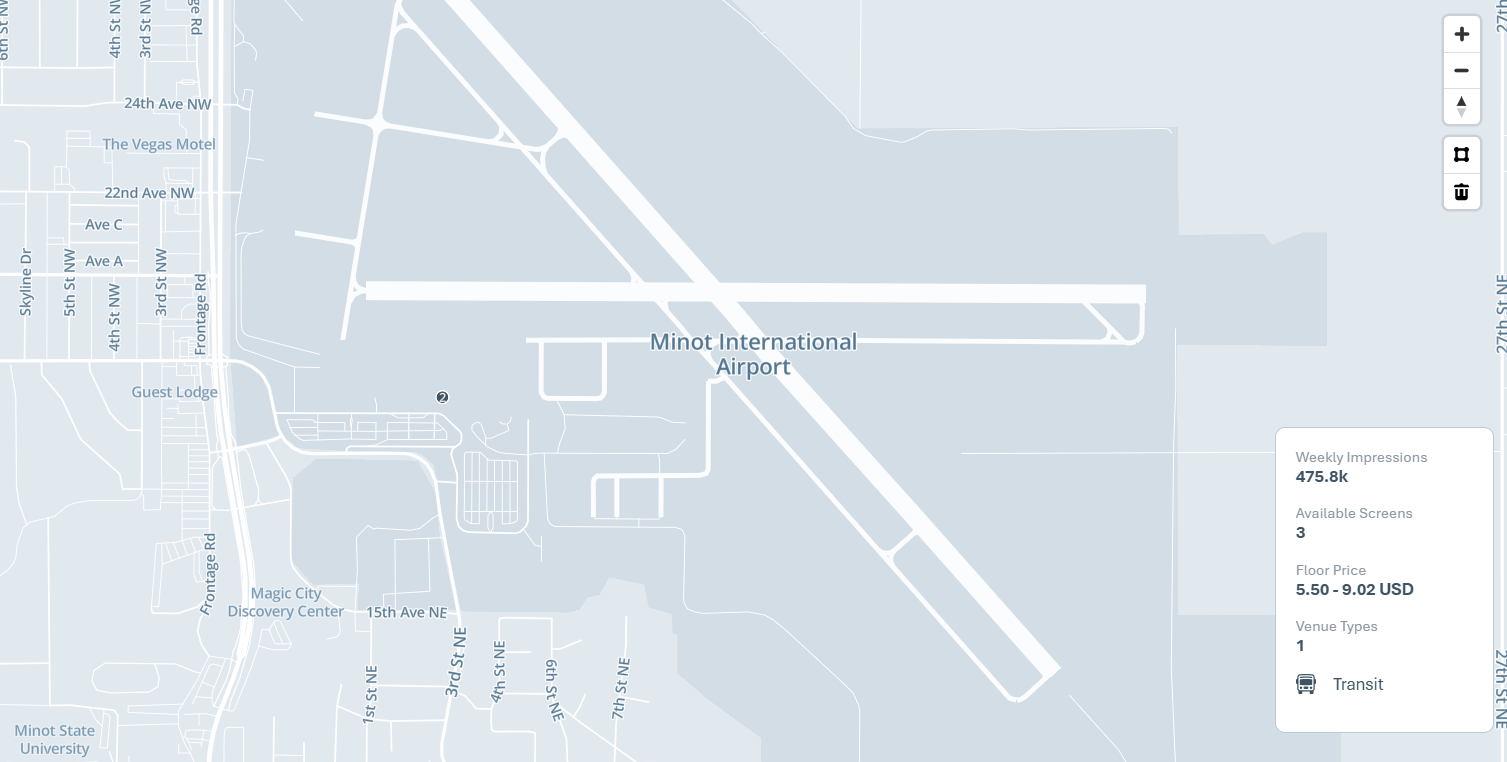
- A single consolidated passenger terminal constructed in 2015 and opened in 2016, replacing a 32,200 square foot 1990 facility. Two levels in linear configuration totalling approximately 125,000 usable square feet, located on the west side of the airfield directly south of the main runway. Single-terminal configuration means every passenger passes through the same circulation spine, delivering near-complete coverage from one footprint.
- The terminal was deliberately designed for expansion, to six gates and to approximately 600,000 annual enplanements. At 337,000 total passengers it is operating well below that ceiling, which is commercially significant: the environment is modern, spacious and uncrowded rather than congested, and inventory is not capacity-constrained.
- Parking sits directly in front of the terminal with public lots to the south and west and rental car facilities to the west, accessed via Airport Road from US Highway 83. The apron is also used for aircraft deicing.
Premium Indicators:
- The terminal quality relative to passenger volume is the airport's most distinctive asset. A purpose-built 2015 facility handling roughly a quarter of its design capacity produces a materially better brand environment than passenger counts would predict, and this is unusual among airports of comparable size.
- General aviation activity is substantial, with 128 based aircraft and 34,305 total annual operations against a modest number of scheduled flights, supporting corporate, agricultural, energy and medical aviation. Customs availability for arrivals from Canada supports cross-border private and business flights.
- Security screening applies full inspection of all passengers and carry-on baggage rather than the selective process used at major airports, which extends processing time and, with it, dwell in the pre-security environment.
- Amenities include restaurants, complimentary wireless connectivity, ample parking, car rental and taxi provision, in a compact single-level departure layout with check-in counters and self-service kiosks immediately at the entrance.
Forward-Looking Signal:
The defining signal is not the airport but the base beside it, and it is unusually concrete. Minot Air Force Base has roughly five billion dollars of construction planned. The Sentinel intercontinental ballistic missile programme carries more than two billion dollars in dedicated construction funding from fiscal 2026 through 2040, spanning the base and missile sites across multiple counties, with major work scheduled to begin around 2027, supported by 2.6 billion dollars for development following an earlier 2.5 billion dollar allocation. The Long-Range Standoff cruise missile programme adds five major renovation projects between fiscal 2026 and 2033 with more than 150 million dollars identified for construction and nearly 800 million dollars for development and procurement, while B-52 upgrades carry more than one billion dollars including new engines that will redesignate the aircraft. A base improvement backlog exceeding 900 million dollars sits alongside all of it. Base economic impact already reached 956.7 million dollars in fiscal 2025 before this construction ramps. Masscom Global advises advertisers to secure multi-year positions now, ahead of the 2027 construction peak, while pricing reflects the airport's current volume rather than its coming decade.
Airline and Route Intelligence
Top Airlines:
Delta Air Lines operating through Delta Connection with the largest share of traffic, United Airlines operating through United Express, and Allegiant Air, alongside charter and general aviation operators.
Key International Routes:
MOT operates no scheduled international passenger service, holding its international designation through customs availability for aircraft arriving from Canada and elsewhere. International travel from this catchment connects through Minneapolis and Denver. Advertisers targeting internationally bound travellers, including heritage travel to Scandinavia and Germany, reach them here at the origin stage.
Domestic Connectivity:
Four scheduled destinations across ten to fifteen daily commercial departures. Delta Connection serves Minneapolis with up to six daily flights and commands the largest share of passengers, United Express serves Denver, and Allegiant serves Phoenix-Mesa and Las Vegas on low-cost leisure schedules.
Wealth Corridor Signal:
With four destinations the corridor analysis is simple and therefore reliable. Minneapolis and Denver are the business, connection and institutional corridors, carrying defence and contractor travellers, energy and agricultural principals, medical and academic professionals and everyone bound internationally, and they are where B2B, engineering, industrial and financial services spend belongs. Phoenix-Mesa and Las Vegas are pure second-home, retirement and leisure corridors carrying local snowbirds and Canadian travellers toward property they own or intend to buy, and they are where real estate, wealth advisory, insurance and premium consumer spend belongs. The absence of any other leisure destination confirms how precisely this network reflects the catchment's two commercial functions.
Media Environment at the Airport
- Single-terminal configuration in a modern 125,000 square foot building running well below design capacity means coverage of the entire catchment's scheduled air market is achievable from a small number of positions, in an uncrowded and well-presented environment.
- Advertising clutter is close to absent. A single well-placed campaign here can own the environment outright, delivering a share of voice unattainable at Minneapolis or Denver at any budget.
- Dwell time is supported by full rather than selective security screening, early-arrival behaviour among military and business travellers, and genuine winter schedule variability. Snowbird repeat travel across the November to April season adds accumulated frequency well beyond raw passenger counts.
- Masscom Global provides advertisers with inventory access, placement precision mapped to route flows, and honest counsel on fit. We separate the Minneapolis and Denver business and defence corridors from the Phoenix-Mesa and Las Vegas leisure flows, so construction and engineering B2B, military financial services and consumer property creative each reach their intended audience.
Strategic Advertising Fit
Best Fit:
- Defence construction, heavy civil and specialist engineering: Roughly five billion dollars of committed Air Force construction from fiscal 2026 to 2040 makes this the most contextually aligned category at this airport by a wide margin.
- Industrial supply, safety, tooling and equipment rental: A decade-long construction pipeline across a base and a missile complex spanning multiple counties, with sustained consumables and equipment demand.
- Workforce, staffing and skilled trades recruitment: Construction mobilisation in a low-population, labour-constrained region makes recruitment one of the most valuable and persistent advertising needs here.
- Military financial services, lending, insurance and relocation: More than 11,000 people at the base on three to four year assignments with federal pay, plus specific disclosure and clearance considerations that reward specialist providers.
- Mineral and royalty management, farm succession and estate planning: Bakken royalty income and durum and canola farmland create substantial asset wealth now moving between generations.
- Agricultural equipment, inputs and land finance: Farm owner-operators with capital authority across the durum belt and national-leading canola production.
- Arizona and Nevada resort and retirement property: Confirmed directly by the airport's only two leisure routes.
- Institutional investment, energy and infrastructure advisory for tribal enterprises: Fort Berthold resource revenue and tribal commercial entities represent genuine, under-served institutional demand.
Brand Alignment at a Glance:
| Category | Fit |
|---|---|
| Defence construction and heavy civil engineering | Exceptional |
| Industrial supply, safety and equipment rental | Exceptional |
| Workforce, staffing and trades recruitment | Strong |
| Military financial services and insurance | Strong |
| Mineral, royalty and farm succession advisory | Strong |
| Agricultural equipment and land finance | Strong |
| Arizona and Nevada retirement property | Moderate |
| Ultra-luxury fashion, haute joaillerie and international property | Poor fit |
Who Should Not Advertise Here:
- Ultra-luxury fashion, haute joaillerie and international property: Volume is small, there is no international transit flow, and northern plains wealth is held in land and mineral interests while being culturally averse to display. These budgets belong at Minneapolis or Denver.
- International residency, citizenship-by-investment and offshore financial products: Demand is effectively absent given North Dakota's very low income tax and no estate tax, and such products are actively unsuitable for the large security-cleared military and contractor population.
- Any campaign requiring national or regional reach: At 337,000 annual passengers across four destinations, MOT cannot carry a reach-dependent plan. It is a precision defence and agricultural buy, and Masscom will recommend Minneapolis or Denver as the anchor where scale matters.
Event and Seasonality Analysis
- Event Strength: Medium, rising to High through the construction decade
- Seasonality Strength: Medium to High
- Traffic Pattern: Stable institutional base with July and October peaks and a winter outbound flow
Strategic Implication:
This airport rewards long commitments, and at this scale they are inexpensive enough to justify easily. The defence, agricultural, energy and healthcare base sustains traffic every month, and the value comes from accumulated frequency against a small, repeat-travelling professional audience. Within that annual base, three windows warrant additional weight. July delivers the state fair and the year's largest consumer concentration. Late September and October combine the Scandinavian festival, harvest business travel, hunting season and the federal fiscal year transition, making it the densest overlap of consumer and B2B audiences. November to April carries the outbound snowbird flow for property, insurance and travel categories. Above all, construction and engineering advertisers should be in position before the 2027 Sentinel construction peak rather than after it, because that is when the audience arrives and when competition for their attention will finally appear. Masscom structures campaigns around exactly that timing.

Poor Placement and Delays Affect Airport Campaigns
We help you move faster, access better inventory, and get it right now.
Talk to an ExpertFinal Strategic Verdict
Minot International is a small airport attached to one of the most concretely funded construction opportunities in the United States, and that mismatch is the entire commercial case. It handled 337,000 passengers in 2024 across four destinations and three carriers, in a modern 125,000 square foot terminal running at roughly a quarter of its design capacity. Thirteen miles north sits the only dual-wing nuclear-capable base in the Department of the Air Force, with more than 11,000 people, 956.7 million dollars of annual economic impact in fiscal 2025, and roughly five billion dollars of construction committed from fiscal 2026 through 2040 across the base and a missile complex spanning multiple counties. Defence construction and heavy civil contractors, specialist engineering firms, industrial and safety suppliers, equipment rental businesses, staffing and trades recruiters, military financial services providers, mineral and farm succession advisers, agricultural lenders and Arizona and Nevada retirement developers will all find their audience here, in an uncrowded terminal with essentially no competing messages. Luxury consumer categories, offshore financial products and any reach-dependent brief should look elsewhere, and Masscom Global will say so plainly. For everyone else, the position to hold is secured before the 2027 construction peak, not after it, and Masscom Global is the partner to secure it.
About Masscom Global
Masscom Global is a premium international airport advertising and media buying agency operating across 140 countries. With deep expertise in airport OOH, premium publications, and high-net-worth audience targeting, Masscom helps brands reach the world's most valuable travellers at the moments that matter most. For advertising packages, media rates, and campaign planning at Minot International Airport and airports across the globe, contact Masscom Global today.
Frequently Asked Questions
How much does airport advertising cost at Minot International Airport?
Cost at MOT varies by format, position and duration, but at this scale the absolute figures are modest and coverage is close to absolute, which is the airport's core advantage. Positions covering departures and the pre-security environment carry premiums around the July state fair and the late September and October festival and fiscal year window. Because the terminal runs well below design capacity, inventory is not currently supply-constrained, which makes multi-year commitments unusually attractive ahead of the 2027 construction peak. Contact Masscom Global for current rates and availability.
Who are the passengers at Minot International Airport?
Four groups. Defence contractors, engineers and programme staff connected to the Air Force base and its modernisation programmes, a group growing sharply as construction mobilises. Air Force personnel and military families, more than 11,000 people at the base on three to four year assignments. Agricultural landowners, Bakken energy principals and mineral royalty owners from across north-central and northwestern North Dakota. And snowbird leisure travellers, including Canadians from Manitoba and Saskatchewan, departing for Phoenix-Mesa and Las Vegas.
Is Minot International Airport good for luxury brand advertising?
No, and Masscom will advise against it. Volume is small, there is no international transit flow, and northern plains wealth is held in farmland and mineral interests while being culturally averse to visible display. Premium pickup trucks, agricultural equipment and specialist financial services perform here; couture, fine jewellery and international property do not. Luxury spend belongs at Minneapolis or Denver, and Masscom can structure a plan that reaches this catchment's wealth where it actually converts.
What is the best airport in North Dakota to reach HNWI audiences?
Fargo is the state's busiest airport and the intercept for Red River Valley agricultural and business-owner wealth. Bismarck serves state government and central North Dakota energy audiences, and Williston sits closest to the Bakken core. Minot delivers something specific and currently unmatched: the defence construction and engineering audience attached to a five billion dollar decade-long build programme, plus northern durum belt agricultural wealth. Masscom recommends Fargo for statewide agricultural and business reach and Minot for defence and construction precision.
What is the best time to advertise at Minot International Airport?
Because the institutional base sustains traffic year-round, annual positions are the right structure. Within that, July delivers the state fair and the year's largest consumer concentration. Late September and October combine the Scandinavian heritage festival, harvest business travel, hunting season and the federal fiscal year transition, making it the densest window of the year. November to April carries the outbound snowbird flow. Construction and engineering advertisers should be in position before the 2027 Sentinel construction peak.
Can international real estate developers advertise at Minot International Airport?
Only with North American inventory. This audience buys in the greater Phoenix, Mesa and Scottsdale corridor, in Yuma, in Las Vegas, and to a lesser extent in Texas, Florida, the Minnesota lakes and Montana, all confirmed by the airport's route network. International property interest is minimal, and offshore products are actively unsuitable for the substantial security-cleared population. Developers with Arizona, Nevada or Sunbelt inventory will find real intent; those with long-haul offshore product will not.
Which brands should not advertise at Minot International Airport?
Ultra-luxury fashion, haute joaillerie and international property, because volume is small and this wealth culture penalises display. International residency, citizenship-by-investment and offshore financial products, which have effectively no demand and carry professional consequences for cleared travellers. And any campaign requiring reach, since 337,000 passengers across four destinations cannot carry a national or regional plan alone.
How does Masscom Global help brands advertise at Minot International Airport?
Masscom Global delivers the full sequence: audience and catchment intelligence specific to the Air Force modernisation pipeline, the Bakken and durum belt economies and the tribal enterprise sector, inventory access and placement precision in a terminal where coverage can be close to absolute, campaign timing structured around the construction mobilisation calendar, the federal fiscal year and the July and October event peaks, and execution management through to performance reporting. Operating across 140 countries, we can activate MOT alongside Minneapolis, Denver and the Arizona and Nevada markets where this catchment winters and buys, reaching the same contractor and the same household at both ends of the corridor. Book a fifteen-minute planning call to review current availability and rates.