


Airport at a Glance
| Field | Detail |
|---|---|
| Airport | Midland International Air and Space Port |
| IATA Code | MAF |
| Country | United States |
| City | Midland, Texas, serving Midland and Odessa |
| Annual Passengers | 767,734 boarding passengers (FY2025), a third consecutive record |
| Primary Audience | Oil and gas executives and operators, mineral and royalty interest owners, oilfield services and rotational workforce |
| Peak Advertising Season | October to December, March, and the biennial October oil show cycle |
| Audience Tier | Tier 1 |
| Best Fit Categories | Energy sector B2B and industrial equipment, private aviation, wealth and mineral rights management, premium automotive and pickup trucks |
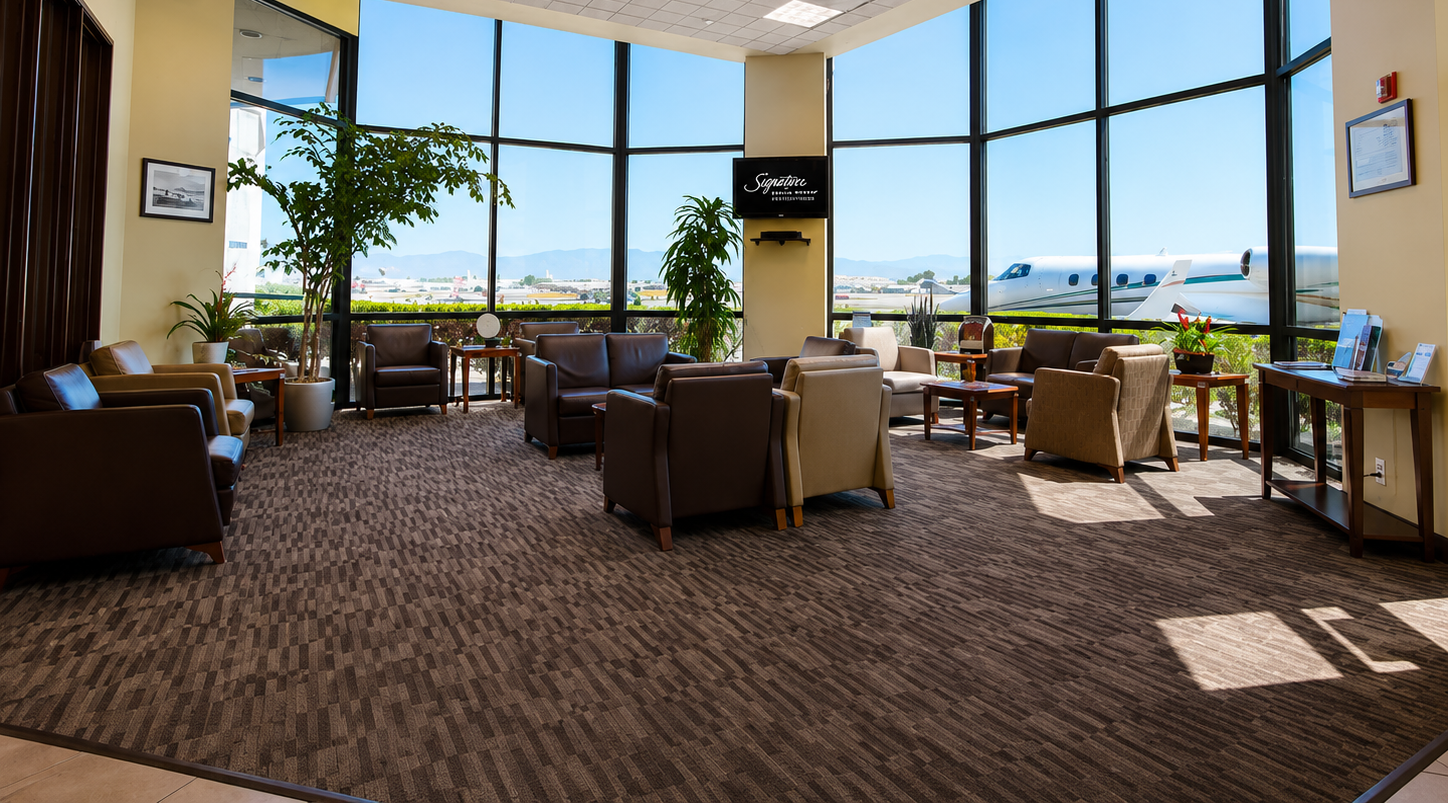
Midland International Air and Space Port recorded 767,734 boarding passengers in fiscal year 2025, a 3.72 percent increase over FY2024 and the third consecutive annual record, with passenger totals up 80 percent against FY2010. Counting arrivals, that implies roughly 1.5 million total two-way passenger movements through one terminal. The airport serves 43 counties across West Texas and eastern New Mexico as the primary commercial gateway to the Permian Basin, the most productive oil-producing region in the United States and the source of a substantial share of national crude output.
What makes MAF commercially exceptional is not scale but the specific composition of the audience. Midland is the white-collar capital of the Permian: the city where operators, independents, mineral and royalty owners, land companies and family offices are headquartered, while neighbouring Odessa concentrates oilfield services and industrial activity. The result is a terminal in which senior energy executives with nine and ten-figure capital authority, generational mineral rights owners, and a rotational technical workforce all pass through the same compact circulation spine. Very few airports in the world present that combination of decision-maker density and low message competition. Masscom Global treats MAF as a B2B and asset-wealth intercept where share of voice is achievable at a level impossible at Houston or Dallas.
Advertising Value Snapshot
- Passenger scale: 767,734 boarding passengers in FY2025, up 3.72 percent on FY2024's 740,219, itself up 11.84 percent on FY2023. Four of the airport's five busiest years have occurred since 2023. February 2026 showed a 3.89 percent monthly decline, consistent with commodity-cycle sensitivity.
- Traveller type: Oil and gas operators and executives, mineral and royalty interest owners, oilfield services and rotational technical workforce.
- Airport classification: Tier 1. Classification reflects decision-maker concentration and asset-wealth density rather than passenger volume, with an acknowledged barbell income distribution.
- Commercial positioning: The corporate and executive gateway to the Permian Basin, and the first commercial airport in the United States licensed for commercial spaceflight operations.
- Wealth corridor signal: The Permian energy wealth corridor, connected to Houston and Dallas capital markets and to the Colorado, New Mexico, Arizona and Gulf Coast second-home and ranch markets.
- Advertising opportunity: For any brand selling to the energy sector, this is the single most efficient decision-maker intercept in North America. The audience that a B2B advertiser would spend heavily to isolate at Houston arrives here pre-filtered, with a fraction of the competing messages. Masscom Global provides inventory access and placement precision across the terminal, including timing aligned to the region's biennial industry exhibition cycle, when the global oilfield supply chain converges on this catchment.
Airport Advertising is Complex to Get Right
We help you execute faster, with proven results and local insight most planners lack starting now.
Talk to an ExpertCatchment Area and Economic Drivers
Top 10 Cities within 150 km, Marketer Intelligence:
- Midland, Texas: The executive and corporate core of the catchment. Concentration of independent operator headquarters, land and mineral companies, energy banking and family offices produces the highest density of ultra-high-net-worth households in West Texas and an audience with immediate capital deployment authority.
- Odessa, Texas: The industrial and services counterpart, roughly 30 kilometres west. Oilfield services, fabrication, trucking and equipment distribution produce a large skilled technical workforce alongside services company owners with substantial business equity. Strong for industrial supply, automotive, insurance and mass-premium consumer categories.
- Big Spring, Texas: Refining, petrochemical processing and pipeline operations centre. Delivers plant management and industrial procurement audiences relevant to B2B chemical, safety, equipment and logistics advertisers.
- Andrews, Texas: Concentrated drilling and completion activity with a high proportion of landowner households holding mineral and royalty interests. Asset wealth here substantially exceeds visible income, making estate, succession and royalty management propositions highly relevant.
- Monahans, Texas: Sand mining, logistics staging and water midstream activity. Produces operations leadership and contractor principals with equipment and fleet purchasing authority.
- Hobbs, New Mexico: The New Mexico side of the Delaware Basin, with distinct state regulatory and royalty regimes. Delivers operator and services audiences whose financial and legal requirements differ from their Texas counterparts, creating a genuine cross-jurisdiction advertising opportunity.
- Seminole, Texas: Agricultural and energy dual economy with a notable Mennonite farming community alongside oil activity. Landowner households combine farm and mineral income, producing an unusually asset-rich and financially conservative audience.
- Lamesa, Texas: Cotton, agriculture and energy crossover market. Produces farm principals and landowners with combined agricultural and royalty income streams, relevant to agricultural equipment, land finance and wealth advisers.
- Pecos, Texas: One of the fastest-growing activity zones in the Delaware Basin, with heavy transient workforce presence and rapid infrastructure build-out. Audience skews toward rotational workers and contractor management, favouring telecom, fleet, safety and value consumer categories.
- Kermit and Wink, Texas: Winkler County sand and drilling corridor. Small population with disproportionate industrial throughput, delivering contractor and operations audiences for equipment, fuel, safety and logistics advertisers.
NRI and Diaspora Intelligence:
The dominant non-Anglophone community across this catchment is Hispanic, principally of Mexican origin and long established, forming a substantial majority of the population in Odessa and close to half in Midland. This community spans the oilfield and construction workforce, a large and growing services business ownership cohort, and second and third-generation professional households with significant purchasing power. It generates concentrated cross-border family travel to Mexico, remittance flow, and gifting cycles around Christmas, Easter, quinceañeras and confirmations. Precise remittance volumes for this catchment are not available.
A second and distinct movement pattern is the rotational and out-of-state technical workforce drawn to the Permian from Louisiana, Oklahoma, the Gulf Coast and the Appalachian basins, travelling on hitch schedules of two to four weeks. This audience is high-earning relative to national averages, spends heavily on vehicles, tools, telecom and travel, and moves through the terminal with unusual frequency, making it an efficient repeat-exposure target.
Economic Importance:
One engine dominates: hydrocarbon extraction and everything attached to it. The Permian Basin is the most productive oil field in the United States, and Midland and Odessa exist as its corporate and industrial capitals. Around that core sit midstream pipelines and gas processing, sand mining, water management, fabrication and trucking, energy banking and land services. Two secondary engines are growing quickly and matter to advertisers: large-scale wind and solar generation across West Texas, and energy-intensive data centre development taking advantage of abundant Permian gas and land. Agriculture, principally cotton and cattle, provides a landowner layer that overlaps heavily with mineral ownership. Every audience in this catchment traces back to who controls the land and who services what comes out of it.
Business and Industrial Ecosystem
- Independent exploration and production operators: Midland hosts the headquarters of numerous independent producers, from large public operators to closely held private companies. Produces chief executives, land managers, drilling and completions leadership and board members with authority over multi-billion dollar capital programmes.
- Mineral and royalty interest ownership and land services: A distinctive Permian institution. Thousands of households and entities hold mineral and royalty interests generating passive income across generations, supported by a dense professional layer of land companies, title firms and royalty aggregators. Produces asset-rich individuals with acute succession and tax planning needs.
- Oilfield services, fabrication and logistics: Pressure pumping, wireline, drilling contracting, sand supply, water midstream, trucking and equipment distribution concentrated across Midland and Odessa. Produces services company owners and operations leadership with heavy fleet, equipment and consumables spend.
- Midstream, processing and emerging power infrastructure: Pipeline, gas processing, wind and solar generation and early data centre development across the basin. Produces infrastructure development, engineering and project finance audiences with long-cycle procurement authority.
Passenger Intent, Business Segment:
Business travellers at MAF are travelling to Houston and Dallas for capital markets, joint venture, service contracting and regulatory business, to Denver and Phoenix for regional operations and industry events, and to Las Vegas and Austin for conferences and state-level engagement. A high proportion of them own the businesses they represent, or control the mineral interests underlying them, which means the person in the terminal signs rather than recommends. Categories that intercept them most effectively are industrial and drilling equipment, energy technology and data services, commercial and reserve-based finance, insurance and risk, private aviation, and wealth, mineral and succession advisory.
Strategic Insight:
The commercial value of the business audience at MAF is that decision-maker density and transaction scale are simultaneously extreme. A single terminal serves the corporate leadership of an oil field producing a significant share of United States crude output, and those individuals travel constantly, repeatedly and through the same two or three gate areas. Combined with message competition far below hub levels, this produces one of the strongest qualified-impression-to-spend ratios available anywhere in American aviation. Masscom Global builds energy B2B campaigns here around the basin's exhibition and budget calendars, when principal travel and procurement decisions concentrate.
Tourism and Premium Travel Drivers
Tourism is not the commercial case for this airport, and advertisers should not be sold one. Inbound leisure volume is modest and the terminal's value lies in business and resident wealth. The genuine premium leisure drivers that do exist are the following.
- Marfa and the Big Bend region: MAF functions as a practical air gateway for the internationally recognised contemporary art destination at Marfa and for Big Bend National Park, drawing a niche but affluent, culturally engaged visitor from Texas metros and both coasts. Relevant to premium hospitality, automotive rental and lifestyle advertisers.
- Executive hunting and ranch leisure: West Texas dove, quail and deer leases and working ranch hospitality draw significant inbound executive and corporate entertainment travel from November through January. Aligns with premium outdoor, firearms-adjacent, apparel, vehicle and hospitality categories.
- Energy heritage and aviation heritage attractions: Museum assets in Midland covering petroleum history, presidential heritage and aviation history sustain modest year-round visitation and provide the region with a distinct cultural identity for local brand association.
- Regional sport and cultural events: Minor league baseball, a nationally recognised high school football culture and a substantial rodeo calendar generate strong local and intra-Texas movement, particularly relevant to automotive, beverage, telecom and consumer brands.
Passenger Intent, Tourism Segment:
Inbound leisure passengers at MAF are largely visiting friends and relatives, attending regional events, or transiting toward Marfa, Big Bend or hunting properties. They arrive with accommodation and transport committed and remaining budget concentrated in dining, retail, vehicle rental and fuel. Outbound leisure is considerably larger and more valuable: resident households departing for Colorado ski and summer property, Santa Fe, Scottsdale, Las Vegas, the Florida panhandle and Los Cabos. Advertisers should treat MAF as a leisure origin market rather than a leisure destination market.
Travel Patterns and Seasonality
Peak seasons:
- October to December: The strongest window of the year, combining fiscal year-start business travel, capital budget planning cycles, hunting season inbound movement and Thanksgiving and Christmas family travel.
- February to April: Heavy industry conference and capital markets travel toward Houston and Dallas, plus spring break outbound leisure. March is consistently among the busiest months.
- June and July: Sustained business travel with a summer family leisure overlay. Monthly boarding totals reached 70,315 in June 2025, one of the airport's strongest months on record.
- The biennial October industry exhibition cycle: The Permian Basin's international oil show operates on an even-year October cycle and produces the highest concentration of industry buyers in the region's calendar.
Traffic volume data:
Boarding passengers reached 767,734 in FY2025 against 740,219 in FY2024. Monthly boarding volumes have ranged from approximately 50,000 to 70,315, with December 2024 at 66,322, April 2025 at 62,534 and June 2025 at 70,315. February 2026 recorded 50,185, down 3.89 percent year on year, indicating some softening in the current cycle. Fuel sales in FY2025 totalled just under 8.5 million gallons, up 3.3 percent.
Event-Driven Movement:
- Permian Basin international oil show (October, even-numbered years): One of the largest onshore energy equipment exhibitions in North America, held within the catchment. Draws operators, service company leadership, equipment manufacturers and international delegations. The highest-value B2B window in the two-year cycle and a priority buy for industrial, technology and finance advertisers.
- Houston and Dallas energy conference season (February and March): Outbound travel spikes as basin leadership attends the industry's major capital markets and technology conferences. Optimal window for reaching decision-makers in departures with proposition-led B2B creative.
- Hunting season (November to January): Inbound corporate entertainment and executive leisure travel to West Texas leases and ranches. Strong for premium outdoor, apparel, vehicle, hospitality and private aviation categories.
- Regional rodeo and stock show calendar (January): Long-established agricultural and cultural events drawing intra-regional and Texas-wide attendance. Relevant to automotive, agricultural equipment, insurance and beverage advertisers.
- High school football season (August to December): A defining cultural institution in this catchment with genuine commercial weight, driving intra-regional travel and community brand affinity. Relevant to automotive, telecom, quick-service and financial services advertisers seeking local credibility.
It's Not Just Where You Advertise, It's How Fast You Execute
We combine local insight with fast rollout to deliver results for you, now.

It’s Not Just Where You Advertise - It’s How Fast You Execute
We combine local insight with fast rollout to deliver results for you, now.
Talk to an ExpertAudience and Cultural Intelligence
Top 2 Languages:
- English: The working language of the energy industry and of executive, professional and corporate audiences. Creative should be plain, specific and proof-led. This audience is technically literate, commercially sceptical and responds to performance data, uptime, total cost of ownership and service reliability rather than to abstraction or lifestyle positioning.
- Spanish: Spoken across a large share of the catchment, with the Hispanic population forming a substantial majority in Odessa and close to half in Midland. This is not a marginal segment. Spanish-language creative is commercially necessary for automotive, telecom, remittance, insurance, retail and financial services categories, and bilingual execution is the standard Masscom recommends for consumer campaigns here.
Other languages are present through the rotational and international technical workforce but at levels that do not warrant dedicated creative.
Major Traveller Nationalities:
The passenger base is overwhelmingly domestic American, drawn from West Texas, eastern New Mexico and the wider United States energy workforce, with strong ties to Louisiana, Oklahoma and the Gulf Coast. Mexican nationals and Mexican-American travellers form the largest cross-border segment. International industry delegations visit the basin around exhibition cycles and operator business, arriving via Houston or Dallas, and represent a small but exceptionally high-value audience for equipment and technology advertisers. Campaign creative should be built for a domestic American energy audience with a substantial Spanish-language overlay, not for an international transit audience.
Religion, Advertiser Intelligence:
Figures below are directional approximations for West Texas rather than airport-level survey data.
- Evangelical and mainline Protestant Christianity (approximately 50 to 55 percent): The dominant religious culture of the catchment, encompassing Baptist, non-denominational and Church of Christ traditions. Drives Christmas and Easter family travel, and notably drives substantial international short-term mission travel from large regional congregations, a recurring and frequently overlooked outbound travel category. Purchase behaviour skews toward community endorsement, family framing and conservative messaging. Advertisers should avoid creative that reads as irreverent or provocative.
- Roman Catholicism (approximately 25 to 30 percent): Concentrated in the Hispanic population across both cities. Drives Christmas, Easter, Día de los Muertos and cross-border family travel, alongside quinceañera, first communion and confirmation gifting cycles. Relevant to jewellery, gifting, apparel, travel and family financial products, with Spanish-language creative essential.
- Religiously unaffiliated and other (approximately 15 to 20 percent): Skews toward the younger transient and out-of-state professional workforce. Higher receptivity to value, convenience, technology and experience positioning.
Behavioral Insight:
Permian wealth is new, cyclical and unusually candid about itself, which distinguishes it from most asset-wealth catchments. Unlike agricultural or old-money regions, this audience is comfortable with visible expression of success, and premium pickup trucks, performance vehicles, watches and private aviation genuinely convert here. At the same time, decision-making is shaped by hard commodity-cycle memory: everyone in this terminal has lived through a downturn, and propositions are evaluated on durability, service response time and downside protection rather than on optimistic projections. Two implications follow. First, luxury and premium categories can be more direct here than in most wealth markets. Second, any B2B proposition must address what happens when prices fall, because that objection is always present whether or not it is voiced.
Outbound Wealth and Investment Intelligence
The outbound passenger at MAF is commercially distinctive because Permian wealth is generated at unusual speed and held in an unusual structure. Mineral and royalty interests produce passive income across generations without operational involvement, and business sales during upcycles produce sudden large liquidity events. The resulting capital deployment runs in three directions: additional mineral and surface acreage within the basin, ranch and recreational land across the Mountain West and Texas, and resort second-home property in a well-defined set of destinations.
Outbound Real Estate Investment:
The dominant destinations for property capital from this catchment are Colorado, principally the Vail, Beaver Creek, Telluride and Crested Butte corridors, Santa Fe and northern New Mexico, Scottsdale and Paradise Valley in Arizona, the Texas Hill Country and Horseshoe Bay, Austin and Dallas urban property, the Florida panhandle around Destin and Highway 30A, and Los Cabos in Mexico. Ranch and recreational land acquisition across West Texas, Montana, Wyoming and Colorado is a persistent theme, frequently structured for both recreational use and long-term land appreciation. For international developers, the realistic proposition here is North American resort and ranch inventory rather than long-haul offshore product.
Outbound Education Investment:
Families from this catchment send children principally to Texas flagship and private institutions including the University of Texas system, Texas A&M, Texas Tech, Texas Christian University, Southern Methodist University and Baylor, alongside a smaller cohort choosing selective private universities elsewhere in the United States. Regional universities in Midland and Odessa serve the local technical and professional workforce. International study is not a dominant pattern. Education advertisers will find the strongest demand among domestic private institutions and specialist petroleum engineering and geoscience programmes.
Outbound Wealth Migration and Residency:
This is where advertisers must calibrate honestly. Texas has no state income tax, which removes the primary driver of wealth migration seen in California, New York and Illinois catchments. Permian wealth stays in Texas, and demand for citizenship-by-investment, golden visa and international residency programmes is minimal. What does exist is intra-Texas and intra-regional relocation, with liquidity events frequently followed by a move to Austin, Dallas or the Hill Country while mineral interests and business ties remain in the basin. Residency and relocation advisers should not treat this airport as a target market.
Strategic Implication for Advertisers:
The propositions that matter to this audience are mineral and royalty interest management, oil and gas estate and succession planning, family office services, private aviation, and ranch and resort property. Wealth here is being transferred generationally right now through royalty interests, and the professional services layer addressing that transfer is a natural fit for this terminal. Masscom Global can activate simultaneously at MAF and at the receiving-market airports across Colorado, New Mexico, Arizona, the Texas Hill Country and the Gulf Coast, reaching the same family at origin and destination inside a single campaign structure.
Airport Infrastructure and Premium Indicators
Terminals:
- A single consolidated passenger terminal, originally built in the late 1990s and now undergoing the largest upgrade in three decades. Single-terminal configuration means every departing and arriving passenger passes through the same circulation spine, delivering near-complete coverage from a compact media footprint.
- A 38 million dollar terminal expansion and modernisation project broke ground in October 2025, relocating all passenger screening to ground level, expanding to six security checkpoint lines and adding a dedicated pre-screening lane. Completion is targeted as early as spring 2027. The project forms part of approximately 150 million dollars in improvements across Midland International and the associated general aviation field, with roughly 73 percent expected to be grant funded and the airport operating on a fully self-sufficient basis.
Premium Indicators:
- Business aviation activity is the airport's most significant premium signal. Permian executive travel relies heavily on private and fractional aircraft, and a companion general aviation field is undergoing development to increase hangar capacity and add a new access point. The top of the regional wealth curve is present in this catchment in volumes that scheduled passenger counts substantially understate.
- The airport holds a Federal Aviation Administration commercial spaceflight licence granted in September 2014, making it the first commercial airport in the United States authorised for commercial space operations. This is a genuinely distinctive institutional credential and a differentiator for aerospace, technology and innovation-positioned advertisers.
- Current screening wait times average around 30 minutes at peak and can extend considerably when checkpoint capacity is constrained, producing substantial and predictable dwell in the pre-security and departures environment.
- Premium hospitality within the catchment is business-oriented rather than resort-oriented, comprising upper-upscale corporate hotels and private clubs in Midland serving the operator and services executive community year-round.
Forward-Looking Signal:
MAF has now set three consecutive annual passenger records, with four of its five busiest years occurring since 2023 and volumes 80 percent above FY2010. Terminal capacity has been the constraint, and the current expansion directly addresses it, with six checkpoint lines and ground-level screening due as early as spring 2027 alongside expanded parking and hangar capacity. Basin activity continues to broaden beyond crude into gas processing, renewables generation and early data centre development, each adding new professional audiences to the same terminal. Advertisers should note the commodity-cycle sensitivity evident in early 2026 monthly figures, which makes the present a favourable negotiating environment. Masscom Global advises securing position and multi-year rates during this window, before expanded terminal capacity and the next upcycle reset the commercial baseline.
Airline and Route Intelligence
Top Airlines:
Southwest Airlines, holding approximately 45.3 percent of boardings in FY2025, United Airlines at approximately 26.3 percent operating largely through SkyWest, and American Eagle as American Airlines' regional operation. Delta Air Lines discontinued its Austin service in November 2025.
Key International Routes:
MAF operates no scheduled international passenger service. International travel from this catchment connects via Houston, Dallas/Fort Worth, Denver and Phoenix. Advertisers targeting internationally bound energy executives reach them here at the origin stage, before hub-level competition for attention begins.
Domestic Connectivity:
Nonstop service operates to Dallas, Houston, Denver, Phoenix, Las Vegas and Austin. Southwest carries the largest share and provides the Austin, Las Vegas and Houston Hobby connectivity, while United serves Denver and Houston Intercontinental and American Eagle serves Dallas/Fort Worth. Verified weekly frequencies by route are not available.
Wealth Corridor Signal:
The route map is one of the most commercially legible of any American airport, because it is built almost entirely around one industry. Houston and Dallas are the capital, legal, banking and service-contracting corridors, carrying operators, financiers and executives on transaction and negotiation business, and they are where energy B2B, finance and professional services spend belongs. Denver and Phoenix are dual-purpose corridors carrying both regional operations travel and second-home and resort movement. Las Vegas is a conference and leisure corridor. Austin carries state regulatory, legislative and technology business. The near-total absence of leisure-only routes confirms what this terminal is: a working airport for an industry, in which almost every passenger has a commercial reason to be there.
Media Environment at the Airport
- Single-terminal configuration at moderate scale means full-journey coverage is achievable at a fraction of the investment required at Houston or Dallas, while addressing a substantially more qualified energy sector audience.
- Advertising clutter is materially lower than at major Texas hubs. A well-placed campaign at MAF achieves standout and recall levels that would demand premium spectacular positioning at Intercontinental or DFW.
- Dwell time is exceptional by regional airport standards. Average peak screening waits of around 30 minutes, with longer periods when checkpoint capacity is limited, combined with early-arrival business travel behaviour, produce sustained exposure in the pre-security and gate environments.
- Masscom Global provides advertisers with inventory access, placement precision mapped to route flows, and execution capability at an airport where local relationship depth determines what is available. We separate the Houston and Dallas executive corridors from the leisure and rotational workforce flows, so B2B, premium consumer and value creative each reach their intended audience rather than a blended average.
Strategic Advertising Fit
Best Fit:
- Energy sector B2B, drilling and completion equipment and oilfield technology: The most contextually aligned category at any airport in North America, addressing operators and service principals with direct procurement authority.
- Industrial equipment, fleet, safety and consumables: Services company owners and operations leadership travel through this terminal constantly with recurring high-volume purchasing needs.
- Private aviation, jet cards and fractional ownership: Permian executive travel is heavily reliant on private aircraft, and companion general aviation infrastructure is expanding.
- Mineral and royalty interest management, oil and gas estate and succession planning: A generational transfer of royalty wealth is underway across this catchment right now, creating immediate demand.
- Commercial and reserve-based finance, insurance and risk management: Capital-intensive, cycle-exposed businesses with continuous financing and hedging requirements.
- Premium automotive, performance vehicles and pickup trucks: Exceptionally high ownership rates, rapid replacement cycles and an audience comfortable with visible expression of success.
- Ranch, recreational land and resort second-home property: Well-defined and documented outbound buying behaviour across Colorado, New Mexico, Arizona, the Texas Hill Country and the Gulf Coast.
- Telecom, connectivity and enterprise technology: Remote operations, data-intensive field activity and emerging data centre development create both consumer and B2B demand.
Brand Alignment at a Glance:
| Category | Fit |
|---|---|
| Energy sector B2B and oilfield technology | Exceptional |
| Industrial equipment, fleet and safety | Exceptional |
| Mineral, royalty and succession advisory | Strong |
| Private aviation and fractional ownership | Strong |
| Premium automotive and pickup trucks | Strong |
| Commercial finance, insurance and risk | Strong |
| Ranch and resort second-home property | Moderate |
| Long-haul offshore property and residency programmes | Poor fit |
Who Should Not Advertise Here:
- Long-haul offshore property and citizenship-by-investment programmes: Texas has no state income tax, which eliminates the primary driver of international wealth migration. This audience keeps its capital in Texas and the American West, and offshore residency propositions face weak intent regardless of exposure quality.
- Ultra-luxury European fashion, couture and haute joaillerie: Wealth here is substantial but expresses itself through vehicles, land, aviation and watches rather than through fashion houses, and there is no international luxury transit flow to compensate. Spend is better placed at Dallas or Houston.
- Inbound destination tourism marketing: This is a leisure origin market, not a leisure destination market. Campaigns positioning the region to visitors will underperform, while campaigns targeting residents departing for Colorado, Arizona and the Gulf Coast will not.
Event and Seasonality Analysis
- Event Strength: Medium, rising to High in even-numbered years
- Seasonality Strength: Low
- Traffic Pattern: Stable and commodity-cycle driven
Strategic Implication:
This airport rewards continuity rather than concentration, which distinguishes it from most Tier 1 catchments. Traffic is business-led and stable across the year, with no collapse in any month, so annual and multi-year contracts deliver the frequency this audience requires and secure prime position at negotiated rates. Within that annual base, three windows warrant additional weight: October to December for fiscal year-start business travel and hunting season, February and March for the Houston and Dallas conference cycle, and the biennial October industry exhibition, which should be treated as a standalone campaign in even-numbered years. Masscom structures buys around this rhythm and advises committing during softer commodity periods, when rates are most favourable.
Poor Placement and Delays Affect Airport Campaigns
We help you move faster, access better inventory, and get it right now.

Poor Placement and Delays Affect Airport Campaigns
We help you move faster, access better inventory, and get it right now.
Talk to an ExpertFinal Strategic Verdict
Midland International Air and Space Port is the highest-value energy sector intercept in North American aviation, and advertisers who judge it on its 767,734 annual boardings will misprice it badly. This is the corporate capital of the most productive oil field in the United States, serving 43 counties across West Texas and eastern New Mexico, and the executives, mineral owners and services principals who control that industry pass through one compact terminal with sustained dwell and almost no competing brand messages. Oilfield equipment and technology providers, industrial and fleet suppliers, reserve-based lenders and insurers, private aviation operators, mineral and succession advisers, premium automotive marques and ranch and resort developers will find an audience here that combines signing authority with genuine asset wealth. European luxury fashion and offshore residency programmes should spend elsewhere. With three consecutive record years behind it, a 38 million dollar terminal expansion due as early as spring 2027 and a basin diversifying into gas, renewables and data infrastructure, current pricing reflects the airport that was rather than the one arriving, and Masscom Global is the partner positioned to secure inventory, timing and placement precision before that gap closes.
About Masscom Global
Masscom Global is a premium international airport advertising and media buying agency operating across 140 countries. With deep expertise in airport OOH, premium publications, and high-net-worth audience targeting, Masscom helps brands reach the world's most valuable travellers at the moments that matter most. For advertising packages, media rates, and campaign planning at Midland International Air and Space Port and airports across the globe, contact Masscom Global today.
Frequently Asked Questions
How much does airport advertising cost at Midland International Air and Space Port?
Cost at MAF varies by format, terminal position, campaign duration and seasonal demand. Positions covering the departures and screening environment during the October to December and February to March business peaks command premiums, as does the biennial October industry exhibition window. Because traffic is stable rather than seasonal, annual and multi-year commitments deliver both better rates and the exposure frequency this repeat-travelling audience requires. Contact Masscom Global for current rates and availability.
Who are the passengers at Midland International Air and Space Port?
Three groups sharing one terminal. Senior oil and gas executives, operators, land and mineral professionals and energy financiers travelling to Houston, Dallas, Denver and Austin on transaction and operations business. Mineral and royalty interest owners, many of them asset-wealthy landowning families across West Texas and eastern New Mexico. And a large rotational oilfield services and technical workforce travelling on hitch schedules, high-earning relative to national averages and travelling with unusual frequency.
Is Midland International Air and Space Port good for luxury brand advertising?
For the right luxury categories, yes, and more so than most people expect. Permian wealth is substantial and comfortable with visible expression, so premium automotive, performance vehicles, watches and private aviation convert well here. European couture, fine fashion and haute joaillerie do not, because this audience expresses success through vehicles, land and aircraft rather than through fashion, and there is no international luxury transit flow. Category selection matters more here than creative budget.
What is the best airport in Texas to reach HNWI audiences?
Dallas/Fort Worth and Houston Intercontinental deliver the greatest volume of wealth traffic in Texas and remain the anchor buys for a statewide campaign. Midland delivers the highest efficiency against energy sector decision-makers and Permian asset wealth specifically, pre-filtered and largely uncontested. Masscom recommends Houston or Dallas for reach and Midland for energy precision, and can structure a coordinated Texas plan across all three.
What is the best time to advertise at Midland International Air and Space Port?
Traffic is stable year-round, so continuity matters more than concentration, and annual contracts outperform short bursts. Within that, October to December is strongest, combining fiscal year-start business travel, capital planning cycles, hunting season and holiday movement. February and March carry the Houston and Dallas energy conference surge. In even-numbered years, October also brings the region's international oil show, the single densest industry buying window in the two-year cycle.
Can international real estate developers advertise at Midland International Air and Space Port?
Selectively. This audience buys ranch and recreational land across West Texas, Colorado, Montana and Wyoming, and resort second homes in Colorado ski country, Santa Fe, Scottsdale, the Texas Hill Country, the Florida panhandle and Los Cabos. Developers with North American resort or ranch inventory will find genuine intent. Developers marketing Dubai, London, Portugal or Southeast Asian property should expect weak response, as Texas taxation gives this audience no reason to move capital offshore.
Which brands should not advertise at Midland International Air and Space Port?
Citizenship-by-investment and international residency programmes, long-haul offshore property, European couture and fine fashion, and inbound destination tourism marketing. The first two conflict with a no-income-tax jurisdiction where wealth stays in Texas. The third misreads how this wealth expresses itself. The fourth misreads the airport, which is a leisure origin market rather than a destination.
How does Masscom Global help brands advertise at Midland International Air and Space Port?
Masscom Global delivers the full sequence: audience and catchment intelligence specific to the Permian Basin energy economy and its mineral wealth structure, inventory access and placement precision mapped to route flows, campaign timing structured around the business travel calendar and the biennial exhibition cycle, and execution management through to performance reporting. Operating across 140 countries, we can activate MAF alongside Houston, Dallas and the Colorado, New Mexico, Arizona and Gulf Coast markets where this audience invests, reaching the same decision-maker at both ends of the corridor. Book a fifteen-minute planning call to review current availability and rates.