

Airport at a Glance
| Field | Detail |
|---|---|
| Airport | Manchester-Boston Regional Airport |
| IATA Code | MHT |
| Country | United States |
| City | Manchester, New Hampshire |
| Annual Passengers | Over 1.38 million (2025), best year since 2019 |
| Primary Audience | New Hampshire high-income residents and tax relocators, defence and advanced manufacturing professionals, Florida-bound leisure and second-home travellers |
| Peak Advertising Season | December to March, June to August, late September to mid-October |
| Audience Tier | Tier 2 |
| Best Fit Categories | Wealth management and tax-domicile advisory, New Hampshire real estate, defence and industrial B2B, private education |

Manchester-Boston Regional Airport handled over 1.38 million passengers in 2025, an increase of almost 9 percent on 2024 and its strongest year since 2019, when volume stood at approximately 1.7 million. Seat capacity rose 13 percent against a national average of roughly 1 percent. The airport also recorded its best cargo year in history, with Amazon Air, FedEx and UPS processing 238 million pounds, about 4 million pounds above the previous record set in 2023, making Manchester the third-largest cargo airport in New England behind Boston Logan and Bradley.
Advertisers need the full context, because it is unusual and it is the entire commercial case. MHT peaked at 4.27 million passengers in 2005 and declined through two decades of airline consolidation and leakage to Boston Logan, roughly an hour south. An independent economic impact study completed in 2025 concluded that passenger levels here are weak relative to New Hampshire's otherwise strong economy, and attributed that gap to state-subsidised bus service to Logan, federal classifications that understate the airport's behavioural catchment, and infrastructure priorities favouring highways to out-of-state hubs. The behavioural catchment extends into northern Massachusetts, southern Maine and Vermont. What this means for advertisers is a wealthy, tax-advantaged, structurally under-served audience arriving through one small terminal at pricing that reflects volume rather than value. Masscom Global treats MHT as an efficiency buy against a high-income catchment, not as a reach buy.
Advertising Value Snapshot
- Passenger scale: Over 1.38 million passengers in 2025, up almost 9 percent, best year since 2019. Seat capacity up 13 percent against a national average near 1 percent. Record cargo year at 238 million pounds.
- Traveller type: New Hampshire high-income residents and inbound tax relocators, defence and advanced manufacturing professionals, Florida and Carolinas leisure and second-home travellers.
- Airport classification: Tier 2. The catchment income profile is genuinely high, but scheduled volume is modest and the airline mix is value-led, with premium business travel leaking to Boston.
- Commercial positioning: New Hampshire's principal commercial airport and New England's third-largest cargo gateway, serving a state with no income tax and no sales tax.
- Wealth corridor signal: The inbound New England tax-migration corridor, receiving Massachusetts, New York and Connecticut wealth, and the outbound Florida and Carolinas second-home corridor.
Advertising opportunity: New Hampshire has among the highest median household incomes in the United States and no income, sales or capital gains tax, yet its airport is priced as a small hub. That mismatch is the opportunity. Masscom Global provides inventory access and placement precision across a single-terminal environment where a well-placed campaign can achieve near-total catchment coverage at a fraction of Boston Logan pricing.
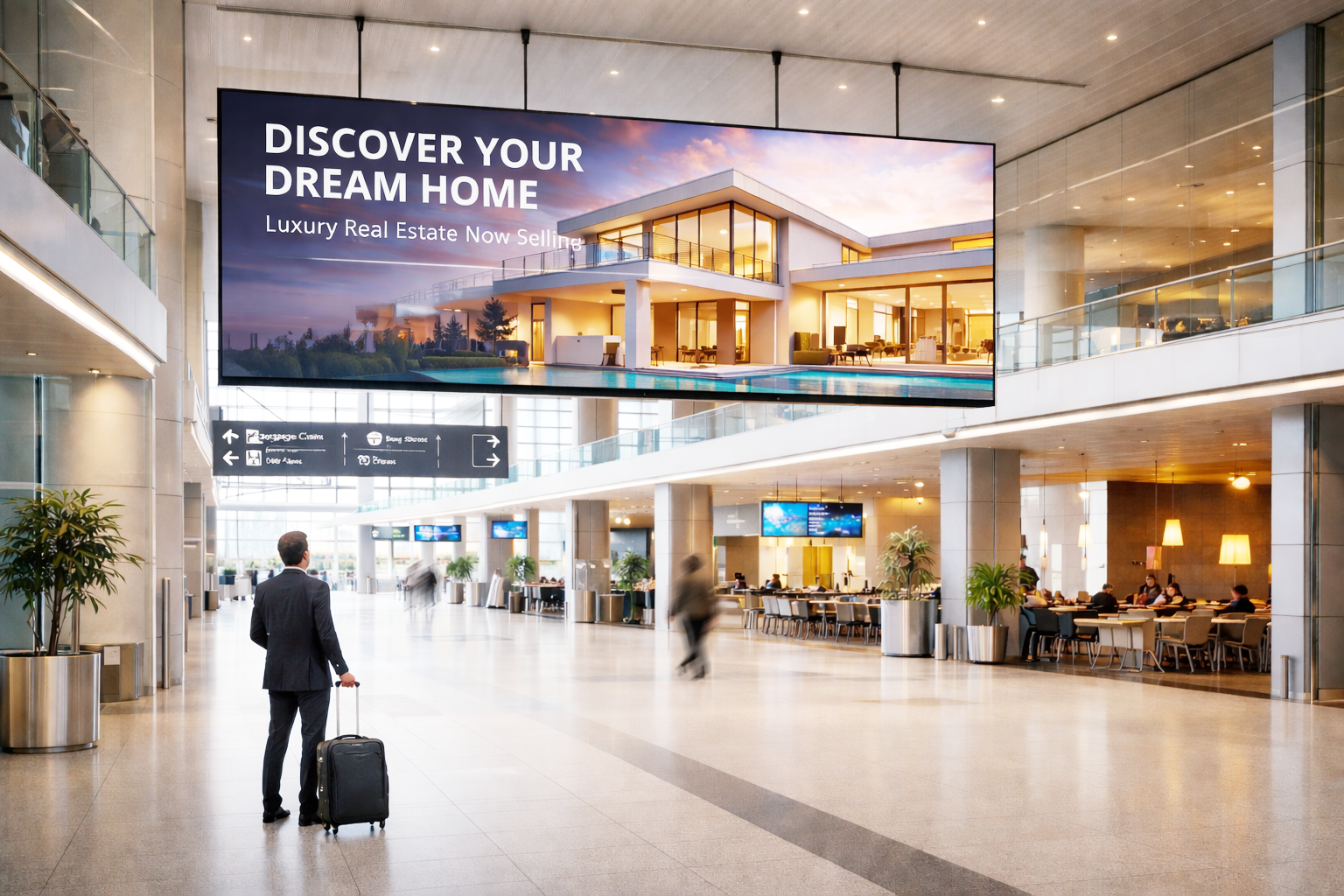
Airport Advertising is Complex to Get Right
We help you execute faster, with proven results and local insight most planners lack starting now.
Talk to an ExpertCatchment Area and Economic Drivers
Top 10 Cities within 150 km, Marketer Intelligence:
- Manchester, New Hampshire: The state's largest city and the airport's immediate market. Combines advanced manufacturing, robotics and biofabrication activity in the historic mill district with healthcare systems and a large online university headquarters, producing a professional and entrepreneurial audience alongside a substantial resettled immigrant population.
- Nashua, New Hampshire: The state's defence electronics and technology centre approximately 30 kilometres south, adjacent to the Massachusetts border. Produces engineering leadership and defence procurement audiences, plus high-income households that work in New Hampshire specifically to avoid Massachusetts income tax.
- Salem, Windham and the border towns: New Hampshire's tax-arbitrage belt, populated heavily by Massachusetts-earning households who have relocated their residence across the state line. This is the single most commercially significant audience concentration in the catchment for wealth advisory, real estate and domicile propositions.
- Concord, New Hampshire: State capital and government, legal and insurance centre approximately 30 kilometres north, and home to one of the most elite boarding schools in the United States. Delivers a professional and political audience plus significant inbound parent travel.
- Portsmouth and the Seacoast, including New Castle and Rye: Affluent coastal market roughly 80 kilometres east, anchored by biologics manufacturing, scientific instruments and a former air base now operating as a business park and secondary airfield. Combines executive and scientific professional audiences with a premium residential and second-home base.
- Lake Winnipesaukee and the Lakes Region: New Hampshire's principal lake-home wealth corridor across Meredith, Wolfeboro and Laconia, with waterfront property owned substantially by Massachusetts and out-of-state buyers. High-value real estate, marine, powersports and wealth advisory relevance.
- The White Mountains and North Conway: Ski, outdoor and fall foliage economy approximately 130 kilometres north, including tax-free retail destinations. Drives seasonal inbound visitation with strong outdoor apparel, automotive, hospitality and premium equipment alignment.
- Andover and North Andover, Massachusetts: Among the wealthiest suburban communities in Massachusetts, roughly 40 kilometres south and within MHT's behavioural catchment. High-income professional households with strong private education, wealth management and premium automotive relevance.
- Lowell and Lawrence, Massachusetts: Large, dense former mill cities with major Hispanic, Cambodian and Portuguese communities. Produces a substantial diaspora consumer audience for remittance, telecom, insurance and value travel categories, distinct from the surrounding affluence.
- Hanover and the Upper Valley: Ivy League university, academic medical centre and precision manufacturing cluster approximately 130 kilometres northwest. Delivers academic, medical and engineering audiences with high category literacy and considerable inbound parent and patient travel.
NRI and Diaspora Intelligence:
The commercially significant diaspora concentration in this catchment sits just across the Massachusetts line rather than in New Hampshire itself. Lawrence and Lowell host large Dominican, Puerto Rican, Guatemalan and Colombian populations alongside the second-largest Cambodian community in the United States and established Portuguese and Brazilian communities. These groups generate consistent Caribbean, Central American and Southeast Asian family travel, heavy remittance flow and strong telecom usage, and are best addressed through Spanish-language and value-led creative on the Florida and connecting flows.
Manchester itself hosts a smaller but notable resettled community including Nepali and Bhutanese, Congolese and Somali populations, generating remittance and international family travel that connects through Boston and New York. Separately, Manchester's historic Franco-American population, descended from Quebec migration to the mill economy, sustains recurring cross-border travel and cultural ties to Canada. Precise remittance volumes for this catchment are not available.
The wealth flow that matters most here, however, runs inward. New Hampshire is a receiving jurisdiction for Massachusetts, New York and Connecticut wealth rather than a source, and that inversion shapes every proposition at this airport.
Economic Importance:
Five engines drive this catchment. Defence electronics and aerospace systems, concentrated around Nashua and Merrimack, form the state's most capital-intensive private sector. Advanced and precision manufacturing spans robotics, medical device development, cutting systems, castings and consumer products across the state. Life sciences and biologics manufacturing anchors the Seacoast. Financial services maintain a major operational campus in the catchment. Tourism across the White Mountains, the Lakes Region and the Seacoast supplies seasonal visitation. Underpinning all of it is fiscal policy: New Hampshire levies no personal income tax, no sales tax and no capital gains tax, which drives cross-border retail, business formation and residential relocation from Massachusetts in volumes that materially shape the local economy. Airport activity itself supported 5,300 statewide jobs, 350 million dollars in earnings and 708 million dollars in total economic activity in 2024.
Business and Industrial Ecosystem
- Defence electronics, aerospace systems and firearms manufacturing: Major defence electronics operations across Nashua and Merrimack alongside globally recognised firearms manufacturing on the Seacoast and in the western part of the state. Produces engineering leadership, programme managers and defence procurement decision-makers with long-cycle contract authority.
- Advanced manufacturing, robotics and biofabrication: Robotics and medical device development in the Manchester mill district, including a regenerative manufacturing institute, alongside precision cutting systems, investment castings and consumer products manufacturing statewide. Produces engineering and industrial procurement audiences.
- Life sciences, biologics and scientific instruments: Contract biologics manufacturing and laboratory instrument operations concentrated on the Seacoast around Portsmouth. Produces scientific, regulatory and executive travellers with recurring national and international business.
- Financial services and insurance: A major asset management operational campus in the catchment alongside regional insurance and banking activity. Produces salaried professional travellers with stable high incomes and strong premium category receptivity.
- Cargo, logistics and distribution: Record cargo throughput of 238 million pounds in 2025 makes this New England's third-largest cargo airport, supported by New Hampshire's absence of sales tax and its position on the interstate corridor. Produces logistics, e-commerce and supply chain decision-makers.
Passenger Intent, Business Segment:
Business travel at MHT is the airport's structural weakness and advertisers should understand why. Premium corporate travel from this catchment leaks heavily to Boston Logan, which offers far greater frequency and international connectivity roughly an hour away, and the loss of twice-daily Newark service in early 2025 removed a key business corridor. What remains is a self-selecting group: travellers who prioritise convenience, parking cost and security speed over network breadth, principally on domestic point-to-point business to Washington, Baltimore, Charlotte, Chicago and Florida. Categories that intercept them effectively are commercial banking, insurance, professional services, business technology and automotive. Advertisers seeking depth in defence or life sciences B2B should treat MHT as a supplement to Boston rather than a substitute.
Strategic Insight:
The commercial insight at MHT is inverted from most airports. The valuable audience here is not primarily defined by why it is travelling but by where it lives. A passenger in this terminal is disproportionately likely to be a New Hampshire resident who chose the state for its tax treatment, or a Massachusetts resident considering the same move, or a lake and coastal property owner. That makes the terminal an unusually efficient channel for propositions tied to residence, domicile, property and wealth structuring rather than to business travel behaviour. Masscom Global builds campaigns here around residency and asset propositions, which is where the catchment's genuine advantage lies.
Tourism and Premium Travel Drivers
- White Mountains ski and outdoor economy: Multiple major ski areas within roughly two hours, plus Mount Washington and extensive national forest, drawing winter and summer visitation from across the Northeast. Strong alignment with outdoor apparel, premium equipment, automotive and hospitality categories.
- Lake Winnipesaukee and the Lakes Region: New England's most significant inland lake resort market, with a substantial second-home and marine economy owned largely by out-of-state buyers. Relevant to real estate, marine, powersports and wealth advisory advertisers.
- The Seacoast, Portsmouth and Hampton Beach: A compact affluent coastal market with a well-regarded culinary and cultural scene alongside high-volume summer beach visitation, extending into the southern Maine coast within easy reach.
- Fall foliage and tax-free retail: Late September through mid-October draws substantial inbound leisure visitation, reinforced year-round by New Hampshire's absence of sales tax, which makes the state a genuine retail destination for Massachusetts and regional shoppers.
Passenger Intent, Tourism Segment:
MHT is predominantly a leisure origin market rather than a leisure destination market, and advertisers should plan accordingly. The dominant flow is outbound: New Hampshire and northern Massachusetts residents departing for Florida on four separate routes, plus the Carolinas, and returning with second-home, resort and retirement decisions in progress. Inbound leisure exists and is seasonally concentrated around skiing, foliage and the summer lake and coastal season, but arrives largely by road from Boston and the wider Northeast rather than by air. The distinct inbound air audience worth naming is parent and family travel to the catchment's elite boarding schools and universities, which is high-income, internationally sourced and highly predictable in timing.
Travel Patterns and Seasonality
Peak seasons:
- December to March: The strongest outbound window, driven by Florida and Carolinas escape travel plus holiday visiting-friends-and-relatives movement. Four Florida routes, including Fort Myers and Tampa services launched in mid-November, are built specifically for this demand.
- June to August: Summer family leisure with an inbound overlay from the Lakes Region and Seacoast season, plus the June motorcycle rally in the Lakes Region and the summer motorsport calendar.
- Late September to mid-October: Fall foliage season generating genuine inbound visitation, alongside strong outbound leisure before winter.
- Late August and early September, and May and June: Boarding school and university arrival, graduation and parents' weekend cycles, producing compressed, high-income and internationally sourced travel surges.
Traffic volume data:
Total passengers exceeded 1.38 million in 2025, up almost 9 percent on 2024 and the highest total since approximately 1.7 million in 2019, against a 2005 peak of 4.27 million. Seat capacity increased 13 percent in 2025 against a national average near 1 percent. Cargo throughput reached a record 238 million pounds. Full monthly distributions are not available.
Event-Driven Movement:
- New Hampshire presidential primary (January of presidential election years): The first-in-the-nation primary concentrates national campaign staff, political media, donors, pollsters and consultants into this catchment for weeks, with the airport as the primary air gateway. This is the single most distinctive advertising window at MHT, recurring on a four-year cycle, and it delivers a national decision-maker and media audience available at no other small airport in America.
- Laconia Motorcycle Week (June): One of the oldest and largest motorcycle rallies in the United States, held in the Lakes Region and drawing very large attendance. Strong for automotive, powersports, aftermarket, apparel, insurance and beverage advertisers.
- National motorsport weekend at the Loudon speedway (summer): Major national-series racing within short reach of the terminal, bringing an enthusiast audience and associated hospitality travel. Relevant to automotive, fuel, beverage and consumer categories.
- Ski season across the White Mountains (December to March): Sustained inbound and intra-regional movement supporting outdoor, equipment, apparel, automotive and hospitality advertisers.
- Fall foliage season (late September to mid-October): Reliable inbound visitation from across the Northeast and internationally, skewing older and more affluent, with strong hospitality, automotive rental, retail and financial services alignment.
- Boarding school and university cycles (late August, May and June): Elite independent schools in Concord and on the Seacoast, plus regional universities, generate compressed high-income and international parent travel with unusually high receptivity to financial, insurance, automotive and hospitality messaging.
It’s Not Just Where You Advertise - It’s How Fast You Execute
We combine local insight with fast rollout to deliver results for you, now.
Talk to an ExpertAudience and Cultural Intelligence
Top 2 Languages:
- English: The dominant language across resident, professional, defence and leisure audiences. New Hampshire's commercial culture is notably practical and independence-minded, and creative should be direct, evidence-led and free of aspirational abstraction. This audience responds to value substantiation, self-reliance framing and clear cost comparison, and is measurably resistant to status-driven messaging.
- Spanish: Spoken by a very large share of the Lawrence and Lowell populations within the airport's behavioural catchment, spanning Dominican, Puerto Rican, Guatemalan and Colombian communities. Spanish-language creative is commercially necessary for telecom, remittance, insurance, automotive and value travel categories on the Florida and Caribbean-connecting flows.
Khmer, Portuguese and French also carry commercial relevance here: the first through the substantial Cambodian community in Lowell, the second through Portuguese and Brazilian populations in the mill cities, and the third through Manchester's Franco-American heritage and cross-border Quebec ties.
Major Traveller Nationalities:
The passenger base is overwhelmingly domestic American, drawn from southern and central New Hampshire, northern Massachusetts, southern Maine and southern Vermont. International travel from this catchment connects through Boston, New York and Fort Lauderdale, with the airport recording over 15,000 connections to 163 international destinations in its pre-pandemic benchmark year. Canadian traffic exists through the Quebec corridor, and a small but high-value international segment arrives for the catchment's boarding schools and universities, principally from East Asia, Europe and Latin America. Campaign creative should be built for a practical domestic American audience with a Spanish-language layer, and a separate high-income international layer timed to the school calendar.
Religion, Advertiser Intelligence:
Figures below are directional approximations for New Hampshire and northern New England rather than airport-level survey data.
- Religiously unaffiliated (approximately 35 to 40 percent): New Hampshire sits among the least religiously affiliated states in the United States, and this is the defining characteristic of the catchment. Purchase triggers are practicality, independence, environmental credentials and value rather than tradition or community endorsement. Creative built on faith or heritage framing underperforms materially here relative to most American markets.
- Roman Catholicism (approximately 25 to 30 percent): Sustained by Franco-American, Irish and Italian heritage in the mill cities and by the Hispanic population of Lawrence and Lowell. Drives Christmas and Easter family travel, first communion and confirmation gifting cycles, and heritage travel to Quebec, Ireland and Italy. Relevant to gifting, travel and family financial products, with Spanish-language creative essential for the Massachusetts border cities.
- Protestant and other Christian traditions (approximately 20 percent): Present across the state's smaller towns and rural communities, historically Congregational and Baptist. Drives Thanksgiving and Christmas travel and charitable giving cycles, with moderate alignment to legacy and philanthropy propositions.
- Judaism and other faiths (approximately 3 to 5 percent combined): Concentrated in the Seacoast, Upper Valley and Massachusetts border communities, supporting cultural travel, private education and philanthropy categories at modest scale.
Behavioral Insight:
Two audience characteristics should shape every campaign at this airport. First, New Hampshire's culture is explicitly fiscal. Residents frequently chose the state for its tax treatment, discuss it openly, and evaluate financial propositions with unusual literacy about domicile, capital gains and estate exposure. Financial services, wealth advisory and real estate creative can therefore be considerably more technical and specific here than at comparable airports, and vagueness reads as evasion. Second, the region's affluence is understated to the point of inversion: visible luxury signalling is not merely ineffective but culturally suspect, and premium propositions must lead with durability, function and long-term cost rather than with prestige. The border-city diaspora audience behaves quite differently, responding to clear price, convenience and payment-flexibility messaging, which is why Masscom separates creative by route and terminal position rather than running one execution across the terminal.
Outbound Wealth and Investment Intelligence
The outbound passenger at MHT sits at the centre of one of the clearest wealth-migration corridors in the United States, but the direction is the opposite of what most advertisers assume. New Hampshire levies no personal income tax, no sales tax and no capital gains tax, while neighbouring Massachusetts introduced a surtax on income above roughly one million dollars in 2023. New Hampshire is therefore a receiving jurisdiction, absorbing wealth from Massachusetts, New York and Connecticut rather than exporting it. Capital deployment from this catchment runs into New Hampshire property itself, into warm-weather second homes, and into portfolio and business structures designed around a no-tax residence.
Outbound Real Estate Investment:
The dominant destinations for property capital are Florida, principally Naples, Fort Myers, Sarasota, Tampa and the Palm Beach corridor, alongside the Carolinas around Myrtle Beach, Charleston and Hilton Head, and Arizona to a lesser degree. Within the region, capital concentrates on Lake Winnipesaukee waterfront, the Seacoast around Portsmouth, New Castle and Rye, the southern Maine coast, and White Mountains ski property. The airport's four Florida routes and its Myrtle Beach service map directly onto this behaviour. Internationally, interest is modest and clusters around Ireland, driven by heritage, alongside Italy, Portugal and the Caribbean resort markets.
Outbound Education Investment:
This catchment is simultaneously a significant education spender and a globally recognised education destination. Families here send children to Ivy League and selective private universities, the New England independent school network and Boston-area institutions, with growing interest in Irish, Scottish and English universities. Far more commercially interesting is the inbound flow: the catchment contains boarding schools of genuinely international standing in Concord and on the Seacoast, which draw fee-paying families from East Asia, Europe, Latin America and the Gulf. This produces a small, wealthy, internationally sourced audience arriving on predictable calendar dates, and it is one of the most under-exploited advertising opportunities at this airport.
Outbound Wealth Migration and Residency:
Advertisers must invert the standard proposition here. There is minimal demand for citizenship-by-investment, golden visa or international residency programmes, because this catchment's residents have already executed the relocation that mattered to them, moving into a jurisdiction with no income, sales or capital gains tax. The active demand is for the inbound version: Massachusetts, New York and Connecticut households evaluating a New Hampshire move, and existing residents structuring trusts, business sales and estates around that residence. Domicile advisory, trust and estate planning and New Hampshire residential real estate all have genuine and immediate demand. Florida domicile remains a secondary consideration for retirees seeking both no income tax and warm weather.
Strategic Implication for Advertisers:
Wealth managers, trust and estate specialists, domicile advisers and New Hampshire and Florida property developers are addressing an audience here that thinks about residence and taxation as a primary financial lever rather than a footnote. Independent schools and universities have a distinct, internationally sourced inbound audience on fixed calendar dates. Masscom Global can activate simultaneously at MHT and at the Boston, Florida and Carolinas airports where this audience's property and domicile decisions land, reaching the same household at both ends of the corridor.
Airport Infrastructure and Premium Indicators
Terminals:
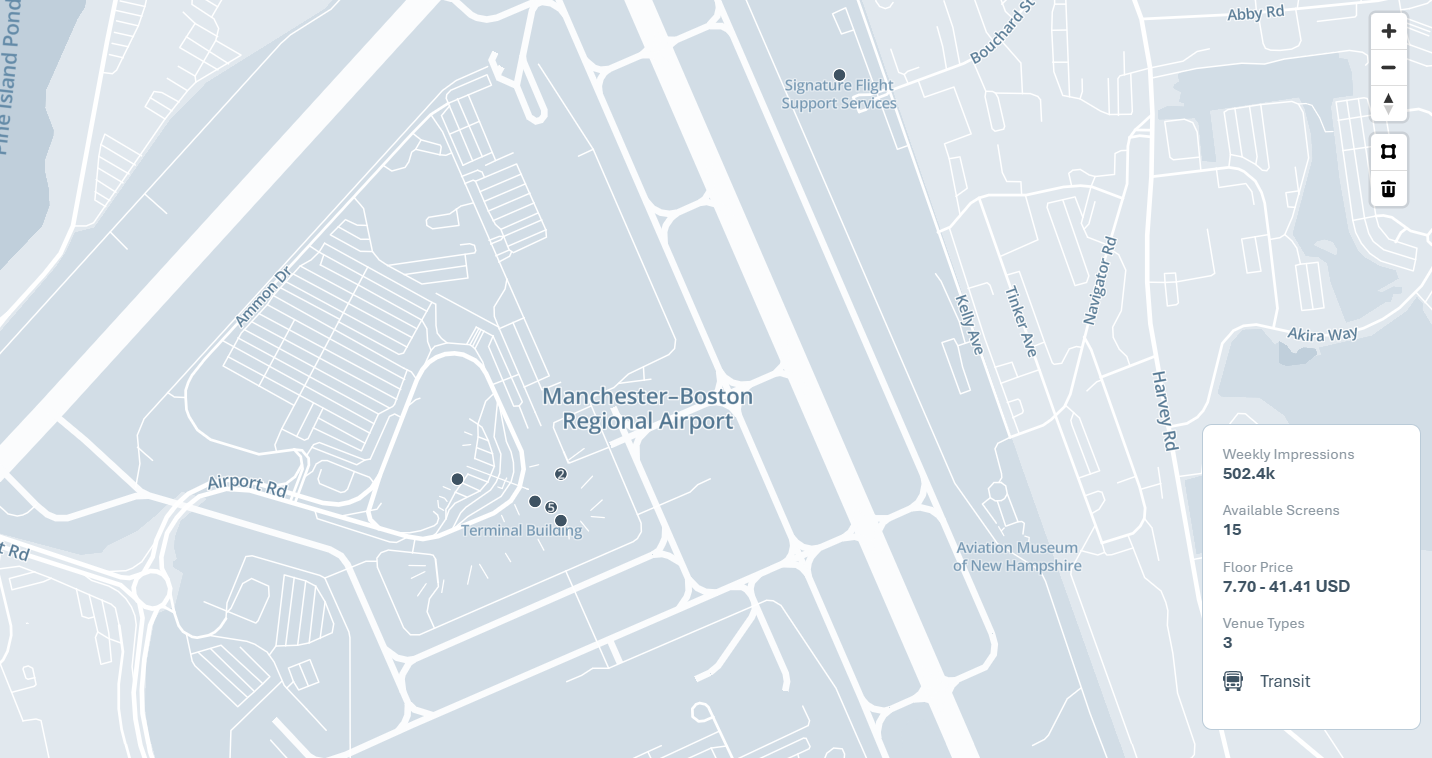
- A single consolidated passenger terminal serving all scheduled traffic, with two runways and substantial airfield capacity relative to current passenger volume. Single-terminal configuration means every arriving and departing passenger passes through the same circulation spine, delivering near-complete coverage from one compact footprint.
- The facility was built and expanded for volumes far above current levels, having handled 4.27 million passengers in 2005. This leaves genuine headroom: the airport is not capacity constrained, security processing is fast, and parking is close and inexpensive, all of which are central to its competitive proposition against Boston Logan.
Premium Indicators:
- The airport's principal premium signal is the wealth of its catchment rather than the opulence of its terminal. New Hampshire ranks among the highest-income states in the United States, and the surrounding communities across the Massachusetts border are wealthier still.
- Cargo operations are a distinctive institutional strength, with record 2025 throughput of 238 million pounds making this New England's third-largest cargo airport. This supports a logistics, e-commerce and supply chain B2B audience alongside passenger traffic.
- General and business aviation activity serves the Lakes Region, Seacoast and White Mountains property audiences, and a separate business-park airfield on the Seacoast handles additional corporate movement. The top of this catchment's wealth curve is present without appearing fully in scheduled passenger counts.
- Elite independent boarding schools in Concord and on the Seacoast, together with an Ivy League university and academic medical centre in the Upper Valley, give this catchment institutional prestige well beyond what its airport volume suggests.
Forward-Looking Signal:
Momentum has turned decisively. Passengers rose almost 9 percent in 2025 to the best level since 2019, seat capacity rose 13 percent against a national average near 1 percent, and cargo set an all-time record. Breeze Airways increased summer seat capacity by more than 13 percent, launched Myrtle Beach service in early 2026 and has signalled intent to add substantially more destinations from Manchester, targeting travellers who prefer to avoid congested hubs. JetBlue entered the market in January 2025, and Spirit operates four Florida routes including Fort Myers and Tampa. Nashville service has been announced. Set against this, United withdrew twice-daily Newark service in March 2025, and the 2025 economic impact study identified state policy choices, including subsidised bus service to Logan and classifications that understate the true catchment, as continuing constraints. Advertisers should read this as a market in recovery with structurally cheap inventory and improving volume. Masscom Global advises securing multi-year positions now, while pricing still reflects the airport's low point rather than its trajectory.
Airline and Route Intelligence
Top Airlines:
Southwest Airlines, Breeze Airways, Spirit Airlines, American Airlines, Delta Air Lines and JetBlue, which entered the market in January 2025. Amazon Air, FedEx and UPS operate the cargo network.
Key International Routes:
MHT operates no scheduled international passenger service. International travel from this catchment connects through Boston, New York and Fort Lauderdale, with the airport recording over 15,000 international connections to 163 destinations in its pre-pandemic benchmark. Advertisers targeting internationally bound travellers reach them here at origin, before hub-level competition for attention begins.
Domestic Connectivity:
The network is domestic point-to-point and leisure-weighted, with four Florida routes including Orlando, Fort Lauderdale, Fort Myers and Tampa, alongside Myrtle Beach, Baltimore, Washington, Charlotte, Chicago, Philadelphia, Detroit and Nashville. Verified weekly frequencies by route are not available.
Wealth Corridor Signal:
The route map is unusually revealing because it is almost entirely leisure and property-driven. Florida in all four of its destinations, plus Myrtle Beach, is not primarily a holiday network: it is the second-home, retirement and domicile corridor for a catchment that has already optimised its tax residence once and is considering doing so again for climate. Baltimore, Washington, Charlotte and Chicago are the residual business and connection corridors, thinner than the catchment's economy would justify because premium corporate travel leaks to Boston. The near-total absence of transcontinental and international service confirms the airport's honest position: this is a regional leisure and origin-market terminal serving a wealthy population, not a business gateway.
Media Environment at the Airport
- Single-terminal configuration with substantial spare capacity means full-journey coverage across the entire catchment is achievable from one compact footprint, at a fraction of Boston Logan pricing for an audience with comparable or higher household income.
- Advertising clutter is among the lowest of any airport serving a high-income American catchment. A well-placed campaign at MHT achieves standout that would require premium spectacular positioning at Logan.
- Dwell time benefits from the airport's core proposition. Passengers choose MHT specifically for close parking and fast security, which means they arrive relaxed and spend their margin of time in the concession and gate environment rather than in queues, producing attentive rather than harried exposure.
- Masscom Global provides advertisers with inventory access, placement precision mapped to route flows, and execution capability at an airport where local relationship depth determines availability. We separate the Florida and second-home departure flows from the border-city diaspora and inbound school calendar flows, so wealth advisory, property, value and education creative each reach their intended audience rather than a blended average.
Strategic Advertising Fit
Best Fit:
- Wealth management, trust, estate and domicile advisory: The catchment's defining characteristic is fiscal residence. This audience is unusually literate about domicile, capital gains and estate exposure, and receptive to technically specific propositions.
- New Hampshire and regional residential real estate: Active inbound relocation from Massachusetts, New York and Connecticut, plus continuous demand for Lake Winnipesaukee waterfront, Seacoast and White Mountains property.
- Florida and Carolinas resort and retirement real estate: Four Florida routes and a Myrtle Beach service confirm exactly where this audience's second-home and retirement capital is heading.
- Defence, aerospace and industrial B2B: A concentrated defence electronics, firearms and precision manufacturing base, best treated as a supplement to Boston rather than a standalone buy.
- Independent schools, universities and education advisory: Internationally recognised boarding schools and an Ivy League institution within the catchment produce both outbound spend and a wealthy inbound parent audience on fixed dates.
- Premium and electric automotive, pickup trucks and powersports: High household incomes, no sales tax on vehicle purchase, strong outdoor and lake usage, and a major regional motorcycle rally.
- Logistics, e-commerce and supply chain B2B: Record cargo throughput and New England's third-largest cargo operation create a genuine, distinct decision-maker audience.
- Remittance, telecom and value travel: Large Hispanic, Cambodian and Portuguese communities in the Massachusetts border cities within the behavioural catchment.
Brand Alignment at a Glance:
| Category | Fit |
|---|---|
| Wealth management, trust and domicile advisory | Exceptional |
| New Hampshire and regional real estate | Exceptional |
| Florida and Carolinas resort real estate | Strong |
| Premium automotive, trucks and powersports | Strong |
| Independent schools and education advisory | Strong |
| Logistics and supply chain B2B | Strong |
| Defence and industrial B2B | Moderate |
| International residency and citizenship programmes | Poor fit |
Who Should Not Advertise Here:
- International residency and citizenship-by-investment programmes: This catchment's residents have already relocated to a jurisdiction with no income, sales or capital gains tax. The proposition has no remaining problem to solve, and intent is close to absent.
- Status-led luxury creative and prestige fashion: Northern New England affluence is deliberately understated to the point of treating visible luxury as a negative signal. The categories occasionally fit but this execution does not, and spend performs better at Boston.
- Advertisers requiring national or international scale from a single airport: At just over 1.38 million passengers, MHT cannot deliver reach-dependent campaigns on its own. It is an efficiency and precision buy, and should be planned alongside Boston rather than instead of it.
Event and Seasonality Analysis
- Event Strength: Medium, rising to Exceptional in presidential primary years
- Seasonality Strength: High
- Traffic Pattern: Leisure-weighted dual peak with a four-year political spike
Strategic Implication:
Two windows carry most of the value. December to March delivers the Florida and Carolinas outbound peak, and this is where wealth advisory, domicile, resort property and premium consumer spend belongs, with creative live before Thanksgiving. June to August delivers the summer leisure and Lakes Region peak alongside the motorcycle rally and motorsport calendar, favouring automotive, powersports, beverage and consumer categories. Late September to mid-October adds a shorter inbound foliage window. Overlaying all of this, the January presidential primary in election years concentrates national campaign, media and donor traffic through this terminal for weeks, a window with no equivalent at any comparable American airport and one worth planning for well in advance. Masscom structures campaigns around this rhythm and advises securing multi-year positions while pricing remains at recovery levels.
Poor Placement and Delays Affect Airport Campaigns
We help you move faster, access better inventory, and get it right now.

Poor Placement and Delays Affect Airport Campaigns
We help you move faster, access better inventory, and get it right now.
Talk to an ExpertFinal Strategic Verdict
Manchester-Boston Regional is a wealthy catchment served by an underweighted airport, and that mismatch is precisely why it deserves a place on a media plan. Over 1.38 million passengers moved through a single terminal in 2025, up almost 9 percent with seat capacity up 13 percent against a national average near 1 percent, and cargo set an all-time record at 238 million pounds. An independent study concluded that passenger levels here are weak relative to New Hampshire's economy, which is another way of saying the audience is better than the price. Wealth managers, trust and estate specialists, domicile advisers, New Hampshire and Florida property developers, independent schools, premium automotive and powersports brands and logistics B2B advertisers will all find a high-income, fiscally literate, tax-motivated audience here at a fraction of Boston Logan pricing. International residency programmes, prestige fashion and reach-dependent campaigns should look elsewhere. With Breeze expanding, JetBlue newly established, four Florida routes running and the four-year primary cycle guaranteeing a national audience, current pricing reflects the airport's low point rather than its direction, and Masscom Global is the partner positioned to secure inventory, timing and placement precision before that gap closes.
About Masscom Global
Masscom Global is a premium international airport advertising and media buying agency operating across 140 countries. With deep expertise in airport OOH, premium publications, and high-net-worth audience targeting, Masscom helps brands reach the world's most valuable travellers at the moments that matter most. For advertising packages, media rates, and campaign planning at Manchester-Boston Regional Airport and airports across the globe, contact Masscom Global today.
Frequently Asked Questions
How much does airport advertising cost at Manchester-Boston Regional Airport?
Cost at MHT varies by format, terminal position, campaign duration and seasonal demand. Pricing here reflects passenger volume rather than catchment income, which makes it one of the more efficient buys available against a high-income American audience. Positions covering the December to March Florida departure flow and the summer leisure peak command the highest premiums, while shoulder periods are considerably more efficient. Contact Masscom Global for current rates and availability.
Who are the passengers at Manchester-Boston Regional Airport?
Predominantly New Hampshire and northern Massachusetts residents, with a behavioural catchment extending into southern Maine and Vermont. The core groups are high-income households who chose New Hampshire for its absence of income, sales and capital gains tax, Florida and Carolinas leisure and second-home travellers, defence electronics and advanced manufacturing professionals, and a diaspora consumer audience from the Lawrence and Lowell border cities. A smaller inbound audience arrives for the catchment's elite boarding schools.
Is Manchester-Boston Regional Airport good for luxury brand advertising?
Only with the right categories and the right creative. Household incomes here are among the highest in the United States, but northern New England affluence is deliberately understated and treats visible luxury signalling as a negative. Premium automotive, powersports, private education, wealth advisory and high-value real estate perform well when creative leads with durability, function and long-term value. Prestige fashion and status-led luxury underperform and belong at Boston.
What is the best airport in New England to reach HNWI audiences?
Boston Logan delivers the greatest volume of wealth traffic and remains the anchor buy for any regional campaign, with the Cape and Islands airports delivering the purest ultra-premium leisure audiences at very low volume. Manchester delivers something different and specific: efficient access to a tax-advantaged, fiscally literate high-income catchment at recovery-level pricing. Masscom recommends Logan for reach and MHT for efficiency against New Hampshire wealth, and can structure a coordinated New England plan across both.
What is the best time to advertise at Manchester-Boston Regional Airport?
December to March is strongest, capturing the Florida and Carolinas outbound peak across four Florida routes plus holiday travel, with creative live before Thanksgiving. June to August delivers the summer leisure and Lakes Region season alongside the June motorcycle rally and the summer motorsport calendar. Late September to mid-October adds an inbound foliage window. In presidential election years, January delivers the first-in-the-nation primary, a national campaign and media audience unavailable at any comparable airport.
Can international real estate developers advertise at Manchester-Boston Regional Airport?
Selectively. This audience buys in Naples, Fort Myers, Sarasota, Tampa and the Palm Beach corridor, in Myrtle Beach, Charleston and Hilton Head, and within the region on Lake Winnipesaukee, the New Hampshire Seacoast, the southern Maine coast and White Mountains ski property. International interest is modest and clusters on Ireland, Italy, Portugal and the Caribbean. Developers with North American resort or regional inventory will find real intent, while long-haul offshore product will not.
Which brands should not advertise at Manchester-Boston Regional Airport?
International residency and citizenship-by-investment programmes, because this catchment has already relocated into a no-tax jurisdiction and the proposition solves nothing. Status-led prestige fashion, because understated affluence penalises visible luxury signalling. And any campaign that depends on scale, since just over 1.38 million passengers cannot carry a reach-driven plan on their own.
How does Masscom Global help brands advertise at Manchester-Boston Regional Airport?
Masscom Global delivers the full sequence: audience and catchment intelligence specific to New Hampshire's tax-driven wealth profile and its defence and manufacturing base, inventory access and placement precision mapped to individual route flows, campaign timing structured around the Florida winter peak, the summer leisure season and the four-year primary cycle, and execution management through to performance reporting. Operating across 140 countries, we can activate MHT alongside Boston and the Florida and Carolinas markets where this audience's property and domicile decisions land, reaching the same household at both ends of the corridor. Book a fifteen-minute planning call to review current availability and rates.