

Airport at a Glance
| Field | Detail |
|---|---|
| Airport | Long Island MacArthur Airport |
| IATA Code | ISP |
| Country | United States |
| City | Ronkonkoma, Islip, Suffolk County, New York |
| Annual Passengers | 1,580,000 (2025) |
| Primary Audience | Long Island mass-affluent and retiree Florida travellers, tax and domicile relocators, South Asian and Hispanic diaspora communities |
| Peak Advertising Season | January to April, June to August, November to December |
| Audience Tier | Tier 2 |
| Best Fit Categories | Florida real estate and retirement communities, wealth and estate advisory, consumer banking and credit, remittance and NRI financial services |

Long Island MacArthur Airport handled 1,580,000 passengers in 2025 across 170,453 aircraft operations, against more than 1.36 million airline passengers in 2024, itself up 6.2 percent on 2023. Seat capacity in the first half of 2025 stood at 557,000 one-way seats, up 24 percent on the same period in 2019 and 12 percent on the first half of 2024. Six carriers now serve the airport following the arrival of Breeze in 2022, JetBlue in October 2024, and Avelo and Cape Air in 2025. The Federal Aviation Administration designated ISP an official New York metropolitan airport in 2011, grouping it with JFK, LaGuardia and Newark.
Advertisers need one number above all others to plan this airport correctly: Florida accounts for roughly 73 percent of scheduled seat capacity. That is not a coincidence of leisure demand. Long Island carries among the highest property tax burdens in the United States alongside New York State income and estate taxes, and it is one of the largest single sources of retiree and tax-domicile migration to Florida in the country. ISP functions as that corridor's dedicated air bridge. The catchment surrounding the terminal contains the Hamptons, Montauk, the Nassau Gold Coast and some of the wealthiest postcodes in America, but advertisers must be clear-eyed: the ultra-high-net-worth layer of that catchment largely travels by private jet, helicopter and seaplane through East Hampton, Republic and Teterboro rather than through this terminal. What ISP delivers is enormous mass-affluent Long Island volume with a defined and highly commercial purpose. Masscom Global structures placement against that reality rather than against the catchment's headline wealth.
Advertising Value Snapshot
- Passenger scale: 1,580,000 passengers in 2025 with 170,453 aircraft operations, following more than 1.36 million in 2024. First-half 2025 seat capacity up 24 percent on 2019 and 12 percent year on year.
- Traveller type: Mass-affluent Long Island residents and retirees on Florida and Southeast routes, active tax and domicile relocators, and substantial South Asian and Hispanic diaspora communities.
- Airport classification: Tier 2. Catchment wealth is exceptional, but the scheduled terminal audience is value-carrier and Florida-weighted, with the UHNWI layer bypassing the terminal.
- Commercial positioning: Long Island's own commercial airport, positioned on convenience, on-time performance and the absence of city-airport congestion, with direct rail access from the Ronkonkoma station.
- Wealth corridor signal: The New York to Florida tax and retirement migration corridor, the single most concentrated example of it in American aviation.
Advertising opportunity: No other airport in the United States delivers this specific audience at this concentration: Long Island households in the act of buying, renting or relocating to Florida, arriving through one compact terminal with message competition far below the New York hub airports. Masscom Global provides inventory access and placement precision that allows Florida developers, wealth advisers and consumer brands to intercept that decision at the exact point it is being made.
Airport Advertising is Complex to Get Right
We help you execute faster, with proven results and local insight most planners lack starting now.
Talk to an ExpertCatchment Area and Economic Drivers
Top 10 Cities within 150 km, Marketer Intelligence:
- Ronkonkoma, Islip and central Suffolk: The airport's immediate market, anchored by one of the largest industrial parks in the United States at Hauppauge, employing tens of thousands across more than a thousand companies. Produces business owners, plant management and procurement decision-makers alongside a large middle-income residential base.
- The Hamptons, including Southampton, Bridgehampton, East Hampton and Sag Harbor: Among the highest-value residential markets on earth, with a summer population drawn from Manhattan finance, media and technology. The audience exists in the catchment but reaches it substantially by private aviation and road, so advertisers should target the resident service economy and shoulder-season travel rather than assume peak UHNWI terminal presence.
- Montauk: Sportfishing capital of the Northeast and a premium resort market with a distinct younger affluent profile. Relevant to marine, outdoor, hospitality and premium beverage advertisers, with a long June to October season.
- Nassau's North Shore Gold Coast, including Great Neck, Manhasset, Sands Point and Roslyn: Extraordinary wealth density combined with unusual community composition, including one of the largest Persian-Jewish populations in the United States and substantial East Asian professional communities. Strong for private banking, jewellery, international education and Israel and Asia-linked travel and financial products.
- Huntington, Cold Spring Harbor and Lloyd Harbor: Affluent North Shore residential belt adjacent to a world-renowned genomics research institution. Combines executive, medical and scientific professional households with high private education and wealth advisory relevance.
- Garden City, Old Westbury and Brookville: Established old-wealth Nassau communities with high concentrations of finance, legal and medical professionals. High private school and country club participation, and strong estate and succession planning demand.
- The North Fork, including Greenport, Southold, Cutchogue and Mattituck: Long Island's wine region with more than sixty producers, plus a rapidly appreciating second-home market attracting buyers priced out of the Hamptons. Relevant to wine, hospitality, real estate and lifestyle advertisers.
- Stony Brook, Smithtown and Port Jefferson: Major public research university, academic medical centre and a national laboratory nearby at Upton. Produces scientific, medical and academic audiences with high category literacy plus significant inbound parent, patient and researcher travel.
- Hicksville, Floral Park and the Nassau South Asian corridor: One of the largest South Asian population concentrations in the New York metropolitan area, spanning Indian, Pakistani, Bangladeshi and Sri Lankan communities with substantial professional and business-owning cohorts. Prime for NRI financial services, Indian real estate, remittance, international education and Gulf-linked travel.
- Brentwood, Central Islip, Huntington Station, Hempstead and Freeport: Large, dense Hispanic communities principally of Salvadoran, Guatemalan, Dominican, Puerto Rican, Colombian and Ecuadorian origin. Produces a substantial diaspora consumer audience for remittance, telecom, insurance, automotive and value travel categories.
NRI and Diaspora Intelligence:
Long Island contains one of the most commercially significant diaspora concentrations of any American airport catchment, and it operates on three distinct axes. The South Asian community centred on Hicksville and the western Nassau corridor is large, prosperous and professionally established across medicine, technology, finance and business ownership. It sustains recurring travel to India, heavy remittance flow, active investment in Indian residential real estate across Mumbai, the Delhi region, Hyderabad, Ahmedabad and Kochi, and growing interest in Gulf property and financial structures. This audience connects internationally via JFK but is reachable at ISP on domestic and Florida itineraries, and it responds strongly to NRI-specific banking, property and taxation propositions.
The Hispanic communities across central Suffolk and southern Nassau generate consistent Central American, Caribbean and South American family travel, substantial remittance volume and heavy prepaid telecom usage, and are highly responsive to Spanish-language, value-led creative.
The Jewish communities of Nassau's Five Towns and Great Neck constitute one of the largest concentrations in the United States, sustaining significant travel to Israel, seasonal Florida travel including organised Passover programmes, and strong demand for Israel-linked property, education and financial products. Precise remittance volumes for this catchment are not available.
Economic Importance:
Five engines drive this catchment. Healthcare and academic medicine dominate employment, with New York State's largest private employer headquartered here alongside a major public research university medical system, a world-renowned genomics laboratory and a federal national laboratory. Advanced manufacturing, aerospace components, medical devices and electronics concentrate in the Hauppauge and Farmingdale industrial corridors. Financial and professional services are represented both by local firms and by an enormous resident population of Manhattan finance professionals. Real estate, construction and the high-end residential service economy support the Hamptons, North Shore and North Fork markets. Agriculture and viticulture on the North Fork, plus commercial and recreational fishing at Montauk, complete the picture. Overlaying all of it is a tax environment among the heaviest in the United States, which shapes both consumption and residence decisions across every income band.
Business and Industrial Ecosystem
- Healthcare, academic medicine and life sciences research: New York State's largest private employer is headquartered in the catchment, alongside a major university medical centre, a globally significant genomics laboratory and a federal national laboratory. Produces physician, executive, scientific and administrative travellers with recurring national conference and clinical business.
- Advanced manufacturing, aerospace components and medical devices: Long Island's aerospace heritage persists in components, avionics, defence electronics and precision manufacturing across the Hauppauge and Farmingdale corridors. Produces engineering leadership and industrial procurement decision-makers.
- Financial and professional services: Local wealth management, accounting, legal and insurance firms alongside a very large resident population of Manhattan-employed finance professionals. Produces high-income salaried travellers with sophisticated financial category literacy.
- Residential real estate, construction and the luxury service economy: The Hamptons, North Shore and North Fork markets sustain an extensive high-end construction, landscaping, property management and hospitality supply chain. Produces developers, brokers and contractor principals.
- Viticulture, agriculture and commercial fishing: More than sixty North Fork wine producers, substantial nursery and sod agriculture, and the Northeast's leading recreational sportfishing port at Montauk. Produces landowner, hospitality and marine business audiences.
Passenger Intent, Business Segment:
Business travel is not ISP's strength and advertisers should not be sold it as one. The route network is domestic, leisure-weighted and Florida-dominated, and premium corporate and international business travel from this catchment routes through JFK, LaGuardia and Newark. What business travel exists is point-to-point domestic on the Boston, Charlotte and Southeast corridors, plus a genuine sales and operations flow to Florida given how many Long Island businesses now have Florida customers, owners or second locations. Categories that intercept these travellers effectively are commercial banking, insurance, business technology, automotive and professional services. Advertisers seeking depth in healthcare or aerospace B2B should treat ISP as a supplement to the New York hubs.
Strategic Insight:
The commercially useful insight at ISP is that business and personal decisions are converging in the same passenger. A very large share of Long Island business owners and professionals are actively evaluating Florida for tax residence, business relocation or retirement, and the Florida flights carry them repeatedly while that decision matures. This makes the terminal an unusually effective channel for propositions that sit at the intersection of business exit, estate planning, domicile and property, which is a combination almost no other airport delivers at this concentration. Masscom Global builds campaigns here around that convergence rather than around conventional business travel behaviour.
Tourism and Premium Travel Drivers
- The Hamptons summer season: One of the world's most recognised luxury resort markets, running Memorial Day to Labor Day with an extensive charity gala, polo and social calendar. The audience is exceptional, though it reaches the region substantially by private aviation and road rather than through this terminal.
- Montauk and the Northeast sportfishing season: June to October recreational and tournament fishing alongside a premium resort and surf economy attracting a younger affluent audience from New York City.
- The North Fork wine region: More than sixty producers with a growing tasting-room, culinary and boutique hospitality economy, drawing affluent day and weekend visitation and increasing second-home purchase interest.
- Long Island golf: One of the greatest concentrations of nationally ranked golf courses in the United States, including private clubs of global standing and a public course that has hosted major championship and international team competition. This produces a distinct, wealthy, travel-active audience with strong luxury, automotive, watch and finance alignment.
Passenger Intent, Tourism Segment:
ISP is overwhelmingly a leisure origin market rather than a destination market, and this is the single most important planning fact after the Florida capacity share. The dominant flow is outbound: Long Island residents departing for Florida, Myrtle Beach, Charleston and Charlotte, many of them travelling to properties they own, are renting seasonally, or are actively evaluating for purchase. A meaningful subset are snowbirds making the same journey multiple times per season, which delivers repeat exposure that far exceeds what passenger counts imply. Inbound leisure is modest and arrives mainly for family visits, university and hospital business, and the shoulder-season Hamptons and North Fork markets. Advertisers should build for departure-side interception.
Travel Patterns and Seasonality
Peak seasons:
- January to April: The dominant window. Snowbird and warm-weather escape travel across four Florida markets plus the Carolinas, carrying retirees, second-home owners and active relocators. This is where the airport's commercial value concentrates.
- June to August: Summer family leisure with an inbound Hamptons, Montauk and Fire Island overlay, plus the North Fork and golf season.
- November and December: Thanksgiving and Christmas visiting-friends-and-relatives travel, historically among the airport's strongest periods, with extended arrival buffers during holiday peaks.
- September and October: North Fork harvest season, the late-summer equestrian and film festival calendar, and strong shoulder-season Hamptons travel at lower cost.
Traffic volume data:
Total passengers reached 1,580,000 in 2025 with 170,453 aircraft operations and 273 based aircraft as of 2022, following more than 1.36 million airline passengers in 2024 and roughly 690,000 enplanements that year. First-half 2025 seat capacity stood at 557,000 one-way seats. Historically, general aviation has accounted for the large majority of aircraft movements at this airport. Full monthly distributions are not available.
Event-Driven Movement:
- Hamptons summer social and charity calendar (June to August): An extensive programme of galas, polo matches and benefit events concentrating extraordinary wealth into the eastern catchment. Best addressed through shoulder-season terminal presence and the resident service economy rather than through peak-weekend terminal traffic.
- Hampton Classic equestrian week (late August into September): One of the largest outdoor horse shows in the United States and a significant society event, drawing national and international attendance with strong luxury, automotive, watch and hospitality alignment.
- Montauk sportfishing and tournament season (June to October): Sustained recreational and competitive fishing activity supporting marine, outdoor, apparel, automotive and beverage advertisers.
- North Fork harvest and wine season (September and October): Concentrated affluent visitation across more than sixty producers, relevant to wine, hospitality, real estate and lifestyle categories.
- Hamptons International Film Festival (October): Shoulder-season cultural event bringing media, entertainment and sponsor travel into the region at a point when terminal traffic is more accessible than in peak summer.
- Major golf championship weeks (periodic): Long Island's championship venues host national and international competition on a rotating basis, producing exceptional short-window inbound travel from a wealthy, travel-active audience. Advertisers should confirm the current schedule when planning.
- Jewish holiday travel cycles (spring and autumn): Passover, Rosh Hashanah and Sukkot generate concentrated travel from Nassau's large Jewish communities, including organised Florida programmes, with strong kosher travel, hospitality and Israel-linked financial relevance.
It’s Not Just Where You Advertise - It’s How Fast You Execute
We combine local insight with fast rollout to deliver results for you, now.
Talk to an ExpertAudience and Cultural Intelligence
Top 2 Languages:
- English: The dominant language across resident, professional and leisure audiences. Long Island's commercial culture is direct and value-conscious even at high income levels, and creative should be specific about cost, terms and benefit. This is a sophisticated consumer market with high advertising literacy and correspondingly low tolerance for vagueness.
- Spanish: Spoken by very large populations across Brentwood, Central Islip, Huntington Station, Hempstead and Freeport, spanning Salvadoran, Guatemalan, Dominican, Puerto Rican, Colombian and Ecuadorian communities. Spanish-language creative is commercially necessary for remittance, telecom, insurance, automotive, retail and value travel categories, and bilingual execution is the standard Masscom recommends for consumer campaigns.
Hindi, Gujarati, Punjabi, Urdu and Bengali carry disproportionate commercial weight relative to speaker share, because the Hicksville and western Nassau South Asian community is prosperous, professionally established and highly active in cross-border property and financial products. Hebrew, Farsi, Italian, Mandarin, Korean and Haitian Creole are also present at commercially meaningful levels.
Major Traveller Nationalities:
The passenger base is overwhelmingly domestic American, drawn from Suffolk and Nassau counties with some eastern Queens overlap. International travel from this catchment routes almost entirely through JFK, with connecting itineraries from ISP reaching Mexico, the Caribbean and beyond via the carriers' Florida and Southeast hubs. The commercially important international ties run to India, Israel, the Dominican Republic, El Salvador, Guatemala, Italy and Ireland through resident communities. Campaign creative should be built for a sophisticated domestic American audience with distinct Spanish and South Asian layers, rather than for an international transit audience.
Religion, Advertiser Intelligence:
Figures below are directional approximations for Long Island rather than airport-level survey data.
- Roman Catholicism (approximately 40 to 45 percent): Built on Irish, Italian, Polish and Hispanic heritage, Long Island is among the most heavily Catholic catchments in the United States, with unusually high participation in Catholic private education. Drives Christmas, Easter and patron saint travel, confirmation and communion gifting cycles, and heritage and pilgrimage travel to Italy and Ireland. Relevant to gifting, jewellery, private education, travel and family financial products.
- Judaism (approximately 10 to 15 percent, considerably higher in specific Nassau communities): One of the largest concentrations in the United States, including substantial Orthodox and Persian-Jewish populations. Drives Passover, Rosh Hashanah and Sukkot travel including organised Florida programmes, gap-year and study travel to Israel, and strong demand for Israel-linked property and financial products. Kosher travel, hospitality and private education are directly addressable.
- Protestant and other Christian traditions (approximately 15 percent): Present across the North Shore and eastern Suffolk, including historic Episcopal communities associated with Gold Coast wealth. Drives Thanksgiving and Christmas travel and philanthropic giving cycles, with alignment to legacy and endowment advisory.
- Hinduism, Islam and other faiths (approximately 5 to 8 percent combined): Concentrated in the western Nassau South Asian corridor and across Suffolk's immigrant communities. Diwali, Eid and Navratri generate concentrated travel, gifting and remittance surges, with Diwali in particular an underused window for gold, jewellery, NRI financial services and India travel advertisers.
- Religiously unaffiliated (approximately 20 percent): Skews younger and toward the professional and academic population. Higher receptivity to experience, technology and sustainability positioning.
Behavioral Insight:
Long Island is one of the most advertising-literate consumer markets in the world, sitting inside the New York media environment, and it will not reward vagueness or unsupported claims. Two decision patterns matter most. First, this audience is acutely tax-aware. Property tax bills here are among the highest in the country and residents discuss them openly, which means financial, property and relocation propositions can and should be technically specific about cost, savings and structure. Vague aspiration reads as evasion. Second, expressed affluence here is comfortable and outward-facing, unlike northern New England or the agricultural Midwest, so premium automotive, jewellery, watches and visible quality signals genuinely convert. The diaspora audiences respond to functional value, payment flexibility and community-specific relevance, particularly around religious festival calendars. Masscom separates creative by route flow and terminal position rather than running one execution across the terminal.
Outbound Wealth and Investment Intelligence
The outbound passenger at ISP sits inside one of the clearest and largest wealth-migration corridors in the United States. Long Island combines New York State income tax, New York estate tax and property tax burdens among the highest in the nation, and the response has been sustained outbound relocation of both residence and business domicile. The airport's route network is the physical expression of that: roughly 73 percent of seat capacity points at Florida. Capital deployment runs into Florida property, into Southeast and Sunbelt alternatives, and into international markets tied to the catchment's diaspora communities.
Outbound Real Estate Investment:
The dominant destinations are Florida's Atlantic corridor, principally Palm Beach, Boca Raton, Delray Beach, Boynton Beach and Jupiter, alongside the Gulf coast at Naples, Fort Myers, Sarasota and Tampa, and Orlando for both leisure and investment property. The Carolinas follow, centred on Myrtle Beach, Charleston and Hilton Head, with Arizona, Nevada and Tennessee attracting smaller flows. Within the region, capital rotates from the saturated Hamptons into the North Fork, Montauk and eastern Suffolk. Internationally, the catchment's communities generate genuine and specific demand: Indian residential property across Mumbai, the Delhi region, Hyderabad, Ahmedabad and Kochi from the South Asian corridor; Israeli property in Tel Aviv, Jerusalem and the coastal cities from the Nassau Jewish communities; Italian and Irish property tied to heritage and citizenship by descent; and Dominican and Caribbean property, including the Punta Cana resort market, from the Hispanic communities.
Outbound Education Investment:
This is among the heaviest private education spending catchments in the United States. Families here fund Catholic and Jewish day school networks, independent preparatory schools, and onward placement at Ivy League and selective private universities, with strong local demand for the region's own public research university. Distinct and highly addressable flows include gap-year and seminary study travel to Israel, and international education planning within the South Asian community spanning both American and Indian institutions. International universities, boarding schools and education advisory firms will find qualified demand, concentrated in spring and late summer.
Outbound Wealth Migration and Residency:
Domestic tax-domicile migration is the dominant behaviour and it is unusually well documented by the airport's own route map. Florida is the primary destination, typically executed around a business sale, retirement or estate planning event, with the Carolinas, Tennessee, Nevada and Arizona as secondary options. This creates immediate and sustained demand for domicile advisory, trust and estate planning, and residency-change professional services. Internationally, the catchment has specific and accessible pathways rather than generic interest: Italian and Irish citizenship by descent are widely available to this population, Israeli aliyah is an established route within the Jewish communities, and Portuguese and Greek residency programmes attract modest secondary interest. Overseas Citizen of India status and related structures are relevant to the South Asian corridor.
Strategic Implication for Advertisers:
Florida developers, retirement community operators, wealth managers, trust and estate specialists, domicile advisers and NRI financial services providers are addressing an audience here at the exact moment the decision is being executed, and many of these passengers are making the same journey several times a season while it matures. Masscom Global can activate simultaneously at ISP and at the Palm Beach, Fort Lauderdale, Fort Myers, Tampa, Orlando, Charlotte and Charleston airports where these decisions land, alongside the Indian, Israeli and Caribbean markets the diaspora communities invest in, reaching the same household at both ends of the corridor.
Airport Infrastructure and Premium Indicators
Terminals:
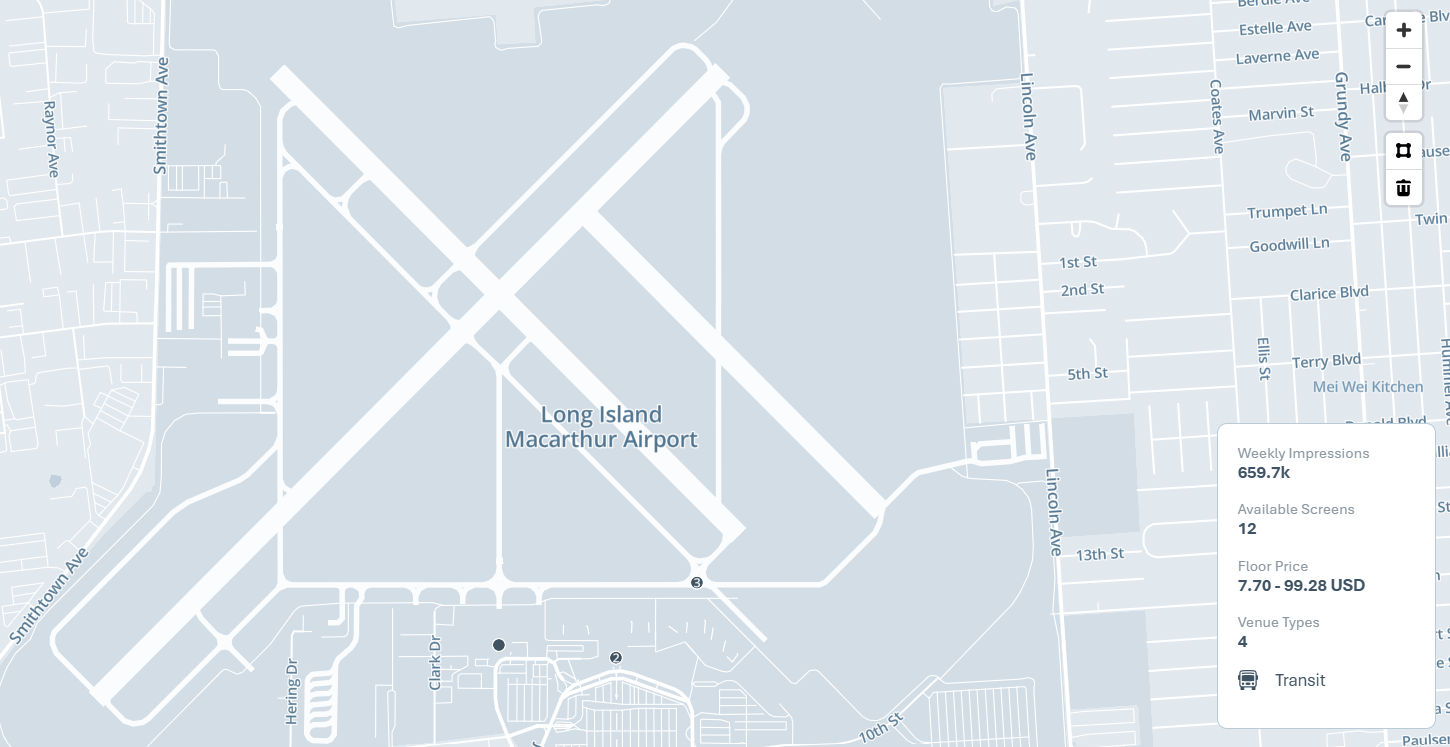
- A single consolidated passenger terminal on a 1,311-acre site with three runways and two helipads, located in Ronkonkoma approximately 45 to 50 miles east of Manhattan. Single-terminal configuration means every arriving and departing passenger passes through the same circulation spine, delivering near-complete coverage from one compact footprint.
- Recent terminal upgrades, advanced security screening, digital wayfinding and real-time information systems have expanded capability to support 16 to 18 nonstop destinations. Because the airport sits outside the congested New York airspace, it has historically posted strong on-time performance, which is central to its competitive proposition.
- Direct rail access via the Ronkonkoma station on the Long Island Rail Road, connecting the airport to central and western Long Island and onward to Manhattan. This is a meaningful ground-access advantage and it broadens the effective catchment considerably.
Premium Indicators:
- General aviation is the airport's most significant premium signal. Historically the large majority of aircraft movements here have been general aviation, with 273 based aircraft and 170,453 total operations recorded in 2025 against a comparatively small number of scheduled flights. Business aviation serving Long Island's corporate and residential wealth is a genuine and separately addressable presence.
- Federal designation as an official New York metropolitan airport since 2011 places ISP alongside JFK, LaGuardia and Newark in traveller search and information systems, which materially improves its visibility to out-of-region audiences.
- The wider catchment contains institutional prestige far beyond what the terminal suggests: a world-renowned genomics laboratory, a federal national laboratory, a major research university medical centre and New York State's largest private healthcare employer.
- Ultra-premium hospitality, marina and club infrastructure across the Hamptons, Montauk and the North Shore sits within 40 to 110 kilometres of the terminal, alongside one of the densest concentrations of nationally ranked golf clubs in the world.
Forward-Looking Signal:
Carrier momentum has been building steadily. Breeze arrived in 2022 and now serves up to nine nonstop destinations plus one-stop no-plane-change connections to New Orleans, Tampa and the Cleveland area. JetBlue entered in October 2024 with Orlando, Palm Beach and Fort Lauderdale and added Fort Myers and Tampa in 2025. Avelo launched in 2025 with Charlotte, Lakeland and Wilmington, adding two further Florida routes ahead of Thanksgiving. Cape Air now operates Boston three to four times daily. Southwest remains the largest operator at 46 percent of seats, ahead of Frontier at 29 percent, JetBlue at 14 percent and Breeze at 11 percent. Airport strategy is explicitly built on keeping landing fees and rental rates below comparable facilities to attract carriers, supported by state-funded marketing of Long Island in ISP's nonstop destination markets. Advertisers should read this as a market in sustained recovery with inventory still priced against its low point. Masscom Global advises securing multi-year positions now, before capacity growth resets the commercial baseline.
Airline and Route Intelligence
Top Airlines:
Southwest Airlines at 46 percent of first-half 2025 seats, Frontier Airlines at 29 percent, JetBlue Airways at 14 percent and Breeze Airways at 11 percent, joined during 2025 by Avelo Airlines and Cape Air.
Key International Routes:
ISP operates no scheduled international passenger service. Connecting itineraries reach Mexico, the Caribbean and beyond through the carriers' Florida and Southeast hubs, while long-haul international travel from this catchment routes through JFK. Advertisers targeting internationally bound travellers, including the substantial South Asian and Israel-linked segments, reach them here at origin before hub-level competition for attention begins.
Domestic Connectivity:
Sixteen to eighteen nonstop destinations across seven states, with Florida accounting for roughly 73 percent of seat capacity. Core markets include Orlando, Fort Lauderdale, Palm Beach, Fort Myers, Tampa and Lakeland, alongside Myrtle Beach, Charleston, Charlotte, Wilmington, Norfolk, Nashville and Boston. Frontier serves the largest number of markets, with Southwest and Breeze close behind. Verified weekly frequencies by route are not available.
Wealth Corridor Signal:
This is one of the most commercially legible route maps in American aviation because it does one thing. Florida at 73 percent of capacity is not a holiday network: it is a retirement, second-home and tax-domicile corridor carrying Long Island households toward properties they own, rent seasonally or are evaluating, in a catchment where property and income taxation is among the heaviest in the country. Myrtle Beach, Charleston and Charlotte extend the same logic into the Southeast. Boston and Norfolk are the residual regional and business corridors. The near-total absence of transcontinental and international service confirms the honest position: ISP is a leisure and relocation origin terminal serving an extremely wealthy region, not a business or luxury gateway, and it should be bought for exactly what it does.
Media Environment at the Airport
- Single-terminal configuration means full-journey coverage across 1.58 million passengers is achievable from one compact footprint, at a fraction of JFK or LaGuardia pricing while reaching a Long Island audience those airports dilute across tens of millions of unrelated travellers.
- Advertising clutter is materially lower than at the New York hub airports. A well-placed campaign at ISP achieves standout and recall that would require premium spectacular positioning at JFK.
- Dwell time is supported by the airport's own guidance that lines form quickly given the terminal's compact size and screening capacity, with extended arrival buffers of up to two hours advised during holiday peaks. Snowbird repeat travel adds accumulated frequency well beyond what raw passenger counts suggest.
- Masscom Global provides advertisers with inventory access, placement precision mapped to individual route flows, and execution capability at an airport where local relationship depth determines availability. We separate the Florida departure flow, where relocation and property propositions belong, from the diaspora and regional flows, so wealth advisory, property, NRI financial and value creative each reach their intended audience rather than a blended average.
Strategic Advertising Fit
Best Fit:
- Florida residential real estate, retirement and active-adult communities: No other airport in the United States concentrates this audience so tightly. Roughly 73 percent of capacity points at the market these advertisers sell.
- Wealth management, trust, estate and domicile advisory: New York income, estate and property taxation combined with an ageing affluent population creates immediate, sustained and technically sophisticated demand.
- Consumer banking, credit cards and instalment products: A mass-affluent, advertising-literate audience travelling on value carriers, highly responsive to specific terms and rewards propositions.
- NRI and cross-border financial services, Indian real estate and remittance: One of the largest South Asian concentrations in the New York metropolitan area sits inside this catchment, with active cross-border property and investment behaviour.
- Remittance, international telecom and value travel: Very large Salvadoran, Guatemalan, Dominican, Puerto Rican and Colombian communities across Suffolk and southern Nassau.
- Private education, independent and faith-based schools, and education advisory: Among the heaviest private education spending catchments in the country, with Catholic and Jewish school networks and strong onward university placement.
- Premium automotive, marine and powersports: High incomes, comfortable expressed affluence, substantial boat ownership across both shores and a major sportfishing market at Montauk.
- Kosher and religious-calendar travel and hospitality: Concentrated Passover, Rosh Hashanah and Sukkot travel including organised Florida programmes, alongside Diwali and Eid cycles in other communities.
Brand Alignment at a Glance:
| Category | Fit |
|---|---|
| Florida real estate and retirement communities | Exceptional |
| Wealth management, trust and domicile advisory | Exceptional |
| Consumer banking, credit and instalment products | Strong |
| NRI financial services and Indian real estate | Strong |
| Remittance, telecom and value travel | Strong |
| Private education and education advisory | Strong |
| Premium automotive, marine and powersports | Moderate |
| Ultra-luxury fashion, haute joaillerie and superyacht brokerage | Poor fit |
Who Should Not Advertise Here:
- Ultra-luxury fashion, haute joaillerie and superyacht brokerage: The catchment contains the audience but the terminal does not. Hamptons and Gold Coast ultra-high-net-worth travel moves through East Hampton, Republic, Teterboro and private aviation, and these budgets belong there or at JFK rather than in a value-carrier terminal.
- Long-haul international property outside the established diaspora corridors: This audience buys in Florida, the Carolinas, India, Israel, Italy, Ireland and the Caribbean. Inventory in London, the Gulf's mid-market or Southeast Asia faces weak intent, with Dubai the one emerging exception worth testing against the South Asian corridor.
- International business travel and premium cabin propositions: With no scheduled international service and a domestic leisure network, airline alliance, premium cabin and business travel programme messaging is misplaced here and belongs at JFK or Newark.
Event and Seasonality Analysis
- Event Strength: Medium
- Seasonality Strength: High
- Traffic Pattern: Winter-weighted with a summer secondary peak
Strategic Implication:
The allocation here is unusually clear-cut. January to April is the primary window, carrying the snowbird, second-home and relocation flow across four Florida markets, and this is where Florida property, retirement community, wealth advisory, domicile and premium consumer spend belongs, with creative live before the New Year. June to August delivers the summer family and regional leisure peak plus Montauk and Hamptons shoulder traffic, favouring consumer, automotive, marine and beverage categories. November and December add a strong holiday window for gifting, retail and travel finance. Diaspora-targeted campaigns should be timed to religious festival calendars rather than to general seasonality, since Passover, Diwali and Eid cycles generate sharper response than any general-market window. Masscom structures campaigns around this rhythm and advises securing annual positions while inventory remains priced against recovery volumes.

Poor Placement and Delays Affect Airport Campaigns
We help you move faster, access better inventory, and get it right now.
Talk to an ExpertFinal Strategic Verdict
Long Island MacArthur is the most purpose-built advertising channel in American aviation, provided advertisers buy it for what it actually is. It handled 1,580,000 passengers in 2025 with six carriers now serving 16 to 18 nonstop destinations, and roughly 73 percent of its seat capacity points at Florida, making it the single most concentrated New York to Florida retirement and tax-domicile corridor available to any media buyer. Florida developers, retirement community operators, wealth managers, trust and estate specialists and domicile advisers will find an audience here in the act of making the decision they sell, frequently making the same trip several times a season. Consumer banking, private education, NRI financial services, remittance and telecom brands will find a mass-affluent, advertising-literate, diaspora-rich Long Island population reachable at a fraction of JFK pricing. Ultra-luxury fashion, superyacht brokerage and premium cabin propositions should spend at East Hampton, Teterboro or JFK, because the catchment's ultra-high-net-worth layer does not pass through this terminal. With carrier capacity up 24 percent on 2019, three new airlines added since late 2024 and a strategy explicitly built on low costs to attract more, current pricing reflects the airport that was rather than the one arriving, and Masscom Global is the partner positioned to secure inventory, timing and placement precision before that gap closes.
About Masscom Global
Masscom Global is a premium international airport advertising and media buying agency operating across 140 countries. With deep expertise in airport OOH, premium publications, and high-net-worth audience targeting, Masscom helps brands reach the world's most valuable travellers at the moments that matter most. For advertising packages, media rates, and campaign planning at Long Island MacArthur Airport and airports across the globe, contact Masscom Global today.
Frequently Asked Questions
How much does airport advertising cost at Long Island MacArthur Airport?
Cost at ISP varies by format, terminal position, campaign duration and seasonal demand. Positions covering the departures and screening environment between January and April command the highest premiums, since that window carries the snowbird and relocation flow. Pricing here reflects passenger volume rather than catchment income, which makes it one of the more efficient buys available against a wealthy American audience. Contact Masscom Global for current rates and availability.
Who are the passengers at Long Island MacArthur Airport?
Predominantly Long Island residents from Suffolk and Nassau counties travelling on value carriers, with Florida accounting for roughly 73 percent of seat capacity. The core groups are retirees and snowbirds, second-home owners, households actively relocating for tax reasons, mass-affluent families on leisure travel, and substantial South Asian and Hispanic diaspora communities. Ultra-high-net-worth Hamptons and Gold Coast travellers are present in the catchment but largely use private aviation rather than this terminal.
Is Long Island MacArthur Airport good for luxury brand advertising?
For premium categories, yes. For ultra-luxury, no. The catchment includes the Hamptons and the Nassau Gold Coast, and premium automotive, marine, jewellery and private education all convert well with a comfortably affluent, advertising-literate audience. However, haute joaillerie, couture and superyacht brokerage should not buy this terminal, because the passengers who fit those propositions travel through East Hampton, Republic, Teterboro or JFK instead. Category selection matters more here than budget.
What is the best airport in the New York area to reach HNWI audiences?
JFK delivers the greatest concentration of high-net-worth traffic in the United States and remains the anchor buy, with Teterboro delivering the purest private aviation audience anywhere. Long Island MacArthur delivers something narrower and highly specific: the Long Island mass-affluent population and, above all, the New York to Florida relocation corridor, at a fraction of hub pricing. Masscom recommends JFK for reach, Teterboro for ultra-premium, and ISP for the Florida corridor and Long Island resident audience.
What is the best time to advertise at Long Island MacArthur Airport?
January to April is the strongest window by a wide margin, capturing snowbird, second-home and relocation travel across four Florida markets, with creative live before the New Year. June to August delivers the summer family and regional leisure peak. November and December add a holiday gifting and travel window. Diaspora-focused campaigns should be timed to Passover, Diwali and Eid rather than to general seasonality.
Can international real estate developers advertise at Long Island MacArthur Airport?
Yes, and the intent here is exceptionally well defined. Florida is the dominant destination, principally Palm Beach, Boca Raton, Delray, Jupiter, Naples, Fort Myers, Sarasota, Tampa and Orlando, followed by the Carolinas. Internationally, the catchment's communities buy in India across Mumbai, the Delhi region, Hyderabad, Ahmedabad and Kochi, in Israel, in Italy and Ireland through heritage ties, and in the Dominican Republic and wider Caribbean. Developers in those markets will find qualified demand.
Which brands should not advertise at Long Island MacArthur Airport?
Ultra-luxury fashion, haute joaillerie and superyacht brokerage, because the ultra-high-net-worth audience bypasses this terminal. Airline alliance, premium cabin and international business travel programme messaging, because the network is domestic and leisure-weighted. And long-haul property outside the Florida, Carolinas, Indian, Israeli, Italian, Irish and Caribbean corridors where this catchment's capital actually moves.
How does Masscom Global help brands advertise at Long Island MacArthur Airport?
Masscom Global delivers the full sequence: audience and catchment intelligence separating the Florida relocation corridor from the diaspora and regional leisure flows, inventory access and placement precision mapped to individual routes, campaign timing structured around the January to April snowbird peak and the religious festival calendars, and execution management through to performance reporting. Operating across 140 countries, we can activate ISP alongside the Palm Beach, Fort Lauderdale, Tampa, Orlando and Charlotte airports where these decisions land, and alongside the Indian, Israeli and Caribbean markets this catchment invests in, reaching the same household at both ends of the corridor. Book a fifteen-minute planning call to review current availability and rates.