

Airport at a Glance
| Field | Detail |
|---|---|
| Airport | Trenton Mercer Airport |
| IATA Code | TTN |
| Country | United States of America |
| City | Trenton (Ewing Township), New Jersey |
| Annual Passengers | 237,477 (2024), with recent-year range of 375,000 to 425,000 |
| Primary Audience | Princeton corridor professionals and executives, corporate and private aviation users, Florida-bound leisure and retiree travellers |
| Peak Advertising Season | February to April, June to August, November to December |
| Audience Tier | Tier 2 by volume, Tier 1 by household wealth density |
| Best Fit Categories | Wealth management and private banking, international real estate, higher education and education advisory, luxury automotive and healthcare |

Trenton Mercer is the wrong airport for advertisers chasing impressions and the right airport for advertisers chasing net worth. It sits inside Mercer County, New Jersey, at the centre of the Princeton corridor, one of the highest median-income and highest-education catchments in the United States. The passenger base is small enough that a single well-placed campaign owns the visual environment, and affluent enough that each impression carries disproportionate commercial weight. For advertisers, the arithmetic is inverted from a hub buy: fewer eyes, far more capital behind each one. Masscom Global treats TTN as a targeted wealth-corridor placement rather than a volume placement.
The airport matters because of who avoids Newark and Philadelphia. Princeton academics, pharmaceutical executives, state government leadership, hedge fund and asset management professionals from the Route 1 corridor, and corporate flight department users all pass through a terminal a fraction of the size of a major hub. Several Fortune 100 companies base aviation units here, and two fixed-base operators handle private movements. That combination of scheduled leisure traffic and high-value general aviation gives advertisers two distinct audiences inside one small footprint.
Advertising Value Snapshot
- Passenger scale: 237,477 total passengers in 2024, against a recent-year band of 375,000 to 425,000. Capacity is rising in 2026 following the return of a second scheduled carrier and three new Florida routes.
- Traveller type: Affluent leisure and retiree travellers on Florida and Southeast routes, corporate and private aviation users, and connecting travellers using the motorcoach link to Philadelphia International for onward global itineraries.
- Airport classification: Tier 2 by traffic volume, Tier 1 by audience wealth. The catchment household income profile outperforms airports many times its size.
- Commercial positioning: Known regionally as the low-friction alternative to Newark and Philadelphia, chosen deliberately by time-sensitive, higher-income travellers.
- Wealth corridor signal: TTN sits on the Princeton to Route 1 pharmaceutical and asset management corridor, midway between the New York and Philadelphia metropolitan economies.
- Advertising opportunity: Terminal scale means very low visual competition and near-total share of attention for a single brand. Masscom Global secures placement precision here that is impossible at hub scale, and can pair TTN with hub buys at Newark, Philadelphia and JFK to build full-corridor coverage. Advertisers get elite catchment exposure at small-airport economics.
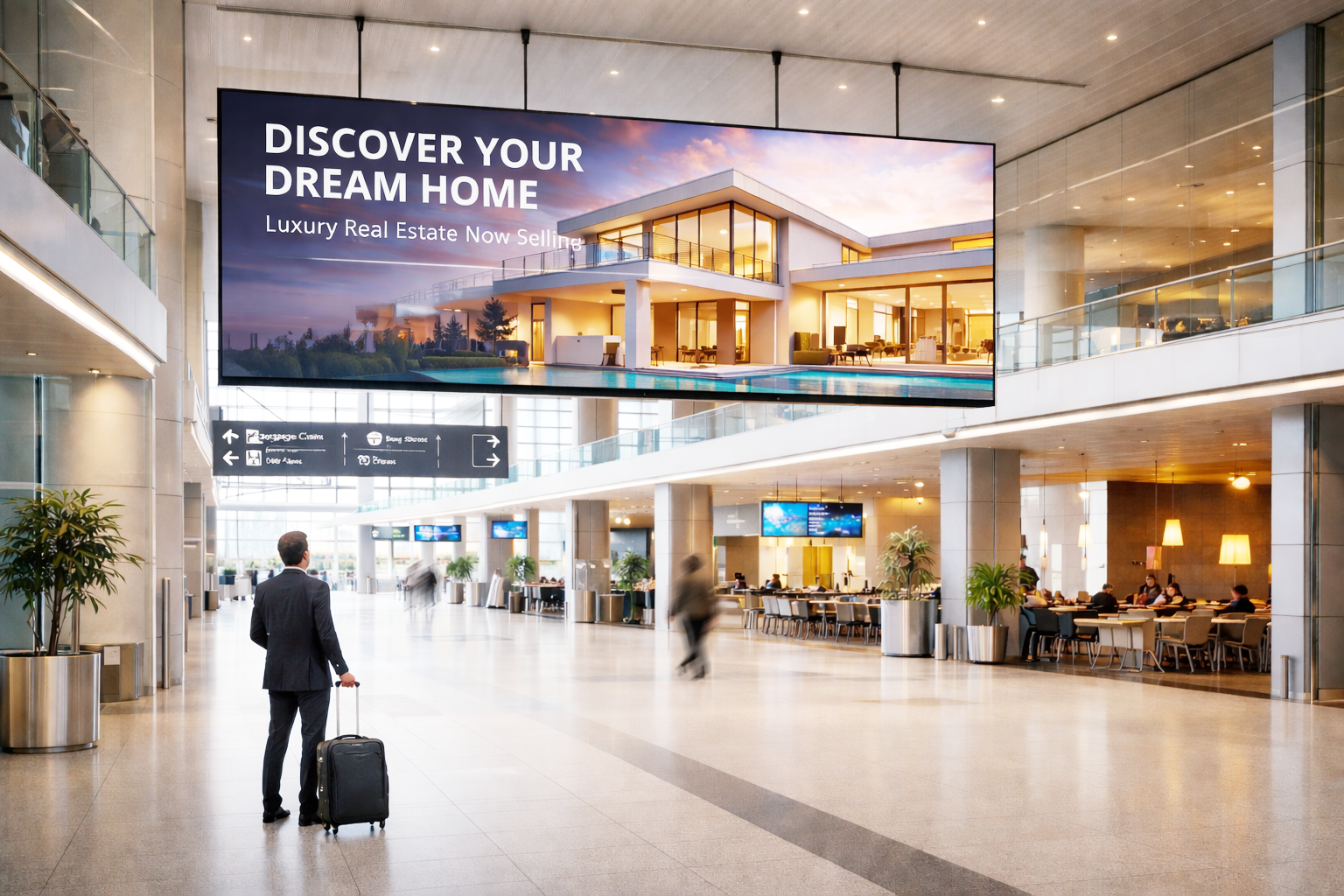
Airport Advertising is Complex to Get Right
We help you execute faster, with proven results and local insight most planners lack starting now.
Talk to an ExpertCatchment Area and Economic Drivers
Top 10 Cities within 150 km, Marketer Intelligence:
- Princeton, New Jersey: Concentrated academic, research and asset management wealth. Audience with international property exposure, multi-generational education spending and private banking relationships. The single highest-value segment in the catchment.
- Trenton, New Jersey: State capital audience of legislators, senior civil servants, lobbyists and legal professionals. Stable, salaried, high-credential decision makers relevant to institutional and B2B advertisers.
- Philadelphia, Pennsylvania: Large metropolitan spend base with strong healthcare, legal and financial services employment. Feeds TTN from travellers avoiding hub congestion.
- New York City, New York: Financial services and media professionals with second-home and weekend property patterns in central New Jersey and Bucks County. Ultra-high discretionary spend.
- Edison and Iselin, New Jersey: Highest-density Indian-American commercial hub on the US East Coast. Heavy outbound India travel, strong remittance and cross-border property investment behaviour, and significant technology and pharmaceutical employment.
- New Brunswick, New Jersey: Pharmaceutical headquarters and academic medical employment. Produces expatriate executives, clinical researchers and relocating families with international needs.
- Doylestown and Bucks County, Pennsylvania: Affluent low-density suburban wealth, high home equity, retirement-stage discretionary spending, strong second-home and cruise participation.
- Lakewood, New Jersey: Large and rapidly growing Orthodox Jewish community with distinct group travel patterns, high family sizes and defined seasonal peaks around religious calendar dates.
- Allentown and Bethlehem, Pennsylvania: Logistics, warehousing and light manufacturing base. Supplies mid-market travellers and operations management audiences relevant to industrial and financial services advertisers.
- Wilmington, Delaware: Corporate registration, credit card and trust administration centre. Produces a legal and financial compliance audience with unusually high understanding of wealth structuring products.
NRI and Diaspora Intelligence:
Central New Jersey holds one of the largest and wealthiest Indian-American populations in the United States, anchored in Edison, Iselin, Plainsboro and Princeton Junction. This community shows consistently high household income, strong professional representation in pharmaceuticals, technology and medicine, and sustained capital flow back to India through property, private equity and family business investment. A meaningful Chinese, Korean and Israeli professional population sits alongside it. While long-haul departures largely route through the larger hubs, TTN captures this audience on domestic legs, family visits and connecting itineraries, making it a viable low-cost channel for brands targeting diaspora capital without paying hub rates.
Economic Importance:
The catchment economy runs on four engines: pharmaceutical and life sciences research along the Route 1 corridor, state government and legal services in Trenton, higher education and academic research in Princeton, and asset management and financial services spilling in from both New York and Philadelphia. Each engine produces a different advertiser audience. Pharma produces mobile senior executives and expatriates. Government produces stable institutional decision makers. Academia produces internationally connected families with heavy education spend. Finance produces the outbound investment audience.
Business and Industrial Ecosystem
- Pharmaceutical and life sciences corridor: Delivers senior executives, R&D leadership and internationally mobile scientific staff. High relevance for private banking, relocation services, premium healthcare and business travel brands.
- State government and legal sector: Produces a concentrated audience of policy, legal and compliance professionals. Ideal for institutional advertising, professional services and public affairs positioning.
- Higher education and research: Generates faculty, visiting academics and family travel with strong international orientation. Relevant to universities, education advisory, insurance and financial planning.
- Corporate and private aviation: Multiple Fortune 100 flight departments and two fixed-base operators put ultra-high-net-worth and C-suite passengers through this facility outside the scheduled terminal flow. The most valuable single audience segment at TTN.
Passenger Intent, Business Segment:
Business travellers here choose TTN for speed and control. They are executives, senior government staff, legal professionals and private aviation users who value avoiding hub friction more than they value fare savings. They arrive early, unhurried and receptive. The categories that intercept them most effectively are wealth management, business and executive education, commercial real estate, luxury automotive and premium healthcare.
Strategic Insight:
The business audience at TTN is commercially valuable because it is pre-filtered. Choosing a small airport over Newark or Philadelphia is a decision made by people whose time carries high monetary value, or by people flying privately. There is no mass-market dilution in this segment. For B2B advertisers, the environment offers something hub terminals cannot: a high-credential audience, minimal competing messaging, and a physical setting calm enough for considered brand communication rather than glance-level exposure.
Tourism and Premium Travel Drivers
- Princeton University and its cultural calendar: Draws academic visitors, prospective families, alumni and donors year-round. Extremely relevant for education, publishing, financial services and luxury hospitality advertisers.
- Washington Crossing and the Revolutionary War heritage corridor: Attracts domestic heritage tourism with older, higher-income visitor profiles and strong receptivity to insurance, healthcare and cruise advertising.
- Bucks County wine, arts and country inn circuit: Weekend leisure economy pulling New York and Philadelphia affluent couples. Aligns with luxury retail, automotive and premium travel brands.
- Jersey Shore and Atlantic City access: Seasonal leisure and gaming travel driving summer volume and family movement, relevant to entertainment, hospitality and resort real estate advertisers.
Passenger Intent, Tourism Segment:
Leisure passengers at TTN split into two clear groups: affluent retirees and second-home owners flying the Florida routes, and families flying Southeast and Midwest routes on price-led fares. The Florida-bound group has already committed to property, seasonal residence or extended holiday spend and is highly receptive to real estate, wealth transfer, healthcare and insurance messaging. The family group responds to travel-adjacent services, telecom, retail and entertainment. Advertisers targeting retirement-stage capital will find few better small-airport environments in the Northeast United States.
Travel Patterns and Seasonality
Peak seasons:
- February to April: Peak Florida and Southeast outbound flow driven by snowbird departures, spring break family travel and the launch window for new seasonal routes.
- June to August: Summer family leisure, Jersey Shore inbound and academic recess travel out of Princeton and the surrounding campuses.
- November to December: Thanksgiving and end-of-year holiday movement, the sharpest short-burst volume of the year with the highest family group travel density.
- Late September to October: Secondary business and academic peak as conference, admissions and corporate travel resume.
Event-Driven Movement:
- Princeton University Reunions (May and June): One of the largest alumni gatherings in American higher education, bringing exceptionally high-net-worth alumni, donors and their families into the catchment. The single highest-value advertising window at this airport.
- Academic admissions and move-in cycle (August and September): Brings prospective and enrolling families with committed multi-year education budgets. Prime timing for education advisory, banking, insurance and relocation advertisers.
- New Jersey legislative session peaks (January to June): Concentrates policy, legal and lobbying travel. Strong window for institutional, energy, healthcare and public affairs advertising.
- Snowbird migration windows (October to November outbound, March to April return): Two predictable annual surges of retirement-stage wealth with active second-property behaviour.
- Holiday season compression (late November and late December): Highest family and multi-generational travel density of the calendar, ideal for retail, telecom and consumer finance campaigns.

It’s Not Just Where You Advertise - It’s How Fast You Execute
We combine local insight with fast rollout to deliver results for you, now.
Talk to an ExpertAudience and Cultural Intelligence
Top 2 Languages:
- English: The dominant language across the catchment and the default for all creative. The audience is highly educated, with unusually high graduate degree density, meaning campaigns can carry more complexity, data and financial specificity than typical airport creative supports.
- Spanish: Significant across Trenton and the wider Mercer County urban core, spanning a broad economic range from working households to established business owners. Relevant for remittance, telecom, consumer finance and family-oriented insurance advertisers.
Major Traveller Nationalities:
The passenger base is predominantly American, with a strong secondary layer of Indian, Chinese, Korean and Israeli origin residents from the central New Jersey professional corridor, plus European academic and pharmaceutical visitors connected to Princeton and the Route 1 research cluster. This means creative should be built for a naturalised, high-credential American audience with active international financial interests rather than for a transient foreign visitor audience. Messaging that assumes cross-border assets, overseas family and international education plans will resonate more accurately than generic domestic creative.
Religion, Advertiser Intelligence:
- Christianity (approximately 60 percent): Christmas and Easter drive the two clearest family travel and gifting peaks. Spending triggers cluster around retail, hospitality, consumer electronics and family experiences in the November to December and late March to April windows.
- Judaism (approximately 6 to 8 percent, with unusually high regional concentration): Rosh Hashanah, Yom Kippur, Sukkot and Passover create defined, calendar-fixed travel spikes with large family group sizes. This community shows strong institutional charitable giving, private education spending and Israel-linked property and investment behaviour. Highly relevant for international real estate, private banking and premium group travel advertisers.
- Hinduism (approximately 4 to 6 percent, heavily concentrated in central New Jersey): Diwali and Navratri drive gold, apparel, electronics and property purchase behaviour, alongside outbound India travel. This is a high-income, high-savings audience with active property investment in India and strong receptivity to wealth structuring, education and cross-border banking messaging.
- Islam (approximately 3 to 4 percent): Ramadan and Eid create concentrated family travel, gifting and remittance activity. Relevant for remittance, telecom, hospitality and halal-aligned financial products.
Behavioral Insight:
This is one of the most financially literate airport audiences in the United States. Graduate degree density is high, professional employment in pharmaceuticals, law, finance and academia is the norm, and the population is accustomed to evaluating products on structure and returns rather than emotional appeal. Vague aspirational creative underperforms here. Specific figures, yield comparisons, tax treatment and credentials outperform. Purchase decisions are researched, family-consulted and slow, which means the airport's role is credibility establishment and consideration entry rather than immediate conversion. Brands that treat TTN as the first credible touchpoint in a long decision cycle extract the most value.
Outbound Wealth and Investment Intelligence
The outbound passenger at TTN is distinctive because the wealth is domestic in origin and international in deployment. This is not a foreign investor audience passing through. It is an American professional and academic elite, plus a large first and second generation immigrant professional class, actively moving capital abroad for property, education, residency and family reasons. That dual character makes the airport relevant to international brands on both ends of the corridor.
Outbound Real Estate Investment:
This catchment's high-net-worth audience is actively buying in the United Arab Emirates, particularly Dubai, where yields and the absence of property tax compare favourably against New Jersey's high property tax burden. Portugal, Spain and Greece attract Princeton corridor buyers seeking European residency-linked assets. India remains a major destination for the central New Jersey diaspora, concentrated in Mumbai, Bengaluru, Hyderabad and Kochi. Israel draws sustained investment from the regional Jewish community. Canada, Mexico and the Caribbean absorb second-home and retirement purchases. International developers advertising at TTN reach a buyer who is already comparing global yields against a high-tax home market.
Outbound Education Investment:
Families from this catchment send children to the United Kingdom, Canada, Ireland, Australia, Switzerland and Singapore for undergraduate, postgraduate and boarding education. The regional norm of graduate-level attainment means education spend is treated as non-negotiable rather than discretionary, and budgets are planned years in advance. International universities, boarding schools, MBA programmes and education advisory firms find here a parent audience that already understands international rankings, application timelines and currency exposure. The August to September and January admissions windows are the highest-intent periods.
Outbound Wealth Migration and Residency:
Demand centres on European Golden Visa and residency-by-investment programmes in Portugal, Greece and Spain, Caribbean citizenship-by-investment in St Kitts and Nevis, Antigua, Dominica and Grenada, and long-term residency options in the United Arab Emirates. Motivation here is typically tax planning, mobility and succession structuring rather than relocation necessity. The audience evaluates programmes on holding periods, tax treaty implications and family inclusion terms, so creative should lead with structural specifics.
Strategic Implication for Advertisers:
International brands on both sides of this corridor should treat TTN as a priority precision buy. A Dubai developer, a Portuguese residency advisor or a UK university reaches a smaller audience here than at a hub, but a materially wealthier and more decision-ready one at a fraction of the cost. Masscom Global activates both ends of the corridor simultaneously, pairing TTN placement with airport buys in Dubai, Lisbon, London and India so brands intercept the same capital at origin and destination.
Airport Infrastructure and Premium Indicators
Terminals:
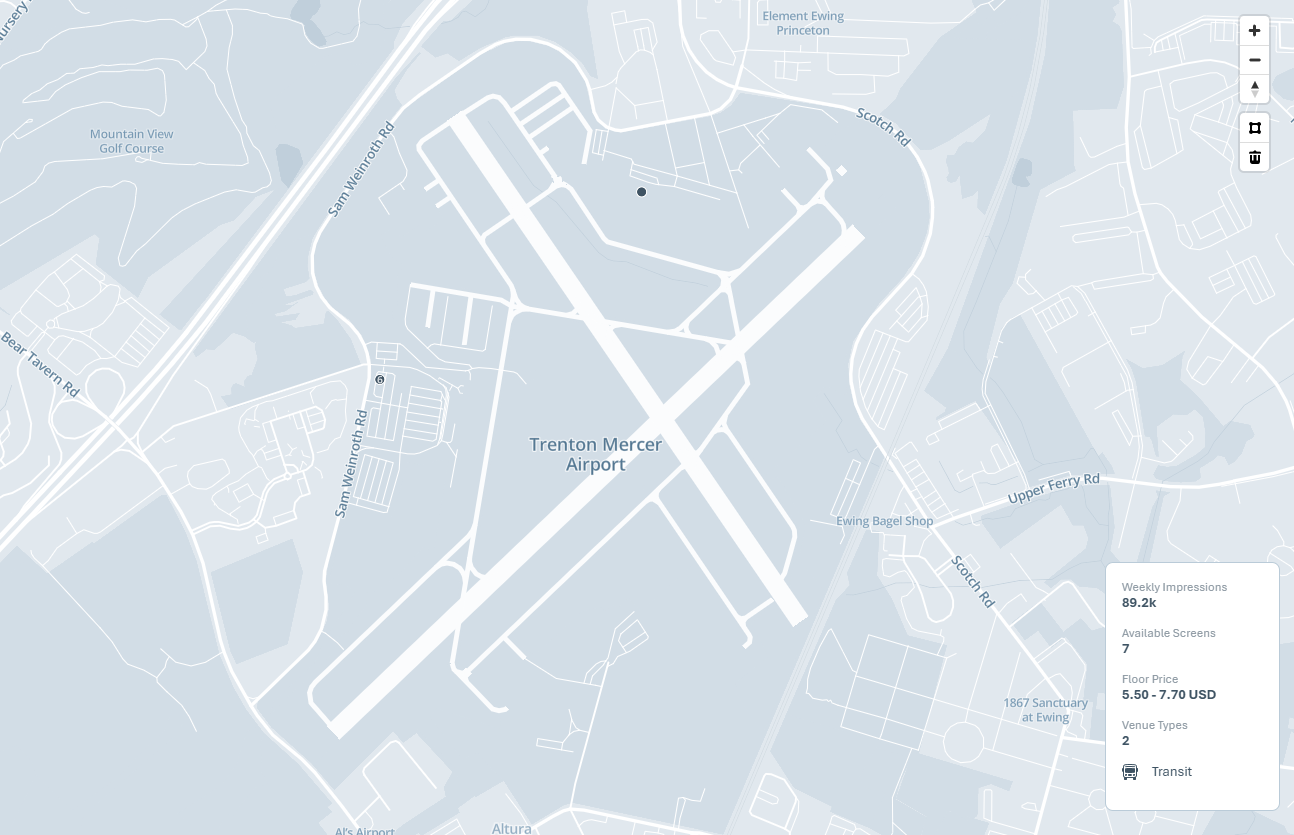
- A single passenger terminal of approximately 28,000 square feet, originally designed in the 1970s, with four aircraft parking positions. Its compact scale means every passenger passes through a shared, concentrated circulation path, which delivers unusually high effective frequency for advertisers.
- General aviation and corporate facilities operate separately from the commercial terminal, handling Fortune 100 flight departments, private movements, state law enforcement and National Guard aviation. This creates a second, physically distinct premium audience environment.
Premium Indicators:
- No conventional airline lounge network. Premium signalling comes instead through the fixed-base operator facilities serving private and corporate aviation, where the highest-value passengers are handled.
- Two fixed-base operators support private aviation, one of the clearest ultra-high-net-worth signals available at any airport of this size.
- Hotel supply sits in the surrounding Princeton, Ewing and Lawrenceville corridor rather than on the airport campus, including full-service and upscale properties serving the pharmaceutical and academic business market.
- Customs and Border Protection presence with biometric entry capability, supporting international general aviation arrivals and reinforcing the private aviation profile.
Forward-Looking Signal:
Mercer County is executing a major capital programme, replacing the 1970s terminal with a new facility expected to exceed 125,000 square feet, alongside taxiway standardisation, expanded parking and new support buildings. A second scheduled carrier returned in February 2026 with three Florida routes, and a premium motorcoach link now connects TTN passengers to a major carrier's global network at Philadelphia International. Terminal capacity is set to increase roughly fourfold, and passenger volume will follow. Masscom Global advises clients to secure position and rates at current levels now, ahead of the capacity expansion that will reset the commercial value of this environment.
Airline and Route Intelligence
Top Airlines:
Frontier Airlines and Allegiant Air operate scheduled service. American Airlines participates through a premium motorcoach connection to Philadelphia International with through-checked baggage and security screening at TTN. Corporate flight departments and charter operators account for a substantial share of total movements.
Key International Routes:
No scheduled international passenger service. International movement occurs through general and corporate aviation, supported by on-site customs clearance, and through connecting itineraries via Philadelphia International.
Domestic Connectivity:
Core network focuses on Florida, including Orlando, Tampa, Fort Lauderdale, Punta Gorda and St. Pete-Clearwater, plus Southeast and Midwest markets such as Atlanta, Raleigh-Durham, Charlotte, Myrtle Beach and Chicago. Route mix is leisure-weighted with strong seasonal variation.
Wealth Corridor Signal:
The route map tells advertisers exactly what to expect. The Florida corridors are wealth transfer routes disguised as leisure routes, carrying second-home owners, snowbirds and retirement-stage capital rather than budget holidaymakers. The Southeast and Midwest routes are family and visiting-relatives traffic with mid-market spending profiles. The corporate aviation layer and the Philadelphia connection carry the executive and international segment. Advertisers should build creative for two audiences, not one, and Masscom Global structures placement so premium and mass-market messaging sit in the right positions within a single small terminal.
Media Environment at the Airport
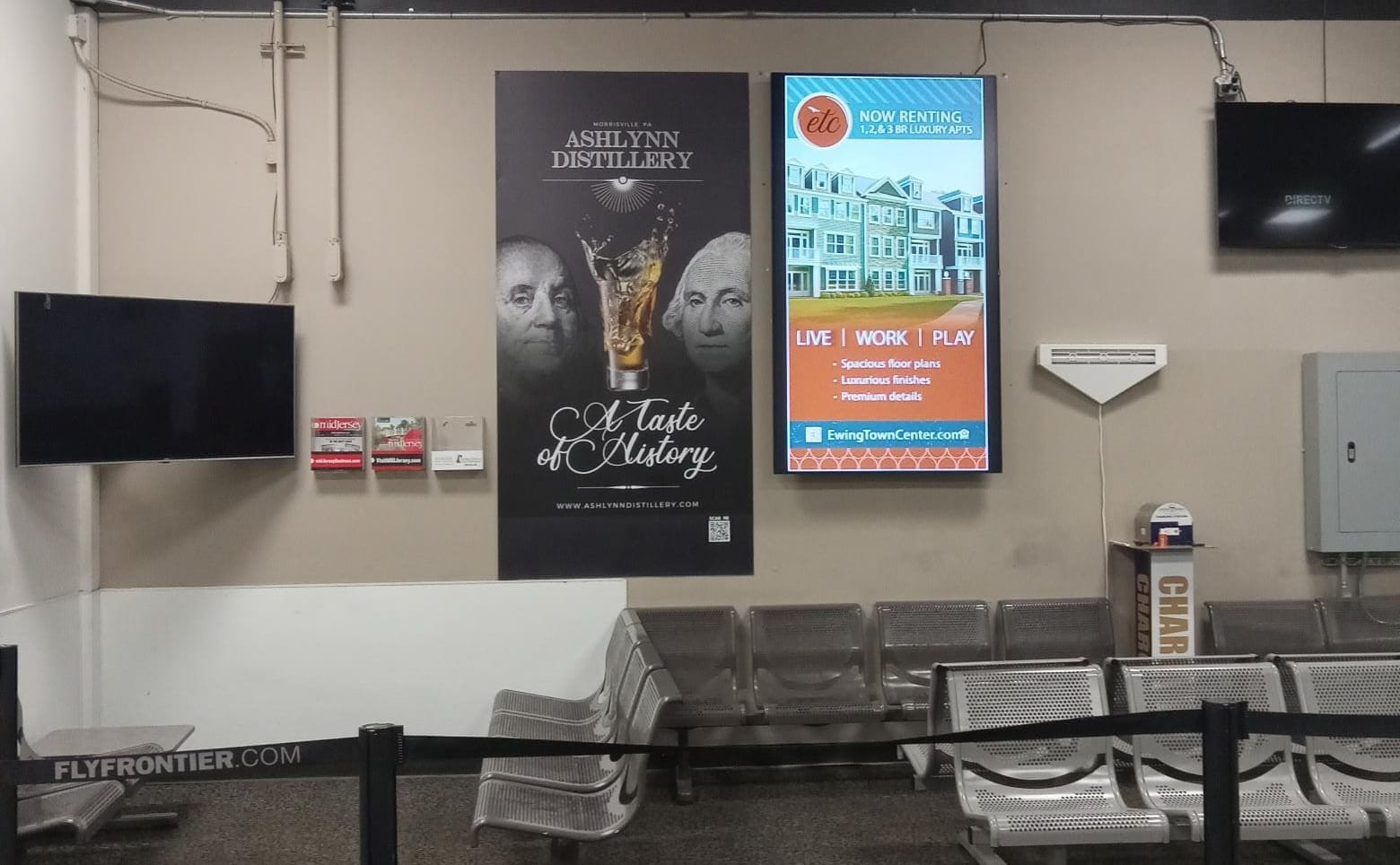
- Terminal scale is compact, which produces the lowest advertising clutter of any commercial airport in New Jersey. A single brand can achieve near-total visual dominance of the passenger journey, an outcome that is financially impossible at Newark or Philadelphia.
- Dwell time is driven by single-terminal processing, a small number of gates and passengers arriving early out of habit rather than necessity. The result is extended, low-stress exposure in a calm environment where longer-form and data-led creative can actually be read.
- The premium environment signal comes from audience quality rather than terminal opulence. Association with the Princeton corridor, the state capital and a private aviation clientele elevates brand perception in a way that raw passenger numbers understate.
- Masscom Global provides inventory access, placement precision and rapid execution at TTN, and can integrate it into a multi-airport Northeast corridor plan covering Newark, Philadelphia, JFK and Teterboro so brands cover both the volume and the wealth in a single buy.
Strategic Advertising Fit
Best Fit:
- Wealth management and private banking: Reaches one of the densest concentrations of investable household wealth in the United States, in a setting that supports credibility-led messaging.
- International real estate developers: Directly intercepts buyers comparing Dubai, Portugal, India and Caribbean yields against a high property tax home market.
- Higher education, boarding schools and education advisory: Speaks to a catchment where graduate attainment is the norm and international education spend is planned years ahead.
- Residency and citizenship-by-investment advisory: Aligns with an audience motivated by tax structuring, mobility and succession rather than relocation necessity.
- Luxury and premium automotive: Matches high household income, suburban multi-vehicle ownership and strong brand consciousness across Mercer and Bucks counties.
- Premium healthcare and specialist medical: Fits an older, affluent, health-literate travelling population with high private insurance penetration.
- Insurance, annuities and retirement products: Directly relevant to the snowbird and retirement-stage passenger flow on the Florida routes.
- Business aviation, charter and yacht services: Reaches an audience already using private aviation facilities at the same airport.
Brand Alignment at a Glance:
| Category | Fit |
|---|---|
| Wealth management and private banking | Exceptional |
| International real estate | Exceptional |
| Higher education and education advisory | Strong |
| Residency and citizenship advisory | Strong |
| Luxury automotive | Strong |
| Premium healthcare and insurance | Strong |
| Luxury retail and duty free | Moderate |
| Mass-market FMCG | Poor fit |
Who Should Not Advertise Here:
- Duty free and travel retail dependent brands: With no scheduled international service, the arriving and departing duty free purchase behaviour that makes these campaigns work does not exist at meaningful scale.
- Mass-market FMCG and low-value consumer goods: Passenger volume is too low to justify a reach-driven media buy, and the audience profile is misaligned with price-led positioning.
- Inbound tourism boards and destination marketing for foreign countries: The flow is domestic outbound leisure with no international arrivals base, so inbound destination messaging reaches the wrong direction of travel.
- Youth-oriented entertainment and nightlife brands: The dominant age and income profile skews toward established professionals and retirement-stage travellers.
Event and Seasonality Analysis
- Event Strength: Medium
- Seasonality Strength: High
- Traffic Pattern: Dual-Peak, with a strong late-winter to spring Florida cycle and a summer leisure cycle
Strategic Implication:
Budget should be weighted heavily toward February to April and June to August, with a compressed high-intensity burst across late November and December. The May and June Princeton alumni window and the August to September admissions window are the two highest-value short buys for education, wealth and real estate advertisers, and should be booked well ahead of the season. Masscom Global structures campaigns around this rhythm, front-loading premium placement into the snowbird and academic peaks where wealth density is highest rather than spreading spend evenly across a low-volume calendar.

Poor Placement and Delays Affect Airport Campaigns
We help you move faster, access better inventory, and get it right now.
Talk to an ExpertFinal Strategic Verdict
Trenton Mercer is the clearest example in the Northeast United States of an airport whose advertising value has almost nothing to do with its passenger count. Fewer than a quarter of a million passengers passed through in 2024, yet those passengers come from the Princeton corridor, a catchment combining pharmaceutical executive wealth, Ivy League academic capital, state capital institutional power and one of America's wealthiest Indian-American professional communities, with Fortune 100 corporate aviation operating on the same field. The terminal is small enough that a single brand can own the entire passenger journey, and the audience is financially literate enough to engage with real numbers rather than aspiration. Wealth managers, international property developers, universities and residency advisors will find a better cost-to-net-worth ratio here than at any hub within 150 kilometres. With terminal capacity set to grow more than fourfold and a second carrier already expanding routes, current rates represent a closing window. Masscom Global has the access, the corridor intelligence and the execution speed to place brands here now and at the destinations this audience is sending its capital to.
About Masscom Global
Masscom Global is a premium international airport advertising and media buying agency operating across 140 countries. With deep expertise in airport OOH, premium publications, and high-net-worth audience targeting, Masscom helps brands reach the world's most valuable travellers at the moments that matter most. For advertising packages, media rates, and campaign planning at Trenton Mercer Airport and airports across the globe, contact Masscom Global today.
Frequently Asked Questions
How much does airport advertising cost at Trenton Mercer Airport?
Cost at TTN varies by format, position within the terminal, campaign duration and seasonal demand. Because the terminal is compact, premium positions are limited in number, and rates move sharply between peak snowbird and summer windows versus shoulder months. Volume-based and multi-airport corridor packages materially change the economics. Contact Masscom Global for current rates and availability.
Who are the passengers at Trenton Mercer Airport?
Predominantly affluent residents of Mercer County, the Princeton corridor, Bucks County and central New Jersey. The mix includes pharmaceutical and life sciences executives, academics and academic families, state government and legal professionals, retirement-stage second-home owners on the Florida routes, and corporate and private aviation users. Household income and education levels in this catchment run well above the national average.
Is Trenton Mercer Airport good for luxury brand advertising?
For considered luxury it is strong. Wealth management, international real estate, luxury automotive, premium healthcare and private aviation services align closely with the audience. For impulse luxury retail and duty free it is weak, because there is no scheduled international service and passenger volume is too low to support transaction-driven retail campaigns. The distinction matters: this airport builds luxury consideration, it does not drive luxury footfall.
What is the best airport in the United States Northeast to reach HNWI audiences?
For raw volume of high-net-worth passengers, the major New York and Boston hubs lead. For efficiency, Trenton Mercer and the region's private aviation focused airports deliver higher wealth density per impression at lower cost. TTN specifically offers the Princeton corridor audience with minimal advertising clutter. The strongest approach is a corridor strategy combining hub reach with precision airports like TTN, which is how Masscom Global structures Northeast plans.
What is the best time to advertise at Trenton Mercer Airport?
February to April captures the peak Florida and spring break flow. June to August captures summer leisure and academic recess travel. Late November and December deliver the sharpest family travel burst. For premium categories, the May and June Princeton alumni period and the August to September admissions window are the two highest-intent short buys of the year.
Can international real estate developers advertise at Trenton Mercer Airport?
Yes, and it is one of the strongest categories here. This catchment's high-net-worth audience is actively buying in Dubai, Portugal, Spain, Greece, India, Israel and the Caribbean, motivated by yield comparison against a high property tax home market, residency benefits and family succession planning. The audience is financially literate, so creative should lead with yields, tax treatment and holding terms. Masscom Global can activate both the New Jersey origin and the destination market simultaneously.
Which brands should not advertise at Trenton Mercer Airport?
Duty free and travel retail brands, given the absence of scheduled international service. Mass-market FMCG and low-value consumer goods, because passenger volume cannot support reach-driven buying. Inbound destination marketing for foreign tourism boards, because the traffic flow is domestic outbound. Youth-focused entertainment and nightlife brands, because the age and income profile skews established professional and retirement stage.
How does Masscom Global help brands advertise at Trenton Mercer Airport?
Masscom Global delivers the full chain: catchment and audience intelligence specific to the Princeton corridor, inventory access and placement precision inside a compact terminal where position determines everything, campaign timing built around the airport's dual-peak rhythm, and execution speed that lets brands secure position ahead of the terminal expansion. Masscom also extends the buy to the destination markets this audience invests in, covering both ends of the wealth corridor. Book a fifteen minute planning call to review availability and rates.