

Airport at a Glance
| Field | Detail |
|---|---|
| Airport | Sugar Land Regional Airport |
| IATA Code | SGR |
| Country | United States |
| City | Sugar Land, Texas (Greater Houston) |
| Annual Passengers | No scheduled commercial service. Approximately 44,000 aircraft movements per year. |
| Primary Audience | Corporate aviation executives, energy sector principals, HNWI and UHNWI family travellers |
| Peak Advertising Season | February to May, October to November |
| Audience Tier | Tier 1 by audience value, Tier 3 by passenger volume |
| Best Fit Categories | Private banking and wealth management, international real estate, residency and citizenship advisory, luxury automotive and aviation services |
Sugar Land Regional Airport is not a mass-reach buy and should never be evaluated as one. It is a city-owned corporate aviation gateway seventeen miles southwest of downtown Houston, purpose-built for business jets and privately flown aircraft. Every passenger who passes through it is either flying privately, chartering, or travelling on a corporate flight department aircraft. That single filter removes the leisure, budget, and transit traffic that dilutes cost per valuable impression at large commercial hubs. For advertisers selling to capital owners rather than consumers, that filter is the entire commercial proposition.
The airport sits at the centre of Fort Bend County, one of the wealthiest and most ethnically diverse counties in the United States, with a county median household income above 113,000 dollars and Sugar Land itself above 137,000 dollars. This is where Houston's energy executives, medical specialists, and first-generation immigrant business owners live. The airport is the point where that residential wealth converts into movement, and where Masscom Global places brands directly in front of it.
Advertising Value Snapshot
- Passenger scale: Approximately 44,000 aircraft movements annually against a runway configuration rated for 268,000, with 24-hour operation and a strong corporate jet mix. Growth is driven by Fort Bend County's population expansion past 890,000 and continued corporate relocation into southwest Houston.
- Traveller type: Corporate flight department and fractional jet passengers, owner-operators of mid-market businesses, energy and medical sector principals.
- Airport classification: Tier 1 by audience value, Tier 3 by volume. Reach is small, but net worth per impression is among the highest available in North America.
- Commercial positioning: Houston's premium corporate aviation gateway, with a full US Customs and Border Protection facility enabling direct international departures.
- Wealth corridor signal: The airport sits on the Houston energy capital corridor and on the Gulf Coast to Mexico and Caribbean private aviation route, two of the most capital-dense short-haul flows in the Americas.
Advertising opportunity: A compact terminal environment means near-total share of voice for a single brand rather than fragmented competition for attention. Masscom Global secures placement in the arrival, lounge, and departure sequence where dwell time is long and mindset is transactional. This is a precision buy, and Masscom structures it as one.
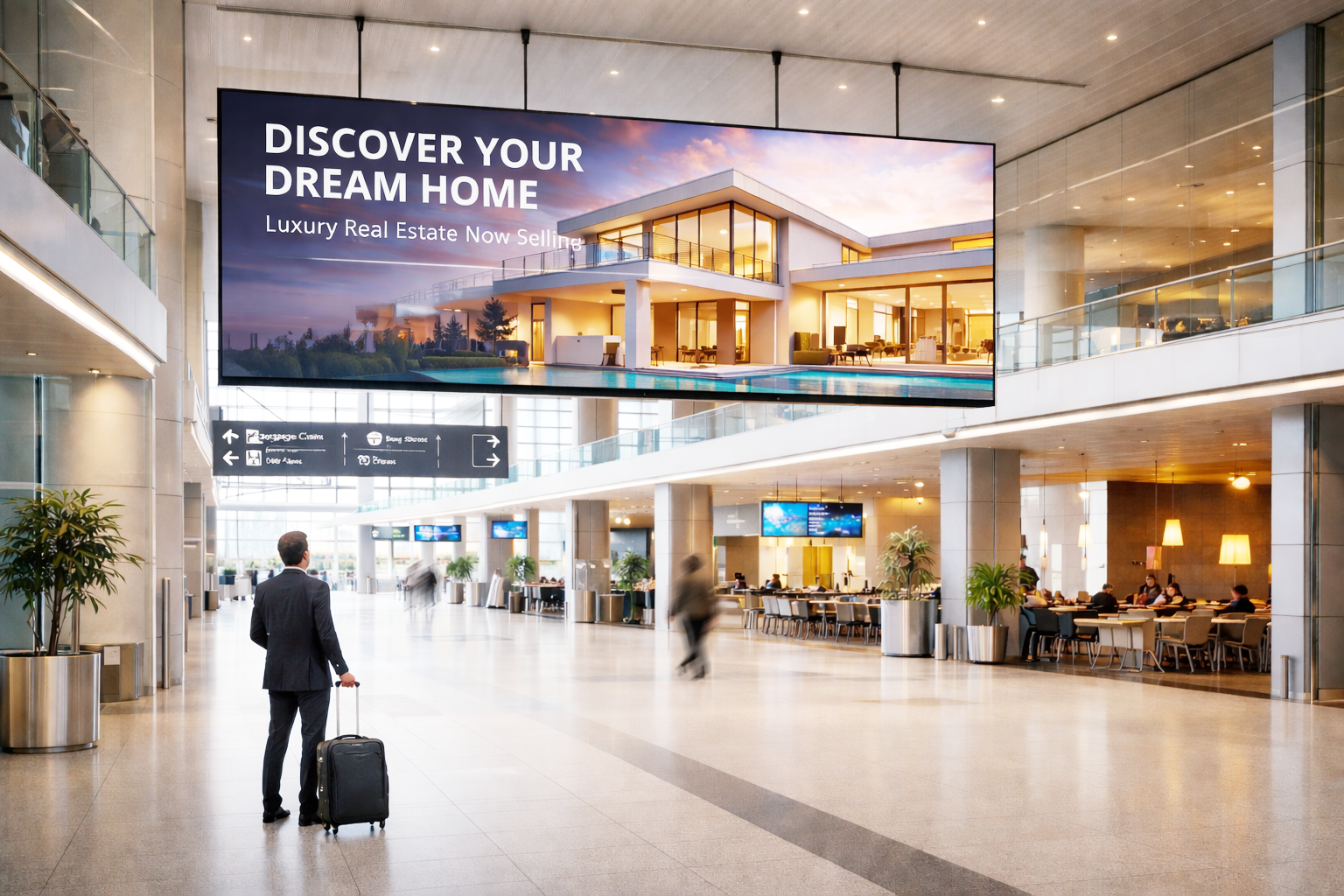
Airport Advertising is Complex to Get Right
We help you execute faster, with proven results and local insight most planners lack starting now.
Talk to an Expert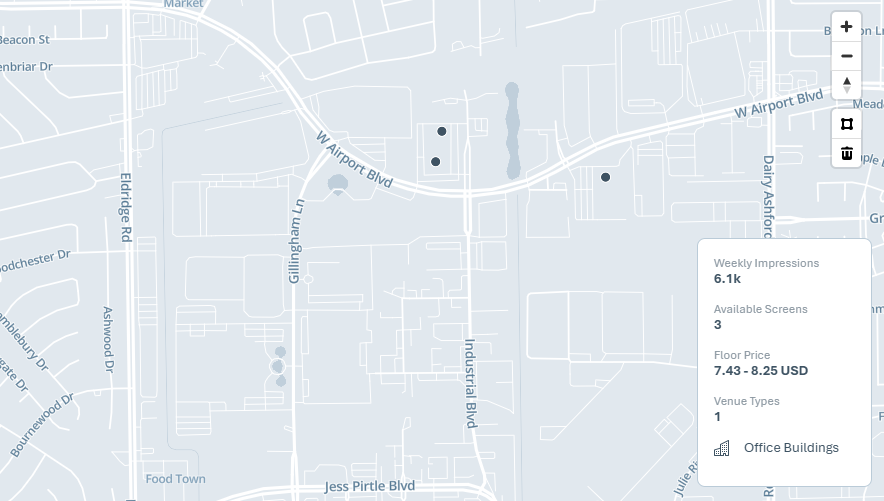
Catchment Area and Economic Drivers
Top 10 Cities within 150 km, Marketer Intelligence:
- Houston: The command centre for global energy capital. Produces C-suite decision makers with discretionary international investment budgets and short booking cycles for private travel.
- Sugar Land: Home base audience. High-income professional households with strong South Asian and East Asian business ownership, high private school enrolment, and elevated second-property intent.
- Missouri City: Established professional and diaspora wealth, strong Nigerian, Indian, and Pakistani business owner presence. Receptive to remittance, cross-border banking, and overseas property messaging.
- Stafford: Dense small and mid-cap manufacturing and technology employer base. Produces owner-operator travellers who fly privately for cost-of-time reasons rather than status.
- Katy: Fast-growing master-planned affluence with dual-income executive households. High propensity for luxury automotive, private education, and family travel spend.
- Richmond: Rapid new-money residential growth backed by land and development capital. Strong candidate audience for construction, equipment, and regional investment advertisers.
- Rosenberg: Logistics, agri-processing, and distribution ownership. Produces B2B decision makers with fleet, industrial, and commercial finance purchasing authority.
- Fulshear: The highest median income community in the catchment, above 178,000 dollars. Concentrated luxury goods, wealth management, and second-home audience.
- Pearland: Medical and aerospace professional density feeding off the Texas Medical Center and the NASA corridor. High-value specialist audience with international conference travel behaviour.
- The Woodlands: Corporate headquarters wealth and executive relocation base. Frequently flies privately southbound through SGR to avoid commercial hub congestion.
NRI and Diaspora Intelligence:
Fort Bend County holds one of the most significant concentrations of Indian, Pakistani, Chinese, Vietnamese, and Nigerian origin wealth in the United States, and Sugar Land is its centre of gravity. This is not a working-class remittance population. It is a second-generation business ownership class with medical practices, energy services firms, technology companies, and commercial property portfolios. Their capital moves in two directions at once, into US business expansion and into ancestral-country real estate and family investment. Advertisers selling cross-border banking, overseas property, and international education reach a rare audience here that is simultaneously US-affluent and internationally invested.
Economic Importance:
The catchment economy runs on energy, energy services technology, healthcare, and engineering, with a growing base of privately held mid-market firms. Energy and oilfield services create principal-level travellers with capital expenditure authority. Healthcare and the Texas Medical Center orbit create high-income specialist professionals with conference-driven travel. Engineering and industrial services create owner-operators who treat private aviation as a productivity tool. Each of these segments buys differently, and Masscom Global maps creative to the segment rather than to the terminal.

Business and Industrial Ecosystem
- Energy and oilfield technology: Sugar Land hosts major energy services and drilling company campuses. Produces senior technical and commercial executives with international project exposure and high private travel frequency.
- Healthcare and life sciences: Proximity to the world's largest medical complex creates a dense specialist physician and medical entrepreneur audience with exceptional net worth and low price sensitivity.
- Engineering, EPC, and industrial services: Project-based businesses with regional Gulf and Latin American operations, generating frequent short-haul international corporate movement.
- Privately held mid-market enterprise: A deep base of family-owned firms across logistics, manufacturing, and professional services. This is the classic owner-operator audience for wealth management, succession advisory, and second-residency products.
Passenger Intent, Business Segment:
Business travellers here are almost never employees on expense policy. They are principals, partners, and owners flying because their time carries a measurable cost. They arrive early, wait in a controlled lounge environment, and are unusually receptive to messages about capital deployment, tax efficiency, and asset diversification. Private banking, commercial finance, aviation services, international real estate, and residency advisory intercept them most effectively.
Strategic Insight:
The commercial value of this airport is that the media environment and the audience mindset are aligned. A person waiting for a private departure is in an unhurried, high-agency state, thinking about the business reason for the trip. There is no crowd, no queue stress, and no competing visual noise. For B2B and wealth advertisers, this is one of the few environments in the United States where a single message can occupy a decision maker's full attention for several uninterrupted minutes.
Tourism and Premium Travel Drivers
- Texas Medical Center complex: Draws high-value inbound medical travellers and their families from Latin America and the Gulf. Relevant to concierge health, hospitality, and premium insurance advertisers.
- Galveston Island and the Gulf Coast: Second-home and weekend leisure corridor for Houston wealth. Signals leisure property and luxury automotive receptivity.
- Houston museum, culinary, and sporting circuit: Anchors inbound corporate hospitality trips built around business meetings.
- Hill Country and Gulf ranch properties: A significant share of private movement through SGR is recreational land and ranch access, a strong signal for land investment, equipment, and luxury goods advertisers.
Passenger Intent, Tourism Segment:
Leisure movement here is discretionary spend that has already been committed. Someone flying privately to a coastal property or a ranch has demonstrated liquidity before they reach the terminal. They are not shopping for a deal, they are open to categories that extend an existing lifestyle position. Luxury automotive, watches and jewellery, resort and branded residence developers, and private club memberships benefit most from this mindset.
Travel Patterns and Seasonality
Peak seasons:
- February to May: The strongest window of the year. Houston's energy and industrial conference calendar concentrates here, alongside the region's largest civic and cultural events, driving both inbound and outbound corporate private movement.
- October to November: Second peak, driven by fiscal year-end corporate travel, the regional festival calendar, and the start of favourable Gulf weather.
- June to September: Softest period. Summer heat and Gulf hurricane season suppress discretionary and corporate movement.
- December to early January: Sharp short-burst peak around holiday family travel and year-end financial planning trips.
Event-Driven Movement:
- Global energy leadership conference season (March): Brings international energy principals and sovereign investors into Houston. The single highest-value advertising window of the year for B2B energy, banking, and legal advertisers.
- Houston Livestock Show and Rodeo (February to March): A major regional wealth and corporate hospitality event that drives significant private aviation into the Houston reliever network, including SGR.
- Offshore and subsea technology conference season (May): International engineering and procurement decision makers. Timed advertiser opportunity for industrial technology and B2B services.
- Sugar Land regional food, wine, and cultural festival season (April): Draws affluent local and out-of-state visitors. Strong luxury consumer and hospitality window.
- Diwali and the South Asian festival cycle (October to November): Triggers family travel, gold and jewellery purchasing, property decision-making, and remittance-linked investment activity across the catchment.
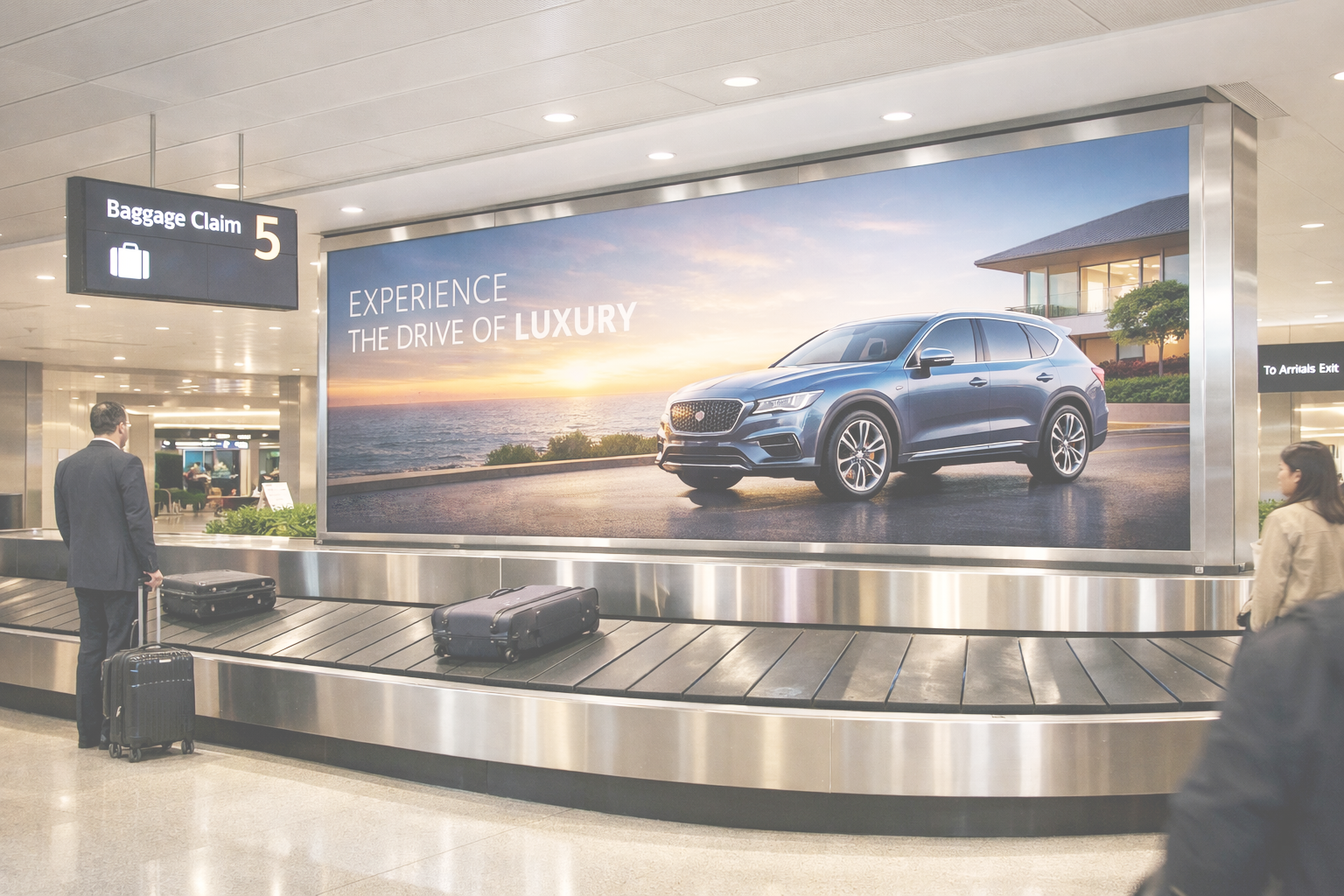
It’s Not Just Where You Advertise - It’s How Fast You Execute
We combine local insight with fast rollout to deliver results for you, now.
Talk to an ExpertAudience and Cultural Intelligence
Top 2 Languages:
- English: The default commercial language for the entire corporate aviation audience. All primary creative should lead in English with no exception, as this is a US-domiciled affluent audience regardless of heritage.
- Spanish: Commercially critical because of the region's large Hispanic population and the airport's direct private aviation link to Mexico. Spanish secondary creative unlocks both the local business owner audience and the Mexican HNWI flow that uses SGR as a Houston entry point.
Beyond these two, Urdu, Hindi, Gujarati, Mandarin, and Vietnamese are widely spoken in the catchment. Masscom Global recommends heritage-language use only in festival-timed executions where it signals cultural fluency rather than translation.
Major Traveller Nationalities:
The dominant profile is American, but with unusually high dual-heritage composition. Mexican nationals form the largest foreign flow, using the airport's customs facility for business and medical travel into Houston. Indian, Pakistani, Chinese, and Nigerian origin travellers dominate the diaspora share, most holding US citizenship or residency while maintaining active business and property interests abroad. Latin American principals from Colombia, Venezuela, and Brazil use the corridor for energy business and healthcare access. Creative should assume American purchasing power with international asset intent, not immigrant messaging.
Religion, Advertiser Intelligence:
- Christianity (approximately 55 to 60 percent): Drives the Thanksgiving to New Year travel block and Easter movement. Creates predictable gifting, luxury retail, and family travel spending triggers. Benefits luxury automotive, jewellery, and resort advertisers in the November to December window.
- Islam (a significant and growing share of the catchment): Fort Bend County holds one of the largest Muslim communities in Texas. Ramadan and Eid drive family reunion travel, charitable giving, and major purchase timing, and Umrah and Hajj movement creates a defined international travel window. Benefits halal-compliant finance, international real estate in the Gulf, and premium travel advertisers.
- Hinduism (a significant share, concentrated in the Sugar Land and Missouri City core): Diwali and the wedding season concentrate gold, jewellery, property, and large-ticket family purchasing into a narrow autumn window. This is the single most reliable seasonal spending trigger in the catchment for luxury and investment categories.
Behavioral Insight:
This audience is wealthy but not ostentatious. Fort Bend money is heavily first-generation and business-built, which produces a financial mindset centred on asset accumulation, tax efficiency, education, and legacy rather than status display. They respond to specificity, numbers, and credibility, and they discount vague aspirational messaging quickly. The most effective creative here states a concrete proposition, a yield, a programme, a jurisdiction, or a capability, and then makes it easy to start a conversation.
Outbound Wealth and Investment Intelligence
The outbound passenger at SGR is unusual because they hold US-scale liquidity while retaining active international asset ambition. This is not a market where wealth is being built and then sent abroad. It is a market where wealth is already established and is being deliberately diversified out of a single-currency, single-jurisdiction position. Energy sector volatility has made this audience structurally comfortable with hedging across geographies, and the diaspora composition gives them existing familiarity with foreign markets.
Outbound Real Estate Investment:
The dominant destination is the United Arab Emirates, with Dubai attracting Houston energy capital for its zero personal income tax position, dollar-pegged currency, and rental yields that materially exceed US metro averages. India follows, with Hyderabad, Bengaluru, Ahmedabad, and Mumbai absorbing diaspora capital into residential and commercial assets. Mexico, particularly Los Cabos, Riviera Maya, and Monterrey, is a strong second-home market given the airport's direct private access. Portugal, Greece, and Spain draw the residency-linked buyer, and the Caribbean draws branded residence and resort investment. International developers in these markets are advertising to a buyer who can transact without financing delays.
Outbound Education Investment:
Families in this catchment spend heavily and early on education. The United Kingdom is the leading outbound destination for undergraduate and postgraduate study, followed by Canada, Switzerland for boarding and hospitality programmes, and Australia. Singapore and the UAE draw international campus enrolment among diaspora families with regional business ties. Household spending on education routinely exceeds all discretionary categories combined, and decisions are made two to three years in advance. International universities, boarding schools, and admissions consultancies reach the decision maker directly at this airport, at a life stage where the budget is already allocated.
Outbound Wealth Migration and Residency:
Second-passport and residency demand in this catchment is driven by business mobility rather than escape. The most active programmes are the UAE Golden Visa, Portugal's residency route, Greece's property-linked residency, and Caribbean citizenship-by-investment programmes in St Kitts and Nevis, Grenada, Antigua, and Dominica. Grenada carries additional relevance because of its treaty-linked US business visa route, which the region's international business owners actively use. Malta and Cyprus attract the upper tier. Advisory firms in this space find an audience here that already understands the product category and needs a provider, not an education.
Strategic Implication for Advertisers:
Capital flows out of this airport in both directions, US money seeking international yield and international money seeking US energy and healthcare access. A brand on either side of that corridor is speaking to the same person at different moments in the same trip. Masscom Global can activate at SGR and at the destination-market airports simultaneously, so the message reaches the buyer at origin and reinforces at arrival. That two-sided execution is where this airport delivers disproportionate return.
Airport Infrastructure and Premium Indicators
Terminals:
- A single consolidated terminal complex of roughly 20,000 square feet, designed entirely around corporate and private aviation rather than mass throughput. Every passenger passes through a small number of controlled, high-quality spaces, which means placement coverage approaches total.
- A dedicated US Customs and Border Protection facility on site allows direct international arrival and departure clearance. This is the infrastructure detail that converts SGR from a domestic reliever into an international wealth gateway, and it is the reason cross-border advertisers should treat it seriously.
Premium Indicators:
- Full-service premium fixed base operator facilities with executive lounge, conference, and crew amenities, delivering long controlled dwell for departing passengers and their guests.
- Substantial based corporate fleet and extensive hangar capacity supporting large-cabin business jets, confirming a resident ultra-high-net-worth and corporate flight department population rather than transient traffic.
- An 8,000 foot instrument-equipped runway, longer than any runway at Houston's Hobby Airport, capable of accommodating the largest long-range business jets on international departures.
- Twenty-four hour operation with air traffic control, signalling schedule flexibility that only genuine corporate aviation demand supports.
Forward-Looking Signal:
Fort Bend County remains one of the fastest-growing affluent counties in the United States, and continued hangar and facility development at SGR is being driven by resident corporate fleet demand rather than speculation. As Houston's commercial airports absorb more congestion, private movement continues to migrate toward relievers with customs capability, and SGR is the primary beneficiary in the southwest quadrant. Advertising inventory in a compact terminal is finite by definition, and value rises as the audience quality becomes more widely understood. Masscom Global is advising clients to secure position at current rates now, before demand for a limited premium environment tightens availability.
Airline and Route Intelligence
Top Airlines:
There is no scheduled commercial airline service at Sugar Land Regional Airport. Traffic is composed of corporate flight departments, fractional ownership fleets, on-demand charter operators, air ambulance and medical transport, government and law enforcement aviation, and privately owned aircraft.
Key International Routes:
International movement is on-demand rather than scheduled, cleared through the on-site customs facility. The dominant flows are to Mexico, including Monterrey, Toluca, Los Cabos, and Cancun, followed by the Caribbean and Central America, and Canada. Weekly frequency data for on-demand movement is not published.
Domestic Connectivity:
The heaviest domestic corridors reflect business and property ownership rather than leisure. Dallas and Austin dominate the intra-Texas corporate shuttle, followed by New Orleans, Oklahoma City, and Midland for energy business, and Florida, Colorado, and the Carolinas for second-home and recreational property movement.
Wealth Corridor Signal:
The route pattern reveals an audience with distributed assets. Short intra-Texas hops indicate multi-site business ownership. Gulf and Mexico routes indicate cross-border commercial and property interests. Mountain and coastal domestic routes indicate second-home portfolios. Almost none of this traffic is price-driven leisure travel, which means advertisers are addressing an audience whose default behaviour is acquisition, not consumption.
Media Environment at the Airport
- Terminal footprint is small and visual clutter is minimal compared with any commercial hub in Texas, which means a single well-placed brand can achieve effectively uncontested share of voice rather than competing with dozens of adjacent messages.
- Dwell time is driven by crew preparation, customs clearance, weather holds, and guest arrival, and passengers wait in comfortable lounge conditions rather than gate crowds, producing extended attentive exposure rather than glanced impressions.
- The premium environment itself elevates brand association. Placement alongside private aviation infrastructure confers credibility that the same creative would not carry in a mass terminal.
- Masscom Global holds the access and execution capability to secure precision placement across arrival, lounge, and departure touchpoints, and builds campaigns sized to audience value rather than raw footfall.
Strategic Advertising Fit
Best Fit:
- Private banking and wealth management: Reaches business owners and energy executives at the exact moment they are thinking about capital deployment and succession.
- International real estate developers: Dubai, India, Portugal, Greece, and Mexico projects reach a buyer who is already invested internationally and can transact without financing delay.
- Residency and citizenship-by-investment advisory: A catchment with high dual-heritage business ownership and existing category awareness.
- Private aviation services, aircraft OEMs, and MRO: The most literal audience-product alignment available anywhere. Every passenger is a current or prospective customer.
- International education, boarding schools, and universities: Families with committed multi-year education budgets and early decision cycles.
- Luxury automotive and marine: High household income across Sugar Land, Fulshear, and Katy with strong replacement cycles.
- Energy technology and industrial B2B: Reaches principals with capital expenditure authority in the world's energy capital.
- Concierge medicine, premium health, and medical tourism services: Anchored by the Texas Medical Center corridor and inbound Latin American medical travel.
Brand Alignment at a Glance:
| Category | Fit |
|---|---|
| Private banking and wealth management | Exceptional |
| Private aviation services and aircraft OEMs | Exceptional |
| International real estate development | Strong |
| Residency and citizenship-by-investment | Strong |
| Luxury automotive and marine | Strong |
| International education | Strong |
| Energy technology B2B | Moderate |