

Airport at a Glance
| Field | Detail |
|---|---|
| Airport | Rocky Mountain Metropolitan Airport |
| IATA Code | BJC |
| Country | United States of America |
| City | Broomfield, Colorado (Denver and Boulder metro) |
| Annual Passengers | Data not available (no scheduled commercial service); 262,348 aircraft operations and 476 based aircraft recorded in 2022 |
| Primary Audience | Corporate flight departments and aerospace and tech executives, ski-season UHNW travellers positioning to mountain resorts, private aircraft owners and pilots |
| Peak Advertising Season | December to March, plus June to August |
| Audience Tier | Tier 1 (by audience quality, not volume) |
| Best Fit Categories | Private aviation and fractional ownership, wealth and asset management, luxury mountain and international real estate, ultra-premium automotive |
BJC is one of the busiest general aviation airports in the United States, recording 262,348 aircraft operations and 476 based aircraft in 2022 across three runways with a longest runway of 9,000 feet. It carries no scheduled commercial airline service, and the semi-private public charter operation that briefly served the field relocated to another Denver-area airport in September 2025. What remains is a pure business and general aviation environment sitting midway between Denver and Boulder on the US 36 corridor, closer to downtown Denver than any other airport. Masscom Global positions BJC as a precision buy against decision-makers rather than a volume buy against travellers.
The reason this airport carries disproportionate commercial weight is the wealth density of its catchment. The Boulder to Denver corridor holds one of the highest concentrations of aerospace, satellite, federal research, and venture-backed technology employment in North America, and that ecosystem generates founder, executive, and equity-holder wealth at scale. Layer on the Colorado ski economy, where BJC functions as a positioning and connection point for aircraft moving toward the mountain resort airports, and the passenger mix skews sharply toward asset owners. Advertisers should also read the operations figure carefully: a meaningful share reflects flight training and light general aviation, so the premium audience is a defined subset within a busy field, which is exactly what makes placement selection decisive.
Advertising Value Snapshot
- Passenger scale: 262,348 aircraft operations and 476 based aircraft as recorded by the FAA for 2022. No scheduled commercial passenger counts exist. Current-year growth rate is data not available.
- Traveller type: Corporate flight department and business jet passengers, aerospace and technology executives, ski-season UHNW leisure travellers, aircraft owners and professional pilots.
- Airport classification: Tier 1 by audience quality. It is a national reliever airport with high operational volume but a small, high-value premium passenger core.
- Commercial positioning: Denver's nearest airfield and the business aviation gateway to the Boulder aerospace corridor and the Colorado high country.
- Wealth corridor signal: Sits on the Front Range technology and aerospace corridor, where wealth is equity-based and liquidity events are frequent, feeding directly into private aviation and asset purchasing.
Advertising opportunity: The premium environment here is uncluttered, and a single well-placed brand presence can dominate attention among business jet arrivals and based-aircraft owners. Masscom Global handles inventory access, placement selection across terminal and FBO environments, production, and rollout, and can pair BJC with the region's commercial gateway and the mountain resort airports so a brand covers the entire Colorado wealth corridor in one execution.
Airport Advertising is Complex to Get Right
We help you execute faster, with proven results and local insight most planners lack starting now.
Talk to an Expert
Catchment Area and Economic Drivers
Top 10 Cities within 150 km, Marketer Intelligence:
- Denver: The financial and corporate centre of the Mountain West. Wealth is concentrated in energy, private equity, real estate development, and professional services, with a dense family office cluster in the Cherry Creek area. Prime for wealth management, luxury automotive, and international property.
- Boulder: Extraordinary density of venture-backed founders, federal research scientists, and university leadership. Equity-driven wealth with liquidity events produces first-time HNWI buyers who are actively shopping for advisers, aircraft access, and second homes.
- Broomfield: The airport's home city and a major aerospace and satellite employment centre. Delivers senior engineering and programme leadership, valuable to B2B aerospace suppliers and executive financial services.
- Louisville and Lafayette: Affluent commuter communities with high household incomes and strong dual-professional profiles. Receptive to premium automotive, private education, and family wealth planning.
- Golden: Federal energy research and engineering education. Produces a technical, credentialed audience relevant to industrial B2B, cleantech, and engineering recruitment advertisers.
- Longmont: Advanced manufacturing, photonics, and optics cluster. A concentration of specialist mid-market business owners, well suited to SME banking, commercial property, and business services.
- Fort Collins: University-anchored with a strong outdoor products and brewing industry base. Delivers brand-building executives and consumer marketing decision-makers.
- Greeley and the DJ Basin corridor: Onshore energy and agribusiness ownership wealth. Cash-rich, cyclical, and strongly aligned with aircraft ownership, premium trucks, and land investment.
- Aurora and the eastern metro: The region's aeromedical, defence, and healthcare employment mass. Large salaried professional base relevant to insurance, education, and mid-tier financial products.
- The mountain resort corridor including Vail and Summit County: Second-home ownership by out-of-state UHNWIs who use Front Range airfields to position and connect. The single most valuable leisure segment reachable from this catchment.
NRI and Diaspora Intelligence:
There is no Indian diaspora movement of commercial significance at this airport. The equivalent dynamic is inbound domestic wealth migration. Colorado has absorbed a sustained inflow of high earners and asset holders from California, Texas, and the Northeast over the past decade, drawn by lifestyle, tax treatment relative to coastal states, and the technology and aerospace employment base. This produces an HNW population that is newer, more mobile, less institutionally loyal, and actively in-market for advisers, aircraft programmes, property, and residency products. For advertisers that combination is unusually favourable, because brand relationships here are still being formed rather than defended.
Economic Importance:
The catchment economy rests on aerospace and satellite manufacturing, federal scientific research, venture-backed software and biotechnology, onshore energy in the DJ Basin, outdoor and consumer products, and the ski and mountain tourism economy. The first three create equity-holding executive and founder wealth, which is the audience for private aviation, wealth management, and residency categories. Energy and agriculture create owner-operator wealth with high discretionary liquidity. Tourism brings in external UHNW visitors during the winter peak. Advertisers should treat these as three distinct audiences moving through the same field at different times of year.
Business and Industrial Ecosystem
- Aerospace, satellite, and space systems manufacturing: The Front Range hosts one of the largest aerospace employment concentrations in the United States. Produces senior programme executives and corporate flight department users, prime for aerospace B2B, industrial suppliers, and executive financial services.
- Federal research laboratories and university science: Boulder and Golden host major national research operations. Delivers a highly credentialed technical audience relevant to instrumentation, cleantech, engineering recruitment, and specialist education.
- Venture-backed software, biotech, and outdoor consumer brands: Generates founders and early employees experiencing liquidity events. The most receptive audience for first-time wealth management, aircraft access, and international property purchases.
- Onshore energy in the DJ Basin and Front Range agribusiness: Produces owner-operator wealth with lumpy, high discretionary income tied to commodity cycles. Strong for aircraft ownership, premium vehicles, and land and ranch investment.
Passenger Intent, Business Segment:
The business traveller here is typically a principal or a senior executive flying on a corporate or fractional aircraft because commercial routing through the region's large hub costs them a working day. That tells advertisers two things: they hold signing authority, and their time carries a quantified premium. The categories that intercept them most effectively are aircraft programmes and fractional ownership, wealth and tax advisory, commercial real estate, executive relocation, aerospace and industrial B2B, and cross-border legal and residency services.
Strategic Insight:
The commercial value of the business audience at BJC is proximity combined with qualification. This is the closest airfield to downtown Denver and it sits directly on the Boulder corridor, which means it captures the executive layer of two distinct economies without the dilution of a commercial terminal. FBO lounges hold these passengers in seated, low-distraction conditions where considered propositions are actually read, which suits categories with long sales cycles and high contract values. Masscom Global can pair this environment with the region's commercial gateway to cover both the principal and the broader corporate travel population within a single plan.
Tourism and Premium Travel Drivers
- The Colorado ski and resort economy: Vail, Beaver Creek, Breckenridge, Aspen, and Steamboat drive the region's private aviation winter peak. BJC serves as a positioning, connection, and weather-alternate field, placing brands in front of resort-bound UHNW travellers.
- Boulder and the Flatirons outdoor economy: Anchors a wellness, endurance sport, and outdoor lifestyle audience with high discretionary spend on gear, travel, and health products.
- Rocky Mountain National Park and Estes Park: Sustains premium summer leisure and family travel, relevant to luxury lodging, automotive, and outdoor brands.
- Denver's cultural, culinary, and stadium calendar: Drives corporate hospitality and out-of-state visitor travel, valuable to premium spirits, hospitality, and financial services advertisers.
Passenger Intent, Tourism Segment:
The leisure passenger arriving privately at BJC has already committed to an aircraft, a mountain property or resort suite, and often ground transfer and ski logistics before landing. That places them in a discretionary, high-consumption mindset and makes them receptive to aspirational propositions rather than utility offers. The categories that benefit most are luxury mountain and international real estate, private membership and club products, fine watches and jewellery, premium automotive with all-wheel-drive relevance, and high-end hospitality and wellness.
Travel Patterns and Seasonality
- Peak seasons: December through March, driven by the ski season and holiday resort travel, with the sharpest spikes around Christmas, New Year, and the February and March school break weeks. June through August, driven by summer mountain tourism, conference season, and the flight training cycle. Shoulder months in April, May, October, and November are materially softer.
- Monthly operations breakdown is data not available.
Event-Driven Movement:
- National Western Stock Show (January): Brings ranching, agribusiness, and land-owning wealth into Denver from across the Mountain West. Strong window for trucks, land and ranch finance, equipment, and insurance.
- Christmas and New Year ski holidays (late December to early January): The highest concentration of private arrivals in the calendar. Prime timing for luxury retail, watches, resort real estate, and private aviation programmes.
- February and March ski break weeks: Sustained family UHNW travel toward the resort corridor. Best window for family office, private schooling, and premium automotive messaging.
- Summer conference and ideas-festival season in the mountains (June to July): Draws executives, investors, and policy figures into the state via Front Range airfields. High value for financial services, institutional advisory, and premium media brands.
- Autumn brewing, food, and cultural festival season in Denver and Boulder (September to October): Delivers consumer marketing decision-makers and affluent regional visitors, suitable for premium beverage, hospitality, and lifestyle advertisers.
It’s Not Just Where You Advertise - It’s How Fast You Execute
We combine local insight with fast rollout to deliver results for you, now.
Talk to an ExpertAudience and Cultural Intelligence
Top 2 Languages:
- English: The default for effectively all business and premium leisure traffic. Creative should use an American register with Mountain West cultural literacy, since this audience reads coastal-generic messaging as unserious.
- Spanish: The second language of the metro area, present across the service, construction, and hospitality economies and in a growing professional and business-owning Latino population. Relevant for consumer finance, telecom, and cross-border property advertisers rather than for the core private aviation audience.
Major Traveller Nationalities:
Traffic is overwhelmingly American, drawn from Colorado and the wider Mountain West, with a strong executive inflow from California, Texas, Illinois, and the Northeast corridor. The airport holds a designated customs port capability, which means direct international private arrivals are possible with advance coordination, though volumes are limited compared with the region's commercial gateway. The practical implication is that creative should be built for a domestic American HNW audience, with international propositions positioned as outbound opportunities rather than inbound welcomes.
Religion, Advertiser Intelligence:
- Protestant and Catholic Christianity (largest combined share): Drives Christmas and Easter family travel, which in Colorado overlaps directly with the ski holiday peak and amplifies December gifting and resort spending. Luxury retail, jewellery, and hospitality categories see their strongest triggers in that overlap.
- Religiously unaffiliated and secular (exceptionally high share by national standards): Colorado ranks among the least religiously observant states, which shifts the audience's value framework toward wellness, environmental credentials, outdoor identity, and personal achievement. Advertising built on sustainability, performance, and experience outperforms tradition-led or faith-adjacent messaging here.
- Judaism and Buddhism, plus a substantial contemplative and wellness community (smaller but commercially notable): Denver and Boulder host a long-established and prosperous Jewish community relevant to private banking and philanthropy advisory, and Boulder in particular anchors a well-funded wellness and contemplative culture that supports premium health, retreat, and longevity products.
Behavioral Insight:
Front Range wealth behaves differently from coastal American wealth in how it signals itself. It is frequently new and equity-derived, it is socially validated through outdoor achievement and environmental credibility rather than overt luxury display, and it is unusually willing to switch advisers, brands, and providers because many holders arrived recently from elsewhere. Messaging that leads on performance, sustainability, technical credibility, and access outperforms heritage and status framing. Brands should also make onboarding easy and explicit, because a large share of this audience is buying a category such as fractional aviation, family office services, or international property for the first time.
Outbound Wealth and Investment Intelligence
The outbound passenger at BJC is typically an equity-holding American who has recently become wealthy or recently relocated, and both conditions make them active buyers rather than passive holders. Capital from this catchment moves toward tangible lifestyle assets and toward jurisdictional diversification, with a pronounced bias for mountain, coastal, and outdoor-oriented destinations that match the identity this audience already holds. That bias is the single most useful targeting insight for international advertisers here.
Outbound Real Estate Investment:
Front Range HNW buyers concentrate outbound property purchasing in Mexico, particularly Los Cabos, the Riviera Maya, and increasingly the Baja coast, where dollar-linked pricing and short flight times suit second-home use. Costa Rica and Panama attract the lifestyle and retirement segment. In Europe, the Portuguese Algarve and Lisbon, Italian Tuscany and the Dolomites, Spain, and the Swiss and French Alps draw the cultural and ski-parallel buyer, with alpine property carrying natural resonance for a Colorado audience. Canada's Whistler corridor also features. International developers marketing mountain, coastal, or environmentally credentialed product will find this audience closely matched.
Outbound Education Investment:
Higher education outbound movement from this catchment runs primarily to the United Kingdom, Canada, Ireland, and the Netherlands, where English-language degrees offer shorter duration and lower cost than comparable US private options, with a secondary flow toward Switzerland and Australia for hospitality, business, and environmental science programmes. Private secondary schooling and gap-year and outdoor-leadership programmes are common among affluent households here, and family education budgets are high. International universities, boarding schools, and admissions consultancies should target the parent rather than the student, since the payer is the passenger.
Outbound Wealth Migration and Residency:
European residency-by-investment routes in Portugal, Greece, Italy, and Malta hold the strongest appeal for this audience, particularly among founders planning around liquidity events and multi-jurisdiction tax exposure. Caribbean citizenship-by-investment programmes including St Kitts and Nevis, Grenada, Antigua and Barbuda, and Dominica attract the mobility and treaty-benefit buyer. Interest in New Zealand and Canadian pathways is present among the technology segment. Programme terms change frequently, so current conditions should be verified before creative is finalised.
Strategic Implication for Advertisers:
This is a corridor where newly liquid capital leaves the country but the decision is made in Colorado, and the private terminal is one of the few places where that decision-maker is both reachable and unhurried. Developers, residency advisers, international institutions, and cross-border tax and legal firms gain disproportionate value from presence here relative to the cost of the buy. Masscom Global activates both ends of the corridor simultaneously, placing the same brand at this origin airfield and at the destination gateway so the message meets the buyer twice within one journey.
Airport Infrastructure and Premium Indicators
Terminals:
- A general aviation terminal supported by FBO facilities, with no scheduled airline processing. Passenger flow moves between FBO lounges, hangars, and the ramp rather than through a commercial concourse. The public charter operation that formerly used the field relocated in September 2025, leaving a pure business and general aviation profile.
- Three runways with a longest runway of 9,000 feet, an ILS approach and an RNAV approach, a modern FAA control tower opened in 2012, Class D airspace, and 24-hour airfield access. Field elevation is 5,673 feet, which is a material performance consideration for operators and a signal of the serious equipment using the field.
Premium Indicators:
- Two full-service fixed base operations serve the field, offering executive passenger lounges, private waiting areas, crew facilities and snooze rooms, concierge and catering coordination, hangarage, de-icing, on-site rental cars, and a large airside canopy sized for corporate aircraft. Competing FBOs of this standard confirm sustained business jet demand.
- 476 based aircraft as of 2022, one of the larger based fleets in the country, spanning corporate jets, owner-flown aircraft, and training fleets. A large based population means recurring exposure to the same high-value owners.
- The airport holds a designated US customs port capability for general aviation, with clearance available by advance coordination. This elevates it above a purely domestic reliever field and enables direct international private arrivals.
- No luxury hotel sits on the airport campus. Premium accommodation is concentrated in downtown Denver, the Cherry Creek district, and Boulder, all within convenient ground transfer distance.
Forward-Looking Signal:
The airport reports close to 200 acres of aeronautical land available for development, which points to further hangar, corporate, and FBO capacity coming online. Beyond the field, the relocation of a major international film festival to Boulder from 2027 will draw entertainment and media wealth into this exact catchment on a recurring annual basis, and continued expansion of the Front Range aerospace and space systems sector will keep corporate aviation demand rising. Masscom Global advises clients to secure position at current rates now, while premium inventory at this field remains available and before demand from these incoming cycles tightens pricing.
Airline and Route Intelligence
Top Airlines:
No scheduled commercial airline service operates at Rocky Mountain Metropolitan. Traffic comprises corporate flight departments, charter and fractional operators, owner-flown business and light aircraft, flight training activity, and aeromedical movements. The semi-private public charter carrier that served the field until September 2025 has moved its Denver-area operation elsewhere.
Key International Routes:
Data not available for general aviation. The airport's customs designation permits direct international private arrivals with advance coordination, though most long-haul international traffic in the region clears at the commercial gateway.
Domestic Connectivity:
Private movement concentrates on the western business and leisure axis, principally Los Angeles and Southern California, the Bay Area, Phoenix and Scottsdale, Dallas, Las Vegas, Chicago, and the New York metropolitan area, alongside heavy short-haul positioning to the Colorado mountain resort airports. Published route frequency data for general aviation is not available.
Wealth Corridor Signal:
The route pattern reveals two overlapping corridors. Movement toward California, Texas, and the Northeast maps onto capital, technology, and energy business relationships, which is the B2B and wealth management opportunity. Short-haul movement into the mountain resort airports maps onto second-home ownership and discretionary lifestyle spending, which is the luxury real estate and premium consumer opportunity. Both audiences pass through the same FBO environments, so a single well-placed campaign can address them together.
Media Environment at the Airport
- Terminal and FBO scale is modest and advertising clutter is minimal compared with any commercial airport in the region, so standout potential per placement is high and a single brand can plausibly own the premium visual environment.
- Dwell time is driven by crew preparation, mountain weather holds, de-icing in winter, and ground transfer coordination rather than security queues, and passengers wait in seated lounge conditions where longer copy is absorbed. Winter weather holds at altitude extend dwell materially during peak season.
- A large based-aircraft population and a dense corporate flight department community mean the same high-value individuals pass through repeatedly, compounding message recall in a way single-visit airport audiences never achieve.
- Masscom Global provides inventory access, placement precision across terminal and FBO environments, creative adaptation for a Mountain West HNW audience, production and installation, and the ability to extend the campaign across the region's commercial gateway and the mountain resort airfields in one coordinated rollout.
Strategic Advertising Fit
Best Fit:
- Private aviation, jet cards, and fractional ownership: The audience already flies privately and 476 based aircraft indicate an ownership culture. No environment carries higher intent.
- Wealth management, family office, and tax advisory: Equity-driven liquidity events and heavy in-migration create constant demand for new advisory relationships.
- Luxury mountain and international real estate: Second-home ownership is normalised in this catchment and outbound buying is active.
- Ultra-premium and performance automotive: High discretionary income, strong all-wheel-drive and adventure-vehicle relevance, and a visible car culture.
- Aerospace, space systems, and industrial B2B: Reaches senior programme and procurement leadership from one of the country's densest aerospace clusters directly.
- Residency, citizenship, and cross-border legal services: Founders and relocated executives are actively diversifying jurisdictions.
- Premium outdoor, wellness, and longevity brands: Aligns precisely with the identity markers this audience uses to signal status.
- Private schooling, boarding schools, and international universities: High education spend among affluent households, with the payer reachable at the terminal.
Brand Alignment at a Glance:
| Category | Fit |
|---|---|
| Private aviation and fractional ownership | Exceptional |
| Wealth management and family office | Exceptional |
| Luxury mountain and international real estate | Strong |
| Ultra-premium automotive | Strong |
| Aerospace and industrial B2B | Strong |
| Residency and citizenship advisory | Moderate |
| Mass-market retail and budget travel | Poor fit |
Who Should Not Advertise Here:
- Mass-market FMCG and value retail: Passenger volume cannot justify cost per impression and the audience is not the target.
- Budget travel, low-cost carriers, and economy accommodation: No behavioural overlap with a private aviation audience.
- Remittance, prepaid telecom, and migrant worker financial services: The relevant audience does not pass through these FBO environments.
- Duty-free and conventional travel retail: Without scheduled international service there is no duty-free audience.
Event and Seasonality Analysis
- Event Strength: Medium to High
- Seasonality Strength: High
- Traffic Pattern: Dual-Peak, with a dominant winter ski peak and a secondary summer peak
Strategic Implication:
Budget should be weighted heavily toward December through March, with the sharpest concentration around the Christmas, New Year, and February and March break windows, and a secondary allocation to June through August. April, May, October, and November should carry minimal weighting. Presence must go live several weeks ahead of each peak so the brand reaches travellers during booking and planning rather than after commitment. Masscom Global structures campaigns around this rhythm and front-loads the pre-season window where conversion is highest.
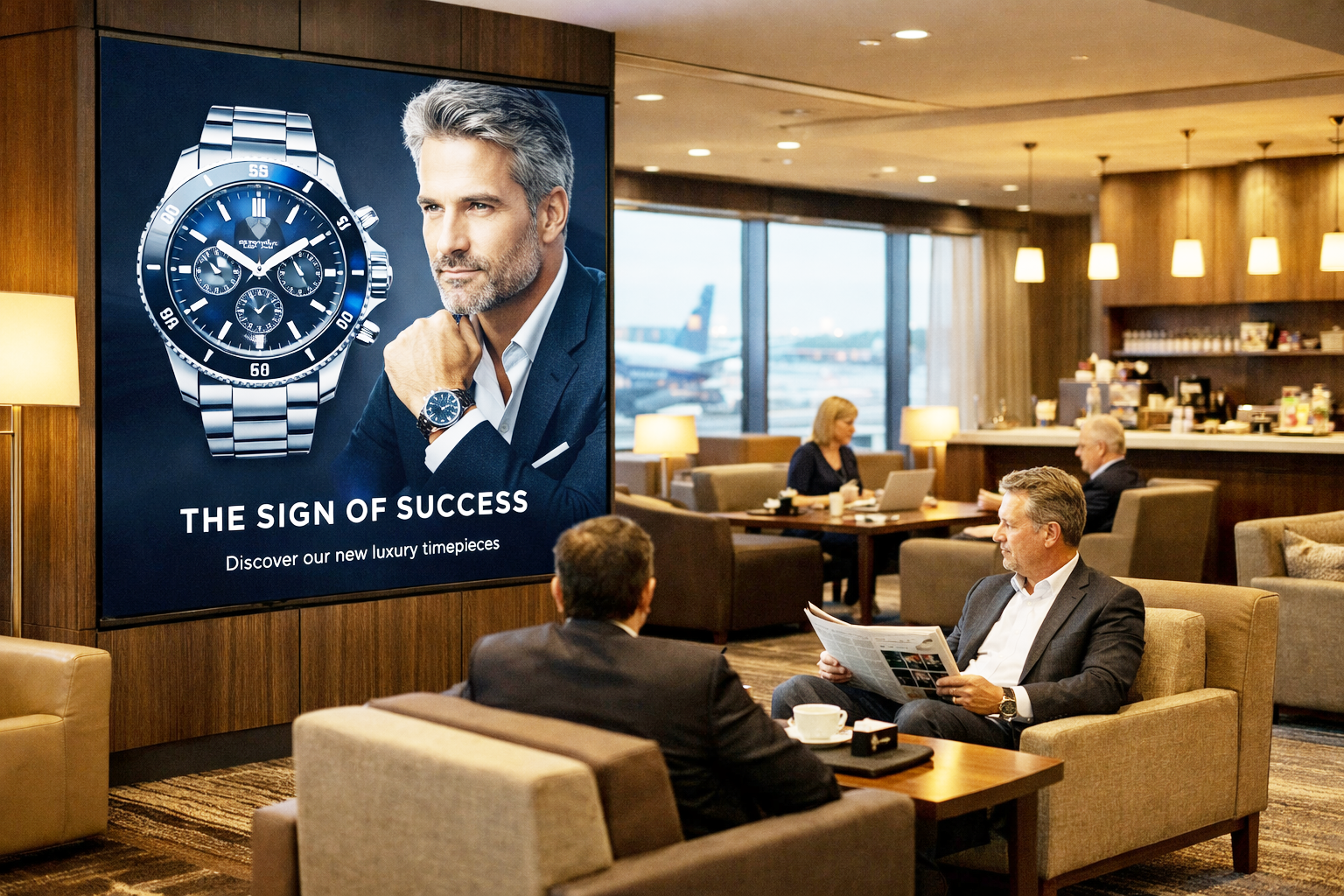
Poor Placement and Delays Affect Airport Campaigns
We help you move faster, access better inventory, and get it right now.
Talk to an ExpertFinal Strategic Verdict
Rocky Mountain Metropolitan is the strongest private aviation advertising environment in the Denver and Boulder corridor and should be bought for who passes through it rather than how many. With 262,348 annual operations, 476 based aircraft, a 9,000-foot runway, customs capability, two competing full-service FBOs, and a catchment built on aerospace, federal research, venture equity, and DJ Basin energy wealth, it delivers a concentration of principals and new HNW buyers that no commercial terminal in the region approaches. Private aviation, wealth management, luxury real estate, premium automotive, and aerospace B2B brands will find their exact buyer here during ski season, in an environment quiet enough for one message to dominate and repetitive enough for it to stick. Masscom Global brings the inventory access, seasonal timing intelligence, and execution speed to convert that concentration into results, and can extend the same campaign across the commercial gateway, the mountain resort airfields, and the destination markets this audience invests in.
About Masscom Global
Masscom Global is a premium international airport advertising and media buying agency operating across 140 countries. With deep expertise in airport OOH, premium publications, and high-net-worth audience targeting, Masscom helps brands reach the world's most valuable travellers at the moments that matter most. For advertising packages, media rates, and campaign planning at Rocky Mountain Metropolitan Airport and airports across the globe, contact Masscom Global today.
Frequently Asked Questions
How much does airport advertising cost at Rocky Mountain Metropolitan Airport? Cost depends on format, terminal and FBO position, campaign duration, and seasonal demand, and rates tighten sharply ahead of the December to March ski peak. Because this is a private aviation environment with a limited number of premium positions, availability drives price more than volume does. Contact Masscom Global for current rates and availability windows.
Who are the passengers at Rocky Mountain Metropolitan Airport? Corporate flight department and business jet passengers, aerospace and technology executives from the Boulder and Broomfield corridor, owner-pilots from a based fleet of 476 aircraft, and ski-season UHNW travellers positioning toward the Colorado resort airports. There is no scheduled airline traffic, so the passenger base is self-selected by mode of travel.
Is Rocky Mountain Metropolitan Airport good for luxury brand advertising? Yes, provided the brand values qualification over reach. The business aviation passenger base is close to uniformly high net worth, FBO lounges provide extended seated dwell, and clutter is minimal, so a luxury brand can achieve near-total share of attention. It suits brands whose Colorado messaging leans on performance, sustainability, and access rather than pure heritage status.
What is the best airport in Colorado to reach HNWI audiences? For pure audience quality per impression, the Denver-area business aviation fields lead, since every business jet passenger is self-selected by how they travel. For raw scale combined with premium reach, the state's commercial gateway is stronger, and for concentrated UHNW leisure the mountain resort airfields peak hardest in winter. The most effective plan combines all three, which is how Masscom Global typically structures Colorado buys.
What is the best time to advertise at Rocky Mountain Metropolitan Airport? Mid-December through March, with the sharpest windows around Christmas, New Year, and the February and March break weeks. June through August provides a secondary summer peak driven by mountain tourism and conference season. April, May, October, and November are the weakest periods and should carry minimal budget.
Can international real estate developers advertise at Rocky Mountain Metropolitan Airport? Yes, and it is one of the strongest categories here. This audience actively buys in Mexico, Costa Rica, Panama, Portugal, Italy, Spain, and the Alps, with a clear bias toward mountain and coastal product that matches their existing lifestyle identity. The FBO environment reaches the principal directly, which shortens the path from awareness to enquiry.
Which brands should not advertise at Rocky Mountain Metropolitan Airport? Mass-market FMCG and value retail, budget travel and low-cost carriers, remittance and prepaid telecom services, and duty-free travel retail. Each either requires scale the airport structurally cannot provide or targets an audience that does not pass through its private aviation facilities.
How does Masscom Global help brands advertise at Rocky Mountain Metropolitan Airport? Masscom Global delivers the full chain: catchment and audience intelligence, inventory access and placement selection across terminal and FBO environments, creative adaptation for a Mountain West HNW audience, production and installation, and post-campaign performance reporting. Masscom also extends campaigns across the region's commercial gateway, the Colorado resort airfields, and the international destinations this audience invests in, so the same buyer is reached at both ends of the journey.