




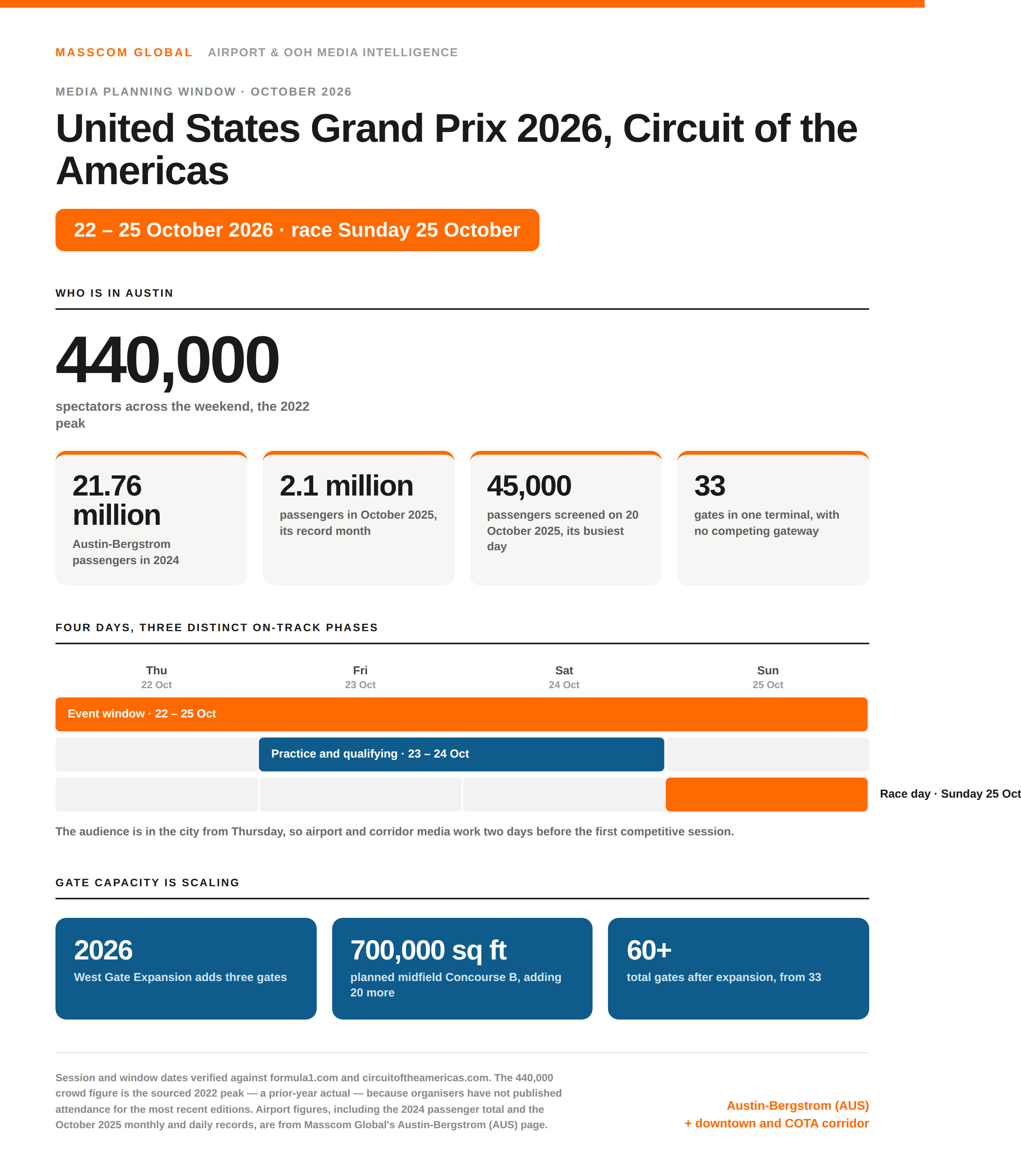
Austin's Grand Prix is the largest-attended motorsport weekend in the United States, with spectator figures peaking at 440,000 across the 2022 weekend and the event continuing to sell out since. The Formula 1 MSC Cruises United States Grand Prix 2026 runs at the Circuit of the Americas from 22 to 25 October 2026, with practice on Friday 23 October, qualifying on Saturday 24 October and the race on Sunday 25 October. COTA has been confirmed on the Formula 1 calendar through 2034, making Austin one of the few American race weekends a brand can plan against as a recurring annual fixture rather than a one-off activation.
What matters commercially is the shape of that crowd: a four-day festival audience layered on a dense corporate hospitality and private-aviation contingent, arriving into a single mid-sized city with one airport and one walkable downtown core.
For media planners, that combination is unusually efficient. Unlike Miami or Las Vegas, where race traffic dissolves into an already saturated metropolitan media market, Austin concentrates almost the entire inbound audience through Austin-Bergstrom International Airport and a compact set of downtown districts. Coverage of the arrival journey plus the city core reaches close to the whole visiting population.
Why Airport & City Advertising Works During the United States Grand Prix
The COTA weekend assembles four distinct high-value audiences in the same window. First, international motorsport travellers buying premium grandstand, paddock and hospitality tickets: a segment that travels several times a year for racing and skews affluent, male-weighted and brand-literate. Second, the corporate and sponsor delegations: automotive, watch, spirits, energy, technology, financial services and aviation brands bring client groups to Austin for the weekend, and the city's hospitality inventory prices accordingly. Third, the private-aviation contingent, for whom Austin-Bergstrom's general aviation operations become a peak-demand environment across the Thursday-to-Monday period. Fourth, Austin's own resident wealth base: a technology and venture-capital ecosystem that has grown substantially over the past decade and treats the Grand Prix as a business-calendar anchor.
COTA's own hospitality build-out reflects this. The circuit now operates a permanent hospitality building, the Guest House at Turn 20, alongside paddock club programmes, all-inclusive dining tiers, downtown shuttle services and Saturday-night concert upgrades. That is the infrastructure of a corporate entertaining weekend, not simply a sporting fixture, and corporate entertaining weekends are where category decisions about wealth management, private aviation, luxury automotive and residency advisory actually get discussed.
The planning insight is that this audience is capturable before it reaches the circuit. Trackside signage inside COTA is priced at global-sponsor level and largely inaccessible to a market-specific campaign. Airport and city media are not, and they deliver the same audience in higher-dwell environments.
Key Benefits of Airport & City Advertising During the United States Grand Prix
Reach a qualified, high-spend audience
Race-weekend arrivals concentrate premium-cabin, business-class and private-aviation travellers into a four-day window at a single airport. Austin-Bergstrom recorded over 2.1 million passengers in a single month in October 2025 (its strongest month on record) and more than 45,000 passengers screened by TSA on 20 October 2025, its busiest single day. Those peaks sit squarely on the Grand Prix window. Airport media in that period reaches an audience that is otherwise fragmented and expensive to buy.
Elevate your brand positioning
Formula 1 is a prestige environment by default, and Austin's edition carries an additional association with American technology wealth and a design-forward city identity. A brand present across the arrival journey and the downtown core is read as part of the weekend's fabric rather than as an interruption to it.
Generate business opportunity
The Grand Prix week functions as a deal environment. Family offices, venture investors, sponsor delegations and international executive groups are all in the same city with unusually open diaries. Visibility during that window supports meeting requests, showroom footfall, launch events and hospitality invitations: commercial outcomes, not only impressions.
Get Free Expert Assistance from Our Global Media Planning Team
Receive strategic recommendations, media planning support, campaign monitoring and reporting to maximise your visibility throughout US F1 Grand Prix (COTA).
Book Expert ConsultationAustin-Bergstrom International Airport (AUS)
Austin-Bergstrom is the single gateway for essentially all inbound air traffic to the Grand Prix. It handled 21.76 million passengers in 2024, its second-busiest year on record, after passing 22 million in 2023. The airport operates a single passenger terminal (the Barbara Jordan Terminal) with 33 gates, which is the structural fact that makes it so valuable to advertisers: there is no terminal split, no competing gateway, and no way for a race-weekend arrival to bypass the concourse.
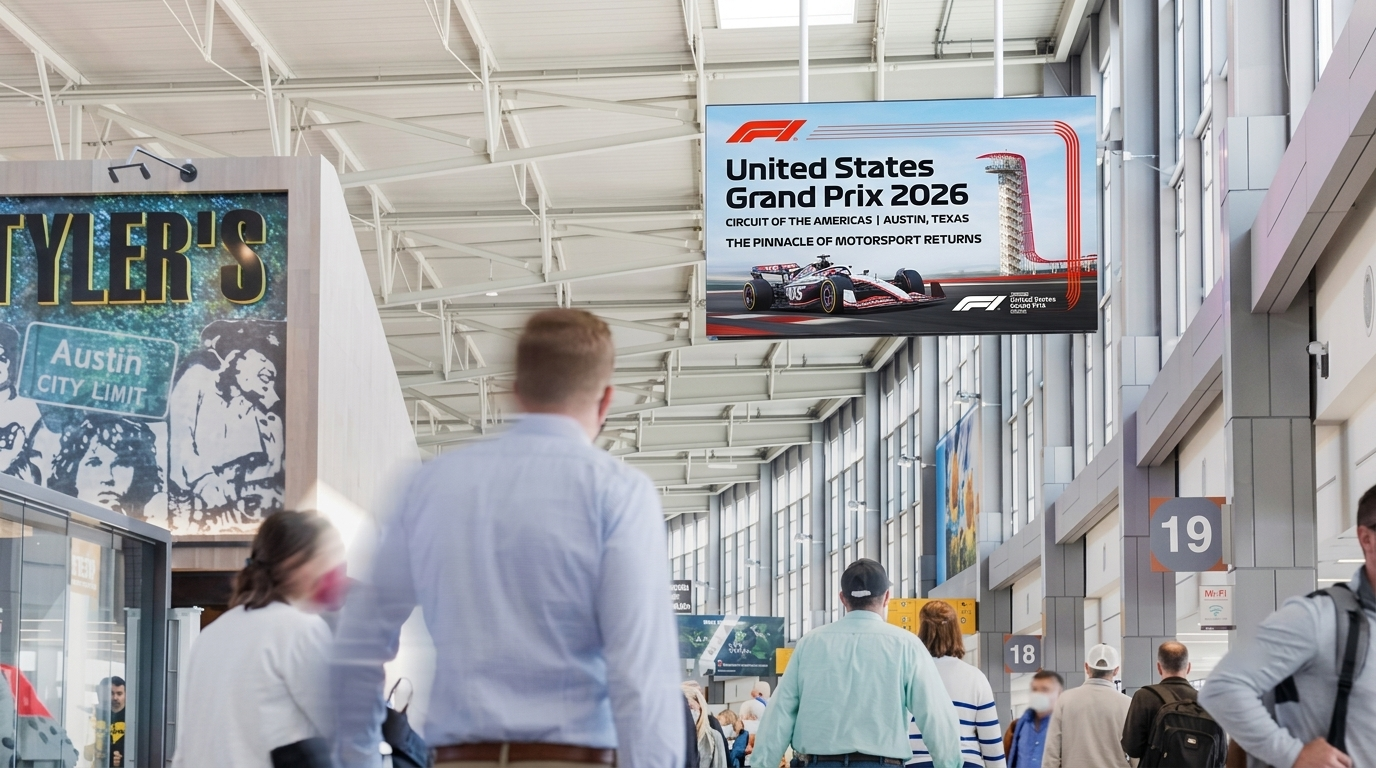
Inventory Highlights
- Digital display environments throughout the Barbara Jordan Terminal, reaching departing and arriving traffic in the same footprint.
- Departure gate environments across the 33-gate concourse, where dwell times during a peak weekend run long as flights bunch.
- Concourse positioning along the primary circulation spine: a single unavoidable path for all passengers.
- International arrivals corridor placements, capturing inbound long-haul traffic from London Heathrow (British Airways, daily, now in its tenth continuous year), Amsterdam (KLM), Frankfurt (Lufthansa), Mexico City (Aeromexico and Viva Aerobus) and Panama City (Copa Airlines).
- Baggage claim and meeter-greeter zones, where arriving groups congregate for extended periods.
Advantages for Advertisers
- Single-terminal capture. One terminal means one media buy reaches the full inbound audience: a structural efficiency that multi-terminal hubs cannot offer.
- Documented October peak. The airport's record monthly and daily volumes both fall in the Grand Prix month, so the buy is timed to demonstrable maximum traffic rather than an assumption.
- Domestic and international layering. Southwest (41% share), American Airlines (19.6%), Delta (15.3%) and United (11.9%) deliver the domestic premium audience, while the European and Latin American long-haul routes deliver the international motorsport traveller.
- Expansion momentum. The West Gate Expansion opening in 2026 adds three gates, and a planned 700,000 square-foot midfield Concourse B will add 20 more, taking total gate capacity from 33 to over 60. Early campaign presence establishes position in an environment that is scaling.
- General aviation adjacency. Private-aviation arrivals for the race weekend concentrate at the same airfield, putting the highest-value segment inside the same catchment.
 Wealth in motion intelligence.
Destination Austin: Full Visitor Journey Coverage
Austin rewards a whole-journey approach more than most F1 host cities, because the geography is simple and repetitive. Visitors land at Austin-Bergstrom, travel roughly eight miles into the city, and then move between a small number of districts for four days: downtown and the Congress Avenue corridor, the Rainey Street and Second Street hospitality zones, South Congress for retail and dining, and the East Austin bar and restaurant belt. COTA sits south-east of the city, reached by a shuttle and highway corridor that the great majority of ticket-holders travel twice a day.
That produces a clean Airport → City → Venue sequence. A campaign should open at the airport, where the visitor's first impression of the market is formed and dwell is highest. It should continue through downtown OOH and DOOH: large-format positions on the arterial routes into the centre, digital screens in hospitality and retail districts, and placements around the hotel clusters where sponsor delegations and hospitality guests are housed. It should close on the circuit-bound corridor, where the same audience passes on each of the four event days in a captive, low-distraction travel state.
Built in that order, the programme delivers three compounding effects. Increased brand recall, because the audience encounters the message at the airport, in the city and en route to the venue rather than once in isolation. Consistent presence, because the brand appears in every environment the visitor occupies across the week, which reads as scale and permanence. Enhanced campaign effectiveness, because repetition against a fixed, high-value audience over a compressed four-day window lifts response well above what the same budget achieves spread thinly across a national market.
Why Brands Choose Airport & City Advertising for United States Grand Prix
Exclusive audience access. The Grand Prix week assembles international motorsport travellers, corporate hospitality guests, sponsor delegations, private-aviation arrivals and Austin's resident technology wealth in one city at one time. Airport and city media reach that population without competing for trackside sponsorship inventory.
A prestigious environment. Formula 1's premium associations transfer to brands visible around it. Austin's edition adds a distinctly American innovation-and-design context that suits technology, automotive, spirits and lifestyle categories particularly well.
End-to-end campaign support. Masscom Global plans, books, verifies and reports across airport and city inventory, so a single brief covers the whole visitor journey rather than requiring separate negotiations with each media owner.
Strategic planning assistance. Our planners advise on format mix, weighting between airport and city, campaign start dates relative to the 22 October opening, and how to phase spend across arrival, in-city and venue-corridor stages for the strongest cumulative effect.
The Masscom Global Standard Behind Every United States Grand Prix Placement
- Verified inventory and audience data: built on Austin-Bergstrom's own documented traffic records, including its record passenger month and day, both inside the Grand Prix window.
- Transparent delivery reporting: across the airport and city inventory, so you see exactly where and when your creative ran.
- Benchmarked recommendations: weighting between airport, city and venue-corridor placements set against comparable race-weekend campaigns.
- We absorb the complexity: one brief covers negotiation, booking, verification and reporting across the whole visitor journey.
Request Your Customised US F1 Grand Prix (COTA) Advertising Plan
Tell us your audience, category and budget. Our planners will return a costed plan across airport and prime city inventory, with availability confirmed.
Book NowFrequently Asked Questions
When is the 2026 United States Grand Prix?
The 2026 Formula 1 United States Grand Prix runs from 22 to 25 October 2026 at the Circuit of the Americas in Austin, Texas. Practice sessions are on Friday 23 October, third practice and qualifying on Saturday 24 October, and the race on Sunday 25 October.
Who attends the United States Grand Prix?
International and domestic motorsport travellers on premium and hospitality tickets, corporate and sponsor delegations across automotive, watch, spirits, technology, energy and financial services, private-aviation arrivals, and Austin's resident executive and investor community. Spectator numbers at COTA peaked at 440,000 across the weekend in 2022, and recent editions have sold out.
Can a campaign reach the same audience beyond the circuit?
Yes, and that is the more accessible route. A combined Austin-Bergstrom and downtown Austin programme reaches arrivals at the airport, in the hotel and hospitality districts, and on the corridor to the circuit: several exposures across the same four days, without requiring trackside sponsorship.
How far in advance should a Grand Prix campaign be booked?
Premium airport and downtown Austin positions for the October window are among the most contested in the market, and Austin-Bergstrom's record volumes fall in this exact month. We recommend confirming availability several months ahead. Later requests can often still be served, but with reduced format choice.
Which brand categories perform best in this window?
Luxury and performance automotive, watches, premium spirits, private aviation and charter, wealth management and private banking, technology and enterprise software, real estate and residency advisory, and international hospitality.
Related Airport Advertising Guides
Detailed inventory, audience and planning notes for the airports covered above:
Wealth in motion intelligence.United States Grand Prix Won't Wait. Neither Should You.
- Confirmed through 2034, contested every year: premium airport and downtown Austin positions for October are already among the most contested in the market.
- Competitors are already moving: every week without a plan is a week an automotive, spirits or wealth management brand gets closer to locking the same inventory.
- The window is exact, not approximate: missing the 22 October opening means missing the four days sponsor delegations and family offices are in the city.
- The alternative is largely closed: trackside sponsorship is inaccessible to a market-specific campaign, leaving airport and city media as the only route in.
Get Free Expert Assistance Now
Tell us your audience, your category and your budget, and our planners will return a costed United States Grand Prix media plan spanning Austin-Bergstrom airport and city inventory.
Request Availability
Positions for the 22 – 25 October 2026 window move quickly. Ask us what is still open.
Austin delivers the largest-attended motorsport weekend in the United States inside a single mid-sized city, with almost the entire visiting crowd funnelled through one airport and one walkable downtown core, unlike the diluted media markets of Miami or Las Vegas. With COTA confirmed on the calendar through 2034, a campaign built around Austin-Bergstrom arrivals and the downtown corridor is not a one-off bet but a recurring annual fixture a brand can plan years ahead. For automotive, spirits, wealth and hospitality brands, that combination of scale and repeatability is rare in American motorsport.







