Airport at a Glance
| Field | Detail |
|---|---|
| Airport | MidAmerica St. Louis Airport |
| IATA Code | BLV |
| Country | United States |
| City | Mascoutah, Illinois (Greater St. Louis) |
| Annual Passengers | More than 384,000 in 2025, up 25.3 percent year on year |
| Primary Audience | Value-driven leisure and family travellers, Sun Belt second-home owners and snowbirds, defence and aerospace personnel |
| Peak Advertising Season | March, June to August, late November to December |
| Audience Tier | Tier 3 |
| Best Fit Categories | Travel and hospitality, Sun Belt real estate, retail banking and consumer finance, defence and aerospace B2B |
MidAmerica St. Louis is one of the fastest-growing airports in the American Midwest by percentage. It handled more than 384,000 passengers in 2025, a 25.3 percent increase on the previous year, breaking monthly records in seven of twelve months and setting an all-time high of roughly 57,000 travellers in July. Almost all of that traffic is leisure, routed to Gulf Coast, Florida, Nevada and Arizona destinations. For advertisers, this is a rare thing in the United States: a growing, uncluttered terminal serving a defined regional consumer audience.
The second layer is what makes BLV distinctive. The airport operates under a joint-use agreement with Scott Air Force Base, home to United States Transportation Command and Air Mobility Command, and it hosts a $200 million, 300,000 square foot Boeing production facility building the MQ-25 Stingray for the US Navy. That places a concentrated defence, aerospace and logistics professional population directly alongside a value leisure passenger flow. Masscom Global treats BLV as a dual-audience buy that almost no other regional airport in the country can offer.
Advertising Value Snapshot
- Passenger scale: More than 384,000 passengers in 2025, up 25.3 percent year on year and 18 percent above the previous record set in 2022, with roughly 192,000 boardings
- Traveller type: Value-conscious family and leisure travellers, Sun Belt snowbirds and second-home owners, defence, aerospace and logistics professionals
- Airport classification: Tier 3. Modest volume, exceptional growth rate, and a highly homogeneous, easily targeted audience
- Commercial positioning: The convenience and value gateway for the Metro East and southern Illinois, and the aviation anchor of a national defence logistics cluster
- Wealth corridor signal: Sits at the crossroads of five interstates, four Class I railroads and two inland port districts, inside Foreign Trade Zone 31
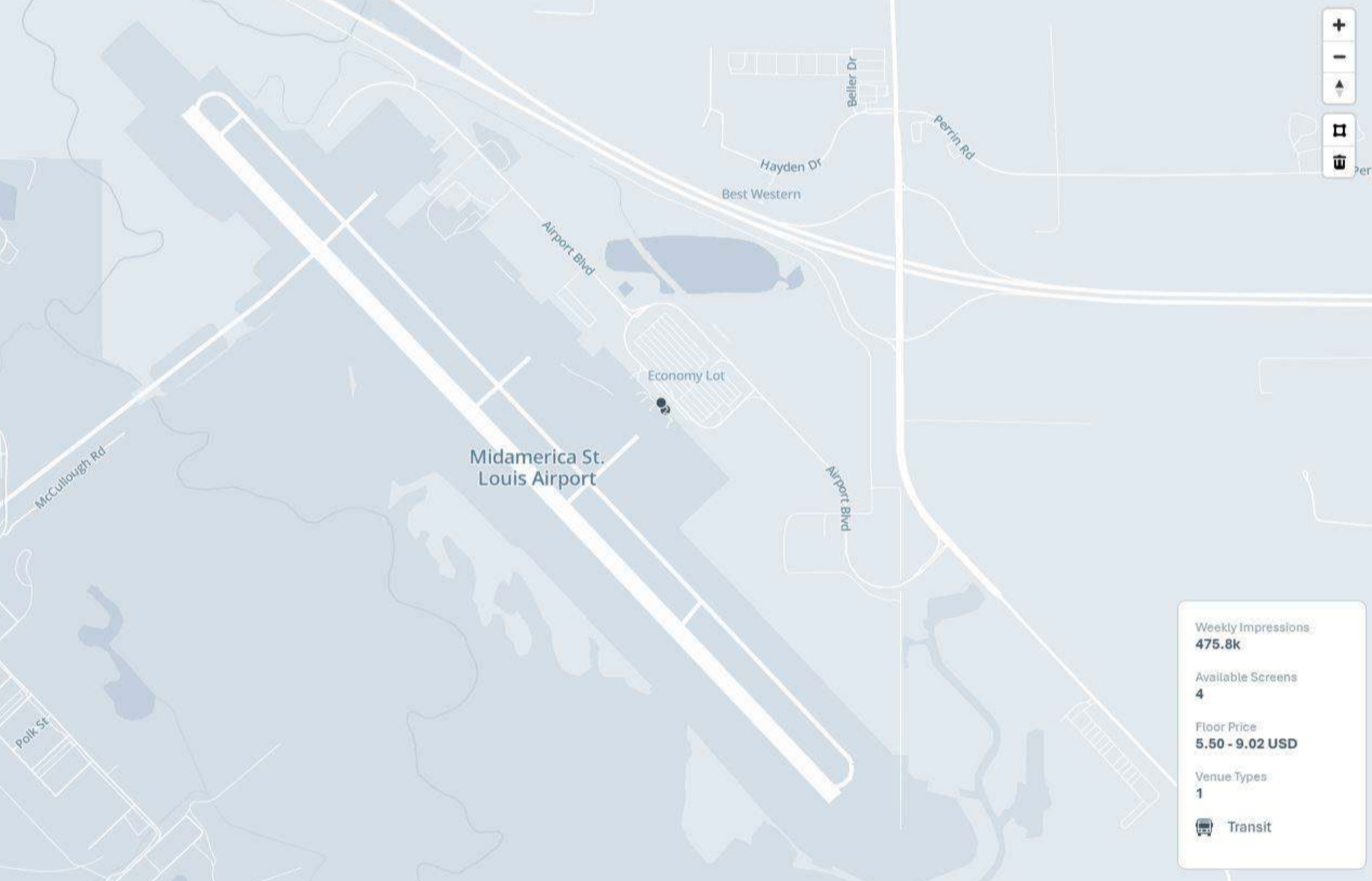
- Advertising opportunity: A single compact terminal expanded in 2023 means every passenger passes the same short sequence of positions, producing high frequency and near total capture. Advertising density remains far below comparable US airports, so standout potential per placement is unusually high. Masscom Global secures placement precision across this flow and structures campaigns to capture both the leisure consumer and the defence and logistics professional audience.
Airport Advertising is Complex to Get Right
We help you execute faster, with proven results and local insight most planners lack starting now.
Talk to an ExpertCatchment Area and Economic Drivers
Top 10 Cities within 150 km, Marketer Intelligence:
- St. Louis, Missouri: The regional economic anchor 18 miles west. Supplies corporate, healthcare, financial services and agri-science households with real discretionary travel budgets.
- Belleville, Illinois: The largest Metro East city and the core of the local catchment. Stable middle-income households with strong auto, home improvement and consumer finance relevance.
- O'Fallon, Illinois: Higher-income suburban growth market driven by defence contracting and professional households. The most affluent concentration in the immediate drive radius.
- Shiloh and Mascoutah: Directly adjacent to the airport and Scott Air Force Base. Delivers military, contractor and federal employee households with reliable income and frequent relocation-linked purchasing.
- Edwardsville, Illinois: University town with a professional and academic population. Strong for education services, technology, insurance and premium consumer categories.
- Collinsville, Illinois: Logistics and distribution corridor town on the interstate spine. Produces trades, transport and warehouse operator audiences with fleet and equipment needs.
- Alton, Illinois: River city with manufacturing heritage and an established retiree base. Relevant for healthcare, insurance, retirement finance and value retail.
- Waterloo and Columbia, Illinois: Fast-growing bedroom communities with high household formation. Prime intercept for mortgage, home services, family financial products and vehicle finance.
- Mount Vernon, Illinois: Southern Illinois trade and healthcare hub feeding the drive-market catchment. Strong for agri-inputs, machinery, healthcare and regional banking.
- Springfield, Illinois: State capital roughly 85 miles north. Contributes government, legal and healthcare professional travellers who choose BLV for schedule and cost convenience.
NRI and Diaspora Intelligence:
There is no large international diaspora using BLV, so the dominant audience movement is domestic and highly patterned. The defining flow is the Sun Belt migration corridor: Midwestern households moving seasonally and permanently toward the Gulf Coast, Florida, Arizona and Nevada, often as a precursor to buying property there. Layered on top is the military relocation cycle, where Scott Air Force Base personnel rotate in and out on multi-year postings, generating repeat demand for housing, storage, vehicle purchase, banking and insurance. Both flows are predictable, calendar-driven and commercially valuable.
Economic Importance:
The catchment economy runs on three engines: defence and aerospace, freight and logistics, and healthcare and public sector employment. Defence creates a stable, security-cleared professional population with dependable income and strong brand loyalty. Logistics creates operator, owner and procurement audiences tied to the rail, river port and interstate network. Healthcare and public employment supply the volume middle-income base that drives the leisure travel numbers. Each produces a distinct advertiser opportunity inside one small terminal.
Business and Industrial Ecosystem
- Defence and military logistics: Scott Air Force Base hosts United States Transportation Command and Air Mobility Command, concentrating senior military, federal and contractor personnel with procurement authority and continuous travel patterns.
- Aerospace manufacturing: A $200 million Boeing production facility on airport grounds builds the US Navy's MQ-25 Stingray, drawing engineering, supply chain and programme leadership audiences to the site.
- Freight, rail and inland port logistics: Access to five interstates, four Class I railroads and two port districts within 22 miles, all inside Foreign Trade Zone 31. Produces logistics executives, fleet owners and industrial site selectors.
- Agriculture and food distribution: Cold chain and produce distribution operations on the airport campus connect the terminal to national food supply networks and their operator audiences.
Passenger Intent, Business Segment:
Business travel is a minority of BLV volume, but the on-site business population is substantial and reachable. Defence contractors, aerospace engineers, federal personnel and logistics operators use the terminal, the general aviation facility and the wider campus continuously. This audience responds to credibility, security, compliance and long-term service capability rather than price promotion. Defence and aerospace B2B, logistics services, insurance, banking and professional services intercept them effectively.
Strategic Insight:
The commercial value of the business audience here comes from concentration rather than volume. National defence logistics decisions and a major naval aviation programme are administered within a few miles of this terminal. For B2B brands selling into defence, aerospace or freight, BLV places a message in front of that community at regional airport cost. Very few US airports offer that level of sector density in such a compact footprint.
Tourism and Premium Travel Drivers
- Gulf Coast beach destinations including Gulf Shores and Destin: The dominant leisure driver, with the Gulf Shores route running near capacity since launch. High-intent family and couples travel with committed accommodation spend.
- Florida markets including Orlando, Fort Lauderdale, Fort Myers and Tampa Bay: Theme park, cruise connection and snowbird traffic. Strong for travel finance, insurance, retail and hospitality brands.
- Las Vegas and Phoenix or Mesa: Entertainment, convention and winter-sun travel with a higher discretionary spend profile than the beach routes.
- St. Louis regional inbound tourism: Arriving visitors heading into the metro for family, sport and cultural travel, reachable at the arrivals moment when spend decisions are still open.
Passenger Intent, Tourism Segment:
Passengers at BLV have deliberately chosen this airport over the larger metro alternative for cost, parking and speed, which tells advertisers something precise: this is a value-optimising household that still spends significantly on the trip itself. They have already committed to flights, accommodation, car hire and a multi-day family holiday before they reach the terminal. On departure they are relaxed and early, and on return they are in an immediate post-holiday state where travel credit cards, insurance, property and next-trip messaging land well. Travel, hospitality, financial services, telecom and Sun Belt real estate benefit most.
Travel Patterns and Seasonality
Peak seasons:
- March: Spring break drives the first record month of the year, with heavy family volume to Florida and the Gulf Coast.
- June to August: The dominant peak. July is the busiest month in the airport's history at roughly 57,000 passengers, with May and June both setting records in 2025.
- October to April: The snowbird corridor to Florida, Arizona and Nevada, producing a mature, higher-net-worth and property-motivated passenger flow.
- Late November and late December: Thanksgiving and Christmas family travel, short and sharp volume spikes with high emotional engagement.
Event-Driven Movement:
- Spring break season (March): Concentrated family leisure surge. Advertiser window opens four weeks prior for travel finance, insurance, telecom, retail and hospitality brands.
- Gulf Coast summer season (May to August): Sustained rather than spiked demand, driven by the newest and most popular routes. The single best continuous window for travel, property and consumer finance campaigns.
- Snowbird departure and return waves (October and April): Two clean bookends carrying the most property-motivated audience of the year. Prime for Sun Belt real estate, retirement finance, healthcare and insurance.
- Thanksgiving and Christmas holiday travel (late November, late December): High-volume, family-heavy, short-duration peaks ideal for retail, telecom, beverage and consumer brand messaging.
- Military rotation and deployment cycles (recurring through the year): Predictable movement tied to base assignment patterns, creating a repeat intercept opportunity for banking, insurance, storage, vehicle and relocation services.
It’s Not Just Where You Advertise - It’s How Fast You Execute
We combine local insight with fast rollout to deliver results for you, now.
Talk to an ExpertAudience and Cultural Intelligence
Top 2 Languages:
- English: The operating language of effectively the entire passenger base. Creative should be plain, direct and value-explicit. This is a Midwestern audience that reads inflated brand language as a warning sign rather than a promise.
- Spanish: The meaningful second language across the St. Louis metropolitan area, concentrated in younger and service sector households. A Spanish-supported layer extends reach without diluting the primary English message.
Major Traveller Nationalities:
The passenger base is overwhelmingly American domestic, drawn from the Illinois Metro East, greater St. Louis and southern Illinois drive market. The distinguishing sub-population is military and federal, including personnel and families posted from across the United States and, in smaller numbers, allied international liaison staff attached to the joint commands. There is currently no scheduled international passenger service. Campaign creative should be built for a Midwestern American consumer, with a separate professional-register layer for the defence and aerospace community.
Religion, Advertiser Intelligence:
- Catholicism (a leading affiliation across the St. Louis metropolitan area): Anchors Christmas and Easter family travel, large extended-family gatherings and strong parochial school enrolment. Drives predictable holiday travel peaks and gifting cycles. Retail, travel, telecom and family financial products all benefit.
- Protestant and Evangelical denominations (a large combined share across southern Illinois): Community and congregation-centred, with conference, mission and family reunion travel patterns. Responds to messaging built on family security, savings and stability rather than status. Relevant for banking, insurance, healthcare and education.
- Religiously unaffiliated (a substantial and growing share, especially among younger households): Spending is driven by secular calendars, school terms and holiday weekends. Advertisers should anchor timing to spring break, summer holidays and the Thanksgiving and Christmas retail cycle rather than religious moments.
Behavioral Insight:
This audience earns steadily rather than spectacularly, and it makes purchase decisions on total cost of ownership. The choice to use BLV instead of the larger metro airport is itself a statement of how they think: they will trade prestige for convenience and value every time, but they will still spend meaningfully on the family experience they are protecting. Proof, warranty, service network and clear pricing outperform exclusivity and aspiration. The purchase triggers are the annual holiday, the military posting, the retirement decision and the move south.
Outbound Wealth and Investment Intelligence
The outbound passenger at BLV is not deploying capital internationally. The wealth movement here is domestic and directional, and it runs almost entirely along the Midwest to Sun Belt axis. Households accumulate equity in low-cost Illinois and Missouri property, then convert it into warm-state second homes, retirement relocation and rental investment. The airport's route map is effectively a map of where that capital goes.
Outbound Real Estate Investment:
The Alabama and Florida Gulf Coast is the primary target, with Gulf Shores, Orange Beach, Destin, Fort Walton Beach and the Fort Myers to Naples corridor absorbing Midwestern second-home and short-term rental capital. Florida's Orlando and Tampa Bay markets follow for combined investment and family-use purchases. Arizona and Nevada attract the retirement relocation buyer seeking climate and tax advantages. Sun Belt developers, resort communities and vacation rental platforms reach this buyer at the exact moment they are travelling to inspect or enjoy the market they are considering.
Outbound Education Investment:
Education spending in this catchment is domestic rather than international. Families fund in-state and regional public universities, with the nearby Illinois and Missouri systems dominant, alongside strong demand for community college, trade certification and online degree completion. Military families use federal education benefits and transferability programmes heavily, which creates a distinct and reachable planning audience. Universities, online degree providers, trade schools and student finance brands find a receptive audience here, particularly during the summer and holiday travel peaks when families travel together.
Outbound Wealth Migration and Residency:
Golden visa, second-residency and citizenship-by-investment activity is not a meaningful factor for this passenger base. The functional equivalent is interstate relocation, where households move domicile to Florida, Texas, Arizona, Tennessee or Nevada for tax and climate reasons. Military personnel add a second layer through state-of-legal-residence planning tied to postings. Wealth advisers, relocation specialists and state tax planning services should target this behaviour rather than international residency messaging.
Strategic Implication for Advertisers:
Sun Belt property developers, resort operators and relocation brands should treat BLV as an origin-market acquisition channel rather than a branding buy, because the outbound passenger here is already travelling to the market they intend to buy into. The cost of reaching that buyer at origin is a fraction of reaching them at destination. Masscom Global activates both ends of this corridor simultaneously, pairing BLV placement with Gulf Coast, Florida, Arizona and Nevada airport inventory so the same household is intercepted on departure and on arrival.
Airport Infrastructure and Premium Indicators
Terminals:
- A single passenger terminal expanded in 2023 through a $34 million project that nearly doubled its size, adding modern amenities and additional gate capacity. All passengers move through one continuous path, giving complete audience capture with no split media buy.
- Parallel runways of 8,000 and 10,000 feet supporting simultaneous operations in all weather conditions, with an annual capacity of 200,000 operations against current usage well below that, meaning growth can be absorbed without disruption.
Premium Indicators:
- A new General Aviation Facility opened in spring 2026, capable of handling international arrivals of up to 20 passengers, which brings corporate and executive aviation traffic directly into the airport's commercial environment.
- Corporate, business and military aviation activity alongside scheduled service, including sustained air cargo operations, giving the airport a professional and institutional passenger layer.
- On-site full service restaurant and bar concessions with free terminal wi-fi, which extends dwell and creates seated, attentive exposure windows in a compact space.
- A national defence logistics command and a major aerospace production programme co-located on the same airfield, which elevates the institutional credibility of the environment for B2B and government-facing brands.
Forward-Looking Signal:
Three infrastructure milestones are converging. A $97 million, 5.2 mile MetroLink light rail extension opens a station directly adjacent to the terminal in summer 2026, connecting BLV to the wider St. Louis rail network and to the region's larger airport through a single system. A 25,277 square foot Federal Inspection Station housing US Customs and Border Protection is on track for completion in 2027, which will unlock scheduled international commercial service and attract additional carriers. A $37 million taxiway project has already opened further campus development capacity. Masscom Global advises clients to secure positions now, at current regional rates, before rail access and international capability reset the value of this environment.
Airline and Route Intelligence
Top Airlines:
Allegiant operates the scheduled passenger service at BLV, supported by air cargo carriers, corporate and general aviation, and extensive military aviation activity through the joint-use agreement. Single-carrier dominance produces an unusually consistent and predictable passenger profile.
Key International Routes:
None scheduled at present. The new General Aviation Facility handles international arrivals of up to 20 passengers, and the Federal Inspection Station due for completion in 2027 is designed to open scheduled international commercial service.
Domestic Connectivity:
The network is built almost entirely around leisure demand, with year-round and seasonal nonstop service to Gulf Coast and Florida destinations including Gulf Shores, Destin and Fort Walton Beach, Fort Lauderdale, the Fort Myers area, Orlando and the Tampa Bay region, alongside Las Vegas and the Phoenix area. Flight volume expanded sharply through 2025, with roughly 180 flights operated in June against about 40 fewer in the same month a year earlier.
Wealth Corridor Signal:
The route map is one of the clearest audience signals available at any US regional airport. There is almost no business corridor in it. Every destination is a warm-weather leisure, retirement or second-home market, which means the passenger is either holidaying, visiting family or evaluating a place to buy. For travel, hospitality, property, insurance and consumer finance brands, that is an audience with intent already declared by their ticket.
Media Environment at the Airport
- A single small terminal with a recently doubled footprint and very low advertising density compared with major US airports. A brand here competes against a fraction of the message volume found at a large hub, so standout potential per position is exceptionally high.
- Dwell time is driven by early arrival behaviour, a single security checkpoint and gate area, and on-site restaurant and bar concessions. Passengers are seated, unhurried and attentive, converting modest physical dwell into strong attention dwell.
- Joint-use status with a national defence logistics command and an on-site aerospace production programme lend the environment institutional weight, which strengthens brand association for B2B, government-facing and technology advertisers.
- Masscom Global provides inventory access, placement precision and rollout speed at BLV, structuring campaigns around the spring break, summer Gulf Coast and snowbird windows that concentrate the highest-intent audience.
Strategic Advertising Fit
Best Fit:
- Travel, hospitality and destination marketing: A passenger base whose entire route map is leisure intent, reachable immediately before and after the trip
- Sun Belt real estate, resort communities and vacation rentals: Buyers travelling to the exact markets they are evaluating, intercepted at origin at low cost
- Retail banking, consumer finance and travel credit cards: Value-optimising households with active credit use and clear seasonal spending cycles
- Insurance including travel, auto, home and life: Family-centred, risk-aware Midwestern households with recurring purchase triggers
- Defence, aerospace and logistics B2B: A concentrated professional audience with procurement authority co-located on the same airfield
- Automotive, particularly trucks, SUVs and family vehicles: High vehicle ownership, long drive-market distances and strong replacement cycles
- Healthcare, retirement services and senior living: A significant retiree and pre-retiree flow along the snowbird corridor
- Telecom, streaming and consumer technology: Family travel with heavy device dependence and clear holiday-period usage spikes
Brand Alignment at a Glance:
| Category | Fit |
|---|---|
| Travel, hospitality and destination marketing | Exceptional |
| Sun Belt real estate and vacation rentals | Exceptional |
| Retail banking, consumer finance and insurance | Strong |
| Defence, aerospace and logistics B2B | Strong |
| Automotive and consumer technology | Strong |
| Healthcare and retirement services | Strong |
| Premium and business-class travel products | Moderate |