

Airport at a Glance
| Field | Detail |
|---|---|
| Airport | MET, Montréal Metropolitan Airport (formerly Montréal Saint-Hubert Airport) |
| IATA Code | YHU |
| Country | Canada |
| City | Saint-Hubert, Longueuil, Québec |
| Annual Passengers | New terminal opened 15 June 2026 with design capacity above 4 million annually and peak processing of up to 15,000 passengers per day |
| Primary Audience | South Shore and Montréal professional households, aerospace and space sector executives, francophone leisure and diaspora travellers |
| Peak Advertising Season | Late July, December to January, March, June to August |
| Audience Tier | Tier 2, on a Tier 1 trajectory |
| Best Fit Categories | Financial services and wealth management, aerospace and industrial B2B, travel and destination marketing, premium automotive |

On 15 June 2026, scheduled airline service returned to the historic Saint-Hubert airfield for the first time in living memory, with a 450 million dollar, 21,000 square metre terminal carrying nine boarding bridges, a 900-seat lounge, and capacity for more than 4 million passengers a year. Greater Montréal now operates a genuine two-airport system, and the second airport sits 15 kilometres from downtown with an express shuttle to the metro. Almost no advertiser in the world gets to enter a metropolitan terminal at day one of its commercial life. Masscom Global reads YHU as the most time-sensitive opportunity in Canadian airport media.
What makes this airport commercially distinct is the catchment it was built for. The South Shore municipalities of Longueuil, Brossard, Boucherville, Saint-Lambert, and Saint-Bruno hold some of the highest household incomes in Québec, and the airport sits inside an aerospace and space cluster that includes a major engine manufacturer's global headquarters and Canada's national space agency. Layered onto that is a francophone travel culture with the most predictable seasonal spending pattern in North America. Masscom activates an affluent, structurally under-served audience in an environment with no accumulated advertising clutter
Advertising Value Snapshot
- Passenger scale: Full-year figures are not yet available. The terminal opened 15 June 2026 with design capacity above 4 million passengers annually, peak throughput of up to 15,000 per day, and an anchor schedule of 138 weekly flights.
- Traveller type: Affluent South Shore and Montréal professional households, aerospace and industrial sector executives, francophone leisure and diaspora travellers.
- Airport classification: Tier 2 today, with capacity, catchment, and carrier commitment that place it on a clear Tier 1 trajectory.
- Commercial positioning: Montréal's second commercial airport, purpose-built for fast domestic travel on modern single-aisle and regional aircraft.
- Wealth corridor signal: YHU sits on the Québec-to-Florida snowbird corridor, the Québec-to-France cultural and capital corridor, and the Montréal-to-Maghreb diaspora corridor.
Advertising opportunity: A compact terminal engineered for rapid curb-to-gate movement concentrates every passenger through a short, tightly defined sequence, so a small number of placements achieves near-total coverage. Because the environment is entirely new, brand association is being established here for the first time rather than competed for. Masscom Global has the access to place clients into that environment now.
Airport Advertising is Complex to Get Right
We help you execute faster, with proven results and local insight most planners lack starting now.
Talk to an Expert
Catchment Area and Economic Drivers
Top 10 Cities within 150 km, Marketer Intelligence:
- Longueuil and Saint-Hubert: The immediate catchment and an aerospace employment centre. Engineering, manufacturing, and space sector professionals with technical literacy and above-average household income.
- Brossard: The South Shore's most internationally diverse affluent municipality, with substantial Chinese, South Asian, and Middle Eastern professional communities plus a major retail and lifestyle district. Strong receptivity to luxury, property, and education messaging.
- Boucherville and Saint-Bruno-de-Montarville: Among the highest median household incomes in Québec. Executive and professional families with premium automotive, private schooling, and wealth management demand.
- Saint-Lambert: Established anglophone and bilingual wealth with intergenerational assets. Conservative money that responds to institutional credibility and stewardship framing.
- Montréal (island): The commercial, financial, and cultural core, now within a shuttle and metro connection of the terminal. Contributes corporate, creative, and diaspora audiences at scale.
- Laval: Pharmaceutical, biotechnology, and life sciences cluster producing clinical and regulatory travellers plus a large young affluent family base.
- Saint-Jean-sur-Richelieu and Chambly: Military college presence, agri-food processing, and commuter professional households. Reliable institutional and family travel.
- Saint-Hyacinthe: Canada's leading agri-food and veterinary science cluster. Delivers technical, research, and agribusiness travellers with genuine procurement authority.
- Granby and Bromont: Microelectronics and advanced manufacturing alongside ski resort and luxury second-home ownership. A rare combination of industrial B2B and leisure wealth.
- Sorel-Tracy, Varennes, and Drummondville: Metallurgy, energy research, and diversified manufacturing. Owner-operator and plant leadership audiences with equipment and finance needs.
NRI and Diaspora Intelligence: Greater Montréal holds one of the most commercially valuable diaspora profiles in North America, and much of it lives in the South Shore catchment. The city is home to Canada's largest francophone North African population, drawn from Algeria, Morocco, and Tunisia, alongside the largest Haitian community in the country, substantial Lebanese and Syrian commercial families, and growing Chinese and South Asian professional populations concentrated in Brossard. These communities travel frequently, remit consistently, and hold property and family interests in origin markets. YHU currently operates domestic routes only, which means these travellers are captured here at origin before they connect internationally, making this terminal an origin-intercept environment for remittance, gold, property, and international education advertisers.
Economic Importance: The immediate catchment economy is anchored by aerospace and space technology, with a global aircraft engine headquarters and Canada's national space agency both located adjacent to the airfield, supported by aerostructures manufacturing and long-established flight training operations. Beyond that sit life sciences in Laval, microelectronics in Bromont, agri-food in Saint-Hyacinthe, and metallurgy and energy along the Richelieu and St Lawrence corridors. Québec's public pension and savings culture also means household investable assets are higher than headline income suggests. For advertisers, this yields a technically educated, financially organised, and highly brand-loyal audience.
Business and Industrial Ecosystem
- Aerospace, aviation, and space technology: A concentration found at almost no other regional airport worldwide, delivering engineers, programme directors, and procurement decision-makers directly to the terminal.
- Life sciences and pharmaceuticals: Laval and Montréal clusters generate clinical, regulatory, and commercial travel with high-value B2B procurement behaviour.
- Advanced manufacturing and microelectronics: Bromont, Granby, and Drummondville produce plant leadership and supplier management on repeat domestic rotations.
- Agri-food, veterinary science, and processing: Saint-Hyacinthe and the Richelieu valley deliver research and agribusiness audiences with real capital authority.
Passenger Intent, Business Segment: Business travellers here fly the Canadian domestic network for corporate meetings, plant and supplier visits, government and regulatory business, and industry conferences, with Toronto, Calgary, Vancouver, and Québec City carrying the heaviest weight. A defining characteristic is that many are choosing this airport specifically to save time, which means they arrive later, move faster, and are in a calm rather than stressed state at the point of exposure. Financial services, professional services, enterprise technology, aerospace and industrial B2B, and premium automotive intercept them most effectively.
Strategic Insight: The B2B value at YHU is the density of the aerospace and space sector immediately surrounding the airfield. Very few airports anywhere place engine manufacturing, aerostructures, national space programme leadership, and flight training within minutes of the departures hall. That produces a sustained flow of technical decision-makers with procurement budgets, and it creates a credible platform for industrial, defence-adjacent, engineering, and enterprise technology brands that would be invisible in a general consumer terminal. Masscom Global builds these campaigns around the aerospace and life sciences conference calendars so exposure lands when specification and procurement decisions are actually being made.
Tourism and Premium Travel Drivers
- Montréal's summer festival season (June to August): International music, comedy, and cultural festivals plus the June motorsport weekend concentrate high-spend inbound visitation across the metropolitan area.
- Mont-Tremblant, Bromont, and the Eastern Townships: Ski, golf, spa, and vineyard tourism with substantial luxury second-home ownership inside the drive catchment.
- Québec regional and remote access: Regional carrier service opens the Gaspé, Îles-de-la-Madeleine, and North Shore, a distinctly Québécois premium leisure market.
- Old Montréal, gastronomy, and the cultural economy: Sustains a year-round international visitor base with high dining, retail, and hospitality spend.
Passenger Intent, Tourism Segment: Outbound leisure passengers here have typically committed to accommodation, resort, or cruise spending well in advance, since Québécois travel planning is unusually structured around fixed holiday periods. That leaves them receptive at the terminal to adjacent categories including travel insurance, currency and payment products, telecom roaming, duty adjacent retail, and destination property rather than base purchases. Inbound visitors arrive at the start of high-budget urban and resort itineraries with dining, retail, and vehicle spend fully open. Financial services, travel intermediaries, telecom, hospitality, and destination marketing organisations benefit most.
Travel Patterns and Seasonality
Peak seasons:
- Late July, the construction holiday: The single most important travel window in Québec. A province-wide two-week industry shutdown sends an extraordinary concentration of families out of the region simultaneously. No other North American market has a peak this sharp or this predictable.
- December to early January: Holiday family travel plus the start of the snowbird migration south.
- March, the school break week: A dense, well-defined family departure window unique to the Québec calendar.
- June to August: Festival season inbound plus general summer leisure outbound at sustained volume.
Event-Driven Movement:
- Québec construction holiday (last two weeks of July): The highest-intent, highest-density travel window of the year. Exceptional for travel, insurance, telecom, automotive, and retail advertisers, and it rewards campaign weight placed weeks ahead of the departure date.
- Saint-Jean-Baptiste, Québec's national holiday (24 June): A major cultural moment driving intercity and family travel with strong francophone brand affinity effects.
- Montréal summer festival season (June to August): International inbound visitation with elevated hospitality and retail spend.
- School break week (early March): Concentrated family departures to sun destinations and ski resorts.
- Ramadan and Eid (moveable): Significant across Montréal's large North African and Middle Eastern communities, driving gifting, food, and family travel spend.
It’s Not Just Where You Advertise - It’s How Fast You Execute
We combine local insight with fast rollout to deliver results for you, now.
Talk to an ExpertAudience and Cultural Intelligence
Top 2 Languages:
- French: The dominant language of the catchment and a legal requirement, not a preference. Québec language legislation governs commercial signage and advertising, and French must lead in any public-facing execution. Beyond compliance, francophone Québécois audiences respond substantially better to creative conceived in French than to translated English, and they penalise brands that appear to treat the market as an afterthought. This is the single most important creative consideration at this airport.
- English: Widely spoken across Montréal, Saint-Lambert, and the West Island, and essential for reaching the anglophone professional and international business segments. English works best as a supporting layer rather than the lead.
Major Traveller Nationalities: Traffic is currently Canadian domestic, drawn from Greater Montréal, the South Shore, the Richelieu valley, and the Eastern Townships, plus a meaningful cross-border draw from northern New York and Vermont. Within that Canadian base, a large share belongs to Algerian, Moroccan, Tunisian, Haitian, Lebanese, Chinese, South Asian, and Vietnamese origin households, meaning nationality on paper and cultural identity in market diverge considerably. There is no scheduled international service yet, so international travel is achieved through connections, which makes YHU an origin capture point for outbound Canadian and diaspora capital. Creative should be French-first with culturally specific variants for the largest diaspora segments.
Religion, Advertiser Intelligence:
- Catholicism (approximately 50 to 55 percent nominal, with low active practice): Cultural rather than devotional for most, but Christmas, New Year, and Easter remain the year's strongest family travel and gifting triggers. Messaging built on family, heritage, and continuity performs well without religious framing.
- No religion (approximately 28 to 35 percent and rising): Very high in Québec relative to the rest of Canada. This is the segment most receptive to conventional premium, lifestyle, wellness, and sustainability positioning, and it skews younger and higher-income.
- Islam (approximately 8 to 12 percent of the metropolitan area, the largest proportional Muslim population in Canada): Concentrated in Montréal and Brossard, predominantly francophone North African. Ramadan and Eid drive defined food, gifting, and travel spending windows, and halal, remittance, and family travel categories convert strongly. Judaism, Orthodox Christianity, Hinduism, Buddhism, and Sikhism add smaller but high-value segments with their own festival-driven triggers.
Behavioral Insight: Québécois consumers are the most distinct market in North America and behave accordingly. Brand loyalty runs unusually deep, local and Québec-origin brands command genuine preference, and campaigns that demonstrate authentic commitment to the market outperform globally standardised creative by a wide margin. This audience is also structurally organised around fixed collective holiday periods, which means purchase intent for travel, vehicles, and financial products concentrates into predictable planning windows rather than distributing evenly across the year. Household savings and pension participation are high, so investable capital exceeds what income data alone suggests, and value arguments framed around long-term security outperform status appeals.
Outbound Wealth and Investment Intelligence
The outbound passenger at YHU is deploying capital along three distinct corridors: sun-belt snowbird property, European cultural and heritage assets, and diaspora investment back into origin markets. Québec wealth is typically pension-backed, property-backed, and professionally advised, which produces a deliberate, well-informed buyer rather than a speculative one. Because the airport is new and no advertising legacy exists here, the entire outbound proposition is available to be claimed.
Outbound Real Estate Investment: Florida dominates and has done for generations, with the Hollywood, Hallandale, and Broward corridor holding one of the densest concentrations of Québécois-owned property anywhere outside Canada. Arizona and the Gulf Coast follow. Mexico, Cuba, and the Dominican Republic attract resort and long-stay purchases. In Europe, France is uniquely powerful given deep cultural, linguistic, and institutional ties, with Provence, Occitanie, and Paris drawing genuine Québécois buying interest, followed by Portugal, Spain, and Italy. Morocco and Tunisia see substantial diaspora property investment. International developers advertising at YHU reach a market with strong currency-diversification motivation and established cross-border ownership habits.
Outbound Education Investment: France holds a structural advantage here, since long-standing France and Québec agreements make French university tuition exceptionally accessible to Québécois students, which produces a genuine and well-established migration pathway. Belgium and Switzerland follow for francophone programmes, with the United Kingdom, Ireland, and the United States drawing English-language postgraduate placements. Within diaspora households, education investment frequently flows to family in origin markets as well. International universities and education consultancies gain real advantage here by advertising in French, because most competing international education messaging in this market does not.
Outbound Wealth Migration and Residency: Second-residency interest here is lifestyle and mobility driven rather than tax driven, with the snowbird pattern of extended winter residence in the United States and the Caribbean forming the practical baseline. Beyond that, Portugal's residency pathways, Greece and Italy elective and investor residency, and Caribbean citizenship-by-investment in St Kitts and Nevis, Grenada, Antigua, and Dominica all see genuine demand. French long-stay and heritage routes carry unusual resonance in this market. Among the North African diaspora segment, dual nationality and property retention in origin countries is standard rather than exceptional.
Strategic Implication for Advertisers: International developers, private banks, residency advisories, universities, and destination marketing organisations should treat YHU as a priority buy precisely because it is new. Brand associations in this terminal are being formed now, in an environment with no visual clutter and no established category ownership, against an audience whose outbound capital flows are among the most predictable in North America. Masscom Global activates both ends of the corridor simultaneously, placing the same brand at YHU and at the destination-market airports in Florida, France, Iberia, and the Maghreb where this capital lands.
Airport Infrastructure and Premium Indicators
Terminals:
- A brand-new 21,000 square metre passenger terminal opened 15 June 2026, built at a cost of approximately 450 million dollars, with nine boarding bridges, design capacity above 4 million passengers annually, and peak processing of up to 15,000 passengers per day.
- The terminal was engineered around a compact, streamlined curb-to-gate flow that reduces processing time and allows later arrival before departure, which concentrates passengers into a short and highly predictable movement sequence.
Premium Indicators:
- A 900-seat waiting lounge with lounge-style seating provided for all passengers rather than a segregated premium enclosure, which is a genuine advertising advantage because premium travellers dwell in the same visible environment as everyone else.
- Extensive general and business aviation activity on the airfield, alongside long-established flight training operations that have historically made this one of Canada's busiest airfields by aircraft movement.
- An aerospace and space technology cluster immediately adjacent to the airport, including a global aircraft engine headquarters and Canada's national space agency, which is an institutional prestige signal no comparable regional airport can claim.
- Retail and food and beverage curated around Québec-based brands, and a dedicated express shuttle connecting the terminal directly to the Longueuil metro station, extending brand exposure across the ground journey.
Forward-Looking Signal: This airport is at the very beginning of its commercial life. It launched with 138 weekly flights and 12 domestic destinations against a terminal built for more than 4 million passengers, and the facility was explicitly designed to accommodate additional carriers as demand develops. A 91 percent increase in peak summer Montréal capacity has already been committed by the anchor carrier, and Greater Montréal's population and South Shore growth both support a sustained ramp. Media pricing today reflects a launch-phase airport rather than the 4 million passenger environment it was built to become. Masscom Global advises clients to secure position now, at launch-cycle rates, and hold it as the airport scales.
Airline and Route Intelligence
Top Airlines: Porter Airlines is the anchor carrier, operating Embraer E195-E2 jets and Dash 8-400 turboprops, supported by regional Québec carrier Pascan Aviation. The terminal is designed to accept additional airlines as demand grows.
Key International Routes: YHU currently operates no scheduled international service. International connectivity is achieved via Toronto, Vancouver, and Montréal Trudeau, which positions this terminal as an origin capture point for outbound Canadian and diaspora travel before it reaches a hub.
Domestic Connectivity: The launch network covers 12 nonstop destinations with 138 weekly flights: Québec City, Toronto City, Toronto Pearson, Hamilton, Ottawa region access by road, Halifax, Moncton, Charlottetown, St John's, Winnipeg, Calgary, Edmonton, and Vancouver, with regional Québec service to remote and eastern communities.
Wealth Corridor Signal: The route map is a precise map of Canadian commercial and family capital. Toronto, in both its downtown and international forms, is the banking, corporate, and international gateway corridor. Calgary, Edmonton, and Vancouver are the energy, corporate, and West Coast property corridors, and they carry the highest-yield business travellers in the network. Halifax, Moncton, Charlottetown, and St John's are Atlantic family and diaspora corridors with strong repeat frequency. Québec City is the provincial government and institutional corridor. Regional Québec service identifies a distinctly premium domestic leisure segment. Almost none of this network is incidental traffic.
Media Environment at the Airport
- A compact single-terminal layout with a deliberately short curb-to-gate sequence delivers near-total audience coverage from a small number of placements, in contrast to the multi-site buys required at Montréal Trudeau.
- Dwell is concentrated in a 900-seat lounge where all passengers wait in the same visible environment, and the terminal's later-arrival design means passengers spend their time seated rather than queuing.
- The environment is entirely new, architecturally clean, and free of accumulated advertising clutter, which means brand association here is being established for the first time rather than fought for against incumbents.
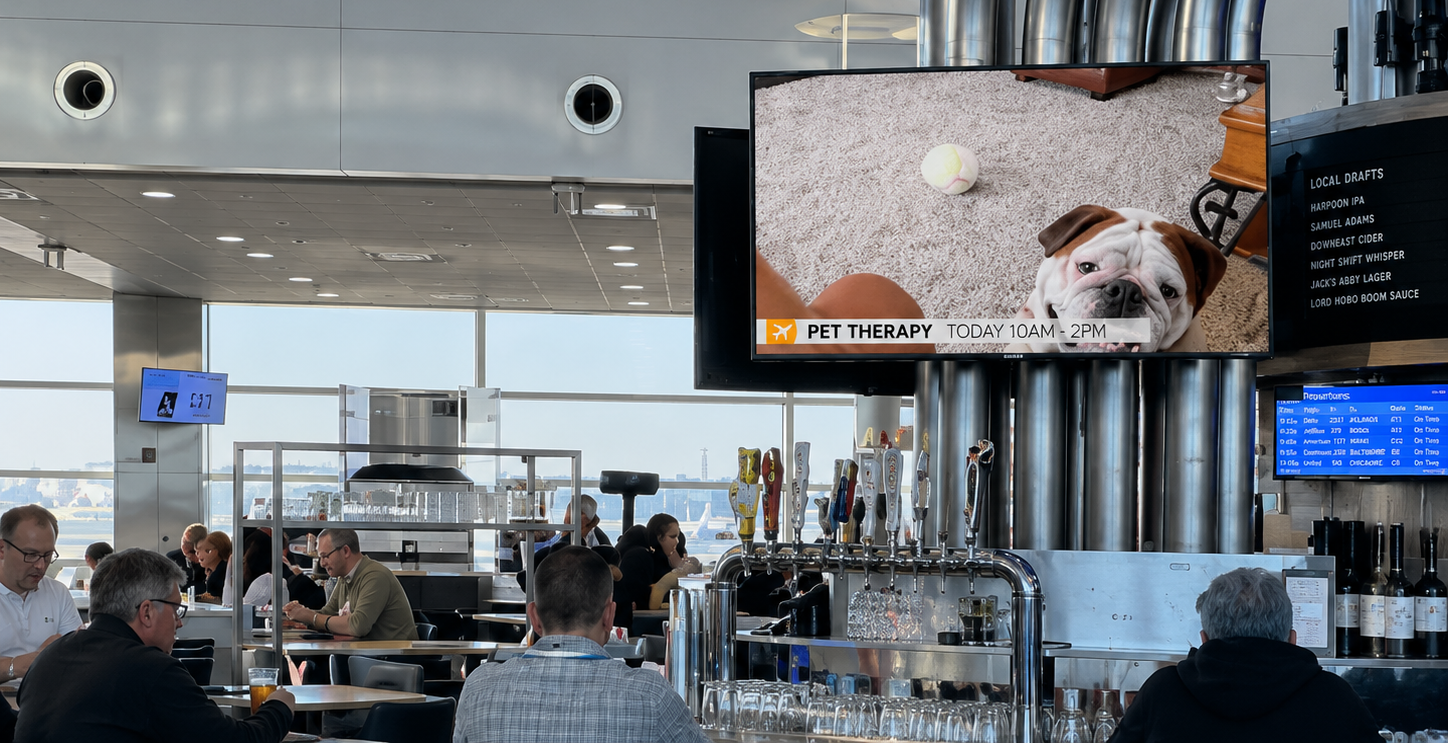
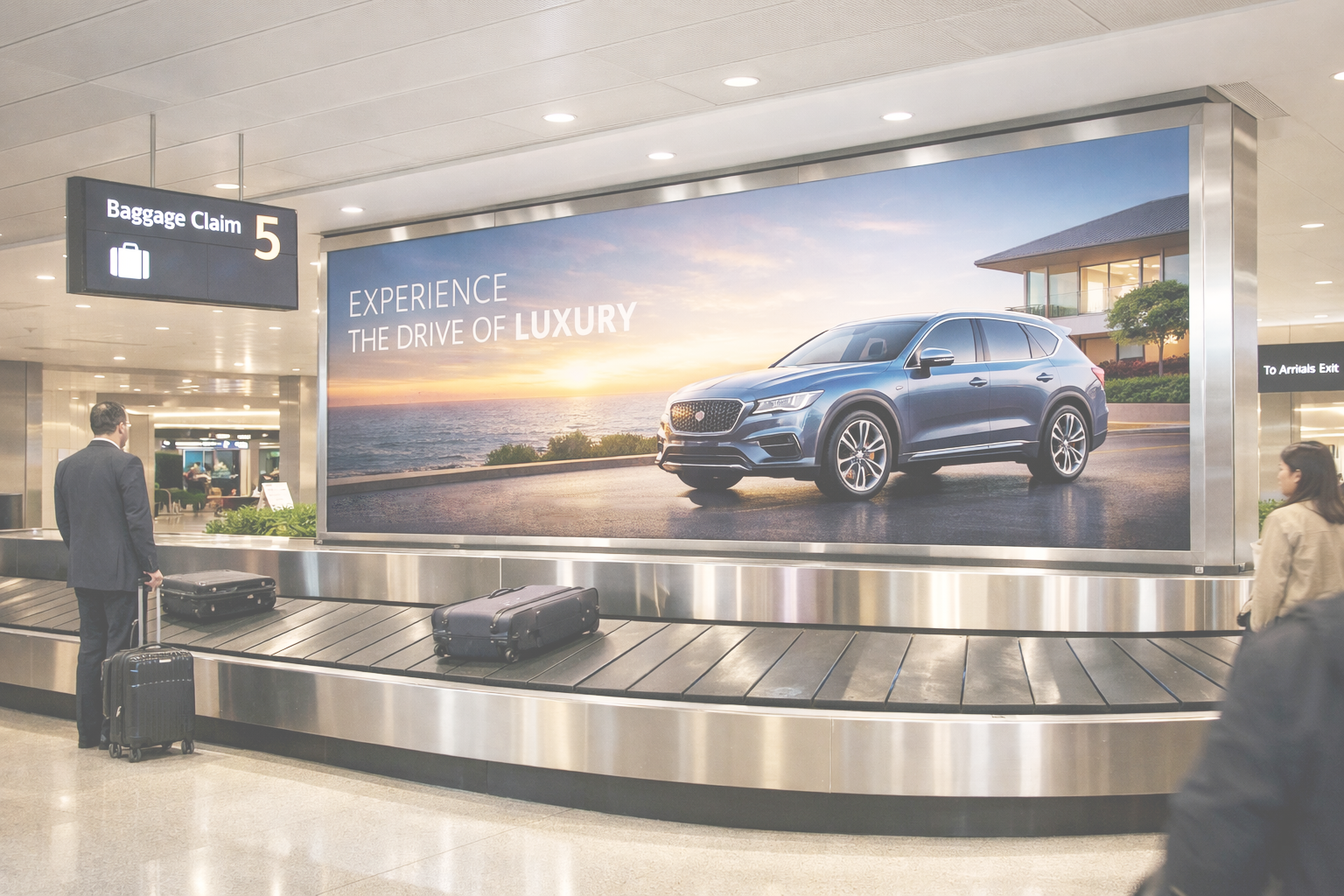
- Masscom Global provides direct inventory access across check-in, screening recomposition, the main lounge, gate zones, and baggage claim, with French-first creative production compliant with Québec language requirements and installation managed end to end.
Strategic Advertising Fit
Best Fit:
- Financial services, banking, and wealth management: High household savings participation, professionally advised capital, and strong cross-border property ownership.
- Aerospace, defence-adjacent, and industrial B2B: An adjacent engine manufacturing headquarters and national space agency put technical procurement decision-makers in the terminal daily.
- Travel, cruise, and destination marketing organisations: The most predictable collective holiday calendar in North America makes campaign timing exceptionally efficient.
- Travel insurance, currency, and payment products: Snowbird and construction-holiday travel create structural, recurring demand.
- International real estate and residency advisory: Established Florida, France, and Maghreb ownership corridors with genuine diversification motivation.
- Premium automotive: High-income South Shore municipalities with strong brand loyalty and winter-driven vehicle replacement cycles.
- Telecom and international roaming: Frequent domestic and diaspora travel with recurring connectivity needs.
- Higher education and international universities: A unique France and Québec education pathway plus large diaspora education spending.
Brand Alignment at a Glance:
| Category | Fit |
|---|---|
| Financial services and wealth management | Exceptional |
| Aerospace and industrial B2B | Exceptional |
| Travel, cruise, and destination marketing | Strong |
| International real estate and residency | Strong |
| Premium automotive | Strong |
| Telecom and roaming products | Moderate |
| Luxury retail and jewellery | Moderate |
| Long-haul airline premium cabins | Poor fit |
Who Should Not Advertise Here:
- Long-haul international airlines and premium cabin products: With no scheduled international service at this terminal, there is no addressable premium cabin buyer, though travel intermediaries and destination marketers remain strong fits.
- Duty free and international travel retail: These formats depend on international departure processing that does not currently exist here. Spend belongs at Montréal Trudeau.
- English-only creative in any category: This is less a category exclusion than a hard operating rule. Campaigns that lead in English will underperform badly in this market and may not satisfy Québec language requirements.
Event and Seasonality Analysis
- Event Strength: Medium, rising
- Seasonality Strength: Very High
- Traffic Pattern: Sharply seasonal with an exceptional single July peak
Strategic Implication: No North American market rewards precise timing like Québec. Budget should be weighted heavily into the two weeks of the July construction holiday and the four to six weeks of planning and booking activity that precede it, because this is when an entire province decides and purchases simultaneously. December to January and the March school break week form the second and third peaks, and the June to August festival period supports inbound-facing categories. Masscom Global structures YHU campaigns around exactly this rhythm, front-loading travel, insurance, automotive, and retail weight into the pre-construction-holiday consideration window while maintaining continuous financial services and aerospace B2B presence against the year-round business audience.

Poor Placement and Delays Affect Airport Campaigns
We help you move faster, access better inventory, and get it right now.
Talk to an ExpertFinal Strategic Verdict
Montréal Metropolitan Airport is the single most time-sensitive airport advertising opportunity in Canada, and possibly in North America. A 450 million dollar terminal opened on 15 June 2026 with nine boarding bridges, a 900-seat lounge, and capacity for over 4 million passengers, serving a South Shore catchment that includes some of Québec's highest household incomes, an adjacent aerospace and national space agency cluster, and Montréal's large francophone North African and Haitian diaspora communities. Financial services, aerospace and industrial B2B, travel and destination marketing, international real estate, residency advisory, and premium automotive gain the most, because this is a high-savings, professionally advised, intensely brand-loyal market whose collective holiday calendar makes campaign timing unusually precise. The decisive fact is that no category association exists in this terminal yet, and pricing still reflects a launch-phase airport rather than the 4 million passenger facility it was built to become. Masscom Global has the inventory access, French-first creative capability, and execution speed to establish your brand here while that remains true.
About Masscom Global
Masscom Global is a premium international airport advertising and media buying agency operating across 140 countries. With deep expertise in airport OOH, premium publications, and high-net-worth audience targeting, Masscom helps brands reach the world's most valuable travellers at the moments that matter most. For advertising packages, media rates, and campaign planning at MET, Montréal Metropolitan Airport and airports across the globe, contact Masscom Global today.
Frequently Asked Questions
How much does airport advertising cost at Montréal Saint-Hubert Airport? Cost at YHU depends on format, position within the terminal, campaign duration, and seasonal demand, with the July construction holiday period and the December holidays carrying the strongest premiums. Because the terminal opened in June 2026 and operates a compact single-flow layout, cost per share of voice here is currently far more efficient than at Montréal Trudeau, and pricing still reflects launch-phase volumes rather than the terminal's 4 million passenger capacity. Contact Masscom Global for current rates and availability.
Who are the passengers at Montréal Saint-Hubert Airport? Predominantly residents of Montréal's South Shore, including Longueuil, Brossard, Boucherville, Saint-Lambert, and Saint-Bruno, plus travellers from Montréal island, the Richelieu valley, the Eastern Townships, and a cross-border draw from northern New York and Vermont. The core segments are professional and executive households, aerospace and space sector engineers and managers from the cluster adjacent to the airfield, francophone families travelling on the Québec holiday calendar, and diaspora travellers from Montréal's large North African, Haitian, Chinese, and South Asian communities.
Is Montréal Saint-Hubert Airport good for luxury brand advertising? It is strong for premium and wealth-adjacent categories and developing for full luxury. Private banking, wealth management, international property, premium automotive, and premium travel perform well, supported by high-income South Shore municipalities, resort second-home ownership in the Eastern Townships and Laurentians, and substantial business aviation on the airfield. Because the terminal is new and passenger volumes are still ramping, luxury retail and jewellery are better treated as brand-building placements than as direct-response buys at this stage.
What is the best airport in Canada to reach HNWI audiences? Toronto Pearson and Vancouver lead on absolute concentration of Canadian wealth, with Montréal Trudeau carrying the largest francophone HNWI base. YHU is the most efficient route specifically to South Shore and Montérégie professional wealth and to the aerospace and space technology decision-maker audience, both of which are structurally under-served by Trudeau-focused plans. Masscom typically recommends YHU paired with Trudeau for complete Greater Montréal coverage.
What is the best time to advertise at Montréal Saint-Hubert Airport? The last two weeks of July, the Québec construction holiday, is the highest-intent window of the year, and campaign weight should begin four to six weeks earlier to reach the booking decision. December to early January delivers holiday family travel and the start of the snowbird migration. Early March captures the school break week. June to August supports inbound-facing categories through Montréal's festival season.
Can international real estate developers advertise at Montréal Saint-Hubert Airport? Yes, and the timing is unusually favourable. This catchment has multi-generational property ownership habits in Florida, active buying interest in France, Portugal, Spain, and Italy, and substantial diaspora investment in Morocco, Tunisia, and Algeria. Because the terminal carries only domestic routes today, these buyers are reachable here at origin before any destination-market advertising touches them. All creative must lead in French. Masscom Global places developers at both origin and destination airports simultaneously.
Which brands should not advertise at Montréal Saint-Hubert Airport? Long-haul international airlines and premium cabin products have no addressable buyer, since the terminal currently operates domestic service only. Duty free and international travel retail formats depend on international departure processing that does not exist here and belong at Montréal Trudeau. More broadly, any brand unwilling to produce French-first creative should not buy this market, because English-led campaigns underperform substantially in Québec and may not satisfy provincial language requirements.
How does Masscom Global help brands advertise at Montréal Saint-Hubert Airport? Masscom Global handles the full campaign lifecycle: South Shore and Montérégie catchment intelligence, format and placement selection mapped to a compact single-flow terminal where complete coverage is achievable with minimal inventory, French-first creative production compliant with Québec language requirements, rate negotiation, installation, and performance reporting. We time campaigns to the construction holiday and school break windows that govern when this market actually purchases, and we extend the same brand to the destination markets in Florida, France, Iberia, and the Maghreb where this capital is deployed. Because this terminal opened in June 2026, position secured now protects both rate and category association as the airport scales toward 4 million passengers. Book a 15-minute planning call.