

Airport at a Glance
| Field | Detail |
|---|---|
| Airport | Mesa Gateway Airport |
| IATA Code | AZA |
| Country | USA |
| City | Mesa, Arizona |
| Annual Passengers | 2,036,218 (2025), up approximately 8% year-on-year |
| Primary Audience | Leisure travellers, aerospace and manufacturing professionals, budget-conscious families |
| Peak Advertising Season | Memorial Day to Labor Day, and winter holiday period (November to January) |
| Audience Tier | Tier 2 |
| Best Fit Categories | Regional tourism, auto and mobility, retail, aerospace and industrial B2B |
A fast-scaling reliever airport turning volume growth into an undervalued advertising opportunity.
Mesa Gateway Airport has crossed two million annual passengers for the first time in its history, a growth curve that few US secondary airports can match. This is not a legacy hub with saturated inventory and inflated rates. It is a rising-volume airport where advertisers can secure premium placement before demand catches up to supply. The audience is overwhelmingly leisure-driven, price-aware, and travelling in family or group units, making this a high-frequency, high-recall environment for brands targeting everyday consumer spend.
What makes Mesa Gateway commercially distinct is its dual identity. On one side sits a leisure travel base flying nonstop to more than 45 destinations on low-cost carriers. On the other sits a concentrated aerospace and advanced manufacturing corridor anchored by major original equipment manufacturers based directly on airport property. Advertisers gain access to two very different but equally valuable audiences inside a single terminal footprint.
Advertising Value Snapshot
- Passenger scale: 2,036,218 passengers in 2025, an increase of approximately 8% year-on-year, with March 2025 setting a single-month record of over 261,000 passengers
- Traveller type: Leisure and vacation travellers, aerospace and industrial professionals, regional commuters
- Airport classification: Tier 2 — a fast-growing reliever airport for the Phoenix metro, not yet at Tier 1 rates or clutter
- Commercial positioning: Known as the low-cost, high-growth alternative to Phoenix Sky Harbor for the East Valley
- Wealth corridor signal: Sits inside a $1.8 billion regional economic engine driven by aerospace, defence, and logistics investment
Advertising opportunity: Masscom Global has direct access and execution capability across this airport's growing terminal footprint, allowing brands to secure strong placement and pricing ahead of the volume curve. As passenger growth compounds, the value of inventory secured today only increases.
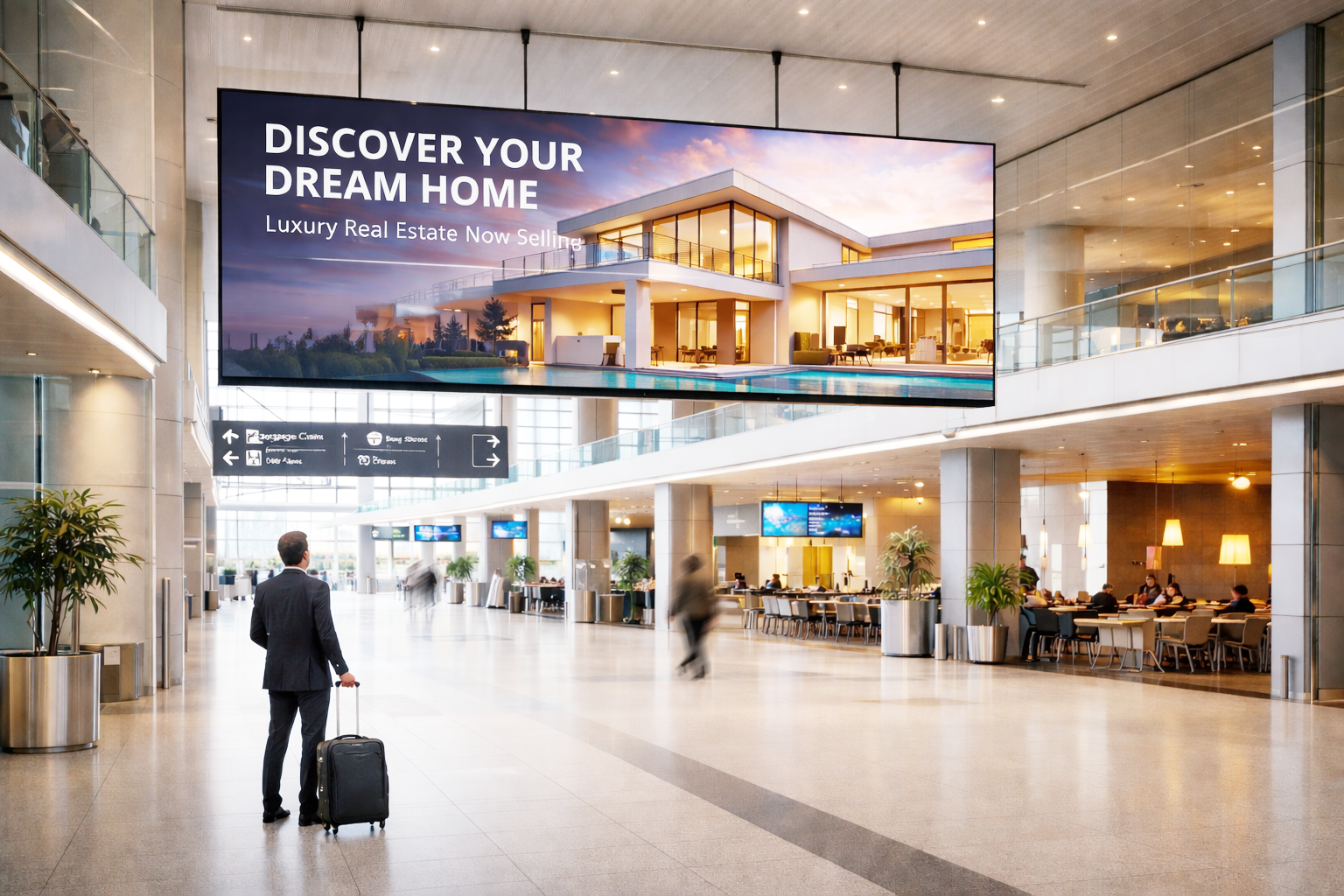
Airport Advertising is Complex to Get Right
We help you execute faster, with proven results and local insight most planners lack starting now.
Talk to an Expert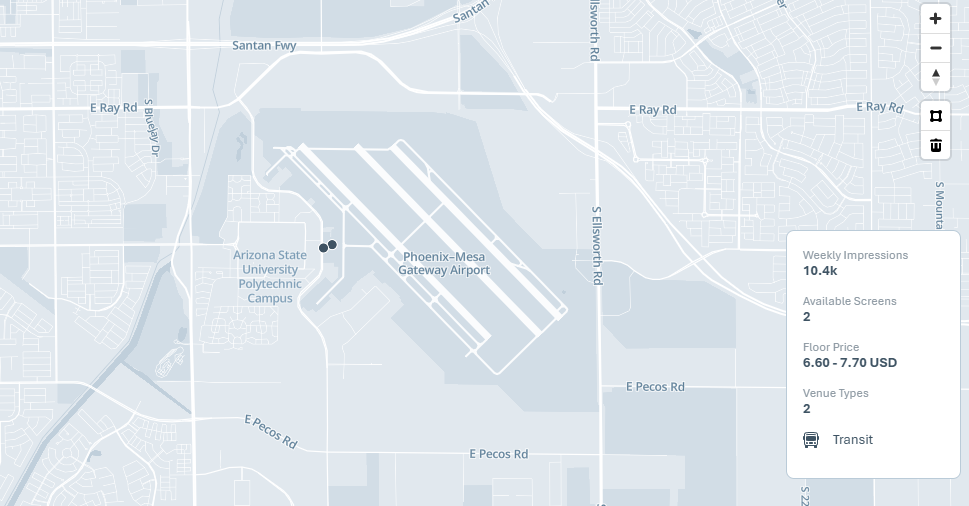
Catchment Area and Economic Drivers
Top 10 Cities within 150 km — Marketer Intelligence:
- Mesa: Direct catchment city with a fast-growing suburban population and rising disposable income tied to tech and manufacturing employment
- Phoenix: Adjacent metro core bringing corporate travellers who choose Gateway for its lower fares and shorter security lines
- Chandler: Home to a dense semiconductor and tech employer base, producing a high-income, brand-attentive commuter audience
- Gilbert: Affluent suburban families with strong retail and home-services spending patterns
- Tempe: University-driven population near ASU, generating younger, digitally engaged travellers receptive to lifestyle and tech brands
- Scottsdale: High-income leisure and second-home audience that occasionally routes through Gateway for lower-cost regional flights
- Queen Creek: Rapidly expanding residential growth corridor with young family households and rising new-home spend
- Casa Grande: Logistics and distribution hub feeding industrial B2B decision-makers through the airport
- Apache Junction: Retiree and outdoor recreation audience aligned with regional tourism spending
- Florence: Government and correctional-sector employment base contributing steady public-sector traveller volume
NRI and Diaspora Intelligence: Mesa Gateway does not carry a significant international diaspora corridor. Its dominant travel signal instead comes from an aerospace and defence workforce that moves regularly between Arizona and other US manufacturing and testing hubs, alongside a growing base of retirees and second-home owners relocating from colder states into the East Valley.
Economic Importance: The catchment economy is anchored by aerospace manufacturing, semiconductor investment, and logistics. These sectors produce a professional, technically skilled traveller base with strong purchasing power, while the surrounding residential growth corridor adds a steady stream of price-sensitive leisure travellers.
Business and Industrial Ecosystem
- Aerospace and defence manufacturing presence directly on airport property, producing frequent business travellers with corporate purchasing authority
- Semiconductor investment in the wider Phoenix East Valley, feeding a technically skilled, higher-income commuter base
- Logistics and distribution operations around Casa Grande and Queen Creek, generating B2B decision-makers who value efficiency-focused messaging
- New-home construction and suburban expansion, producing a young family audience with active home and lifestyle spend
Passenger Intent — Business Segment: Business travellers here are largely aerospace engineers, defence contractors, and logistics executives moving between manufacturing sites. They respond to messaging around efficiency, precision, and industrial capability rather than lifestyle aspiration. B2B, industrial technology, and enterprise service categories intercept this audience most effectively.
Strategic Insight: Few US secondary airports combine a concentrated aerospace employer base with terminal-level advertising access this directly. Brands targeting technical B2B buyers gain a rare, low-clutter environment to reach decision-makers who are otherwise difficult to intercept at scale.
Tourism and Premium Travel Drivers
- Regional outdoor recreation including desert hiking, golf, and lake access across the greater Phoenix area
- Spring training baseball season drawing a concentrated wave of out-of-state leisure travellers each March
- Scottsdale and Phoenix resort and spa tourism drawing value-seeking visitors who choose Gateway for lower airfares
- Retiree and snowbird migration during winter months, bringing sustained visitor volume from northern US states
Passenger Intent — Tourism Segment: Tourists arriving at Mesa Gateway have already committed spend to flights, accommodation, and activities before landing. They are highly receptive to local experience offers, retail, dining, and mobility services at the point of arrival. Regional tourism boards, car rental brands, and hospitality categories benefit most from this intercept.
Travel Patterns and Seasonality
Peak seasons: Winter months (November through January) driven by snowbird and retiree travel, and summer months (Memorial Day through Labor Day) driven by family vacation travel. March delivers an additional surge tied to spring training baseball.
Event-Driven Movement:
- Spring Training (March): Baseball-driven leisure travel bringing a concentrated wave of out-of-state visitors with active discretionary spend
- Winter Snowbird Season (November to January): Sustained retiree and second-home traveller volume from colder US states
- Summer Family Travel (June to August): Peak vacation period with high family and group travel volume
- Barrett-Jackson Auto Auction Season (January): Draws an affluent automotive-enthusiast audience into the greater Phoenix area
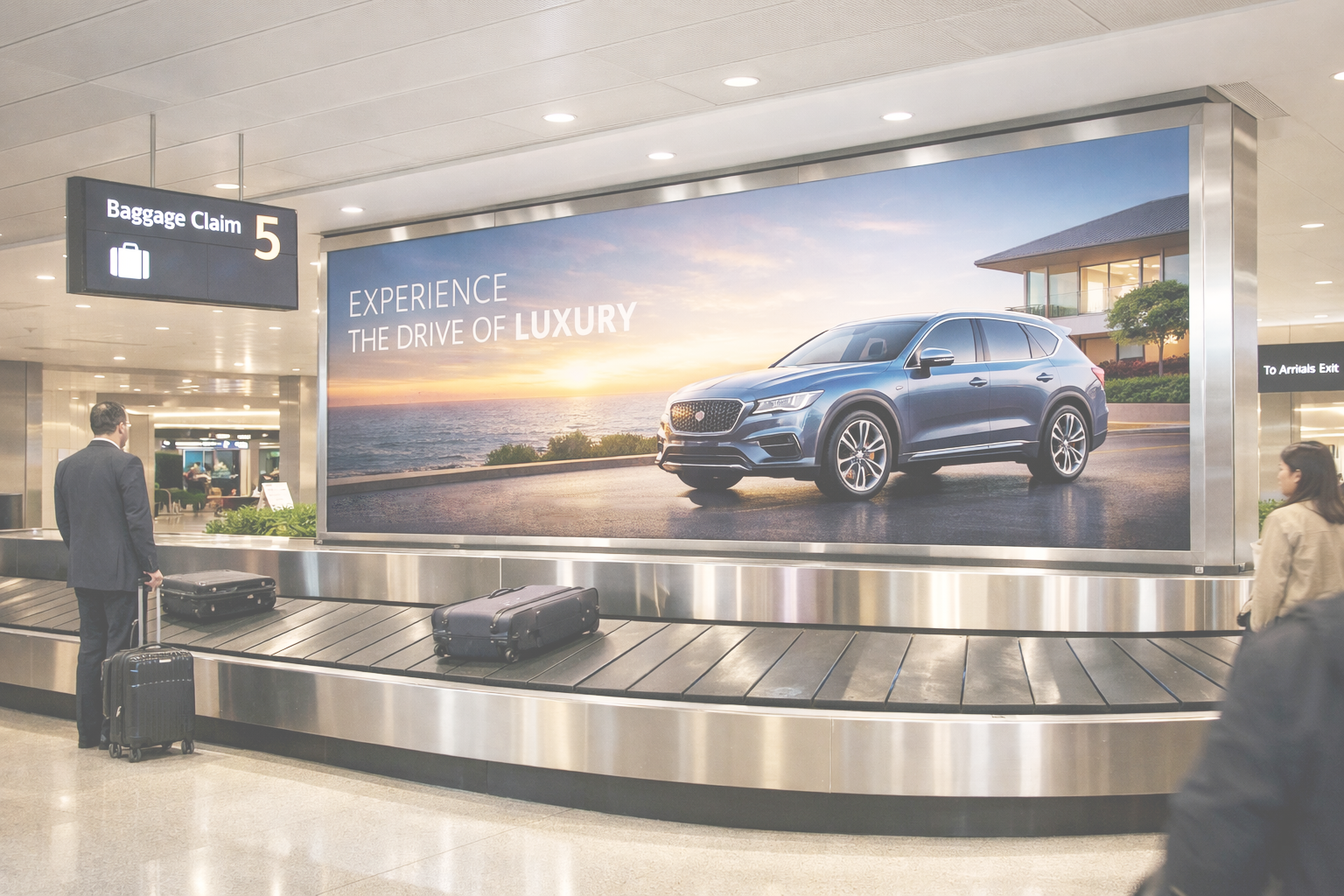
It’s Not Just Where You Advertise - It’s How Fast You Execute
We combine local insight with fast rollout to deliver results for you, now.
Talk to an ExpertAudience and Cultural Intelligence
Top 2 Languages:
- English: The dominant language across the catchment, reflecting a broad domestic US traveller base with mainstream retail and lifestyle purchasing habits
- Spanish: A significant secondary language reflecting Arizona's large Hispanic population, relevant for bilingual creative and regional retail targeting
Major Traveller Nationalities: The traveller base at Mesa Gateway is almost entirely domestic US travellers, drawn from across the country via low-cost nonstop routes. This means campaign creative should prioritize broad domestic appeal, value messaging, and mainstream US cultural references rather than international targeting.
Religion — Advertiser Intelligence:
- Christianity (approximately 70%): Drives strong travel volume around Christmas and Easter holidays, creating spend triggers around gift retail, family travel, and hospitality categories
- Non-religious or unaffiliated (approximately 20%): Correlates with discretionary leisure and experience-driven spending patterns rather than holiday-specific triggers
- Other faiths (approximately 10%): Smaller but present, with limited distinct seasonal travel signal at this airport
Behavioral Insight: This audience is value-conscious and deal-driven, shaped by a low-cost carrier environment and a household budget mindset. Messaging that emphasizes savings, family value, and practical benefit consistently outperforms aspirational luxury framing at this airport.
Outbound Wealth and Investment Intelligence
Mesa Gateway's traveller base skews domestic rather than international, so outbound capital deployment here is modest compared to a global gateway airport. The more relevant signal is inbound investment migration, as retirees and remote professionals relocate capital into the greater Phoenix area for property and lifestyle reasons.
Outbound Real Estate Investment: Data not available for significant outbound international property investment tied specifically to this airport's passenger base.
Outbound Education Investment: Data not available for a distinct outbound international education migration pattern tied to this catchment.
Outbound Wealth Migration and Residency: Data not available for citizenship-by-investment or golden visa activity tied to this airport's audience.
Strategic Implication for Advertisers: The stronger opportunity at Mesa Gateway is inbound rather than outbound capital. Real estate developers, relocation services, and financial planning brands targeting retirees and remote professionals moving into Arizona should treat this airport as a direct-intercept channel, and Masscom Global can activate that inbound audience at scale.
Airport Infrastructure and Premium Indicators
Terminals:
- A single passenger terminal with 10 gates, recently expanded with a 30,000 square-foot addition to accommodate rising volume
- Designed for efficient, low-dwell-friction processing rather than high-luxury throughput
Premium Indicators:
- Limited traditional airline lounge infrastructure, consistent with a low-cost carrier-dominated terminal
- Adjacent aerospace and private aviation activity through on-site manufacturers and general aviation operations
- No dedicated luxury hotel directly on airport property
- Three long runways supporting both commercial and aerospace testing operations, reflecting a technically serious, non-tourist-driven side of the airport's identity
Forward-Looking Signal: A $130 million airfield investment programme and a multi-phase master plan targeting up to 10 million enplanements by 2030 signal a long runway of passenger and inventory growth ahead. Advertisers who secure placement now lock in rates well below where they will sit once this growth curve matures. Masscom Global advises clients to act on this window while inventory remains attractively priced.
Airline and Route Intelligence
Top Airlines: Allegiant Air is the dominant carrier and operates its Arizona base from Mesa Gateway.
Key International Routes: Data not available. Mesa Gateway currently operates a domestic-only route network.
Domestic Connectivity: Nonstop service to more than 45 US destinations, weighted toward leisure and vacation markets across the western, midwestern, and southern United States.
Wealth Corridor Signal: This is a leisure and value corridor rather than a wealth-transfer corridor. The route network reveals a domestic, price-sensitive traveller base rather than an international high-net-worth flow, meaning advertisers should prioritize volume and frequency-driven strategies over ultra-premium targeting.
Media Environment at the Airport
- A compact, low-clutter terminal environment where a single well-placed campaign achieves strong share of attention versus larger, cluttered US hubs
- Longer relative dwell time driven by a leisure traveller base without tight business-travel schedules, increasing effective exposure per placement
- A clean, newly expanded terminal environment that lends a modern, credible backdrop to brand placements
- Masscom Global holds direct inventory access and execution capability across this airport, enabling precise placement as the terminal continues to expand
Strategic Advertising Fit
Best Fit:
- Regional tourism boards and attractions targeting incoming leisure visitors
- Auto and mobility brands, including car rental and ride-hailing services
- Value-oriented retail and quick-service dining brands
- Aerospace, defence, and industrial B2B brands targeting the on-site manufacturing workforce
- Home and relocation services targeting retirees and new residents
- Regional financial services and insurance brands
Brand Alignment at a Glance:
| Category | Fit |
|---|---|
| Auto and mobility | Exceptional |
| Regional tourism | Exceptional |
| Aerospace and industrial B2B | Strong |
| Retail and dining | Strong |
| Financial services | Moderate |
| Ultra-luxury goods | Poor fit |
Who Should Not Advertise Here:
- Ultra-luxury fashion and jewellery brands, as the audience skews value-driven rather than premium-discretionary
- International private banking and wealth management services, given the near-total absence of international high-net-worth traffic
- High-end international travel and hospitality brands with no relevance to this domestic leisure base
Event and Seasonality Analysis
- Event Strength: Medium
- Seasonality Strength: High
- Traffic Pattern: Dual-Peak
Strategic Implication: Advertisers should weight budget toward the summer family travel window and the winter snowbird season, with a secondary tactical push around the March spring training surge. Masscom Global structures campaigns around this dual-peak rhythm so that inventory activation aligns precisely with when spend intent is highest, maximizing return on each placement.

Poor Placement and Delays Affect Airport Campaigns
We help you move faster, access better inventory, and get it right now.
Talk to an ExpertFinal Strategic Verdict
Mesa Gateway Airport is one of the fastest-growing secondary airports in the United States, and its advertising inventory has not yet caught up to its passenger growth. Brands that secure placement now gain access to a high-frequency leisure audience alongside a concentrated aerospace and industrial workforce, all inside a low-clutter terminal environment. This is not a luxury gateway, and it should not be treated as one. It is a volume-and-value airport where auto, retail, tourism, and industrial B2B brands can achieve outsized share of attention at a fraction of the cost of a Tier 1 hub. Partnering with Masscom Global ensures brands capture this growth curve early, with execution speed and inventory access that keeps pace with the airport's expansion.
About Masscom Global
Masscom Global is a premium international airport advertising and media buying agency operating across 140 countries. With deep expertise in airport OOH, premium publications, and high-net-worth audience targeting, Masscom helps brands reach the world's most valuable travellers at the moments that matter most. For advertising packages, media rates, and campaign planning at Mesa Gateway Airport and airports across the globe, contact Masscom Global today.
Frequently Asked Questions
How much does airport advertising cost at Mesa Gateway Airport? Cost varies by format, terminal position, campaign duration, and seasonal demand. Rates are especially favourable right now given the airport's early growth stage. Contact Masscom Global directly for current rates and package options.
Who are the passengers at Mesa Gateway Airport? The passenger base is overwhelmingly domestic US leisure travellers flying on low-cost carriers, alongside a distinct aerospace and industrial professional segment tied to on-site manufacturers.
Is Mesa Gateway Airport good for luxury brand advertising? Not for ultra-luxury categories. The audience is value-driven and domestic, making it a poor fit for premium international luxury brands, but a strong fit for accessible retail, auto, and lifestyle categories.
What is the best airport in Arizona to reach HNWI audiences? Phoenix Sky Harbor International Airport carries a more international and business-premium audience profile, while Mesa Gateway is better suited to volume-driven, value-conscious campaigns.
What is the best time to advertise at Mesa Gateway Airport? The strongest windows are the summer family travel season, the winter snowbird period, and the March spring training surge.
Can international real estate developers advertise at Mesa Gateway Airport? The stronger opportunity here is inbound rather than outbound. Developers targeting retirees and relocating professionals moving into the greater Phoenix area can use this airport as a direct-intercept channel.
Which brands should not advertise at Mesa Gateway Airport? Ultra-luxury fashion, international private banking, and high-end international hospitality brands are misaligned, as the audience is domestic and value-driven rather than international high-net-worth.
How does Masscom Global help brands advertise at Mesa Gateway Airport? Masscom Global provides full-service intelligence, inventory access, execution, and performance tracking at Mesa Gateway Airport, helping brands capture this airport's growth curve early and at favourable rates. Contact Masscom Global to start planning your campaign.