


Airport at a Glance
| Field | Detail |
|---|---|
| Airport | Lake Charles Regional Airport |
| IATA Code | LCH |
| Country | United States |
| City | Lake Charles, Calcasieu Parish, Louisiana |
| Annual Passengers | 82,425 enplanements in calendar year 2023, equating to roughly 165,000 total passenger movements. Domestic only, no scheduled international service. |
| Primary Audience | Energy and petrochemical executives, EPC and construction leadership, expatriate project management |
| Peak Advertising Season | February to May, September to November |
| Audience Tier | Tier 2 by audience value, Tier 3 by passenger volume |
| Best Fit Categories | Industrial and energy B2B, engineering and EPC services, commercial banking and insurance, workforce recruitment and relocation |
Lake Charles Regional Airport handled 82,425 enplanements in its most recent full reported calendar year across a 45,000 square foot, four-gate terminal serving a combined statistical area of around 375,000 people. Judged on volume alone it is unremarkable. Judged on who is actually walking through it, it is one of the most concentrated B2B advertising environments in the United States. Southwest Louisiana is now the centre of American liquefied natural gas export construction, and the people arriving here are project directors, EPC leadership, petrochemical executives, and international joint venture partners, not tourists.
What makes this airport commercially distinctive is the ratio of decision-making authority to passenger count. A single LNG facility under construction in Calcasieu Parish represents a 17.5 billion dollar investment and the largest foreign direct investment in Louisiana history, with a second 13 billion dollar terminal breaking ground nearby, and Louisiana has now passed 100 billion dollars in announced private investment. The capital moving through this catchment is enormous and the airport serving it is small. For industrial, engineering, financial, and services brands selling into that spend, the cost of reaching an authorised buyer here is unusually low.
Advertising Value Snapshot
- Passenger scale: 82,425 enplanements in calendar year 2023, served by two carriers with daily connections to Dallas Fort Worth and three daily nonstops to Houston Intercontinental. Growth is tied directly to the LNG and petrochemical construction cycle, which is expanding through 2029 and 2030 project completion horizons.
- Traveller type: Energy, LNG, and petrochemical executives, engineering and construction project leadership, and international expatriate management on rotation.
- Airport classification: Tier 2 by audience value, Tier 3 by passenger volume. This is a B2B environment, not a luxury consumer environment, and should be bought as one.
- Commercial positioning: The scheduled-service gateway to America's LNG export capital and one of the densest petrochemical corridors on the Gulf Coast.
- Wealth corridor signal: The airport sits on the Gulf Coast energy capital corridor, connecting Louisiana's industrial buildout to Houston and Dallas and onward to Tokyo, Seoul, Perth, London, and Johannesburg through international project ownership.
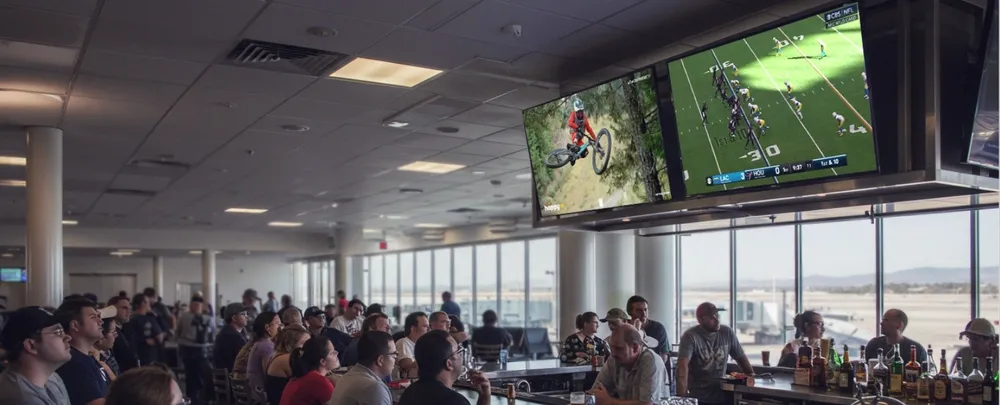
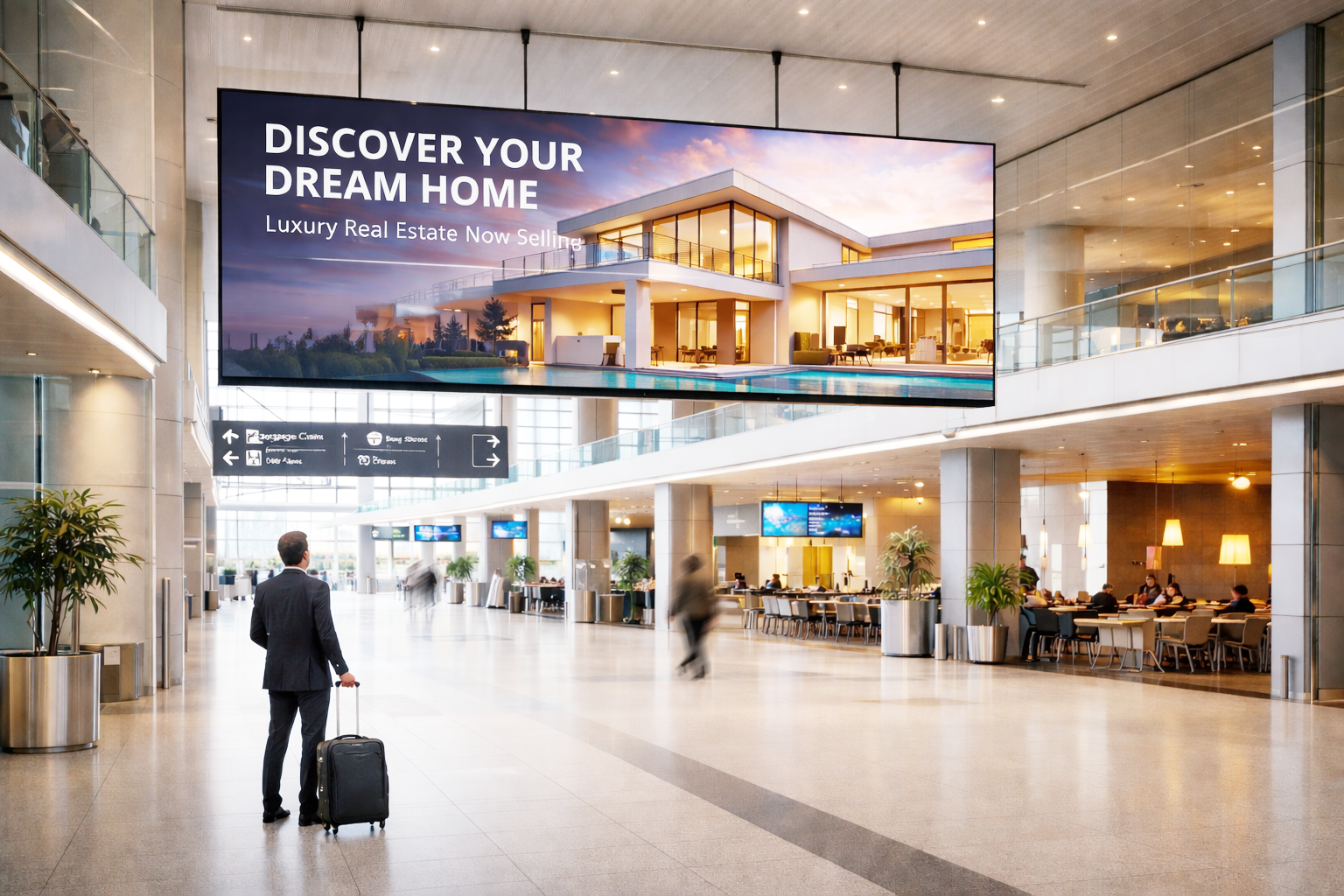
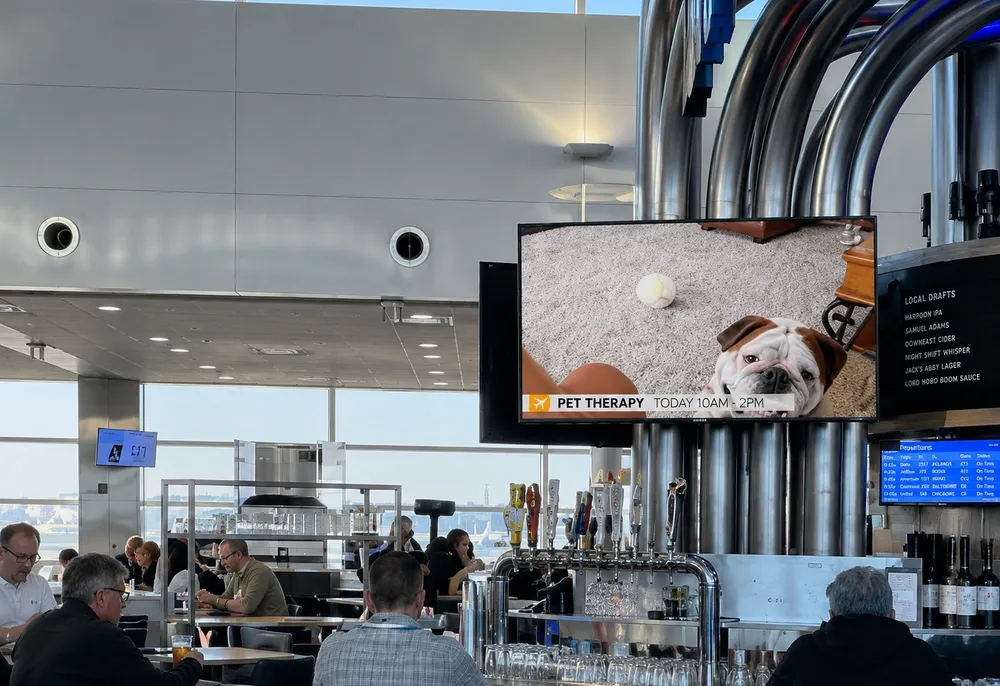
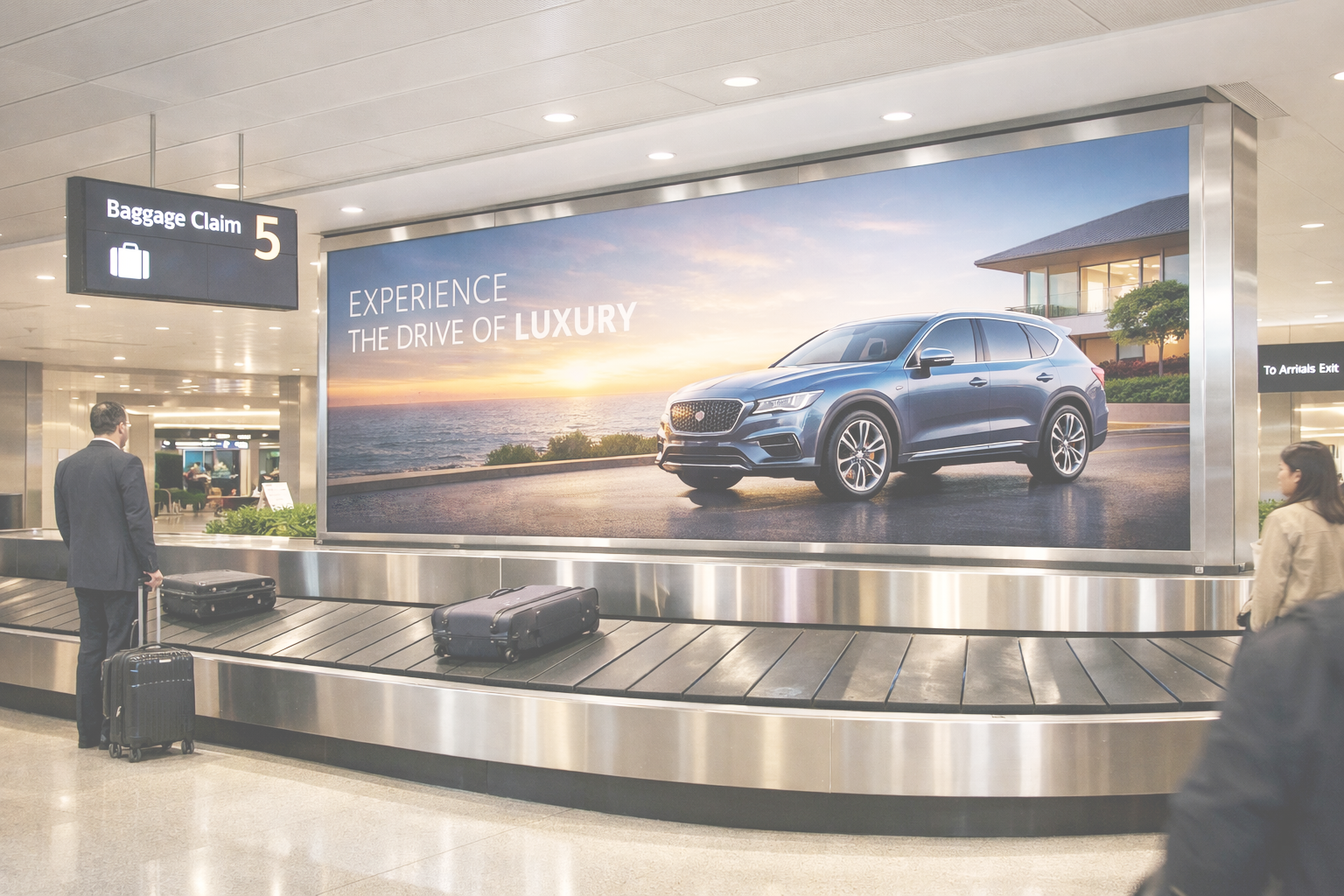
- Advertising opportunity: A four-gate terminal means a single brand can dominate the entire passenger journey rather than compete for fragmented attention. Masscom Global secures placement across arrival, hold room, and baggage claim where dwell is extended by the connecting-flight structure of every itinerary. For B2B advertisers this delivers repeated exposure to the same named accounts throughout a project cycle.
Airport Advertising is Complex to Get Right
We help you execute faster, with proven results and local insight most planners lack starting now.
Talk to an Expert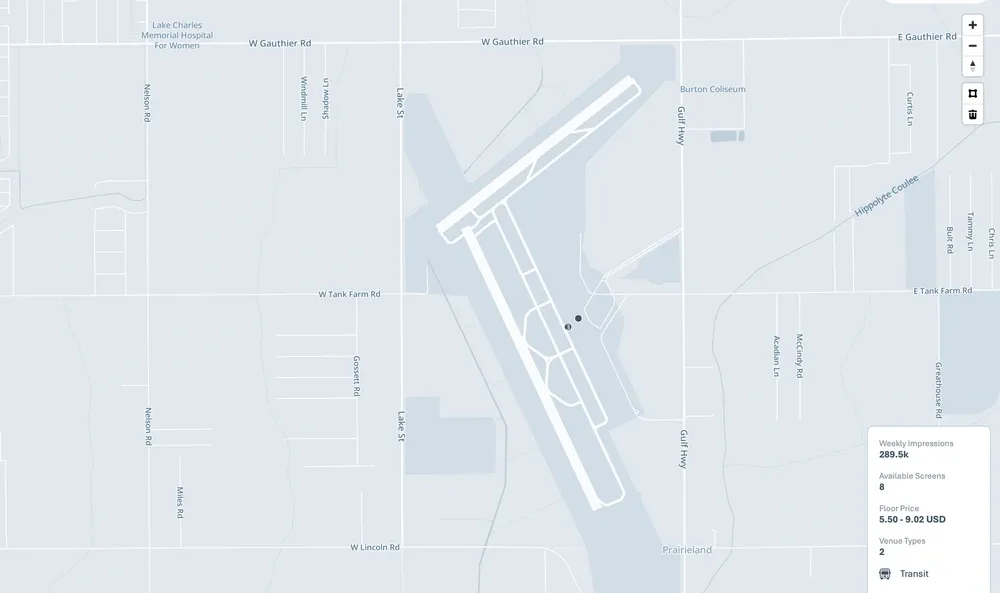
Catchment Area and Economic Drivers
Top 10 Cities within 150 km, Marketer Intelligence:
- Lake Charles: The commercial and administrative core. Concentrates energy project offices, industrial contractor headquarters, banking, and the region's dominant casino and hospitality cluster. Produces both executive and consumer audiences in the same catchment.
- Sulphur: Heavy industrial and refining base immediately west of the airport. Produces plant leadership, skilled trades supervisors, and contractor owners with substantial equipment and services purchasing authority.
- Westlake: Petrochemical manufacturing anchor. A dense concentration of process industry management with recurring capital expenditure cycles and long project timelines.
- Vinton: Anchored by a major racing and gaming property drawing heavily from East Texas. Produces a leisure and discretionary spending audience distinct from the industrial base.
- Jennings: Oilfield services and agricultural processing town. Produces owner-operator business audiences with fleet, equipment, and commercial finance needs.
- Crowley: Agricultural processing and rice industry centre with an established festival economy. Relevant to agri-equipment, commodity finance, and regional consumer advertisers.
- Lafayette: The largest affluent market in the catchment and the commercial capital of Acadiana. Concentrates oilfield services ownership, healthcare, professional services, and genuine regional wealth.
- DeRidder and Leesville: Anchored by a major army installation and forestry industry. Produces military leadership, defence contracting, and stable government-linked professional audiences.
- Beaumont: Across the Texas line, a refining and petrochemical centre functionally integrated with the Louisiana industrial corridor. Executives here treat LCH as an alternative gateway.
- Port Arthur and Orange: The Texas end of the same industrial belt, with major refining and shipbuilding activity. Produces cross-border project and procurement traffic that moves through this airport regularly.
NRI and Diaspora Intelligence:
There is no traditional diaspora community driving traffic here, and advertisers should not plan for one. What exists instead is an unusual expatriate executive population created by international ownership of the region's industrial assets, drawn from Australia, Japan, South Korea, South Africa, and Western Europe. These are senior project and technical personnel on multi-year assignments with high salaries, corporate housing, and strong home-country financial ties. They travel frequently, they maintain investments and property abroad, and they are among the most underserved international audiences at any American regional airport. Cross-border banking, relocation services, international schooling, and home-market brands reach a captive and affluent audience here that no other Louisiana airport delivers.
Economic Importance:
Three engines drive this catchment. The first is LNG export construction and operation, currently absorbing tens of billions in capital across Calcasieu and Cameron parishes with foundation-phase projects targeting first production in 2029 and 2030. The second is petrochemical and refining manufacturing, one of the densest concentrations on the Gulf Coast. The third is gaming and hospitality, which makes Lake Charles the leading casino market in Louisiana and pulls consistent discretionary visitor spend from East Texas. Each engine produces a different audience, and Masscom Global maps creative to the engine an advertiser is selling into rather than to the terminal as a whole.
Business and Industrial Ecosystem
- LNG liquefaction and export: A 17.5 billion dollar terminal under construction with roughly 1,800 workers on site and a permitted capacity of 27.6 million tonnes per annum, joined by a 13 billion dollar project that broke ground in 2026. Produces the highest-authority project executive audience in the region.
- Petrochemicals and refining: Long-established crackers, refineries, and derivative plants across Calcasieu Parish. Produces plant management, turnaround leadership, and industrial procurement decision makers on a continuous cycle.
- Engineering, procurement, and construction: Global EPC contractors maintain rotating project leadership in the region for the duration of multi-year builds. This is the single most reachable high-value segment at this airport.
- Port, marine, and Gulf aviation services: Deepwater port activity plus a substantial helicopter fleet based at this airport serving the offshore petroleum industry, alongside regional aviation maintenance capacity. Produces logistics, marine services, and aviation procurement audiences.
Passenger Intent, Business Segment:
Almost every business traveller here is connecting through Houston or Dallas, which means they arrive early, they wait, and they pass through the same small terminal in both directions on a repeating rotation schedule. They are project directors, engineering managers, plant leaders, and contractor principals with real budget authority over equipment, services, insurance, and workforce. Industrial equipment, EPC and technical services, commercial banking and surety, insurance, workforce recruitment, and business travel and accommodation brands intercept them most effectively.
Strategic Insight:
The commercial value of this airport is frequency against a named account list. Unlike a large hub where a B2B message reaches a scattered and mostly irrelevant audience, LCH delivers the same few hundred senior industrial decision makers repeatedly across a multi-year construction cycle. A brand advertising here for twelve months will be seen dozens of times by the exact people who authorise its category of spend. For industrial and services marketers accustomed to trade shows and outbound sales, this is a persistent presence at a fraction of the cost, and Masscom Global builds it as an account-based buy rather than a reach buy.
Tourism and Premium Travel Drivers
- Casino and gaming resorts: Lake Charles is the leading gaming market in Louisiana, drawing sustained discretionary visitor volume from Houston and East Texas. Relevant to hospitality, entertainment, automotive, and consumer finance advertisers.
- Mardi Gras and the Louisiana festival calendar: One of the state's largest Mardi Gras celebrations plus a dense regional festival circuit produces concentrated seasonal leisure travel and consumer spending peaks.
- Cajun and Creole culinary and cultural tourism: A nationally recognised food and music identity that drives leisure visitation and supports food, beverage, and hospitality brand association.
- Coastal fishing, hunting, and outdoor recreation: Gulf sportfishing and marsh hunting attract a well-funded recreational audience relevant to marine, vehicle, outdoor equipment, and lodging advertisers.
Passenger Intent, Tourism Segment:
Leisure movement through this airport is modest in volume and specific in character. Most regional gaming visitors drive from Texas rather than fly, so the leisure passengers who do use LCH are typically travelling further, visiting family, or combining leisure with business. They have committed to a trip with a fixed budget and are receptive to categories that extend it, principally hospitality, dining, vehicle rental, and entertainment. Advertisers should treat leisure as a secondary layer here and weight the buy toward the industrial audience.
Travel Patterns and Seasonality
Peak seasons:
- February to May: The strongest window. Mardi Gras and the regional festival calendar lift leisure movement while the industrial year runs at full pace with spring turnaround and project mobilisation activity.
- September to November: The second peak. Post-summer project acceleration, autumn corporate travel, and the regional festival circuit combine, and weather stabilises after the storm season.
- December to early January: A short holiday family travel spike with a corresponding drop in business movement, making it strong for consumer categories and weak for B2B.
- June to early September: The softest and riskiest period. Gulf hurricane season introduces genuine disruption risk in this catchment, and heat suppresses discretionary movement.
Granular monthly passenger data for this airport is not published in current public form. Data not available.
Event-Driven Movement:
- Mardi Gras (February to early March): One of Louisiana's largest celebrations outside New Orleans. Drives family and visitor movement, hospitality demand, and concentrated consumer spending across the catchment.
- Regional festival and pirate festival season (May): A major Lake Charles civic event drawing sustained regional visitation. Strong window for consumer, food and beverage, and hospitality advertisers.
- Acadiana international music and cultural festival season (April): Draws visitors into the wider catchment and creates a leisure travel uplift alongside the spring business peak.
- Autumn agricultural and harvest festival circuit (October): Regional consumer activity that supports agri-equipment, commodity finance, and community-facing brands.
- Project milestone and turnaround windows (spring and autumn): Plant turnarounds and construction milestones bring surges of contractor and specialist personnel into the region. The single most valuable timing signal for industrial B2B advertisers.
It’s Not Just Where You Advertise - It’s How Fast You Execute
We combine local insight with fast rollout to deliver results for you, now.
Talk to an ExpertAudience and Cultural Intelligence
Top 2 Languages:
- English: Dominant and the correct language for all primary creative. This is a domestic American industrial audience with international visitors who operate professionally in English, so English-language execution carries the full campaign weight.
- Spanish: The most significant second language across the catchment, concentrated in the construction, industrial services, and hospitality workforce. Commercially relevant for workforce recruitment, financial access, remittance, and employer-facing advertisers, and increasingly relevant given the scale of construction labour demand.
Louisiana French and Cajun French remain a powerful cultural marker across Acadiana even where fluency has declined. Masscom Global recommends using it as a creative signal of regional authenticity rather than as a translation strategy, because it earns local credibility that generic national creative does not.
Major Traveller Nationalities:
The traveller base is predominantly American, drawn from Texas, the wider Gulf states, and the Northeast through connecting hubs. The distinguishing feature is the international executive layer created by foreign ownership of the region's LNG and petrochemical assets, with Australian, Japanese, South Korean, South African, and Western European personnel present in significant numbers on multi-year assignment. These travellers are high-earning, mobile, and maintain active financial and property interests in their home markets. Creative should assume professional English fluency and business-context messaging rather than tourism framing.
Religion, Advertiser Intelligence:
- Catholicism (a large share of the catchment, reflecting strong Acadiana heritage): Drives the Mardi Gras and Lenten calendar, which is the most reliable seasonal spending trigger in this region and shapes hospitality, food and beverage, and family travel demand from February through March. Also drives a substantial spring wedding and sacrament season with associated retail and travel spend.
- Baptist and evangelical Protestantism (a large share, dominant in the northern and western catchment): Anchors the Thanksgiving to Christmas family gathering block and Easter travel. Creates predictable gifting, vehicle purchase, and family hospitality windows and shapes a conservative, value-oriented purchasing culture that responds to durability and practicality claims.
- Other faith communities including Buddhist and Muslim populations tied to the expatriate and Vietnamese-American coastal communities (small but distinct shares): Add Lunar New Year and Ramadan and Eid travel patterns and support food, remittance, and travel advertisers in defined windows.
Behavioral Insight:
This is a practical, value-conscious, and highly relationship-driven market. Wealth here is earned through industry, contracting, and land rather than finance or inheritance, which produces buyers who trust demonstrated performance, referrals, and long-standing supplier relationships over brand prestige. They are sceptical of polish and responsive to specifics, uptime, safety record, delivery timelines, warranty terms, and total cost of ownership. The most effective creative here is direct, concrete, and technically credible, and treats the reader as someone who already understands the category.
Outbound Wealth and Investment Intelligence
The outbound picture at LCH differs sharply from a luxury leisure airport and advertisers should plan for that difference. Capital here moves in two distinct streams: locally generated industrial and contracting wealth seeking domestic diversification, and expatriate executive earnings flowing back to home markets abroad. Neither behaves like classic ultra-high-net-worth leisure capital. Both are underserved by advertisers who assume a regional Louisiana airport carries no international investment relevance.
Outbound Real Estate Investment:
Locally generated wealth concentrates domestically rather than internationally. The dominant destinations are Texas, particularly Houston and the Hill Country, and Florida's Gulf and Atlantic coasts, driven by tax treatment, hurricane risk diversification, and family proximity. Secondary flows go to Colorado and the Carolinas for recreational property, and to Los Cabos and the Caribbean for second homes among the upper tier. The expatriate executive layer invests back into Australia, Japan, South Korea, South Africa, and the United Kingdom, and represents a genuine opportunity for home-market developers and property advisers who understand where these workers actually are.
Outbound Education Investment:
Families in this catchment overwhelmingly choose Texas and Louisiana universities, with strong engineering and petroleum engineering enrolment reflecting the local economy. International outbound study is limited among the domestic population but significant among the expatriate community, whose children attend schools in the United Kingdom, Australia, and Singapore or return to home-market institutions. International schools, boarding schools, and university recruiters targeting expatriate industrial families will find a concentrated and otherwise hard-to-locate audience here.
Outbound Wealth Migration and Residency:
Citizenship-by-investment and golden visa demand from the domestic population is limited, and advertisers in that category should calibrate expectations accordingly. The relevant activity is inbound and employment-linked, with visa, immigration, and relocation services for international project personnel representing genuine and growing demand as LNG construction expands. Portugal, Greece, and Caribbean programmes carry moderate appeal among the region's upper industrial ownership tier as diversification rather than relocation.
Strategic Implication for Advertisers:
The honest read is that this is an industrial B2B corridor with an embedded international executive population, not a luxury wealth corridor, and brands that position accordingly will outperform. Immigration and relocation services, cross-border banking, international schooling, and home-market property developers from Australia, Japan, Korea, and South Africa have a captive audience here that reaches them nowhere else in the United States at this density. Masscom Global can activate at LCH and simultaneously in the origin markets those executives come from, closing the loop on both sides of the assignment.
Airport Infrastructure and Premium Indicators
Terminals:
- A single 45,000 square foot two-storey passenger terminal opened in 2009, built in Louisiana plantation architectural style after the previous facility was destroyed by hurricane. Four gates, two with boarding bridges and two accessed by stairwell, sized for regional jet operations.
- Because there is one terminal, one security checkpoint, and one hold room area, every departing passenger follows an identical path. Placement coverage is effectively complete from a small number of positions, which is the opposite of the fragmentation problem at large hubs.
Premium Indicators:
- Ninety-three based aircraft including a substantial helicopter fleet serving the offshore petroleum industry, plus based business jets. This confirms genuine corporate and industrial aviation demand alongside scheduled service.
- First class cabin availability on select scheduled departures, signalling sufficient premium demand from the executive travel base to support it.
- Free parking across all terminal-adjacent lots, an unusual amenity that lengthens the arrival and departure sequence and increases time spent in the terminal environment.
- Significant regional aviation maintenance and repair capacity nearby, reinforcing the airport's role within a broader aerospace and industrial services ecosystem.
Forward-Looking Signal:
The trajectory for this catchment is exceptional and it is documented, not speculative. A 17.5 billion dollar LNG facility is roughly a quarter complete with first production targeted for 2029, a 13 billion dollar terminal broke ground in 2026 with operations expected in 2030, and Louisiana has now passed 100 billion dollars in announced private investment. Every one of those projects generates years of executive, engineering, and contractor air travel through this terminal. Inventory in a four-gate airport is finite by definition, and value rises as the construction cycle accelerates. Masscom Global is advising clients to secure position at current rates now, before demand tightens against a fixed supply.
Airline and Route Intelligence
Top Airlines:
Two carriers serve the airport with scheduled service. One operates daily connections to its Dallas Fort Worth global hub with first class available on select flights, and the other operates three daily nonstops to its Houston Intercontinental global hub.
Key International Routes:
There is no scheduled international service. International passengers connect through Houston or Dallas, both of which offer direct service to Tokyo, Seoul, London, Sydney, and Johannesburg, the principal home markets of the region's expatriate executive population. Weekly frequency data for onward international connections from this catchment is not published. Data not available.
Domestic Connectivity:
Connectivity is entirely hub-dependent, with Houston and Dallas serving as the two gateways to the rest of the network. This structure means every LCH passenger is a connecting passenger, which lengthens terminal dwell at the origin and makes the local hold room environment a genuine attention window rather than a rushed transit.
Wealth Corridor Signal:
The route network is a pure energy corridor. Houston and Dallas are the two command centres of the American energy industry, and the entire scheduled network at this airport exists to move people between Southwest Louisiana's construction sites and those two headquarters cities. There is virtually no leisure-driven route structure. Advertisers here are addressing an audience whose travel is generated by industrial capital deployment, which is precisely the audience that industrial, engineering, financial, and professional services brands spend heavily to find elsewhere.
Media Environment at the Airport
- The terminal is compact with four gates and minimal existing visual competition, so a single well-placed brand can own the entire departure and arrival journey rather than fight for share against dozens of adjacent messages.
- Dwell is structurally extended because every itinerary is a connection, passengers are advised to arrive an hour ahead, and free adjacent parking removes the rush that shortens exposure at larger airports.
- The audience is repetitive rather than transient. Project personnel on rotation pass through the same environment dozens of times across a multi-year build, which converts a modest impression count into deep frequency against a defined account list.
- Masscom Global holds the access and execution capability to secure precision placement across check-in, security, hold room, and baggage claim touchpoints, and structures campaigns as account-based industrial buys rather than generic reach buys.
Strategic Advertising Fit
Best Fit:
- Industrial equipment, valves, rotating machinery, and process technology: Reaches plant and project leadership with direct specification and procurement authority.
- Engineering, EPC, and technical services: Sells peer to peer into a market where multi-year contracts are being awarded continuously.
- Commercial banking, surety, and project finance: Reaches contractor principals and project controllers at a moment of active capital deployment.
- Property, casualty, and hurricane risk insurance: A market with acute, lived exposure to storm risk and correspondingly high receptivity.
- Workforce recruitment, skilled trades, and staffing: Construction labour demand across the LNG buildout is a sustained and unmet need in this catchment.
- Immigration, relocation, and expatriate services: A concentrated international project workforce with recurring visa, housing, and family relocation requirements.
- Commercial vehicles, fleet, and heavy transport: A market where trucks and fleets are core operating assets rather than lifestyle purchases.
- Hospitality, gaming, and business accommodation: Supported by the leading casino market in Louisiana and sustained contractor accommodation demand.
Brand Alignment at a Glance:
| Category | Fit |
|---|---|
| Industrial equipment and process technology | Exceptional |
| Engineering, EPC, and technical services | Exceptional |
| Commercial banking, surety, and insurance | Strong |
| Workforce recruitment and expatriate relocation | Strong |
| Commercial vehicles and fleet | Strong |
| Hospitality, gaming, and accommodation | Moderate |
| International education for expatriate families | Moderate |