


Airport at a Glance
| Field | Detail |
|---|---|
| Airport | Grand Junction Regional Airport |
| IATA Code | GJT |
| Country | United States |
| City | Grand Junction, Colorado (Mesa County) |
| Annual Passengers | 318,106 enplanements in 2025, up 13.6%, and more than 600,000 total commercial passengers |
| Primary Audience | Energy and resource sector professionals, resort and second-home travellers, healthcare and university travellers, outdoor recreation and wine tourism visitors |
| Peak Advertising Season | May to June, August to October, late November, December to March |
| Audience Tier | Tier 3 by volume, Tier 2 by wealth density with Tier 1 resort adjacency |
| Best Fit Categories | Private aviation and premium automotive, resort and mountain real estate, healthcare and insurance, outdoor and adventure brands |
GJT is the strongest growth story in Colorado aviation and one of the more overlooked advertising propositions in the American West. It closed 2025 with 318,106 enplanements, a 13.6% increase over 280,094 in 2024, and more than 600,000 total commercial passengers, both all-time records. That is double-digit growth in a period when most US regional airports were fighting to hold flat, and it followed 11.1% growth the year before. Masscom Global reads consecutive double-digit expansion at a monopoly regional gateway as the clearest possible signal that the underlying catchment is gaining wealth and population, not just recovering traffic.
What makes the audience commercially valuable is the unusual layering of wealth in this catchment. GJT is the primary commercial airport for the entire Western Slope of Colorado, a region with no competing full-service airport across a vast geography, and it functions as the practical air gateway and weather alternate for the Aspen, Snowmass, Telluride, and Vail resort corridor. That means the same terminal carries Piceance Basin energy executives, Grand Valley agricultural and wine producers, regional medical and university professionals, in-migrating California and Texas equity buyers, and resort-bound high-net-worth travellers heading to some of the most expensive real estate in North America. Masscom Global positions GJT as a precision buy where audience quality dramatically outperforms passenger count.
Advertising Value Snapshot
- Passenger scale: 318,106 enplanements in 2025, up 13.6% year on year, with more than 600,000 total commercial passengers. Over 90% of traffic is domestic, with Denver alone accounting for roughly 150,000 passengers and one-stop access to more than 200 global destinations.
- Traveller type: Energy and resource professionals, resort and second-home travellers, healthcare and higher-education travellers, and outdoor recreation and wine country visitors.
- Airport classification: Tier 3 on volume, Tier 2 on wealth density, with Tier 1 resort adjacency. Fifth busiest airport in Colorado and 180th in the United States, but serving a catchment with disproportionate land, energy, and second-home wealth.
- Commercial positioning: The sole commercial air gateway to Colorado's Western Slope, the access point for Moab and the Colorado Plateau national park corridor, and a working alternate for the state's ultra-premium ski resort airports.
- Wealth corridor signal: GJT sits on the corridor carrying California and Texas relocation equity into the Grand Valley, energy and royalty income out of the Piceance and Uinta basins, and resort capital into the Aspen, Telluride, and Vail second-home markets.
Advertising opportunity: Masscom Global delivers advertisers a single recently refreshed terminal where every commercial passenger passes through the same limited set of zones, so near-total catchment coverage is achievable from a small number of premium positions. Because the airport is small, low-clutter, and growing at double-digit rates, standout potential per placement ranks among the highest in the Mountain West. Masscom builds GJT campaigns around the resort, harvest, and holiday calendar rather than a generic seasonal template.
Airport Advertising is Complex to Get Right
We help you execute faster, with proven results and local insight most planners lack starting now.
Talk to an Expert
Catchment Area and Economic Drivers
Top 10 Cities within 150 km — Marketer Intelligence:
- Grand Junction: The catchment's complete commercial nucleus, holding the Western Slope's banking, legal, medical, and corporate headquarters functions. Spending concentrates on trucks and SUVs, healthcare, home improvement, and outdoor equipment. The highest-value single audience for financial services, automotive, and healthcare brands west of the Continental Divide.
- Fruita: Fast-growing residential and mountain biking destination attracting in-migrating professionals and remote workers with out-of-state incomes. Receptive to outdoor gear, premium vehicles, and property messaging.
- Palisade: Colorado's premier peach and wine region, producing an audience of vineyard and orchard owners plus a steady inflow of affluent culinary tourists. Strong alignment with premium food and beverage, hospitality, and agricultural equipment brands.
- Clifton and the Orchard Mesa corridor: Denser, mid-income working population with substantial Hispanic representation and active remittance behaviour. Best reached with Spanish-language money transfer, telecoms, insurance, and value travel messaging.
- Delta and the Uncompahgre corridor: Agricultural and ranching economy with landowning families and coal-transition workforce dynamics. Audience of asset-rich, cash-flow-cyclical operators aligned to land finance and equipment categories.
- Montrose: Secondary regional centre and the road gateway to Telluride, combining agriculture, manufacturing, and a growing retiree and second-home population with real discretionary capacity.
- Rifle and the Garfield County energy corridor: Natural gas extraction and services base producing field supervisors, well service owners, and royalty-holding households whose liquidity spikes with commodity cycles and converts quickly into vehicles and equipment.
- Glenwood Springs and Carbondale: Affluent resort-adjacent residential belt housing the professional and management class that services the Aspen economy. Small in population, disproportionately valuable for private banking, luxury automotive, and premium real estate.
- Aspen, Snowmass, and the Roaring Fork Valley: Among the highest concentrations of ultra-high-net-worth property ownership in North America. GJT serves this audience directly as a practical and weather-reliable alternative gateway, making it the most valuable single audience segment passing through the terminal.
- Moab, Utah, and the Colorado Plateau corridor: International and national adventure tourism gateway generating a high-spend, pre-committed inbound visitor flow that treats GJT as its default airport despite crossing state lines.
NRI and Diaspora Intelligence: GJT does not serve a South Asian diaspora corridor, so the commercially relevant international movement here is different and consistently overlooked. The dominant non-Anglo audience is a long-settled and growing Mexican-American population concentrated in agriculture, food processing, construction, and hospitality across Grand Junction, Clifton, Delta, and the orchard corridor, sustaining steady remittance flows and clustering long-haul family travel around Christmas, Easter, and national holidays. A smaller but affluent international layer arrives through the Moab and national park corridor, principally German, Dutch, French, Swiss, and Australian adventure travellers with high per-day discretionary budgets and long baggage claim and rental car dwell times. Separately, the region's in-migrating population from California, Texas, and Arizona behaves like an internal diaspora: high household income, no local media loyalty, and reachable through airport OOH in a way that domestic regional media cannot match.
Economic Importance: The Western Slope economy rests on five commercially distinct pillars. Natural gas, oil, and mineral extraction across the Piceance and adjacent basins generate royalty-holding households and energy services businesses with cyclical liquidity. Agriculture, orchards, and the Palisade wine industry produce landowning operators with capital equipment needs and a premium consumer tourism draw. Healthcare and higher education, anchored by regional hospital systems, a veterans medical centre, and Colorado Mesa University, create a permanent professional class of physicians, specialists, and academics. Outdoor recreation and adventure tourism drive both inbound visitation and a resident industry of guides, retailers, and manufacturers. Finally, resort economy spillover from Aspen and Telluride pushes wealth and service demand down the valleys into the Grand Valley itself. Advertisers who segment against these pillars rather than against generic income banding consistently outperform here, because each pillar travels on a different calendar with a different purchase trigger.
Business and Industrial Ecosystem
- Energy extraction and services: Natural gas, oil, and mineral operations across western Colorado and eastern Utah generate corporate energy travel plus a resident population of royalty-income households with investable surplus and strong preference for tangible assets.
- Aviation maintenance and business aircraft services: The airport hosts nationally significant business jet maintenance, completions, and refurbishment operations, which brings corporate flight departments, aircraft owners, brokers, and aviation executives into Grand Junction on a continuous basis. This is the single most underrated audience at GJT and it is unavailable at comparable regional airports.
- Healthcare and higher education: Regional hospital systems, a veterans medical centre, specialty clinics, and Colorado Mesa University sustain a high-income professional and academic travel base that is largely immune to commodity and tourism cycles.
- Agriculture, viticulture, and food production: Orchard, vineyard, ranching, and food processing operations produce owner-operators with equipment, land, and financing decisions, plus a premium agritourism draw that lifts inbound visitor quality.
- Advanced manufacturing and wildfire aviation: Specialist manufacturing operations plus the airport's role in supporting aerial wildfire suppression create a federal, contractor, and technical workforce presence with seasonally intense activity.
Passenger Intent — Business Segment: Business travellers at GJT are predominantly owners, operators, senior technical staff, and medical professionals rather than corporate middle management, and they travel almost entirely through Denver, Dallas/Fort Worth, Phoenix, and Salt Lake City to reach buyers, regulators, conferences, and financial partners. Because the schedule is built around early morning connections into those hubs, the weekday dawn window carries a disproportionate share of the Western Slope's highest-value decision-makers. The categories that intercept them most effectively are private banking and wealth management, business and agricultural lending, private aviation and aircraft services, energy services technology, commercial and business insurance, premium trucks and SUVs, and healthcare and medical technology.
Strategic Insight: The business audience at GJT is commercially valuable because of ownership concentration combined with aviation adjacency. In most US airports of this size, the business traveller is an employee spending a corporate budget through a procurement process. At GJT, a substantial share are principals, landowners, royalty holders, physicians, and aircraft owners who can approve a major purchase without a committee. The presence of significant business aviation activity on the field additionally means the terminal audience overlaps with an aircraft-owning population, which is exceptional for an airport of this scale. Masscom Global structures GJT campaigns to intercept exactly that weekday principal traffic.

Tourism and Premium Travel Drivers
- Colorado National Monument and the Grand Valley canyon country: A nationally significant landscape immediately adjacent to the city, drawing year-round domestic and international visitation with committed multi-day travel budgets. Prime window for hospitality, outdoor retail, and automotive rental.
- Moab, Arches, and Canyonlands access: GJT is a primary air gateway to one of the most visited adventure and national park corridors in North America, delivering an inbound audience with high per-day spend and strong international composition, particularly German, Dutch, French, Swiss, and Australian.
- Aspen, Snowmass, Telluride, and Vail resort access: The commercially decisive tourism layer. GJT serves as a practical and weather-reliable gateway to resort destinations where property values and visitor spending rank among the highest in the world. This audience arrives with fully committed lodging and lift budgets and is exceptionally receptive to luxury, financial, and real estate messaging.
- Palisade wine country and culinary tourism: Colorado's principal wine region, drawing affluent Front Range and out-of-state visitors for tasting, harvest, and festival travel. Strong fit for premium food and beverage, hospitality, and lifestyle brands.
- World-class mountain biking and outdoor sport: The Fruita and Grand Junction trail systems attract a national and international enthusiast audience with high equipment and travel spend, alongside major organised event traffic.
- Hunting, fishing, and ranch recreation: Autumn and winter inbound travel by high-income sportsmen from Front Range metros and out of state, aligned to premium vehicles, outdoor equipment, and land brokerage.
Passenger Intent — Tourism Segment: Inbound leisure travellers at GJT arrive having already committed to lodging, vehicle rental, guiding, lift tickets, or resort accommodation, which places them in upgrade and acquisition mode rather than evaluation mode. Resort-bound travellers carry the highest budgets and the strongest property and luxury intent, and they are most receptive in arrivals halls, baggage claim, and rental car zones where dwell is longest given ski and outdoor equipment handling. International adventure travellers heading to Moab have the longest ground dwell of any segment. Outbound residents heading to Phoenix, Las Vegas, Dallas, and Southern California respond well to travel insurance, currency, roaming, and destination hospitality messaging in departure zones.
Travel Patterns and Seasonality
- Peak seasons:
- May to June: Spring adventure tourism, major mountain biking and organised sporting events, and a nationally recognised collegiate baseball tournament that fills the valley. Strong dual business and consumer window.
- August to October: The highest-value window of the year, combining peach and wine harvest tourism, the region's flagship wine festival, autumn colour travel, and hunting season inbound movement by affluent out-of-state sportsmen.
- Late November: Thanksgiving delivers the single busiest travel day of the year, with the Sunday after Thanksgiving generating the airport's peak volume. Parking was expanded by 313 spaces and filled completely in 2025.
- December to March: Ski season traffic to the Aspen, Snowmass, Telluride, and Vail corridor, with GJT gaining volume whenever weather closes the resort airports. Lower total volume than summer but the highest per-passenger wealth of the year.
- Traffic volume data: 318,106 enplanements in 2025 against 280,094 in 2024 and roughly 252,000 in 2023, representing two consecutive years of double-digit growth. Total commercial passengers exceeded 600,000 for the first time. Denver dominates the route map at roughly 150,000 passengers, followed by Phoenix at about 56,700 and Dallas/Fort Worth at about 56,200.
Event-Driven Movement:
- Spring mountain biking and off-road season (April to May): Organised endurance events in Fruita and Grand Junction plus the Easter-timed off-road festival in Moab bring national and international enthusiast audiences with heavy equipment and vehicle spend.
- Collegiate baseball world series (late May to early June): A nationally recognised tournament that fills Grand Junction with visiting teams, families, and media for over a week. Concentrated family and hospitality audience with strong receptivity to travel, dining, and consumer brands.
- Summer music and country festival season (June): Large multi-day festival traffic delivering a young, high-engagement audience in a compressed window.
- Palisade Peach Festival (August): Regional and Front Range visitation centred on premium agriculture and food, ideal for food and beverage, hospitality, and lifestyle categories.
- Colorado Mountain Winefest (September): The region's flagship affluent tourism event, drawing out-of-state and Front Range visitors with high discretionary spend and strong alignment to premium wine, hospitality, and luxury lifestyle brands.
- Hunting season and Thanksgiving (October to late November): High-income sportsmen inbound through October and November, followed by the airport's absolute peak volume across the Thanksgiving weekend.

It’s Not Just Where You Advertise - It’s How Fast You Execute
We combine local insight with fast rollout to deliver results for you, now.
Talk to an ExpertAudience and Cultural Intelligence
Top 2 Languages:
- English: The primary language of business, ownership, resort travel, and virtually all high-value decision-making in this catchment. Creative should be direct, plain-spoken, and outcome-led, and should lean on landscape, capability, and durability rather than urban sophistication, which reads as culturally foreign here.
- Spanish: The working language of a substantial share of the agricultural, orchard, food processing, construction, and hospitality workforce across Grand Junction, Clifton, Delta, and the Palisade corridor. Spanish-language execution is essential for money transfer, telecoms, insurance, and family travel categories, reaching a household segment with steady wage income and disciplined remittance behaviour.
Major Traveller Nationalities: The dominant nationality is American, drawn from western Colorado, eastern Utah, and the Front Range, with substantial resort-bound traffic originating from California, Texas, Illinois, New York, and Florida. The most significant settled international presence is Mexican. Inbound international leisure traffic through the Moab and national park corridor is led by German, Dutch, French, Swiss, British, and Australian travellers, with a growing Canadian ski segment. For creative planning this means plain English as the default with Spanish parity on consumer categories, English-language internationalised creative in arrivals to serve the adventure tourism inflow, and avoidance of coastal-urban visual language, which depresses response among the resident audience while adding nothing for the visitor.
Religion — Advertiser Intelligence:
- Protestant Christianity, evangelical and mainline (approximately 35 to 40 percent): The strongest cultural framework among the long-settled Western Slope population. Sunday morning travel is suppressed, and Easter, Thanksgiving, and Christmas are the dominant family travel and gifting triggers, with Thanksgiving specifically producing the airport's peak volume day. Brands leading with family, stewardship, and community credibility outperform brands leading with individual status.
- No religious affiliation (approximately 30 to 35 percent): Large and growing, concentrated among in-migrating professionals, remote workers, university-linked households, and the outdoor recreation community. Purchase behaviour is driven by lifestyle, environmental credentials, and product performance rather than tradition. Sustainability and technical performance claims convert strongly with this segment.
- Catholicism (approximately 15 to 20 percent): Concentrated in the Hispanic population and in the region's older mining and agricultural communities. Drives quinceañera, wedding, baptism, and Christmas gifting spend plus cross-border family travel. High relevance for jewellery, photography, financial services, and travel with Spanish-language creative.
- Latter-day Saints (meaningful minority): Present given proximity to Utah and cross-border family and business ties, creating distinctive multi-generational family travel patterns, large-vehicle demand, and strong preference for family-scale hospitality and travel products.
Behavioral Insight: This catchment holds two audiences that think very differently, and effective campaigns treat them separately. The resident Western Slope buyer makes decisions on durability, service reliability, and personal relationship, holds wealth in land, minerals, and equipment, and manages it conservatively across generations, so financial messaging built on succession, land, tax treatment, and stewardship outperforms messaging built on growth and returns. Scepticism toward distant institutions is high and local presence must be proved. The resort-bound and in-migrating buyer arrives in a permission-granted spending state, is wealthier and more brand-fluent, and responds to design quality, exclusivity, and time-saving convenience. A brand that runs one generic creative across both wastes half its spend.
Outbound Wealth and Investment Intelligence
The outbound passenger at GJT is commercially distinctive because this catchment sits at the receiving end of a national wealth migration rather than at the exporting end of an offshore one. Capital is flowing into western Colorado from California, Texas, Arizona, and the Front Range as households relocate equity into a lower-cost, high-amenity region, while resident energy, ranch, and royalty wealth deploys outward into land, mountain property, and warm-climate second homes. Travel here is transactional and lifestyle-driven rather than residency-driven, which changes both the offer and the creative that works.
Outbound Real Estate Investment: This audience's property capital concentrates domestically and regionally. The most active markets are additional ranch, orchard, vineyard, and mineral-bearing land across western Colorado, eastern Utah, and Wyoming, mountain second homes in the Aspen, Snowmass, Telluride, Crested Butte, and Vail corridors, and warm-climate winter property in Phoenix and Scottsdale, Palm Springs and the California desert, Las Vegas, and Texas Hill Country. Internationally, the consistent interest is in Mexican Pacific and Caribbean coastal property including Cabo San Lucas, Puerto Vallarta, and the Riviera Maya, with selective interest in Costa Rica and Belize. Developers and brokerages marketing Colorado mountain property, Southwestern desert communities, or Mexican resort real estate will find a cash-capable, land-literate buyer at this airport, and Masscom Global places those campaigns where the outbound decision-maker dwells longest.
Outbound Education Investment: Students from this catchment migrate principally within Colorado and the Mountain West, to the University of Colorado, Colorado State, the Colorado School of Mines, and Utah institutions, with Colorado Mesa University retaining a large local share. Higher-income energy, medical, and ranching families additionally send children to private universities across the West and to selective institutions on both coasts, and a smaller cohort pursues postgraduate study in Canada and the United Kingdom. Spending is savings, land, and royalty-income funded rather than debt-funded, decisions are made early with heavy parental involvement, and the March to April and August to September windows carry the densest decision-stage traffic. Universities, boarding schools, and education finance providers gain most from sustained presence rather than short bursts.
Outbound Wealth Migration and Residency: Golden Visa and citizenship-by-investment demand is minimal in this catchment and advertisers should not build against it. The relevant equivalent activity is domestic wealth structuring and interstate relocation: mineral rights and ranch succession planning, family limited partnerships, conservation easements, agricultural and land trusts, opportunity zone deployment, and the ongoing inbound migration of retirees and remote-working professionals from higher-cost states. Private banks, family offices, agricultural and land lenders, mineral rights advisers, and estate and succession practices have genuine product-market fit here, as do relocation-linked mortgage, insurance, and wealth transfer services aimed at incoming Californian and Texan equity.
Strategic Implication for Advertisers: Brands should treat GJT as a wealth-inflow and lifestyle-deployment corridor rather than a wealth-export corridor. The international brands with a credible claim on this audience are Mexican and Caribbean resort developers, global outdoor and adventure equipment manufacturers, premium automotive and business aviation brands with strong US service networks, and international wine and hospitality groups aligned to the Palisade corridor. Masscom Global activates GJT alongside the Phoenix, Las Vegas, Dallas, Southern California, and Mexican resort airports where this audience's capital and leisure travel lands, capturing the same household at both ends of the journey.
Airport Infrastructure and Premium Indicators
Terminals:
- A single consolidated terminal with a compact check-in hall, single security checkpoint, and unified gate concourse, freshly upgraded as part of $33 million of landside and airside construction completed in 2025 including a full terminal refresh. The advertising consequence is total funnel control combined with a genuinely modern brand environment, a rare pairing at regional airport scale.
- A concentrated flight schedule built around early morning and evening banks into Denver, Dallas/Fort Worth, Phoenix, and Salt Lake City, plus low-cost service to Las Vegas and Southern California, producing predictable and repeatable exposure windows rather than dispersed all-day traffic.
- Substantial general aviation, business aviation, and wildfire aviation apron capacity separate from the passenger terminal, sustaining a resident aviation, maintenance, and federal contractor workforce on the airport campus.
Premium Indicators:
- Nationally significant business jet maintenance, completions, and refurbishment activity based at the airport, drawing corporate flight departments, aircraft owners, and brokers to Grand Junction continuously. This is the airport's strongest and least understood premium signal, indicating an aircraft-owning audience presence far beyond what enplanements imply.
- Direct role as the practical and weather-reliable air gateway to the Aspen, Snowmass, Telluride, and Vail second-home corridor, placing genuine ultra-high-net-worth traffic in a Tier 3 terminal environment.
- A completed terminal refresh alongside $40.5 million in federal airport funding awarded in 2024, signalling institutional confidence and delivering a modern, high-quality physical environment for brand association.
- Expanded parking capacity of 313 additional spaces plus a two-hour free parking policy that deliberately draws greeting family members inside the terminal, materially increasing non-passenger footfall and total impressions per placement.
- Designated support role for aerial wildfire suppression operations, giving the airport civic and federal significance that transfers institutional credibility to advertisers placed there.
Forward-Looking Signal: Two consecutive years of double-digit enplanement growth, the first crossing of 600,000 total commercial passengers, a completed terminal modernisation, $40.5 million in federal funding, restored and expanded carrier service including returning Delta operations, and sustained in-migration of high-income households into the Grand Valley all point to continued expansion of both audience volume and audience wealth in this catchment. Airport leadership has flagged fuel cost and fare pressure as near-term headwinds while continuing route development. Masscom Global advises advertisers to secure premium positions at GJT at current rate levels now, because a compact terminal reprices sharply once demand for its finite premium inventory rises, and the inventory here is genuinely limited.
Airline and Route Intelligence
Top Airlines: United Airlines operates the dominant service through Denver. American Airlines serves Dallas/Fort Worth and Phoenix. Delta, through its regional affiliate, serves Salt Lake City with expanded service returning. Breeze Airways operates low-cost leisure service to Las Vegas and Southern California, and has become a meaningful contributor to the airport's recent growth. Cargo and business aviation operators maintain a continuous presence on the field.
Key International Routes: There are no scheduled nonstop international passenger routes from GJT. Over 90% of traffic is domestic, and international travel from this catchment is entirely connecting, principally through Denver for Europe, Latin America, and Asia, with Dallas/Fort Worth and Salt Lake City providing additional long-haul access. The Denver connection alone opens one-stop access to more than 200 global destinations. Advertisers should read this as an audience that is internationally mobile but locally captive, the ideal combination for global brands seeking efficient reach.
Domestic Connectivity: Denver is overwhelmingly dominant at roughly 150,000 passengers, functioning as the gateway for both business and international connecting travel. Phoenix at about 56,700 and Dallas/Fort Worth at about 56,200 are close seconds, serving snowbird property, business, and hub-connection demand. Salt Lake City at about 18,600 serves regional business and Utah family ties. Las Vegas and Santa Ana carry pure low-cost leisure demand.
Wealth Corridor Signal: The route map separates cleanly into three commercial layers. Denver is the wealth and business corridor, carrying energy executives, medical professionals, ranch and mineral principals, and every international journey originating on the Western Slope, plus a large share of resort-bound connecting traffic. Phoenix and Dallas/Fort Worth are the snowbird property and business corridors, mixing corporate travel with active second-home ownership in Arizona and Texas. Las Vegas and Santa Ana are pure leisure. Advertisers who concentrate on the Denver morning and evening banks reach the region's international and highest-value audience at small-airport rates, and Masscom Global builds placement strategy around exactly that arbitrage.
Media Environment at the Airport
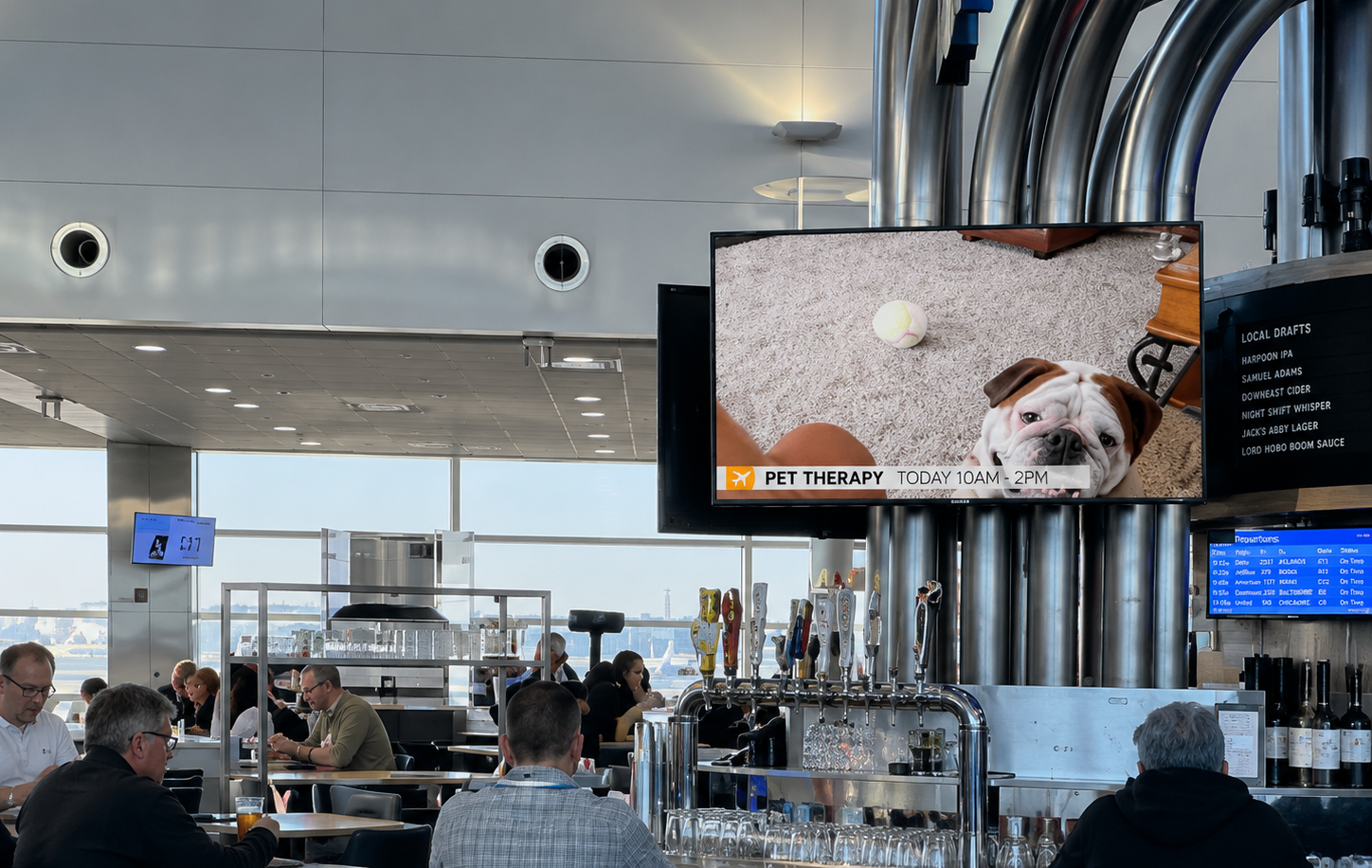
- The terminal is compact and recently refreshed, and advertising clutter is very low compared with Denver or the Front Range. Standout potential per placement ranks among the highest in Colorado, and a single dominant position effectively defines the visual memory of the airport for the entire Western Slope population.
- Dwell time is driven by early arrival habits typical of regional airports, single-checkpoint security queues, extended baggage claim waits for ski, golf, hunting, and outdoor equipment, rental car processing for inbound visitors, and a deliberate two-hour free parking policy that brings greeting families into the terminal. Exposure is sustained, repeated, and extends well beyond ticketed passengers.
- The premium environment is reinforced by the completed terminal modernisation, visible business aviation and corporate aircraft activity on the field, and the airport's function as a gateway to some of the most valuable resort real estate in North America. Brand association here punches far above the passenger count.
- Masscom Global holds direct access to premium inventory across the full passenger journey at GJT, with the intelligence to separate resort-bound and in-migrating wealth from resident Western Slope traffic, dual-language English and Spanish creative capability, and the execution speed to move from brief to live campaign faster than planners working without on-ground partners.
Strategic Advertising Fit
Best Fit:
- Private aviation, aircraft management, charter, and premium automotive: An airport hosting significant business jet maintenance activity, serving an ultra-premium resort corridor, in a catchment where trucks and SUVs are working assets rather than luxuries.
- Mountain, ranch, and resort real estate brokerage and development: Direct access to Aspen, Snowmass, Telluride, and Vail second-home buyers alongside a resident audience actively acquiring land and mineral-bearing property.
- Private banking, wealth management, mineral rights, and land finance: Asset-rich, cash-flow-cyclical owners with continuous financing, succession, and structuring needs, plus incoming out-of-state equity requiring relocation-linked services.
- Healthcare systems, specialty medical services, and insurance: Regional medical hub status combined with a dispersed rural catchment that travels for specialist care and prioritises reliability over price.
- Outdoor, adventure, and performance equipment brands: World-class mountain biking, national park adjacency, hunting, fishing, and ski access produce one of the most concentrated enthusiast audiences in the United States relative to airport size.
- Premium wine, food, and hospitality groups: The Palisade wine and orchard corridor gives food and beverage brands a genuine regional story that resonates with both residents and affluent visitors.
- Resort hotels, ski operators, and travel loyalty programmes: A captive gateway audience heading to high-value destinations with fully committed trip budgets.
- Universities, boarding schools, and education finance: Savings and land-income funded families making early, research-driven education decisions.
Brand Alignment at a Glance:
| Category | Fit |
|---|---|
| Private aviation and premium automotive | Exceptional |
| Mountain, ranch, and resort real estate | Exceptional |
| Private banking, land, and mineral finance | Strong |
| Outdoor and adventure equipment | Strong |
| Healthcare, insurance, and education | Strong |
| Premium wine, food, and hospitality | Strong |
| Global luxury fashion and high jewellery | Moderate |
| European and Gulf residency-by-investment programmes | Poor fit |
Who Should Not Advertise Here:
- European and Gulf Golden Visa and citizenship-by-investment programmes: This audience holds illiquid land, mineral, and property wealth in a state and country they have deliberately chosen, and has minimal appetite for offshore residency. The offer solves no problem present in this terminal.
- Global luxury fashion, high jewellery, and status watch brands at full brand weight: Real wealth passes through, including genuine resort-corridor ultra-high-net-worth traffic, but the local retail infrastructure to support conversion is absent and prestige-led creative reads as out of place in a Western Slope environment. These brands should either adapt creative toward utility, craftsmanship, and outdoor performance, or buy the resort airports directly.
- Urban lifestyle, ride-hailing, micro-mobility, and dense-city consumer services: The catchment is car-dependent and geographically vast, so the product has no functional relevance and the spend is wasted regardless of creative quality.
Event and Seasonality Analysis
- Event Strength: Medium to High
- Seasonality Strength: High
- Traffic Pattern: Dual-Peak with a sharp Thanksgiving spike
Strategic Implication: Advertisers should treat GJT as a base-plus-spike market with two distinct audience seasons rather than one seasonal curve. Maintain continuous presence to exploit the airport's captive-catchment economics, which deliver cumulative reach against essentially the entire Western Slope population at low cost, then layer concentrated weight into August to October for the harvest, wine festival, and hunting window, into the Thanksgiving weekend for the year's single peak volume, and into December to March for the highest per-passenger wealth of the year as resort traffic dominates. May to June deserves separate treatment for the adventure sport and collegiate tournament audience. Attempting a summer-only burst wastes the airport's core strength, which is repeated exposure to a fixed high-value population supplemented by seasonal wealth inflow. Masscom Global structures GJT campaigns around this rhythm to maximise return across the full year.

Poor Placement and Delays Affect Airport Campaigns
We help you move faster, access better inventory, and get it right now.
Talk to an ExpertFinal Strategic Verdict
Grand Junction Regional is the best growth-adjusted advertising buy in Colorado outside the Front Range. It delivered 318,106 enplanements in 2025, up 13.6% on top of 11.1% the previous year, crossed 600,000 total commercial passengers for the first time, and completed $33 million of construction including a full terminal refresh backed by $40.5 million in federal funding. Inside that traffic sits an audience layering no other airport of this size can replicate: Piceance Basin energy and royalty wealth, Grand Valley agricultural and vineyard owners, a substantial regional medical and university professional class, in-migrating California and Texas equity, national park and adventure tourism inflow, and genuine Aspen, Snowmass, Telluride, and Vail second-home traffic using GJT as its reliable gateway, all funnelled through one compact, low-clutter, newly modernised terminal where a handful of positions achieve near-total catchment coverage. Private aviation and premium automotive brands, mountain and ranch real estate firms, private banks and land and mineral lenders, outdoor and adventure equipment manufacturers, healthcare systems, and premium wine and hospitality groups will extract more value per dollar here than at any Front Range airport. Masscom Global holds the inventory access, the Western Slope catchment intelligence, and the execution speed to secure it while the airport is still priced as a small regional field rather than as the wealth gateway it has become.
About Masscom Global
Masscom Global is a premium international airport advertising and media buying agency operating across 140 countries. With deep expertise in airport OOH, premium publications, and high-net-worth audience targeting, Masscom helps brands reach the world's most valuable travellers at the moments that matter most. For advertising packages, media rates, and campaign planning at Grand Junction Regional Airport and airports across the globe, contact Masscom Global today.
Frequently Asked Questions
How much does airport advertising cost at Grand Junction Regional Airport? Cost at GJT varies by format, terminal position, campaign duration, and seasonal demand. Premium check-in hall, security exit, gate concourse, and baggage claim positions carry the highest rates, particularly across the August to October harvest and hunting window, the Thanksgiving peak, and the December to March resort season. Because GJT is a compact single-terminal monopoly gateway with very low advertising clutter and a two-hour free parking policy that pulls greeting families inside, effective cost per relevant impression is often far lower than at Denver or Colorado Springs despite the smaller passenger base. Contact Masscom Global for current rates and availability.
Who are the passengers at Grand Junction Regional Airport? The core audience is Western Slope residents from Grand Junction, Fruita, Palisade, Delta, Montrose, Rifle, and Glenwood Springs, extending into eastern Utah. Weekday morning traffic weights toward energy and mineral principals, ranch and orchard owners, physicians and specialists, aviation executives, and university professionals connecting through Denver, Dallas/Fort Worth, Phoenix, and Salt Lake City. Seasonal traffic adds national park and Moab adventure tourism, wine and harvest visitors, high-income hunting travel, and resort-bound passengers heading to Aspen, Snowmass, Telluride, and Vail. A substantial Spanish-speaking agricultural and hospitality workforce travels on holiday and family cycles.
Is Grand Junction Regional Airport good for luxury brand advertising? Selectively, and only with adapted creative. Genuine wealth passes through, including resort-corridor ultra-high-net-worth traffic and an aircraft-owning audience drawn by the airport's business jet maintenance activity. But Western Slope culture is understated and asset-oriented, and local luxury retail infrastructure is limited, so global fashion and high jewellery underperform at full brand weight. Luxury categories that succeed here are private aviation and charter, premium trucks and SUVs, mountain and ranch real estate, private banking and mineral rights advisory, premium outdoor equipment, and high-end wine and hospitality, where value is framed around capability, craftsmanship, and legacy rather than status.
What is the best airport in Colorado to reach HNWI audiences? Denver leads on absolute volume and corporate wealth, while Aspen and Eagle serve the purest concentration of ultra-high-net-worth resort traffic at premium rates and with very limited inventory. GJT occupies a distinct and far more efficient position: it is the only airport reaching the entire Western Slope's energy, mineral, ranch, and medical wealth, and it simultaneously carries resort-corridor traffic that uses it as a reliable alternative gateway. Advertisers targeting land, mineral, ranch, and aviation wealth, or seeking resort-adjacent audiences without resort-airport pricing, should treat GJT as a priority buy alongside Denver.
What is the best time to advertise at Grand Junction Regional Airport? August to October is the highest-value window, combining peach and wine harvest tourism, the flagship Colorado wine festival, autumn colour travel, and high-income hunting season inbound movement. The Thanksgiving weekend delivers the airport's single peak volume day. December to March carries the highest per-passenger wealth of the year as ski and resort traffic dominates, especially when weather diverts resort airport arrivals to GJT. May to June is strong for adventure sport, festival, and collegiate tournament audiences. Continuous base presence plus concentrated weight into these windows is the correct structure.
Can international real estate developers advertise at Grand Junction Regional Airport? Yes, with the right market focus. This audience buys ranch, orchard, vineyard, and mineral-bearing land across western Colorado, Utah, and Wyoming, mountain second homes in the Aspen, Snowmass, Telluride, Crested Butte, and Vail corridors, and warm-climate winter property in Phoenix, Scottsdale, Palm Springs, Las Vegas, and Texas. Internationally, the credible markets are Mexican Pacific and Caribbean coastal property including Cabo San Lucas, Puerto Vallarta, and the Riviera Maya, plus selective Costa Rica and Belize interest. European and Gulf developers marketing residency-linked property will find weak alignment. Masscom Global places these campaigns in the arrivals and outbound zones where the buyer dwells longest.
Which brands should not advertise at Grand Junction Regional Airport? European and Gulf Golden Visa and citizenship-by-investment programmes should avoid GJT, because this audience holds illiquid land and mineral wealth in a jurisdiction it has deliberately chosen. Global luxury fashion, high jewellery, and status watch brands running unadapted prestige creative will underperform against the region's understated culture and thin luxury retail base. Urban lifestyle services including ride-hailing, micro-mobility, and dense-city consumer apps have no functional relevance in a car-dependent catchment spanning hundreds of miles.
How does Masscom Global help brands advertise at Grand Junction Regional Airport? Masscom Global delivers the full chain: Western Slope catchment and audience intelligence segmented by energy, agriculture and wine, healthcare and education, outdoor recreation, and resort spillover pillars, direct access to premium inventory throughout a compact single-terminal environment where coverage compounds quickly, placement precision that separates weekday principal traffic from resort-bound and adventure tourism waves, dual-language English and Spanish creative guidance, and campaign performance measurement against defined objectives. Masscom also activates the Denver, Phoenix, Dallas/Fort Worth, Southern California, and Mexican resort airports where this audience's capital and leisure travel lands, capturing the same household at both ends.