

Airport at a Glance
| Field | Detail |
|---|---|
| Airport | Eppley Airfield |
| IATA Code | OMA |
| Country | United States of America |
| City | Omaha, Nebraska |
| Annual Passengers | 5.28 million (2024 record). June 2026 set an all-time monthly record of 530,157 |
| Primary Audience | Fortune 500 corporate executives and investors, farmland and agribusiness wealth, defence and strategic command personnel |
| Peak Advertising Season | Early May, June, September to October, November to December |
| Audience Tier | Tier 1 by corporate and investor wealth density, Tier 2 by passenger volume |
| Best Fit Categories | Wealth management and private banking, agricultural and industrial B2B, insurance and financial services, premium automotive and business travel |
Eppley Airfield carried a record 5.28 million passengers in 2024 and set an all-time monthly record of 530,157 in June 2026. Those numbers understate its commercial significance. Omaha holds one of the highest concentrations of Fortune 500 headquarters per capita in the United States, including a globally significant investment conglomerate, a Class I railroad, one of the largest privately held construction and engineering firms in the world, a major mutual insurer and a leading trucking company. Add United States Strategic Command at the neighbouring air force base and a world-renowned academic medical centre, and the passenger base becomes unusually dense in genuine decision-making authority.
The airport matters because of what the region owns. Nebraska and Iowa farmland is among the most valuable agricultural land on earth, held in concentrated multi-generational family hands. Omaha is also the annual gathering point for one of the largest investor meetings in the world, when tens of thousands of shareholders fly in each May, many of them high-net-worth and ultra-high-net-worth individuals. A 950 million dollar terminal programme is simultaneously doubling the facility to roughly 646,000 square feet by 2028, creating an entirely new inventory environment. Masscom Global positions OMA as one of the most underpriced Tier 1 audience opportunities in North America.
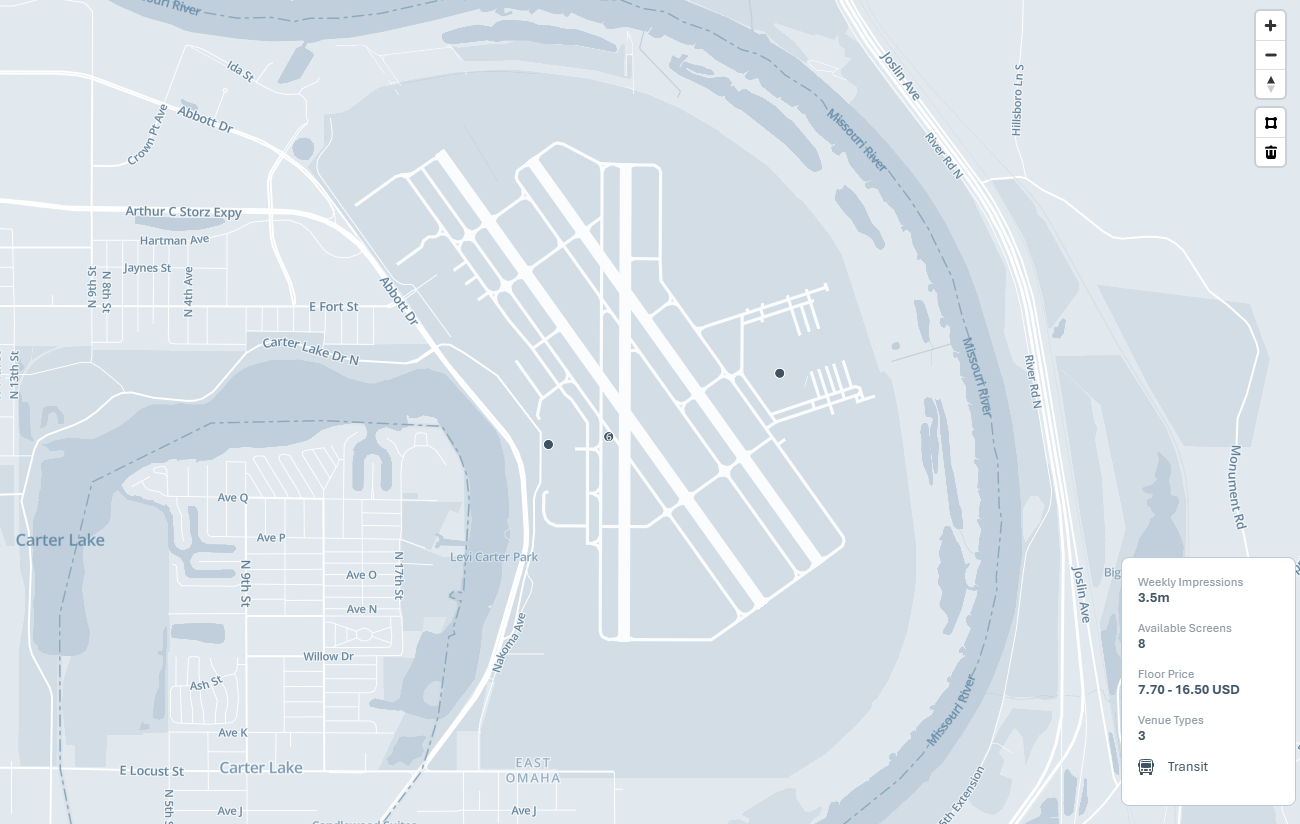
Advertising Value Snapshot
- Passenger scale: Record 5.28 million passengers in 2024, up 5 percent. June 2026 delivered 530,157 passengers, the busiest month in the airport's history, beating the June 2025 record of 524,331. Airlines have provided more seat capacity to Omaha than ever before.
- Traveller type: Fortune 500 corporate executives and institutional investors, agribusiness and farmland-owning families, defence and strategic command personnel, and a growing leisure and event-driven segment.
- Airport classification: Tier 1 by corporate and investor wealth density, Tier 2 by passenger volume. The primary air gateway for eastern Nebraska and western Iowa with no competing airport in reach.
- Commercial positioning: Known nationally as the airport of American corporate insurance, rail and investment capital, and as the annual destination of one of the world's largest shareholder gatherings.
- Wealth corridor signal: OMA sits where Corn Belt farmland wealth meets Fortune 500 corporate equity, with capital concentrated in land, closely held businesses and long-hold investment portfolios.
- Advertising opportunity: The 950 million dollar Build OMA programme is creating brand new concourse, gate and central pavilion environments, with the first new gates opening in November and full completion in 2028. Advertisers securing position during construction lock in current rates ahead of a facility nearly double its present size. Masscom Global secures this inventory and pairs OMA with Chicago, Denver, Dallas, Atlanta and Minneapolis so corporate and agricultural brands cover origin and connection in one plan.
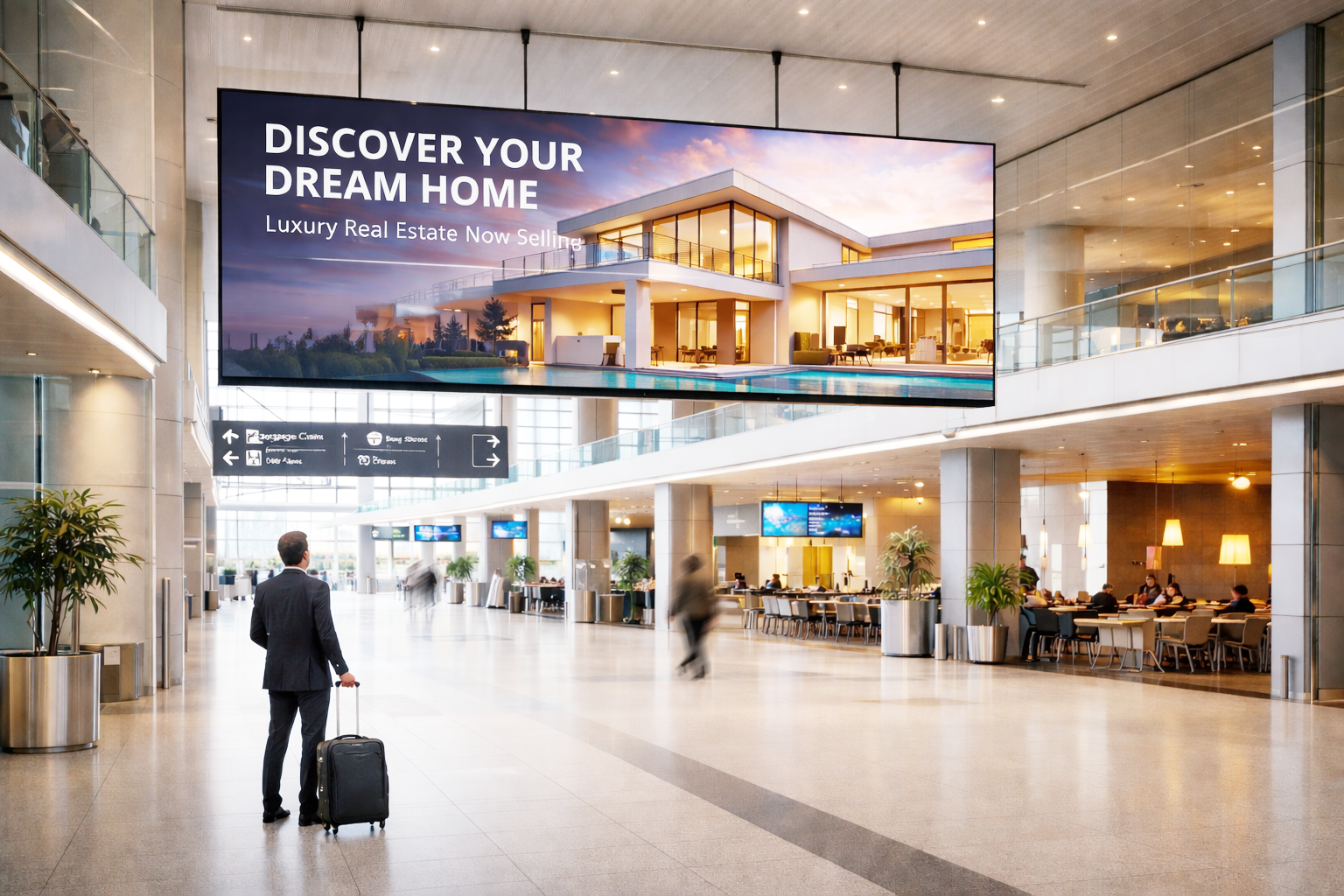
Airport Advertising is Complex to Get Right
We help you execute faster, with proven results and local insight most planners lack starting now.
Talk to an ExpertCatchment Area and Economic Drivers
Top 10 Cities within 150 km, Marketer Intelligence:
- Omaha, Nebraska: Home to one of the highest concentrations of Fortune 500 headquarters per capita in the United States, spanning investment, insurance, rail, construction and transport. Produces the highest-value audience in the catchment: senior executives, institutional investors and business owners with substantial personal net worth and corporate purchase authority.
- Lincoln, Nebraska: State capital and flagship university city, with a large insurance and technology sector and one of the largest Yazidi communities in the United States. Produces government, academic and professional audiences plus major football-driven travel demand.
- Bellevue and Offutt, Nebraska: Anchored by United States Strategic Command. Produces senior military leadership, defence contractors and security-cleared engineers travelling on federal business. A stable, high-credential audience with predictable travel patterns.
- Papillion and La Vista, Nebraska: The centre of Nebraska's rapidly expanding data centre corridor, with multi-billion dollar hyperscale investment. Produces technology, construction and energy management audiences alongside affluent suburban households.
- Council Bluffs, Iowa: Major data centre and logistics hub across the river, plus casino and gaming activity. Produces industrial procurement, technology infrastructure and hospitality management audiences.
- Fremont and Blair, Nebraska: Agricultural processing and biofuels centres. Produces plant management, commodity traders and farm operators with significant equipment and input purchasing budgets.
- Columbus, Nebraska: Manufacturing base including globally exporting industrial equipment producers. Produces engineering and export-oriented business travellers relevant to industrial supply and business services.
- Nebraska City and Plattsmouth, Nebraska: Agricultural and river commerce communities with concentrated farmland ownership. Land values here create genuinely wealthy families with strong wealth management and land brokerage relevance.
- Sioux City, Iowa: Protein processing and agricultural trading centre at the catchment's northern edge, with a diverse immigrant workforce driving remittance and consumer finance demand alongside agribusiness leadership.
- Norfolk, Nebraska: Regional agricultural and healthcare service centre serving a wide rural hinterland. Produces farm operators and medical professionals who use OMA as their only realistic air gateway.
NRI and Diaspora Intelligence:
There is no large South Asian or Gulf expatriate population here, so the relevant diaspora picture is unusual and commercially real. Omaha and Lincoln have been major refugee resettlement centres for decades, producing one of the largest South Sudanese communities in the United States, one of the largest Yazidi communities anywhere outside Iraq, and significant Somali, Karen and Burmese, Vietnamese and Bhutanese populations. South Omaha holds a large and economically established Mexican and Central American community. Remittance volume, international calling, money transfer, cross-border insurance and immigration legal services all have genuine demand. The dominant HNI movement, however, is corporate and agricultural: Fortune 500 executives on global business, institutional investors, and farmland-owning families whose wealth is held in land and long-hold equity rather than deployed internationally.
Economic Importance:
Five engines drive this catchment. Insurance, investment and financial services create the region's defining executive and investor audience and its extraordinary concentration of institutional capital. Class I rail, construction, engineering and trucking create industrial and logistics leadership with national operational responsibility. Row crop agriculture, beef and biofuels create farmland wealth and enormous input and equipment demand. Defence and strategic command create a federal contracting and engineering population. Academic medicine and hyperscale data centre investment create physician, researcher and technology infrastructure audiences. Each produces a clearly separable advertiser target inside one terminal.
Business and Industrial Ecosystem
- Investment, insurance and financial services: Produces senior executives, institutional investors, actuaries and advisors. Core audience for private banking, wealth management, international real estate, luxury automotive and premium business services advertisers.
- Class I rail, construction, engineering and trucking: Produces national and international operations leadership with major procurement authority. Relevant to industrial equipment, enterprise technology, logistics services and commercial insurance advertisers.
- Agriculture, beef, grain and biofuels: Produces owner-operators and processing management with high borrowing capacity and large annual capital expenditure on machinery, inputs, technology and land.
- Defence, strategic command and hyperscale data centres: Produces security-cleared engineers, federal contractors and technology infrastructure management. Relevant to industrial supply, cybersecurity, professional services and business travel brands.
Passenger Intent, Business Segment:
Business travel dominates the weekday flow. Passengers are corporate executives connecting through Chicago, Denver, Dallas, Atlanta and Minneapolis toward national and global operations, defence contractors and military leadership on federal business, agricultural principals travelling to trade shows and commodity meetings, and physicians and researchers moving to conferences. They travel frequently and book on schedule rather than price. Private banking, wealth management, agricultural machinery and inputs, enterprise technology, commercial insurance, premium automotive and business travel intercept them most effectively.
Strategic Insight:
The business audience at OMA is commercially valuable because corporate authority and personal wealth sit in the same individuals, and both are concentrated in an unusually small geography. Very few cities of Omaha's size carry this density of headquarters-level decision making, and almost none combine it with farmland wealth of this magnitude in the same catchment. A single terminal placement therefore reaches the institutional buyer, the private investor and the asset-rich landowner simultaneously. Advertising clutter remains low relative to any comparable hub, and the new terminal environment will elevate presentation quality substantially, which makes this one of the strongest cost-to-authority propositions in American airport advertising.
Tourism and Premium Travel Drivers
- Annual shareholder meeting weekend (early May): One of the largest investor gatherings in the world, drawing tens of thousands of shareholders including a very high concentration of high-net-worth and ultra-high-net-worth individuals from across the globe. The single most valuable advertising window at any mid-size American airport.
- NCAA Men's College World Series (June): A multi-week national championship event drawing hundreds of thousands of visitors and directly credited with driving the airport's record June traffic. Strong corporate hospitality and family spending profile.
- Henry Doorly Zoo and Aquarium, and the riverfront district: A globally ranked zoo anchoring sustained family tourism, alongside a substantially redeveloped downtown riverfront. Relevant to hospitality, retail, family finance and travel services advertisers.
- University football and regional sport (September to November): Sellout stadium crowds in Lincoln drive substantial inbound travel from across the country, with strong alumni affluence and hospitality spending.
Passenger Intent, Tourism Segment:
Inbound leisure and event visitors are the distinctive opportunity here. The May shareholder weekend brings arguably the wealthiest single visitor cohort of any regional American airport, people who arrive specifically to think about capital allocation, and who are exceptionally receptive to financial services, wealth management, insurance and international investment messaging in that mindset. The June championship and autumn football calendar bring high-volume family and alumni travel with strong hospitality, retail and consumer finance relevance. Outbound leisure passengers are Midwest families and retirees flying to Florida, Arizona, Nevada and Texas, receptive to travel finance, insurance and destination services.
Travel Patterns and Seasonality
Peak seasons:
- Early May: The shareholder meeting weekend produces a short, extreme spike in both volume and audience wealth, unmatched by any other period in the calendar.
- June: The strongest month of the year, driven by summer leisure, the College World Series and expanded flight options. June 2026 set the all-time monthly record at 530,157 passengers, following June 2025 at 524,331.
- September to November: Autumn business peak combined with harvest-period commercial activity and football-driven inbound travel.
- Late November to December: Thanksgiving and year-end holiday compression, the sharpest family travel burst of the calendar.
Additional route-level monthly breakdowns: Data not available.
Event-Driven Movement:
- Annual shareholder meeting (early May): Tens of thousands of investors arrive over a single weekend, including institutional allocators, family offices and high-net-worth individuals from around the world. Unmatched timing for private banking, wealth management, international real estate and residency advisory.
- NCAA Men's College World Series (June): Multi-week national championship with sustained visitor volume, corporate hospitality and sponsor activity. Directly credited with the airport's record June performance.
- University football season (September to November): Sellout crowds in Lincoln drive repeated weekend inbound surges with affluent alumni and strong hospitality spending.
- Agricultural trade show and commodity meeting season (December to February): Drives outbound business travel by farm operators and agribusiness principals. Highest-intent window for machinery, inputs and agricultural finance advertisers.
- National swimming and sporting championships hosted in Omaha: The city periodically hosts major national trials and championships, producing concentrated athlete, official, media and spectator travel with strong sportswear, health and hospitality relevance.
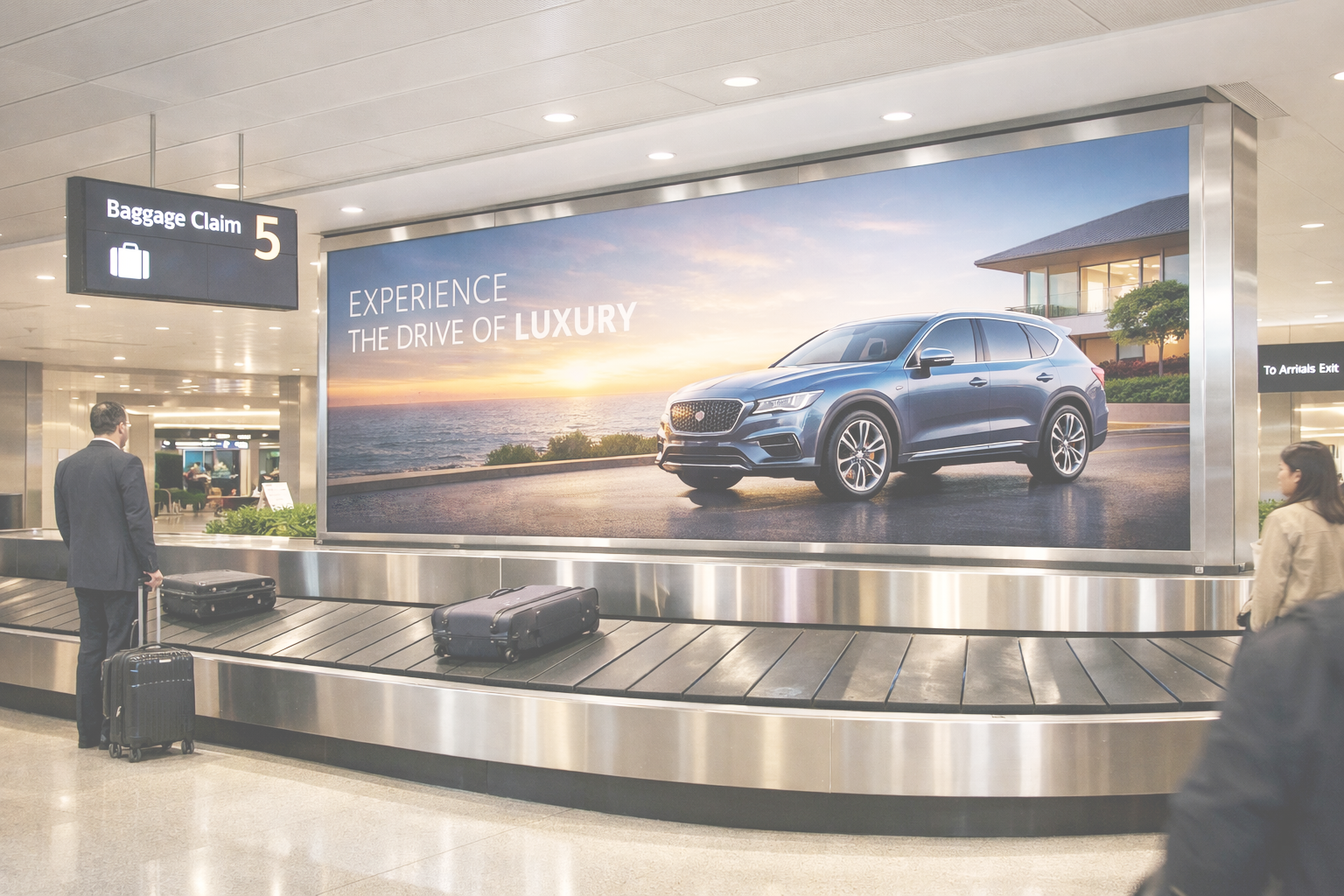
It’s Not Just Where You Advertise - It’s How Fast You Execute
We combine local insight with fast rollout to deliver results for you, now.
Talk to an ExpertAudience and Cultural Intelligence
Top 2 Languages:
- English: The language of the corporate, investor, defence and landowner audience. This is a financially literate and analytically minded readership, accustomed to evaluating performance figures, holding periods and total cost of ownership, which means creative can carry substantially more specificity than typical airport advertising supports.
- Spanish: Spoken across a large and economically established Mexican and Central American population concentrated in South Omaha and the regional processing towns, spanning skilled trades through business ownership. Essential for remittance, telecom, consumer finance, healthcare and family insurance advertisers.
Major Traveller Nationalities:
The passenger base is overwhelmingly American, with two distinct international layers. Corporate and defence activity brings visiting executives, engineers and delegations from Europe, Japan, India, Brazil and Australia into the region for headquarters and programme business, and the May shareholder weekend brings investors from across the world including Europe, China, India, Japan and the Gulf. Resettlement has created significant South Sudanese, Yazidi, Somali, Karen, Vietnamese and Bhutanese communities. For creative this means English-led corporate and financial messaging that assumes global investment context, Spanish localisation for consumer categories, and a distinct multilingual remittance and telecom opportunity that most planners overlook entirely.
Religion, Advertiser Intelligence:
- Christianity, Catholic (approximately 30 to 35 percent of the catchment): Very strong across Irish, German, Italian, Polish and Hispanic communities, reinforced by a Jesuit university and major Catholic institutions. Christmas, Easter, Lent, confirmation and quinceañera milestones drive family gathering, gifting, apparel and travel spending. Relevant to consumer finance, remittance, retail and family insurance advertisers.
- Christianity, Protestant including Lutheran and Methodist (approximately 35 to 40 percent): Dominant among the farming and established business population. Christmas and Easter drive family travel and gifting, and community and institutional trust networks strongly shape purchase decisions, favouring credibility-led and relationship-led messaging. Relevant to agricultural finance, insurance and healthcare.
- Islam (approximately 2 to 3 percent, with established Somali and Sudanese communities): Ramadan and Eid produce concentrated family travel, remittance, gifting and food purchasing, alongside genuine Umrah and Hajj travel demand. Relevant to money transfer, halal finance, telecom and community banking advertisers.
- Judaism (small but long established and economically prominent in Omaha): Rosh Hashanah, Yom Kippur, Hanukkah and Passover create calendar-fixed family travel dates within a professionally established, higher-income community with strong philanthropic and Israel-linked investment behaviour. Relevant to premium travel, wealth management and private education advertisers.
Behavioral Insight:
This is one of the most value-disciplined wealthy audiences in the world, and that shapes what works. The region's dominant investment culture prizes long holding periods, understated presentation, demonstrable fundamentals and scepticism toward hype, and those attitudes have permeated the wider business community. Overt luxury signalling and aspirational abstraction underperform badly here. What performs is track record, fee transparency, tenure, credentials and clear arithmetic. Wealth is substantial and almost always invisible, held in farmland, closely held businesses and long-hold equity rather than displayed. Purchase decisions are researched, peer-referenced and advisor-mediated with long cycles, so the airport's function is establishing legitimacy and shortlist presence rather than driving immediate action. Brands that present themselves as institutions rather than as opportunities extract disproportionate value.
Outbound Wealth and Investment Intelligence
The outbound passenger at OMA is commercially distinctive because this catchment controls an extraordinary amount of capital while deploying its private wealth conservatively and largely within North America. Recognising that distinction is what separates a productive campaign from a wasted one. This is a farmland, corporate equity and long-hold investment base, not a globally mobile lifestyle-migration audience, and the May shareholder weekend temporarily overlays it with a genuinely international investor cohort.
Outbound Real Estate Investment:
The dominant behaviour is domestic: second-home and retirement purchase in Arizona particularly Scottsdale and Phoenix, Florida, Texas, Colorado and the Ozarks lake markets, driven by climate and tax considerations. Farmland acquisition across Nebraska, Iowa, Kansas and Missouri remains the region's primary asset accumulation strategy. Cross-border activity concentrates in Mexico, particularly Los Cabos and Puerto Vallarta, alongside Costa Rica and Belize for retirement buyers, and family-linked property in Mexico and Central America among the diaspora population. European and Gulf luxury property has limited traction. International developers should lead with retirement lifestyle, cost of living and yield arithmetic rather than trophy positioning, and should concentrate premium messaging around the May investor weekend when a far more internationally minded audience is present.
Outbound Education Investment:
Higher education movement is primarily domestic, into the University of Nebraska system, Creighton, Iowa, Kansas and the regional private colleges, with agricultural science, engineering, actuarial science, medicine, nursing and business dominating. International undergraduate and postgraduate study in the United Kingdom, Canada, Ireland and Australia occurs among executive and physician families, and MBA and executive education demand is significant given the corporate profile. The academic medical centre also generates real inbound and outbound international movement. International universities, business schools and education advisory firms have a real if selective audience, strongest in the January and August to September windows.
Outbound Wealth Migration and Residency:
Golden Visa and citizenship-by-investment demand is limited within the resident population, concentrated on Portugal and Caribbean programmes among a small number of business owners and executives. Domestic tax domicile migration to Florida, Texas, Nevada and Arizona is far more common among retiring business owners. The immigration services demand that does exist is substantial but runs the other way, covering work authorisation, permanent residency, family reunification and cross-border tax advisory for the region's resettled and Hispanic communities and for corporate expatriate assignments. The May investor weekend is the one period when residency-by-investment advertising reaches a genuinely receptive international audience at this airport.
Strategic Implication for Advertisers:
The commercial logic here has two distinct modes and both are addressable. Year-round, this is a domestic wealth, farmland and corporate B2B environment where credibility and arithmetic win. For one weekend in May, it becomes one of the most internationally significant concentrations of investable private capital in the world. Advertisers who plan for both extract far more than those who treat it as a single audience. Masscom Global structures campaigns to hold year-round corporate and agricultural presence while deploying premium international wealth messaging into the May window, and can extend placement to the hubs and destination markets this capital moves through.
Airport Infrastructure and Premium Indicators
Terminals:
- A single terminal currently operating as separated north and south sections since January 2025 while construction proceeds, requiring passengers to move between halves via outdoor walkways and the south garage lower level. This split configuration continues through 2027 and concentrates passenger attention in defined, high-traffic circulation zones.
- A new concourse with additional gates begins opening to south terminal passengers in November, the first phase of the new terminal, with further phases in 2027 and 2028. On completion the terminal will span approximately 646,000 square feet with a single unified concourse, nearly double its current size.
Premium Indicators:
- Carrier lounge provision is limited at present, which is typical for the airport's tier, but the modernisation programme adds substantially expanded gate areas, new concessions beyond security and improved passenger amenities that will materially raise the premium standard.
- Significant corporate and private aviation activity reflecting the presence of multiple Fortune 500 headquarters in the immediate catchment, alongside the neighbouring strategic command installation. One of the clearest executive and ultra-high-net-worth signals available at a mid-size American airport.
- Hotel supply sits in downtown Omaha and the surrounding corridor rather than on the airport campus, including full-service business and riverfront properties serving corporate and event demand.
- A new central utility plant operating since May 2025 replaces decades-old systems with modern heating, cooling, electrical and data infrastructure, and a full-length illuminated glass canopy with programmable lighting now spans Terminal Drive. Genuine design and efficiency credentials supporting brand association.
Forward-Looking Signal:
Build OMA is a 950 million dollar programme, the airport's most significant investment in nearly four decades, funded through airport revenues, federal grants and bonds rather than local taxation. The first new gates open in November, the Central Pavilion housing centralised security and new concessions opens in 2027, and the complete unified terminal at roughly 646,000 square feet arrives in 2028. Passenger volume set an annual record in 2024 and monthly records in June 2025 and again in June 2026, with airlines supplying more seat capacity to Omaha than at any point in the airport's history. Advertising rates currently reflect a facility mid-construction while the audience quality and volume trajectory already justify far more. Masscom Global advises clients to secure position now, ahead of the 2027 and 2028 reveals that will reset this market.
Airline and Route Intelligence
Top Airlines:
Southwest Airlines, American Airlines, Delta Air Lines and United Airlines account for the majority of traffic, with Allegiant Air and Frontier Airlines providing additional low-cost and seasonal leisure capacity. Carriers have collectively provided more seat capacity to Omaha than at any previous point.
Key International Routes:
No scheduled international passenger service. International travel from this catchment connects through Chicago, Denver, Dallas-Fort Worth, Atlanta, Minneapolis and Houston. Weekly frequency data by route: Data not available.
Domestic Connectivity:
A broad domestic network covering every major United States hub plus significant leisure markets, including Chicago, Denver, Dallas-Fort Worth, Atlanta, Minneapolis, Detroit, Charlotte, Houston, Phoenix, Las Vegas, Los Angeles, Seattle, Washington, New York, Orlando, Tampa and Nashville. Expanded flight options have been a direct driver of record traffic.
Wealth Corridor Signal:
The route network reveals three separable audiences. The hub routes to Chicago, Denver, Dallas, Atlanta and Minneapolis are corporate corridors carrying Fortune 500 executives, defence contractors and agribusiness principals toward national and global operations. The Phoenix, Las Vegas, Florida and Texas routes are wealth transfer and retirement corridors carrying second-home owners and domicile migrants. The Washington route carries federal and defence business tied to the strategic command presence. Advertisers should build for all three within one terminal, and Masscom Global structures placement so corporate, agricultural and premium leisure messaging each reach the right flow.
Media Environment at the Airport
- The current split-terminal configuration concentrates passengers into defined circulation routes and outdoor walkways, which creates unusually predictable and high-frequency exposure points for advertisers who understand the layout. Clutter remains low relative to any comparable hub.
- Dwell time is driven by construction-period recommendations to allow extra time, centralised security processing, connection-dependent itineraries and a passenger base that lives close to the terminal and arrives early. Business travellers waiting longer than usual represent extended, low-distraction exposure among the highest-value segment.
- Premium environment signalling is improving rapidly and measurably. The illuminated glass canopy, modernised finishes, new concourse and gates from November, and the Central Pavilion with concessions beyond security in 2027 are transforming a nearly forty-year-old facility into a contemporary environment that will directly elevate the association value of every placement inside it.
- Masscom Global provides inventory access, placement precision and rapid execution at OMA, including navigation of the construction-phase layout, and integrates it into a Midwest corridor plan spanning Chicago, Denver, Dallas-Fort Worth, Minneapolis and Atlanta so brands intercept the same executives at origin and at every connecting hub.
Strategic Advertising Fit
Best Fit:
- Private banking, wealth management and family office services: Reaches Fortune 500 executives, institutional investors and farmland-owning families year-round, and one of the world's most concentrated gatherings of investable private capital each May.
- Agricultural machinery, inputs, agtech and farmland asset management: Speaks directly to owner-operators holding some of the most valuable farmland on earth with large annual capital budgets.
- Insurance, reinsurance, annuities and actuarial services: Aligns with a regional economy built substantially on insurance and with an audience that understands the products at a technical level.
- Industrial B2B, enterprise technology, logistics and rail services: Reaches national operations leadership in rail, construction, engineering and trucking with genuine procurement authority.
- Premium and luxury automotive: Fits executive and landowner income levels, strong suburban multi-vehicle ownership and a substantial pickup and utility vehicle culture.
- Business travel, hotels, corporate cards and executive services: Matches a high-frequency connecting business traveller base across five major hub corridors.
- International real estate and residency advisory, concentrated in the May window: Reaches a globally sourced investor cohort in a capital allocation mindset, which is exceptionally rare outside major financial capitals.
- Healthcare, academic medicine and specialist medical services: Relevant to a competitive regional healthcare market anchored by a world-renowned academic medical centre.
Brand Alignment at a Glance:
| Category | Fit |
|---|---|
| Private banking and wealth management | Exceptional |
| Agricultural machinery and farmland assets | Exceptional |
| Insurance and financial services | Strong |
| Industrial B2B and logistics | Strong |
| Premium automotive and business travel | Strong |
| International real estate, May window | Strong |
| Healthcare and academic medicine | Moderate |
| Duty free and status luxury | Poor fit |
Who Should Not Advertise Here:
- Duty free and travel retail: No scheduled international service and no international departure environment, which removes the transactional basis these campaigns require.
- Overt status luxury, watches and trophy asset positioning: This audience holds enormous wealth but its dominant culture prizes understatement, fundamentals and value discipline. Loud luxury messaging reads as misjudged and underperforms badly.
- International residency and citizenship-by-investment outside the May window: Resident demand is limited, and budget is far better concentrated into the shareholder weekend when a genuinely international investor audience is present.
- Inbound foreign tourism boards and long-haul destination marketing: International journeys begin at the connecting hub rather than here, so origin-airport destination messaging reaches the audience at the wrong point.
- Discount-led and low-margin volume FMCG: Reach is available but the audience profile and premium inventory cost misalign with price-led positioning.
Event and Seasonality Analysis
- Event Strength: High
- Seasonality Strength: Medium
- Traffic Pattern: Stable business base with sharp event-driven peaks, notably early May and June
Strategic Implication:
OMA rewards a two-layer approach. A continuous year-round layer holds visibility against the corporate, agricultural and defence business base, which flies consistently every week and where repeat exposure builds the credibility this audience requires before acting. On top of that, concentrated bursts should target early May for the shareholder weekend, which is the single highest-value wealth audience window available at any mid-size American airport, June for record-setting volume driven by the College World Series and summer leisure, September to November for harvest business and football-driven inbound travel, and December to February for the agricultural trade show cycle. Advertisers should also secure longer terms now rather than season by season, because the 2027 and 2028 terminal completions will reset pricing. Masscom Global structures campaigns around exactly this rhythm.

Poor Placement and Delays Affect Airport Campaigns
We help you move faster, access better inventory, and get it right now.
Talk to an ExpertFinal Strategic Verdict
Eppley Airfield delivers Tier 1 audience quality at Tier 2 pricing, and the window to buy it that way is closing. Omaha carries one of the highest concentrations of Fortune 500 headquarters per capita in the United States across investment, insurance, rail, construction and transport, sits beside United States Strategic Command, anchors a world-renowned academic medical centre, and is surrounded by farmland among the most valuable on earth held in concentrated family hands.
Traffic set an annual record of 5.28 million in 2024 and monthly records in June 2025 and again in June 2026 at 530,157, with more airline seat capacity than at any point in the airport's history. Each May the city hosts one of the largest gatherings of investable private capital anywhere in the world, a single weekend that no other regional airport can offer. Meanwhile 950 million dollars is doubling the terminal to roughly 646,000 square feet, with new gates opening in November and full completion in 2028, and rates still reflect a facility mid-construction. Private banks, agricultural and industrial B2B brands, insurers, premium automotive and international investment advisors should hold position here now. Masscom Global has the access, the catchment intelligence and the execution speed to place them before the reveal resets the market.
About Masscom Global
Masscom Global is a premium international airport advertising and media buying agency operating across 140 countries. With deep expertise in airport OOH, premium publications, and high-net-worth audience targeting, Masscom helps brands reach the world's most valuable travellers at the moments that matter most. For advertising packages, media rates, and campaign planning at Eppley Airfield and airports across the globe, contact Masscom Global today.
Frequently Asked Questions
How much does airport advertising cost at Eppley Airfield?
Cost at OMA varies by format, position, duration and seasonal demand, and currently reflects a facility mid-way through a 950 million dollar modernisation rather than the audience quality or volume the airport now carries. Early May and June command the sharpest premium demand. Advertisers taking longer terms secure position ahead of the 2027 Central Pavilion and 2028 full terminal completion, both of which will reset pricing. Multi-airport Midwest corridor packages improve the economics further. Contact Masscom Global for current rates and availability.
Who are the passengers at Eppley Airfield?
Predominantly residents of eastern Nebraska and western Iowa, with a heavy corporate weighting. The mix includes Fortune 500 executives from the region's investment, insurance, rail, construction and trucking headquarters, institutional investors, farmland-owning families and agribusiness principals, senior military leadership and defence contractors connected to the neighbouring strategic command installation, physicians and researchers from a leading academic medical centre, and a growing event and leisure segment.
Is Eppley Airfield good for luxury brand advertising?
Selectively, and the distinction matters. Private banking, wealth management, premium automotive, business travel and executive services perform well because income and asset levels genuinely support them. Overt status luxury, watches and trophy asset positioning perform poorly, because the region's dominant investment culture prizes understatement, fundamentals and value discipline. Duty free is not viable given the absence of international service. The one exception is the May shareholder weekend, when a far more internationally minded high-net-worth audience is present.
What is the best airport in the American Midwest to reach corporate and agricultural wealth?
For volume, Chicago and Minneapolis lead but at high cost with heavily diluted audiences. For concentration, Omaha is arguably unmatched among mid-size airports, because Fortune 500 headquarters density, farmland wealth and a globally significant annual investor gathering all sit in the same catchment. Des Moines, Kansas City and Quad City International offer complementary agricultural reach. The strongest approach pairs OMA with Chicago, Denver and Dallas hub placement, which is how Masscom Global builds Midwest corporate and agricultural plans.
What is the best time to advertise at Eppley Airfield?
Early May is the highest-value window of the year, when tens of thousands of investors including a very high concentration of high-net-worth individuals arrive for the annual shareholder meeting. June is the highest-volume month, setting all-time records in both 2025 and 2026 on the strength of the College World Series and summer demand. September to November combines harvest business travel with football-driven inbound surges. December to February is the highest-intent window for agricultural machinery and finance advertisers.
Can international real estate developers advertise at Eppley Airfield?
Yes, and the timing choice determines the return. Year-round, this audience buys second homes and retirement property in Arizona, Florida, Texas, Colorado and the Ozarks, plus Mexico, particularly Los Cabos and Puerto Vallarta, and Costa Rica and Belize. Creative should lead with cost of living, climate and yield arithmetic rather than trophy positioning. The May shareholder weekend is the exception and the opportunity, delivering an internationally sourced investor audience in an active capital allocation mindset. Masscom Global can structure both the year-round and the May-concentrated approach.
Which brands should not advertise at Eppley Airfield?
Duty free and travel retail, given no scheduled international service. Overt status luxury and trophy property, which misread a deliberately understated, value-disciplined audience. International residency and citizenship-by-investment outside the May window, where resident demand is limited. Foreign tourism boards and long-haul destination marketing, because international journeys begin at the connecting hub. Discount-led and low-margin volume FMCG, which achieves better efficiency in cheaper environments.
How does Masscom Global help brands advertise at Eppley Airfield?
Masscom Global delivers catchment intelligence specific to Omaha's Fortune 500 headquarters density, farmland wealth structure and strategic command presence, inventory access and placement precision including navigation of the current split-terminal configuration and the new concourse opening from November, campaign structures that hold year-round corporate visibility while concentrating premium spend into the May investor window, and integration across Chicago, Denver, Dallas-Fort Worth, Minneapolis and Atlanta. Book a fifteen minute planning call to review availability and rates before the 2027 and 2028 completions reset this market.