


Airport at a Glance
| Field | Detail |
|---|---|
| Airport | Comox Valley Airport, shared airfield with 19 Wing Comox (YQQ) |
| IATA Code | YQQ |
| Country | Canada |
| City | Comox, British Columbia |
| Annual Passengers | Nearly 450,000 in 2025, the busiest year on record, up almost 12 percent on 2024 |
| Primary Audience | Affluent retirees and second-home owners, military and defence personnel, premium leisure and sport fishing visitors |
| Peak Advertising Season | June to September, with a secondary winter sun and ski peak from December to March |
| Audience Tier | Tier 2 |
| Best Fit Categories | Financial services and wealth transfer, real estate and property developers, premium automotive and marine, snowbird travel and destination property |

Comox Valley Airport is the strongest commercial proposition on Vancouver Island outside Victoria, and the numbers explain why. The airport closed 2025 with nearly 450,000 passengers, its busiest year ever, beating a record of 420,811 that had stood since 2018 and growing almost 12 percent year on year. Eight of the twelve months in 2025 set records, and August alone carried more than 50,000 passengers, the single busiest month in the airport's history. This is not a quiet regional field. It is a small terminal handling large-airport growth rates.
The audience behind that growth is what makes YQQ commercially valuable. The Comox Valley is one of Canada's most sought-after retirement and second-home destinations, drawing affluent buyers from Alberta and the Lower Mainland into a market of golf courses, marinas, oceanfront property and a ski hill thirty minutes from the terminal. Layered on top is a permanent defence population at 19 Wing Comox, the primary air defence installation on Canada's Pacific coast. Masscom Global reads YQQ as a Tier 2 audience arriving through a Tier 3 sized terminal, which is the most favourable ratio a media planner can find.
Advertising Value Snapshot
- Passenger scale: Nearly 450,000 passengers in 2025, up almost 12 percent on 2024 and past the previous 2018 record. Summer growth ran at 17 percent in June, 16 percent in July and 15 percent in August.
- Traveller type: Affluent retirees and second-home owners, Canadian Armed Forces personnel and families, and premium leisure visitors for skiing, sport fishing, golf and cycling.
- Airport classification: Tier 2. Small volume but high household net worth, strong property ownership and consistent double-digit growth.
- Commercial positioning: Marketed as the Vancouver Island Airport, the natural gateway to central and northern Vancouver Island, connected by two major provincial highways.
- Wealth corridor signal: YQQ sits on the Alberta to Vancouver Island retirement and second-home corridor, with year-round nonstop service from both Calgary and Edmonton.
Advertising opportunity: Masscom Global provides access to a single-terminal environment where one brand can hold near-total share of voice against an audience with property, pension and investment decisions actively in play. The terminal already runs a curated rotating art programme, which means the environment is treated as a considered space rather than a corridor, and brand association benefits accordingly. Growth of this speed also means today's rates are priced against yesterday's volumes.

Airport Advertising is Complex to Get Right
We help you execute faster, with proven results and local insight most planners lack starting now.
Talk to an Expert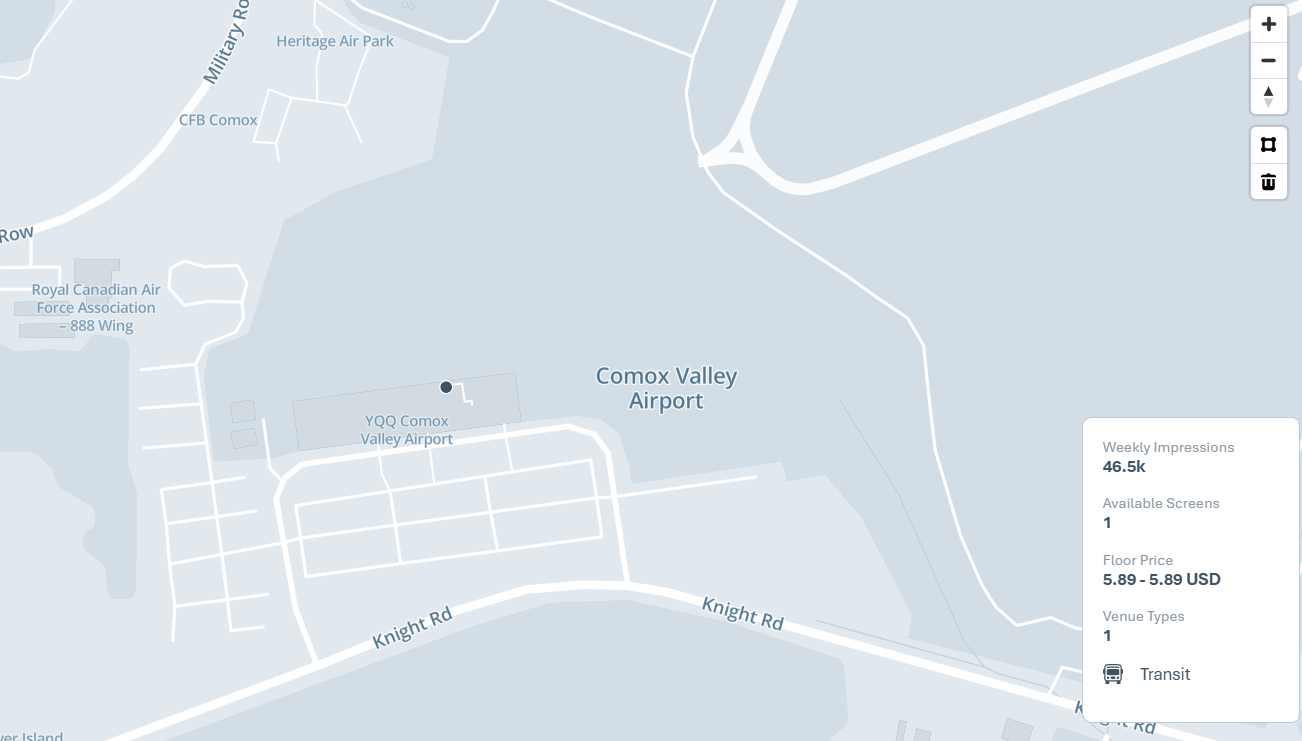
Catchment Area and Economic Drivers
Top 10 Cities within 150 km, Marketer Intelligence:
- Comox (approximately 5 km): Affluent waterfront town with a working marina and a large concentration of retired senior officers and professionals. The highest-value residential audience within immediate reach of the terminal.
- Courtenay (approximately 10 km): Commercial and retail centre of the valley and the region's healthcare hub. Produces the working professional and family audience plus regional retail decision-makers.
- Cumberland (approximately 20 km): Former coal town now a nationally known mountain biking destination, attracting younger high-income in-migrants and remote workers. Prime audience for outdoor, vehicle and technology brands.
- Denman and Hornby Islands (approximately 30 km): Arts communities with disproportionately high property values and a strong second-home ownership profile. Small population, exceptional per-household wealth.
- Powell River (approximately 40 km across the strait): Coastal pulp and forestry town with a growing retirement inflow and ferry dependency. Air travel is a genuine convenience purchase for this audience rather than a default.
- Campbell River (approximately 50 km): Canada's sport fishing capital, with luxury fishing lodges, forestry and aquaculture. Generates high-spend visitor traffic and resource-industry management audiences.
- Qualicum Beach (approximately 80 km): One of Canada's oldest median-age communities and among the most affluent per capita on the Island. The single most receptive catchment point for wealth transfer, estate and healthcare propositions.
- Parksville (approximately 90 km): Resort and retirement town with substantial seasonal accommodation and second-home stock. Strong fit for property, travel and leisure advertisers.
- Port Alberni (approximately 110 km): Forestry and industrial town with lower household income and the gateway route to the Pacific Rim coast. Delivers working-household reach and trades audiences rather than premium consumers.
- Nanaimo (approximately 110 km): The Island's second largest city and main ferry gateway, with its own airport. Relevant as a spill catchment for YQQ when schedules or fares favour Comox, and as a competitive reference point for planning.
NRI and Diaspora Intelligence:
YQQ carries no significant diaspora flow and should not be planned as one. The dominant movement is domestic wealth relocation: Canadians from Alberta and the Lower Mainland arriving to retire, buy second homes or visit family who already have. Both Calgary and Edmonton hold year-round nonstop service, which is the clearest possible signal that the Alberta corridor is structural rather than seasonal. The other permanent flow is military: personnel, families and defence contractors rotating in and out of 19 Wing on posting cycles that typically run three to five years. That posting rhythm creates predictable, repeating demand for relocation services, mortgages, insurance, vehicles and household furnishing.
Economic Importance:
The regional economy rests on four pillars: defence, healthcare, resources and retirement in-migration. The air force wing is one of the largest single employers in the valley, the regional hospital anchors a substantial clinical workforce, and forestry, aquaculture and shellfish production in the surrounding waters carry the resource sector. Retirement and second-home migration is the growth engine, driving construction, professional services, hospitality and retail. For advertisers this means the audience combines stable public sector income, resource-industry management, and a large cohort holding liquid retirement capital.
Business and Industrial Ecosystem
- Defence and aerospace: 19 Wing hosts long-range maritime patrol and search and rescue squadrons, an air maintenance squadron and the national school where all Canadian search and rescue technicians train. Produces a technical, procurement-adjacent audience alongside a large uniformed and civilian workforce.
- Healthcare and clinical services: The regional hospital and associated specialist services support a large professional workforce serving an ageing population. Generates clinical recruitment demand and a high-income professional audience.
- Forestry, aquaculture and shellfish: Established resource sectors across the valley and the Campbell River corridor, including significant shellfish production in adjacent waters. Delivers operations management and equipment purchasing audiences.
- Construction, trades and professional services: Driven by sustained residential in-migration and second-home development. This is the fastest-growing commercial audience in the catchment and the one most exposed to financing, insurance and equipment advertising.
Passenger Intent, Business Segment:
Business travel at YQQ is a minority of traffic but a valuable one. It comprises defence personnel and contractors on posting and duty travel, healthcare professionals moving between Island and mainland facilities, resource sector management, and the professional services layer supporting a construction and property boom. Their travel is scheduled, repeating and tied to the Vancouver, Calgary and Edmonton nonstops. Categories that intercept them effectively are business banking, commercial insurance, professional recruitment, fleet and equipment finance, and relocation services.
Strategic Insight:
What makes the YQQ business audience unusual is that it sits alongside a consumer audience with more money than the business audience has. In most regional airports the premium segment is the corporate traveller. Here it is the retiree with a paid-off house in Alberta, a boat in Comox harbour and a portfolio in transition. Masscom Global positions YQQ so that a single buy reaches both, with B2B messaging carried on the weekday schedule and wealth-facing messaging weighted into the summer and winter peaks.
Tourism and Premium Travel Drivers
- Mount Washington Alpine Resort (approximately 30 minutes from the terminal): The Island's principal ski destination, delivering a December to April season and a summer mountain biking product. Direct relevance for outdoor apparel, equipment, vehicle and property advertisers.
- Sport fishing and luxury lodges around Campbell River and the Discovery Islands: A world-recognised salmon fishery served by high-end lodges with international guest lists. One of the highest per-visitor spend audiences in the catchment.
- Golf, marinas and Desolation Sound cruising grounds: Championship-standard courses in the valley and access to some of the best protected cruising water on the Pacific coast. Signals boat and second-property ownership at scale.
- Cumberland mountain biking and the Island trail network: Nationally significant riding that pulls a younger, high-income visitor with strong gear and vehicle spend, balancing the older resident profile.
Passenger Intent, Tourism Segment:
Leisure travellers through YQQ have already committed to a destination that requires deliberate effort to reach, which filters out casual and price-driven trips. The record 2025 summer was explicitly shaped by high levels of leisure and family travel, reinforced by the seasonal Toronto nonstop that brought eastern Canadian visitors directly onto the Island. On arrival they are buying accommodation, guiding, equipment rental, vehicle hire and dining, and many are quietly assessing whether to buy property. Advertisers who benefit most are premium hospitality, experience operators, outdoor and marine retail, vehicle rental, and residential developers.
Travel Patterns and Seasonality
- Peak seasons: June to September is the dominant peak, with August the single strongest month on record at over 50,000 passengers. A secondary peak runs December to March, combining the ski season, holiday family travel and the seasonal Mexico service. October, November and April are the softest windows.
- Traffic volume data: Nearly 450,000 passengers in 2025, up almost 12 percent on 2024. Summer month-on-month growth ran at 17, 16 and 15 percent for June, July and August respectively against 2024.
Event-Driven Movement:
- Peak summer festival season in the valley (July and August): The valley's music, arts and community festival calendar concentrates into these months and coincides with the airport's record volumes. The highest-reach consumer window of the year.
- Ski season opening and holiday travel (mid-December to early January): Combines resort demand with family visitation, producing the strongest non-summer volumes and a receptive audience for retail, gifting and travel offers.
- Winter sun departure season (January to March): The seasonal Puerto Vallarta service turns the terminal into a snowbird departure point, which is the single most valuable moment for destination property and long-stay travel advertisers.
- Spring aerobatic team training at the wing (spring): The national demonstration team has trained at Comox for decades and has performed at the local air show, drawing regional public attention to the airfield. Useful for community-facing and automotive activations.
- Sport fishing season (July to September): Overlaps the volume peak and brings the highest-spend individual visitors in the catchment. Prime window for marine, outdoor and premium hospitality advertisers.

It’s Not Just Where You Advertise - It’s How Fast You Execute
We combine local insight with fast rollout to deliver results for you, now.
Talk to an ExpertAudience and Cultural Intelligence
Top 2 Languages:
- English: The overwhelming operating language of the airport, the region and the local economy. Creative should be in Canadian English with an outdoor and coastal register rather than an urban one.
- French: Canada's other official language, and materially relevant here because of the air force wing. Defence personnel and families posted from Quebec and francophone communities elsewhere form a real segment of the resident and travelling population, and bilingual execution signals institutional credibility to that audience.
Major Traveller Nationalities:
Passengers are overwhelmingly Canadian, drawn from Vancouver Island, the Lower Mainland, Alberta and, through the seasonal eastern service, Ontario. International traffic is seasonal and thin, arriving mainly through the winter Mexico service and through connecting itineraries via Vancouver, Calgary and Toronto. The airport does operate a customs area on the shared airfield, which supports that seasonal transborder capability. For campaign planning this means a domestic Canadian audience with a strong Alberta skew, and creative that should assume the reader either owns property here, is thinking about it, or is visiting someone who does.
Religion, Advertiser Intelligence:
- No religious affiliation (the largest single group in British Columbia, well above the Canadian average): Secular, values-driven consumers whose purchase triggers are environmental credentials, product durability and price transparency rather than calendar observance. Travel peaks in summer and around school holidays. Best served by outdoor, technology, vehicle and financial propositions framed around practicality and sustainability.
- Christianity, chiefly Protestant and Catholic (a substantial minority in this catchment, skewing older): Culturally significant among the retirement population, shaping spending through Christmas, Easter and family gathering periods. Categories that benefit are gifting, domestic travel, consumer durables, estate planning and charitable giving.
- Sikh, Buddhist, Muslim and Hindu communities (small locally, significant provincially): Present in the wider British Columbia catchment and reachable through connecting traffic rather than resident population. Relevant for advertisers extending an Island campaign into the provincial market.
The K'ómoks First Nation is the Indigenous nation of this territory, and Indigenous cultural presence is a defining part of the region's identity. Advertisers should treat this as context to respect and acknowledge rather than as visual material to borrow.
Behavioral Insight:
This audience holds wealth in property and pensions rather than in income, which changes how it buys. Decisions are researched slowly, discussed with a spouse and an advisor, and made decisively once trust is established, which rewards advertising that provides substance rather than urgency. The dominant financial questions in the catchment are what to do with equity released by selling a mainland or Alberta home, how to structure retirement income, and whether to buy a second property in the sun. Coastal British Columbia culture is also quietly anti-ostentation, so premium works well here while flashy does not.
Outbound Wealth and Investment Intelligence
The outbound passenger at YQQ is deploying retirement capital, and the airport's own route map proves it. A small regional airport does not sustain a seasonal nonstop to a Mexican Pacific resort city unless it is serving a genuine snowbird population, and this one does. The pattern is annual, repeating and highly predictable: depart in the new year, return in spring, and in a meaningful number of cases buy property at the destination after two or three seasons of renting. Masscom Global treats this as one of the cleanest outbound corridors in Canadian regional aviation.
Outbound Real Estate Investment:
The primary destinations for this catchment's capital are Arizona around Phoenix, Scottsdale and Yuma, the California desert around Palm Springs and Palm Desert, Hawaii, and Mexico's Pacific coast around Puerto Vallarta, Nuevo Vallarta and Los Cabos. Florida draws a smaller share than it does from eastern Canada because of flight geography. A newer and growing flow targets Portugal's Algarve and Spain's Mediterranean coast among buyers seeking a European base. Developers should lead with rental management, healthcare access, Canadian tax treatment and cross-border banking rather than with lifestyle imagery, because this buyer has already decided they want sunshine and is now assessing execution risk.
Outbound Education Investment:
Students from this catchment move primarily to the United States, the United Kingdom and Australia for undergraduate and postgraduate study, with the Netherlands and Ireland attracting cost-conscious applicants. Domestic pathways through the Island's regional college and university system absorb a large share, particularly in healthcare and trades. Family spending is funded from property equity and registered education savings rather than from current income, which makes the decision horizon long and the audience receptive years in advance. International institutions and pathway providers should target the grandparent as well as the parent in this catchment, because intergenerational funding is common.
Outbound Wealth Migration and Residency:
Demand here is retirement residency rather than citizenship by investment. Mexico's temporary and permanent residency routes are the most relevant given the direct seasonal service and established Canadian communities on the Pacific coast, followed by Panama and Costa Rica for the pensioner-focused programmes and Portugal for the European option. United States investor and treaty routes attract the business-owner segment, though most Canadians in this catchment prefer the snowbird pattern of extended stays over formal migration. Advisory firms find an audience here that is well informed on tax residency questions and expects specificity, not brochures.
Strategic Implication for Advertisers:
International brands on both sides of this corridor should treat YQQ as a priority small-airport buy, because the audience is pre-qualified by the route map itself and the media environment is almost entirely uncontested. A Mexican or Arizona developer, a cross-border tax advisory and a Canadian wealth manager are all speaking to the same departure lounge in February. Masscom Global activates both ends of the corridor, placing the destination proposition at YQQ during the winter departure window and the Vancouver Island message at the destination airport, so the same household is reached at both ends of the same trip.
Airport Infrastructure and Premium Indicators
Terminals:
- A single passenger terminal operated by a regional airport commission, sharing the airfield with the air force wing. All passengers pass through one check-in hall, one security screening point and one departure area, concentrating the full audience into a compact and controllable footprint.
- The shared airfield carries military-grade runway and approach infrastructure well in excess of what a 450,000 passenger civil operation would otherwise justify, supporting reliable year-round operation and larger aircraft than comparable regional airports can accept. A customs area supports seasonal transborder traffic.
Premium Indicators:
- Ramp expansion completed in 2025 improved aircraft parking and airside operations, adding capacity during peak periods, with further facility enhancements planned as demand grows.
- A curated rotating art programme runs in the terminal in partnership with regional arts organisations, with new collections installed through the year. This is a meaningful signal for advertisers, because it establishes the terminal as a considered environment where placement carries cultural credibility.
- Co-location with the primary air defence installation on Canada's Pacific coast, home to long-range maritime patrol and search and rescue squadrons, the national search and rescue technician training school, and an air force museum. This underpins the region's economic stability.
- Access to genuine premium leisure product within thirty to sixty minutes, including an alpine resort, championship golf, working marinas and internationally known sport fishing lodges.
- Passenger-facing service additions including a comfort pet programme and an e-bike share scheme, plus parking that now runs close to capacity at summer peak, which is itself evidence of demand outpacing infrastructure.
Forward-Looking Signal:
Every indicator at YQQ points the same direction. Volumes have grown almost 12 percent in a single year and past a record that stood for seven years, eight months of 2025 set individual records, airside capacity has just been expanded with more planned, and summer parking is running out. Route development is adding rather than shedding, with a fourth year-round British Columbia destination established in recent years and seasonal eastern and Mexican services performing strongly. Masscom Global advises clients to secure positions now, because inventory in a single-terminal airport is finite and rates in a market growing at this rate reprice upward with a lag.
Airline and Route Intelligence
Top Airlines:
Three carriers serve the airport. The largest by volume grew its passenger numbers here more than 12 percent in 2025 and accounted for the majority of the airport's overall growth. A British Columbia regional carrier has served the airport for more than 25 years, and a national carrier's regional operation provides the mainland link.
Key International Routes:
Seasonal service to Puerto Vallarta, Mexico, operating in the winter window. This is the airport's only scheduled international route and is commercially disproportionate to its size, because it identifies and concentrates the snowbird audience in one place at one time of year.
Domestic Connectivity:
Year-round nonstop service to Vancouver, Calgary, Edmonton and Kelowna, plus seasonal nonstop service to Toronto through the peak summer period. The Toronto service was specifically credited with shaping the record 2025 summer.
Wealth Corridor Signal:
The route map is a wealth map. Two year-round Alberta nonstops from a small Island airport tell you that Alberta capital is buying and visiting property here, and that the corridor is durable enough to sustain daily service through the winter. The Kelowna link connects two of Canada's most desirable retirement and second-home markets directly to each other. The seasonal Toronto and Puerto Vallarta services bracket the year, bringing eastern Canadian visitors in during summer and taking resident capital out to the sun in winter. For advertisers, that means one terminal intercepts both inbound property interest and outbound property spending.
Media Environment at the Airport
- Single-terminal footprint with minimal competing advertising presence, allowing a brand to achieve dominant share of voice at a fraction of the cost of a Vancouver or Calgary position while reaching many of the same households.
- Dwell is long relative to airport size. Small terminals concentrate waiting into one room, security processing is quick so passengers arrive with time to spare, and the summer peak now produces genuine congestion with parking running close to capacity.
- The premium environment signal is unusually strong for a regional airport, combining a curated art programme, an affluent resident audience and co-location with a national defence installation. Brand association here reads as established and community-embedded rather than transient.
- Masscom Global provides inventory access, placement precision and execution across the terminal environment, with the ability to time activation to the summer volume peak and the winter snowbird departure window, and to extend a campaign across the wider Vancouver Island catchment.
Strategic Advertising Fit
Best Fit:
- Wealth management, retirement planning and estate services: A catchment where property equity is actively converting into retirement income, with Qualicum Beach and Comox among the most receptive audiences in Canada for this category.
- Residential real estate and property developers: Sustained in-migration from Alberta and the mainland, with visitors routinely converting into buyers. Both local and destination developers perform here.
- Destination property and long-stay travel, especially Mexico, Arizona and the California desert: The winter route map pre-qualifies the audience, and the departure window concentrates them.
- Premium automotive, particularly SUVs, pickups and electric vehicles: Rural coastal driving conditions, ski access and boat towing drive category relevance, with high household capacity to buy.
- Marine, boating and outdoor equipment: Working marinas, Desolation Sound access and a world-class fishery make this among the most naturally aligned categories at the airport.
- Healthcare, private clinics and insurance: An ageing, affluent population with active concerns about access, wait times and cross-border coverage.
- Defence, aerospace and technical recruitment B2B: Co-location with a major air wing and a national training school creates a procurement-adjacent and technical talent audience unavailable at comparable airports.
- Premium hospitality, resorts and experience operators: A high-intent leisure audience arriving with accommodation, guiding and dining spend still to allocate.
Brand Alignment at a Glance:
| Category | Fit |
|---|---|
| Wealth management and retirement planning | Exceptional |
| Real estate and destination property | Exceptional |
| Premium automotive and marine | Strong |
| Healthcare, clinics and insurance | Strong |
| Premium hospitality and experiences | Moderate |