

Airport at a Glance
| Field | Detail |
|---|---|
| Airport | Columbia Metropolitan Airport |
| IATA Code | CAE |
| Country | United States of America |
| City | Columbia (West Columbia), South Carolina |
| Annual Passengers | 1,371,977 (2025, record year) |
| Primary Audience | Government and public-sector officials, military families, corporate and manufacturing executives, university-linked families |
| Peak Advertising Season | March to April, June to August, October to November |
| Audience Tier | Tier 2 |
| Best Fit Categories | Financial services and wealth management, healthcare and pharma, international real estate, higher education and relocation services |
A single-terminal capital-city gateway where state government, the US Army's largest training installation, and Southern equestrian wealth pass through the same 13 gates.
Columbia Metropolitan Airport serves the seat of South Carolina's state government and a metro economy built on public administration, defence, healthcare, insurance, and advanced manufacturing. In 2025 it handled 1,371,977 passengers, a second consecutive record year and roughly 0.7 percent above 2024. For advertisers, the value here is not raw volume but audience composition: a high concentration of decision-makers, salaried professionals, and repeat business flyers moving through one uncluttered terminal. Masscom Global reads CAE as a precision buy rather than a reach buy.
What makes CAE commercially distinct is the overlap of three separate wealth streams in a small footprint. State legislators, agency heads, and lobbyists fly the Washington and Atlanta corridors on legislative rhythm. Fort Jackson generates a continuous flow of visiting military families from across all fifty states. Aiken and Camden, both inside the catchment, hold some of the American Southeast's densest equestrian and retiree wealth, much of it relocated from the Northeast. Masscom activates all three with a single terminal placement.
Advertising Value Snapshot
- Passenger scale: 1,371,977 passengers in 2025, up approximately 0.7 percent year on year, following 1,362,374 in 2024. Two consecutive all-time records against a cooling national market.
- Traveller type: Government and institutional travellers, military families and service personnel, corporate and manufacturing executives.
- Airport classification: Tier 2. Strong audience quality and repeat frequency, moderate absolute volume, near-zero competition for attention.
- Commercial positioning: South Carolina's capital and defence gateway, and the closest commercial airport to the Midlands manufacturing corridor.
- Wealth corridor signal: CAE sits on the Northeast-to-Southeast relocation corridor, moving capital, retirees, and corporate investment into low-tax South Carolina.
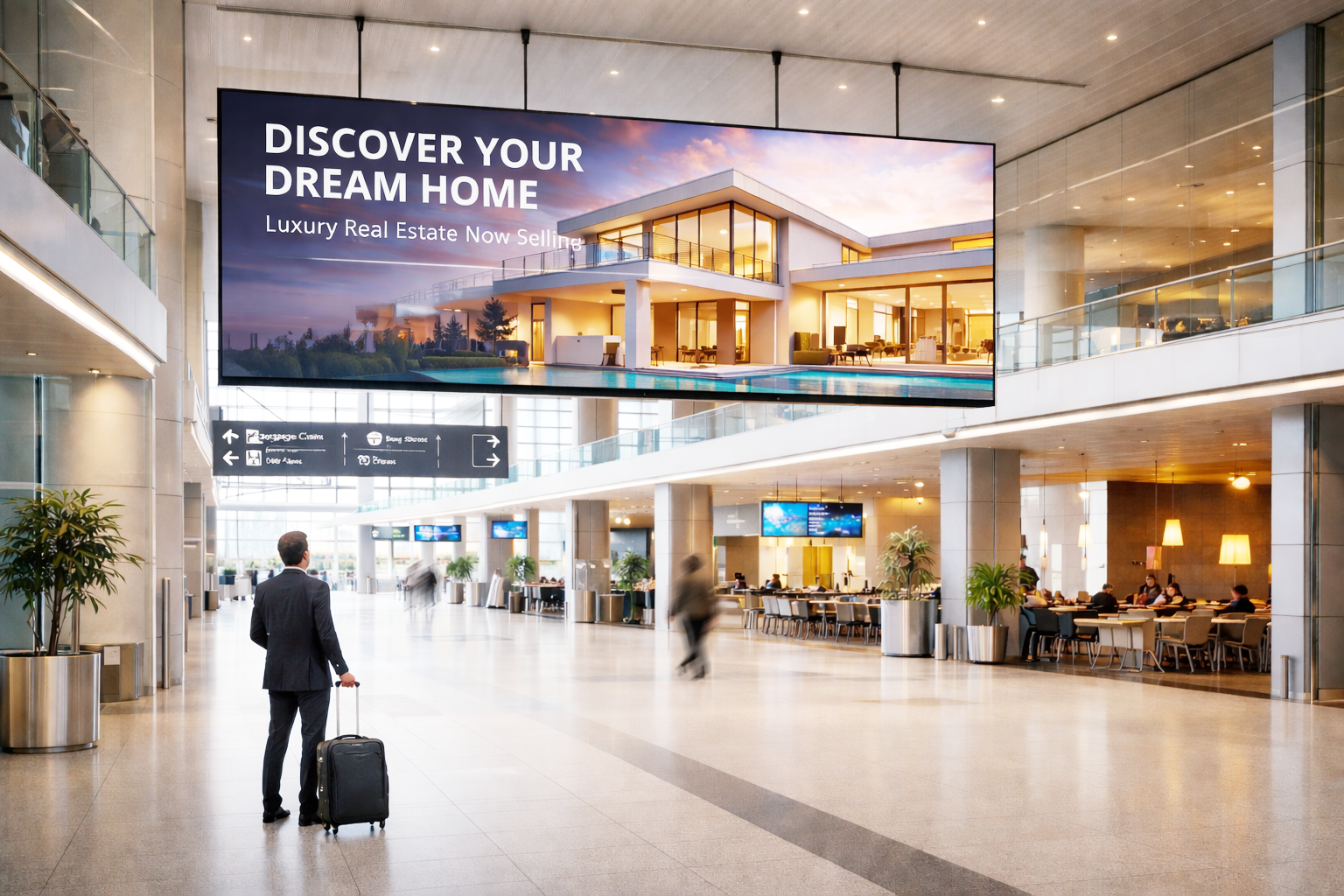
- Advertising opportunity: Low visual clutter means a single well-placed unit carries disproportionate share of voice compared with a large hub terminal. Masscom Global secures placement across arrivals, security recomposition, and gate-hold zones where dwell is longest. Our teams handle planning, production, and installation end to end so campaigns go live on your timeline, not the market's.
Airport Advertising is Complex to Get Right
We help you execute faster, with proven results and local insight most planners lack starting now.
Talk to an Expert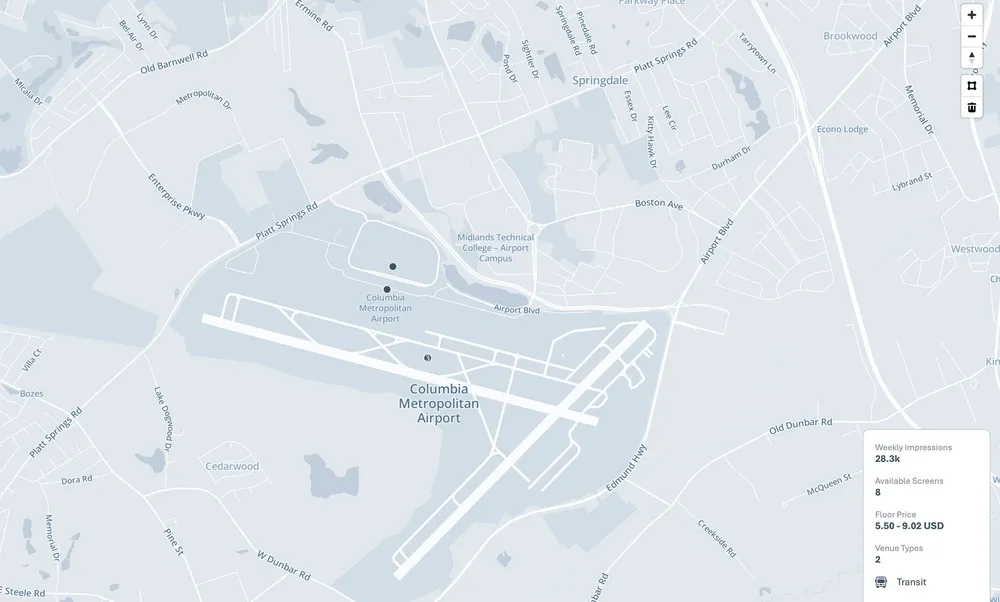
Catchment Area and Economic Drivers
Top 10 Cities within 150 km, Marketer Intelligence:
- Columbia: The decision-making core. State government, university leadership, hospital systems, and insurance headquarters concentrate salaried professional and institutional-buyer audiences in one metro.
- Lexington: Highest-income residential belt in the Midlands. Dual-income professional households with school-age children, strong receptivity to wealth management, private education, and premium automotive.
- Irmo and Chapin: Lake Murray waterfront and second-home households. Discretionary spend skews to boating, home upgrade, travel, and property investment messaging.
- Blythewood: New advanced manufacturing wealth from large-scale automotive investment. Produces relocating engineers, executives, and supplier management on frequent business travel.
- Cayce and West Columbia: Logistics, rail, and airport-adjacent employment. Delivers frequent-flyer operational and supply chain managers who transit the terminal weekly.
- Sumter: Air force installation and defence-supplier community. Reliable military family travel plus federal contractor decision-makers, receptive to insurance, banking, and relocation services.
- Camden: Historic equestrian and steeplechase wealth with a strong seasonal Northeast presence. One of the highest luxury-receptive micro-audiences in the catchment.
- Aiken: Equestrian estates, nuclear and energy sector professionals, and affluent retirees relocated from the Northeast and Midwest. Premium banking, art, watches, and international property all land here.
- Orangeburg: Manufacturing and agribusiness base with two universities. Produces institutional travel and first-generation professional families receptive to education and financial products.
- Newberry and Winnsboro: Textile-legacy and light manufacturing towns feeding plant management and skilled supervisory travel through CAE rather than distant hubs.
NRI and Diaspora Intelligence: CAE does not serve a large single-origin diaspora, so the commercially relevant flow is domestic HNI and relocation movement. The dominant pattern is inbound wealth: professionals, retirees, and business owners moving from New York, New Jersey, Ohio, and Illinois into South Carolina for tax and cost advantages, then flying back frequently to manage property, family, and business interests. A smaller but high-value South Asian and Middle Eastern professional community, largely in medicine, pharmaceuticals, and university faculty, uses CAE to connect onward to international hubs. Both groups over-index on financial services, private healthcare, and overseas property messaging.
Economic Importance: Public administration, defence, healthcare, and insurance anchor the catchment and produce stable, salaried, high-frequency travellers rather than volatile leisure volume. Advanced manufacturing investment in automotive and pharmaceuticals is layering a newer executive and engineering audience on top. Logistics presence at and around the airport adds a constant operational management stream. For advertisers, this mix means audience quality holds steady through economic cycles that would thin out a leisure-dependent airport.
Business and Industrial Ecosystem
- State government and public administration: Legislators, agency executives, and policy professionals. High-credibility environment for institutional finance, infrastructure, consulting, and technology brands.
- Defence and military training: Army and air force installations inside the catchment generate officer, contractor, and family audiences with predictable, year-round movement and strong insurance and banking receptivity.
- Healthcare, pharmaceuticals, and insurance: Hospital systems, generic and sterile drug manufacturing, and insurance headquarters produce clinical, regulatory, and executive travellers ideal for medtech and B2B healthcare messaging.
- Advanced manufacturing and logistics: Automotive, tyre, and machinery plants plus air-side distribution operations deliver plant leadership and supply chain executives on repeat rotations.
Passenger Intent, Business Segment: Business travellers here are largely institutional rather than entrepreneurial. They travel to Washington for policy and funding, to Atlanta and Charlotte for banking and regional management, and to Dallas and Chicago for plant, supplier, and conference obligations. They move on fixed schedules, arrive early, and repeat the same route monthly, which makes CAE a frequency environment rather than a one-impression environment. Financial services, professional services, enterprise technology, and corporate relocation intercept them most effectively.
Strategic Insight: The commercial value of the CAE business audience is authority per impression. A capital-city terminal delivers legislators, regulators, hospital and university executives, and defence contractors in the same corridor, which is rare at this passenger scale. Because the terminal carries far less advertising density than a major hub, a B2B brand can hold visible presence across an entire travel cycle at a fraction of hub-level investment. Masscom Global builds these campaigns around legislative and fiscal calendars so exposure peaks when budget authority is actually in motion.
Tourism and Premium Travel Drivers
- Aiken and Camden equestrian season: Steeplechase racing, polo, and thoroughbred training draw affluent seasonal residents and out-of-state owners. Directly relevant to luxury, private banking, watches, and international property.
- Augusta major golf week: CAE functions as an overflow and private-aviation gateway during the April tournament, briefly concentrating one of the wealthiest inbound audiences in the American Southeast.
- University of South Carolina and football weekends: A 77,000-seat stadium and large out-of-state alumni base create high-volume, high-spend inbound weekends through autumn.
- Lake Murray, Congaree, and Riverbanks: Regional leisure assets that extend visitor stays and support hospitality, automotive rental, and family retail messaging.
Passenger Intent, Tourism Segment: Leisure arrivals at CAE have already committed to a paid reason for being here: a graduation, a wedding, a game weekend, a horse event, or a golf trip. They arrive with a fixed budget already allocated and remaining discretionary spend on dining, retail, vehicles, and accommodation. Departing after the event, they are in a reflective, high-recall state which favours brand and consideration messaging over immediate call-to-action. Hospitality, premium automotive, financial services, and destination real estate benefit most.
Travel Patterns and Seasonality
Peak seasons:
- March to April: Equestrian season, regional golf week, spring break, and university events converge into the year's most affluent traffic window.
- June to August: Summer leisure, family travel, and university orientation cycles lift volumes across all cabins.
- October to November: The strongest single stretch. October was the busiest month of 2025 at 129,176 passengers, driven by football weekends, autumn business travel, and pre-holiday movement.
- Late November to December: Holiday and military graduation travel produces short, dense spikes with high family co-travel.
Event-Driven Movement:
- Carolina Cup, Camden (late March): Steeplechase and social event drawing affluent regional and out-of-state attendees. Ideal window for luxury, spirits, watch, and private banking creative.
- Augusta major golf week (April): Corporate hospitality and HNWI inbound, plus elevated private aviation. Strongest luxury and wealth-management window of the year.
- University graduation and orientation cycles (May, August): Out-of-state parent travel with committed education spend. Prime for financial products, insurance, and relocation services.
- Fort Jackson basic training graduations (year-round, weekly): Continuous family inbound from across all fifty states. Highly effective for banking, insurance, telecom, and automotive.
- Gamecock home football weekends (September to November): Repeat alumni and corporate-guest inbound with high disposable spend and strong regional pride triggers.
It’s Not Just Where You Advertise - It’s How Fast You Execute
We combine local insight with fast rollout to deliver results for you, now.
Talk to an ExpertAudience and Cultural Intelligence
Top 2 Languages:
- English: The functional language of essentially all commercial, institutional, and military travel here. Creative should be direct and confident, since this audience responds to clear value propositions rather than aspiration-led abstraction.
- Spanish: Reflects a growing Hispanic workforce and professional community across the Midlands manufacturing and construction economy. Relevant for remittance, telecom, insurance, and automotive advertisers seeking incremental reach.
Major Traveller Nationalities: The passenger base is overwhelmingly American domestic, drawn from South Carolina, the Northeast, the Midwest, and neighbouring Southeastern states. International travellers connect through Atlanta, Charlotte, Dallas, Chicago, and Washington rather than flying nonstop, and skew toward university faculty, students, pharmaceutical and automotive technical staff, and medical professionals with links to India, China, Germany, and the United Kingdom. For campaign creative, this means English-first messaging with brand cues that read as globally credible, since the connecting international traveller here is educated, senior, and comparison-driven.
Religion, Advertiser Intelligence:
- Protestant Christianity (approximately 60 to 65 percent): Baptist, Methodist, and AME traditions dominate. Easter, Thanksgiving, and Christmas drive dense family travel and gifting, dining, and automotive spend. Family-oriented, trust-led messaging outperforms status-led messaging.
- Catholicism (approximately 8 to 10 percent): Concentrated among relocated Northeastern and Hispanic households. Easter and Christmas travel plus confirmation and wedding events support jewellery, hospitality, and financial planning categories.
- Judaism, Islam, and Hinduism (small but high-value minorities): Concentrated in medical, academic, and pharmaceutical professional households. High Holy Days, Eid, and Diwali drive international connecting travel and gold, gifting, travel, and overseas property purchase behaviour. Small in share, disproportionate in value per impression.
Behavioral Insight: This is a conservative-money audience. Wealth here is typically salaried, inherited, or built slowly through property and business ownership, not from equity windfalls, so purchase decisions favour durability, institutional credibility, and stewardship language over novelty. Trust signals matter more than discounting, and referral and reputation carry heavy weight in categories like banking, healthcare, and property. Campaigns that lead with permanence, family legacy, and proven track record convert better here than campaigns built on urgency or exclusivity alone.
Outbound Wealth and Investment Intelligence
The outbound traveller at CAE is deploying capital defensively rather than speculatively. This is a market of business owners, physicians, senior public officials, retirees with liquid portfolios, and equestrian and land-owning families, all seeking tax efficiency, currency diversification, and second-home lifestyle assets. Because they connect through major hubs, they are captured most reliably at origin, which is exactly what makes CAE an efficient buy for international brands.
Outbound Real Estate Investment: This audience buys in the Caribbean and Central America first, with Turks and Caicos, the Bahamas, Cayman, and Costa Rica leading for rental yield and proximity. In Europe, Portugal, Spain, Italy, and Greece attract retirement and lifestyle purchases, supported by favourable pricing against US dollar strength and long-stay residency pathways. The United Arab Emirates has emerged for higher-yield, zero-income-tax property allocation among younger business owners. International developers advertising at CAE reach these buyers at the point of intent, before competing markets reach them at the connecting hub.
Outbound Education Investment: Families from this catchment send students primarily to the United Kingdom, Ireland, Canada, and Australia for undergraduate and postgraduate study, with growing interest in continental European programmes taught in English for cost reasons. Household budgets are substantial and typically planned years in advance through dedicated education savings vehicles. International universities, boarding schools, and education consultancies gain meaningful advantage here because this catchment is under-serviced by international education marketing relative to its actual purchasing capacity.
Outbound Wealth Migration and Residency: Second-residency demand is rising among physicians, retirees, and business owners looking for optionality rather than relocation. The most relevant programmes are Portugal's residency and fund-based routes, Greece and Italy investor and elective residency options, and Caribbean citizenship-by-investment programmes in St Kitts and Nevis, Grenada, Antigua, and Dominica, which appeal for mobility and estate planning. UAE long-term residency is gaining traction among the younger commercial segment.
Strategic Implication for Advertisers: Brands on both ends of this corridor should treat CAE as a low-competition, high-intent origin point for American capital seeking offshore deployment. Developers, residency advisories, private banks, and international universities can reach a wealth pool that hub-focused media plans systematically miss. Masscom Global activates both sides of the corridor at once, placing the same brand at CAE and at the destination-market airports where these buyers land.
Airport Infrastructure and Premium Indicators
Terminals:
- Single consolidated passenger terminal with two concourses and roughly a dozen gates serving all scheduled commercial traffic. The concentration is an advantage for advertisers: every passenger passes through the same limited set of decision points.
- Recent multi-year enhancement work has expanded the security checkpoint, upgraded the concourse, revised passenger exit routing, and added amenities including sensory and pet relief facilities, all of which reshaped passenger flow and dwell.
Premium Indicators:
- Lounge provision is limited relative to hub airports, which pushes premium and business passengers into shared concourse and gate-hold environments where advertising exposure is higher, not lower.
- Established fixed-base operations support significant general and private aviation traffic, including corporate flights tied to state government, defence, and equestrian and golf season movement.
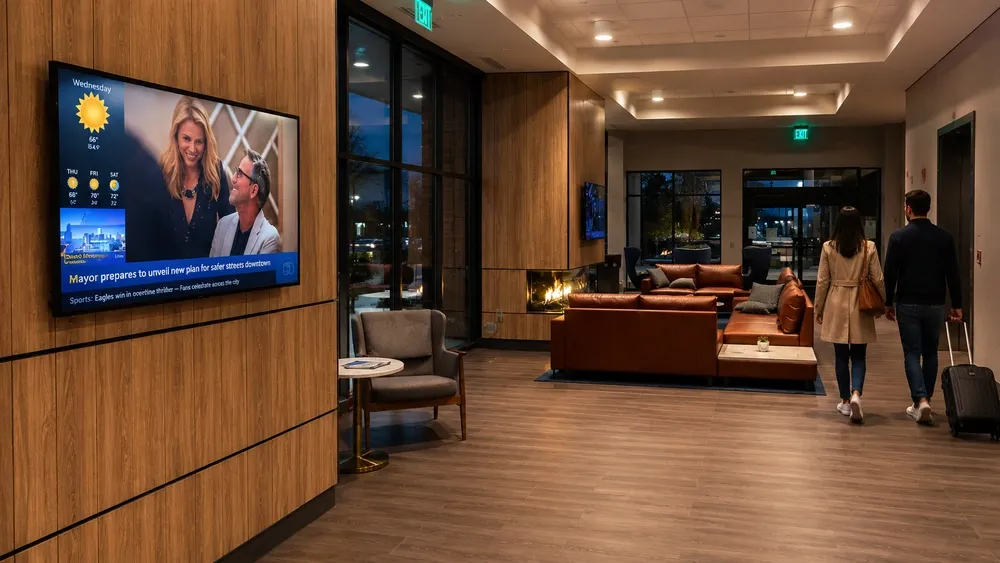
- Full-service accommodation clusters immediately around the airport and in the Columbia business district rather than on-terminal, extending brand exposure across the ground journey.
- A long-running airport art programme, returning for its seventh year in 2026, has given the terminal a curated, gallery-like character that materially elevates brand association for premium advertisers.
Forward-Looking Signal: CAE is executing against a multi-year master plan while capital spending continues on concourse improvements, technology, and parking. Route development is expanding rather than contracting, with legacy carrier nonstop service to Miami restarting in May 2026, and large-scale automotive manufacturing investment inside the catchment is set to add sustained executive and supplier traffic. Every one of these signals points toward rising commercial value and rising media demand at CAE. Masscom Global advises clients to secure position now, at current-cycle rates, before expanded capacity and new routes tighten availability.
Airline and Route Intelligence
Top Airlines: American Airlines, Delta Air Lines, United Airlines and their regional partners operate the scheduled network, supported by a significant integrated air cargo presence on airport property.
Key International Routes: CAE has no scheduled nonstop international service. International passengers connect through Atlanta, Charlotte, Dallas Fort Worth, Chicago, Washington, and Miami, which makes CAE an origin capture point rather than a transfer environment.
Domestic Connectivity: Core routes serve Atlanta, Charlotte, Dallas Fort Worth, Chicago, and the Washington area, with seasonal and returning service to Miami and Florida leisure markets. These are hub-feed routes with high repeat frequency rather than point-to-point leisure routes.
Wealth Corridor Signal: The route map tells advertisers precisely who this audience is. Washington service is a policy and federal funding corridor. Charlotte and Atlanta are banking, regional management, and international gateway corridors. Dallas and Chicago are corporate, manufacturing, and conference corridors. Miami and Florida service is the wealth and second-home corridor, doubling as the practical gateway to Caribbean and Latin American property interests. Almost nothing in this network is casual leisure, which is why impressions here carry higher commercial weight than the passenger count alone suggests.
Media Environment at the Airport
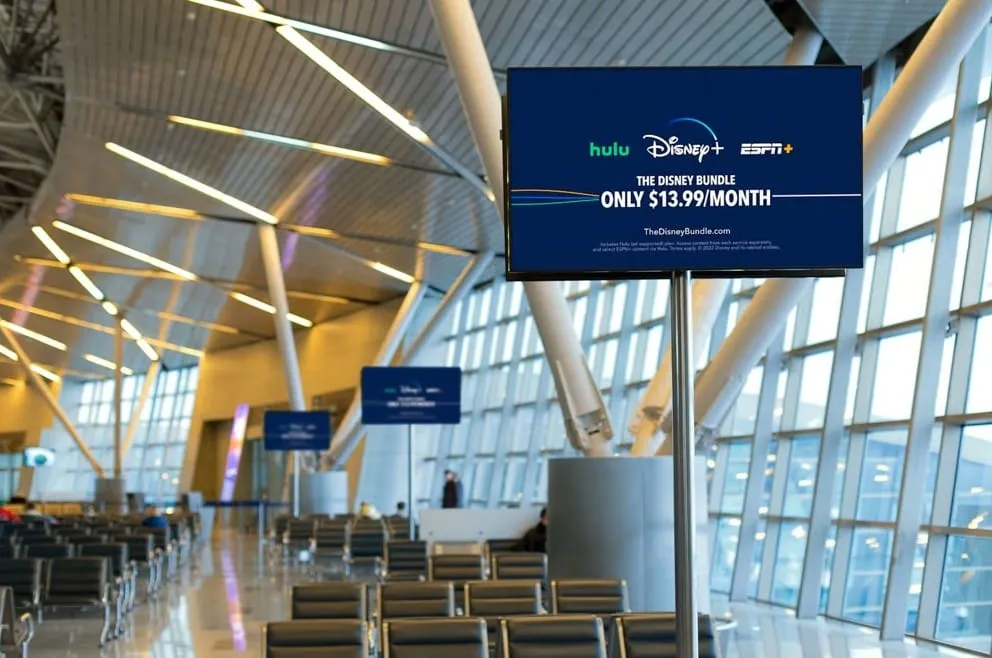
- Compact single-terminal layout with materially lower advertising clutter than Atlanta, Charlotte, or Dallas, so a single well-positioned unit commands share of voice that would require a multi-site buy at a hub.
- Dwell is driven by hub-connection scheduling, early arrival behaviour typical of smaller-airport travellers, and concentrated gate-hold areas, which extends effective exposure time per passenger well beyond hub averages.
- The curated art programme and recently upgraded concourse create a calm, considered environment that flatters premium brand association rather than competing with it.
- Masscom Global provides direct inventory access across arrivals, checkpoint recomposition, concourse, and gate-hold zones, with precise placement mapped to passenger flow post-renovation, plus production and installation managed end to end.
Strategic Advertising Fit
Best Fit:
- Financial services and wealth management: Salaried professional, retiree, and business-owner wealth with conservative, advisory-led purchase behaviour.
- Insurance and protection products: Continuous military and federal-contractor family flow with structural demand for life, auto, and property cover.
- Healthcare, pharma, and medtech: Hospital systems, pharmaceutical manufacturing, and clinical travel create a genuine B2B and B2C dual audience.
- International real estate and residency advisory: Active outbound buyer pool for Caribbean, European, and UAE property that competing channels do not reach at origin.
- Higher education and international universities: Large university-linked catchment with committed multi-year education budgets and strong overseas study intent.
- Premium automotive: Affluent suburban households in Lexington, Irmo, Chapin, Aiken, and Camden with high vehicle replacement rates.
- Government-adjacent B2B, infrastructure, and consulting: Direct access to legislators, agency leadership, and procurement decision-makers.
- Relocation, moving, and residential property services: Sustained inbound migration from Northeast and Midwest markets.
Brand Alignment at a Glance:
| Category | Fit |
|---|---|
| Financial services and wealth management | Exceptional |
| Healthcare, pharma, and medtech | Exceptional |
| International real estate and residency | Strong |
| Higher education and international universities | Strong |
| Premium automotive | Strong |
| Luxury retail and jewellery | Moderate |
| Duty free and travel retail | Moderate |
| Mass-market fast fashion | Poor fit |
Who Should Not Advertise Here:
- Ultra-luxury fashion and haute couture flagships: The HNWI presence is real but too dispersed and too understated in consumption to justify flagship-tier investment at this volume.
- Nightlife, gaming, and casino brands: Culturally misaligned with a conservative, family-weighted, military-adjacent audience and likely to generate resistance rather than response.
- Youth-led discount app and fast fashion campaigns: The student population largely travels by road and does not represent meaningful share of terminal traffic.
Event and Seasonality Analysis
- Event Strength: High
- Seasonality Strength: Medium
- Traffic Pattern: Dual-Peak with continuous event underlay
Strategic Implication: Budget should be weighted toward two windows: March to April for the affluent equestrian and golf audience, and October to November for peak volume, business travel, and football weekends. Because Fort Jackson graduation traffic runs year-round, a continuous baseline presence protects reach between those peaks rather than leaving gaps. Masscom Global structures CAE campaigns around exactly this rhythm, front-loading premium formats into the two high-value peaks while maintaining always-on coverage for the military and government audience.

Poor Placement and Delays Affect Airport Campaigns
We help you move faster, access better inventory, and get it right now.
Talk to an ExpertFinal Strategic Verdict
Columbia Metropolitan Airport is one of the most efficient authority buys in the American Southeast. At 1,371,977 passengers in 2025, its second straight record year, CAE delivers state legislators, agency leadership, hospital and university executives, defence contractors, military families from all fifty states, and the equestrian and retiree wealth of Aiken and Camden through a single terminal with a fraction of the advertising clutter found at Atlanta or Charlotte. Financial services, healthcare, international real estate, residency advisory, and international education gain the most here, because this is a conservative-money audience with real capital, genuine outbound investment intent, and almost no competing messaging reaching them before they connect. Expansion under the master plan, returning Miami nonstop service in 2026, and major automotive manufacturing investment inside the catchment all point one direction, which means the window for current-cycle rates is finite. Masscom Global has the inventory access, catchment intelligence, and execution capability to put your brand in front of this audience at both ends of its wealth corridor.
About Masscom Global
Masscom Global is a premium international airport advertising and media buying agency operating across 140 countries. With deep expertise in airport OOH, premium publications, and high-net-worth audience targeting, Masscom helps brands reach the world's most valuable travellers at the moments that matter most. For advertising packages, media rates, and campaign planning at Columbia Metropolitan Airport and airports across the globe, contact Masscom Global today.
Frequently Asked Questions
How much does airport advertising cost at Columbia Metropolitan Airport? Cost at CAE depends on format, position within the terminal, campaign duration, and seasonal demand. Digital and large-format placements in the concourse and gate-hold zones carry different rates from arrivals and baggage claim positions, and pricing tightens sharply around the March to April and October to November peaks. Because CAE has relatively low advertising density, cost per share of voice is significantly more efficient than at nearby hubs. Contact Masscom Global for current rates and availability.
Who are the passengers at Columbia Metropolitan Airport? Predominantly domestic American travellers from South Carolina's Midlands, plus inbound visitors from across all fifty states. The core segments are state government and public-sector professionals, military personnel and their visiting families, healthcare and pharmaceutical staff, manufacturing and logistics executives, university-linked families, and affluent retirees and equestrian residents from Aiken, Camden, Lexington, and the Lake Murray corridor. Repeat business frequency is high because nearly all routes are hub connections.
Is Columbia Metropolitan Airport good for luxury brand advertising? It is strong for premium and wealth-adjacent categories, and selective for pure luxury. Private banking, wealth management, international property, watches, premium automotive, and residency advisory perform well because Aiken, Camden, and Lexington hold real HNWI density and private aviation traffic is meaningful. Flagship haute couture and ultra-luxury fashion are a weaker fit, since wealth in this catchment is deliberately understated in its consumption.
What is the best airport in South Carolina to reach HNWI audiences? Charleston leads on inbound luxury tourism volume and Greenville on corporate manufacturing wealth, but CAE is the state's uncontested channel for government authority, defence, and inland equestrian and retiree wealth. It is also the most efficient of the three on cost per premium impression because advertising clutter is lowest. For statewide HNWI coverage, Masscom typically recommends CAE paired with one coastal airport.
What is the best time to advertise at Columbia Metropolitan Airport? Two windows deliver the most value. March and April combine the Camden equestrian season, Augusta golf week overflow, and spring break into the year's most affluent traffic. October and November deliver peak volume, with October 2025 the busiest month on record at 129,176 passengers, driven by football weekends and autumn business travel. Year-round military graduation traffic makes a continuous baseline presence worthwhile between peaks.
Can international real estate developers advertise at Columbia Metropolitan Airport? Yes, and it is one of the most under-exploited opportunities at this airport. This catchment's HNI audience is actively buying in Turks and Caicos, the Bahamas, Cayman, Costa Rica, Portugal, Spain, Italy, Greece, and the United Arab Emirates, motivated by yield, tax efficiency, and residency optionality. Because these buyers connect through hubs, they are reachable at CAE before any destination-market advertising touches them. Masscom Global places developers at both origin and destination airports simultaneously.
Which brands should not advertise at Columbia Metropolitan Airport? Nightlife, gaming, and casino brands are culturally misaligned with a conservative, family-weighted, military-adjacent audience. Youth-focused discount apps and fast fashion have little traction because the student population travels overwhelmingly by road. Ultra-luxury fashion flagships will not recover investment at this passenger scale, even though wealth-adjacent premium categories perform well.
How does Masscom Global help brands advertise at Columbia Metropolitan Airport? Masscom Global handles the full campaign lifecycle: catchment and audience intelligence, format and placement selection mapped to post-renovation passenger flow, rate negotiation, production, installation, and performance reporting. We time campaigns to CAE's dual-peak rhythm and continuous military underlay, and we extend the same brand across the connecting hubs and destination markets this audience travels to. Book a 15-minute planning call to review current availability and rates.