

Airport at a Glance
| Field | Detail |
|---|---|
| Airport | Bellingham International Airport |
| IATA Code | BLI |
| Country | United States of America |
| City | Bellingham, Washington |
| Annual Passengers | 456,410 (2025) |
| Primary Audience | Metro Vancouver Canadian leisure travellers, South Asian and Chinese Canadian diaspora households, Pacific Northwest energy and marine professionals |
| Peak Advertising Season | April, June to September, December to February |
| Audience Tier | Tier 3 by scale, Tier 1 catchment wealth adjacency |
| Best Fit Categories | Cross-border financial services, international real estate and residency, diaspora travel and remittance, outdoor and marine lifestyle |
Bellingham International handled 456,410 passengers in 2025, down from around 529,000 in 2024 as cross-border travel demand softened. That contraction is the reason this airport deserves an advertiser's attention rather than a reason to dismiss it. Volume has fallen while the catchment behind it has not: Metro Vancouver still sits 90 kilometres north, the border is still 30 kilometres away, and the structural fare and fee gap that built this traffic remains intact. Masscom Global reads BLI as a distressed-rate window on a genuinely high-value audience.
What makes BLI commercially unique is that it functions as a Canadian airport under an American flag. Passenger fees here run a fraction of those at Vancouver International, which for decades has pulled affluent British Columbians south by road to fly domestic US routes. The people making that drive are self-selecting: they are price-aware, high-frequency, and disproportionately drawn from Surrey, Abbotsford, Langley, and Richmond, home to two of the wealthiest and most internationally connected diaspora communities in North America. Masscom activates a Canadian HNWI audience at American media rates.
Advertising Value Snapshot
- Passenger scale: 456,410 passengers in 2025 against roughly 529,000 in 2024, following a period of carrier consolidation and softer cross-border demand.
- Traveller type: Canadian leisure and family travellers from Metro Vancouver, South Asian and Chinese Canadian diaspora households, regional energy, marine, and university travellers.
- Airport classification: Tier 3 by passenger volume, but with Tier 1 catchment wealth sitting directly behind it. An anomaly worth pricing carefully.
- Commercial positioning: North America's best-known cross-border fare arbitrage airport and the road gateway between Vancouver and the US domestic network.
- Wealth corridor signal: BLI sits on the Vancouver-to-Asia and Vancouver-to-Punjab wealth corridors, intercepting capital that ultimately moves between British Columbia, India, China, and the Gulf.
Advertising opportunity: A single terminal with five gates and one security checkpoint means near-total audience coverage from a very small number of placements. Softer volume has pushed rates to a level that does not reflect the household income sitting in this catchment. Masscom Global secures position at current pricing and structures campaigns to capture the recovery rather than pay for it later.
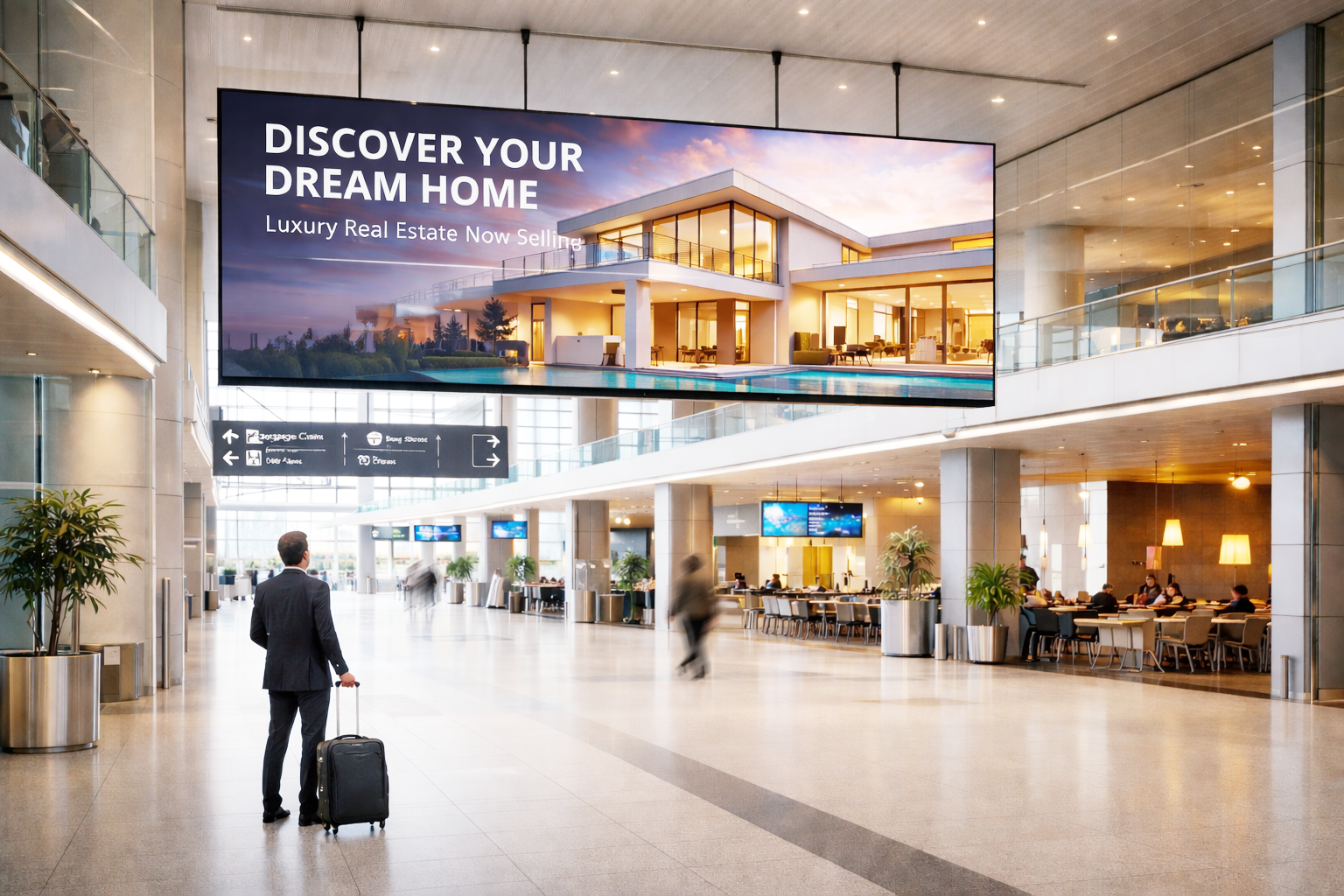
Airport Advertising is Complex to Get Right
We help you execute faster, with proven results and local insight most planners lack starting now.
Talk to an Expert
Catchment Area and Economic Drivers
Top 10 Cities within 150 km, Marketer Intelligence:
- Vancouver, British Columbia: The primary wealth engine of the catchment. Some of the highest residential property values in North America produce equity-rich households with strong appetite for offshore property, private banking, and premium travel.
- Surrey, British Columbia: One of the largest Punjabi Sikh communities outside India. Large multi-generational households, significant business ownership, high remittance and gold purchase behaviour, and heavy India-bound family travel.
- Richmond, British Columbia: Predominantly Chinese Canadian, with deep Hong Kong, Mainland, and Taiwanese wealth. Highly brand-literate, luxury-receptive, and active in cross-border property and education spending.
- Abbotsford, British Columbia: Agricultural and transport business wealth combined with a large established South Asian community. Owner-operator money that buys practically but at scale.
- Langley and White Rock, British Columbia: Affluent suburban and retiree households with second-property ownership and the shortest drive to the terminal. Strong receptivity to wealth management and warm-weather property offers.
- Bellingham, Washington: The local core. University leadership, healthcare, marine industry, and a professional in-migration population from Seattle and California.
- Lynden and Ferndale, Washington: Dairy, berry, and energy sector wealth. Whatcom County is a world-leading red raspberry producer, and refinery employment here delivers high-wage industrial households.
- Blaine and Point Roberts, Washington: Border commerce, logistics, and cross-border retail. Also home to significant resort and marina wealth serving Canadian second-home owners.
- Mount Vernon, Burlington, and Anacortes, Washington: Agriculture, refining, and yachting. Anacortes marine wealth and San Juan Islands ownership deliver a genuinely high-net-worth micro-audience.
- Oak Harbor and Everett, Washington: Naval aviation and aerospace manufacturing. Produces defence, engineering, and supplier travel plus reliable military family movement.
NRI and Diaspora Intelligence: This is one of the strongest diaspora advertising propositions of any airport its size in the United States. The Surrey and Abbotsford corridor holds one of the largest Punjabi Sikh populations anywhere outside India, characterised by transport, construction, and agricultural business ownership, large households, and sustained remittance flows to Punjab. Richmond and Vancouver hold a comparably significant Chinese Canadian population with substantial Hong Kong and Mainland-origin capital and long-established cross-Pacific investment behaviour. Both communities use BLI heavily for US domestic legs and for onward international connections at lower cost. For advertisers in gold, remittance, property, education, and travel, these are decision-ready audiences reachable at a fraction of Vancouver-market media cost.
Economic Importance: The American side of the catchment runs on petroleum refining at Cherry Point, agriculture and food processing, commercial fishing and marine services, higher education, and cross-border logistics. Bellingham is a homeport for the Alaska fishing fleet and the southern terminus of the Alaska Marine Highway, which adds a distinct seasonal maritime workforce and cruise-adjacent visitor flow. The Canadian side contributes property wealth, small and mid-sized business ownership, and a large professional and technology workforce. For advertisers, this produces two clearly separable audiences in one terminal: high-wage industrial and marine households on one side, and equity-rich diaspora and suburban wealth on the other.
Business and Industrial Ecosystem
- Petroleum refining and energy at Cherry Point: High-wage engineering, operations, and contractor households with strong receptivity to financial services, insurance, and premium automotive.
- Cross-border trade and logistics: Two of the busiest western land crossings sit inside the catchment, producing owner-operator transport wealth concentrated in the Surrey and Abbotsford corridor.
- Commercial fishing, marine services, and boatbuilding: Bellingham's harbour economy and Alaska fleet homeporting create seasonal high-income earners and a substantial yacht and marine ownership base.
- Higher education, healthcare, and agriculture: A major regional university, hospital systems, and a globally significant berry and dairy sector deliver institutional and agribusiness travel year-round.
Passenger Intent, Business Segment: Pure business travel is the smaller share here, and it concentrates on the Seattle shuttle, which operates multiple daily rotations and functions as the airport's connectivity spine. These passengers are heading to Sea-Tac to join long-haul and international networks, which makes the terminal an origin capture point for internationally bound professionals. The larger commercially relevant segment is the owner-operator: transport, agriculture, construction, and marine business owners from both sides of the border who travel frequently and control their own spend. Financial services, insurance, commercial vehicles, equipment finance, and business travel brands intercept them most effectively.
Strategic Insight: The B2B value at BLI lies in reaching business owners rather than employees. Corridor economies like this one concentrate decision-making authority in individuals rather than committees, which compresses the sales cycle for financial, insurance, and equipment categories. Because the terminal has a single security checkpoint and a compact concourse, a brand can achieve effectively complete coverage of that audience with minimal inventory. Masscom Global builds these campaigns around border and freight seasonality so exposure aligns with the periods when this audience is actually deploying capital.
Tourism and Premium Travel Drivers
- Mount Baker and the North Cascades: Winter ski and summer alpine traffic drawing both Canadian and regional visitors. Strong alignment with outdoor premium, apparel, and vehicle brands.
- San Juan Islands and the Salish Sea: Yachting, island property ownership, and charter activity supported by regional air service from the terminal. One of the clearest luxury and marine signals in the catchment.
- Alaska Marine Highway southern terminus: Bellingham is where the Alaska ferry system begins, producing a distinct long-duration, high-budget adventure traveller through the summer.
- Skagit Valley Tulip Festival and regional agritourism (April): A major short-window inbound draw pulling large Canadian and international visitor volumes into the catchment.
Passenger Intent, Tourism Segment: Leisure passengers here fall into two very different intent states. Canadians departing for Las Vegas, Phoenix, Palm Springs, San Diego, and Burbank have already committed to accommodation, vehicles, and entertainment budgets, and are receptive at the airport to adjacent categories including currency, travel insurance, credit products, and destination property. Inbound visitors arriving for Mount Baker, the islands, or the Alaska ferry are at the start of high-budget multi-week trips with gear, vehicle, and hospitality spend still open. Financial services, travel insurance, telecom, automotive, and destination real estate benefit most.
Travel Patterns and Seasonality
Peak seasons:
- December to February: Canadian snowbird and warm-weather escape traffic to Nevada, Arizona, and California, the airport's structural core.
- April: Vaisakhi celebration travel across the Surrey and Abbotsford corridor plus the tulip festival inbound window converge into a dense short peak.
- June to September: Summer leisure, Alaska ferry departures, island and alpine visitation, and diaspora family travel at maximum volume.
- Late March and spring break: Concentrated Canadian family departures with the largest group sizes of the year.
Event-Driven Movement:
- Vaisakhi, Surrey and Abbotsford (April): One of the largest Sikh gatherings outside India takes place inside this catchment, drawing extended family inbound and outbound. Exceptional window for gold, remittance, travel, and property advertisers.
- Lunar New Year (January or February): Richmond and Vancouver Chinese Canadian households travel at scale and gift heavily. Prime timing for luxury, jewellery, travel, and financial brands.
- Diwali (October or November): Strong purchase-trigger period across the South Asian catchment covering gold, apparel, electronics, and property deposits.
- Skagit Valley Tulip Festival (April): High-volume regional and international inbound with hospitality, retail, and automotive spend.
- Alaska ferry sailing season (May to September): Recurring departures of long-duration, high-budget adventure travellers with committed outdoor and vehicle budgets.
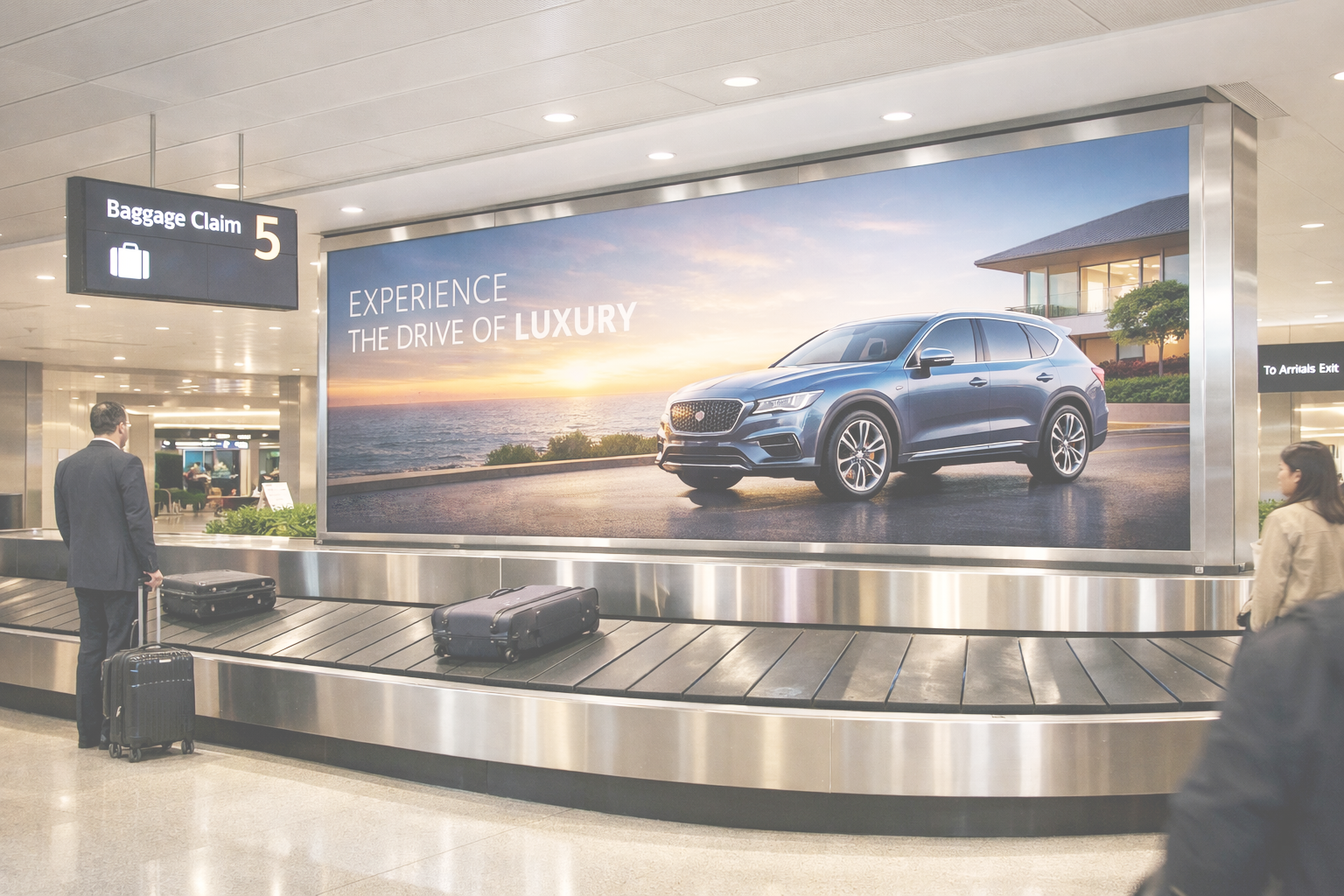
It’s Not Just Where You Advertise - It’s How Fast You Execute
We combine local insight with fast rollout to deliver results for you, now.
Talk to an ExpertAudience and Cultural Intelligence
Top 2 Languages:
- English: The functional commercial language on both sides of the border and the default for all creative. This audience is comparison-driven and price-literate by definition, so specific value claims outperform aspirational framing.
- Punjabi: Commercially the most valuable second language at this airport. The Surrey and Abbotsford corridor holds one of the largest Punjabi-speaking populations outside India, with high business ownership, large households, and heavy India-bound travel. Punjabi creative here signals genuine cultural respect and consistently outperforms English-only for financial, gold, travel, and property categories. Mandarin and Cantonese follow closely given the Richmond catchment, and Spanish carries weight within the Whatcom agricultural workforce.
Major Traveller Nationalities: Canadians represent roughly 45 to 55 percent of all passengers, overwhelmingly from British Columbia, which is a share no comparable American airport approaches. The remainder is predominantly American, drawn from Whatcom, Skagit, Island, and Snohomish counties. Within the Canadian share, a large proportion are first and second generation Indian, Chinese, Filipino, Korean, and Iranian Canadians, meaning nationality on paper and cultural identity in market are materially different here. For creative, this demands bilingual and culturally specific execution rather than generic North American messaging, and it makes BLI unusually effective for brands targeting diaspora wealth.
Religion, Advertiser Intelligence:
- Christianity, Protestant and Catholic (approximately 40 to 45 percent of the combined catchment): Concentrated on the Whatcom and Skagit side and among established suburban Canadian households. Christmas and Easter drive family travel, gifting, and dining spend, with conventional family-trust messaging performing well.
- Sikhism (approximately 10 to 12 percent of the Canadian catchment, far higher in Surrey and Abbotsford): Vaisakhi in April is the dominant travel and spending trigger, alongside wedding season and gurdwara community events. Gold, jewellery, remittance, apparel, property, and India-bound travel are the categories that convert.
- Buddhism, Chinese folk traditions, Hinduism, and Islam (collectively significant across Richmond, Vancouver, and Surrey): Lunar New Year, Diwali, and Eid each produce sharply defined travel and gifting spikes. These are small percentage shares with very high value per impression, particularly for luxury, jewellery, and cross-border financial products.
- Non-religious (a very large share, higher here than most of North America): The Pacific Northwest and British Columbia both index low on religious affiliation. This segment is the most receptive to conventional lifestyle, outdoor, sustainability, and premium positioning without cultural qualification.
Behavioral Insight: This is an audience that has already demonstrated willingness to take action for financial advantage, because crossing an international border by road to save on airfare is itself a deliberate value decision. That mindset carries directly into how they buy: they compare, they calculate, and they respond strongly to quantified savings, yield, and total cost arguments rather than status signalling. Within the diaspora segment, decisions are family-consulted and community-referred, so trust markers, community language, and visible track record matter more than advertising polish. Brands that lead with a specific number convert here; brands that lead with prestige alone do not.
Outbound Wealth and Investment Intelligence
The outbound passenger at BLI is unusual in that their capital is Canadian, their travel is American, and their investment interests are frequently Asian. This is property-equity wealth built through decades of British Columbia real estate appreciation, combined with owner-operator business income and inherited cross-Pacific family assets. They are actively rebalancing away from a single overheated home market, which makes them one of the most receptive audiences in North America for offshore property and residency propositions.
Outbound Real Estate Investment: The dominant flows run to the southwestern United States, where Arizona, Nevada, California, and increasingly Texas and Florida absorb Canadian snowbird and rental-yield purchases, a pattern the route map at this airport directly serves. Beyond North America, Mexico's Pacific coast draws lifestyle and rental buyers, while the United Arab Emirates has become a significant destination for South Asian Canadian capital seeking zero-income-tax yield and Golden Visa eligibility. Portugal, Spain, and Greece attract European retirement and residency purchases, and India remains a live market for agricultural land, commercial property, and family housing in Punjab and Delhi NCR. International developers advertising at BLI reach buyers whose home-market yields are compressed and who are already actively looking elsewhere.
Outbound Education Investment: Families across this catchment send students to the United Kingdom, Australia, Ireland, and the United States, with strong and growing flows into Dubai and Singapore institutions among the South Asian and Chinese segments. Education spending here is treated as a family obligation rather than a discretionary purchase, funded across multiple relatives and planned years ahead. International universities, pathway programmes, and education consultancies gain real advantage at BLI because this audience combines high willingness to spend, established migration culture, and comparatively little competing international education advertising at the airport level.
Outbound Wealth Migration and Residency: Second-residency demand here is driven by tax planning, currency diversification, and mobility for children. The most relevant programmes are UAE long-term and Golden Visa residency, which resonate strongly with the South Asian business-owner segment, Portugal's fund-based residency and Greece and Italy investor routes for European optionality, and Caribbean citizenship-by-investment in St Kitts and Nevis, Grenada, Antigua, and Dominica for estate structuring and travel freedom. Interest in Gulf and Southeast Asian residency is notably higher in this catchment than the Canadian national average.
Strategic Implication for Advertisers: International developers, private banks, residency advisories, and universities should treat BLI as the cheapest available entry point to Metro Vancouver diaspora wealth. The same household reached at Vancouver International or through Vancouver media costs materially more to touch, and BLI intercepts them in a longer, calmer dwell environment. Masscom Global activates both ends of the corridor at once, placing the same brand at BLI and at the destination-market airports in the Gulf, India, and Europe where this capital lands.
Airport Infrastructure and Premium Indicators
Terminals:
- A single passenger terminal operating five boarding gates and one security checkpoint with two screening lanes, following a 38.5 million dollar expansion completed in 2014 that tripled gate capacity.
- The terminal operates around the clock, and typical weekday activity runs roughly 8 to 12 commercial departures with a matching arrival pattern, which concentrates passengers into predictable, repeatable flow windows.
Premium Indicators:
- No airline lounge provision, which means premium and business passengers dwell in the shared concourse and gate-hold areas where advertising exposure is highest.
- Substantial general and corporate aviation activity, with fixed-base operations serving private movement into the San Juan Islands, Mount Baker, and the Vancouver corridor.
- The Port of Bellingham operates significant marina and harbour assets alongside the airport, and the region's yacht and island property ownership represents a genuine luxury wealth signal within the catchment.
- Resort-grade accommodation at Blaine and Semiahmoo plus Mount Baker lodging inventory serves an affluent Canadian and regional visitor base, extending brand exposure across the ground journey.
Forward-Looking Signal: BLI is at an inflection point rather than a decline. Its dominant carrier will move to a turn-based operating model in November 2026 while confirming that all existing routes and schedules continue, meaning passenger-facing service is unchanged. The Port continues active air service development work, the structural fee advantage over Vancouver remains fully intact, and the airport retains its Port of Entry designation, which keeps a pathway open to scheduled international and cross-border service. Any recovery in Canadian travel demand flows straight back through this terminal, and media rates today are set against the trough rather than the rebound. Masscom Global advises clients to lock position now, at current-cycle rates, and hold it through the recovery.
Airline and Route Intelligence
Top Airlines: Allegiant Air is the dominant carrier at roughly 60 percent of capacity, with Alaska Airlines at approximately 38 percent and San Juan Airlines operating regional island service from the airport as its hub.
Key International Routes: BLI currently has no scheduled international passenger service. Its international function is by road: roughly 30 kilometres from the primary Vancouver-area border crossing, which is precisely why half its passengers are Canadian. International connectivity is achieved through Seattle, Las Vegas, and Phoenix.
Domestic Connectivity: The core network serves Las Vegas, Phoenix and Mesa, San Diego, Palm Springs, and Burbank, with Alaska Airlines operating a high-frequency Seattle shuttle at around four daily round trips. San Juan Airlines adds island service to Friday Harbor and the Salish Sea communities.
Wealth Corridor Signal: The route map is almost purely a snowbird and warm-weather leisure network, and that tells advertisers exactly what to sell. Las Vegas, Phoenix, Palm Springs, and San Diego are Canadian second-home and retirement corridors, which makes cross-border property, mortgage, currency, health insurance, and estate planning products structurally relevant rather than speculative. The Seattle shuttle is the wealth-transfer route, feeding long-haul departures toward Asia, the Gulf, and Europe, which is where this catchment's diaspora capital actually travels. Island service signals marine and second-property ownership. Very little of this network is incidental.
Media Environment at the Airport
- A five-gate single-terminal layout with one security checkpoint delivers near-complete audience coverage from a small number of placements, something no metropolitan airport can match at any price.
- Dwell is extended by the ultra-low-cost carrier profile and by cross-border passengers who build large buffers for border queues, meaning many arrive at the terminal well ahead of schedule.
- Twenty-four hour terminal operation and low-frequency scheduling create long, quiet exposure windows rather than the compressed rushes typical of hub environments.
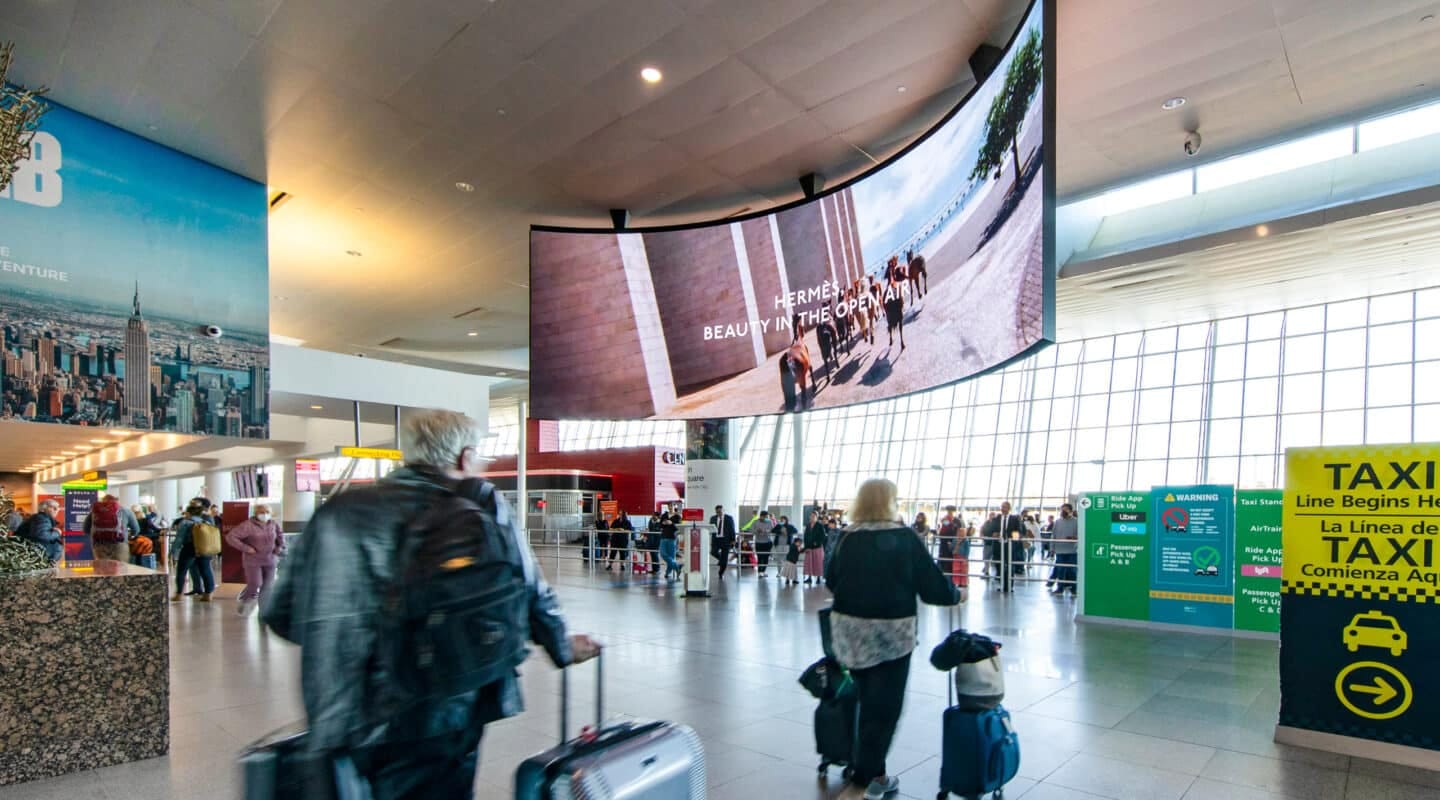
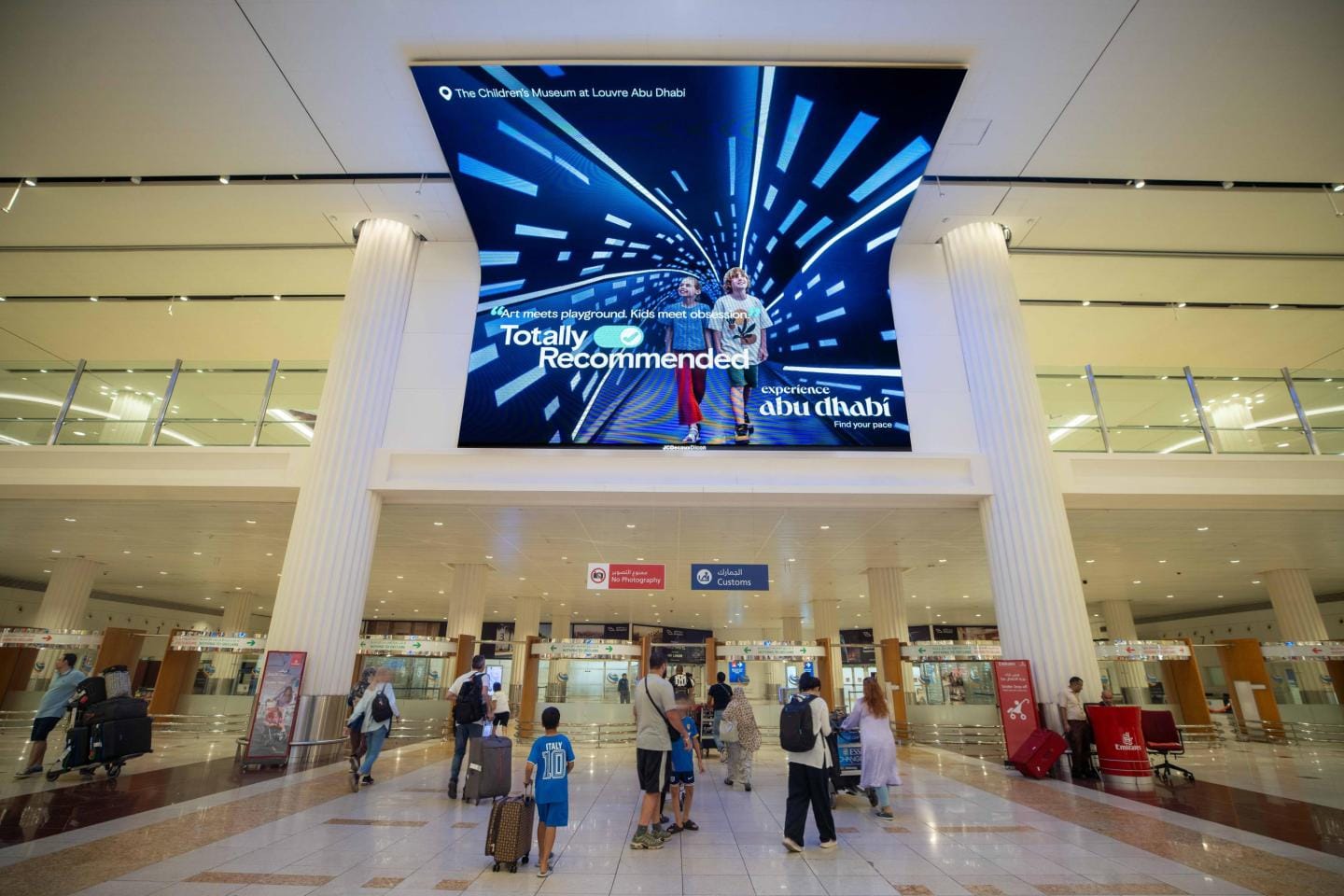
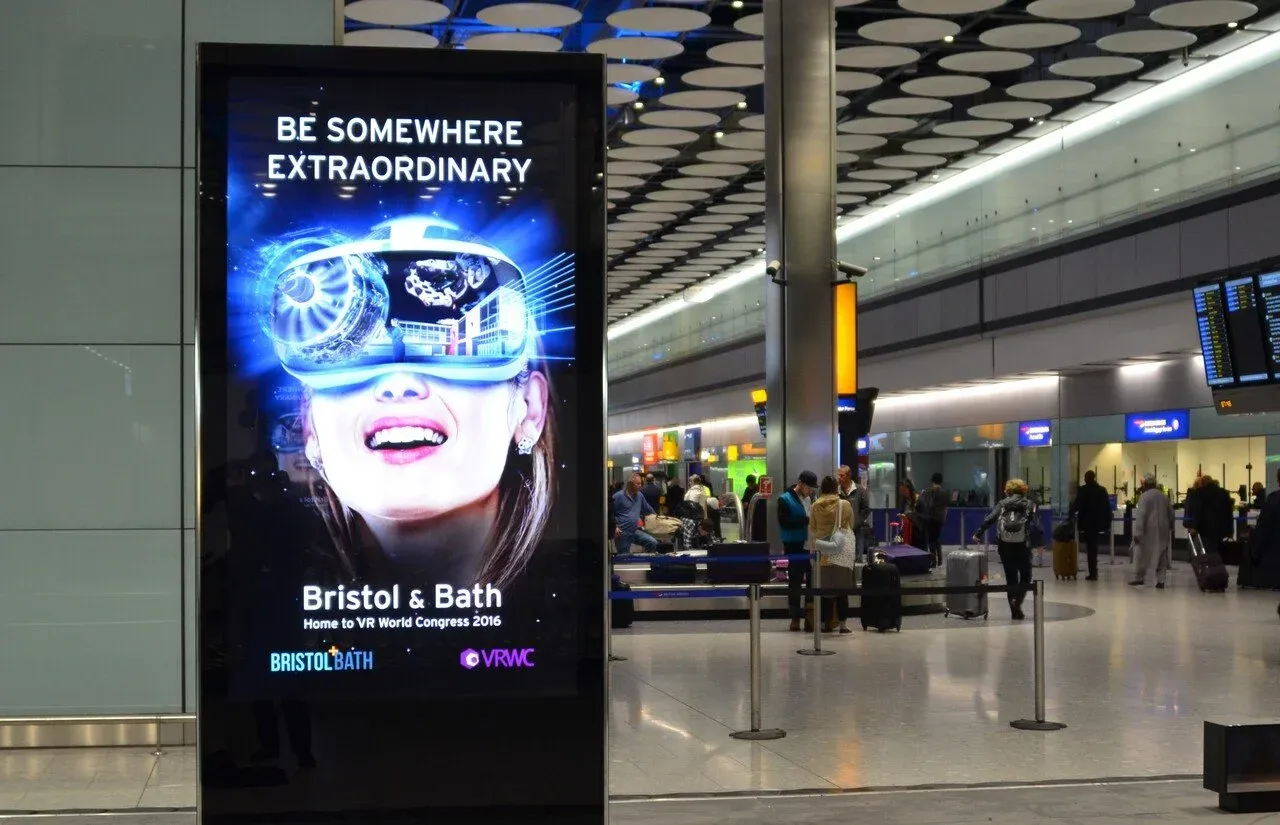
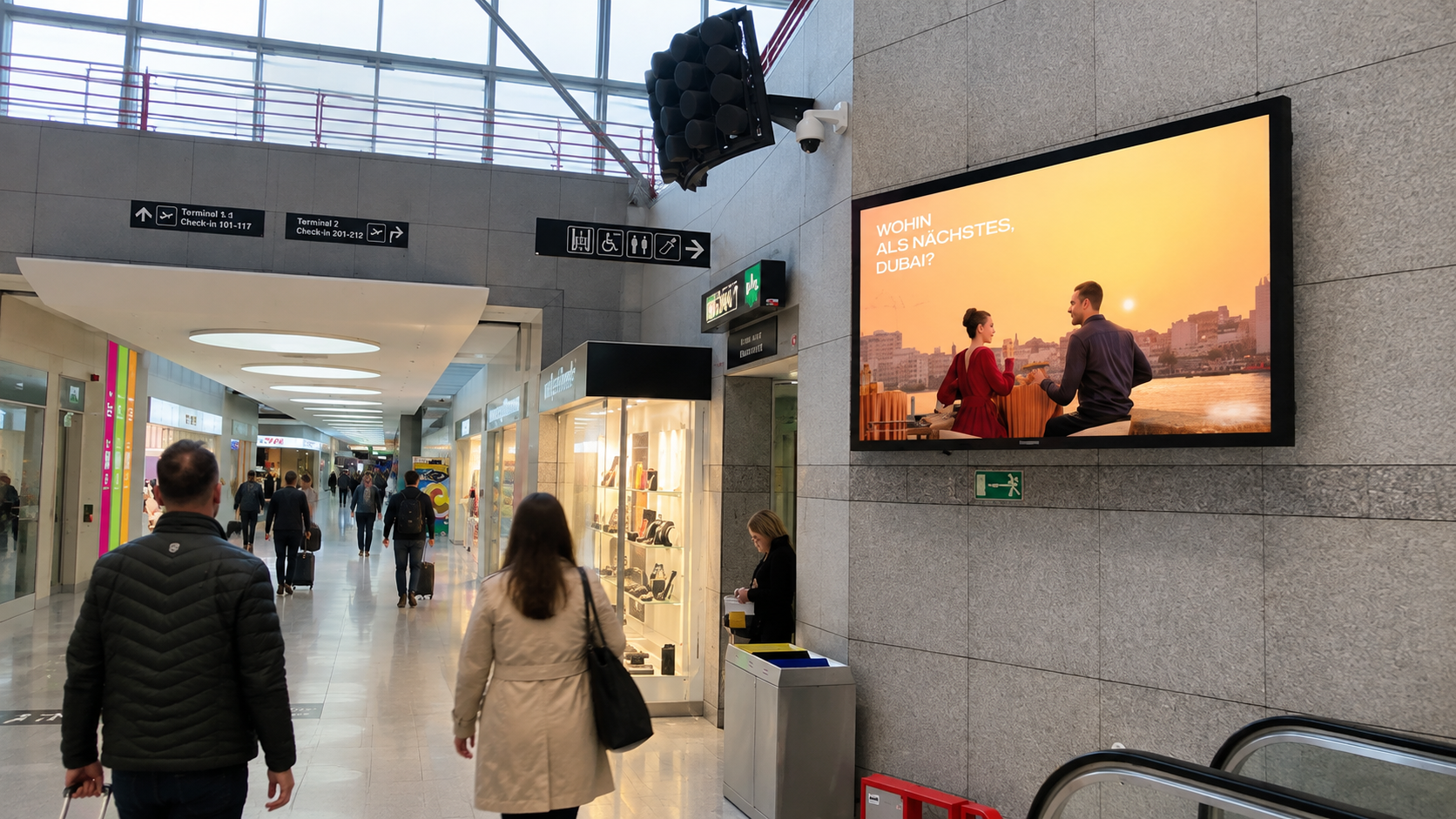
- Masscom Global provides direct inventory access across check-in, security recomposition, concourse, gate-hold, and baggage claim positions, with bilingual creative production and installation managed end to end.
Strategic Advertising Fit
Best Fit:
- Cross-border banking, currency, and mortgage services: A structurally bi-national audience with genuine dual-currency financial needs and no equivalent channel to reach them.
- International real estate and residency advisory: Equity-rich Canadian and diaspora buyers actively diversifying out of an expensive home property market.
- Diaspora-focused remittance, gold, and jewellery: One of the strongest Punjabi and Chinese Canadian catchments in North America, with clear festival purchase triggers.
- Travel insurance and out-of-country health cover: Essentially mandatory for Canadian snowbirds and directly aligned with every core route.
- Higher education and international universities: High-migration-culture households treating education spend as a family priority.
- Outdoor, marine, and yachting brands: Mount Baker, the San Juan Islands, and Bellingham harbour create authentic category alignment.
- Commercial vehicles, equipment finance, and business insurance: Owner-operator transport and agricultural wealth concentrated across the border corridor.
- Telecom and international roaming products: Cross-border travellers with genuine, recurring connectivity friction.
Brand Alignment at a Glance:
| Category | Fit |
|---|---|
| Cross-border financial and currency services | Exceptional |
| International real estate and residency | Exceptional |
| Diaspora remittance, gold, and jewellery | Strong |
| Travel insurance and health cover | Strong |
| Higher education and international universities | Strong |
| Outdoor and marine lifestyle brands | Moderate |
| Premium automotive | Moderate |
| Ultra-luxury fashion flagships | Poor fit |
Who Should Not Advertise Here:
- Ultra-luxury fashion and haute couture flagships: Real HNWI wealth exists in this catchment, but it does not pass through this terminal at flagship-justifying density. That audience flies Vancouver International.
- Corporate enterprise B2B and government-facing brands: There is no meaningful legislative, regulatory, or Fortune 500 headquarters audience here. Spend is misdirected.
- Long-haul international airlines and premium cabin products: With no scheduled international service and an ultra-low-cost passenger profile, there is no addressable premium cabin buyer at this airport.
Event and Seasonality Analysis
- Event Strength: Medium
- Seasonality Strength: High
- Traffic Pattern: Seasonal with defined cultural event spikes
Strategic Implication: Budget should be weighted heavily toward December to February for the snowbird and warm-weather core, and June to September for peak leisure and diaspora family travel. April carries a dedicated tactical weight for Vaisakhi and the tulip festival window, and Lunar New Year and Diwali each justify separate short-burst flighting rather than absorption into general activity. Masscom Global structures BLI campaigns around exactly this rhythm, running always-on financial and insurance presence against the snowbird corridor while layering culturally specific bilingual creative into the four festival windows that drive the highest purchase intent.

Poor Placement and Delays Affect Airport Campaigns
We help you move faster, access better inventory, and get it right now.
Talk to an ExpertFinal Strategic Verdict
Bellingham International is the most mispriced audience in the American Northwest right now. At 456,410 passengers in 2025 it is small, and softer cross-border demand has pushed rates down, but the catchment behind those five gates is Metro Vancouver: 2.6 million people, some of the highest property equity in North America, and two of the largest and wealthiest South Asian and Chinese diaspora communities on the continent, all reachable through a single terminal with one security checkpoint. Cross-border financial services, international real estate, residency advisory, remittance and gold, travel insurance, and international education gain the most, because this audience is bi-national by definition, actively diversifying its capital, and demonstrably willing to act on a quantified financial advantage. The fee gap that built this traffic has not closed, all existing routes and schedules continue, and every signal points to rates rising when Canadian demand returns. Masscom Global has the inventory access, bilingual creative capability, and cross-border intelligence to secure this audience before the market reprices it.
About Masscom Global
Masscom Global is a premium international airport advertising and media buying agency operating across 140 countries. With deep expertise in airport OOH, premium publications, and high-net-worth audience targeting, Masscom helps brands reach the world's most valuable travellers at the moments that matter most. For advertising packages, media rates, and campaign planning at Bellingham International Airport and airports across the globe, contact Masscom Global today.
Frequently Asked Questions
How much does airport advertising cost at Bellingham International Airport? Cost at BLI depends on format, position within the terminal, campaign duration, and seasonal demand, with the December to February snowbird window and the April festival period carrying the strongest premiums. Because the terminal operates only five gates and one security checkpoint, cost per share of voice here is exceptionally efficient, and softer recent volume has kept rates below what this catchment's household income would normally command. Contact Masscom Global for current rates and availability.
Who are the passengers at Bellingham International Airport? Roughly 45 to 55 percent are Canadians, overwhelmingly from Metro Vancouver, Surrey, Abbotsford, Langley, White Rock, and Richmond, who cross the border by road to access lower US fares and passenger fees. The remainder are residents of Whatcom, Skagit, Island, and Snohomish counties, including refinery and marine industry households, university-linked travellers, and naval aviation families. A large share of the Canadian segment belongs to Punjabi Sikh and Chinese Canadian communities with significant business ownership and property wealth.
Is Bellingham International Airport good for luxury brand advertising? It is strong for wealth-adjacent categories and weak for flagship luxury. Private banking, cross-border wealth management, international property, residency advisory, jewellery, and gold perform well because the catchment holds substantial property equity and diaspora capital. Ultra-luxury fashion flagships should not buy here, since that specific audience flies Vancouver International and does not pass through this terminal at meaningful density.
What is the best airport in Washington State to reach HNWI audiences? Seattle-Tacoma leads on absolute volume and international connectivity, but BLI is the only airport in the state that delivers a majority-Canadian, diaspora-weighted audience with cross-border financial needs. For brands whose proposition is bi-national, offshore, or diaspora-specific, BLI reaches buyers that a Seattle-only plan will never touch. Masscom typically recommends BLI paired with Seattle-Tacoma for full statewide coverage.
What is the best time to advertise at Bellingham International Airport? December to February delivers the structural snowbird and warm-weather core, and June to September delivers peak leisure and diaspora family travel volume. April is the highest-intent tactical window, combining Vaisakhi travel across the Surrey and Abbotsford corridor with the Skagit Valley tulip festival inbound. Lunar New Year and Diwali each produce sharp, short, high-conversion spikes worth dedicated flighting.
Can international real estate developers advertise at Bellingham International Airport? Yes, and it is arguably the most efficient origin buy for this category on the West Coast. This catchment holds equity-rich Canadian households actively diversifying out of an expensive home property market, with live interest in Arizona, Nevada, California, Mexico, the United Arab Emirates, Portugal, Greece, and India. Reaching the same household through Vancouver media costs materially more. Masscom Global places developers at both origin and destination airports simultaneously.
Which brands should not advertise at Bellingham International Airport? Ultra-luxury fashion flagships will not recover investment here despite genuine wealth in the catchment, because that segment departs from Vancouver International. Corporate enterprise B2B and government-facing brands have no addressable audience, as there is no legislative or major headquarters presence. Long-haul international airlines and premium cabin products are also misaligned, given no scheduled international service and an ultra-low-cost passenger profile.
How does Masscom Global help brands advertise at Bellingham International Airport? Masscom Global handles the full campaign lifecycle: cross-border catchment intelligence, format and placement selection across a compact terminal where coverage is achievable with minimal inventory, bilingual and culturally specific creative production in English, Punjabi, and Chinese, rate negotiation, installation, and performance reporting. We time campaigns to the snowbird corridor and the four cultural spending windows that drive the highest intent, and we extend the same brand to the destination markets in the Gulf, India, and Europe where this capital lands. Book a 15-minute planning call to review current inventory and rates.