




Airport at a Glance
| Field | Detail |
|---|---|
| Airport | Tri-State Airport / Milton J. Ferguson Field |
| IATA Code | HTS |
| Country | United States |
| City | Huntington, West Virginia |
| Annual Passengers | 182,000 (2024) |
| Primary Audience | Industrial, energy and refining executives, healthcare and university professionals, outbound Florida leisure and snowbird travellers |
| Peak Advertising Season | January to March, June to August, September to November |
| Audience Tier | Tier 3 by volume, Tier 2 by audience concentration |
| Best Fit Categories | Industrial equipment and engineering services, financial services and wealth management, healthcare and medical technology, Florida real estate and retirement living |
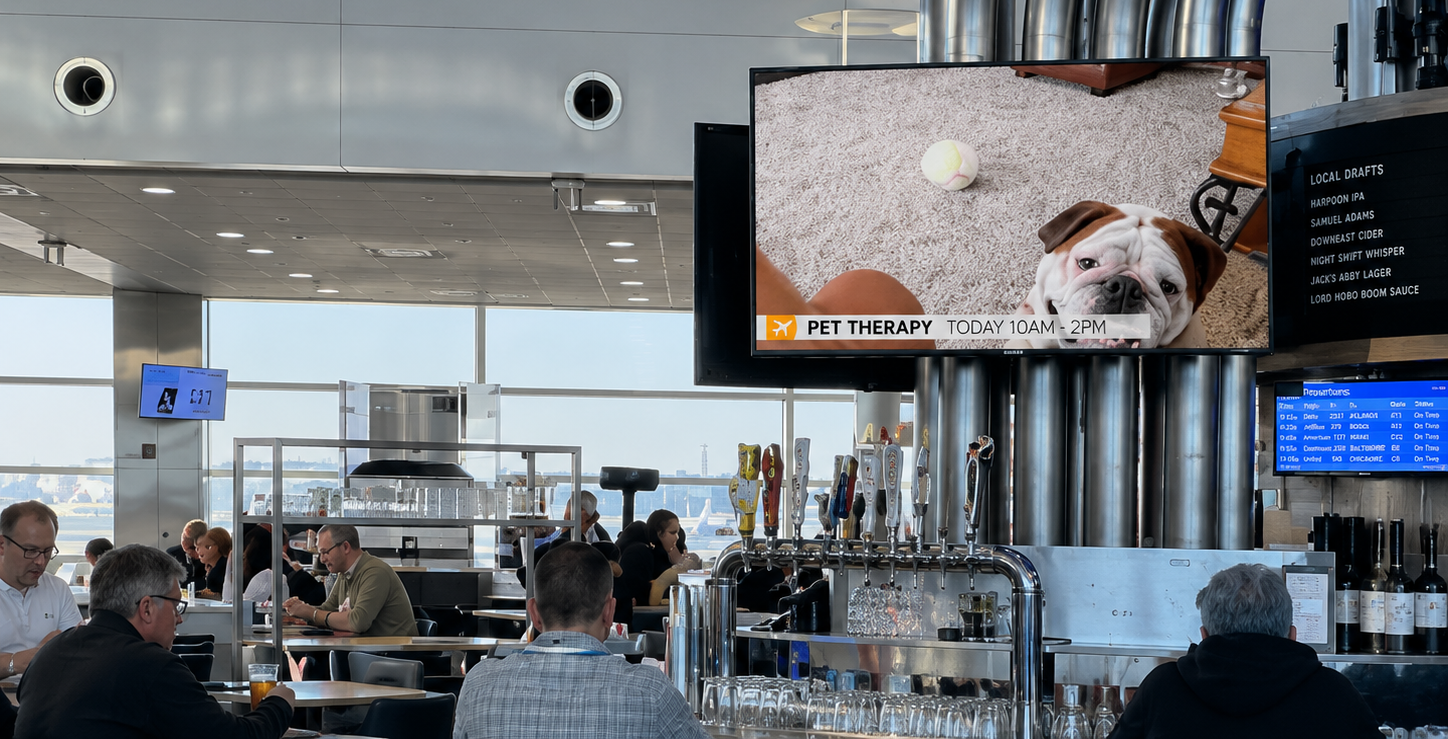
Tri-State Airport is a small facility serving a disproportionately industrial economy. It handled 182,000 passengers in 2024, but those passengers originate from a tri-state catchment spanning West Virginia, eastern Kentucky, and southern Ohio, anchored by one of the largest inland refineries in the United States, a specialty nickel alloy operation of global significance, a major inland river port, and a university and medical complex that employs thousands of high-income professionals. The composition of traffic is what makes this airport commercially interesting, not the count.
This is a wealth corridor built on assets rather than headlines. Household wealth in the catchment concentrates among refinery and plant management, physicians and surgeons at two competing hospital systems, university leadership, contracting and logistics business owners, and multi-generational families holding land, mineral rights, and closely held businesses. That wealth is quiet, durable, and largely invisible to national advertisers who write off Appalachia as a low-value market. For brands willing to look past the volume figure, HTS offers a concentrated, uncontested audience at a fraction of the cost of any metropolitan buy.
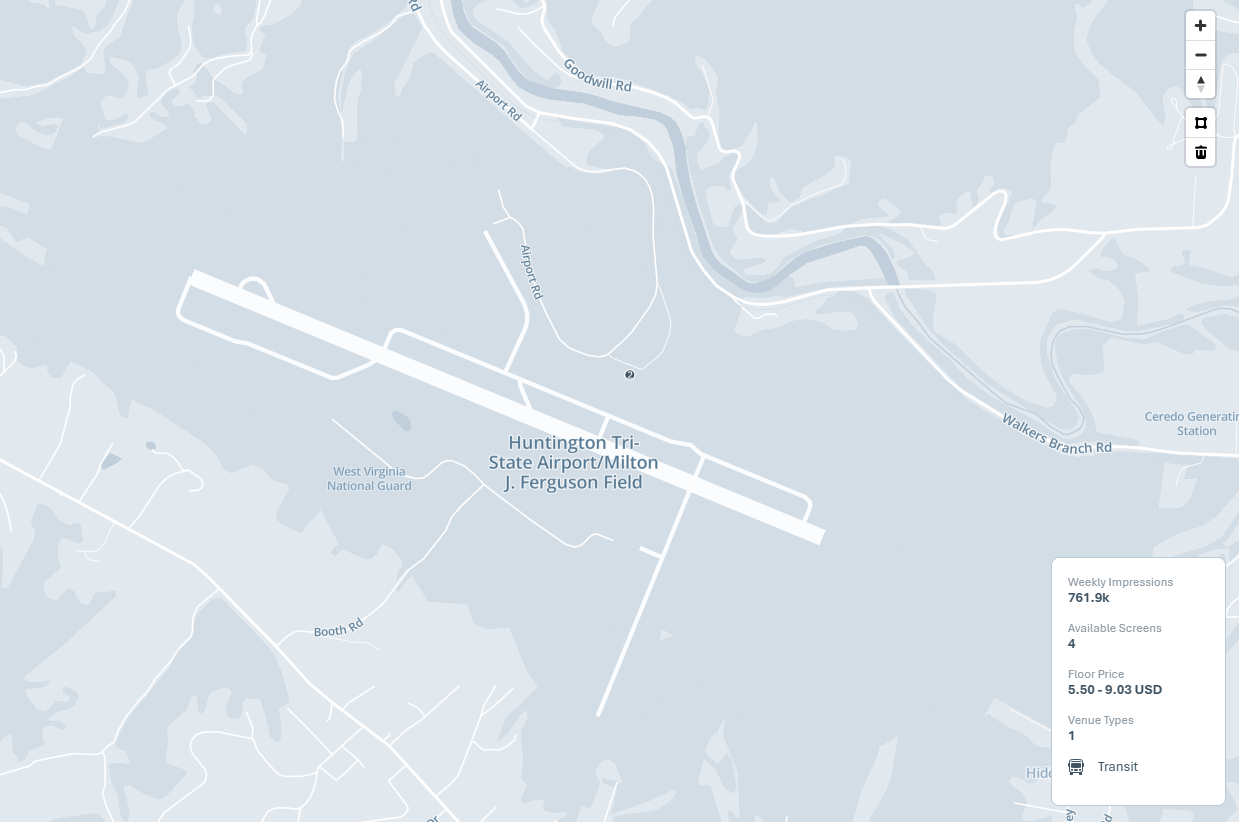
Advertising Value Snapshot
- Passenger scale: 182,000 total passengers in 2024, with 14,924 aircraft operations and 36 based aircraft. Year-to-date 2026 boardings are tracking roughly 6 percent ahead of 2025, though month-to-month movement has been uneven.
- Traveller type: Industrial and energy executives, healthcare and academic professionals, outbound Florida leisure and retirement travellers.
- Airport classification: Tier 3 by volume, Tier 2 by audience concentration. Small terminal, high proportion of purpose-driven travel, negligible transit noise.
- Commercial positioning: The air gateway to the Huntington and Ashland industrial corridor and the largest inland port complex in the United States by tonnage.
- Wealth corridor signal: Huntington to Charlotte is the corporate and connecting corridor. Huntington to Florida is the retirement and second-property corridor. Both carry money in different forms.
- Advertising opportunity: One terminal, one screening point, one departure concourse. Every commercial passenger follows the same physical path, which means a small number of correctly placed units achieve near-total audience capture. Masscom Global structures HTS campaigns for saturation rather than share, delivering repeat exposure to the same industrial and professional audience across a full travel cycle.
Airport Advertising is Complex to Get Right
We help you execute faster, with proven results and local insight most planners lack starting now.
Talk to an ExpertCatchment Area and Economic Drivers
Top 10 Cities within 150 km, Marketer Intelligence:
- Huntington, West Virginia: The primary passenger source. Hospital systems, university employment, and industrial management create a professional income base with strong healthcare, financial services, and premium vehicle demand.
- Ashland, Kentucky: Refining and chemicals management centre with an established wealthy professional class and a regional medical complex. High-value target for wealth management and executive services.
- Ironton, Ohio: Small industrial and logistics community feeding the river and rail corridor. Trades and supervisory households responsive to automotive, insurance, and home improvement messaging.
- Charleston, West Virginia (80 km): State capital, legal, government, and chemical industry hub. Spillover business travel into HTS occurs for Charlotte connectivity and Florida leisure pricing.
- Barboursville, West Virginia: The region's dominant retail and affluent residential suburb. Highest concentration of discretionary household spending in the immediate catchment.
- Catlettsburg, Kentucky: Refinery town anchoring one of the largest inland refining operations in the country. Direct catchment for industrial equipment, contractor services, and safety technology advertisers.
- Portsmouth, Ohio (75 km): Ohio River industrial and healthcare centre with an ageing, property-owning population. Fit for retirement planning, medical, and travel advertisers.
- Point Pleasant and Mason County, West Virginia (95 km): Site of major new steel manufacturing investment, producing an incoming construction and engineering workforce with above-average incomes and travel needs.
- Logan and southern West Virginia coalfields (100 km): Coal, timber, and mineral-rights wealth alongside an established powersports and outdoor recreation economy. Responsive to trucks, equipment, and land-related financial products.
- Ripley and Jackson County, West Virginia (110 km): Manufacturing corridor including major automotive component production. Produces engineering and plant management travellers with corporate purchase authority.
NRI and Diaspora Intelligence:
There is no significant South Asian or Gulf diaspora corridor here, so the relevant movement pattern is different and specific. The catchment holds long-established Italian, Lebanese, Greek, and Eastern European communities formed through nineteenth and twentieth century industrial migration, many of whom now own multi-generational family businesses in retail, construction, and property. The newer international population is concentrated in medicine and higher education, with physicians, residents, researchers, and graduate students drawn from India, Nigeria, Egypt, China, and the Philippines to the regional hospitals and the university medical school. This group travels internationally on a seasonal cycle, sends remittances, sponsors family visits, and connects almost exclusively through Charlotte, creating a consistent long-haul connecting audience that departs from a single small concourse.
Economic Importance:
Four sectors define the catchment. Petroleum refining and chemicals generate senior plant management, engineering contractors, and corporate visitors from national energy firms. Specialty metals and steel production, including high-performance nickel alloy manufacturing serving aerospace and energy markets globally, generate technical and procurement travel with international purchase authority. Inland port, rail, and barge logistics move commodity and industrial freight at national scale, producing an owner-operator and logistics executive audience. Healthcare and higher education anchor the professional income base, with two hospital systems and a university medical and business school employing the region's highest earners. Each sector produces a distinct, addressable segment inside one terminal.

Business and Industrial Ecosystem
- Petroleum refining and chemical processing: Produces plant executives, turnaround contractors, safety and engineering specialists, and visiting corporate delegations. Prime audience for industrial equipment, engineering services, safety technology, and commercial insurance advertisers.
- Specialty metals and steel manufacturing: Produces metallurgical engineers, procurement leadership, and international customer visits tied to aerospace, energy, and defence supply chains. Strong fit for B2B industrial, logistics, and trade finance messaging.
- Inland port, rail, and river logistics: Produces transport company owners, terminal operators, and commodity traders. Aligned to commercial vehicle, fleet, fuel, insurance, and asset finance advertisers.
- Regional healthcare and academic medicine: Produces physicians, surgeons, hospital administrators, and university leadership with high income and low price sensitivity. The single strongest audience for wealth management, private banking, premium automotive, and luxury travel.
Passenger Intent, Business Segment:
Business travel at HTS is operational and repetitive rather than discretionary. Plant and engineering staff fly to corporate headquarters and supplier sites, typically via Charlotte for national and international connections. Medical and academic professionals travel for conferences, credentialing, and clinical collaboration on a predictable annual rhythm. These are short, frequent, scheduled trips, which means the same individuals pass the same placements repeatedly across a month. Categories that intercept them most effectively are industrial technology and equipment, commercial vehicles and fleet, professional and commercial insurance, business banking, medical technology, and executive recruitment.
Strategic Insight:
The B2B value here rests on density rather than scale. In a major hub, an industrial equipment advertiser pays for hundreds of thousands of irrelevant impressions to reach a handful of qualified buyers. At HTS, a weekday morning departure to Charlotte carries a meaningful concentration of refinery, metals, logistics, and healthcare decision-makers from a single regional economy. Very few United States airports deliver that ratio of qualified industrial buyer to total audience, and almost none deliver it at this cost level.
Tourism and Premium Travel Drivers
- Hatfield-McCoy Trails system: One of the largest off-highway vehicle trail networks in the world, drawing high-spend powersports tourism from across the eastern United States. Riders arrive having already committed to machines, trailers, gear, and lodging. Strong fit for powersports, insurance, outdoor apparel, and truck advertisers.
- Marshall University athletics and campus events: Football and basketball seasons generate visiting alumni, donor, and supporter travel with above-average incomes and strong regional loyalty. Relevant to financial services, automotive, and hospitality advertisers.
- Ohio River recreation, Greenbo Lake, and Carter Caves: Regional lake, boating, and outdoor tourism supporting a sustained summer visitor economy across the three states.
- Cultural and heritage attractions in Huntington and Ashland: Museums, historic districts, and seasonal festivals that anchor family and heritage travel, particularly in autumn.
Passenger Intent, Tourism Segment:
Inbound visitors are largely returning family, alumni, and outdoor recreation travellers who have already committed to accommodation, equipment, and event spending, and are receptive to rental vehicle, insurance, dining, and financial messaging on arrival. The larger and more valuable flow is outbound. Local residents fly nonstop to Florida and coastal destinations on leisure service, and this group has booked a holiday, is in an active spending mindset, and includes a high proportion of near-retirement and retired homeowners. Florida and coastal real estate, retirement living communities, travel banking, cruise operators, and residency and tax advisory perform best against this second group.
Travel Patterns and Seasonality
- Peak seasons: January to March is driven by outbound Florida and Gulf Coast leisure escape traffic. June to August is driven by summer family travel, outdoor recreation tourism, and industrial turnaround activity. September to November is driven by the university athletic calendar, autumn heritage tourism, and the corporate and conference cycle.
- Traffic volume data: Monthly passenger counts are reported to the airport authority but are not published in a consolidated public series. Data not available.
Event-Driven Movement:
- Marshall University football season (September to November): Home game weekends and away-game travel generate visiting alumni, donor, and supporter movement with elevated spending profile. The strongest consumer advertising window of the autumn.
- Winter Florida escape season (January to March): Peak outbound leisure and snowbird departure period. Highest-value window for property, retirement, and travel advertisers.
- Refinery and plant turnaround cycles (Spring and Autumn): Bring large numbers of specialist contractors, engineers, and project management staff into the region for concentrated periods. High-authority industrial procurement audience.
- Summer river and trail recreation season (June to August): Drives inbound powersports and outdoor tourism alongside outbound family holiday travel, creating dual-direction volume.
- Regional festival and heritage calendar (July and October): Independence Day riverfront events and autumn heritage festivals produce short, concentrated inbound arrival windows with family and reunion spending patterns.

It’s Not Just Where You Advertise - It’s How Fast You Execute
We combine local insight with fast rollout to deliver results for you, now.
Talk to an ExpertAudience and Cultural Intelligence
Top 2 Languages:
- English: Overwhelmingly dominant across every segment. All commercial, B2B, and consumer creative should be English-first. Regional audiences respond to plain, direct, unembellished language and are notably resistant to corporate abstraction.
- Spanish: A small but growing second language, concentrated in construction, agriculture, and healthcare support employment. Relevant for remittance, telecom, and money transfer advertisers, but not required for mainstream campaigns at this airport.
Major Traveller Nationalities:
The passenger base is almost entirely United States domestic, drawn from the three-state catchment. International presence is limited but commercially meaningful, consisting of visiting corporate and technical personnel tied to the metals and refining sectors and a resident population of internationally trained physicians, researchers, and graduate students. Creative should be built for an American regional audience with a pragmatic, value-led tone, with B2B industrial messaging written for a technically fluent professional reader who evaluates on specification and total cost.
Religion, Advertiser Intelligence:
- Protestant Christianity (approximately 60 to 65 percent): Dominant across the catchment, with strong Baptist, Methodist, and non-denominational presence. Christmas, Easter, and Thanksgiving are the primary family travel triggers, producing November, December, and spring peaks with gifting, reunion, and family-financial spending patterns. Community trust and local endorsement carry unusual weight with this audience.
- Catholicism (approximately 10 to 12 percent): Concentrated among the Italian, Lebanese, and Eastern European descended families of the industrial era, many of whom hold established business wealth. Christmas and Easter travel triggers apply, with a stronger multi-generational family travel pattern and heritage travel interest.
- No religious affiliation and other faiths (approximately 25 percent): Growing among younger professionals, university staff, and the internationally trained medical population. Purchase triggers here are seasonal and life-stage driven rather than calendar-religious. Advertisers should time against travel seasons and academic cycles for this group.
Behavioural Insight:
This audience is skeptical, practical, and financially conservative, and it holds more wealth than its self-presentation suggests. Money here sits in land, property, closely held businesses, mineral interests, and retirement accounts rather than in visible consumption. Purchase decisions are made slowly, with heavy weight on durability, warranty, service availability, and whether a brand has a real local presence. Messaging that emphasises reliability, long-term value, straight numbers, and demonstrated performance outperforms aspirational, urban, or status-led creative, which tends to be actively rejected. Trust must be earned in the copy, not assumed from the logo.
Outbound Wealth and Investment Intelligence
The outbound passenger at Tri-State Airport falls into two commercially distinct profiles. The first is the industrial and medical professional travelling for corporate purpose, carrying procurement authority and institutional budgets far exceeding their personal net worth. The second is the accumulated-wealth resident, typically a plant executive, physician, business owner, or landowning family approaching or in retirement, deploying decades of earnings into warm-climate property, retirement income structures, and estate planning. Both pass through the same concourse, and both are systematically underserved by advertisers who dismiss this region as low value.
Outbound Real Estate Investment:
Capital from this catchment moves consistently and predictably into Florida, with the Gulf Coast around Fort Myers, Punta Gorda, and the Tampa and St. Petersburg corridor absorbing the largest share, reinforced by direct nonstop access. The Florida Atlantic coast and the Daytona and Orlando corridor form a strong secondary market. Coastal South Carolina, particularly the Myrtle Beach corridor, attracts second-home and retirement buyers seeking lower entry pricing with direct air access. The Gulf Coast panhandle around Destin and Fort Walton draws family second-home purchases. Beyond the United States, Mexico's Riviera Maya and Puerto Vallarta and the Caribbean, particularly the Dominican Republic and Belize, attract the more adventurous retirement buyer seeking cost advantage. Developers targeting American heartland retirement capital have a clean, uncontested channel here at a cost far below Florida-facing metropolitan airports.
Outbound Education Investment:
Families in this catchment send students primarily to in-state and neighbouring-state universities, with a well-defined secondary flow to nationally ranked private institutions and to specialist programmes in medicine, engineering, pharmacy, and aviation. International study destinations, when chosen, concentrate on the United Kingdom, Ireland, and Australia, often through structured semester-abroad rather than full-degree enrolment. Physician and academic households support full tuition without financial aid dependence and decide a full academic year in advance, making the September to January window the decision period. There is also a substantial reverse flow, with international students and medical residents arriving for local institutions, creating a genuine dual-direction education audience for universities, boarding schools, and advisory firms.
Outbound Wealth Migration and Residency:
United States passport holders do not pursue residency programmes for mobility, so demand is entirely lifestyle and tax driven. The relevant products are Portugal and Greece residency by investment, Caribbean citizenship by investment in St Kitts and Nevis, Antigua, and Dominica, and Mexican, Costa Rican, and Panamanian residency for retirees. State income tax arbitrage is the more immediate driver, with Florida and Tennessee relocation actively considered by retiring professionals and business owners in this catchment. Estate planning, business succession, and mineral-rights structuring advisory find a receptive and financially capable audience here that is rarely targeted directly.
Strategic Implication for Advertisers:
Brands on both sides of this corridor should treat HTS as an efficiency play, not a scale play. The cost of reaching an American industrial-wealth or physician household here is a small fraction of what it costs in any metropolitan market, and the audience is unsaturated, attentive, and loyal once won. Masscom Global activates both ends of the corridor at once, placing property, retirement, and residency messaging at HTS while running destination-market activity for the same client, so a single plan captures the audience at departure and again at arrival.
Airport Infrastructure and Premium Indicators
Terminals:
- A single passenger terminal serving all commercial traffic, with one security checkpoint and a consolidated gate area. Every departing passenger follows an identical physical sequence, which guarantees audience capture for correctly positioned inventory.
- Separate general aviation infrastructure supported by a fixed base operation with pilot facilities, hangarage, and fuel services, handling corporate, charter, and medical aircraft that do not appear in commercial passenger statistics.
Premium Indicators:
- No branded commercial lounge network operates at the airport. Premium audience contact occurs in the main gate area and at check-in, which materially increases the value of general terminal placements.
- Substantial general aviation and corporate activity, with 14,924 aircraft operations against 182,000 commercial passengers and 36 based aircraft. That ratio confirms meaningful corporate, charter, and business flying beyond scheduled service.
- A primary runway of 7,017 feet by 150 feet, the second longest in West Virginia, capable of handling narrow-body and corporate jet equipment and supporting charter and cargo operations.
- Established air cargo presence supporting regional freight distribution, reinforcing the airport's logistics role alongside the inland port and rail network.
- Aviation training and maintenance development on site through a university-affiliated flight school and aircraft maintenance technician programme, adding a permanent professional aviation population to the airport environment.
- No on-airport luxury hotel. Premium accommodation is located in Huntington and Barboursville, a short drive from the terminal.
Forward-Looking Signal:
The airport authority is actively pursuing air service development, working with aviation consulting support to add routes and capacity, with year-to-date boardings running ahead of the prior year. Aviation maintenance and pilot training investment is expanding the airport's role beyond passenger service into workforce and industrial infrastructure, and major manufacturing investment in the wider catchment will add engineering and executive travel demand over the coming years. Each of these signals points toward rising volume and rising advertising rates. Advertisers who establish position now secure preferential terms ahead of that repricing, and Masscom Global advises clients to lock multi-period placements while the market is still building.
Airline and Route Intelligence
Top Airlines:
American Airlines operating as American Eagle, Allegiant Air, and cargo carriers serving regional freight distribution.
Key International Routes:
Scheduled international service is not offered. All international travel is connecting, routed principally through Charlotte. Weekly international frequency data is not applicable.
Domestic Connectivity:
Charlotte is the anchor route, operated by American Eagle and providing the airport's national and worldwide connectivity through a major hub. Allegiant operates nonstop leisure service to Florida and coastal markets including the Orlando and Sanford area, the Tampa and St. Petersburg and Clearwater corridor, Punta Gorda and Fort Myers, Destin and Fort Walton Beach, and Myrtle Beach. As of mid-2026 the airport offers nonstop service to seven destinations across two airlines.
Wealth Corridor Signal:
The route map states the commercial case plainly. Charlotte is the corporate, financial, and connecting corridor, carrying the highest-value business traffic and every international journey originating in this catchment. The Florida and coastal network is the retirement and consumer wealth corridor, carrying discretionary spending, property intent, and multi-decade savings toward warm-climate purchase decisions. These are two entirely different audiences using one terminal on different days of the week, and advertisers should build creative for each corridor separately rather than treating HTS as a single undifferentiated audience.
Media Environment at the Airport
- Single terminal, single checkpoint, single gate area. Advertising clutter is minimal by any national standard, which means individual placements command a far higher share of voice than the same spend would achieve in Charlotte, Columbus, or Pittsburgh.
- Dwell time is extended by regional aviation realities. Passengers arrive early for a limited daily departure bank, connecting itineraries through Charlotte encourage conservative timing, and weather and regional aircraft delays are routine. Longer, undistracted dwell produces actual reading time rather than passing glance exposure.
- The environment is calm, uncrowded, and community-oriented rather than transactional. Brand association here reads as credible and locally invested, which suits financial services, healthcare, industrial, insurance, and institutional advertisers seeking trust over spectacle.
- Masscom Global provides inventory access, placement precision, and execution management at HTS alongside the wider United States regional airport network, allowing advertisers to construct an Appalachian, Ohio Valley, or national regional package from a single point of contact with unified reporting and consistent creative deployment.
Strategic Advertising Fit
Best Fit:
- Industrial equipment, engineering, and turnaround services: The most aligned category. Refining, metals, and logistics buyer density here is exceptional relative to airport size.
- Commercial vehicles, pickup trucks, and fleet leasing: A trades, logistics, and resource audience with among the highest per-capita truck ownership in the country.
- Wealth management, retirement planning, and private banking: Targets physicians, plant executives, and landowning business families at the accumulation and decumulation stages.
- Florida and coastal real estate and retirement communities: Reaches committed snowbird and retirement buyers at the exact moment of departure on nonstop service to those markets.
- Healthcare, medical technology, and pharmaceutical services: Two competing hospital systems and an academic medical school create a dense clinical decision-maker audience.
- Commercial insurance, surety, and risk management: Serves refining, construction, logistics, and contracting businesses with high-exposure operational profiles.
- Powersports, outdoor recreation, and recreational vehicles: Matches the dominant discretionary spending pattern across the entire catchment.
- Estate planning, business succession, and tax advisory: Addresses closely held business and mineral-interest wealth that is rarely targeted directly.
Brand Alignment at a Glance:
| Category | Fit |
|---|---|
| Industrial equipment and engineering services | Exceptional |
| Commercial vehicles and fleet | Exceptional |
| Wealth management and retirement planning | Strong |
| Florida and coastal real estate | Strong |
| Healthcare and medical technology | Strong |
| Powersports and outdoor recreation | Strong |
| International education and residency advisory | Moderate |
| High-fashion luxury and designer retail | Poor fit |
Who Should Not Advertise Here:
- High-fashion, couture, and designer luxury retail: Wealth in this catchment is asset-based and deliberately understated. There is no receptive audience, no supporting retail environment, and status-led creative is actively distrusted.
- Inbound destination tourism campaigns for competing global markets: Passenger volume is too low and the outbound leisure audience travels on booked nonstop leisure service with destination already fixed.
- Youth-led fast fashion, streetwear, and app-first consumer brands: The passenger profile skews older, professional, and family-oriented, with limited alignment outside narrow university-linked windows.
Event and Seasonality Analysis
- Event Strength: Medium
- Seasonality Strength: High
- Traffic Pattern: Dual-Peak
Strategic Implication:
Budget should be concentrated rather than spread evenly. January to March delivers the outbound Florida and retirement audience at its highest intent, making it the strongest consumer window of the year. September to November delivers the university athletic calendar, autumn plant turnaround activity, and the corporate conference cycle, making it the strongest combined B2B and consumer window. Masscom Global structures HTS campaigns around this rhythm, weighting inventory into the two peaks and using summer and shoulder months for lower-cost brand maintenance, which typically improves effective cost per relevant impression across a twelve-month plan.

Poor Placement and Delays Affect Airport Campaigns
We help you move faster, access better inventory, and get it right now.
Talk to an ExpertFinal Strategic Verdict
Tri-State Airport is a precision buy for advertisers who understand where American industrial wealth actually sits. With 182,000 passengers in 2024, a single-terminal funnel, and a catchment built on refining, specialty metals, inland port logistics, academic medicine, and closely held business ownership, HTS delivers something no metropolitan airport can offer: near-complete capture of a specific regional economy at a cost that makes year-round presence affordable. Industrial equipment firms, commercial vehicle brands, wealth managers, healthcare suppliers, and Florida property developers reach a buyer here who holds real assets, real purchase authority, and almost no competing advertising demanding their attention. Boardings are growing, air service development is active, and major manufacturing investment in the wider catchment will push demand higher. Advertisers who move now secure position and pricing ahead of that shift, and Masscom Global has the inventory access, audience intelligence, and execution capability to place them correctly the first time.
About Masscom Global
Masscom Global is a premium international airport advertising and media buying agency operating across 140 countries. With deep expertise in airport OOH, premium publications, and high-net-worth audience targeting, Masscom helps brands reach the world's most valuable travellers at the moments that matter most. For advertising packages, media rates, and campaign planning at Tri-State Airport and airports across the globe, contact Masscom Global today.
Frequently Asked Questions
How much does airport advertising cost at Tri-State Airport? Cost varies by format, terminal position, campaign duration, and seasonal demand. The winter Florida departure season and the autumn athletic and corporate cycle carry premium pricing, while summer and shoulder months offer lower entry points. Because HTS is a single-terminal environment, a smaller budget achieves substantially higher share of voice than at a hub airport. Contact Masscom Global for current rates and availability.
Who are the passengers at Tri-State Airport? Predominantly American travellers from the three-state catchment of West Virginia, eastern Kentucky, and southern Ohio. The core segments are refining, metals, and logistics executives and engineers, physicians and hospital administrators from two competing health systems, university faculty and leadership, and outbound leisure and retirement travellers on nonstop Florida and coastal service. There is also meaningful corporate and charter aviation activity beyond scheduled traffic.
Is Tri-State Airport good for luxury brand advertising? It depends on the category. Fashion-led and designer luxury has no audience here and tends to be actively rejected. Asset-based premium categories perform well, including premium pickup trucks and SUVs, private banking and wealth management, marine and powersports, second-home and retirement real estate, and estate and succession advisory. The wealth is real but expressed through ownership rather than display.
What is the best airport in West Virginia to reach HNWI audiences? Tri-State Airport is the strongest option for reaching industrial, refining, and academic medical wealth in the Huntington and Ashland corridor, because it is the only commercial gateway to that specific three-state economy. Charleston serves the state government, legal, and chemical audience and is the natural complement. For full West Virginia and Ohio Valley coverage, HTS and Charleston together outperform either as a standalone buy.
What is the best time to advertise at Tri-State Airport? January to March captures the outbound Florida and retirement audience at peak purchase intent and is the highest-value consumer window. September to November captures the university athletic season, autumn industrial turnaround activity, and the corporate conference cycle, making it the strongest B2B window. Advertisers with a single-season budget should choose based on whether the target is consumer or business.
Can international real estate developers advertise at Tri-State Airport? Yes, and it is one of the better-aligned categories, though the strongest opportunity is domestic. This catchment sends consistent retirement and second-home capital into Florida, coastal South Carolina, and the Gulf panhandle, with a secondary flow into Mexico and the Caribbean. Reaching these buyers at the departure gate, as they board a nonstop flight to the destination market itself, captures intent at its absolute peak and at a cost far below Florida-facing metropolitan airports.
Which brands should not advertise at Tri-State Airport? High-fashion and designer luxury retail, because the audience is practical, asset-focused, and skeptical of status messaging. Inbound destination tourism campaigns for competing global markets, because volume is too low and the leisure audience has already booked a fixed nonstop destination. Youth-led fast fashion and app-first consumer brands, because the passenger profile skews older, professional, and family-oriented.
How does Masscom Global help brands advertise at Tri-State Airport? Masscom Global provides the full chain: audience intelligence specific to the Huntington and Ashland industrial and medical catchment, inventory access and placement recommendation, creative guidance tuned to a value-led regional audience, campaign execution and installation management, and performance reporting. We also build multi-airport United States regional packages so a single plan can cover HTS alongside comparable Ohio Valley and Appalachian markets with unified reporting. Book a fifteen-minute call to review availability and rates.







