

Airport at a Glance
| Field | Detail |
|---|---|
| Airport | Baton Rouge Metropolitan Airport, also known as Ryan Field |
| IATA Code | BTR |
| Country | United States |
| City | Baton Rouge, East Baton Rouge Parish, Louisiana |
| Annual Passengers | 844,025 (2024), a record, with 2025 tracking approximately 6 percent higher through Q1 |
| Primary Audience | Petrochemical and industrial construction decision-makers, state government and government affairs travellers, LSU-driven academic and sports travel |
| Peak Advertising Season | March to June, September to November, plus spring and autumn turnaround windows |
| Audience Tier | Tier 2 |
| Best Fit Categories | Industrial and petrochemical B2B, engineering and construction services, commercial insurance and risk, government affairs and professional services |
Baton Rouge Metropolitan Airport welcomed a record 844,025 passengers in 2024, averaging 70,335 per month and up 10.65 percent on the 762,789 carried in 2023, surpassing the previous record of approximately 821,000 set in 2019. Traffic through the first three months of 2025 ran roughly 6 percent ahead of 2024, with January enplanements at 27,697. Recovery has been steep, rising from about 364,000 passengers in 2020 to roughly 650,000 in 2022, 763,000 in 2023 and 844,000 in 2024, growth of approximately 30 percent across two years. The airport is the second-busiest in Louisiana by passenger volume and generates an annual economic impact of about 1.1 billion dollars, supporting over 4,500 direct and indirect jobs. Verified full-year 2025 figures are not available.
What distinguishes BTR from most airports of comparable size is that it is not a leisure airport at all. It is served exclusively by American, Delta and United, feeding five major hubs at Dallas/Fort Worth, Charlotte, Atlanta, Houston Intercontinental and Washington Reagan National, on larger regional jets and mainline aircraft offering first class and premium economy, with load factors that have run above 80 percent. There are no low-cost carriers, no beach routes and no international service. Every passenger is either connecting onward or has business in Louisiana's capital. That business is unusually concentrated: the Mississippi River corridor running from Baton Rouge toward New Orleans hosts one of the densest petrochemical and refining complexes on earth, alongside all of Louisiana's state government and a major research university with an outsized athletics programme. Masscom Global treats BTR as a B2B and institutional intercept, not a consumer reach buy.
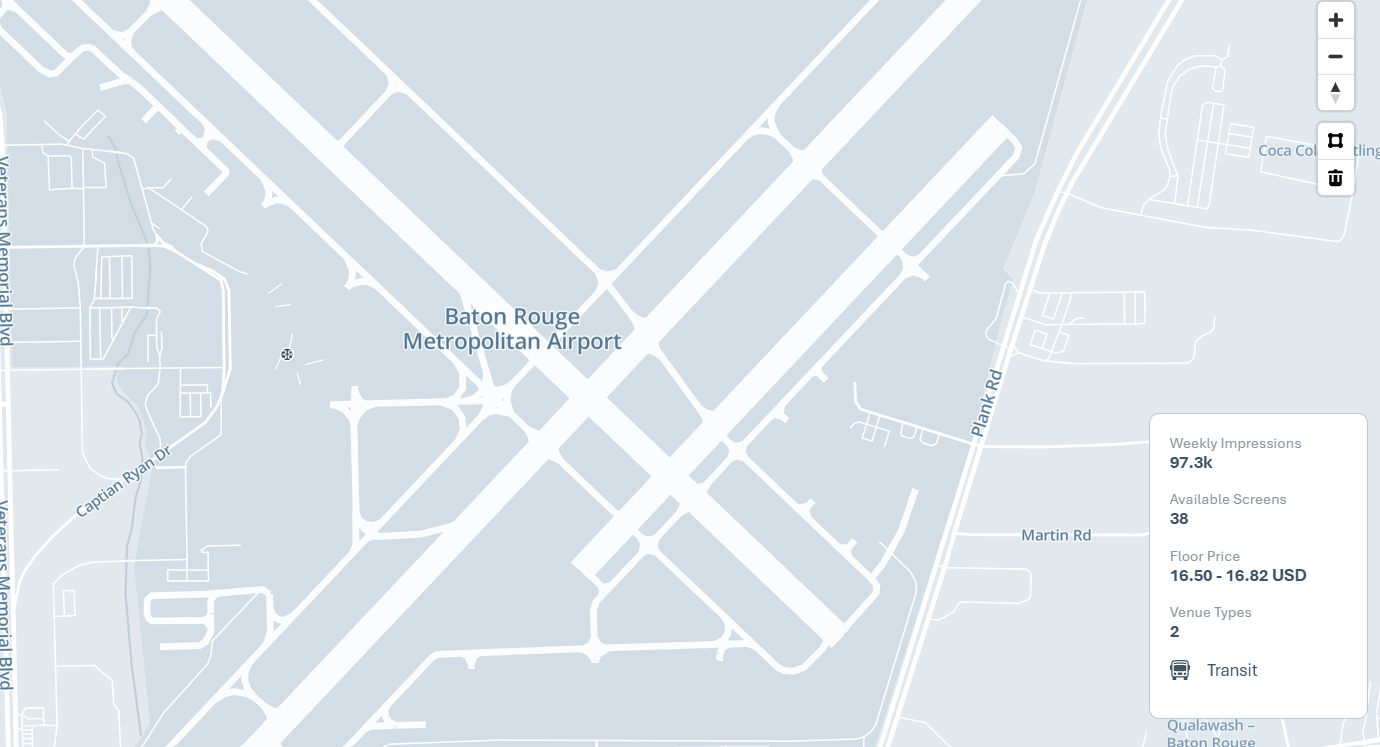
Advertising Value Snapshot
- Passenger scale: 844,025 passengers in 2024, a record, up 10.65 percent on 2023, with Q1 2025 running approximately 6 percent higher again. Growth of about 30 percent from 2022 to 2024. Load factors above 80 percent.
- Traveller type: Petrochemical, refining and industrial construction decision-makers, state government and government affairs travellers, and academic, medical and university sports travel.
- Airport classification: Tier 2. Consumer wealth in the catchment is moderate, but B2B decision-maker density and premium cabin share are genuinely high for an airport of this size.
- Commercial positioning: Louisiana's capital city airport and the second-busiest in the state, operating purely as a legacy hub-feed facility with premium cabin availability on most flights.
- Wealth corridor signal: The Mississippi River petrochemical corridor, connected to Houston capital and engineering markets and to Washington policy channels.
Advertising opportunity: Almost every passenger in this terminal has a commercial reason to be here, and a disproportionate share hold procurement, engineering, regulatory or legislative authority in an industry that commits capital in the billions. Reaching that audience at Houston Intercontinental means competing with an enormous hub; reaching it here means near-total coverage of one compact terminal. Masscom Global provides inventory access and placement precision aligned to the hub route flows and the industrial turnaround calendar.
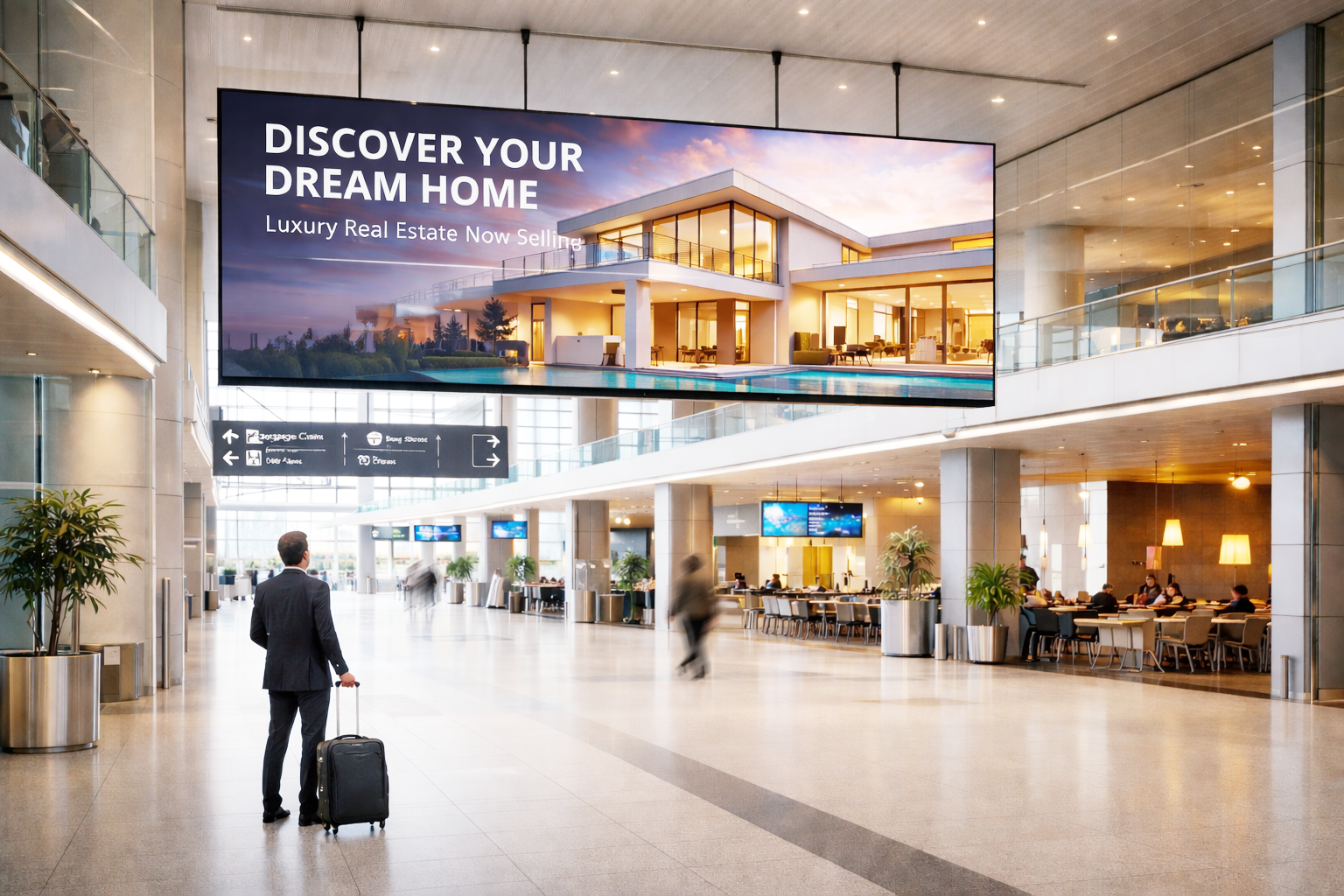
Airport Advertising is Complex to Get Right
We help you execute faster, with proven results and local insight most planners lack starting now.
Talk to an ExpertCatchment Area and Economic Drivers
Top 10 Cities within 150 km, Marketer Intelligence:
- Baton Rouge: The state capital and commercial core, roughly 7 kilometres from the terminal. Concentrates all Louisiana state agencies, a major research university, three regional health systems, the headquarters of several nationally significant industrial construction contractors and a large refining and chemical complex. Produces government affairs, engineering, medical and executive audiences in one market.
- Gonzales and Ascension Parish: The heart of the petrochemical corridor approximately 30 kilometres southeast, hosting multiple world-scale chemical plants and among the highest median household incomes in Louisiana. Produces plant management, engineering leadership and procurement decision-makers with substantial capital authority.
- Prairieville: The region's most affluent residential community, populated heavily by petrochemical, engineering and professional households. Prime for premium automotive, private education, wealth advisory and home services propositions.
- Geismar, Plaquemine and Iberville Parish: Dense concentration of chemical manufacturing, including one of the largest single chemical production sites in North America. Produces industrial procurement, safety, maintenance and contractor audiences relevant to B2B equipment, services and insurance advertisers.
- Zachary and Central: Affluent northern suburbs with strongly performing school districts, attracting professional and medical households. Relevant to private education, insurance, automotive and family financial products.
- Denham Springs, Walker and Livingston Parish: Fast-growing suburban corridor housing much of the region's skilled trade and industrial construction workforce. Produces a large, well-paid technical audience with heavy vehicle, tool, telecom and insurance spend.
- St. Francisville and the Felicianas: Historic plantation country roughly 50 kilometres north, supporting heritage tourism, boutique hospitality and a landowning agricultural base. Relevant to hospitality, land, timber and wealth advisory categories.
- New Roads and Pointe Coupee Parish: Sugarcane, soybean and row-crop agriculture with a landowning principal base whose asset wealth exceeds visible income. Relevant to agricultural equipment, land finance, crop insurance and succession advisers.
- Hammond: University town and interstate logistics node approximately 70 kilometres east, with distribution, warehousing and academic employment. Produces logistics decision-makers and a student and academic travel base.
- Lafayette: The capital of Acadiana approximately 90 kilometres west and Louisiana's oil and gas services centre. Produces offshore energy services principals and engineering audiences, some of whom route through BTR when Lafayette schedules do not suit.
NRI and Diaspora Intelligence:
This catchment has a modest diaspora profile relative to the airport's B2B value, and advertisers should be realistic about it. The Hispanic population has grown substantially, driven largely by industrial construction and plant maintenance labour demand across the corridor, and generates cross-border family travel, remittance flow and heavy prepaid telecom usage. An established Vietnamese community linked to Gulf Coast fishing and small business is present at smaller scale, alongside a modest but professionally significant South Asian community centred on physicians, university faculty and engineers.
Far more commercially interesting is a different kind of international presence. The petrochemical corridor's plants are owned and operated by Japanese, Taiwanese, German, Dutch, Korean and Canadian parent companies, which means a steady flow of expatriate managers, visiting engineers, project teams and corporate delegations passes through this catchment. This audience is small in number but exceptional in transaction authority, connects through Houston, Atlanta and Dallas, and represents one of the more overlooked high-value segments at any mid-size American airport. Precise volumes are not available.
Economic Importance:
Four engines drive this catchment. Petrochemical manufacturing and refining along the Mississippi corridor form one of the largest such concentrations in the Western Hemisphere, with continuous multi-billion-dollar capital project activity including fertiliser, methanol, plastics and emerging low-carbon hydrogen and ammonia investment. Industrial construction, maintenance and turnaround contracting is a nationally significant sector here, with several major contractors headquartered locally. State government concentrates every Louisiana agency, the legislature and the associated lobbying, legal and association infrastructure in one city. Higher education, academic medicine and biomedical research centre on a major research university, a historically Black university and three health systems. Agriculture, timber, and the furthest inland deep-draft port on the Mississippi complete the picture.
Business and Industrial Ecosystem
- Petrochemical manufacturing and refining: A large integrated refining and chemical complex in Baton Rouge itself plus multiple world-scale plants across Ascension and Iberville parishes, several among the largest of their type globally. Produces plant managers, engineering directors, procurement leads and corporate delegations with authority over contracts measured in hundreds of millions.
- Industrial construction, maintenance and turnaround contracting: Several nationally significant industrial contractors are headquartered in Baton Rouge, servicing the entire Gulf Coast. Produces executives, project directors and superintendents who travel constantly and who buy equipment, safety products, insurance and labour services at scale.
- State government, legislative and government affairs: All Louisiana state agencies, the legislature, regulatory bodies and an extensive lobbying, legal and trade association layer. Produces a policy and government affairs audience with unusually direct Washington connectivity through the Reagan National route.
- Higher education, academic medicine and biomedical research: A major public research university with a nationally prominent athletics programme, a historically Black university, a biomedical research institute and three regional health systems including a large faith-based hospital network headquarters. Produces academic, clinical and executive travellers plus substantial event-driven volume.
- Port, logistics and agriculture: The furthest inland deep-draft port on the Mississippi handling grain, petroleum and bulk cargo, alongside sugarcane, row-crop and timber production across the surrounding parishes.
Passenger Intent, Business Segment:
The business audience at BTR travels to Houston for engineering, capital project and corporate business, to Dallas and Charlotte for financial, legal and corporate purposes, to Atlanta for regional and connecting business, and to Washington Reagan National for regulatory, legislative and federal affairs. That Washington route is unusually significant for an airport of this size and it carries a policy and government affairs audience that few comparable terminals reach. Categories that intercept these travellers most effectively are industrial equipment and process technology, engineering and EPC services, commercial insurance and risk management, safety and compliance products, commercial banking and legal and professional services.
Strategic Insight:
The commercial value here is authority concentration in a heavily capital-intensive industry. A single plant turnaround in this corridor can involve thousands of contract workers and tens of millions in spend, and the people who authorise it move through this terminal repeatedly. Because BTR has no low-cost carriers and no leisure network, the ratio of qualified B2B impressions to total impressions is far higher than at most airports of this size, and message competition is a fraction of Houston Intercontinental levels. Masscom Global builds industrial campaigns here around the spring and autumn turnaround calendar and the legislative session, when travel by decision-makers concentrates most sharply.
Tourism and Premium Travel Drivers
Tourism is not the commercial case for BTR and advertisers should not be sold one. The airport's inbound leisure volume is limited and much of the region's visitor traffic arrives by road, including from New Orleans. The genuine drivers worth naming are the following.
- University athletics, principally football and baseball: Home football weekends at a stadium seating over 100,000 transform regional travel demand across autumn, and a nationally dominant baseball programme extends event traffic into spring. This is the single largest inbound event driver at this airport.
- State government and association calendar: Legislative sessions, agency conferences, trade association meetings and lobbying activity produce recurring inbound professional visitation concentrated in spring.
- Plantation country, historic architecture and river heritage: The Felicianas, the river road estates and Baton Rouge's historic core support heritage and cultural tourism, drawing an older and more affluent visitor, frequently as part of a wider Louisiana itinerary.
- Louisiana cultural and culinary calendar: Regional Mardi Gras parades, blues and music festivals, and the food culture of the capital region and adjacent Acadiana support event-driven weekend visitation.
Passenger Intent, Tourism Segment:
Inbound leisure passengers are predominantly visiting friends and relatives, attending university events or travelling for weddings, graduations and reunions, and arrive with accommodation committed. Outbound leisure is the larger flow, with residents connecting through Atlanta, Dallas, Houston and Charlotte for Florida, Gulf Coast, Caribbean and cruise travel, and for European trips. Because there are no nonstop leisure routes, this audience is captured at the origin stage in a premium-cabin-equipped terminal rather than in a value-carrier environment, which is a meaningful quality distinction for travel, financial and insurance advertisers.
Travel Patterns and Seasonality
Peak seasons:
- March to June: The strongest business window, combining the Louisiana legislative session, spring plant turnaround activity, university baseball and graduation travel.
- September to November: University football season plus autumn turnaround activity and fiscal-year-start corporate travel. The highest-density business and event overlap of the year.
- February and March: Mardi Gras and the associated regional celebration calendar, generating short, intense travel surges.
- Spring and autumn industrial turnaround windows: Plant maintenance shutdowns across the corridor bring thousands of specialist contractors, engineers and vendors into the region on schedules set by the plants rather than by the leisure calendar. These are the most commercially valuable weeks of the year for industrial B2B advertisers.
Traffic volume data:
Passenger volume reached a record 844,025 in 2024, an average of 70,335 per month, following 762,789 in 2023, roughly 650,000 in 2022 and approximately 364,000 in 2020, against a pre-pandemic 2019 record of about 821,000. Q1 2025 ran approximately 6 percent ahead of 2024, with January enplanements of 27,697, up 4 percent. Load factors have run above 80 percent. Verified full-year 2025 and 2026 figures are not available.
Event-Driven Movement:
- University football season (September to November, extending into December): Home weekends at a stadium seating over 100,000 generate the largest recurring travel surges at this airport, drawing alumni, corporate hospitality groups and visiting supporters from across the Southeast and nationally. Prime for automotive, beverage, telecom, financial services and consumer brands.
- Spring and autumn petrochemical turnaround seasons: Plant maintenance shutdowns across Ascension, Iberville and East Baton Rouge parishes bring large volumes of specialist engineering and contracting personnel into the region. The definitive B2B window for industrial equipment, safety, tooling, insurance and labour services advertisers.
- Louisiana legislative session (spring): Concentrates lawmakers, lobbyists, industry associations, legal counsel and government affairs professionals in the capital for months. The natural window for policy, energy, healthcare and infrastructure advertisers, and the route to Reagan National makes this audience federally connected.
- University baseball season and postseason (February to June): A nationally dominant programme drawing substantial inbound travel, including deep postseason runs that generate short-notice high-volume demand.
- Mardi Gras and the regional carnival calendar (February or March): Local parades plus proximity to New Orleans produce concentrated short-duration travel and celebration spending, with strong beverage, consumer and hospitality relevance.
- Historically Black university homecoming and cultural calendar (autumn): Draws significant alumni travel from across the country and reaches an audience with distinct media behaviour and strong brand loyalty, relevant to automotive, telecom, financial services and consumer advertisers.
Note that June through November is Atlantic hurricane season. This introduces genuine schedule disruption risk, makes Baton Rouge a receiving city during coastal evacuations, and makes property and commercial insurance among the most contextually relevant categories in this market given Louisiana's insurance environment.
It’s Not Just Where You Advertise - It’s How Fast You Execute
We combine local insight with fast rollout to deliver results for you, now.
Talk to an ExpertAudience and Cultural Intelligence
Top 2 Languages:
- English: Overwhelmingly dominant across business, government, academic and leisure audiences. Creative should be direct, technically substantiated and warm in tone. Louisiana business culture places high value on relationship and local presence, so claims of local capability and service response carry more weight here than national scale messaging.
- Spanish: The clear second language, concentrated in the industrial construction and plant maintenance workforce and in growing residential communities across the corridor. Spanish-language creative is commercially warranted for automotive, telecom, remittance, insurance, safety products and value travel categories.
Louisiana French and Creole remain culturally significant across the region, particularly toward Acadiana in the west, and function as heritage and identity signals in creative rather than as practical language targets. Vietnamese is present at modest scale through Gulf Coast community ties.
Major Traveller Nationalities:
The passenger base is almost entirely domestic American, drawn from the Baton Rouge metropolitan area of over 830,000 people and the surrounding parishes. The commercially important international segment is corporate rather than demographic: expatriate managers, project teams and visiting delegations tied to the Japanese, Taiwanese, German, Dutch, Korean and Canadian parent companies that own plants across the corridor. This group connects through Houston, Atlanta and Dallas and is small in number but exceptionally valuable to industrial technology, engineering services and premium hospitality advertisers. Campaign creative should be built for a domestic American business and institutional audience with a Spanish-language secondary layer and, where relevant, English-language technical creative aimed at international industrial visitors.
Religion, Advertiser Intelligence:
Figures below are directional approximations for the Baton Rouge region rather than airport-level survey data.
- Roman Catholicism (approximately 30 to 35 percent): Baton Rouge sits at the boundary between Catholic south Louisiana and the Protestant north, and the Catholic calendar shapes regional consumption measurably. Mardi Gras, Ash Wednesday, the Lenten Friday seafood tradition and the crawfish season together create one of the most commercially distinct religious calendars in the United States. Highly relevant to food and beverage, hospitality, retail and family travel advertisers.
- Baptist and evangelical Protestant traditions (approximately 30 to 35 percent): Strong across the northern and eastern parishes and the suburban corridor. Drives Christmas and Easter family travel, church-organised group and mission travel, and charitable giving cycles, with purchase behaviour responsive to family framing and community endorsement.
- Historically Black Protestant churches (a significant share within the above and a distinct commercial audience): Baton Rouge has a large and established African American middle class tied to state government employment, healthcare and the historically Black university. Church networks are central to community media and word-of-mouth, and homecoming, revival and convention travel generate real volume. This audience rewards authentic local engagement and penalises tokenism.
- Religiously unaffiliated and other faiths (approximately 15 to 20 percent): Concentrated among the university population and younger professionals. Higher receptivity to technology, experience and sustainability positioning.
Behavioral Insight:
Two characteristics should shape creative here. First, this is a relationship market. Louisiana business culture, in both the industrial and government spheres, places unusual weight on local presence, personal relationships and demonstrated service history, which means propositions built purely on national scale or price underperform against those that evidence local capability and response time. For industrial advertisers, uptime, turnaround response and safety record are the persuasive levers, not brand prestige. Second, risk consciousness runs deep. Hurricane exposure, an acute property and commercial insurance environment, and long institutional memory of storm disruption make this audience highly attentive to coverage, contingency and continuity language, and correspondingly intolerant of vagueness on those points. Insurance, risk, business continuity and infrastructure advertisers who are specific will substantially outperform those who are not.
Outbound Wealth and Investment Intelligence
The outbound passenger at BTR requires honest framing, because this catchment's wealth profile is narrower than its industrial significance suggests. Louisiana's median household income sits below the national average and consumer affluence is concentrated in specific suburban pockets rather than broadly distributed. The genuine wealth here is corporate and asset-based: industrial contracting business equity, professional practice income, agricultural land, and the compensation of a petrochemical and engineering management class. Capital deployment runs into Gulf Coast second homes, into out-of-state relocation, and into regional land and business assets.
Outbound Real Estate Investment:
The dominant destinations for property capital are the Alabama and Florida panhandle coast, principally Gulf Shores, Orange Beach, Destin, the Highway 30A corridor and Pensacola, which function as the region's default second-home market. Texas, particularly Houston and the Hill Country, and Tennessee, especially the Nashville area, attract both second-home and relocation capital. Florida's Gulf coast and Colorado and North Carolina mountain markets draw smaller flows. Within the region, capital concentrates on Prairieville, Zachary and the Feliciana parishes, and on agricultural and timber land. International property interest is modest, clustering on Mexican and Caribbean resort markets.
Outbound Education Investment:
Families here fund the state's flagship and regional universities heavily, alongside Southeastern Conference and Texas institutions, with strong local loyalty to the Baton Rouge universities. Catholic school participation is high and constitutes a significant household expenditure across the region. International education demand is limited relative to the Northeastern and coastal markets, and education advertisers should weight spend toward domestic private schools, regional universities and professional and executive programmes in engineering, energy and healthcare rather than toward international institutions.
Outbound Wealth Migration and Residency:
Louisiana has experienced sustained net domestic outmigration, driven by employment opportunity, hurricane and insurance exposure, and taxation, with Texas, Florida, Tennessee and Georgia the principal receiving states. Recent state tax reform moving Louisiana to a flat personal income tax rate is a genuine counter-signal, and the corridor's low-carbon and petrochemical capital pipeline provides an employment counterweight, so advertisers should treat this as a contested rather than a settled picture. Demand for international residency, golden visa and citizenship-by-investment programmes is minimal and should not be a planning assumption. Where relevant international demand exists, it sits with the corridor's expatriate corporate population rather than with the local audience.
Strategic Implication for Advertisers:
The propositions that genuinely fit this audience are industrial and institutional rather than luxury. Commercial insurance and risk management, business continuity, industrial finance and leasing, succession planning for contracting and professional firms, agricultural land and timber advisory, and Gulf Coast second-home property all have real demand. Masscom Global can activate simultaneously at BTR and at the Houston, Dallas, Atlanta and Gulf Coast airports where this catchment's business relationships and property decisions land, reaching the same decision-maker at both ends of the corridor.
Airport Infrastructure and Premium Indicators
Terminals:
- A single consolidated passenger terminal located approximately four miles north of downtown Baton Rouge, operating within Class C airspace on a runway system comprising parallel and intersecting runways. Single-terminal configuration means every arriving and departing passenger passes through the same circulation spine, delivering near-complete coverage from one compact footprint.
- The airport is a genuinely mixed-use facility, combining commercial airline service with substantial transient and local general aviation, air taxi and military operations. Construction and improvement activity has been ongoing, and passenger-facing upgrades including a ticketless parking system have been introduced.
Premium Indicators:
- Premium cabin availability is the airport's most distinctive commercial signal. Because BTR is served only by American, Delta and United, most flights operate on larger regional jets or mainline aircraft offering first class, premium economy and coach. Very few airports of this size offer premium cabins on essentially every departure, and it materially changes the passenger quality profile relative to value-carrier terminals of similar volume.
- General aviation is described by the airport as a commercial driver in its own right, contributing to the 1.1 billion dollar economic impact and over 4,500 jobs, with a major national fixed base operator having expanded private aviation facilities on the field. Corporate aviation serving the petrochemical corridor and state government is a genuine and separately addressable presence.
- The Washington Reagan National route is an unusual asset for a market of this size, providing direct capital-to-capital connectivity and carrying a federally engaged policy and government affairs audience.
- Sustained connectivity to five major hubs across three global airline alliances gives passengers worldwide onward access, which means internationally bound travellers are reachable here at the origin stage before hub-level competition for attention begins.
Forward-Looking Signal:
The trajectory is one of steady recovery converting into record territory. Passenger volume rose roughly 30 percent between 2022 and 2024 to an all-time high of 844,025, surpassing the 2019 record, with Q1 2025 running about 6 percent ahead again and load factors above 80 percent. The airport operates an active local-loyalty campaign encouraging residents to fly from Baton Rouge rather than leak to larger airports, explicitly to demonstrate the viability of new nonstop routes including the Washington service, which indicates route expansion ambition constrained principally by demonstrated demand. Beyond the terminal, the corridor's capital project pipeline in petrochemicals, fertiliser and emerging low-carbon hydrogen and ammonia points toward sustained industrial travel demand. Masscom Global advises advertisers to secure position and multi-year rates while volume is still building against a compact terminal footprint.
Airline and Route Intelligence
Top Airlines:
American Airlines, Delta Air Lines and United Airlines. There are no low-cost or ultra-low-cost carriers at this airport, which is unusual for a market of this size and materially improves the passenger quality profile.
Key International Routes:
BTR operates no scheduled international passenger service. International travel from this catchment connects through Houston Intercontinental, Atlanta, Dallas/Fort Worth and Charlotte, giving access to destinations worldwide through the three global airline alliances. Advertisers targeting internationally bound travellers, including the corridor's expatriate industrial population, reach them here at origin.
Domestic Connectivity:
Five hub destinations: Dallas/Fort Worth and Charlotte on American, Atlanta on Delta, Houston Intercontinental on United, and Washington Reagan National on American, the latter introduced in June 2023. Most services operate on larger regional jets or mainline aircraft with first class and premium economy. Frequencies have historically run to several daily roundtrips per hub. Verified current frequencies are not available.
Wealth Corridor Signal:
This is one of the most legible route maps in American aviation because it consists entirely of hubs, and each hub reveals a different audience. Houston Intercontinental is the engineering, capital project and energy corporate corridor, and it carries the highest-value industrial audience at this airport. Dallas/Fort Worth and Charlotte are the financial, legal and corporate corridors, and they carry connecting international traffic. Atlanta is the general connection and leisure gateway. Washington Reagan National is the policy corridor, carrying legislators, regulators, lobbyists and government affairs professionals between two capitals. The complete absence of leisure nonstops confirms the airport's honest position: this is a business and institutional terminal in which almost every passenger has a commercial or governmental reason to be present, and it should be bought accordingly.
Media Environment at the Airport
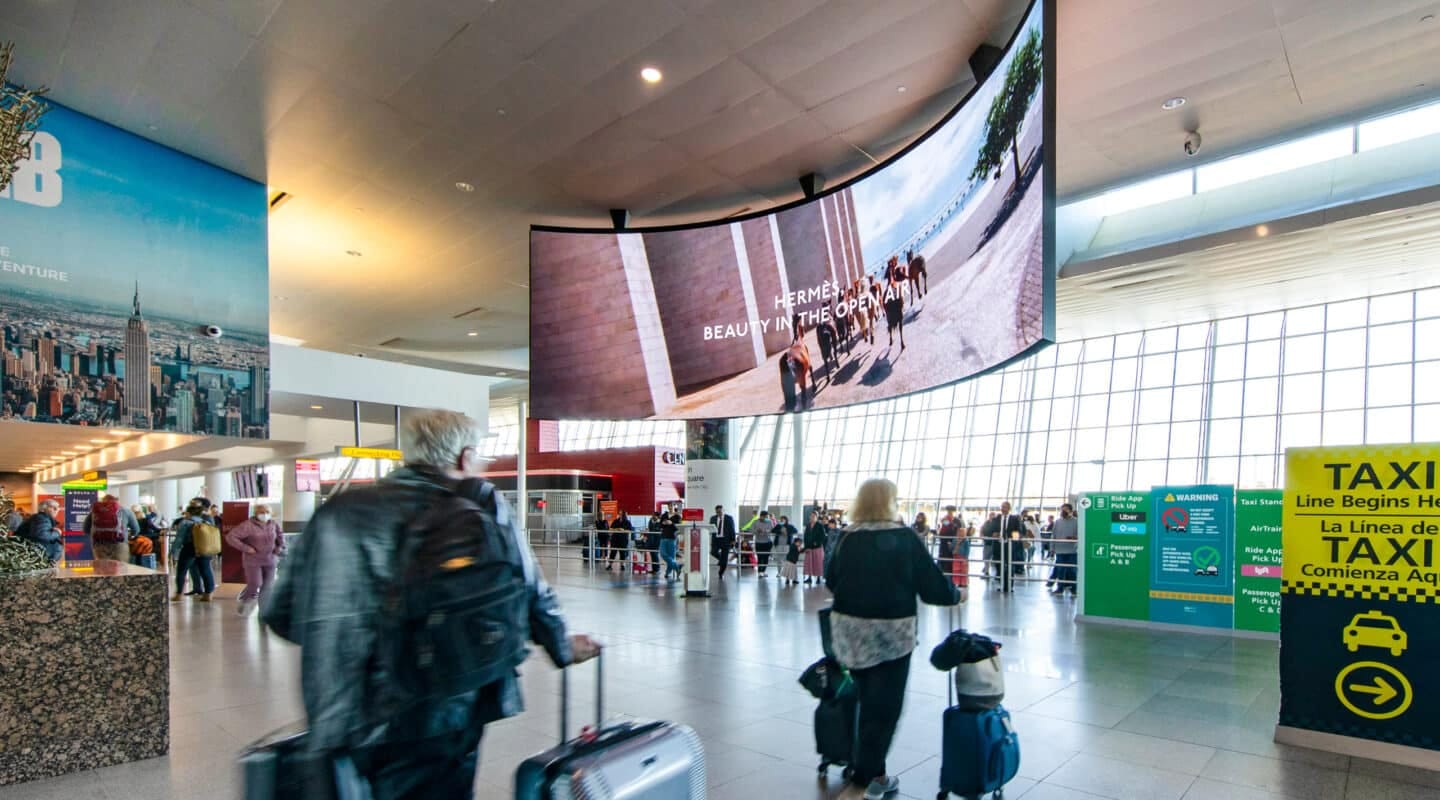
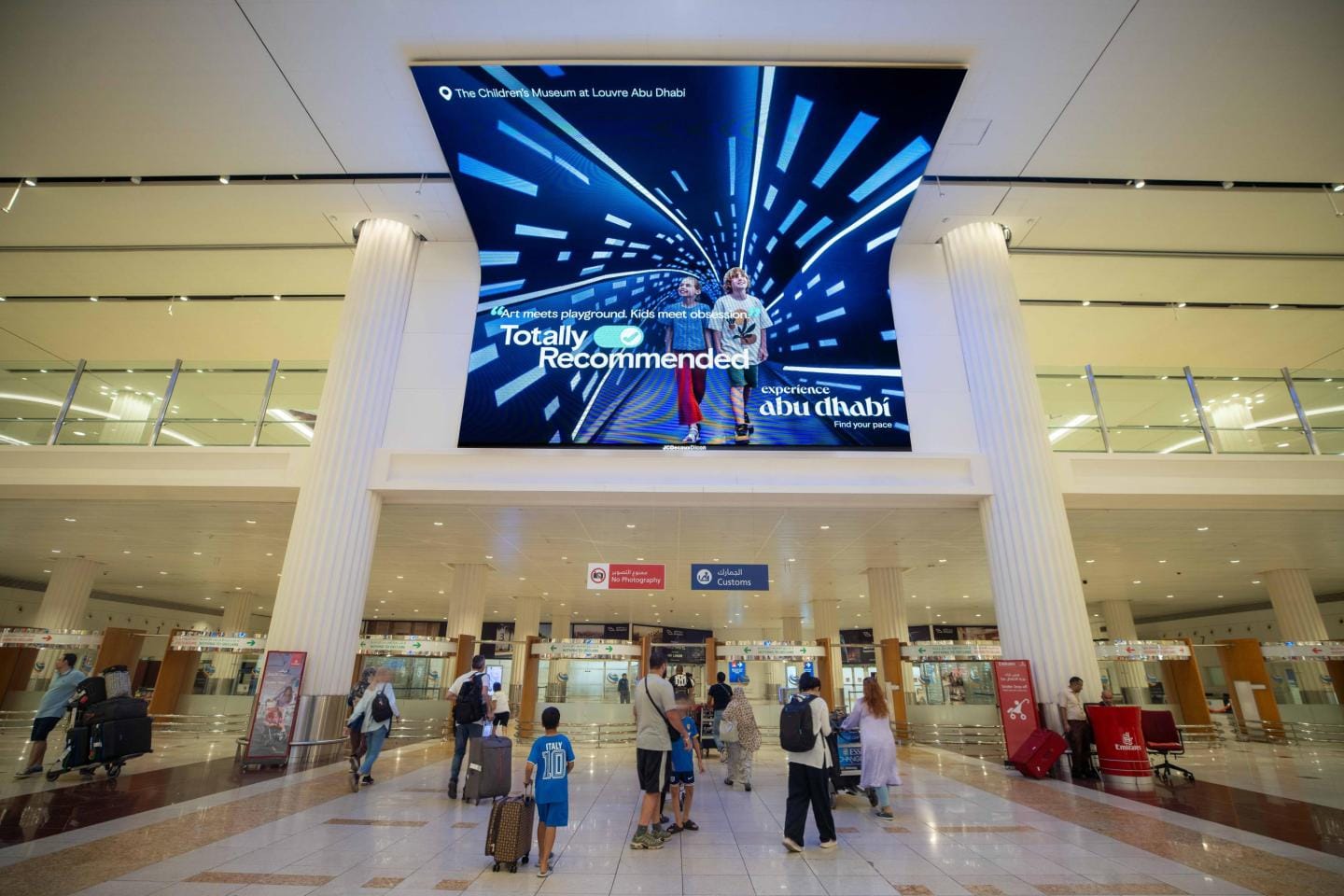
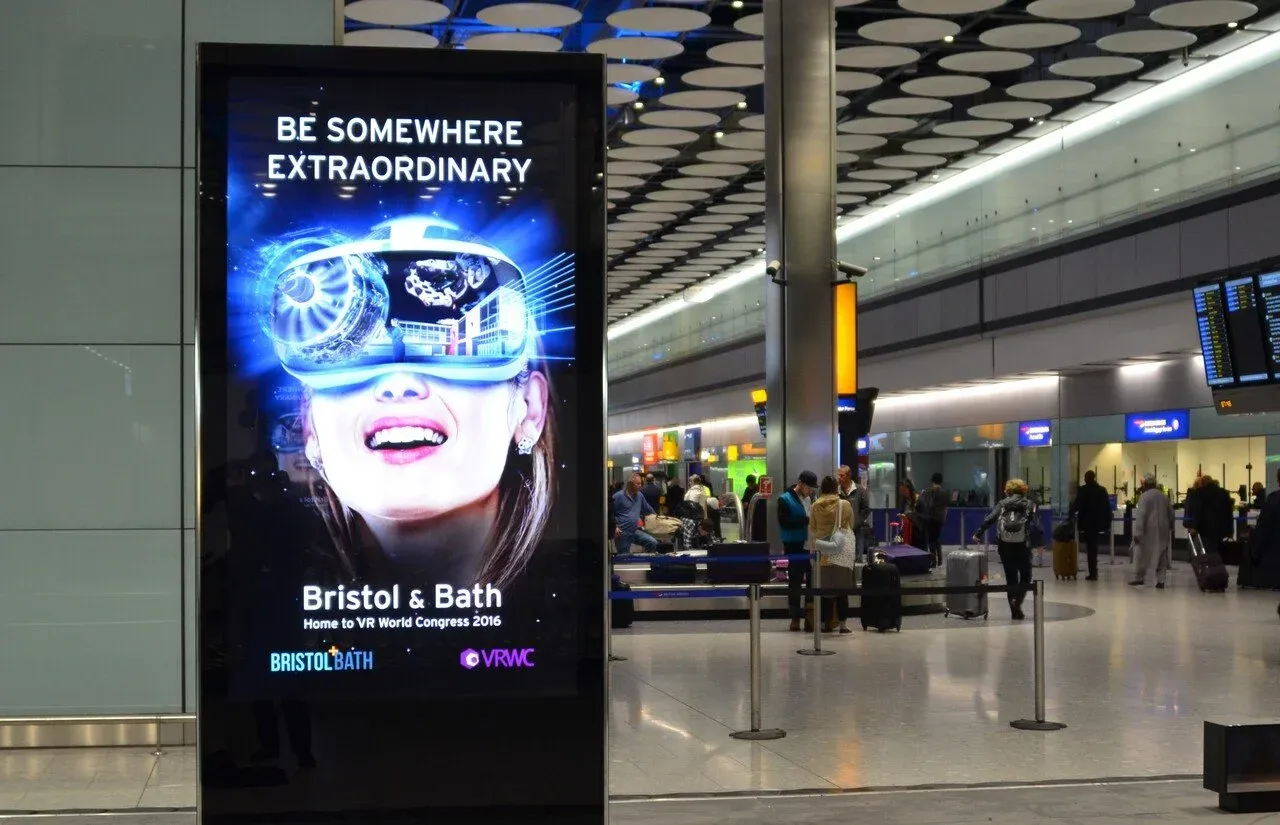
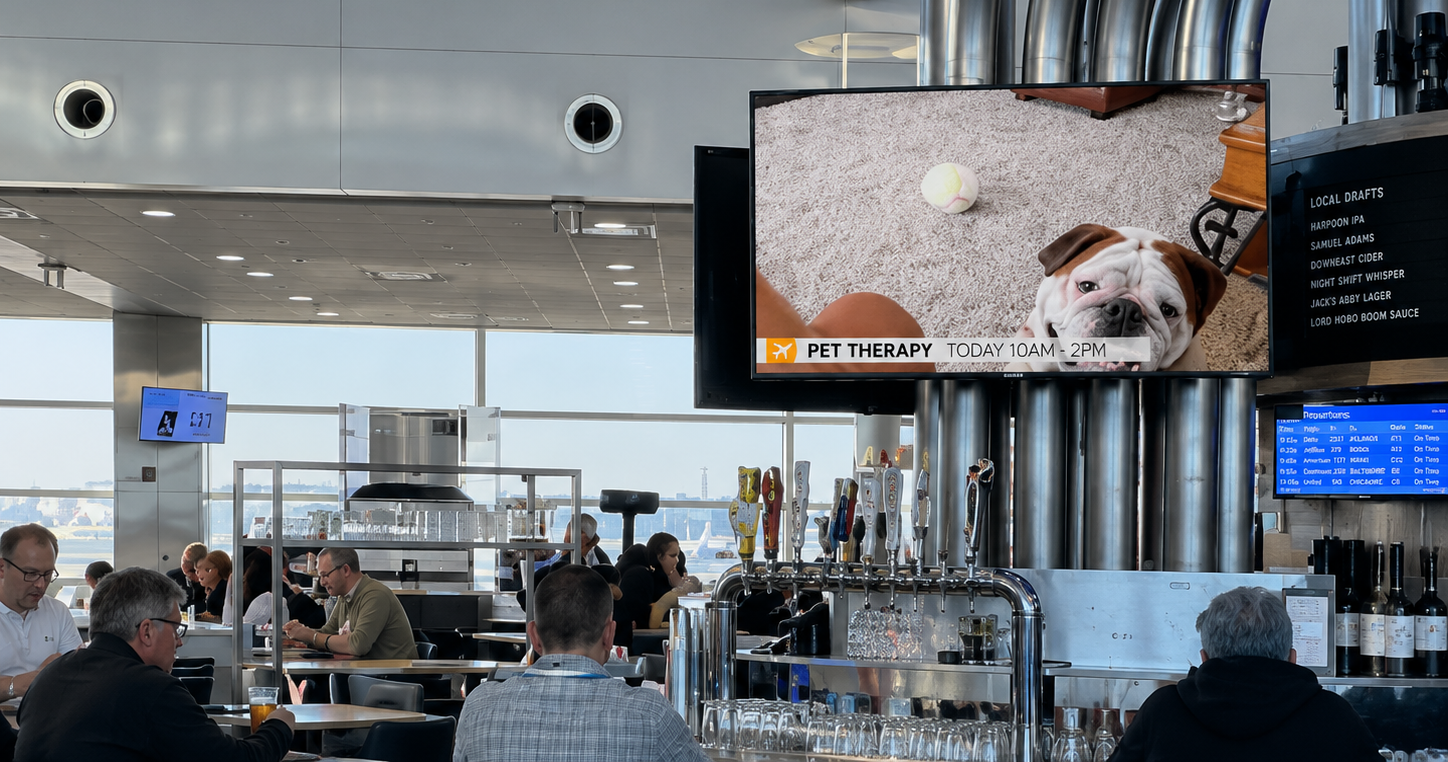
- Single-terminal configuration means full-journey coverage across roughly 844,000 passengers is achievable from one compact footprint, at a fraction of Houston Intercontinental pricing while reaching a far higher proportion of qualified petrochemical and industrial decision-makers.
- Advertising clutter is materially lower than at the Gulf Coast hub airports. A well-placed campaign at BTR achieves standout and recall that would demand premium spectacular positioning at Houston or Atlanta.
- Dwell time is supported by early-departure business travel behaviour, with the first Washington service departing at 6:00 am, and by the connecting nature of every itinerary, which encourages generous arrival buffers. University event weekends produce sharp additional concentration.
- Masscom Global provides advertisers with inventory access, placement precision mapped to individual hub route flows, and execution capability at an airport where local relationship depth determines availability. We separate the Houston industrial flow, where petrochemical and engineering propositions belong, from the Washington policy flow and the Atlanta and Charlotte leisure and connecting flows, so B2B, government affairs and consumer creative each reach their intended audience rather than a blended average.
Strategic Advertising Fit
Best Fit:
- Industrial equipment, process technology and petrochemical services: The most contextually aligned category at this airport, addressing plant management and procurement leadership across one of the densest chemical complexes on earth.
- Engineering, EPC and industrial construction services: Several nationally significant contractors are headquartered here, and the turnaround calendar concentrates project decision-makers repeatedly.
- Commercial insurance, risk management and business continuity: Hurricane exposure and Louisiana's insurance environment make this among the most receptive markets in the United States for specific, well-substantiated coverage propositions.
- Safety, compliance, industrial hygiene and workforce services: Continuous demand across the corridor's plants and contractors, with purchasing authority concentrated in this terminal.
- Government affairs, public policy, legal and lobbying services: The state capital function plus a direct Washington route creates a policy audience unavailable at most comparable airports.
- Commercial banking, industrial finance and equipment leasing: Capital-intensive businesses with continuous financing, leasing and hedging requirements.
- Premium automotive and pickup trucks: High ownership and replacement rates among the engineering, contracting and professional population, particularly across the affluent southeastern suburbs.
- Healthcare systems, specialist medical services and biomedical research recruitment: Three competing regional health systems and a biomedical research institute in a multi-parish referral market.
Brand Alignment at a Glance:
| Category | Fit |
|---|---|
| Industrial equipment and petrochemical services | Exceptional |
| Engineering, EPC and construction services | Exceptional |
| Commercial insurance and risk management | Strong |
| Government affairs, policy and legal services | Strong |
| Commercial banking and industrial finance | Strong |
| Premium automotive and pickup trucks | Strong |
| Healthcare and biomedical services | Moderate |
| Ultra-luxury fashion, haute joaillerie and yachting | Poor fit |
Who Should Not Advertise Here:
- Ultra-luxury fashion, haute joaillerie and yachting: Consumer affluence in this catchment is concentrated in narrow suburban pockets, there is no international luxury transit flow, and premium expression here runs to vehicles and land rather than to fashion houses. Spend belongs at Houston, Dallas or New Orleans.
- International residency, citizenship-by-investment and offshore property: Demand is minimal among the local audience, and the corridor's expatriate population is served by corporate mobility programmes rather than by consumer residency products.
- Inbound destination tourism marketing: BTR is a business and origin terminal, not a leisure destination gateway. Regional visitor traffic arrives substantially by road, and campaigns positioning the region to air visitors will underperform relative to the same budget spent on the resident and business audience.
Event and Seasonality Analysis
- Event Strength: High
- Seasonality Strength: Medium
- Traffic Pattern: Stable business base with event and turnaround spikes
Strategic Implication:
This airport rewards continuity punctuated by targeted weight. The business base sustains meaningful traffic every month, so annual contracts deliver the frequency this repeat-travelling audience requires and secure prime position at negotiated rates. Within that base, three windows warrant additional weight: the spring legislative session and turnaround season from March to June, for industrial, policy and insurance categories; the autumn football and turnaround overlap from September to November, the densest business and event period of the year, for consumer, automotive and financial categories alongside continued B2B; and February to March for the carnival calendar. Industrial advertisers should align flight timing to the plants' turnaround schedules rather than to the general calendar, since those weeks concentrate decision-maker travel more sharply than any consumer season. Masscom structures campaigns around exactly that rhythm.

Poor Placement and Delays Affect Airport Campaigns
We help you move faster, access better inventory, and get it right now.
Talk to an ExpertFinal Strategic Verdict
Baton Rouge Metropolitan is one of the purest business-audience airports in the United States, and its 844,025 record passengers understate its value badly. Served only by American, Delta and United, feeding five hubs with first class available on essentially every departure and load factors above 80 percent, it carries almost no leisure traffic and almost no low-cost traffic. What it carries instead is the decision-making layer of one of the densest petrochemical and refining corridors on earth, the entirety of Louisiana's state government and legislative apparatus, several nationally significant industrial contractors, and the direct capital-to-capital link to Washington Reagan National. Industrial equipment and process technology providers, engineering and EPC firms, commercial insurers and risk managers, safety and compliance suppliers, industrial lenders, government affairs practices and premium automotive brands will find that audience here at a fraction of Houston Intercontinental pricing, with a share of voice impossible at a major hub. Ultra-luxury consumer categories and international residency programmes should look elsewhere. With volume up roughly 30 percent across two years to an all-time high, a corridor capital pipeline extending into low-carbon projects and route expansion ambitions constrained only by demonstrated demand, Masscom Global is the partner positioned to secure inventory, timing and placement precision while pricing still reflects the airport's volume rather than its audience.
About Masscom Global
Masscom Global is a premium international airport advertising and media buying agency operating across 140 countries. With deep expertise in airport OOH, premium publications, and high-net-worth audience targeting, Masscom helps brands reach the world's most valuable travellers at the moments that matter most. For advertising packages, media rates, and campaign planning at Baton Rouge Metropolitan Airport and airports across the globe, contact Masscom Global today.
Frequently Asked Questions
How much does airport advertising cost at Baton Rouge Metropolitan Airport?
Cost at BTR varies by format, terminal position, campaign duration and seasonal demand. Positions covering the departures and gate environment on the Houston and Washington route flows carry premiums during the spring legislative and turnaround season and the autumn football and turnaround overlap. Because traffic is business-led and stable rather than seasonal, annual and multi-year commitments deliver both better rates and the frequency this repeat-travelling audience requires. Contact Masscom Global for current rates and availability.
Who are the passengers at Baton Rouge Metropolitan Airport?
Almost entirely business, government and institutional travellers, because the airport has no low-cost carriers and no leisure nonstops. The core groups are petrochemical and refining plant management, engineering and procurement leadership, industrial construction and turnaround contracting executives, state government officials, lobbyists and government affairs professionals, and academic, medical and university sports travellers. A small but high-value expatriate industrial population tied to the corridor's international plant owners is also present.
Is Baton Rouge Metropolitan Airport good for luxury brand advertising?
For premium categories aligned to this audience, yes. Premium automotive and pickup trucks, business aviation, private wealth advisory and premium hospitality all perform, helped by the fact that most flights offer first class and premium economy, which is unusual at this passenger volume. For ultra-luxury fashion, haute joaillerie and yachting, no. Consumer affluence is concentrated in narrow suburban pockets, there is no international luxury transit flow, and those budgets deliver better returns at Houston, Dallas or New Orleans.
What is the best airport in Louisiana to reach HNWI audiences?
New Orleans Louis Armstrong delivers the greatest volume of premium leisure, hospitality and international traffic in the state and remains the anchor buy for a consumer or luxury campaign. Baton Rouge delivers something different and more specific: the highest concentration of petrochemical, industrial and state government decision-makers in Louisiana, in a terminal with premium cabins on nearly every flight. Masscom recommends New Orleans for consumer and luxury reach and Baton Rouge for industrial and institutional precision, and can structure a coordinated Louisiana plan across both.
What is the best time to advertise at Baton Rouge Metropolitan Airport?
Because the base is business-led and stable, annual campaigns outperform short bursts. Within that, March to June carries the legislative session, spring plant turnarounds, university baseball and graduation travel. September to November combines football season with autumn turnarounds and fiscal-year-start corporate travel, and is the densest period of the year. February and March add the carnival calendar. Industrial advertisers should align timing to plant turnaround schedules specifically, as those weeks concentrate procurement decision-makers most sharply.
Can international real estate developers advertise at Baton Rouge Metropolitan Airport?
This is a weaker proposition than at most airports and advertisers should calibrate carefully. Property capital from this catchment moves principally to the Alabama and Florida panhandle coast, Texas and Tennessee, with modest interest in Mexican and Caribbean resort markets. Developers with Gulf Coast, Texas or Southeastern inventory will find genuine demand. Long-haul international inventory faces weak intent, and the expatriate industrial population is served by corporate mobility programmes rather than consumer property marketing.
Which brands should not advertise at Baton Rouge Metropolitan Airport?
Ultra-luxury fashion, haute joaillerie and yachting, because consumer affluence is narrow and there is no luxury transit flow. International residency and citizenship-by-investment programmes, because local demand is minimal. And inbound destination tourism marketing, because this is a business origin terminal rather than a leisure gateway, with most regional visitor traffic arriving by road.
How does Masscom Global help brands advertise at Baton Rouge Metropolitan Airport?
Masscom Global delivers the full sequence: audience and catchment intelligence specific to the Mississippi River petrochemical corridor, the state government apparatus and the industrial contracting sector, inventory access and placement precision mapped to individual hub route flows, campaign timing structured around the turnaround calendar, legislative session and university event seasons, and execution management through to performance reporting. Operating across 140 countries, we can activate BTR alongside Houston, Dallas, Atlanta and the Gulf Coast markets where this audience's business and property decisions land, reaching the same decision-maker at both ends of the corridor. Book a fifteen-minute planning call to review current availability and rates.