




Airport at a Glance
| Field | Detail |
|---|---|
| Airport | Chinggis Khaan International Airport |
| IATA Code | UBN |
| Country | Mongolia |
| City | Ulaanbaatar |
| Annual Passengers | 2.18 million (2024), 1.7 million international |
| Primary Audience | Mining and commodities executives, outbound Mongolian leisure travellers, adventure and premium inbound tourists |
| Peak Advertising Season | June to August, plus December to February |
| Audience Tier | Tier 2 |
| Best Fit Categories | Mining and heavy equipment, banking and wealth management, international education, luxury retail and duty free |
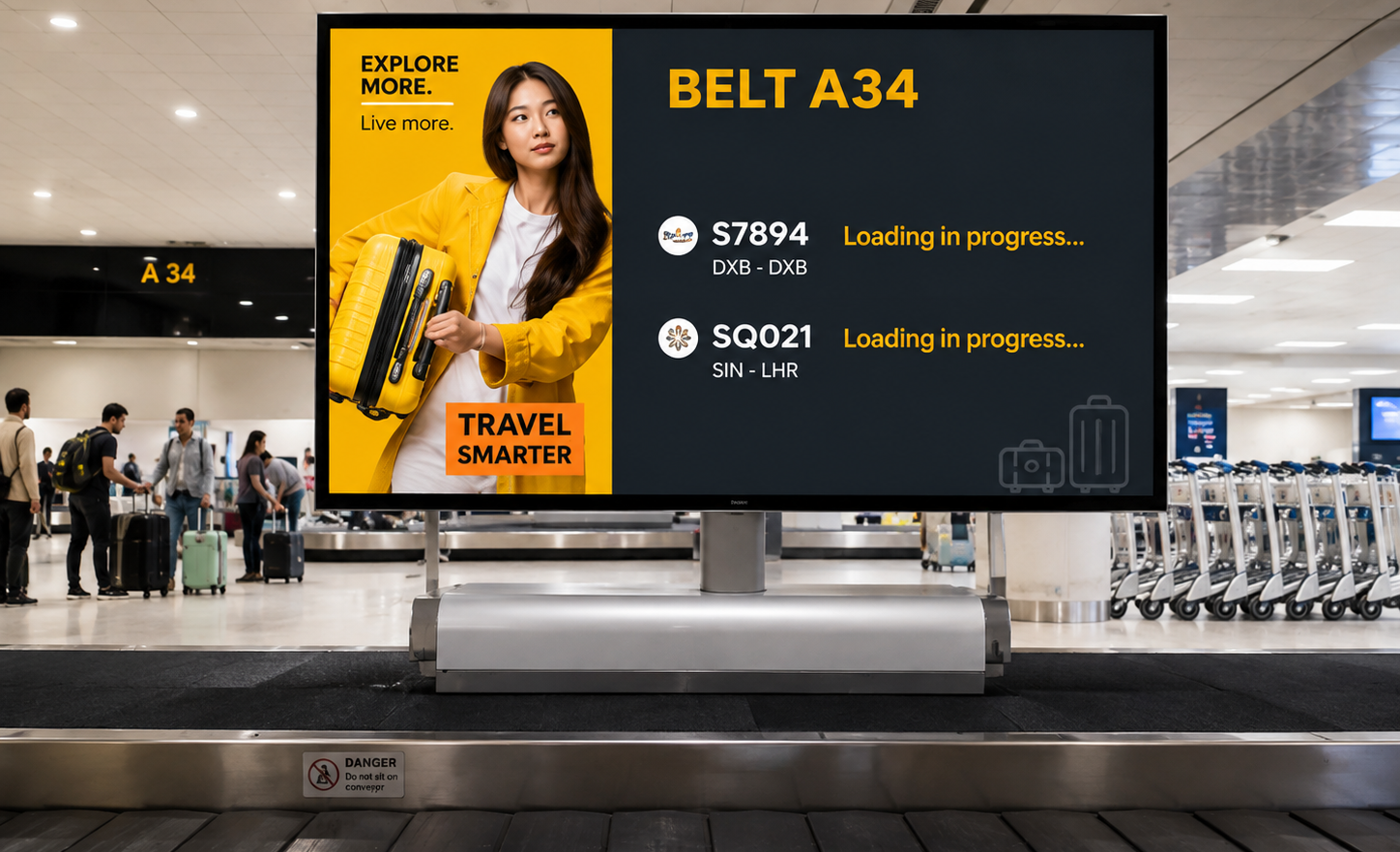
The only international gateway to a resource economy where every high-value decision maker in the country passes through a single terminal.
Chinggis Khaan International Airport is the single point of international entry and exit for Mongolia. There is no secondary international hub, no alternate gateway, and no way for a Mongolian executive, an inbound mining investor, or an outbound family to bypass this terminal. For advertisers, that produces something extremely rare: total national coverage of the affluent audience through one airport. A single well-placed campaign at UBN reaches effectively the entire internationally mobile population of Mongolia.
The commercial weight comes from concentration rather than volume. Roughly half of Mongolia's population lives in Ulaanbaatar, and the capital generates the majority of national economic output. Mining royalties, commodity trading income, banking, and construction wealth all pool in one city that feeds one airport. With 1.7 million of 2.18 million passengers travelling internationally in 2024, UBN carries an unusually high international share, and international passengers are the highest-value audience in any airport environment.
Advertising Value Snapshot
- Passenger scale: 2.18 million passengers in 2024, up around 25 percent from 1.73 million in 2023, with the airport targeting 2.4 million and already pressing against its 2.3 million design capacity.
- Traveller type: Mining and commodities business travellers, outbound Mongolian leisure and family travellers, inbound premium adventure and expedition tourists.
- Airport classification: Tier 2. Moderate absolute volume, but exceptional audience concentration and a national monopoly on international traffic.
- Commercial positioning: Mongolia's sole international gateway and the transit point for the country's mining, cashmere, and commodity export economy.
- Wealth corridor signal: UBN sits on the Northeast Asia resource corridor linking Mongolian mineral wealth to buyers, financiers, and lifestyle markets in China, South Korea, Japan, and increasingly the Gulf.
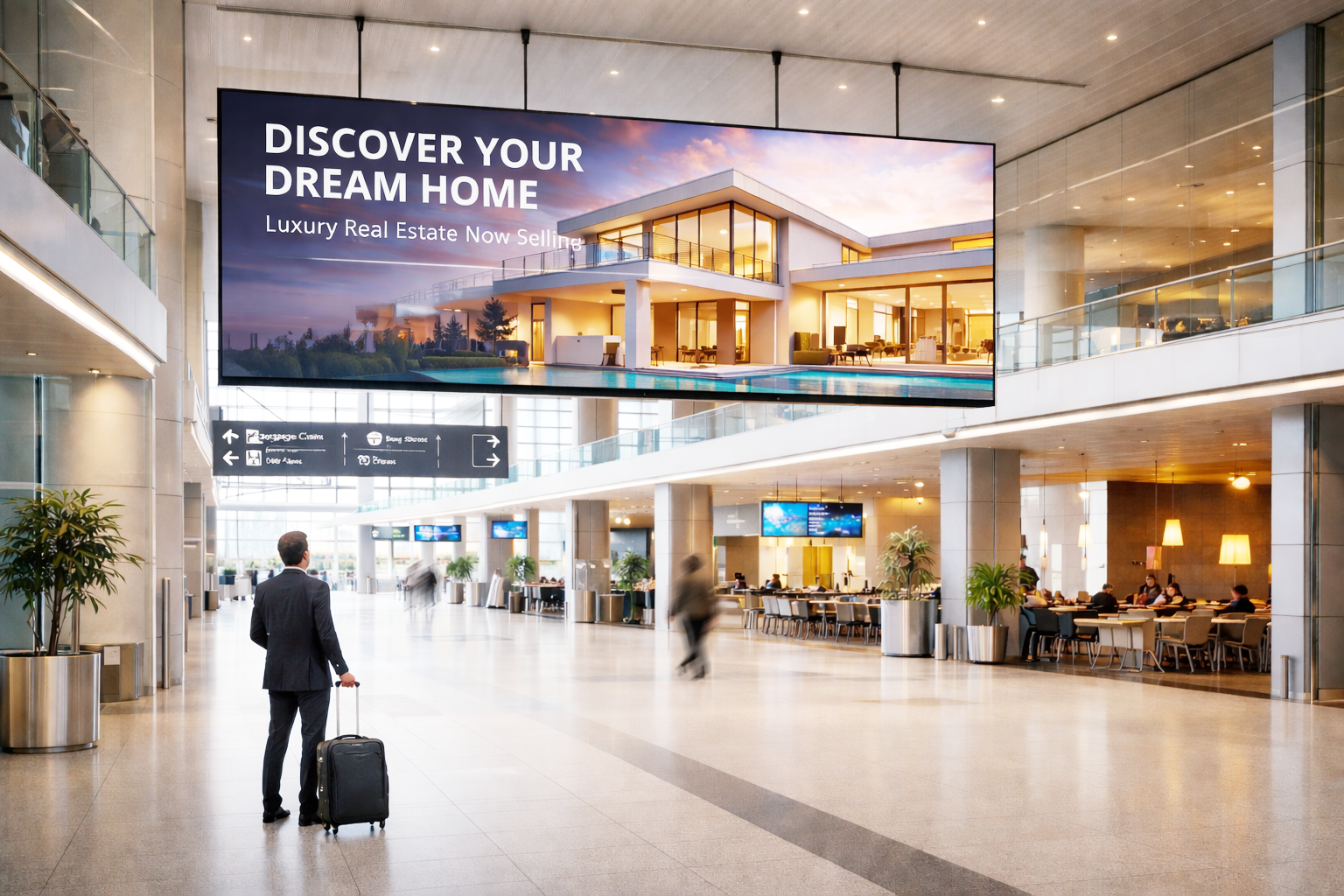
- Advertising opportunity: Masscom Global provides direct access to placement across this single-terminal environment, where the absence of parallel gateways means share of voice is achievable at a scale impossible in multi-airport markets. Masscom structures campaigns to intercept the full international passenger flow rather than a fragmented slice of it. Brands entering Mongolia can establish national visibility through one coordinated buy.
Airport Advertising is Complex to Get Right
We help you execute faster, with proven results and local insight most planners lack starting now.
Talk to an ExpertCatchment Area and Economic Drivers
Top 10 Cities within 150 km, Marketer Intelligence:
- Ulaanbaatar: Home to roughly half the national population and the overwhelming majority of Mongolian disposable income. Every bank headquarters, mining corporate office, luxury retailer, and premium developer sits here. This is the audience with capital to deploy.
- Zuunmod: Töv provincial capital and the closest administrative centre to the terminal. Produces government and provincial administrative travellers, plus a growing commuter class servicing airport-linked employment.
- Nalaikh: Industrial and coal-linked district on the Ulaanbaatar periphery. Generates a working and supervisory audience relevant to remittance services, telecom, and value retail rather than luxury.
- Baganuur: Coal mining settlement supplying Ulaanbaatar's power base. Delivers a technically skilled, mining-employed audience with above-average household income and strong outbound leisure appetite.
- Sergelen: The airport's host soum and site of Mongolia's planned satellite city development. Currently generates construction, logistics, and land investment interest, making it a signal for property and infrastructure advertisers.
- Choir: Former strategic aviation town in Gobisümber, now positioned on the southbound freight corridor. Produces logistics operators and transport-sector decision makers.
- Bagakhangai: Small administrative enclave along the southern rail route. Contributes rail and freight-linked travellers rather than a consumer audience.
- Batsümber: Töv agricultural and resort belt north of the capital. The resort economy here draws Ulaanbaatar's affluent weekenders, making it a proxy indicator for domestic premium spending.
- Bornuur: Core of Mongolia's vegetable and crop belt. Produces agribusiness owners and equipment buyers, an underserved audience for agricultural machinery and finance brands.
- Erdene: Gateway settlement toward Mongolia's most visited national park zone. The tourism traffic through here identifies the inbound premium leisure segment that later departs through UBN with duty free intent intact.
NRI and Diaspora Intelligence: Mongolia's diaspora is concentrated in South Korea, Japan, the United States, Germany, and the Czech Republic, and Seoul alone accounted for roughly 638,000 passengers at UBN in 2024. This community travels with high frequency, carries foreign currency earnings, and makes purchase decisions on both sides of the corridor. Diaspora travellers are the primary buyers of Mongolian property, education for siblings and children, and cross-border financial products. They arrive with foreign income and depart with domestic obligations, which makes them receptive to remittance, banking, property, and insurance messaging at the terminal.
Economic Importance: Mongolia's economy runs on mineral extraction, principally copper, gold, coal, and iron ore, supported by cashmere and livestock exports. Mining generates a compact, high-earning executive and technical class, plus the banking, legal, and logistics services that orbit it. Cashmere and agriculture create a separate entrepreneurial owner audience with real liquidity but different spending patterns. For advertisers, this means two distinct affluent segments passing through one terminal: corporate mining wealth and family business wealth.
Business and Industrial Ecosystem
- Copper and gold mining: Produces senior expatriate and Mongolian executives, engineers, and institutional investors travelling on multi-year project cycles. The highest-value B2B audience in the country.
- Coal export and logistics: Generates freight, trading, and commodity finance travellers moving on the southern corridor toward Chinese buyers.
- Banking and financial services: Ulaanbaatar's concentrated banking sector produces frequent-flying finance professionals and the wealth advisory audience that international private banks target.
- Cashmere and textile export: Creates owner-operator entrepreneurs travelling to buyer markets in Europe, Japan, and China, a self-funded audience with discretionary spending authority.
Passenger Intent, Business Segment: Business travellers at UBN are travelling to raise capital, close offtake agreements, meet regulators, or oversee remote site operations. They fly repeatedly on the same corridors, dwell in a single terminal, and make procurement and vendor decisions at scale. Heavy equipment, industrial services, business banking, corporate insurance, professional services, and premium hospitality intercept this segment most effectively.
Strategic Insight: The business audience at UBN is commercially valuable precisely because it cannot be reached anywhere else. Mining decision makers do not congregate at trade shows in Mongolia with the same reliability that they pass through this terminal. A brand selling to Mongolian resource capital has one guaranteed physical touchpoint with the entire buying class, and Masscom Global controls the intelligence and access needed to place inside it.
Tourism and Premium Travel Drivers
- Gobi Desert expedition circuits: Attract high-spend international travellers on pre-paid multi-week itineraries. Premium outdoor gear, camera equipment, travel insurance, and luxury lodge brands align directly.
- Steppe and nomadic experience tourism: Draws affluent Western and Northeast Asian travellers seeking scarcity rather than comfort. This audience skews toward experiential luxury and adventure finance products.
- National park and mountain zones near the capital: Feed short-stay premium visitors who route back through UBN with residual budget and duty free intent.
- Naadam cultural tourism: Concentrates the highest-value inbound arrivals into a compressed July window, producing a predictable annual spike in premium foreign passenger density.
Passenger Intent, Tourism Segment: Inbound tourists at UBN have already committed significant spend before arrival, since Mongolia is a considered, high-cost, long-haul destination rather than an impulse trip. That self-selects for disposable income. On departure they carry unspent local budget and strong souvenir and gifting intent, which favours cashmere retail, duty free spirits, luxury accessories, watches, and premium travel services. Inbound arrivals are simultaneously receptive to connectivity, financial, and hospitality messaging in the first minutes on the ground.
Travel Patterns and Seasonality
- Peak seasons: June to August is the dominant inbound peak, driven by the short Mongolian summer, the Naadam festival, and expedition season. December to February drives heavy outbound leisure traffic as Mongolians escape extreme winter for Southeast Asian beach destinations, with Thailand a consistent favourite. Late January to February also carries Lunar New Year family movement.
- Traffic volume data: Monthly breakdown data not available. Directional evidence points to a pronounced summer inbound peak and a distinct winter outbound peak, producing a dual-peak annual profile.
Event-Driven Movement:
- Naadam Festival (July): Mongolia's national cultural festival and the single largest driver of premium inbound arrivals. Advertisers should have creative live from mid-June to capture the arrival build.
- Tsagaan Sar, Lunar New Year (February): Family reunion and gifting season generating diaspora inbound flow and heavy domestic movement. Peak window for gifting, retail, banking, and telecom offers.
- Winter outbound holiday season (December to February): Mongolian families and affluent professionals departing for Southeast Asia. Prime window for travel retail, resort, insurance, and duty free messaging.
- Mining and investment conference season (spring and autumn): Concentrates international resource investors and corporate delegations into short windows. High-value period for B2B, financial, and premium hospitality advertisers.
- Golden Eagle and autumn cultural season (September to October): Draws a niche but very high-spend photography and expedition audience departing through UBN.

It’s Not Just Where You Advertise - It’s How Fast You Execute
We combine local insight with fast rollout to deliver results for you, now.
Talk to an ExpertAudience and Cultural Intelligence
Top 2 Languages:
- Mongolian: The language of the domestic affluent audience, including mining executives, business owners, and outbound family travellers. Local-language creative signals commitment and materially lifts recall among the domestic wealth segment.
- English: The working language of the mining, finance, and inbound tourism audience, and the default for expatriate executives and international investors. English creative is essential for all B2B and premium inbound targeting.
Major Traveller Nationalities: South Korean and Chinese nationals dominate international movement through UBN, reflecting Mongolia's largest trade and tourism relationships, with Seoul the single biggest market at around 638,000 passengers and Beijing next at around 240,000. Turkish traffic through Istanbul added roughly 147,000, functioning as Mongolia's principal bridge to Europe and the Middle East. Japanese travellers arrive through longstanding investment and development ties, and Russian movement continues via the northern corridor. Campaign creative should be bilingual at minimum and, for retail and hospitality categories, extended to Korean and Chinese to capture the largest inbound cohorts.
Religion, Advertiser Intelligence:
- Buddhism (approximately 50 to 53 percent): Tibetan Buddhist observance shapes the calendar, with Tsagaan Sar the dominant commercial event. It drives family gifting, new clothing, gold and jewellery purchases, and domestic and diaspora travel. Retail, jewellery, banking, telecom, and gifting categories see their sharpest annual uplift here.
- No religious affiliation (approximately 35 to 40 percent): An unusually large secular share for Asia. This audience responds to performance, status, and value propositions rather than tradition-led messaging, which favours technology, automotive, financial products, and international education creative.
- Islam (approximately 3 percent): Concentrated in Mongolia's Kazakh western population. Small in absolute terms but tied to distinct festival travel and a specific outbound corridor toward Turkey and Kazakhstan, which is relevant for airline, remittance, and halal hospitality advertisers.
- Christianity and shamanist practice (remaining share): Christianity is small but urban and youth-skewed, while shamanist practice persists alongside Buddhism. Both reinforce that Mongolian consumers layer identity rather than following a single framework, so messaging should avoid narrow religious framing.
Behavioral Insight: Mongolian affluent consumers built wealth quickly and recently, largely inside one generation of resource-driven growth. That produces visible-status purchasing behaviour, strong brand-name preference, and a willingness to buy imported quality over local substitutes. At the same time, exposure to commodity price volatility creates real caution around long-horizon commitments, so financial and property messaging performs better when it emphasises security, tangibility, and asset protection rather than leverage. Family remains the decision unit, and education for children is treated as the highest-priority discretionary spend in the household.
Outbound Wealth and Investment Intelligence
The outbound passenger at UBN is deploying capital out of a small, volatile, landlocked economy into larger and more stable ones. Mongolian high-net-worth individuals hold concentrated exposure to commodity cycles and the domestic currency, which creates persistent demand for offshore diversification. They move toward Northeast Asian and Gulf markets that combine accessibility, residency pathways, and hard-currency asset security. That intent is fully formed before they reach the terminal, which is what makes airport messaging effective rather than introductory.
Outbound Real Estate Investment: Dubai has become the dominant offshore property destination for Mongolian capital, offering zero income tax, dirham stability, and residency linked to property purchase. Bangkok attracts a parallel flow driven by the established winter travel corridor, delivering low entry prices and rental yields well above Ulaanbaatar's. Seoul and Tokyo draw a smaller, more conservative cohort prioritising capital preservation and proximity to family already studying or working there. International developers marketing at UBN reach an audience that is already currency-diversifying and already flying to these cities, which shortens the sales cycle considerably.
Outbound Education Investment: South Korea and Japan are the primary higher education destinations, reinforced by dense diaspora networks and direct daily connectivity. The United States, Australia, Germany, the Czech Republic, and Hungary all draw significant Mongolian student cohorts, with Turkey growing through the Istanbul corridor. Families routinely allocate a disproportionate share of household wealth to overseas education, treating it as intergenerational insurance rather than expenditure. Universities, pathway colleges, IELTS and language providers, education loan products, and student housing brands find a highly qualified and motivated audience in this terminal.
Outbound Wealth Migration and Residency: UAE Golden Visa and residency-linked property programmes are the most relevant to this audience, since they pair directly with existing Dubai investment activity. Turkish citizenship by investment is accessible through the daily Istanbul corridor and appeals to families seeking European proximity. Portugal, Greece, and Malta residency programmes attract the top tier of Mongolian wealth seeking Schengen mobility, while Thailand's long-stay visa options suit the winter-migration cohort. Second residency is understood here as risk management against a single-commodity national economy.
Strategic Implication for Advertisers: Brands on both sides of this corridor should treat UBN as a priority buy because the airport concentrates 100 percent of Mongolia's outbound capital flow into one terminal. A Gulf developer, an Asian university, and a residency advisory firm are all addressing the same passengers in the same building at the same moment of intent. Masscom Global activates on both sides of the corridor simultaneously, pairing UBN placement with destination-market airport visibility so the message meets the investor at departure and again at arrival.
Airport Infrastructure and Premium Indicators
Terminals:
- A single integrated passenger terminal of approximately 37,000 square metres handles all domestic and international traffic through shared circulation space. There is no separation of premium and economy passenger flow into different buildings, which means every placement reaches the full audience spectrum including the highest-value segment.
- The facility supports around 17 aircraft parking stands and a 3,600 metre runway serving 11 domestic destinations plus international routes across Asia and Europe, with capacity utilisation already at design ceiling.
Premium Indicators:
- Business lounge facilities including a dedicated VIP room operate within the terminal, providing a controlled high-net-worth environment distinct from general concourse traffic.
- Charter and private aviation movements operate through the airport as Mongolia's sole international field, servicing mining executives accessing remote project sites and inbound expedition clients.
- Dedicated luxury hotel inventory at the terminal itself is not available, with premium accommodation concentrated in Ulaanbaatar approximately 50 km away, which extends dwell time and transfer exposure.
- The airport holds a 4-Star Skytrax rating, the first awarded to any Mongolian airport, alongside active energy efficiency and waste reduction programmes that support ESG-aligned brand association.
Forward-Looking Signal: UBN is operating above its 2.3 million design capacity and is in active discussion with government on terminal expansion, additional floor space, and further aircraft stands. New and returning routes to Singapore, Shanghai, Frankfurt, and the Gulf are widening the international mix, while a planned satellite city development adjacent to the airport signals a longer-term commercial district. Each expansion phase raises passenger volumes and, with them, the cost of terminal visibility. Masscom Global advises clients to secure positions now, at current rate levels and with current availability, before capacity growth and route expansion intensify competition for prime inventory.
Airline and Route Intelligence
Top Airlines: MIAT Mongolian Airlines, Aero Mongolia, Hunnu Air, Korean Air, Asiana Airlines, Jeju Air, Air Busan, Air China, Turkish Airlines, Cathay Pacific, S7 Airlines.
Key International Routes: Seoul Incheon is the dominant corridor with daily service from multiple carriers and around 638,000 passengers annually. Beijing follows at approximately 240,000 passengers, and Istanbul at approximately 147,000 with daily narrowbody service. Additional international service links Hong Kong, Tokyo Narita, Irkutsk, Singapore, Shanghai, and Frankfurt on seasonal or limited-frequency patterns. Precise weekly frequency data across the full network is not available.
Domestic Connectivity: Eleven domestic destinations are served, connecting Ulaanbaatar to provincial centres and the Gobi region. Domestic traffic is heavily tied to mining site access and summer tourism distribution rather than routine commuting.
Wealth Corridor Signal: The route network reveals a clear split. Seoul, Beijing, Tokyo, and Hong Kong function as wealth transfer corridors carrying capital, trade negotiation, medical travel, education, and diaspora income. Istanbul operates as the strategic bridge to Europe and the Gulf, and increasingly as a residency and investment pathway. Bangkok and Southeast Asian seasonal service is leisure spending rather than capital movement. Advertisers should weight financial, education, property, and residency messaging toward the Northeast Asia and Istanbul gates, and lifestyle, retail, and hospitality messaging toward the winter leisure flow.
Media Environment at the Airport
- Single-terminal architecture with a compact 37,000 square metre footprint produces materially lower advertising clutter than comparable Northeast Asian gateways. Standout potential per placement is exceptionally high because there is no competing sprawl of parallel concourses.
- The airport sits roughly 50 km from Ulaanbaatar, which means passengers arrive early and with buffer time built in. Extended pre-security and post-security dwell converts directly into higher message frequency and deeper brand exposure per passenger.
- A 4-Star rated, recently built facility with modern finishes and business lounge infrastructure creates a premium environment that elevates brand association, particularly valuable for financial, luxury, and institutional advertisers.
- Masscom Global delivers inventory access, placement precision, and execution capability across this terminal, including passenger-flow mapping that positions brands at arrival intent, departure dwell, and lounge-level high-net-worth touchpoints.
Strategic Advertising Fit
Best Fit:
- Mining equipment, industrial services, and engineering: The entire Mongolian resource buying class transits this terminal, making it the most efficient B2B environment in the country.
- Banking, wealth management, and private banking: An affluent audience actively seeking currency and asset diversification with high receptivity to offshore financial products.
- International real estate developers: Dubai, Bangkok, Seoul, and Tokyo property buyers are already in this passenger flow and already committed to offshore purchase.
- International education, universities, and study-abroad consultancies: Education is the top discretionary priority for affluent Mongolian families, with defined destination corridors to Korea, Japan, Europe, and the United States.
- Residency and citizenship by investment advisory: Structural demand for second residency driven by commodity-linked economic concentration.
- Luxury retail, watches, jewellery, and duty free: Status-driven purchasing behaviour combined with departing tourists holding unspent budget.
- Airlines, travel insurance, and premium hospitality: Dual-peak seasonality and long-haul considered travel create year-round relevance.
- Telecom, roaming, and fintech remittance: Diaspora frequency and cross-border earnings make this a high-conversion category at arrival and departure.
Brand Alignment at a Glance:
| Category | Fit |
|---|---|
| Mining and industrial B2B | Exceptional |
| Banking and wealth management | Exceptional |
| International education | Strong |
| International real estate and residency | Strong |
| Luxury retail and duty free | Strong |
| Airlines and travel services | Strong |
| Telecom and fintech | Moderate |
| Mass-market FMCG | Poor fit |
Who Should Not Advertise Here:
- Mass-market FMCG and everyday grocery brands: The audience is internationally mobile and affluent, not a general consumer sample, and the cost per relevant contact is inefficient.
- Hyperlocal services and neighbourhood retail: The terminal sits 50 km outside the city with no meaningful local catchment population to convert.
- Entry-level budget travel and hostel-tier accommodation: Both the inbound expedition audience and the outbound Mongolian traveller at this airport self-select for higher spend, so budget positioning misreads the room.
Event and Seasonality Analysis
- Event Strength: Medium
- Seasonality Strength: High
- Traffic Pattern: Dual-Peak
Strategic Implication: Advertisers should weight budget toward two distinct windows rather than spreading evenly: June through August for premium inbound tourism and Naadam, and December through February for outbound leisure and Tsagaan Sar family spending. The two windows demand different creative, since summer targets arriving foreign travellers while winter targets departing Mongolian households. Masscom Global structures campaigns around this rhythm, front-loading creative from mid-June and mid-December to capture the build rather than the peak, which is where the strongest return on investment sits.

Poor Placement and Delays Affect Airport Campaigns
We help you move faster, access better inventory, and get it right now.
Talk to an ExpertFinal Strategic Verdict
Chinggis Khaan International Airport offers something almost no other airport in Asia can: complete national coverage of an affluent, internationally mobile audience through a single terminal, with no alternative gateway to dilute reach. With 2.18 million passengers in 2024, 1.7 million of them international, and roughly 25 percent year-on-year growth against a capacity ceiling already breached, this is a rising market caught at the exact point before terminal expansion resets the cost base. Mining and industrial B2B brands reach the entire Mongolian resource buying class here. Banks, developers, universities, and residency advisors reach a wealth segment structurally motivated to move capital into Dubai, Bangkok, Seoul, Tokyo, and Europe. Luxury retail reaches both a status-driven domestic buyer and a departing expedition traveller with budget intact. The combination of low clutter, extended dwell driven by the 50 km city distance, a 4-Star rated premium environment, and a single unified concourse means share of voice here is achievable at a level that Seoul, Beijing, or Istanbul will never permit. Masscom Global brings the market intelligence, inventory access, and execution speed to convert that structural advantage into measurable brand outcomes, and to activate both ends of the wealth corridor at once.
About Masscom Global
Masscom Global is a premium international airport advertising and media buying agency operating across 140 countries. With deep expertise in airport OOH, premium publications, and high-net-worth audience targeting, Masscom helps brands reach the world's most valuable travellers at the moments that matter most. For advertising packages, media rates, and campaign planning at Chinggis Khaan International Airport and airports across the globe, contact Masscom Global today.
Frequently Asked Questions
How much does airport advertising cost at Chinggis Khaan International Airport? Cost depends on format, position within the terminal, campaign duration, and seasonal demand. Placements in high-dwell departure zones and lounge-adjacent positions carry premium pricing, and rates rise sharply during the June to August inbound peak and the December to February outbound peak. Because the airport operates a single terminal at full capacity, prime inventory is limited and prices move with availability. Contact Masscom Global for current rate cards and package options.
Who are the passengers at Chinggis Khaan International Airport? Roughly 78 to 80 percent of passengers travel internationally. The mix is dominated by mining, commodities, and finance business travellers, outbound Mongolian families and professionals heading to Southeast Asia and Northeast Asia, diaspora travellers based in South Korea and Japan, and inbound premium adventure and expedition tourists. Because Mongolia has no second international gateway, this passenger base represents effectively the entire internationally mobile population of the country.
Is Chinggis Khaan International Airport good for luxury brand advertising? Yes, for the right luxury categories. Mongolian affluent consumers display strong status-signalling purchase behaviour and clear imported-brand preference, and departing inbound tourists arrive at the terminal with unspent budget and gifting intent. Watches, jewellery, cashmere, spirits, and premium accessories align well. The 4-Star rated modern terminal and business lounge environment supports premium brand association. Absolute HNWI volumes are smaller than in major Asian hubs, so luxury brands should expect high engagement quality rather than high raw scale.
What is the best airport in Mongolia to reach HNWI audiences? Chinggis Khaan International Airport is the only viable option. It is Mongolia's sole international gateway, meaning every high-net-worth individual entering or leaving the country passes through this terminal. Domestic airports serve provincial and mining-access traffic without international passenger value. Within the wider Northeast Asian region, UBN functions as the concentrated access point to Mongolian resource wealth specifically.
What is the best time to advertise at Chinggis Khaan International Airport? Two windows deliver the strongest returns. June through August captures the inbound premium tourism peak and the Naadam festival in July, ideal for retail, duty free, hospitality, and luxury. December through February captures heavy outbound leisure movement to Southeast Asia plus Tsagaan Sar family and gifting spending, ideal for banking, telecom, travel, and retail. Creative should be live from mid-June and mid-December to capture the traffic build.
Can international real estate developers advertise at Chinggis Khaan International Airport? This is one of the strongest use cases at the airport. Mongolian high-net-worth individuals are actively buying property in Dubai, Bangkok, Seoul, and Tokyo, driven by demand for hard-currency assets, tax efficiency, and residency pathways outside a commodity-dependent domestic economy. Because all outbound capital flow passes through one terminal, a single campaign reaches essentially the entire buyer pool. Masscom Global can pair UBN placement with visibility in the destination market airport for corridor-wide coverage.
Which brands should not advertise at Chinggis Khaan International Airport? Mass-market FMCG and everyday grocery brands see poor efficiency, since the audience skews affluent and internationally mobile rather than representing general consumers. Hyperlocal services and neighbourhood retail have no catchment to convert, as the terminal sits around 50 km outside Ulaanbaatar. Budget travel and hostel-tier accommodation misread the audience, since both inbound expedition travellers and outbound Mongolian passengers here self-select for higher spend.
How does Masscom Global help brands advertise at Chinggis Khaan International Airport? Masscom Global delivers the full chain: catchment and audience intelligence, format and placement recommendation based on passenger-flow mapping, inventory access, creative adaptation for Mongolian, English, Korean, and Chinese audiences, campaign execution, and performance reporting. Masscom also activates the outbound wealth corridor, positioning brands at both UBN and destination-market airports so the message reaches the traveller at departure and arrival. Speak to the team to build a campaign around Mongolia's dual-peak travel calendar.







