


Airport at a Glance
| Field | Detail |
|---|---|
| Airport | Sialkot International Airport |
| IATA Code | SKT |
| Country | Pakistan |
| City | Sialkot, Punjab |
| Annual Passengers | 939,899 (July 2024 to June 2025), up 10.03% year on year |
| Primary Audience | Export manufacturers and business owners, Gulf-based labour and professional expatriates, UK and Europe diaspora families |
| Peak Advertising Season | May to August, plus Ramadan and Eid windows and the Hajj and Umrah season |
| Audience Tier | Tier 2 with Tier 1 wealth density in the business segment |
| Best Fit Categories | Banking and remittance services, international real estate, trade finance and logistics, education and immigration services |
Pakistan's only privately built international airport, sitting on the country's densest concentration of self-made export wealth.
Sialkot is a small-volume airport with a disproportionately wealthy passenger base, and that mismatch is precisely the commercial opportunity. Just under 940,000 passengers moved through the terminal in the twelve months to June 2025, growing above 10% year on year. But the profile matters more than the number. This catchment produces a large share of Pakistan's manufactured exports and one of the highest per capita income levels in Punjab. The traveller here is frequently a factory owner, an exporter, or a family funded by decades of overseas earnings.
The airport exists because the local business community built it. That single fact tells advertisers everything about the audience: entrepreneurial, cash-generative, internationally networked, and accustomed to transacting in foreign currency. Layered on top is one of the world's most concentrated diaspora corridors, with Sialkot, Gujrat and the adjacent Mirpur belt supplying generations of migrants to the United Kingdom and the Gulf. That corridor moves capital, not just people, and Masscom Global positions SKT as the interception point for both directions of that flow.
Advertising Value Snapshot
- Passenger scale: 939,899 passengers in the July 2024 to June 2025 period, growth of 10.03% year on year, with aircraft movements up 9.03%
- Traveller type: Export business owners and trade delegations, Gulf-based expatriate workers and professionals, UK and Europe diaspora families travelling on extended visits
- Airport classification: Tier 2 by volume, with Tier 1 audience quality in the business and diaspora segments driven by exceptional income concentration in a compact catchment
- Commercial positioning: Pakistan's export gateway and the country's leading privately operated airport, known for cargo capability and Gulf connectivity
- Wealth corridor signal: Sits at the centre of the Sialkot, Gujranwala and Gujrat industrial triangle, the highest per capita earning belt in Punjab and the second largest source of national foreign exchange
- Advertising opportunity: Low passenger clutter combined with high audience value produces an unusually efficient cost per valuable impression. Masscom Global provides direct placement access across the terminal environment and structures campaigns around the corridor's remittance and trade rhythms rather than generic seasonal calendars. For brands targeting Pakistani manufacturing wealth and diaspora capital, this is a precision buy rather than a reach buy.
Airport Advertising is Complex to Get Right
We help you execute faster, with proven results and local insight most planners lack starting now.
Talk to an ExpertCatchment Area and Economic Drivers
Top 10 Cities within 150 km, Marketer Intelligence:
- Sialkot: Owner-operator wealth at scale. Thousands of registered exporters across sports goods, surgical instruments and leather, producing a decision-maker audience that spends on capital equipment, international travel, property and children's overseas education.
- Gujranwala: Heavy engineering, ceramics, fans and steel fabrication. Produces cash-rich industrial families who are conservative with financial products but aggressive on real assets, especially land and gold.
- Gujrat: The most diaspora-dependent economy in the catchment. Furniture, fans and electric goods manufacturing sit alongside households whose primary income is remittance from Europe. High receptivity to money transfer, currency and dual-market property messaging.
- Mirpur belt (Azad Kashmir): The densest British Pakistani source region anywhere. An audience of returning UK passport holders and pension recipients with sterling income and local spending power far above the regional norm.
- Wazirabad: Global cutlery and stainless steel cluster. Small and medium exporters with frequent Gulf and Europe trade travel, receptive to logistics, trade finance and business banking.
- Daska: Agricultural machinery manufacturing hub. Creates a rural-industrial buyer with equipment financing needs and strong appetite for vehicles and farmland investment.
- Narowal: Agrarian income base with heavy Gulf labour migration. Remittance-led household consumption, high volume for money transfer and telecom categories.
- Jhelum: Long military and overseas employment tradition producing pension and remittance income. Stable, brand-loyal spenders with strong interest in housing schemes and savings products.
- Sheikhupura: Industrial and agri-processing corridor feeding Lahore. Mid-market managerial audience, relevant for consumer finance, insurance and automotive.
- Lahore: Within reach for premium corporate traffic choosing SKT for direct Gulf timings. Adds a genuinely affluent professional, medical and legal audience to the passenger mix.
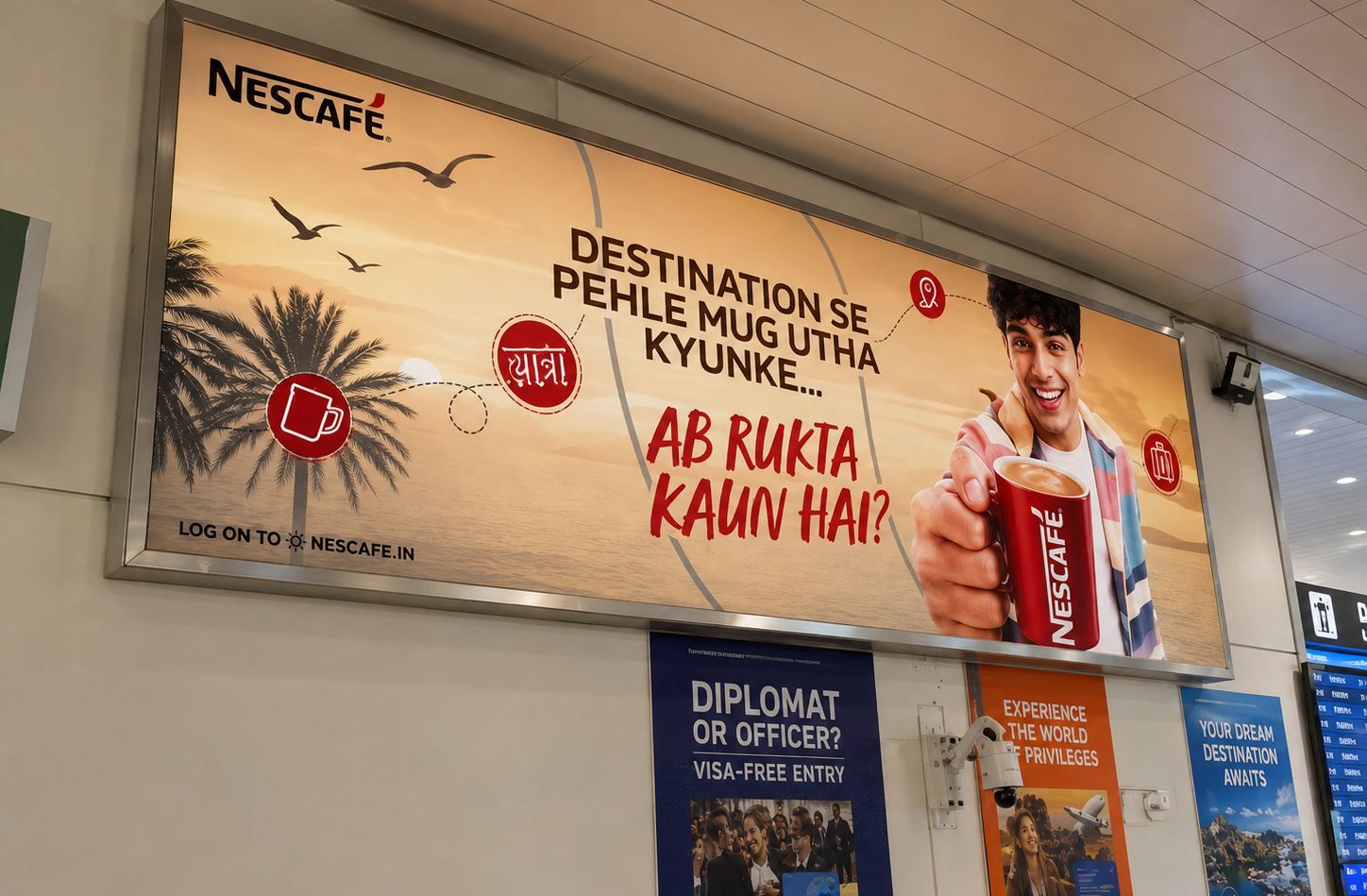
NRI and Diaspora Intelligence:
This catchment is one of the highest remittance-earning regions in Pakistan, and remittances are a structural feature of household wealth rather than a supplementary one. The dominant flows come from the United Kingdom, Saudi Arabia, the United Arab Emirates and increasingly from Europe. British Pakistani families from the Sialkot, Gujrat and Mirpur belt travel on extended multi-week visits, arriving with foreign currency and a fixed list of financial and property decisions to complete. Gulf-based workers and professionals travel on shorter, more frequent cycles tied to leave calendars and Eid. For advertisers, this means the arrivals audience is in an active spending posture at the moment of arrival, which is rare.
Economic Importance:
The regional economy is manufacturing for export, and that shapes audience creation directly. Sports goods, surgical instruments and leather generate a compact, wealthy owner class with international buyer relationships. Engineering and cutlery clusters generate a broad small-and-medium enterprise layer with recurring trade travel. Agriculture and overseas labour migration generate a remittance-funded consumer base. Three distinct audience tiers, one terminal, all reachable in the same buy.
Business and Industrial Ecosystem
- Sports goods manufacturing: Sialkot supplies a majority of the world's hand-stitched footballs and works with global sporting brands. Produces owner-exporters who travel for buyer meetings and trade fairs, ideal for trade finance, logistics, business travel and premium consumer categories.
- Surgical and medical instruments: A global manufacturing centre exporting to the United States, Germany and the United Kingdom. Creates a technically sophisticated, compliance-driven business audience relevant to industrial equipment, certification services and international banking.
- Leather goods and apparel: Exports to the United States, United Kingdom, Italy and France. Generates fashion-adjacent decision-makers who travel to Europe, receptive to luxury retail, hospitality and duty-free messaging.
- Engineering, cutlery and agricultural machinery: Concentrated across Wazirabad, Gujranwala and Daska. Produces a high-volume small business owner audience with strong demand for credit, insurance and vehicle categories.
Passenger Intent, Business Segment:
Business travel from SKT is buyer-driven and sourcing-driven. Owners and export managers fly to Dubai, Sharjah, Doha and Jeddah for meetings, trade exhibitions and onward connections to Europe and North America. They travel frequently, book their own itineraries, and control company spend personally. Categories that intercept them most effectively are trade finance and business banking, freight and logistics, industrial certification and machinery, telecom roaming, and premium hospitality.
Strategic Insight:
What makes this business audience commercially unusual is the absence of a corporate approval layer. The person walking through the terminal is the owner, the treasurer and the buyer in one. B2B messaging here does not need to generate a lead that travels through a procurement chain. It reaches the person who signs. Combined with modest passenger volumes and low competitive noise inside the terminal, the effective cost of reaching a qualified export decision-maker at SKT is materially lower than at Pakistan's larger metro airports.
Tourism and Premium Travel Drivers
- Religious travel to Saudi Arabia: Hajj and Umrah movement is the single largest premium-adjacent travel driver, with dedicated seasonal charter activity. Travellers have already committed significant household budget and are receptive to currency, insurance, telecom and gifting categories.
- Allama Iqbal heritage and Sialkot city culture: Draws domestic and diaspora visitors reconnecting with family origin, supporting hospitality and gifting messaging.
- Kashmir and Jhelum valley approaches: Northern leisure routing for diaspora families visiting during summer, extending trip length and local spend.
- Family and wedding travel: Diaspora weddings concentrate in the summer and post-Eid windows, driving jewellery, apparel, hospitality and event-related spending at exceptional per-household values.
Passenger Intent, Tourism Segment:
The leisure passenger at SKT is rarely a conventional tourist. This is visiting-friends-and-relatives traffic and religious travel, which behaves very differently. These travellers arrive having already absorbed the largest cost, the flight itself, and carry discretionary foreign currency earmarked for family, property and gifting. Their airport receptivity is highest for money transfer and currency services, telecom and connectivity, jewellery and gifting, real estate, and airport transfer and hospitality. Categories dependent on impulse luxury retail underperform. Categories tied to money movement and family investment overperform.
Travel Patterns and Seasonality
- Peak seasons: May to August is the strongest window, driven by diaspora summer visits, school holidays in the United Kingdom and Europe, and wedding season concentration. Ramadan and the Eid periods create sharp bidirectional surges as Gulf-based workers return home. The Hajj and Umrah season adds dedicated seasonal charter volume. December and January carry a secondary peak from winter diaspora travel and year-end business closures.
- Traffic volume data: Monthly breakdowns are not publicly disclosed. Overall movement grew 9.03% and passengers 10.03% in the twelve months to June 2025, indicating sustained upward trend across all peaks.
Event-Driven Movement:
- Ramadan and Eid al-Fitr (variable, spring): Highest-density family and expatriate return movement of the year. Advertisers should be live two to three weeks ahead of Eid to capture gifting, remittance and travel-purchase decisions.
- Hajj season (variable, mid-year): Dedicated pilgrimage charters create a distinct, highly emotionally engaged audience. Optimal for insurance, currency, telecom roaming and gifting.
- Eid al-Adha (variable): Second major remittance and return spike, with heavy household spending on livestock, gold and property deposits.
- Summer diaspora season (June to August): Longest dwell and highest household spend of the year. The primary window for real estate, education and wealth migration advertising.
- International trade exhibition cycles (autumn and spring): Outbound export delegations travelling to Gulf and European fairs. Precision window for B2B, logistics and trade finance messaging.

It’s Not Just Where You Advertise - It’s How Fast You Execute
We combine local insight with fast rollout to deliver results for you, now.
Talk to an ExpertAudience and Cultural Intelligence
Top 2 Languages:
- Punjabi: The everyday language of the catchment and the language of trust in commercial conversation. Punjabi-inflected creative signals authenticity to local business owners and older diaspora travellers, and materially lifts response for financial and property categories.
- Urdu: The national commercial and media language, understood across every passenger segment. Urdu carries formal credibility, making it the default for banking, government-linked and institutional messaging. English works effectively as a secondary layer for the export business elite and UK-raised diaspora travellers.
Major Traveller Nationalities:
The dominant passport mix is Pakistani nationals, followed by a substantial cohort of British Pakistani dual nationals and Gulf residency holders from Saudi Arabia and the United Arab Emirates. Smaller but commercially significant flows include Pakistani-origin travellers holding Italian, Spanish, Norwegian and Canadian documentation. The implication for creative is direct: campaigns must speak simultaneously to a domestic manufacturing audience and to a foreign-currency-earning diaspora audience. Bilingual, dual-market creative outperforms single-market messaging at this airport consistently.
Religion, Advertiser Intelligence:
- Islam (approximately 96%): Ramadan, Eid al-Fitr, Eid al-Adha and the Hajj and Umrah calendar govern travel volume and spending intensity. Eid triggers gifting, gold, apparel and remittance spikes. Eid al-Adha triggers large livestock and property deposit outlays. Hajj triggers insurance, currency and telecom purchases. Categories that benefit most are Islamic banking, money transfer, jewellery, telecom and travel insurance.
- Christianity (approximately 3%): A long-established and locally significant community in the Sialkot district, with Christmas and Easter travel activity and notable diaspora links to the United Kingdom. Relevant for money transfer, education and family travel categories.
- Hinduism and other faiths (approximately 1%): Limited presence in this catchment. Not a material planning consideration.
Behavioral Insight:
This is a wealth-building audience rather than a wealth-displaying audience. Money earned through manufacturing and overseas labour is deployed into tangible, transferable assets: land, built property, gold and business capacity. Decisions are made within family and biradari networks, and social proof carries more weight than advertising claims. Messaging that emphasises security, ownership, family provision and generational outcome outperforms messaging built on status or aspiration. Concrete numbers, named locations and clear terms convert. Abstract lifestyle imagery does not.
Outbound Wealth and Investment Intelligence
The outbound passenger at SKT is distinctive because capital moves in both directions through the same terminal. Export earnings flow out of the catchment into overseas assets, while diaspora earnings flow in and are converted into local and third-country holdings. The result is a passenger who is often actively evaluating a cross-border financial decision while in the terminal, either deploying export profit abroad or arriving with foreign currency to place. Few airports of this size carry that density of transaction intent.
Outbound Real Estate Investment:
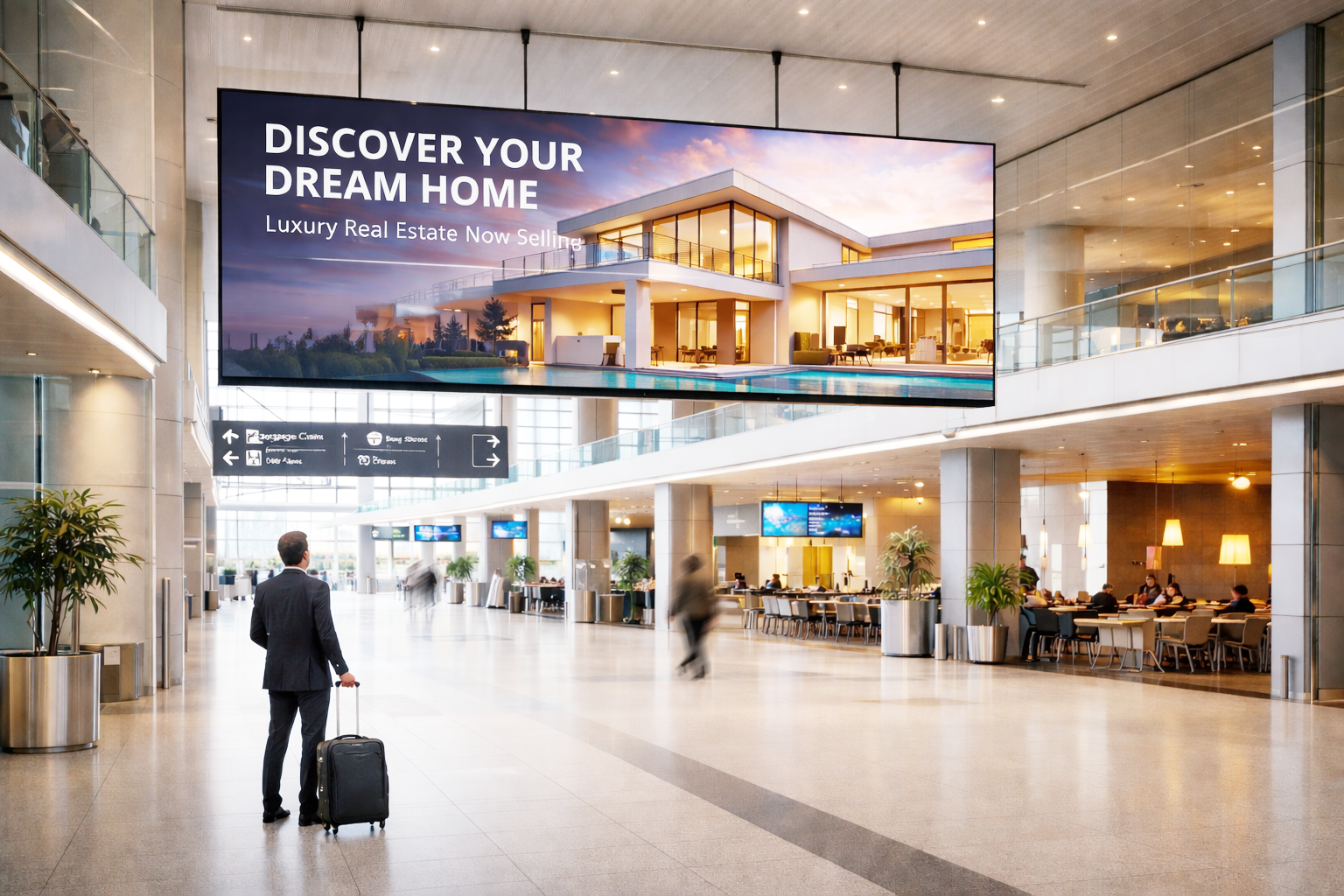
Dubai is the primary destination for this audience's overseas property capital, favoured for zero personal income tax, freehold ownership for foreign nationals, rental yields above what Punjab urban property delivers, and residency linkage through investment. Sharjah and Ajman attract the more price-sensitive first-time overseas buyer. The United Kingdom remains a core market for the British Pakistani segment, concentrated in Birmingham, Bradford, Manchester and East London where family networks already exist. Turkey, particularly Istanbul, has gained traction as an accessible residency-linked purchase. Saudi Arabia is emerging following ownership reforms. International developers targeting Pakistani manufacturing wealth and British Pakistani capital should treat SKT as a primary channel, and Masscom Global can place developer campaigns directly into the terminal environment where these decisions are already being weighed.
Outbound Education Investment:
The United Kingdom is the dominant higher education destination for this catchment, reinforced by family presence and post-study work pathways. Canada and Australia follow, valued for permanent residency routes. Germany attracts engineering and medical technology students, which aligns naturally with the region's surgical instrument industry. China draws medical and engineering enrolment on scholarship pathways, and Malaysia, Turkey and the United Arab Emirates serve as regional cost-efficient options. Export families routinely fund full overseas degrees from business earnings without external financing, and treat education spend as non-negotiable. International universities, pathway colleges, language testing providers and immigration consultancies reach a pre-qualified, budget-ready audience here.
Outbound Wealth Migration and Residency:
The United Arab Emirates Golden Visa is the most actively pursued programme in this catchment, accessible through property investment and increasingly through business ownership, and attractive because it preserves the ability to run Pakistani operations. Turkey's citizenship-by-investment route appeals for its mobility upgrade at accessible thresholds. Portugal and Greece residency programmes attract the segment prioritising European access. The United Kingdom and Canada remain the ultimate settlement objectives for families with existing relatives, pursued through skilled and family routes rather than investment. Second-residency demand in this region is driven by mobility and asset security rather than tax optimisation, and messaging should reflect that.
Strategic Implication for Advertisers:
SKT is one of the few airports where a brand can address wealth creation and wealth export in a single placement, reaching manufacturing capital heading outward and diaspora capital heading inward. Developers, universities and residency advisories that activate only in London or Dubai are reaching the intermediary and missing the decision-maker. Masscom Global activates both ends of this corridor simultaneously, coordinating SKT placements with Gulf and United Kingdom airport inventory so the same household sees the same brand at both ends of the journey.
Airport Infrastructure and Premium Indicators
Terminals:
- A single integrated passenger terminal handles all international and domestic traffic, with segregated arrival and departure processing, immigration and customs, and a full air freight unit alongside. Concentration into one building is a planning advantage: there is no audience fragmentation across separate structures, so a single well-positioned campaign reaches effectively the entire passenger base.
- The airport operates a substantial apron and one of Pakistan's most advanced cargo terminals, with automated handling, cold storage, secure valuables facilities and bonded warehousing. Cargo capability sustains a steady flow of trade professionals, freight agents and export executives through the landside environment.
Premium Indicators:
- Lounge provision serves premium cabin and paid-access passengers, and functions as a business owner and trade delegation environment rather than a leisure lounge. This is the highest-value concentration of decision-makers in the building.
- Business and general aviation handling is supported through the airport's private operating structure, serving corporate and charter movements for the export community.
- Hotel supply is concentrated in Sialkot city and the Sambrial corridor rather than on the airport campus, which extends the transfer journey and lengthens landside brand exposure.
- The airport's status as Pakistan's only privately built and privately operated international airport, funded by the local business community, is itself a premium signal. It reflects an unusually organised and capitalised commercial class in the catchment.
Forward-Looking Signal:
Terminal and runway upgrade work is progressing toward handling significantly larger wide-body capacity and expanded cargo throughput, supported by new boarding bridges, upgraded runway lighting and digitalised ground operations. Route expansion continues toward additional Gulf and regional destinations, and cargo capacity is being built toward substantially higher annual tonnage. Every one of those developments raises passenger quality and pushes future rate cards upward. Masscom Global advises clients to secure positions at current rate levels now, ahead of the volume and competitive intensity that expanded capacity will bring.
Airline and Route Intelligence
Top Airlines:
AirSial (which bases its operations here), Pakistan International Airlines, Emirates, flydubai, Air Arabia, Qatar Airways, Gulf Air, Oman Air, and seasonal Hajj and Umrah charter operators.
Key International Routes:
Dubai and Sharjah carry the highest combined frequency, operating at daily or better levels across multiple carriers. Doha, Abu Dhabi, Muscat, Bahrain, Dammam, Jeddah and Al Ain form the core Gulf network. Jeddah and Medina volume rises sharply during the pilgrimage season. Onward connectivity through Dubai, Doha and Abu Dhabi links the catchment to London, Manchester, Birmingham, Frankfurt, Milan and Toronto, which is how the diaspora and export audiences actually reach their end markets.
Domestic Connectivity:
Karachi and Islamabad are the principal domestic sectors, serving business travel toward Pakistan's financial and administrative centres. Domestic volume is modest relative to international, reinforcing that SKT's commercial value is fundamentally cross-border.
Wealth Corridor Signal:
The route map is a near-pure wealth transfer network with almost no leisure content. Dubai, Sharjah, Doha and Abu Dhabi are simultaneously trade routes, employment routes and capital deployment routes, which is why the same corridor generates both export negotiation travel and property investment travel. Jeddah and Medina represent committed high-value religious spend. The absence of conventional holiday destinations tells advertisers something valuable: virtually every passenger is travelling for money, family or faith, and all three are high-intent states. Advertisers should build for outcome-driven messaging, not entertainment.
Media Environment at the Airport
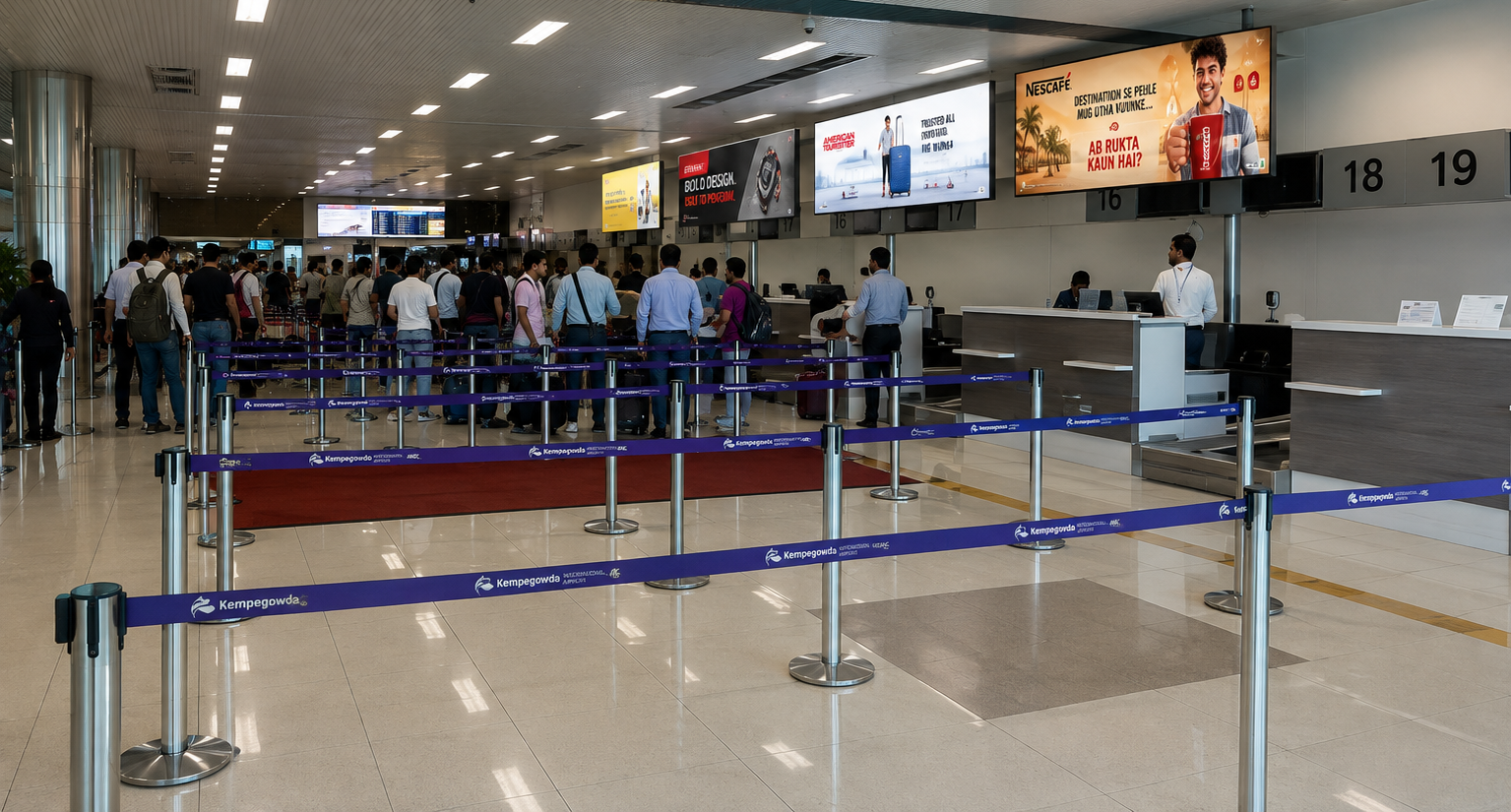
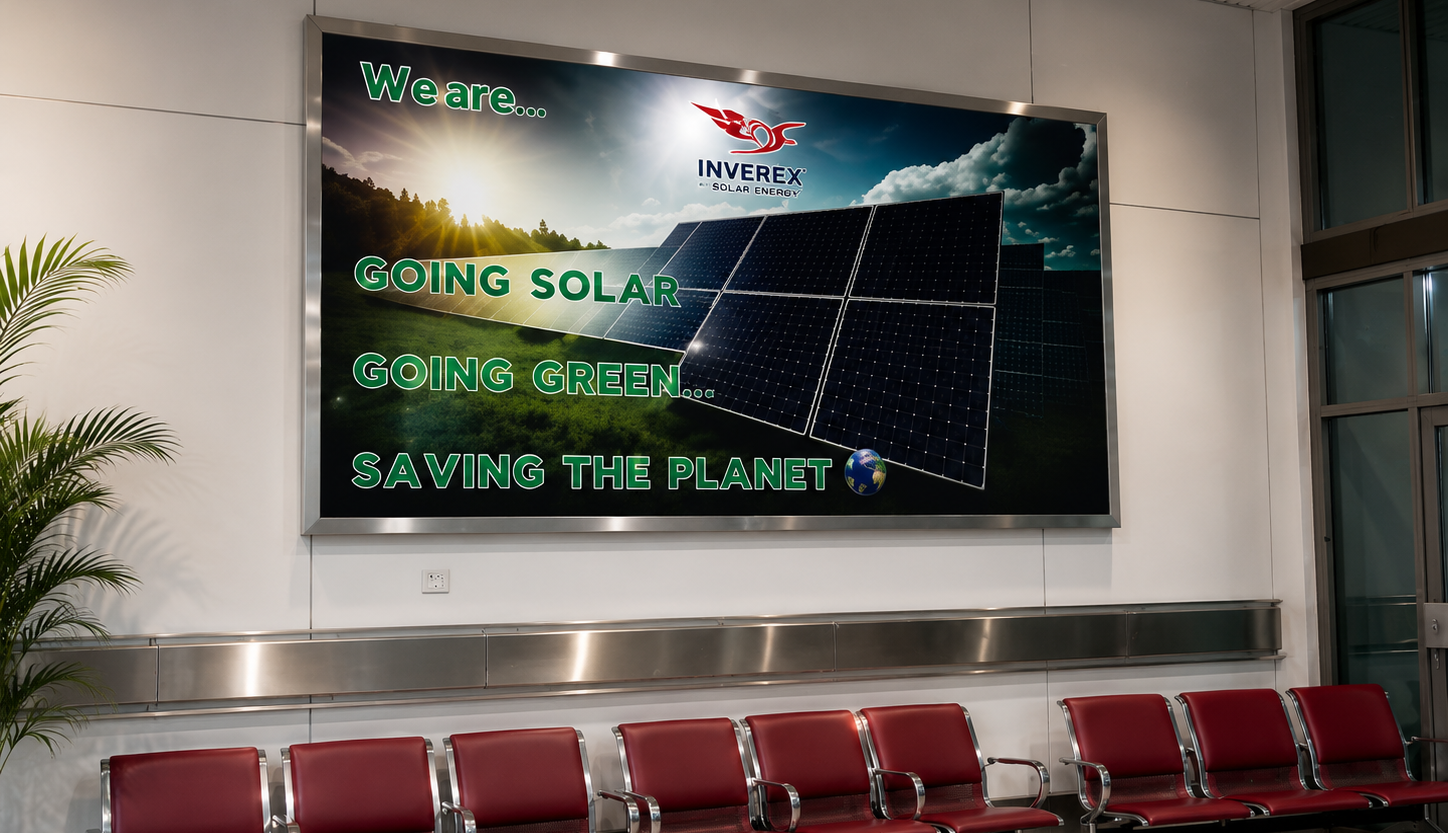
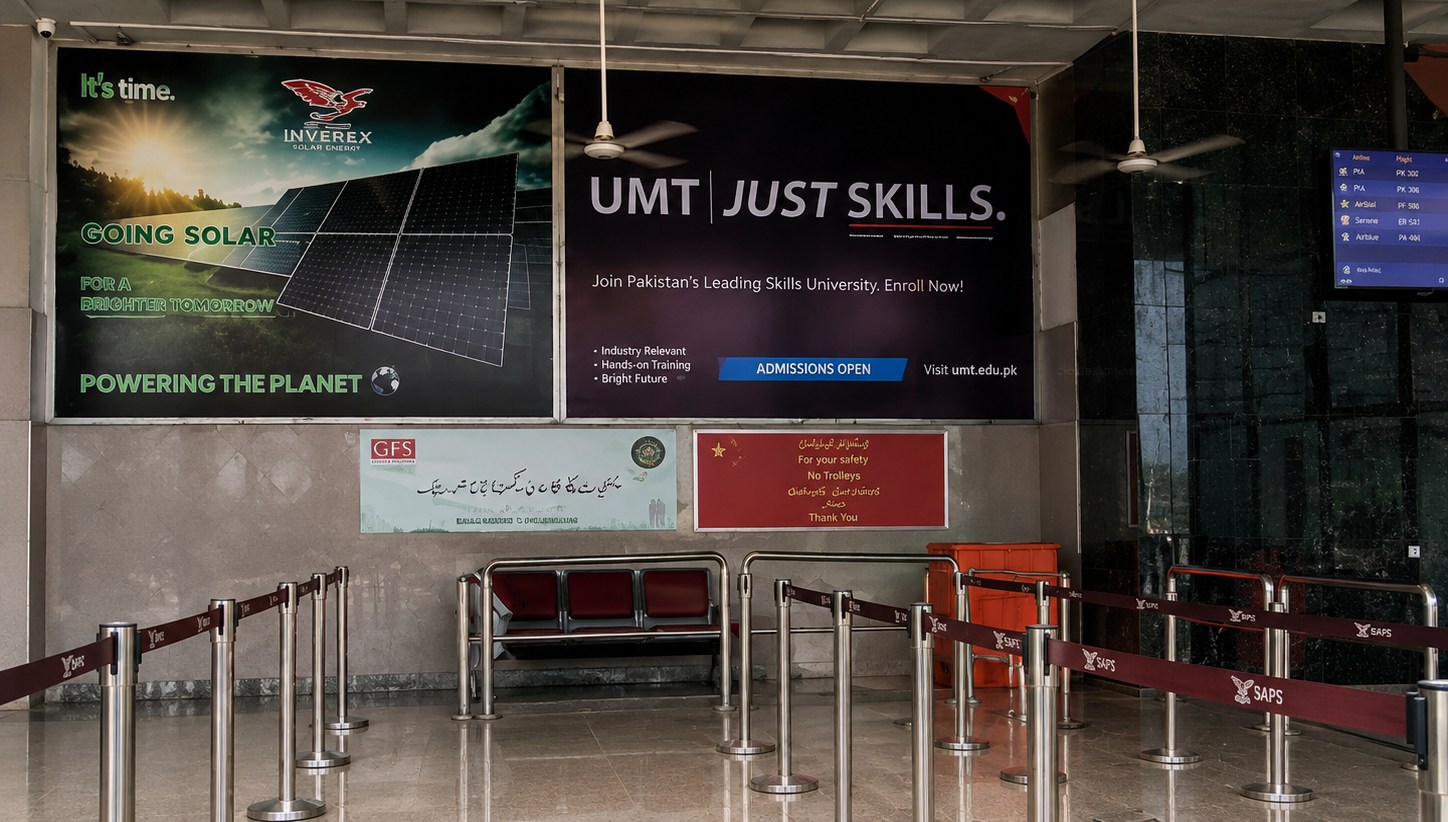
- Single-terminal architecture with sub-million annual throughput produces a low-clutter environment where a well-placed campaign achieves share of voice that would be impossible at Karachi, Lahore or Islamabad. Standout potential here is exceptional relative to cost.
- Dwell time is extended by international check-in and immigration processing, pilgrimage group handling, and the landside transfer journey to Sialkot and Gujranwala. Diaspora travellers with large baggage volumes and family groups sit in the terminal considerably longer than the average domestic passenger.
- The premium environment is defined by the lounge and business handling zones, where export owners and trade delegations concentrate. Brand association in these spaces reads as peer-level rather than aspirational, which is precisely what this audience responds to.
- Masscom Global provides direct inventory access across the terminal environment, from arrivals capture through departures and lounge placement, with the placement precision to target the business segment and diaspora segment differently within the same building and the execution speed to be live before a specific Eid, Hajj or trade fair window opens.
Strategic Advertising Fit
Best Fit:
- Money transfer and remittance services: The single strongest fit. This catchment is one of Pakistan's largest remittance destinations, and the audience is transacting constantly.
- Banking, Islamic banking and currency exchange: Foreign currency arrivals and export receipts create continuous demand for accounts, conversion and cross-border facilities.
- International real estate developers: Dubai, Sharjah, United Kingdom and Turkey projects reach an audience with committed appetite and cash capability.
- Higher education, pathway colleges and immigration consultancies: United Kingdom, Canada, Australia and Germany institutions reach families who fund full degrees from business earnings.
- Trade finance, freight, logistics and export services: Directly relevant to the owner-exporter core audience passing through daily.
- Telecom, roaming and connectivity: Essential purchase for every diaspora and Gulf-bound traveller at the moment of travel.
- Jewellery, gold and gifting: Eid, wedding season and diaspora arrival spending converge on this category.
- Travel, health and pilgrimage insurance: Hajj and Umrah volume plus frequent Gulf travel create structural demand.
Brand Alignment at a Glance:
| Category | Fit |
|---|---|
| Money transfer and remittance | Exceptional |
| International real estate | Exceptional |
| Education and immigration services | Strong |
| Trade finance and logistics | Strong |
| Jewellery, gold and gifting | Strong |
| Telecom and roaming | Strong |
| Travel and health insurance | Moderate |
| Luxury fashion and high-end cosmetics | Poor fit |
Who Should Not Advertise Here:
- Luxury fashion houses and ultra-premium watch and jewellery maisons: The wealth is real but expresses itself through assets and property, not conspicuous branded goods. There is no duty-free luxury retail dynamic here to support the category.
- Alcohol, gaming and betting: No audience alignment and no regulatory or cultural viability in this market.
- Inbound leisure tourism, resorts and cruise operators: This is a visiting-relatives, trade and pilgrimage airport. Discretionary holiday intent is close to absent.
Event and Seasonality Analysis
- Event Strength: High
- Seasonality Strength: High
- Traffic Pattern: Dual-Peak, driven by summer diaspora movement and the Ramadan, Eid and Hajj religious calendar
Strategic Implication:
Budget should be weighted heavily toward two windows: the June to August diaspora and wedding season, and the Ramadan through Eid al-Adha religious cycle including the pilgrimage period. Because the Islamic calendar shifts annually, planners working from fixed Gregorian schedules consistently miss the highest-intent weeks. Masscom Global structures campaigns around this rhythm, going live ahead of each surge rather than during it, and holds a lighter always-on layer through the shoulder months to maintain presence with the year-round business segment.

Poor Placement and Delays Affect Airport Campaigns
We help you move faster, access better inventory, and get it right now.
Talk to an ExpertFinal Strategic Verdict
Sialkot International Airport is the most efficient way to reach Pakistani manufacturing wealth and British Pakistani diaspora capital in a single environment. Under a million passengers a year moving through one uncluttered terminal, drawn from the highest per capita earning belt in Punjab and a region that ranks second nationally as a source of foreign exchange, produces a cost per qualified decision-maker that Pakistan's metro airports cannot match. The audience is owner-operators who sign their own cheques, Gulf professionals on fixed leave cycles, and diaspora families arriving with sterling and euros allocated to property, education and family provision. Financial services, international developers, education institutions and trade services benefit most, and they benefit most when they arrive before capacity expansion resets the rate card. Masscom Global brings the inventory access, corridor intelligence and execution speed to make that position count on both sides of the wealth route.
About Masscom Global
Masscom Global is a premium international airport advertising and media buying agency operating across 140 countries. With deep expertise in airport OOH, premium publications, and high-net-worth audience targeting, Masscom helps brands reach the world's most valuable travellers at the moments that matter most. For advertising packages, media rates, and campaign planning at Sialkot International Airport and airports across the globe, contact Masscom Global today.
Frequently Asked Questions
How much does airport advertising cost at Sialkot International Airport? Cost varies by format, terminal position, campaign duration and seasonal demand. Rates rise sharply around the summer diaspora season and the Ramadan, Eid and Hajj windows, and fall in the shoulder months. Because SKT operates a single terminal with sub-million annual throughput, share of voice per rupee spent is high relative to Pakistan's metro airports. Contact Masscom Global for current rates and availability across the terminal environment.
Who are the passengers at Sialkot International Airport? Three distinct groups. Export business owners and managers from the Sialkot, Gujranwala, Gujrat and Wazirabad manufacturing cluster travelling to Gulf hubs for buyer meetings and onward to Europe and North America. Gulf-based expatriate workers and professionals travelling on leave cycles to Dubai, Sharjah, Doha, Abu Dhabi and Dammam. And diaspora families, heavily British Pakistani from the Sialkot, Gujrat and Mirpur belt, travelling on extended summer and winter visits. Pilgrimage traffic to Jeddah and Medina adds significant seasonal volume.
Is Sialkot International Airport good for luxury brand advertising? It depends entirely on the luxury category. For international real estate, private banking, wealth migration and premium education, the fit is exceptional, because this catchment holds unusual income concentration and deploys it into assets. For luxury fashion, high-end watches and prestige cosmetics, the fit is weak. The wealth here is asset-directed rather than display-directed, and the terminal does not support a duty-free luxury retail dynamic. Advertise the investment, not the object.
What is the best airport in Pakistan to reach HNWI audiences? Karachi and Lahore deliver the largest absolute numbers of affluent travellers. Sialkot delivers the highest concentration of self-made industrial and export wealth relative to passenger volume, in the country's strongest per capita earning region and its densest diaspora corridor. For brands prioritising reach, the metros. For brands prioritising precision access to manufacturing capital and diaspora money at efficient cost, SKT is the strongest buy in Pakistan.
What is the best time to advertise at Sialkot International Airport? Two primary windows. June to August captures diaspora summer arrivals, school holidays in the United Kingdom and Europe, and wedding season concentration. The Ramadan through Eid al-Adha cycle, including the Hajj and Umrah season, captures the highest-intent religious and remittance movement. Campaigns should go live two to three weeks ahead of each surge. December and January offer a useful secondary window.
Can international real estate developers advertise at Sialkot International Airport? Yes, and it is one of the strongest categories at this airport. This audience actively buys in Dubai, Sharjah and Ajman for tax treatment, yields and residency linkage, in the United Kingdom where family networks are established, and increasingly in Turkey and Saudi Arabia. Reaching them at SKT addresses the decision-maker directly rather than through an overseas intermediary. Masscom Global can also coordinate matching placements at Gulf and United Kingdom airports to cover both ends of the corridor.
Which brands should not advertise at Sialkot International Airport? Luxury fashion and prestige watch and cosmetics brands, because the wealth here does not express itself through branded goods and the retail environment does not support the category. Alcohol, gaming and betting, which have no cultural or regulatory viability. And inbound leisure tourism, resorts and cruise operators, because discretionary holiday intent is nearly absent from a passenger base travelling for trade, family and pilgrimage.
How does Masscom Global help brands advertise at Sialkot International Airport? Masscom Global delivers the full chain: catchment and audience intelligence specific to the Sialkot, Gujranwala and Gujrat export belt, direct inventory access across the terminal environment, creative guidance calibrated for Punjabi, Urdu and dual-market diaspora messaging, campaign timing built around the Islamic calendar rather than a fixed Gregorian one, and coordinated activation at Gulf and United Kingdom airports on the other side of the corridor. Rates are moving as terminal capacity expands, so early positioning matters.