

Airport at a Glance
| Field | Detail |
|---|---|
| Airport | Kuala Lumpur International Airport |
| IATA Code | KUL |
| Country | Malaysia |
| City | Sepang, Selangor (serving Greater Kuala Lumpur) |
| Annual Passengers | Approximately 45 million (2023, recovering toward pre-pandemic peak of 62 million) |
| Primary Audience | Malaysian Chinese business elite, Southeast Asian HNWI business and leisure travellers, Gulf Arab transit and inbound tourists, South Asian professional diaspora, outbound Malaysian investment and education families |
| Peak Advertising Season | November to February (school holiday and year-end peak), June to August (summer outbound peak), Hari Raya and Chinese New Year windows |
| Audience Tier | Tier 1 Premium |
| Best Fit Categories | International luxury real estate, Islamic finance and wealth management, premium automotive, international education, ultra-luxury halal hospitality and travel, premium lifestyle and fashion |
Kuala Lumpur International Airport is the defining commercial aviation gateway of Southeast Asia's most economically and culturally complex nation, and its advertising value cannot be reduced to any single audience dimension without losing what makes it commercially exceptional. KUL is simultaneously the primary gateway to Malaysia's Chinese-Malaysian business community, whose family enterprise wealth and manufacturing leadership represent some of the most established commercial fortunes in the region; the Islamic finance capital of the world, whose Kuala Lumpur headquarters of institutions including Maybank Islamic, CIMB Islamic, and the Islamic Financial Services Board creates a sovereign and institutional halal wealth ecosystem without parallel in Southeast Asia; the most significant Muslim-majority HNWI leisure and transit hub in Southeast Asia for Gulf Arab travellers; and a critical South Asian diaspora gateway whose Indian and Bangladeshi professional communities generate among the most commercially significant bilateral remittance and investment flows in the Indian Ocean economy.
No single Southeast Asian airport combines these four premium audience dimensions within a single terminal environment at the quality and scale that KUL delivers. The result is an airport advertising environment of extraordinary commercial breadth, where a single well-executed campaign can simultaneously engage Malaysian Chinese property investors, Gulf Arab premium leisure travellers, South Asian professional remittance senders, and the institutional Islamic finance community whose investment decisions shape sovereign wealth allocation across the Organisation of Islamic Cooperation's 57 member states. For advertisers seeking Southeast Asian market depth, Islamic world commercial access, and the crossroads between East Asia's manufacturing economy and the Gulf's sovereign wealth, KUL is the single most strategically productive airport advertising investment in the region.


Advertising Value Snapshot
- Passenger scale: Approximately 45 million annual passengers in 2023, recovering strongly toward a pre-pandemic peak of 62 million, with international route recovery accelerating as Malaysia's inbound tourism growth, Gulf Arab leisure travel revival, and South Asian diaspora travel resumption compound simultaneously
- Traveller type: Malaysian Chinese business and manufacturing elite, Gulf Arab premium leisure and transit travellers, South Asian and Southeast Asian professional expatriate communities, Islamic finance and banking institutional professionals, and outbound Malaysian HNWI families investing in international education and real estate
- Airport classification: Tier 1 Premium regional hub, with an audience quality index anchored by Malaysia's position as Southeast Asia's most economically diversified economy and the world's most significant Islamic finance market
- Commercial positioning: Southeast Asia's premier crossroads hub, connecting every major wealth corridor from the Gulf to East Asia within a single terminal environment whose audience breadth, cultural diversity, and commercial depth make it the most strategically valuable advertising platform in the ASEAN aviation network
- Wealth corridor signal: KUL sits at the convergence of the Gulf-Southeast Asia Islamic finance corridor, the China-ASEAN manufacturing and investment axis, the India-Malaysia professional diaspora network, and the intra-ASEAN premium tourism and business travel circuit whose combined commercial weight makes Kuala Lumpur the most commercially connected city in the Islamic world outside of Dubai
- Advertising opportunity: Masscom Global provides structured access to the KUL media environment, delivering campaigns calibrated to Malaysia's unique cultural intelligence requirements, the specific investment and lifestyle categories that generate maximum commercial return across the airport's multiple premium audience dimensions, and the sustained contact patterns that compound brand recognition into confirmed purchase intent across every premium category where KUL's diverse HNWI audience is most commercially concentrated.
Airport Advertising is Complex to Get Right
We help you execute faster, with proven results and local insight most planners lack starting now.
Talk to an ExpertCatchment Area and Economic Drivers
Top 10 Cities within 150 km — Marketer Intelligence:
- Kuala Lumpur (KLCC, Bukit Bintang, Mont Kiara, Bangsar): The political, financial, and commercial capital of Malaysia and the primary feeder market for KUL, Kuala Lumpur's core commercial districts house the headquarters of Maybank, CIMB Group, Public Bank, Petronas, and the operational offices of every major global financial institution's Malaysia presence. The HNWI and corporate elite resident in KL's premium districts of Mont Kiara, Damansara Heights, Kenny Hills, and Bangsar represents the most commercially valuable domestic advertising audience in Malaysian aviation, with premium consumption spanning international real estate, private banking, ultra-luxury automotive, and international education categories that make every campaign impression directed at this community commercially consequential.
- Petaling Jaya: Malaysia's most significant commercial and professional suburb at approximately 35 km north of KUL, Petaling Jaya is the operational home of Malaysia's most significant concentration of multinational corporation regional offices, technology company Malaysia headquarters, and a dense professional and upper-income residential community whose above-average household income, high travel frequency through KUL, and confirmed premium consumption patterns in financial services, real estate, and lifestyle categories make them a high-contact-frequency advertising audience of consistent commercial value.
- Shah Alam: The state capital of Selangor at approximately 30 km north, Shah Alam is a major Malay-majority industrial and administrative city housing significant automotive manufacturing including Proton's headquarters, a growing technology and halal industry cluster, and the residential community of Selangor's civil service and professional leadership. Shah Alam's above-average income professional community is a consistent KUL user with strong receptivity to Islamic finance, premium automotive, and family lifestyle advertising in both Malay and English registers.
- Subang Jaya: One of Malaysia's most affluent planned urban communities at approximately 35 km north, Subang Jaya houses a substantial concentration of Malaysian Chinese upper-income professional and business families alongside a significant international expatriate community whose combined purchasing power, above-average international travel frequency, and confirmed premium consumption behaviour create a productive and high-frequency KUL advertising audience. The Subang Jaya professional community's above-average English proficiency and international brand awareness make them among the most accessible premium advertising targets in the KUL catchment.
- Putrajaya: Malaysia's federal administrative capital at approximately 25 km north, Putrajaya houses the operational headquarters of the Malaysian government's ministries, the Securities Commission, Bank Negara Malaysia's secondary campus, and the administrative leadership of Malaysia's national institutions. Senior government officials, statutory body leadership, and the professional class serving Malaysia's public administration generate a consistent KUL user community with above-average income and strong receptivity to Islamic finance, premium lifestyle, and professional services advertising.
- Cyberjaya: Malaysia's purpose-built technology city adjacent to Putrajaya, Cyberjaya is the primary location of Malaysia's Multimedia Super Corridor and the operational base for Malaysia Digital Economy Corporation, the regional headquarters of major technology companies, and a growing financial technology and startup ecosystem. The technology professional and executive community resident in Cyberjaya is internationally educated, above-average income, and strongly receptive to premium technology, financial services, and international lifestyle advertising, with a young professional demographic whose premium consumption trajectory is strongly upward.
- Klang and Port Klang: Approximately 40 km west and Malaysia's most significant port and manufacturing hub, Klang and Port Klang house Malaysia's largest container port operations, a substantial concentration of manufacturing and logistics company owners and executives, and one of the largest Indian-Malaysian communities in the country whose established commercial wealth and active premium consumption provide a distinct and commercially valuable audience layer. The Klang Valley manufacturing and trading business community's consistent KUL usage and above-average income from port and logistics operations make them a productive premium secondary audience for financial planning, automotive, and business services advertising.
- Seremban: The capital of Negeri Sembilan state at approximately 60 km south, Seremban is a major manufacturing and commercial hub whose established business community includes significant concentrations of Malaysian Chinese and Indian manufacturing and trading family wealth alongside a growing technology and professional services sector. Seremban residents are consistent KUL users for both domestic and international travel and represent a mid-to-upper-premium audience whose engagement with financial services, real estate, and premium lifestyle categories is expanding with the city's integration into the greater Klang Valley economic ecosystem.
- Nilai: An emerging commercial and educational hub at approximately 20 km north-northeast of KUL, Nilai houses a significant concentration of private universities including INTI International University and Nilai University, a growing pharmaceutical and manufacturing industrial base, and a rapidly expanding professional residential community. Its proximity to KUL and its educational infrastructure make Nilai a productive secondary catchment for student travel, education services, and professional lifestyle advertising targeting the young professional and family education investment community.
- Port Dickson: A premium coastal resort town approximately 75 km south, Port Dickson is Malaysia's most accessible premium beach resort destination from KL and houses a growing community of HNWI second-home owners, luxury resort guests, and established Negeri Sembilan coastal property owners whose leisure spending patterns, consistent KUL usage for outbound international travel, and premium real estate investment behaviour create a productive secondary advertising audience with strong receptivity to domestic and international property, luxury hospitality, and lifestyle brand advertising.
NRI and Diaspora Intelligence:
Kuala Lumpur International Airport's diaspora intelligence operates on multiple commercially distinct layers, each generating different and complementary advertising opportunities. The Malaysian diaspora community, concentrated in the United Kingdom, Australia, Singapore, and the United States with a predominantly Malaysian Chinese professional profile, generates consistent return visit traffic through KUL from a community whose international professional exposure has calibrated their brand standards against global rather than domestic benchmarks, and whose investment decisions span Malaysian property markets, international real estate, and the private financial structures serving Malaysian families with cross-border asset holdings. The South Asian expatriate community in Malaysia, primarily Indian nationals across professional, technical, and hospitality sectors alongside a significant Bangladeshi and Pakistani workforce community, generates one of the most commercially significant bilateral remittance and financial services advertising audiences in the ASEAN region, with upper-income South Asian professionals actively engaging with investment products, insurance, and financial planning services designed for the NRI and expatriate worker community. The Gulf Arab community using KUL as a leisure and transit destination contributes an inbound ultra-HNWI audience whose confirmed Halal tourism spending, premium hospitality consumption, and luxury retail purchasing creates direct commercial value for brands in the premium lifestyle, real estate, and Islamic finance categories. For advertisers in international real estate, NRI financial services, Islamic finance, and premium lifestyle, the KUL diaspora dimension creates a multi-directional wealth engagement opportunity that no other Southeast Asian airport delivers with the same cultural diversity and commercial depth.
Economic Importance:
The KUL catchment economy is Malaysia's most productive and most diversified, encompassing the oil and gas wealth generated by Petronas's global operations, the manufacturing and electronics export economy of the Klang Valley's industrial zones, the Islamic finance capital market ecosystem that makes Kuala Lumpur the global headquarters city for Sharia-compliant finance, and the rapidly expanding digital economy whose technology cluster in Cyberjaya and Bangsar South is producing a new generation of technology HNWI wealth. The combination of resource sector sovereign wealth, manufacturing family commercial wealth, professional services and financial industry compensation, and digital economy equity accumulation creates a premium advertising catchment of unusual breadth whose multiple income sources and diverse economic drivers sustain premium consumer spending across categories from luxury automotive to international real estate to Islamic investment products across different economic cycles.
Business and Industrial Ecosystem
- Islamic finance, banking, and capital markets: Maybank Islamic, CIMB Islamic, AmBank Islamic, RHB Islamic, the Islamic Financial Services Board, and the Securities Commission Malaysia's Islamic capital market division collectively make Kuala Lumpur the institutional headquarters of the global Islamic finance industry, generating Malaysia's most senior and highest-compensated Islamic financial services professional community. The institutional leadership and senior commercial community of this sector travels through KUL at above-average frequency on the Kuala Lumpur-Dubai, Kuala Lumpur-London, and Kuala Lumpur-Singapore corridors for global Islamic capital market activity, Sukuk issuance management, and regulatory framework development, representing the most commercially valuable business advertising audience for Islamic finance, international real estate, and premium wealth management categories at any airport in Southeast Asia.
- Oil, gas, and energy sector: Petronas's global headquarters and exploration and production operations, Shell Malaysia, ExxonMobil Malaysia, and a dense network of oil and gas service and engineering companies generate Malaysia's highest-compensated technical and managerial workforce. The energy sector professional and executive community travels consistently through KUL for international upstream operations management, refinery partnership activity, and capital market engagement, creating a confirmed premium business travel audience with strong receptivity to financial planning, premium automotive, and executive lifestyle brand advertising.
- Manufacturing, electronics, and technology export: Malaysia's electronics and electrical manufacturing sector, anchored by semiconductor fabrication and assembly operations in Penang and the Klang Valley, generates a senior operations and commercial leadership community whose international supply chain travel patterns, above-average professional compensation, and established business family wealth create a consistent premium advertising audience at KUL with strong engagement in financial services, international real estate, and premium automotive categories.
- Real estate development, infrastructure, and construction: Malaysia's most active property development and infrastructure companies, including IGB Corporation, Sime Darby Property, Gamuda, and IJM Corporation, generate a senior commercial and technical leadership community whose project development travel, capital market engagement, and established business owner wealth create productive advertising targets for international real estate, financial planning, and premium lifestyle categories at KUL.
Passenger Intent — Business Segment:
The business travellers transiting KUL are operating at the intersection of Southeast Asia's most commercially dynamic economies, connecting Malaysia's Islamic finance capital market ecosystem, Petronas's global energy operations, and the broader ASEAN manufacturing and services economy to the international capital markets, technology partnerships, and global investment relationships that sustain Malaysian and regional economic activity. At the airport they carry the professional confidence of a business community that manages Southeast Asia's most internationally connected economy from its ASEAN geographic midpoint, and their advertising receptivity reflects this regional perspective: they respond to brands that understand Malaysia's unique position at the intersection of the Islamic world, the Chinese commercial tradition, and the broader Asia-Pacific premium consumer market, and whose advertising communicates with the cultural sophistication this intersection requires.
Strategic Insight:
The KUL business audience carries a commercially defining characteristic that distinguishes it from every other ASEAN hub airport's professional community: the intersection of Islamic institutional authority with Chinese commercial pragmatism operating within an English-language business culture whose global connectivity exceeds that of any comparable Southeast Asian capital. Malaysian Chinese business professionals who speak Mandarin, Malay, and English fluently and who navigate the Islamic finance regulatory framework in their daily professional lives represent the most commercially versatile and most globally connected premium business audience in Southeast Asia, and the brands that learn to communicate across this cultural intersection consistently outperform those that target only one dimension of this audience's identity.
Tourism and Premium Travel Drivers
- Petronas Twin Towers and the KLCC premium lifestyle precinct: The Petronas Towers complex anchors one of the most concentrated luxury retail, premium dining, and ultra-luxury hospitality ecosystems in Southeast Asia, drawing consistent inbound premium tourism from across the Muslim world, East Asia, and Western markets whose confirmed luxury spending at Suria KLCC and the surrounding five-star hotel precinct creates a direct inbound premium consumer audience flowing through KUL.
- Halal tourism and Islamic heritage destinations: Malaysia's status as the world's most developed halal tourism destination, encompassing Sharia-compliant premium hotels, halal fine dining, Islamic cultural institutions, and faith-tourism experiences at Putrajaya's Islamic complex and the National Mosque, draws a growing inbound Muslim leisure audience from the Gulf, the broader Islamic world, and East Asian Muslim communities whose confirmed premium hospitality spending and luxury retail purchasing create a direct commercial benefit for premium halal lifestyle and hospitality brand advertising at KUL.
- Langkawi, Sabah, Sarawak, and premium nature tourism: Malaysia's extraordinary natural tourism offer, encompassing the duty-free luxury resort island of Langkawi, Sabah's premium dive sites and wildlife experiences, and Sarawak's UNESCO-heritage rainforest, draws an inbound premium adventure and nature tourism audience from Western markets, Japan, and Australia whose per-visit spending on premium lodge accommodation, guided experiences, and conservation tourism confirms their position at the top of the inbound Southeast Asian tourism spending hierarchy.
- Medical tourism and healthcare excellence: Malaysia's internationally recognised and competitively priced healthcare sector, encompassing Gleneagles, Prince Court Medical Centre, and the KPJ hospital network, draws a substantial inbound medical tourism audience from Indonesia, South Asia, the Middle East, and increasingly Western markets whose healthcare service spending and premium accommodation bookings create a confirmed high-value inbound audience at KUL with strong receptivity to private health, wellness, and insurance brand advertising.
- Heritage and cultural tourism: Georgetown's UNESCO World Heritage precinct, Malacca's historic Portuguese, Dutch, and British colonial architecture, and the Cameron Highlands' premium hill resort circuit draw a culturally sophisticated inbound tourism audience from East Asia, Australia, and Europe whose above-average education, premium hospitality spending, and confirmed cultural engagement quality place them at the upper tier of the inbound Southeast Asian cultural tourism hierarchy.
Passenger Intent — Tourism Segment:
The premium tourists arriving at KUL represent one of Southeast Asia's most diverse and commercially productive inbound audiences, spanning Gulf Arab Halal tourism seekers whose per-night premium accommodation spending exceeds most Western visitor cohorts, Japanese and Korean cultural and nature tourism enthusiasts with confirmed premium hospitality bookings, Indonesian luxury retail visitors whose relative proximity creates a consistent high-frequency premium consumer flow, and Western medical and nature tourism travellers whose healthcare and adventure tourism spending commitments are made months in advance. Each of these inbound segments has self-selected Kuala Lumpur or Malaysia for a specific premium reason, and their confirmed advance expenditure commitment signals a purchasing confidence and category-specific spending motivation that makes KUL's inbound audience unusually receptive to advertising that extends and enhances the experience they have already committed to delivering.
Travel Patterns and Seasonality
Peak seasons:
- Year-end and school holiday peak (November to January): Malaysia's school year-end holiday aligns with the northern hemisphere Christmas and New Year travel season to create the year's highest sustained passenger volume at KUL, with Malaysian families taking international leisure trips alongside inbound Gulf Arab tourism at its annual peak and the broader Southeast Asian holiday travel surge. This window delivers both maximum outbound Malaysian HNWI leisure spending motivation and maximum inbound premium Gulf Arab tourism audience density simultaneously.
- Chinese New Year travel window (January to February): Malaysia's Chinese New Year is the most culturally significant premium travel and gifting event for the Malaysian Chinese community, generating a concentrated outbound leisure travel surge toward Taiwan, Japan, South Korea, and Europe alongside the year's most intense domestic premium gifting and family gathering spending. The KUL audience during the Chinese New Year window is at its highest luxury purchasing motivation of the entire year for premium gifting, international hospitality, and luxury lifestyle categories.
- Summer outbound peak (June to August): Malaysia's mid-year school holiday drives significant outbound family travel among upper-income Malaysians heading to the UK, Europe, Japan, South Korea, and Australia, while inbound tourism from the Gulf Arab market, whose summer heat makes Malaysia's tropical climate attractive rather than discouraging, creates a sustained dual-direction premium audience through the summer months.
- Hari Raya Aidilfitri travel window (date varies by Islamic lunar calendar): Malaysia's most culturally significant Malay-Muslim festival generates the year's most concentrated domestic and short-haul international leisure travel surge as Malaysian Muslim families travel for family reunion visits, with a substantial international departure component among upper-income Malay-Muslim families making confirmed premium leisure bookings to the Middle East, Turkey, and other Muslim-majority destinations.
Event-Driven Movement:
- Hari Raya Aidilfitri departure surge (end of Ramadan, date varies): The most emotionally significant travel moment for the majority of Malaysia's population, generating the year's highest single-week departure volume as Malaysian Muslim families travel simultaneously for Hari Raya celebrations. Premium advertising during the Ramadan shopping season and the pre-Raya departure window captures the year's highest luxury gifting, fashion, and family lifestyle spending motivation among the Malay-Muslim HNWI community.
- Chinese New Year departure and gifting surge (January to February): The Malaysian Chinese community's most commercially significant festival generates concentrated outbound travel alongside the year's most intense luxury gifting exchange, with premium food hampers, luxury products, and high-end gifting driving above-average retail spending at KUL's departure environment during the two-week window preceding the festival.
- Malaysia Grand Prix (Formula One, September to October, Sepang International Circuit): The Sepang Circuit, adjacent to KUL, hosts one of Formula One's most atmospheric events, drawing global Formula One racing enthusiasts, automotive industry VIPs, and luxury hospitality corporate guests through the airport in concentrated volume. For premium automotive, luxury hospitality, and sports lifestyle brands, the Malaysian Grand Prix creates a standalone high-quality audience concentration event within the airport's immediate vicinity that warrants targeted campaign activation.
- Deepavali (October to November): Malaysia's Indian-Malaysian community's most celebrated festival generates a concentrated premium gifting, family gathering, and outbound India visit travel surge among the Tamil and Indian professional community. Gold jewellery purchasing, premium food gifting, and family travel to Chennai, Penang, and Indian destinations create a specific commercial window for gold, jewellery, Indian travel, and premium food and beverage brand advertising aligned with the Deepavali cultural calendar.
- Wesak Day and Buddhist festivals (May): Malaysia's Chinese Buddhist community's observance of Wesak Day and the broader Buddhist festival calendar creates secondary premium gifting and family travel moments whose cultural depth and spending motivation reward brands with culturally aware Buddhist festival creative positioning.
- International trade events and Malaysia Investment Week (various, KLCC): The Kuala Lumpur Convention Centre's active international conference and trade fair calendar, including the Malaysia International Halal Showcase, the International Islamic Finance Conference, and the various ASEAN Summit and bilateral diplomatic events hosted in KL, generates consistent waves of international government officials, institutional investors, and senior corporate delegates through KUL whose confirmed ultra-HNWI profiles and institutional decision-making authority make them directly relevant for premium financial services, international investment, and luxury hospitality advertising.
- Year-end school holiday outbound surge (November to December): Malaysia's school year-end holiday generates the most sustained family outbound travel surge of the year, with upper-income Malaysian families departing for Australia, the UK, Japan, and Southeast Asian resort destinations in concentrated volume from mid-November through late December. International education, premium family hospitality, and lifestyle brands find their most family-decision-motivated audience at KUL during this extended departure window.
It’s Not Just Where You Advertise - It’s How Fast You Execute
We combine local insight with fast rollout to deliver results for you, now.
Talk to an ExpertAudience and Cultural Intelligence
Top 2 Languages:
- Bahasa Malaysia (Malay): The national language of Malaysia and the official language of government, education, and public administration, Bahasa Malaysia is the primary communication register for Malaysia's Malay-Muslim majority community whose purchasing decisions in Islamic finance, halal lifestyle, premium automotive, and family education categories represent the most commercially significant consumer market in Malaysian domestic economy advertising. Campaign creative in Bahasa Malaysia must operate with cultural intelligence that respects the values of the Malay community's Islamic faith, family-centred social structure, and growing aspirational premium consumption culture while communicating with the authentic warmth and directness that Malay cultural communication rewards. Brands that invest in genuine Bahasa Malaysia creative quality, rather than translated generic English advertising, consistently outperform with the Malay-Muslim HNWI and professional community and build brand loyalty of unusual depth within Malaysia's most numerically significant consumer community.
- English: The dominant language of Malaysian business, professional services, and inter-ethnic communication, English is the primary language of the Malaysian Chinese and Indian professional communities, the multinational corporate sector, and the internationally educated professional class across all ethnic communities. English campaign creative at KUL reaches the broadest possible cross-ethnic premium audience and is the most commercially efficient language register for categories including international real estate, private banking, premium technology, and international education, where the international quality signal that English communication provides is itself a brand value proposition component. Malaysia's above-average English proficiency across its educated professional class, a legacy of the country's Commonwealth education heritage, makes English-language creative broadly accessible and commercially effective across every premium audience segment at KUL.
Major Traveller Nationalities:
The KUL passenger mix is one of the most internationally diverse of any Southeast Asian hub airport, reflecting Malaysia's geographic and cultural position as the region's crossroads nation. Malaysian nationals form the dominant commercial audience. Indonesian nationals, representing the largest single international arrival nationality by volume, contribute a significant inbound premium shopping, medical, and leisure tourism audience whose confirmed per-visit spending on Malaysian luxury retail and healthcare services places them at the top of the inbound Southeast Asian visitor spending hierarchy. Singaporean nationals contribute a premium business and transit audience. Chinese nationals generate growing inbound tourism and business travel flow reflecting Malaysia's significant bilateral trade and investment relationship with China and the cultural familiarity that Malaysian Chinese heritage creates for mainland Chinese visitors. Indian nationals, both business travellers and diaspora community visitors, form a significant South Asian audience layer with confirmed premium professional profiles. Gulf Arab nationals, primarily from Saudi Arabia, the UAE, Kuwait, and Qatar, represent the most commercially significant inbound premium leisure audience at KUL outside the immediate Southeast Asian region, with confirmed luxury accommodation bookings, Halal dining spending, and premium retail purchasing placing them among the highest per-visit spending international visitor segments at any Malaysian airport. Australian and British nationals form the primary Western visitor communities, reflecting Malaysia's Commonwealth heritage and its strong bilateral education and tourism relationships with both countries.
Religion — Advertiser Intelligence:
- Islam (approximately 61% of Malaysia's population, predominantly Malay-Muslim): Malaysia's Islamic identity is the most commercially significant religious advertising consideration at KUL, encompassing not just the Malay-Muslim majority but the growing Gulf Arab inbound tourism community and the international Muslim business traveller audience transiting Malaysia's position as the world's Islamic finance hub. Ramadan is the most commercially significant Islamic advertising period, requiring creative that embodies the sanctity of the season while engaging the intense pre-Ramadan shopping surge and the Hari Raya Aidilfitri gifting and travel explosion that follows. The Zakat gifting obligation creates specific premium giving behaviour during Ramadan that rewards brands in premium food, fashion, and lifestyle categories with culturally appropriate Ramadan positioning. Islamic finance products, halal-certified luxury goods, and Sharia-compliant investment platforms find a primary and institutionally sophisticated audience at KUL whose Islamic faith orientation is a structural purchasing decision parameter rather than a secondary consideration.
- Buddhism (approximately 20%, predominantly Malaysian Chinese): The Malaysian Chinese Buddhist community's cultural calendar, encompassing Chinese New Year, the Hungry Ghost Festival, Wesak Day, and the Mid-Autumn Festival, creates a series of commercially significant gifting, family gathering, and premium consumption events throughout the year. The Malaysian Chinese HNWI community's confirmed luxury purchasing behaviour, active international investment activity, and above-average international travel frequency make them the most commercially significant secondary religious community at KUL for premium lifestyle, real estate, and financial services brand advertising. Chinese New Year is the most commercially productive single festival moment for this community, generating the year's most concentrated luxury gifting and outbound premium leisure travel purchasing at KUL.
- Hinduism (approximately 6%, predominantly Tamil-Malaysian): Malaysia's Indian-Tamil community observes Deepavali, Thaipusam, and the broader Hindu festival calendar with a confirmed premium gifting and family gathering spending orientation whose gold jewellery, traditional textiles, and premium food categories create specific commercial opportunities for brands whose positioning aligns with the Tamil-Malaysian community's cultural spending patterns. The upper-income tier of the Malaysian Indian professional community, concentrated in legal, medical, and accounting professions, carries above-average income and confirmed premium consumption behaviour that makes them a productive secondary audience for financial planning, premium automotive, and international education advertising.
- Christianity (approximately 9%, concentrated among Malaysian Chinese, Eurasian, and East Malaysian communities): Malaysia's Christian community, particularly concentrated among the Kadazan-Dusun, Iban, and other East Malaysian indigenous communities alongside urban Malaysian Chinese and Eurasian families, generates secondary Christmas and Easter spending windows. The Malaysian Christian community's above-average urbanisation, international education profile, and premium consumption orientation make them a productive secondary audience for lifestyle, education, and premium financial services advertising.
Behavioral Insight:
The KUL premium consumer makes purchasing decisions through a uniquely Malaysian cultural framework that reflects the country's extraordinary ethnic and religious diversity in ways that have commercial implications for every category of advertising placed at this airport. The Malay-Muslim HNWI values Islamic compliance, family advancement, and the community social standing that generous gifting and premium hospitality confer. The Malaysian Chinese HNWI values pragmatic quality evaluation, long-term relationship loyalty, and the investment efficiency that confirms their commercial heritage as the descendant of merchant families whose trading judgement built generational wealth. The Malaysian Indian professional values educational excellence, family provision, and the institutional quality credentials that justify premium purchasing decisions to a community whose professional achievements rest on academic merit. Advertising that understands and respects these distinct cultural purchasing motivations, rather than defaulting to generic Southeast Asian premium messaging, consistently delivers better commercial outcomes at KUL than campaigns calibrated for a homogeneous audience that does not exist in this market. Masscom Global's cultural intelligence for the Malaysian market encompasses this full ethnic and religious dimension, ensuring campaign creative that earns genuine engagement from every commercially significant community within the airport's diverse audience.
Outbound Wealth and Investment Intelligence
The outbound Malaysian HNWI and professional community transiting Kuala Lumpur International Airport represents one of Southeast Asia's most internationally active and most commercially sophisticated outbound wealth deployment communities, operating from a structural wealth base that combines Petronas-adjacent oil economy wealth, Malaysian Chinese manufacturing and trading family fortunes, Islamic finance professional compensation, and the growing equity wealth of the technology and digital economy sector. Malaysian outbound investors are not exploring international markets for the first time. They are managing established international property portfolios, funding children in Australian, British, and American universities, and deploying capital across the Gulf, East Asian, and Western markets through private banking relationships whose sophistication reflects decades of cross-border commercial engagement. For international brands, KUL's outbound audience represents a uniquely multi-cultural Southeast Asian capital deployment community whose investment decisions are informed by both the Chinese commercial tradition's emphasis on property and family advancement and the Islamic world's growing engagement with Sharia-compliant international investment vehicles.
Outbound Real Estate Investment:
Malaysian HNWI nationals are among Southeast Asia's most active international real estate investors, with portfolio approaches shaped by education access, capital protection, lifestyle diversification, and the cultural conviction that property ownership represents the most reliable vehicle for intergenerational wealth transfer. Australia, specifically Melbourne, Sydney, the Gold Coast, and Perth, is the most active and historically established destination, driven by the proximity of Australian universities where Malaysian students have enrolled in large numbers for decades, the established Malaysian community infrastructure across major Australian cities, the lifestyle quality alignment between coastal Australian and Malaysian premium leisure culture, and the confirmed long-term capital appreciation track record of Australian prime residential markets. The United Kingdom, particularly London's prime residential market, Manchester, and Nottingham's student property corridor, attracts the education investment segment whose children are enrolled at British universities alongside the capital diversification segment seeking sterling-denominated safe haven assets with EU legal framework security. Japan, specifically Tokyo's prime residential districts, Osaka's central city market, and Hokkaido's ski resort and nature property sector, attracts growing Malaysian HNWI interest driven by yield differential dynamics, cultural affinity developed through inbound Japanese tourism to Malaysia, and the confirmed long-term stability of Japanese prime property as a capital protection vehicle. Singapore's prime residential sector draws Malaysian HNWI investment from business families whose cross-border commercial activities require a Singapore base and whose children attend Singaporean international schools and universities. The United States attracts a smaller but growing segment whose Ivy League and top-tier university education history creates direct American market familiarity and whose technology industry connections support property investment in California and New York. Dubai continues to attract Malaysian Islamic finance and business community investment through its structural tax advantages, Arabic-compatible halal lifestyle, and direct flight connectivity that makes it the most accessible Middle Eastern property market from Kuala Lumpur.
Outbound Education Investment:
Education investment is the single most culturally universal premium outbound spending category across all three of Malaysia's major ethnic communities, reflecting a shared national value system that places educational achievement at the centre of family advancement strategy regardless of ethnic or religious identity. Australia is the dominant destination, with Australian universities receiving more Malaysian students per capita than any comparable Southeast Asian market, driven by geographic proximity, English-language instruction, manageable living costs relative to the UK and US, and the established Malaysian community that provides immediate social integration for arriving students. The United Kingdom follows closely, with British universities drawing the Malaysian HNWI community's most academically ambitious students toward Oxford, Cambridge, Imperial College, and the London School of Economics, with British boarding schools also receiving the children of Malaysia's most established business and government families. The United States attracts the technology and business-oriented cohort, with American universities in computer science, business administration, and medicine drawing Malaysian students whose parents' international business exposure has calibrated their academic destination selection against American market advantage. Canada draws a growing segment seeking a North American alternative to the increasingly competitive US admissions environment, with the University of Toronto, McGill, and UBC offering comparable academic quality with more accessible admissions and a confirmed pathway to Canadian permanent residency that appeals to families with cross-border capital and lifestyle considerations. Singapore's NUS, NTU, and Singapore Management University attract a growing cohort whose parents value Pacific proximity, Mandarin-familiar environment, and the direct ASEAN business network access that a Singapore degree provides for graduates entering the regional economy.
Outbound Wealth Migration and Residency:
Second residency and citizenship-by-investment interest among Malaysia's HNWI community is among the most active of any Southeast Asian country, reflecting a combination of capital protection diversification, education access, and the lifestyle flexibility that international residency provides for a professional community whose English-language business fluency and global commercial exposure has normalised international mobility as a standard family strategy rather than an exceptional aspiration. The United Kingdom's various visa pathways attract the segment with children in British schools and universities whose property investment and frequent UK travel make formal residency a natural extension of an existing relationship. Australia's Significant Investor Visa and various state nomination pathways draw interest from Malaysian families whose confirmed Australian property portfolio and student children create a natural basis for formal residency consideration. Portugal's Golden Visa programme, particularly the investment fund pathway, has attracted significant Malaysian investor interest as a European diversification vehicle and Schengen access point for families with broader European education and lifestyle investment. Canada's investor and entrepreneur immigration pathways attract the segment seeking North American permanent residency aligned with children's university education decisions. The UAE's various investor and entrepreneur visa programmes attract the Malaysian Islamic finance and business community whose Dubai commercial relationships and Halal lifestyle alignment create a natural basis for UAE residency consideration. Caribbean citizenship-by-investment programmes attract the segment seeking travel document diversification for the global commercial travel patterns of Malaysia's most internationally active business community.
Strategic Implication for Advertisers:
International brands at the intersection of luxury real estate, private wealth management, education investment, and residency planning should treat Kuala Lumpur International Airport as a mandatory Southeast Asian advertising channel that delivers the most culturally diverse, the most internationally commercially experienced, and the most linguistically accessible outbound HNWI investor community of any ASEAN hub airport. The Malaysian HNWI audience's combination of Chinese commercial pragmatism, Islamic finance sophistication, and English-language global business fluency creates an outbound investment audience that evaluates international real estate, financial products, and education offerings with the full depth of multiple cultural quality frameworks simultaneously, requiring advertising that meets the standards of a market whose sophistication has been shaped by the intersection of three of the world's most commercially distinct investment cultures. Masscom Global positions international advertisers at KUL and simultaneously at the destination airports where Malaysian capital is being deployed, creating compounding brand exposure across the full investment journey from Southeast Asia's crossroads capital to the global markets where its most commercially significant outbound investments are concentrated.
Airport Infrastructure and Premium Indicators
Terminals:
- The KLIA Main Terminal, designed by British architect Sir Norman Foster and opened in 1998, is one of the most architecturally celebrated airport buildings in Asia, incorporating natural light, tropical forest interior landscaping, and a grand spatial vocabulary that creates a premium physical brand association context of genuine international distinction. The main terminal's scale, its comprehensive luxury retail and dining environment, and its premium lounge infrastructure serve the full-service international carrier community whose passengers represent the highest-income tier of the KUL passenger base.
- klia2, the adjacent low-cost carrier terminal, serves AirAsia's extensive domestic and regional route network alongside other low-cost and regional carriers. While primarily serving a budget travel audience, klia2's premium traveller layer, including AirAsia premium cabin passengers and connecting passengers from regional markets, adds a secondary commercial audience whose aspirational premium consumption behaviour and above-average AirAsia Platinum member frequency creates a supplementary advertising contact surface.
- The Satellite Terminal, connected to the main terminal via an automated Aerotrain, extends the main terminal's gate capacity and creates additional commercial and advertising spaces within the passenger flow that are accessible to international departure and arrival audiences transiting through the satellite gates.
Premium Indicators:
- Malaysia Airlines' Golden Lounge and Business Class facilities at the main terminal serve the highest-income tier of the KUL passenger base in a premium environment whose dining, business service, and comfort standards reflect the expectations of Malaysia's corporate elite and international premium cabin traveller community. Premium lounge-adjacent advertising formats at KUL deliver the most commercially concentrated audience within the terminal ecosystem.
- The main terminal's luxury retail environment, encompassing all major global luxury maisons alongside premium Malaysian batik, traditional craft, and artisan food brands, creates a confirmed premium purchasing context whose active luxury retail behaviour among departing Malaysian HNWI travellers and arriving Gulf Arab tourism visitors validates the commercial case for premium brand advertising across the full terminal footprint.
- The Sama-Sama Hotel, directly connected to the main terminal and one of the most premium airport hotels in Southeast Asia, serves a consistent transit, corporate, and premium leisure guest community whose confirmed five-star accommodation standard and high-frequency KUL usage create a captive high-income advertising audience within the immediate terminal environment.
- KUL's status as the designated hub of Malaysia's National Aerospace Blueprint and the operational base for Malaysia Airlines and AirAsia's expanding international network signals a confirmed long-term infrastructure investment commitment that supports continued premium route development and growing international audience diversity over the coming decade.
Forward-Looking Signal:
Kuala Lumpur International Airport is at the beginning of its most significant transformation since the original terminal's opening, with the KUL 2030 Master Plan committing to terminal expansion, new premium retail and hospitality facilities, and substantially enhanced international connectivity designed to position KUL as Asia's premier Islamic travel gateway and Southeast Asia's leading international hub airport. Malaysia's ambitious Visit Malaysia tourism campaigns, combined with the government's confirmed commitment to growing Islamic tourism, medical tourism, and premium inbound visitor spending, are driving accelerating investment in the airport's commercial and hospitality infrastructure on a timeline that will systematically elevate both the international audience volume and the premium commercial environment quality at KUL over the next five years. The simultaneous expansion of AirAsia's and Malaysia Airlines' international route networks, particularly the opening of new direct routes to Middle Eastern, Central Asian, and African markets whose Muslim-majority populations represent the primary growth market for KUL's Islamic tourism positioning, will increase the geographic diversity and the commercial depth of the KUL advertising audience substantially. Masscom Global advises brands to establish premium advertising positions at KUL now, ahead of the significant inventory demand growth that the airport's expanding international profile, growing Gulf Arab inbound tourism, and rising Malaysian HNWI wealth concentration will generate as the KUL 2030 Master Plan programmes reach their operational milestones.
Airline and Route Intelligence
Top Airlines:
- Malaysia Airlines (national full-service carrier)
- AirAsia and AirAsia X (world's most celebrated low-cost carrier, extensive network from klia2)
- Batik Air Malaysia (formerly Malindo Air, full-service regional)
- Firefly (domestic and regional turboprop)
- Emirates
- Qatar Airways
- Etihad Airways
- Singapore Airlines
- Cathay Pacific
- Thai Airways International
- Garuda Indonesia
- Philippine Airlines
- Vietnam Airlines
- China Southern Airlines
- China Eastern Airlines
- Air China
- Korean Air
- Asiana Airlines
- Japan Airlines (JAL)
- All Nippon Airways (ANA)
- Turkish Airlines
- British Airways
- Lufthansa
- Air France
- KLM Royal Dutch Airlines
- Sri Lanka Airlines
- Air India
- IndiGo
- SpiceJet
Key International Routes:
- Dubai International (DXB) and Abu Dhabi (AUH): Gulf premium corridor, multiple daily frequencies, the most commercially significant bilateral aviation relationship for Islamic finance and Gulf Arab tourism
- Singapore Changi (SIN): Highest volume Southeast Asian corridor, financial hub connection and premium business transit
- London Heathrow (LHR): Malaysia Airlines direct, UK education, investment, and diaspora corridor
- Beijing Capital (PEK) and Shanghai Pudong (PVG): China corridors for bilateral investment, manufacturing, and recovering tourism
- Tokyo Narita (NRT) and Osaka Kansai (KIX): Japan corridors for technology, manufacturing, and growing outbound Malaysian tourism
- Seoul Incheon (ICN): Korea corridor for K-culture tourism and technology business
- Sydney (SYD) and Melbourne (MEL): Australia education and lifestyle investment corridors
- Colombo (CMB) and Dhaka (DAC): South Asian diaspora and professional community corridors
- Jakarta (CGK): Indonesia bilateral corridor, highest non-Singapore ASEAN route volume
- Bangkok (BKK): Thailand bilateral corridor for tourism and business
- Mumbai (BOM) and Chennai (MAA): India South Asian diaspora and business corridors
- Istanbul (IST): Turkey corridor, growing Muslim leisure and Islamic culture tourism connection
- Jeddah (JED) and Riyadh (RUH): Saudi Arabia religious and business corridors
Domestic Connectivity:
Malaysia Airlines, Batik Air, and AirAsia operate comprehensive domestic services connecting KUL to Penang, Kota Kinabalu, Kuching, Kota Bharu, Langkawi, Johor Bahru, and all major Malaysian domestic destinations. The domestic network creates an advertising environment at KUL where the full spectrum of the Malaysian premium business, government, and leisure community transits the main terminal and klia2 for both domestic and international travel, compounding brand contact frequency across the full Malaysian consumer base within a single airport advertising campaign footprint.
Wealth Corridor Signal:
The KUL route network is the most commercially diverse of any Southeast Asian hub airport, and each major corridor carries a specific and commercially actionable audience signal for advertisers. The Gulf corridors, led by Dubai and Abu Dhabi, carry both the outbound Malaysian Islamic finance professional community travelling to the world's other Islamic financial hub and the inbound Gulf Arab premium leisure tourism audience whose confirmed halal lifestyle spending capacity is among the highest of any international visitor segment at KUL. The UK and Australia corridors carry the education investment and property-owning Malaysian diaspora audience at the premium tier of the outbound investment community. The Japan and Korea corridors carry the growing outbound Malaysian HNWI leisure audience whose cultural engagement with Japanese and Korean premium tourism is one of the fastest-growing bilateral tourism trends in the Southeast Asian premium market. The China corridors carry both the recovering Chinese inbound tourism audience and the bilateral manufacturing and investment management business community. The South Asian corridors carry the professional diaspora remittance and family visit community whose financial services and investment advertising relevance compounds with every year of growing South Asian professional presence in Malaysia's economy. For advertisers, the KUL route network is the most complete commercial map of Southeast Asia's most internationally connected Islamic economy available at any single airport in the region.
Media Environment at the Airport
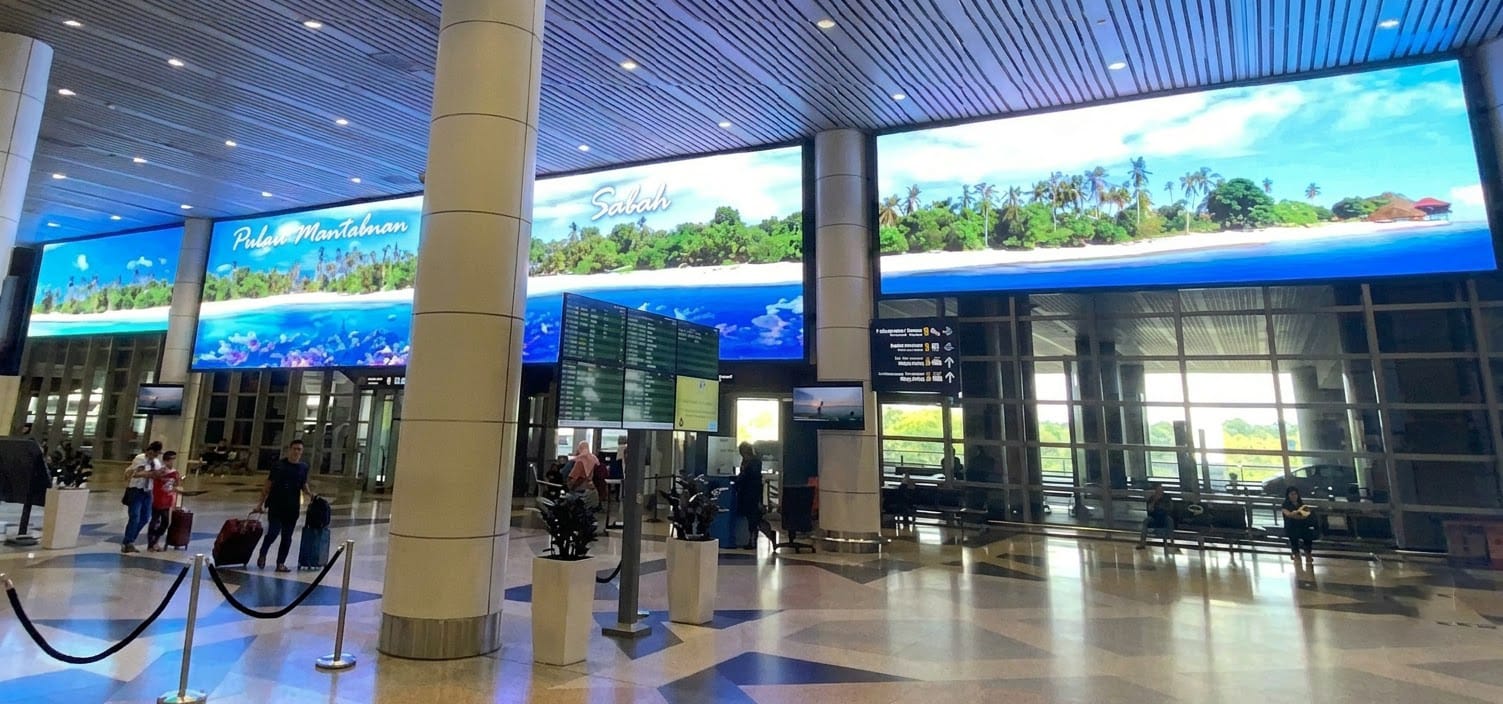
- The main terminal's architecturally celebrated Norman Foster-designed interior creates an advertising canvas of international premium quality whose tropical forest landscaping, dramatic skylights, and grand spatial proportions provide a brand association context that elevates every advertising impression through direct environmental association with one of the most recognisable and most positively evaluated airport buildings in the world. Brands advertised within this architectural landmark benefit from the same quality halo that the terminal's international design reputation generates in the minds of an audience that has experienced, or is experiencing, one of Asia's most celebrated airport environments.
- Dwell time at KUL is elevated by the airport's distance from the city centre, the cultural orientation of Malaysian and Gulf Arab travellers toward generous pre-departure preparation time, the premium retail and food and beverage environment's confirmed purchasing behaviour engagement, and the prayer room and Ramadan-oriented hospitality facilities that extend dwell time for the Muslim traveller community through religiously motivated terminal engagement. The combination of these dwell-extending factors creates an airport advertising environment where brand contact time per passenger is above the Southeast Asian regional airport average.
- The premium retail and luxury commercial environment at KUL, confirmed by the main terminal's comprehensive luxury brand portfolio and the consistent purchasing behaviour of both outbound Malaysian HNWI travellers and inbound Gulf Arab visitors, creates a commercial context where premium brand advertising is received as natural purchasing information within an active luxury consumption environment rather than interruptive brand messaging.
- Masscom Global approaches KUL placements with Malaysia-specific cultural intelligence as the operational foundation, ensuring that all campaign creative meets the linguistic, cultural, and religious sensitivity standards required across Malaysia's three major ethnic communities simultaneously, that Islamic cultural calendar timing is integrated into campaign architecture for categories where Ramadan and Hari Raya positioning delivers maximum commercial return, and that placement positioning within the terminal captures the specific audience flow patterns that distinguish the Gulf Arab inbound tourist, the Malaysian Chinese business traveller, and the South Asian professional diaspora from each other within the same terminal environment.
Strategic Advertising Fit
Best Fit:
- International luxury real estate: Developers offering Australian, UK, Japanese, Singaporean, Dubai, and US properties to Malaysian HNWI buyers find at KUL a directly validated and actively purchasing audience whose outbound real estate investment behaviour in these exact markets is confirmed across multiple ethnic community investment traditions, with the Malaysian Chinese property investment culture, the Malay-Muslim community's growing international property engagement, and the Indian-Malaysian professional community's Australian and UK property purchasing all creating overlapping but distinct audience segments within a single terminal advertising footprint.
- Islamic finance, Islamic wealth management, and Sharia-compliant investment products: No airport in Southeast Asia delivers a more institutionally sophisticated and more personally motivated Islamic finance advertising audience than KUL. The institutional leadership of the global Islamic finance industry, the Malay-Muslim HNWI community's confirmed preference for Sharia-compliant investment vehicles, and the Gulf Arab business visitor community's Islamic finance professional engagement combine at KUL to create the most commercially precise Islamic finance advertising environment available at any airport outside of Dubai and Riyadh.
- Premium and ultra-luxury automotive: The Malaysian automotive culture at the HNWI level combines the Malaysian Chinese community's deep European luxury marque brand loyalty with the Malay-Muslim community's growing engagement with premium automotive status and the energy sector professional community's confirmed executive vehicle purchasing behaviour. Both European ultra-luxury marques and Japanese premium brands find at KUL an audience whose vehicle purchase evaluation operates at the highest available standard of brand sophistication and purchasing capacity within Southeast Asian automotive advertising.
- International education: Australian, British, Canadian, and Singaporean universities and premium international school programmes find at KUL a parent and family decision-making audience across all three of Malaysia's major ethnic communities whose education investment per child is among the highest in Southeast Asia and whose confirmed outbound study destination choices in these exact markets create a directly validated purchasing intent audience for international education advertising across the full year.
- Ultra-luxury halal hospitality and Islamic tourism: Premium resort brands with halal certification, private island retreats with Muslim-friendly amenities, and ultra-luxury cruise lines offering halal dining options find at KUL an inbound Gulf Arab tourism audience and an outbound Malaysian Muslim leisure audience whose combined premium halal hospitality spending represents one of the fastest-growing segments in the global luxury tourism market. Brands that have invested in genuine halal quality certification and Muslim-friendly facility development find at KUL the most commercially productive global gateway for reaching this audience.
- Premium fashion, jewellery, and luxury lifestyle brands: The Malaysian Chinese HNWI community's confirmed luxury retail purchasing behaviour at KUL and at international destination retail environments, combined with the Gulf Arab inbound visitor community's premium shopping orientation and the growing Malay-Muslim premium fashion market's engagement with luxury modest fashion brands, creates multiple overlapping premium fashion and jewellery advertising audiences within the same terminal environment. International luxury maisons and premium Asian fashion brands both find a diverse and high-spending audience at KUL that spans cultural luxury purchasing traditions from Chinese jewellery gifting culture to Gulf Arab fashion luxury spending.
- Premium healthcare, medical concierge, and wellness tourism: Malaysia's position as Southeast Asia's most internationally recognised medical tourism destination creates a confirmed inbound medical and wellness tourism audience transiting KUL from Indonesia, the Middle East, South Asia, and Western markets. Simultaneously, the Malaysian HNWI community's growing engagement with executive wellness, preventive medicine, and private healthcare services creates a domestic premium health advertising audience whose spending capacity and health investment orientation is expanding with rising household income across the KUL catchment.
- NRI financial services, remittance, and investment products: The South Asian professional diaspora community in Malaysia, whose upper-income tier is actively engaged with investment planning, international money transfer, and cross-border asset management, represents a directly relevant audience for NRI-oriented financial services, Indian real estate investment platforms, and premium international money transfer services. KUL is among the most productive airports in Southeast Asia for reaching this community in a confirmed international financial engagement context.
Brand Alignment at a Glance:
| Category | Fit |
|---|---|
| Islamic finance and Sharia-compliant investment | Exceptional |
| International luxury real estate | Exceptional |
| International education | Exceptional |
| Premium and ultra-luxury automotive | Strong |
| Ultra-luxury halal hospitality and travel | Strong |
| Premium fashion, jewellery, and luxury lifestyle | Strong |
| Premium healthcare and medical concierge | Strong |
| NRI financial services and remittance products | Strong |
| Mass-market consumer goods | Poor fit |
Who Should Not Advertise Here:
- Alcohol and conventional spirits brands: Malaysia's Muslim-majority population and the Islamic cultural standards that govern the airport's primary Malay-Muslim audience make alcohol advertising at KUL culturally inappropriate and commercially ineffective. Any brand whose core identity involves alcohol will generate audience rejection among the largest and most commercially significant community at the airport regardless of creative quality or placement prominence.
- Mass-market consumer goods and commodity retail brands: The KUL HNWI and upper-income professional audience evaluates brands against international quality standards shaped by confirmed international purchasing experience and applies a quality-first framework to every category engagement. Mass-market brand advertising generates active disengagement from a community whose international travel frequency has calibrated their brand standards against the world's most premium retail environments.
- Budget travel and low-cost airline brands operating outside klia2: Price-led travel messaging directed at the main terminal's full-service passenger community finds no commercially relevant primary audience among confirmed premium business and HNWI travellers whose travel decisions are made on service standard, route directness, and premium cabin quality rather than ticket price.
Event and Seasonality Analysis
- Event Strength: Very High (Islamic calendar-driven, Chinese festival calendar-driven, Grand Prix globally significant)
- Seasonality Strength: Very High
- Traffic Pattern: Multi-Peak (Year-end November to January, Chinese New Year January to February, Hari Raya variable, Summer June to August) with strong baseline business travel year-round
Strategic Implication:
The KUL advertising calendar is the most culturally layered of any Southeast Asian airport, structured around three distinct and commercially significant festival calendars operating simultaneously: the Islamic Hijri calendar governing Ramadan and Hari Raya, the Chinese lunar calendar governing Chinese New Year and Mid-Autumn Festival, and the secular international calendar governing school holidays, Golden Week, and the Formula One Grand Prix. Masscom Global structures KUL campaign schedules around this multi-calendar framework, identifying the peak audience windows for each cultural community and each premium advertising category simultaneously and building campaign architectures that capture the highest-quality audience concentration for the most commercially relevant festival window for each brand's target segment. The year-end school holiday and Hari Raya windows deliver the broadest multi-community premium audience density at KUL; the Chinese New Year window delivers the highest Malaysian Chinese HNWI luxury purchasing concentration; the Grand Prix delivers the global automotive and sports luxury audience; and the Ramadan window delivers the Islamic finance and halal lifestyle brand's most purchase-motivated Muslim audience. No single campaign activation window captures all dimensions of this multi-cultural commercial calendar, and sustained year-round presence with culturally calibrated event-specific activations is the most commercially optimal strategy for brands seeking genuine KUL market depth across Malaysia's full premium consumer spectrum.
Poor Placement and Delays Affect Airport Campaigns
We help you move faster, access better inventory, and get it right now.
Talk to an ExpertFinal Strategic Verdict
Kuala Lumpur International Airport is Southeast Asia's most commercially complex and most commercially underutilised airport advertising opportunity, whose unique position at the intersection of three of the world's most commercially distinct HNWI communities, the Chinese commercial tradition, the Islamic finance world, and the English-speaking South Asian professional diaspora, creates an advertising environment with no precise equivalent at any other hub airport in the region. No other ASEAN airport delivers simultaneous access to the institutionally sophisticated Islamic finance leadership whose decisions shape sovereign wealth allocation across 57 nations, the Malaysian Chinese manufacturing and trading family wealth whose commercial depth rivals the established fortunes of any Southeast Asian economy, the Gulf Arab inbound premium leisure audience whose per-night halal hospitality spending sets the regional benchmark for Muslim luxury tourism consumption, and the South Asian professional diaspora whose bilateral remittance and investment flows represent billions of dollars of annually recurring financial services advertising opportunity. Norman Foster's architecturally celebrated terminal creates a premium brand association context that elevates every advertising impression through the quality signal of one of Asia's most internationally recognised airport buildings. The KUL 2030 Master Plan's confirmed terminal expansion and international connectivity growth will systematically increase both the audience volume and the premium commercial environment quality at the airport, making current inventory positions significantly more valuable in retrospect than their present pricing reflects. International luxury real estate developers whose Malaysian HNWI buyer pipeline spans multiple ethnic communities with distinct but equally active international property investment traditions, Islamic finance platforms whose primary global audience is most concentrated and most institutionally sophisticated at this specific airport, international universities whose Malaysia student recruitment requires engagement with three distinct cultural communities whose education investment motivations each require culturally specific advertising calibration, and premium brands across every relevant lifestyle category whose Southeast Asian market strategy requires genuine Malaysian market depth all find at Kuala Lumpur International Airport the direct, multi-culturally calibrated, and commercially precise access to Southeast Asia's most internationally engaged HNWI community that no alternative channel in the region provides with the same cultural breadth, commercial depth, or strategic value. Masscom Global delivers the Malaysian cultural intelligence spanning Malay, Chinese, and Indian community purchasing frameworks simultaneously, the regional network spanning 140 countries for brands seeking to reach KUL's audience across their full international travel and investment footprint, and the campaign execution precision to convert this exceptional multi-cultural opportunity into the sustained brand performance that Southeast Asia's most commercially sophisticated crossroads market rewards and the global premium advertising industry has not yet fully claimed.
About Masscom Global
Masscom Global is a premium international airport advertising and media buying agency operating across 140 countries. With deep expertise in airport OOH, premium publications, and high-net-worth audience targeting, Masscom helps brands reach the world's most valuable travellers at the moments that matter most. For advertising packages, media rates, and campaign planning at Kuala Lumpur International Airport and airports across the globe, contact Masscom Global today.
Frequently Asked Questions
How much does airport advertising cost at Kuala Lumpur International Airport?
Advertising costs at Kuala Lumpur International Airport vary by terminal zone, format type, placement position within the passenger flow, campaign duration, and seasonal demand. The main terminal commands premium rates reflecting its architecturally distinguished environment and confirmed HNWI passenger concentration. The year-end school holiday and Hari Raya windows command the highest seasonal pricing reflecting their combined multi-community audience density. The Chinese New Year window carries premium pricing for luxury gifting and outbound leisure categories. The Formula One Grand Prix period warrants standalone activation pricing for automotive and luxury lifestyle brands. Ramadan period placements require culturally calibrated creative and deliver the year's most concentrated Islamic finance and halal lifestyle audience motivation window. For current media rates, format availability, and tailored campaign packages at KUL, contact Masscom Global directly for a proposal aligned to your brand category, target cultural community, and Southeast Asian market objectives.
Who are the passengers at Kuala Lumpur International Airport?
Passengers at Kuala Lumpur International Airport represent one of the most culturally diverse premium travel audiences of any Asian hub airport. Malaysian nationals form the dominant commercial audience, with the Malaysian Chinese manufacturing and business elite, the Malay-Muslim professional and government community, and the Indian-Malaysian professional class collectively constituting a multi-ethnic HNWI and upper-income audience whose confirmed premium purchasing behaviour, above-average international travel frequency, and active international investment orientation make them among Southeast Asia's most commercially valuable airport advertising targets. Gulf Arab nationals, particularly from the UAE, Saudi Arabia, Kuwait, and Qatar, represent the highest per-visit spending inbound international audience, arriving for Halal tourism, medical services, and premium leisure with confirmed ultra-HNWI spending profiles. Indonesian nationals form the largest volume inbound segment with active premium retail and medical tourism spending. South Asian professionals contribute a significant diaspora financial services and family visit audience. Singaporean and Chinese business travellers add premium bilateral business and transit audience depth.
Is Kuala Lumpur International Airport good for luxury brand advertising?
Kuala Lumpur International Airport is among the strongest luxury brand advertising environments in Southeast Asia for brands targeting Malaysian HNWI consumers and Gulf Arab inbound premium tourists. The Malaysian Chinese community's confirmed luxury retail purchasing behaviour at international destinations and at KUL's own luxury retail environment, combined with the Gulf Arab inbound community's premium shopping orientation and the growing Malay-Muslim luxury lifestyle market's engagement with Sharia-compliant premium brands, creates a multi-layer luxury brand advertising audience of exceptional breadth and spending depth. For luxury automotive, international real estate, Islamic fashion, premium jewellery, and ultra-luxury halal hospitality brands, KUL delivers an audience whose combined cultural purchasing traditions represent the most commercially diverse luxury consumer community available at any airport in the ASEAN region.
What is the best airport in Southeast Asia to reach HNWI audiences?
Kuala Lumpur International Airport is the most culturally diverse and commercially comprehensive HNWI access point in Southeast Asia, uniquely delivering simultaneous access to the Malaysian Chinese commercial elite, the Islamic finance institutional community, and the Gulf Arab inbound premium tourism audience within a single terminal environment. Singapore Changi Airport serves a higher-income per capita audience with greater volume but in a smaller and more homogeneous market. Bangkok Suvarnabhumi serves a larger tourism market with a lower HNWI concentration. A coordinated multi-airport strategy combining KUL with Singapore Changi and Bangkok, structured by Masscom Global, creates the comprehensive Southeast Asian HNWI platform that reaches the full regional premium audience spectrum across its most commercially significant national markets and cultural communities.
What is the best time to advertise at Kuala Lumpur International Airport?
The highest-value advertising windows at KUL reflect the multi-cultural calendar structure of Malaysia's diverse community. The year-end school holiday from November through January delivers the broadest multi-community premium audience density at maximum annual volume. The Chinese New Year window in January and February delivers the Malaysian Chinese HNWI luxury purchasing and outbound leisure motivation at its annual peak. The Hari Raya departure and return window delivers the Malay-Muslim community's most intensive gifting and travel spending moment of the year. The summer school holiday from June through August delivers sustained outbound education and family leisure travel purchasing intent across all communities. The Formula One Malaysian Grand Prix period in September to October delivers a premium global automotive audience concentration event. Masscom Global recommends campaign timing calibrated to the specific cultural community and purchasing category of each brand's target audience, with sustained year-round presence strongly preferred for brands seeking compound frequency advantage across Malaysia's full premium consumer spectrum.
Can international real estate developers advertise at Kuala Lumpur International Airport?
International real estate developers targeting Malaysian HNWI buyers across all ethnic communities should consider KUL a mandatory channel in any Southeast Asian market advertising strategy. Malaysian outbound real estate investment in Australia, the UK, Japan, Singapore, Dubai, and Canada is confirmed across Malaysian Chinese, Malay-Muslim, and Indian-Malaysian community investment traditions, with each community's distinct cultural investment motivation creating separate but equally commercially valuable purchase intent audiences within the same terminal footprint. Developers offering properties in Melbourne, Sydney, London, Tokyo, Singapore, Dubai, and Vancouver find directly validated purchasing intent audiences within each cultural community at KUL, whose investment behaviour in these exact markets is confirmed by the established bilateral property investment patterns of all three Malaysian ethnic communities. Masscom Global can structure campaigns that reach these audiences at KUL and simultaneously at destination airports where Malaysian buyers are arriving to view properties, creating compounding brand exposure across the complete acquisition decision cycle.
Which brands should not advertise at Kuala Lumpur International Airport?
Alcohol and conventional spirits brands are categorically excluded from KUL's primary terminal advertising environment by the cultural standards of Malaysia's Muslim-majority passenger base and the Islamic values that govern the most commercially significant community at the airport. Budget travel brands directed at the main terminal's premium passenger flow find no commercially relevant primary audience among confirmed HNWI and upper-income travellers. Mass-market consumer goods and commodity financial products are misaligned with an audience whose international travel frequency has calibrated their brand evaluation against the world's most premium consumer environments. Any brand whose advertising creative conflicts with Malaysian cultural or religious standards, or whose product category is incompatible with the Islamic values that govern the majority of the airport's domestic audience, must receive comprehensive cultural and regulatory compliance review before any KUL investment is committed. Masscom Global provides this multi-cultural compliance assessment as a standard component of every Southeast Asian market campaign briefing.
How does Masscom Global help brands advertise at Kuala Lumpur International Airport?
Masscom Global provides complete airport advertising services at Kuala Lumpur International Airport, from initial audience intelligence and Malaysia market multi-cultural strategy through to inventory access across the main terminal and satellite facilities, Bahasa Malaysia and English creative adaptation calibrated to each ethnic community's specific cultural and linguistic quality standards, Islamic calendar planning for Ramadan and Hari Raya activations, Chinese festival calendar planning for Chinese New Year and Mid-Autumn Festival activations, Grand Prix event activation structuring, campaign deployment, and performance review. Our Malaysia market cultural intelligence spans the full spectrum of Malay, Chinese, and Indian community purchasing frameworks simultaneously, ensuring that every campaign placed at KUL engages its target cultural community with the authentic cultural respect and commercial specificity that Malaysia's diverse premium audience demands. With a global network spanning 140 countries and established relationships across the Southeast Asian airport advertising ecosystem, Masscom Global delivers campaigns that perform at KUL and coordinate seamlessly with brand activity at the international destination airports where Malaysian outbound capital, education investment, and Islamic finance relationships are most commercially concentrated.