


Airport at a Glance
| Field | Detail |
|---|---|
| Airport | Surat Thani International Airport |
| IATA Code | URT |
| Country | Thailand |
| City | Surat Thani |
| Annual Passengers | 1,516,470 (2025) |
| Primary Audience | Island-bound international leisure travellers, domestic Thai holidaymakers, regional agri-commodity business travellers |
| Peak Advertising Season | November to April, with a secondary July to August spike |
| Audience Tier | Tier 2 |
| Best Fit Categories | Hospitality and resorts, travel financial services, wellness and retreat brands, premium consumer goods |

The lowest-cost entry point to one of Southeast Asia's highest-spend island tourism corridors.
Surat Thani International Airport handled 1,516,470 passengers in 2025 and functions as the mainland pressure valve for the Samui archipelago. Passengers here are not incidental travellers. They are people who have deliberately chosen the ferry-and-transfer route to Koh Samui, Koh Phangan and Koh Tao because it is cheaper than flying direct, which makes them budget-aware but committed to a multi-day island stay. The airport also feeds Khao Sok National Park, a high-value nature and eco-lodge destination that draws long-stay European visitors. For advertisers, URT delivers a captive audience at a fraction of the exposure cost of Thailand's Tier 1 gateways.
What makes URT commercially distinct is the dwell profile created by its geography. Every island-bound passenger must transfer onward by coach and ferry, and that transfer is coordinated inside and immediately around the terminal, producing extended stationary time that larger airports cannot match. Surat Thani province is simultaneously the commercial capital of southern Thailand, anchored by rubber, palm oil and coconut trade, which layers a steady domestic business audience underneath the leisure flow. Masscom Global reads this airport as a dual-engine environment: seasonal high-spend international tourism stacked on year-round regional commerce.
Advertising Value Snapshot
- Passenger scale: 1,516,470 passengers in 2025, following a marginal 0.79 percent year-on-year movement, with the airport's historic peak at 2,247,344 indicating substantial headroom as regional capacity returns
- Traveller type: International island-bound leisure travellers, domestic Thai holiday and family travellers, southern Thailand agri-commodity and construction business travellers
- Airport classification: Tier 2. Sub-two-million throughput but with an audience quality profile well above its volume band because of the island tourism corridor it serves
- Commercial positioning: Known as the value gateway to Koh Samui, Koh Phangan, Koh Tao and Khao Sok
- Wealth corridor signal: Sits on the Europe-to-Gulf-of-Thailand leisure spending corridor, where visitor spend is concentrated into island resorts, dive tourism and wellness retreats rather than the departure city
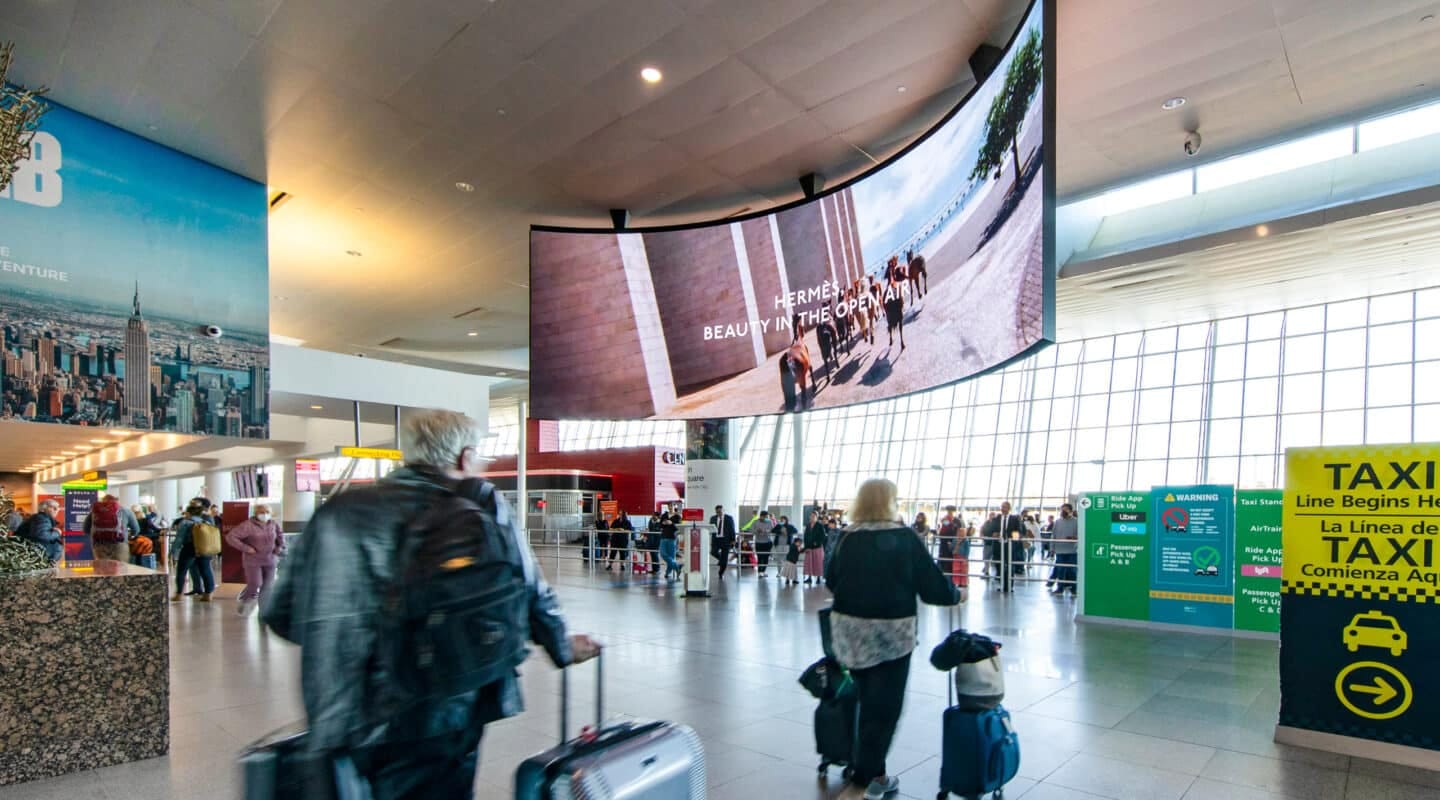
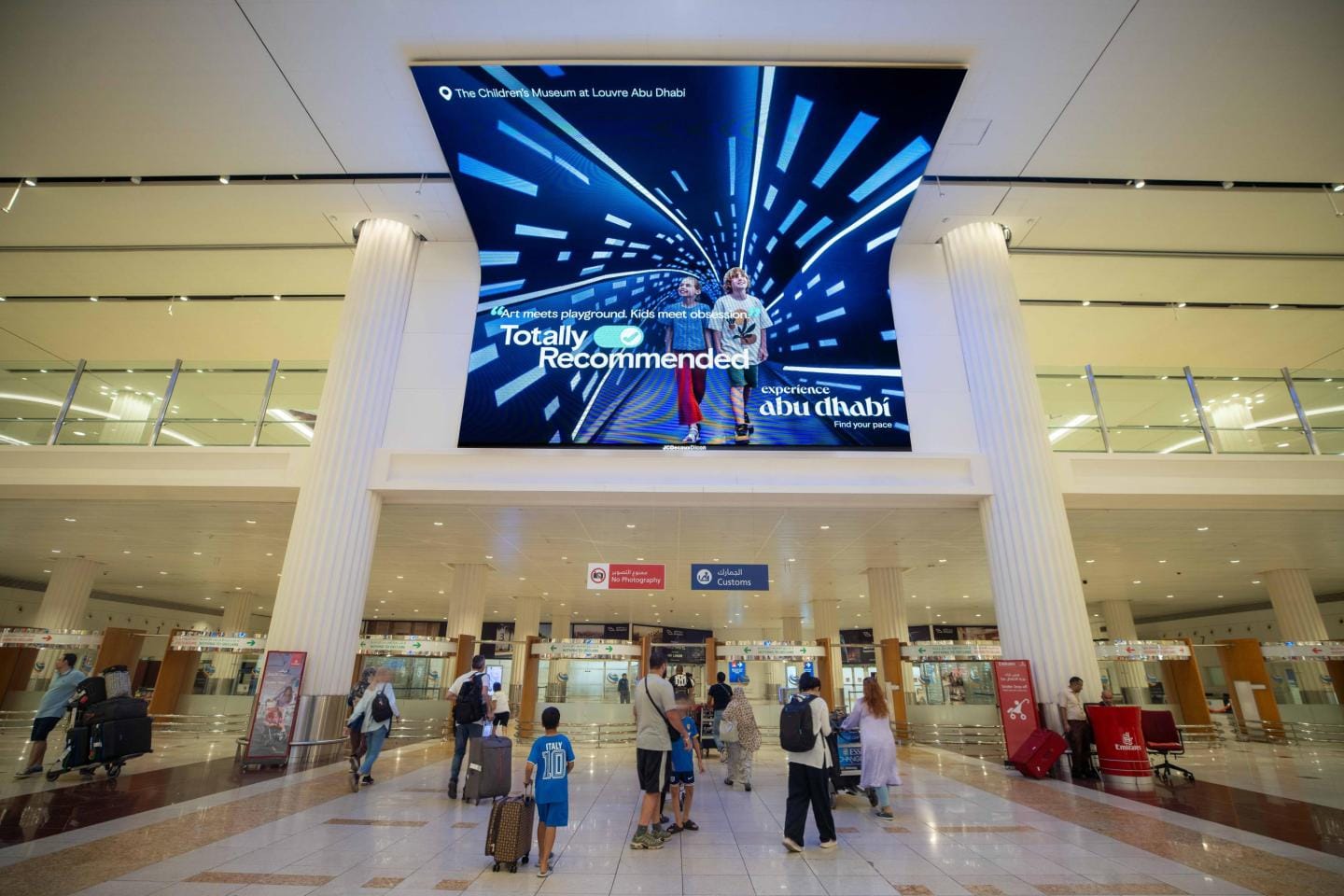
- Advertising opportunity: Masscom Global provides direct access to placements across the arrivals and departures halls of this compact terminal environment, where a single well-positioned execution reaches a very high share of total traffic. Because clutter levels are low relative to Bangkok, Phuket or Chiang Mai, brand recall per exposure is materially stronger. Masscom structures URT buys as high-efficiency additions to broader Thailand airport campaigns.
Airport Advertising is Complex to Get Right
We help you execute faster, with proven results and local insight most planners lack starting now.
Talk to an Expert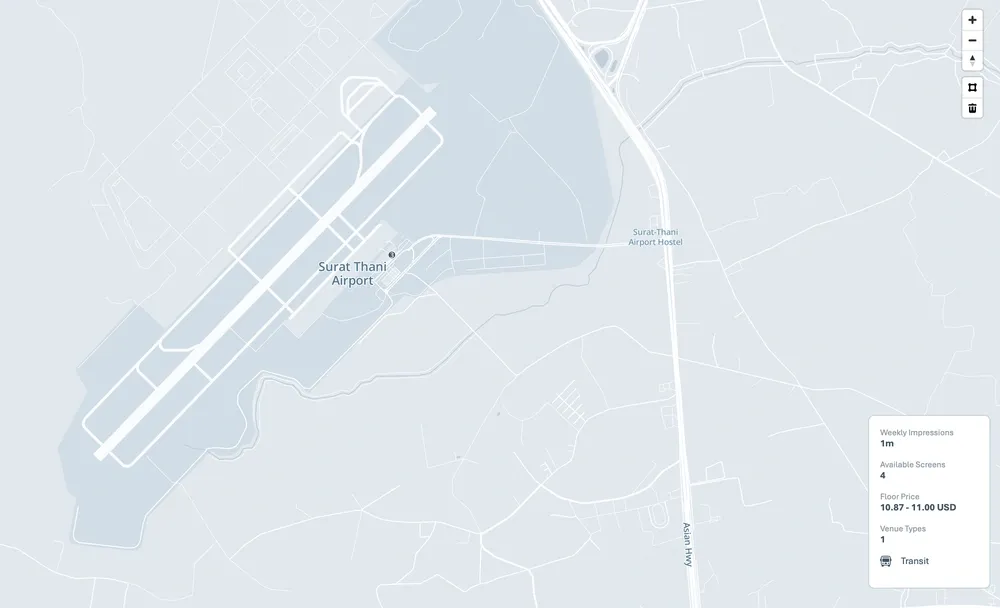
Catchment Area and Economic Drivers
Top 10 Cities within 150 km — Marketer Intelligence:
- Surat Thani City: The commercial and administrative core of the province. Produces trading families, provincial civil servants and agri-business owners with stable disposable income and strong appetite for banking, insurance and vehicle brands
- Phunphin: Rail and logistics junction town immediately adjacent to the airport. Delivers a transit-heavy audience of domestic travellers connecting between rail, road and air, receptive to telecom and travel convenience messaging
- Nakhon Si Thammarat: Major regional education and administrative centre. Generates student and academic families, an audience that responds to education services, consumer electronics and financing offers
- Koh Samui: The wealth endpoint of this catchment. Resort owners, expatriate business operators and hospitality investors who travel frequently and represent genuine HNI purchasing power in real estate and luxury services
- Koh Phangan: Wellness, retreat and long-stay expatriate economy. Produces an audience with high discretionary spend on health, fitness and lifestyle categories rather than traditional retail
- Koh Tao: Global dive tourism hub. Delivers a young, internationally mobile, repeat-visit audience valuable to insurance, outdoor equipment and fintech brands
- Chumphon: Agricultural and coastal trade town feeding the same ferry corridor. Supplies domestic leisure travellers and small business owners sensitive to value and financing propositions
- Krabi: Adjacent tourism economy generating cross-provincial hospitality workers and business travellers, an audience useful to employment, remittance and mobile payment brands
- Ban Na San: Rubber plantation belt. Produces landowning agricultural households with lumpy but significant seasonal income, aligned to vehicles, agri-machinery and gold or savings products
- Kanchanadit: Coconut and aquaculture processing area. Generates export-linked SME owners who travel to Bangkok for trade and finance, an audience relevant to B2B logistics and banking
NRI and Diaspora Intelligence:
Surat Thani does not carry a significant outbound diaspora corridor in the way South Asian or Gulf-facing airports do. The dominant wealth movement here is inbound and resident expatriate. Koh Samui and Koh Phangan host a substantial long-stay European and Australian population, alongside a growing base of remote-working professionals and retirees on long-term Thai visas. This community travels through URT repeatedly rather than seasonally, holds foreign currency income, and makes property, healthcare and cross-border banking decisions locally. For advertisers, this is a high-frequency, high-net-worth audience that no other airport in southern Thailand intercepts as consistently on the mainland route.
Economic Importance:
The catchment economy rests on three pillars: island tourism, agricultural commodities and regional trade logistics. Tourism creates the international leisure audience and the expatriate resident audience. Rubber, palm oil and coconut production creates landowning provincial wealth that concentrates in gold, vehicles and property rather than branded retail. Trade logistics through the province's port and rail links creates the domestic business traveller. Each pillar produces a distinct audience type, and Masscom Global maps campaign creative to the pillar an advertiser actually needs.

Business and Industrial Ecosystem
- Rubber and palm oil production: Southern Thailand's commodity heartland, producing plantation owners and export traders who travel to Bangkok for finance and buyer meetings. Strong audience for banking, agri-equipment and commercial vehicle brands
- Coconut and food processing: Export-oriented SME cluster generating owner-operators with international buyer relationships. Relevant to trade finance, logistics and packaging B2B advertisers
- Hospitality and resort development: Continuous investment across the Samui archipelago produces developers, contractors and hotel management executives, a compact but high-value B2B audience
- Aquaculture and fisheries: Coastal processing and export businesses feeding regional supply chains, producing a cold-chain logistics and industrial equipment audience
Passenger Intent — Business Segment:
Business travellers at URT are predominantly provincial owner-operators and hospitality sector executives moving between Surat Thani and Bangkok. They travel to secure financing, meet buyers, or oversee island projects. They are decision-makers with signing authority rather than corporate employees, which shortens the path from advertising exposure to commercial action. Banking, commercial vehicles, construction materials, logistics services and business insurance intercept them most effectively.
Strategic Insight:
The business audience at URT is small in volume but unusually senior in composition. In a Bangkok terminal, a B2B advertiser competes for attention among hundreds of thousands of junior corporate travellers. Here, the business traveller is far more likely to be the person who owns the plantation, runs the processing plant or controls the resort budget. That concentration of authority in a low-clutter environment makes URT a disproportionately efficient B2B placement for brands selling into southern Thailand's commodity and hospitality economy.
Tourism and Premium Travel Drivers
- Koh Samui: Thailand's second most established luxury island resort market. Delivers travellers who have already committed to multi-night premium accommodation, making them receptive to spa, dining, watersports and retail messaging on arrival
- Koh Phangan: Global wellness, yoga and retreat destination with a defined monthly event calendar. Produces long-stay visitors with high per-day discretionary spend on health, fitness and lifestyle categories
- Koh Tao: One of the world's highest-volume dive certification destinations. Young, international, repeat-visit audience valuable to travel insurance, equipment and digital payment brands
- Khao Sok National Park: Premium eco-lodge and floating raft house destination drawing long-stay European nature travellers who book far in advance and spend heavily on guided experiences
Passenger Intent — Tourism Segment:
Tourists arriving at URT have already spent on airfare, accommodation and onward ferry transfers before they land. They are in a committed spending posture, not an evaluation posture, and their remaining budget is allocated to experiences, dining, wellness and retail at destination. Arrival is the single highest-leverage moment to influence that allocation, because the itinerary beyond the flight is still loosely defined. Resorts, spa and wellness operators, tour and activity brands, currency and payment services, telecom and premium consumer goods gain the most from this segment.
Travel Patterns and Seasonality
Peak seasons:
- November to April: The dry-season high tourism window for the Gulf islands, driven by European and Australian long-haul winter escape travel. This is the highest-value advertising window of the year
- July to August: Secondary European summer holiday peak, plus domestic Thai school holiday travel
- December to early January: Highest-intensity fortnight of the year, combining Christmas, New Year and island celebration traffic
- April: Songkran travel surge across Thailand, adding heavy domestic family movement
- Traffic volume data: Monthly breakdown not available. January 2025 recorded notably strong growth, particularly in international arrivals
Event-Driven Movement:
- Full Moon Party, Koh Phangan (monthly, peaking December to March): Global youth and backpacker influx tied to the lunar calendar, creating a predictable monthly traffic pulse. Advertiser timing opportunity for telecom, payments, insurance and beverage brands
- Songkran (April): Thai New Year water festival. Drives the year's largest domestic family movement plus international festival tourism. Prime window for consumer goods, retail and telecom
- Loy Krathong (November): National festival opening the high season. Combines domestic travel with early international arrivals, ideal for launch campaigns
- Chak Phra Festival, Surat Thani (October): The province's signature Buddhist boat procession festival. Draws regional domestic visitors and marks a local pride moment suited to FMCG and banking activation
- Chinese New Year (January or February): Significant regional Asian arrivals into the Samui corridor, a defined window for luxury retail, jewellery and premium hospitality messaging

It’s Not Just Where You Advertise - It’s How Fast You Execute
We combine local insight with fast rollout to deliver results for you, now.
Talk to an ExpertAudience and Cultural Intelligence
Top 2 Languages:
- Thai: The language of the domestic leisure traveller and the provincial business owner. Thai-language creative is essential for banking, insurance, vehicle and FMCG brands targeting the resident catchment audience
- English: The working language of the international leisure and expatriate resident audience across Samui, Phangan and Tao. English creative carries the premium hospitality, wellness, financial services and luxury retail message
Major Traveller Nationalities:
The international mix at URT is led by Western European travellers, particularly German, British, French and Scandinavian visitors drawn to the Gulf islands during the northern winter. Australian and Israeli travellers form a consistent secondary bloc, alongside growing regional Asian arrivals from China, Singapore and Malaysia. The Europeans travel long and stay long, favouring extended narrative creative and premium positioning. Regional Asian travellers move in shorter, higher-frequency cycles and respond to immediate offer-led messaging. Masscom Global recommends dual-track creative rather than a single global execution at this airport.
Religion — Advertiser Intelligence:
- Buddhism (approximately 90 percent of the Thai catchment): Drives the Chak Phra Festival, Loy Krathong, Songkran and Vesak. These periods trigger family reunion travel, merit-making expenditure, gold and gift purchasing, and new-vehicle timing. Banking, gold and jewellery, consumer durables and FMCG brands benefit most from campaigns aligned to these windows
- Islam (a significant southern Thai minority): Concentrated in the wider southern provinces feeding this catchment. Ramadan and Eid drive family travel clustering and elevated food, apparel and gifting spend. Halal-certified food brands, family travel packages and remittance services align well
- Christianity (small resident and large visitor share): Marginal locally but dominant among the European visitor base, making Christmas and New Year the highest-spend fortnight at the airport. Luxury retail, premium spirits, hospitality and gifting categories should concentrate budget here
Behavioral Insight:
This audience splits into two decision architectures that advertisers must address separately. The provincial Thai traveller thinks in terms of asset accumulation and family security, favouring gold, land, vehicles and savings products, and responds to trust signals and long-standing brand presence over novelty. The international leisure traveller thinks in terms of experience maximisation within a fixed trip budget, having already sunk cost into getting there, and responds to convenience, immediacy and quality assurance. The expatriate resident sits between both, holding foreign income while making local property and healthcare decisions, and responds to credibility and cross-border capability. Messaging that acknowledges which of these three the brand is speaking to consistently outperforms generic travel creative.
Outbound Wealth and Investment Intelligence
The outbound passenger at URT is commercially unusual because the wealth at this airport is largely resident rather than transiting. Thai provincial wealth from rubber, palm oil and coconut trade deploys domestically into land, gold and Bangkok property rather than internationally. The genuinely internationally mobile capital here belongs to the Samui archipelago's expatriate and hospitality investor community, whose money flows in the reverse direction, out of Europe and Australia and into Thai coastal real estate. Advertisers should read URT as a capital destination corridor as much as a capital origin corridor.
Outbound Real Estate Investment:
Thai HNI buyers from this catchment concentrate on domestic assets first, with Bangkok condominiums and Samui coastal land as the primary vehicles. Where they move offshore, Malaysia, Singapore and Australia are the recognised destinations, with Malaysia's long-stay residency framework and Australian education-linked property purchases the most common triggers. The larger and more actionable opportunity runs inbound: European, Australian and Chinese buyers acquiring villas and resort-linked leasehold on Samui and Phangan. International real estate developers advertising at URT reach both sides of that transaction in a single terminal, and Masscom Global positions creative accordingly.
Outbound Education Investment:
Students from Surat Thani and Nakhon Si Thammarat migrate primarily to Bangkok for higher education, with international destinations led by Australia, the United Kingdom, the United States and increasingly China and Japan for scholarship-backed places. Plantation-owning and trading families treat overseas education as the single largest discretionary outlay of their lifecycle, funded from land equity rather than salary. International universities, pathway providers, education loan products and language testing services have a clearly defined and underserved audience here.
Outbound Wealth Migration and Residency:
Second-residency interest in this catchment centres on Malaysia's long-stay programme and Australian and Canadian skilled and investor pathways. Running alongside it is strong inbound residency demand: the Thai Long Term Resident and Elite visa routes are actively used by the Samui and Phangan expatriate community, making URT a rare airport where residency and relocation advisory brands can address both emigration and immigration intent simultaneously.
Strategic Implication for Advertisers:
URT is a bidirectional wealth corridor, not a one-way outflow route, and that is rare at this passenger scale. International brands should treat it as a place to reach European and Australian capital arriving to buy Thai assets and Thai provincial capital preparing to spend on education and offshore residency. Masscom Global activates both directions in the same terminal, sequencing creative by season so inbound and outbound intent are addressed when each peaks.
Airport Infrastructure and Premium Indicators
Terminals:
- A compact two-floor terminal structure with arrival and departure halls separated across two terminal areas, serving predominantly narrow-body domestic and regional traffic. The layout concentrates all passenger flow through a small number of chokepoints, which is a structural advantage for advertisers seeking near-total audience coverage
- Terminal 2 expansion has been completed, raising handling capacity and improving passenger circulation ahead of the wider upgrade programme
Premium Indicators:
- Lounge provision is limited relative to Thailand's primary gateways, reflecting an airport where premium value comes from destination spend rather than airport-side luxury infrastructure
- The airport is co-located with Royal Thai Air Force squadrons and supports general and business aviation movements serving the Samui archipelago investor community. Dedicated commercial FBO detail is not available
- No integrated luxury airport hotel. Premium accommodation inventory sits at the island destinations, which is precisely why arrival-hall messaging carries such influence over onward spend
- A single paved runway of 3,018 metres, capable of handling the aircraft types the route network requires
Forward-Looking Signal:
A multi-billion baht upgrade programme is underway, with the terminal being expanded toward a 3.6 million annual passenger capacity, apron expansion to accommodate eleven Boeing 737-class aircraft simultaneously, car parking scaled to 700 vehicles and a new integrated transportation centre. Airlines have announced additional routes including direct connections toward Phuket and Krabi, signalling a shift from a two-destination domestic network toward genuine regional connectivity. Capacity of that scale against 2025 throughput of 1.5 million implies a step change in both audience volume and quality once complete. Masscom Global advises clients to secure positions now, while rates reflect current traffic rather than post-expansion demand.
Airline and Route Intelligence
Top Airlines:
Thai AirAsia, Thai Lion Air, Nok Air, Thai VietJet Air, with EZY Airlines operating regional service.
Key International Routes:
The airport currently operates no scheduled long-haul international routes. International passengers arrive via Bangkok connections at Suvarnabhumi and Don Mueang. Additional regional routes have been announced as part of the network expansion.
Domestic Connectivity:
Bangkok Don Mueang and Bangkok Suvarnabhumi dominate the schedule and account for the overwhelming majority of movements. Chiang Mai is the longest domestic sector. Hua Hin is served regionally, with Phuket and Krabi connections announced.
Wealth Corridor Signal:
The route network reveals a specific and useful truth for advertisers: URT is a connecting-passenger airport, not an origin-destination one. Almost every international traveller here has already passed through a Bangkok hub, meaning they are late in their journey, close to their destination, and in active planning mode for the days ahead. The Bangkok trunk routes function as the wealth transfer corridor, carrying both European leisure spend and Thai business capital, while the Chiang Mai and Hua Hin sectors are pure domestic leisure. Advertisers should treat URT arrivals messaging as the final and most decisive touchpoint before destination spend is committed.
Media Environment at the Airport
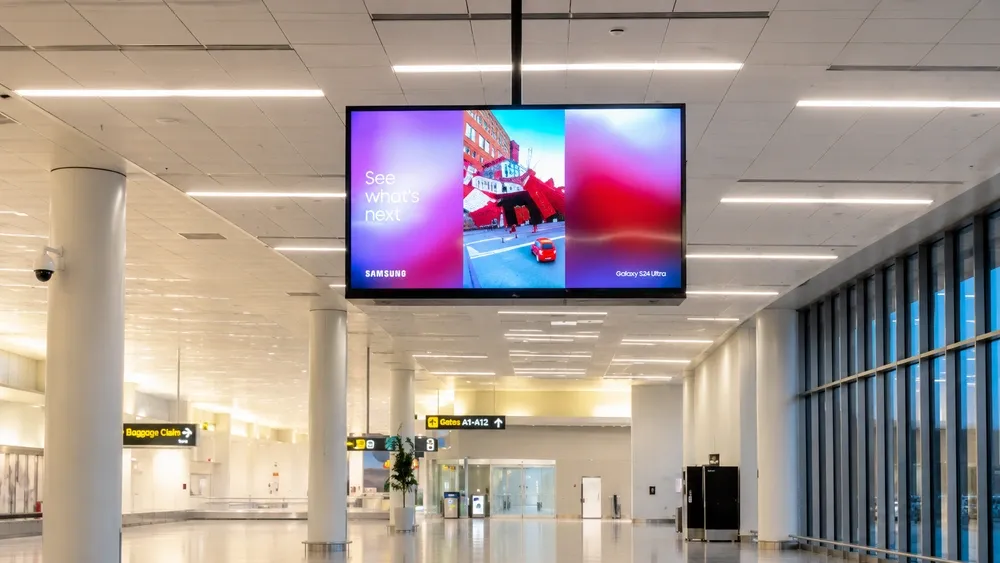
- A compact terminal footprint with very low advertising clutter compared with Phuket, Bangkok or Chiang Mai. A single strong execution here achieves share of voice that would require a multi-site buy at a Tier 1 gateway
- Dwell time is structurally extended by the onward transfer model, because island-bound passengers wait for coordinated coach and ferry connections rather than exiting immediately. This produces genuine attention time rather than transit glance value
- The arrivals environment carries elevated influence because passengers are making onward decisions about dining, activities, transport and accommodation upgrades while still in the terminal
- Masscom Global provides direct inventory access across the terminal's high-traffic chokepoints, with placement precision at the specific transfer and arrival points where the island-bound audience concentrates, plus rapid execution timed to the seasonal windows that matter
Strategic Advertising Fit
Best Fit:
- Hospitality and resort brands: Reaching travellers hours before they commit to onward dining, spa and upgrade spend on Samui, Phangan and Tao
- Wellness, spa and retreat operators: A destination audience explicitly travelling for wellness, particularly through the Phangan retreat economy
- Travel insurance and payment services: Dive tourism, adventure travel and long-stay visitors create real and immediate need
- Telecom and connectivity providers: International arrivals purchasing local data and roaming at the point of arrival
- Tour, activity and dive operators: Itineraries beyond flights and hotels remain unbooked at arrival, making this the decision moment
- International real estate developers: Both the inbound European and Australian buyer of Thai coastal property and the Thai provincial buyer looking offshore
- Banking, gold and savings products: Provincial commodity wealth with strong asset accumulation behaviour and festival-timed purchasing
- International education and residency advisory: Plantation and trading families funding overseas study, plus active Thai long-stay residency demand among expatriates
Brand Alignment at a Glance:
| Category | Fit |
|---|---|
| Hospitality and resorts | Exceptional |
| Wellness and retreat brands | Exceptional |
| Travel insurance and payments | Strong |
| Tour and activity operators | Strong |
| International real estate | Strong |
| Banking, gold and savings | Moderate |
| International education | Moderate |
| Enterprise B2B technology | Poor fit |
Who Should Not Advertise Here:
- Enterprise software and corporate technology: There is no meaningful concentration of corporate IT decision-makers or multinational headquarters traffic in this catchment
- Ultra-luxury automotive: The genuine ultra-high-net-worth population is resident on the islands and reached through destination and lifestyle channels, not a Tier 2 mainland terminal
- Heavy industrial and manufacturing capital equipment: The provincial economy is agricultural and hospitality-led, with no industrial manufacturing base to justify the spend
Event and Seasonality Analysis
- Event Strength: High
- Seasonality Strength: High
- Traffic Pattern: Dual-Peak, seasonal
Strategic Implication:
Budget should concentrate heavily in the November to April high season, with a defined secondary allocation across July and August. The December to early January fortnight and the April Songkran window deliver the highest spend-per-passenger of the year and warrant premium placement rather than baseline presence. Masscom Global structures URT campaigns around this rhythm, front-loading international-facing creative into the dry season and Thai-language creative into festival windows, so budget follows audience value rather than spreading evenly across months that deliver materially less.

Poor Placement and Delays Affect Airport Campaigns
We help you move faster, access better inventory, and get it right now.
Talk to an ExpertFinal Strategic Verdict
Surat Thani International Airport delivers something few Tier 2 airports can: a committed, high-spend destination audience at Tier 2 exposure cost. Its 1.5 million annual passengers are not casual traffic but people who have already paid to reach Koh Samui, Koh Phangan, Koh Tao or Khao Sok, and who make their remaining spending decisions in the hours after they land. The compact terminal, the low clutter environment and the extended dwell created by onward ferry transfers combine to produce recall per exposure that Bangkok and Phuket cannot match. Layered beneath that sits provincial commodity wealth and a resident expatriate investor community that make this a bidirectional capital corridor, not a simple leisure route. With a terminal expansion targeting 3.6 million passengers and new regional routes announced, the window to secure position at current rates is defined and closing. Masscom Global holds the inventory access, the audience intelligence and the execution speed to place brands here before the market reprices.
About Masscom Global
Masscom Global is a premium international airport advertising and media buying agency operating across 140 countries. With deep expertise in airport OOH, premium publications, and high-net-worth audience targeting, Masscom helps brands reach the world's most valuable travellers at the moments that matter most. For advertising packages, media rates, and campaign planning at Surat Thani International Airport and airports across the globe, contact Masscom Global today.
Frequently Asked Questions
How much does airport advertising cost at Surat Thani Airport?
Cost at URT varies by format, terminal position, campaign duration and seasonal demand. High season rates from November to April carry a premium over green season months, and arrivals-hall positions command more than general concourse placements because of their influence on onward spend. Masscom Global provides current rate cards and package options on request.
Who are the passengers at Surat Thani Airport?
Roughly three audiences share the terminal. International leisure travellers, led by German, British, French, Scandinavian and Australian visitors, connecting through Bangkok toward Koh Samui, Koh Phangan, Koh Tao and Khao Sok. Domestic Thai holidaymakers and family travellers on the Bangkok trunk routes. And provincial business travellers from the rubber, palm oil, coconut and hospitality development economies of southern Thailand.
Is Surat Thani Airport good for luxury brand advertising?
Selectively. URT is not a luxury retail terminal, and ultra-premium categories such as high-end automotive find better efficiency elsewhere. However, luxury hospitality, premium wellness, resort real estate and high-end experience brands perform strongly because the audience is travelling directly into one of Thailand's most established luxury island markets and is receptive at the point of arrival.
What is the best airport in southern Thailand to reach HNWI audiences?
Phuket leads on raw volume and long-haul international HNWI arrivals. URT is the sharper choice for reaching the Samui archipelago audience specifically, including its resident expatriate investor community and the resort development sector, and it does so at a substantially lower cost per exposure. Most effective Thailand strategies use both rather than choosing between them.
What is the best time to advertise at Surat Thani Airport?
November through April is the primary window, driven by dry-season island tourism. Within it, mid-December to early January is the highest-value fortnight, and April's Songkran period delivers the largest domestic surge. July and August provide a strong secondary window for European summer travel and Thai school holidays.
Can international real estate developers advertise at Surat Thani Airport?
Yes, and it is one of the strongest fits at this airport. URT reaches European, Australian and regional Asian travellers moving into a coastal property market they actively buy into, alongside Thai provincial wealth that invests in Bangkok, Samui land, and increasingly Malaysia, Singapore and Australia. Masscom Global builds developer campaigns that address both directions of that corridor.
Which brands should not advertise at Surat Thani Airport?
Enterprise software and corporate technology, ultra-luxury automotive, and heavy industrial capital equipment. None of these has a matching audience concentration here. The catchment economy is agricultural and hospitality-led, and the traveller base is leisure-dominant rather than corporate.
How does Masscom Global help brands advertise at Surat Thani Airport?
Masscom Global delivers the full chain: catchment and audience intelligence specific to URT, direct inventory access across the terminal's highest-traffic positions, creative guidance calibrated to the airport's dual-language and dual-audience reality, seasonal campaign sequencing built around the November to April peak, and post-campaign performance reporting. With the terminal expansion underway, now is the moment to lock position at current rates.