


Airport at a Glance
| Field | Detail |
|---|---|
| Airport | Nakhon Si Thammarat Airport |
| IATA Code | NST |
| Country | Thailand |
| City | Nakhon Si Thammarat, Southern Thailand |
| Annual Passengers | 1,040,791 total passengers in 2024, up 12.93 percent year on year, with 8,037 aircraft movements. All scheduled traffic is domestic |
| Primary Audience | Domestic Thai faith and heritage tourists, Southern Thai business owners and traders, agricultural and fisheries enterprise |
| Peak Advertising Season | January to May, September to October |
| Audience Tier | Tier 2 by regional volume, Tier 3 by audience wealth |
| Best Fit Categories | Domestic travel and hospitality, telecom and consumer finance, automotive and agricultural equipment, banking and insurance |

The fastest-growing domestic airport in Southern Thailand, arriving at exactly the moment its province became a UNESCO destination.
Nakhon Si Thammarat handled 1,040,791 passengers in 2024, a 12.93 percent year-on-year increase alongside an 11.81 percent rise in aircraft movements, making it one of the strongest growth stories in the Department of Airports network. Four Thai low-cost carriers operate roughly 13 flights a day through a 7,985 square metre terminal located 14 kilometres from the city, with a runway and apron sized for Boeing 737 and ATR 72 equipment. The growth is not incidental. It is driven by a genuine and sustained surge in Thai domestic faith and heritage tourism into this province.
Then, on 25 July 2026, UNESCO's World Heritage Committee inscribed Wat Phra Mahathat Woramahawihan on the World Cultural Heritage list, making it the first cultural World Heritage site in Southern Thailand and Thailand's sixth. That designation arrives on top of an already accelerating tourism base and a national government commitment to develop high-quality cultural tourism around the site. For advertisers, this is the rare situation where a small airport's audience is about to be structurally revalued, and the media rates have not yet moved.
Advertising Value Snapshot
- Passenger scale: 1,040,791 passengers in 2024, up 12.93 percent, with aircraft movements up 11.81 percent to 8,037 and freight up 7.86 percent. Growth is broad, consistent, and driven by domestic demand rather than a single route addition.
- Traveller type: Domestic Thai faith and heritage tourists, Southern Thai business owners and traders, and agricultural, fisheries, and rubber sector enterprise.
- Airport classification: Tier 2 by regional volume within Thailand's domestic network, Tier 3 by audience wealth. This is a high-frequency consumer environment, not a luxury environment.
- Commercial positioning: The air gateway to Southern Thailand's first UNESCO World Heritage site and to the country's most significant contemporary faith tourism destination.
- Wealth corridor signal: The airport sits on the Bangkok to Southern Thailand domestic corridor and at the centre of a rubber, palm oil, and fisheries economy that supplies national and export supply chains.
- Advertising opportunity: A single compact terminal with concentrated flows delivers high frequency against a defined audience rather than diluted reach. Masscom Global secures placement across check-in, security, and gate touchpoints where low-cost carrier passengers arrive early and dwell long. With UNESCO status newly conferred and visitor numbers set to rise, Masscom positions clients ahead of the repricing rather than after it.
Airport Advertising is Complex to Get Right
We help you execute faster, with proven results and local insight most planners lack starting now.
Talk to an Expert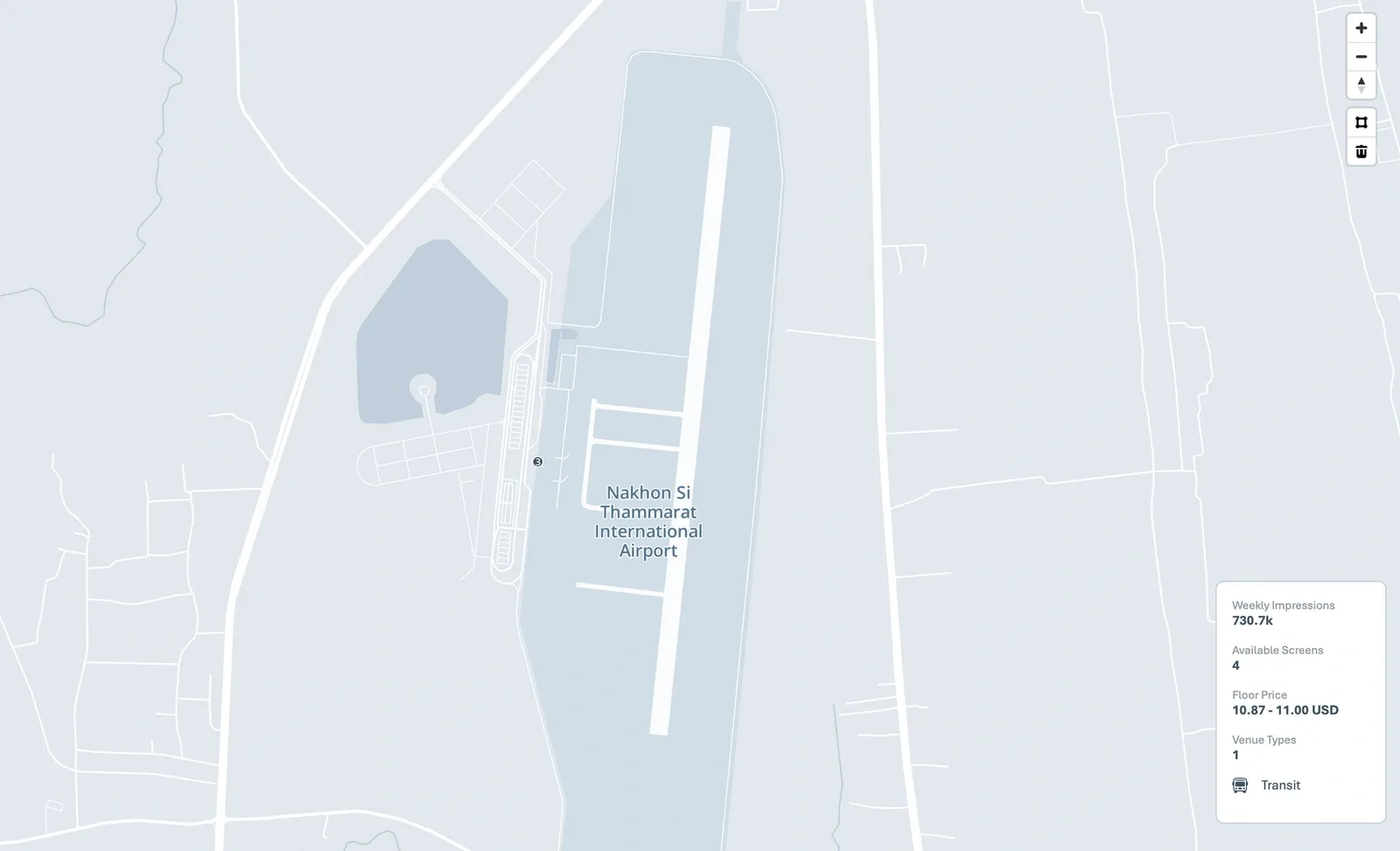
Catchment Area and Economic Drivers
Top 10 Cities within 150 km, Marketer Intelligence:
- Nakhon Si Thammarat city: The provincial capital and administrative centre, now Southern Thailand's first UNESCO heritage city. Concentrates government, retail, private healthcare, and a professional services base, and is the primary destination for pilgrim and heritage visitor spending.
- Sichon: The epicentre of Thailand's contemporary faith tourism phenomenon, roughly 60 kilometres north of the city, alongside a developing beach resort strip. Produces the highest visitor volume growth in the province and an expanding hospitality and small enterprise market.
- Thung Song: The province's second city and a major rail junction and rubber trading hub. Produces commodity traders, logistics operators, and small enterprise owners with real purchasing authority.
- Khanom: Coastal resort district known for marine wildlife tourism and an emerging premium hospitality segment. Produces resort development and leisure consumer audiences.
- Pak Phanang: Fisheries, shrimp aquaculture, and the province's distinctive edible bird's nest industry. Produces aquaculture enterprise owners and export-linked trading families with substantial liquidity.
- Tha Sala: Home to the province's major university. Produces a young, digitally engaged student and academic audience and an education services market.
- Ron Phibun: Agricultural and former mining district. Produces farming households with equipment, input, and seasonal credit requirements.
- Surat Thani: The largest economy in Southern Thailand and the mainland gateway to the Gulf islands. Adds palm oil and agribusiness decision makers plus overflow tourism logistics.
- Phatthalung: Agricultural province with a growing wetland and eco-tourism profile. Increasingly marketed alongside Nakhon Si Thammarat as a two-province itinerary.
- Trang: Rubber production centre with an established Thai-Chinese commercial community and Andaman coast tourism. Produces trading families and commercial enterprise with cross-peninsula reach.
NRI and Diaspora Intelligence:
There is no large foreign diaspora driving traffic at this airport, and advertisers should not plan for one. The dominant high-value audience movement is the Southern Thai working diaspora based in Bangkok, Phuket, and the Eastern Seaboard, who return home for festivals, family obligations, and merit-making with a consistency that structures the entire annual calendar. Alongside this, the province has a long-established Thai-Chinese commercial community whose trading families control much of the rubber, fisheries, and retail economy and represent the catchment's genuine business wealth. For advertisers, the commercially relevant insight is that this is a returning-resident and domestic-pilgrim market, not an international one.
Economic Importance:
Four engines drive this catchment. Rubber is the foundation, with the province among Thailand's leading producers, setting commodity-linked household income cycles. Palm oil and tropical fruit agriculture form the second engine, adding processing and export activity. Fisheries and aquaculture, concentrated around Pak Phanang, produce a distinct enterprise-owner class with export exposure. The fourth and fastest-growing engine is tourism, now transformed by UNESCO inscription and by a faith tourism surge that has already lifted airport traffic by double digits. Masscom Global maps creative to the engine an advertiser is selling into rather than treating the terminal as one audience.
Business and Industrial Ecosystem
- Rubber production, processing, and trading: The province's economic backbone. Produces plantation owners, processors, and commodity traders whose spending tracks global rubber prices and who buy equipment, vehicles, and finance in cycles.
- Palm oil and tropical fruit agriculture: Adds processing and export activity across the catchment. Produces agribusiness management and agricultural machinery purchasing decisions.
- Fisheries, shrimp aquaculture, and bird's nest industry: A high-value coastal enterprise cluster with export orientation. Produces business owners with unusually strong liquidity relative to the wider provincial economy.
- Tourism, hospitality, and construction: The newest and fastest-growing sector, now backed by UNESCO status and a national commitment to develop sustainable cultural tourism. Produces hotel development, construction, and hospitality supply chain audiences.
Passenger Intent, Business Segment:
Business travel here is dominated by owner-operators rather than corporate employees. They are rubber and palm traders, aquaculture and fisheries enterprise owners, retail and property developers, and construction contractors flying to Bangkok for supply, finance, and government business. They are practical, price-aware, and make decisions personally rather than through procurement committees. Banking and commercial finance, agricultural and industrial equipment, insurance, logistics, and telecoms intercept them most effectively.
Strategic Insight:
The commercially important shift at this airport is that a tourism-driven growth curve is now colliding with a UNESCO designation and an explicit government plan to build high-quality cultural tourism around the site. That combination reliably produces hotel construction, hospitality investment, retail development, and infrastructure spending in the years following inscription, which in turn creates a new B2B audience where one barely existed. Construction, hospitality supply, property finance, and franchise brands entering Southern Thailand should be establishing presence here now rather than reacting later. Masscom Global builds this as a forward-positioned buy against a market that is visibly about to expand.
Tourism and Premium Travel Drivers
- Wat Phra Mahathat Woramahawihan: Inscribed as a UNESCO World Heritage Site on 25 July 2026, the first cultural World Heritage site in Southern Thailand and Thailand's sixth. An eighth-century royal temple containing a Buddha tooth relic, with a 78 metre chedi surrounded by 173 smaller ones. The single most important advertiser-relevant development in the province in decades.
- Wat Chedi Ai Khai in Sichon: The most visited contemporary faith destination in Southern Thailand, drawing very large domestic crowds who make offerings and vows. This site alone accounts for a substantial share of the province's tourism growth and the airport's double-digit passenger increase.
- Khanom and Sichon coast: Gulf coast beaches, marine wildlife tourism, and a developing resort segment that extends visitor stay beyond a single-day pilgrimage.
- Khao Luang National Park and the inland highlands: Waterfalls, trekking, and nature tourism that broaden the province's appeal and support multi-day itineraries.
Passenger Intent, Tourism Segment:
The defining visitor here is a Thai domestic traveller arriving with a faith or merit-making purpose, and that intent shapes everything about their receptivity. They have travelled deliberately, they are in a generous and outward-facing frame of mind, and they spend on offerings, gifts for family, local products, and food at rates well above a typical leisure trip. They are highly receptive to telecom offers, consumer finance, domestic travel and hotel promotions, insurance, and local food and craft brands. International luxury framing does not reach this audience. Warm, value-clear, family-oriented creative does.
Travel Patterns and Seasonality
Peak seasons:
- January to May: The strongest sustained window. Gulf coast weather is at its best, the Makha Bucha cloth procession festival falls within it, Songkran drives the largest return migration of the year, and pilgrimage volume runs high throughout.
- September to October: The Tenth Lunar Month festival is Nakhon Si Thammarat's signature annual observance and the largest homecoming event in the Southern Thai calendar, bringing the working diaspora back from Bangkok and Phuket in force.
- June to August: A steady secondary period supported by school holidays and continued pilgrimage traffic, without a defined peak.
- November to December: The softest window. The northeast monsoon brings the Gulf coast rainy season, which runs opposite to the Andaman side and suppresses both leisure and business movement.
Granular monthly passenger data is not published in current public form. Data not available.
Event-Driven Movement:
- Sart Duan Sib, the Tenth Lunar Month festival (September to October): The province's defining annual event and the largest homecoming occasion in Southern Thailand, drawing the working diaspora back from across the country. Concentrated family spending on offerings, gifts, food, and travel.
- Hae Pha Khuen That, the cloth procession festival at the UNESCO temple (February to March, around Makha Bucha): A major merit-making procession that wraps sacred cloth around the central chedi. Now carrying international heritage visibility following inscription.
- Songkran (April): Thai New Year and the peak of return migration, with family-directed spending on vehicles, home goods, gifts, and telecom services.
- Visakha Bucha and the Buddhist observance calendar (May and July): Drive candlelit processions and pilgrimage volume at the temple complex, reinforcing the province's year-round faith tourism base.
- UNESCO inscription anniversary and associated cultural programming (from July 2026 onward): A newly created annual moment that provincial and national authorities are expected to build tourism programming around. Advertisers should watch this window closely as it develops.

It’s Not Just Where You Advertise - It’s How Fast You Execute
We combine local insight with fast rollout to deliver results for you, now.
Talk to an ExpertAudience and Cultural Intelligence
Top 2 Languages:
- Thai (Central): The official and commercial language and the correct default for all creative. Thai script is essential, and English-only execution will fail entirely with this domestic audience.
- Southern Thai (Pak Tai): The household language across the catchment and a powerful marker of regional identity. Southern Thai speakers are known nationally for a distinct, direct, and humorous communication style, and creative that reflects that register earns credibility that Bangkok-produced generic advertising does not.
English matters only as a light secondary layer for the small international heritage tourism segment, which is likely to grow following UNESCO inscription but remains a minority of traffic today.
Major Traveller Nationalities:
The passenger base is overwhelmingly Thai, drawn from the province itself, the surrounding Southern provinces, and the Southern Thai working diaspora based in Bangkok, Phuket, and the Eastern Seaboard. International visitors are currently a small share, arriving via Bangkok and skewing toward heritage and cultural interest rather than beach leisure. UNESCO inscription is expected to raise the international share over time, and advertisers with a longer planning horizon should factor that shift into creative strategy. For now, campaigns should be built for a Thai-first environment.
Religion, Advertiser Intelligence:
- Theravada Buddhism (the dominant faith across the catchment): Not merely the majority religion here but the actual economic engine of the province's tourism. Merit-making, offerings, votive purchases, and pilgrimage travel are direct consumer spending categories, and the festival calendar of Makha Bucha, Visakha Bucha, Khao Phansa, and the Tenth Lunar Month structures the entire travel year. Benefits domestic travel, hospitality, food, gifting, telecom, and consumer finance advertisers.
- Spirit veneration and vow-making practice (interwoven with mainstream Buddhism): The faith destination in Sichon operates on a vow-and-fulfilment cycle in which visitors return to give thanks after a wish is granted, producing repeat visitation rather than one-time tourism. This is an unusually durable traffic driver and advertisers should understand it as recurring rather than novelty demand.
- Islam and Chinese folk religion (established minority shares): The Muslim community is present across Southern Thailand though far less dominant here than in the deep south provinces, and the Thai-Chinese community observes Lunar New Year and vegetarian festival traditions that create distinct retail and food spending windows. Both merit tailored seasonal creative.
Behavioral Insight:
This is a merit-oriented, family-centred, and value-conscious market where a significant share of discretionary spending is directed at religious offering, family obligation, and gifting rather than at personal consumption. Household income tracks rubber and agricultural commodity prices, which means purchasing power is cyclical and buyers are acutely price-aware in weak commodity years. Instalment terms often matter more than headline price for vehicles, appliances, and phones. Southern Thai audiences also respond strongly to directness and humour and are notably resistant to overly polished Bangkok-style advertising, so locally grounded creative materially outperforms national templates.
Outbound Wealth and Investment Intelligence
The wealth picture at this airport requires honesty. This is not an outbound capital corridor, and advertisers applying an international investment template here will waste budget. Nakhon Si Thammarat is a commodity-based provincial economy in which wealth is concentrated among rubber traders, aquaculture and fisheries owners, and Thai-Chinese commercial families, and that wealth is deployed domestically. What is genuinely changing is the tourism investment picture, which UNESCO inscription has just altered materially. That is where the opportunity sits.
Outbound Real Estate Investment:
Outbound international property investment from this catchment is negligible and international developers targeting Thai buyers should be in Bangkok or Phuket instead. The relevant property activity is domestic and inbound to the province. Provincial trading families buy Bangkok condominiums as asset diversification and for children studying in the capital, and there is growing local and national investor interest in hospitality and land in Sichon, Khanom, and around the UNESCO site itself. Thai developers, hospitality investors, and construction and building materials brands have a real and expanding audience here.
Outbound Education Investment:
Families in this catchment educate domestically, principally at the province's own university in Tha Sala, at the major Southern institutions, and at Bangkok universities. Thai-Chinese commercial families are the most likely to send children abroad, with Australia, the United Kingdom, and China the leading destinations, but the volume is modest. Thai universities, regional international schools, tutoring and admissions services, and vocational training providers have a genuine audience. Foreign boarding schools and overseas universities do not, and should not buy this airport.
Outbound Wealth Migration and Residency:
Citizenship-by-investment, golden visa, and second-residency demand in this catchment is effectively absent, and advertisers in those categories should look elsewhere in Thailand. The migration story here is domestic and internal: Southern Thai workers moving to Bangkok, Phuket, and the Eastern Seaboard for employment and returning home for the festival calendar, alongside a smaller structured overseas labour flow to South Korea, Taiwan, Israel, and the Gulf. Employment agencies, foreign exchange, and remittance providers have a modest but real audience.
Strategic Implication for Advertisers:
The correct read is that this is a domestic consumer and provincial B2B airport standing at the start of a tourism investment cycle, and brands should position for the cycle rather than the current snapshot. Domestic hospitality groups, hotel and resort developers, construction and building materials suppliers, franchise and retail operators, and banking and property finance providers should be establishing presence now, before UNESCO-driven investment raises both competition and rates. Masscom Global can activate here and across the Southern Thai domestic network simultaneously to build regional coverage as the market develops.
Airport Infrastructure and Premium Indicators
Terminals:
- A single terminal building of 7,985 square metres opened in December 1998, located 14 kilometres from the city centre, with published capacity of around 32 flights and 2,504 passengers per day. Every passenger follows an identical path through one check-in and departure environment, so placement coverage is effectively complete from a limited number of positions.
- A 2,100 by 45 metre runway with two Boeing 737 stands, two ATR 72 stands, and two helipads across a 17,000 square metre apron. The airport spans 2.9 million square metres, meaning there is substantial land available for future expansion.
Premium Indicators:
- Passenger growth of 12.93 percent and movement growth of 11.81 percent in 2024, among the strongest performances in the Department of Airports network and a signal of genuine underlying demand rather than schedule manipulation.
- Four competing Thai low-cost carriers operating the route network, which indicates the market is commercially attractive enough to sustain real competition rather than requiring subsidy.
- Freight volumes rising 7.86 percent alongside passenger growth, reflecting the province's agricultural and aquaculture export activity.
- Substantial undeveloped airport land relative to current terminal footprint, giving the facility clear physical headroom to expand as demand grows.
Forward-Looking Signal:
The UNESCO World Heritage inscription of 25 July 2026 is the most consequential development in this province's commercial history. The Ministry of Culture and the Ministry of Natural Resources and Environment have committed to a long-term management plan balancing conservation with sustainable, high-quality cultural tourism explicitly aimed at boosting the economy of Nakhon Si Thammarat and Southern Thailand. Inscription reliably drives international visibility, hotel and hospitality investment, infrastructure spending, and passenger growth in the years that follow, and this airport is already growing at double digits before any of that lands. Terminal capacity is currently rated at 2,504 passengers a day against a rising trajectory, which points to expansion. Inventory is finite and rates still reflect the pre-inscription market. Masscom Global is advising clients to secure position now, ahead of the revaluation.
Airline and Route Intelligence
Top Airlines:
Four Thai low-cost carriers operate scheduled service, delivering roughly 13 flights a day using Boeing 737 and Airbus A320 family equipment. The competitive structure keeps fares low and frequency high, which is a significant part of why domestic pilgrimage traffic has grown so quickly.
Key International Routes:
There is no scheduled international service. International visitors connect through Bangkok. Weekly frequency data for any charter activity is not published. Data not available. UNESCO inscription may change the case for future international or regional connectivity, and advertisers with longer horizons should monitor this.
Domestic Connectivity:
Bangkok dominates through both Don Mueang and Suvarnabhumi, with the low-cost hub at Don Mueang carrying the bulk of traffic on a one hour fifteen minute sector. The network is essentially a high-frequency shuttle to the capital, reflecting a market whose demand is pilgrimage, family, and provincial business rather than point-to-point leisure between regions.
Wealth Corridor Signal:
The route map reveals a market defined by its relationship with Bangkok in two directions at once. Outbound, it carries provincial business owners going to the capital for finance, supply, and government. Inbound, it carries Bangkok-based Southern Thai workers coming home and Bangkok-based pilgrims coming to make merit. Both flows are recurring rather than one-off, which converts a one million passenger base into deep repeat frequency against a stable audience. That repetition is the core of the media value here, and Masscom Global prices and plans against it.
Media Environment at the Airport
- A single compact terminal with limited existing visual competition, so a well-placed brand achieves high frequency across the complete passenger journey rather than fragmented share at a large hub.
- Dwell is structurally long because low-cost carrier passengers arrive early, the terminal is small enough that waiting is concentrated in a few spaces, and pilgrimage travellers frequently move in extended family groups with children and luggage.
- Audience receptivity is unusually high because a significant share of passengers are travelling with a merit-making purpose, which produces a generous and outward-facing mindset rather than the transactional impatience typical of business terminals.
- Masscom Global holds the access and execution capability to secure precision placement across check-in, security, and gate touchpoints, and structures campaigns around the festival and pilgrimage calendar rather than as a flat annual buy.
Strategic Advertising Fit
Best Fit:
- Domestic travel, hotels, and hospitality: Reaches a rapidly growing domestic tourism audience at the moment of arrival and departure, in a province where accommodation demand is rising faster than supply.
- Telecommunications and mobile services: A high-volume, digitally engaged, price-sensitive audience with constant switching activity and strong data consumption during travel.
- Consumer and vehicle finance: Instalment credit is the mechanism through which most big-ticket purchasing happens in this market, and commodity-linked income makes financing structure decisive.
- Automotive, pickup trucks, and motorcycles: The pickup is the defining household and business vehicle across Southern Thailand's agricultural economy.
- Banking, insurance, and agricultural finance: Serves rubber, palm, and aquaculture enterprise owners whose income is cyclical and who need working capital and risk cover.
- Agricultural machinery, inputs, and aquaculture equipment: A rubber, palm, and shrimp economy with concentrated seasonal and cyclical purchasing.
- Construction, building materials, and hospitality supply: Positioned directly against the investment cycle UNESCO inscription is expected to trigger.
- FMCG, food, beverage, and local product brands: Pilgrimage travellers buy heavily in gifting and local product categories, and this is the highest-conversion consumer environment in the province.
Brand Alignment at a Glance:
| Category | Fit |
|---|---|
| Domestic travel, hotels, and hospitality | Exceptional |
| Telecommunications and consumer finance | Exceptional |
| Automotive, pickups, and motorcycles | Strong |
| Banking, insurance, and agricultural finance | Strong |
| Construction and hospitality supply | Strong |
| Agricultural and aquaculture equipment | Moderate |
| FMCG, food, and gifting brands | Moderate |