

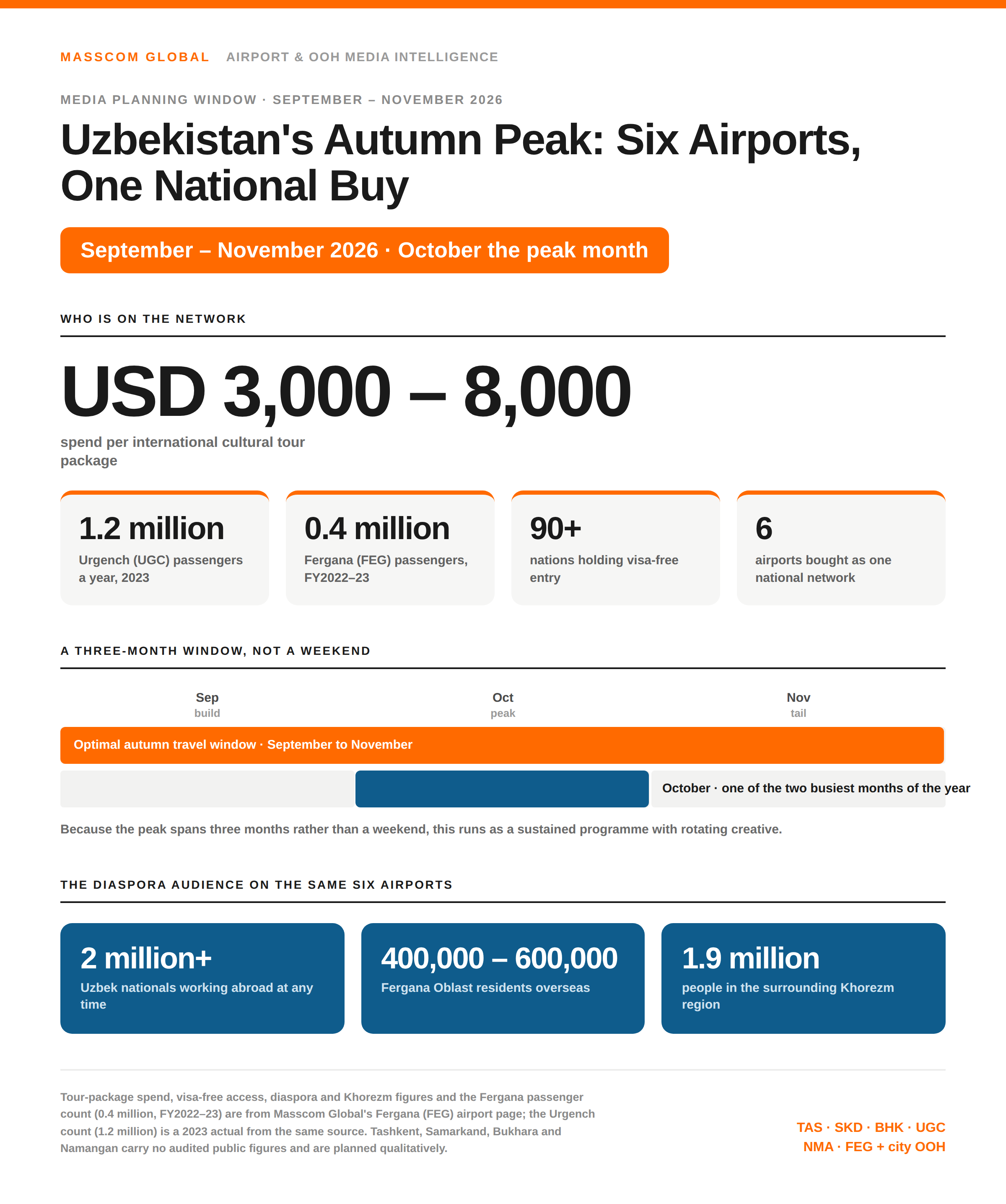
Uzbekistan has two peak travel windows, and the autumn one is the stronger for high-value inbound traffic. The optimal travel period runs September to November, mirroring the March-to-May spring window, and the two busiest months of the year are April and October. The reason is climatic: summers in the Uzbek lowlands exceed 40°C and the autumn shoulder settles into the low-to-mid 20s Celsius: the only conditions in which a full Silk Road itinerary across Samarkand, Bukhara and Khiva is comfortable on foot. In October, the monumental sites of Bukhara, Samarkand and Khiva are at their busiest of the year.
For media planners, that produces something more useful than a festival: a predictable three-month concentration of affluent cultural travellers arriving through a national airport network largely free of the clutter saturating comparable Gulf and European gateways.
Destination Uzbekistan: Full Visitor Journey Coverage
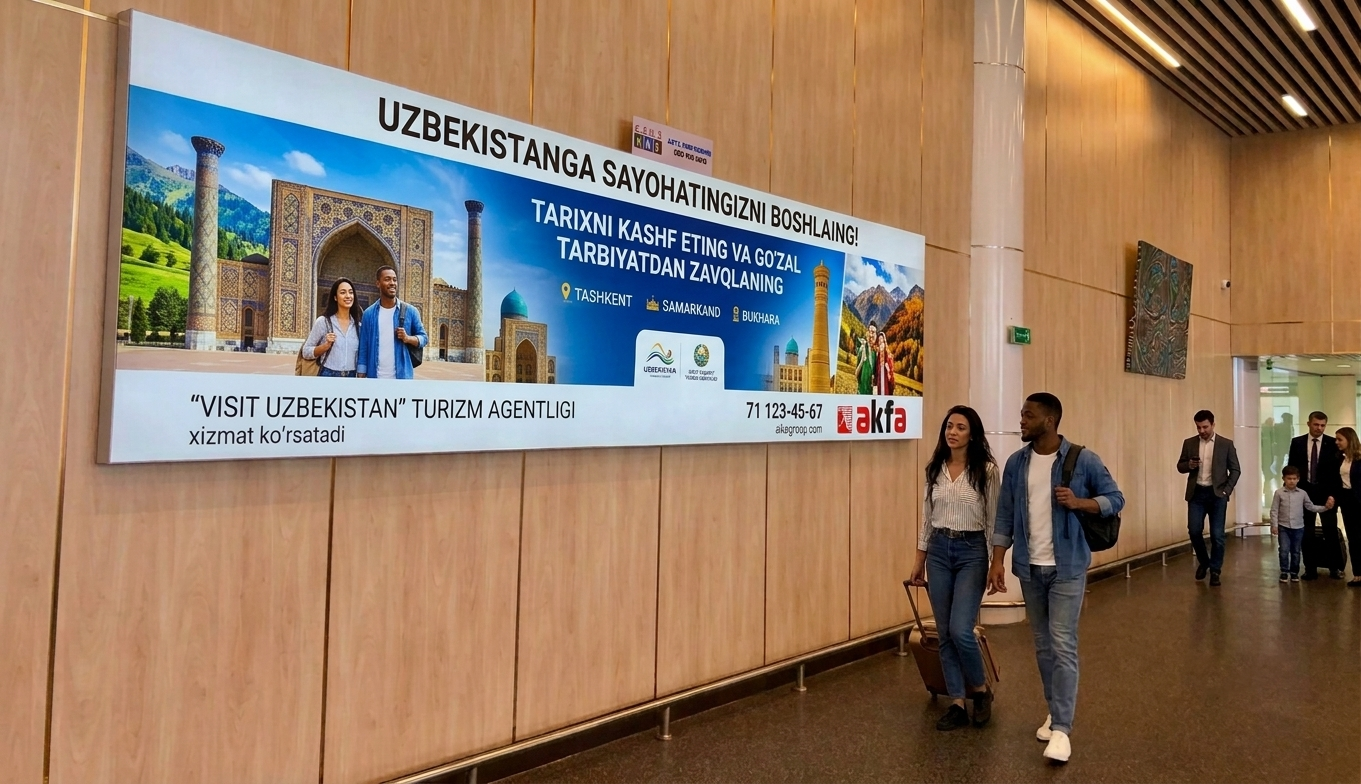
The autumn itinerary is consistent from visitor to visitor, which is what makes a sequenced national buy work. Arrival is at Tashkent or direct into Samarkand; the route runs Samarkand to Bukhara to Khiva by rail and road; departure is from Tashkent, Samarkand or Urgench. The same audience passes the same few airports, station approaches, hotel districts and historic-centre entrances over ten to fourteen days.
An Airport → City → Site sequence therefore delivers genuine frequency: own arrivals at the gateways, sustain presence with OOH and DOOH along the Tashkent city core and the approach corridors into the historic centres of Samarkand and Bukhara, then appear at the transfer and station environments linking them. Because the peak spans three months rather than a weekend, this runs as a sustained programme with rotating creative.
Three effects follow:
- Increased brand recall: repeated exposure at arrival, in the city and near the sites themselves
- Consistent presence: the brand becomes part of the season's visual environment across the whole circuit
- Enhanced campaign effectiveness: a coordinated six-airport network buy outperforms the same budget spent in a single city
Why Advertise During Uzbekistan's Autumn Peak?
The inbound autumn audience is defined by spend rather than volume. International cultural tourists on Uzbekistan tour packages spend USD 3,000 to 8,000 per package: a figure that filters the market toward the affluent segments and toward curated, guided and private itineraries rather than mass leisure. Uzbekistan has opened access to match, with more than 90 nations holding visa-free entry.
A second, distinct audience runs on the same network. More than two million Uzbek nationals are abroad at any given time, principally in Russia, the UAE, Turkey, South Korea and Kazakhstan; in the Fergana Valley alone an estimated 400,000 to 600,000 residents of Fergana Oblast work overseas at any point. That population flies home repeatedly, remits significantly, and makes high-value purchase decisions (property, vehicles, education, financial services) during those visits.
Layered over both is a business and investment audience: Uzbekistan's privatisation and infrastructure programme, its mineral and energy sector, and the institutions financing them. Delegation travel is scheduled in autumn for the same reasons that drive the tourism peak.
Key Benefits of Advertising During Uzbekistan's Autumn Peak
Reach a qualified audience
A USD 3,000 to 8,000 package price is a hard qualifying filter. The October cultural traveller is on a curated itinerary, staying in the better hotels of Samarkand and Bukhara, and buying at the top of the local craft and jewellery trade. Airport media reaches them before the itinerary absorbs them.
Elevate your brand positioning
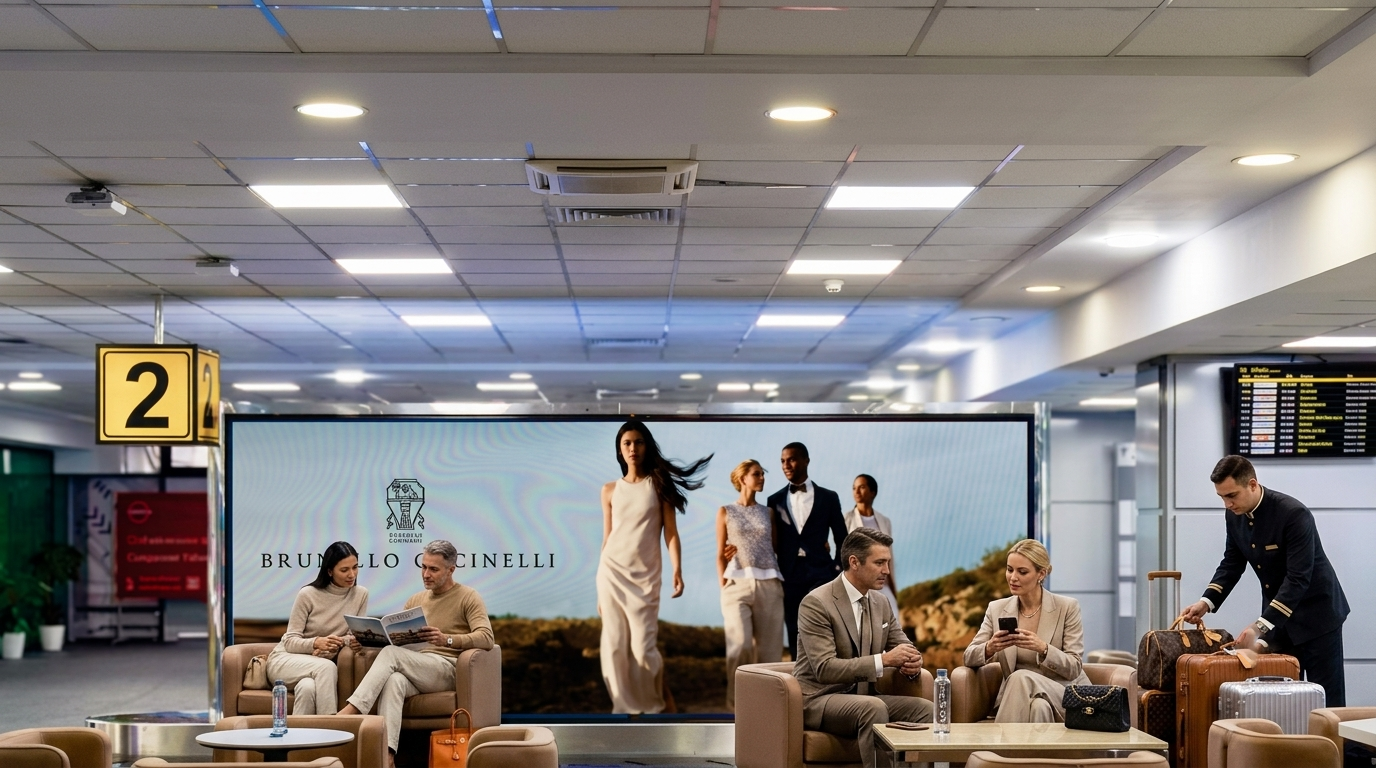
Uzbekistan's airport media carries very low commercial density compared with Gulf or European hubs. A single well-placed execution commands a disproportionate share of attention, and a brand appearing across the whole network reads as an established regional presence.
Generate real business opportunity
The autumn window aligns tourism traffic with delegation and investment travel. Financial services, infrastructure, telecoms and logistics brands reach decision-makers and diaspora remitters through the same inventory in the same weeks.
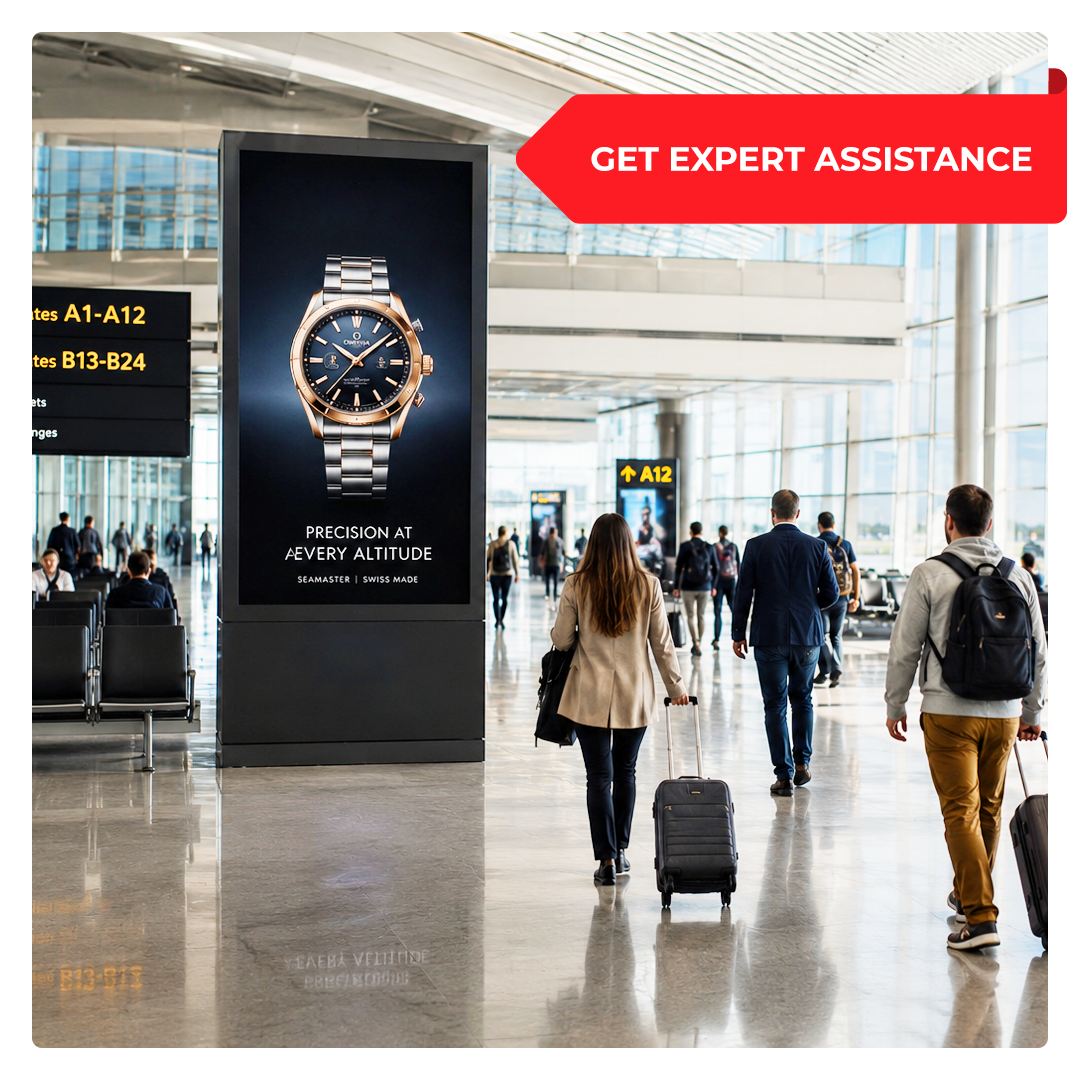
Get Free Expert Assistance from Our Global Media Planning Team
Receive strategic recommendations, media planning support, campaign monitoring and reporting to maximise your visibility throughout Uzbekistan autumn UHNWI peak.
Book Expert ConsultationTashkent International Airport (TAS)
Tashkent is the national gateway and primary long-haul entry point, connecting Uzbekistan to Europe, the Gulf, Russia, Turkey and East Asia, and feeding the domestic network to Samarkand, Bukhara, Urgench, Namangan and Fergana. Almost every autumn itinerary begins or ends here, and delegation travel concentrates in the capital.
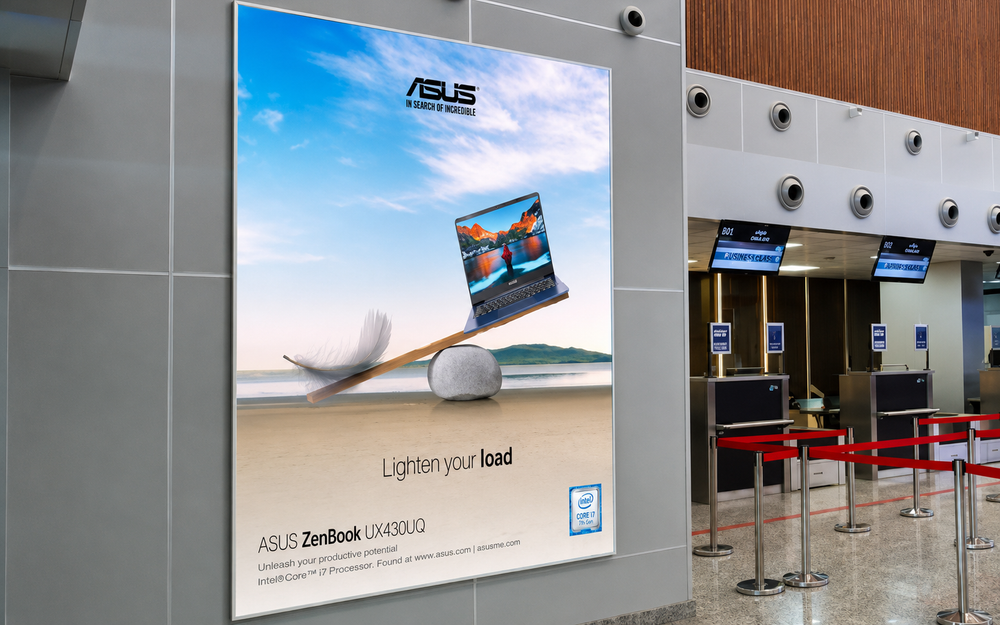
Inventory Highlights
- International arrivals and immigration approach positions: the country's highest-value first-impression environment
- Baggage reclaim and arrivals hall placements with extended captive dwell
- Departure concourse and premium check-in zones reaching outbound business traffic
- Domestic transfer environments capturing onward Samarkand, Bukhara and Urgench connections
Advantages for Advertisers
- National reach from one point: most international arrivals to Uzbekistan pass through Tashkent
- Reaches the capital's business and government audience alongside the cultural-tourism flow
- Ideal anchor for a national buy, with regional airports adding depth at the destination end
 Wealth in motion intelligence.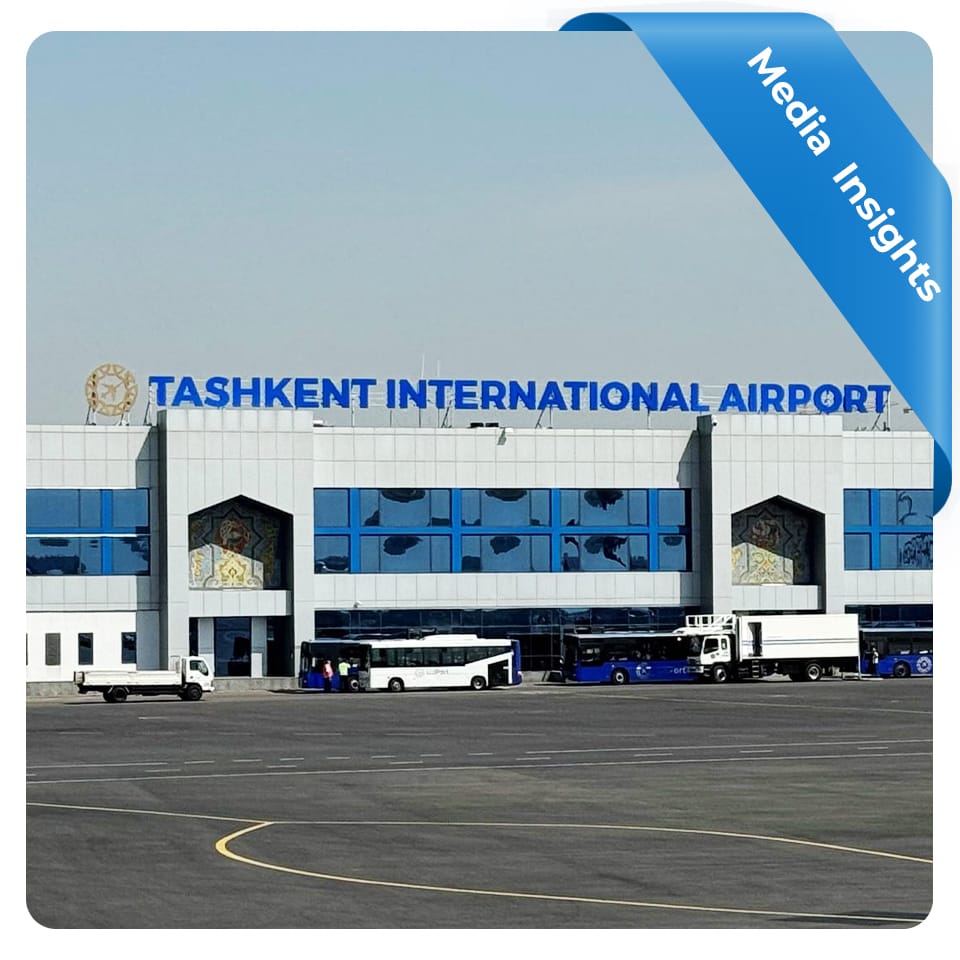
Samarkand International Airport (SKD)
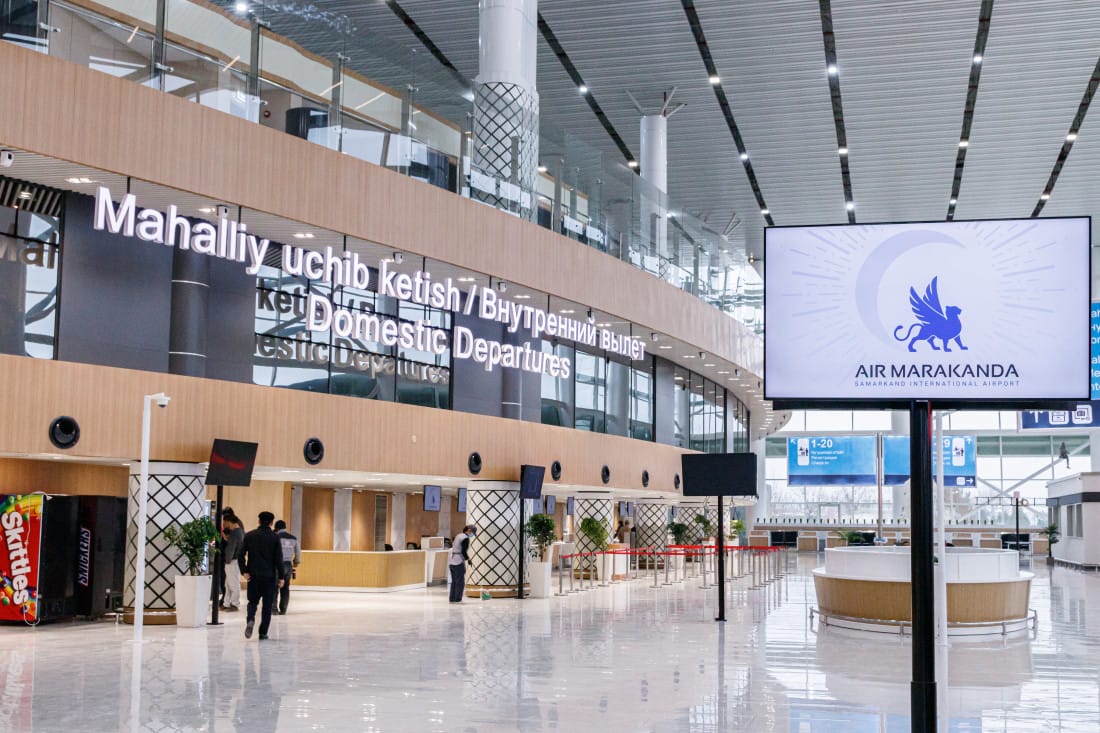
Samarkand is the destination the itinerary is built around. Registan Square, the Gur-e-Amir and Shah-i-Zinda draw the highest concentration of premium cultural visitors in Central Asia, and autumn is when that traffic peaks.
Inventory Highlights
- Arrivals hall and immigration positions reaching visitors arriving directly rather than via Tashkent
- Departure and check-in environments at the end of a multi-day, high-spend itinerary
- Landside placements on the short approach into the historic city
Advantages for Advertisers
- The purest cultural-tourism audience on the network: almost exclusively premium guided itineraries
- High-intent departure-side moment for craft, jewellery, hospitality and luxury-travel messaging
- Direct international services make this a standalone gateway, not only a domestic spur
 Wealth in motion intelligence.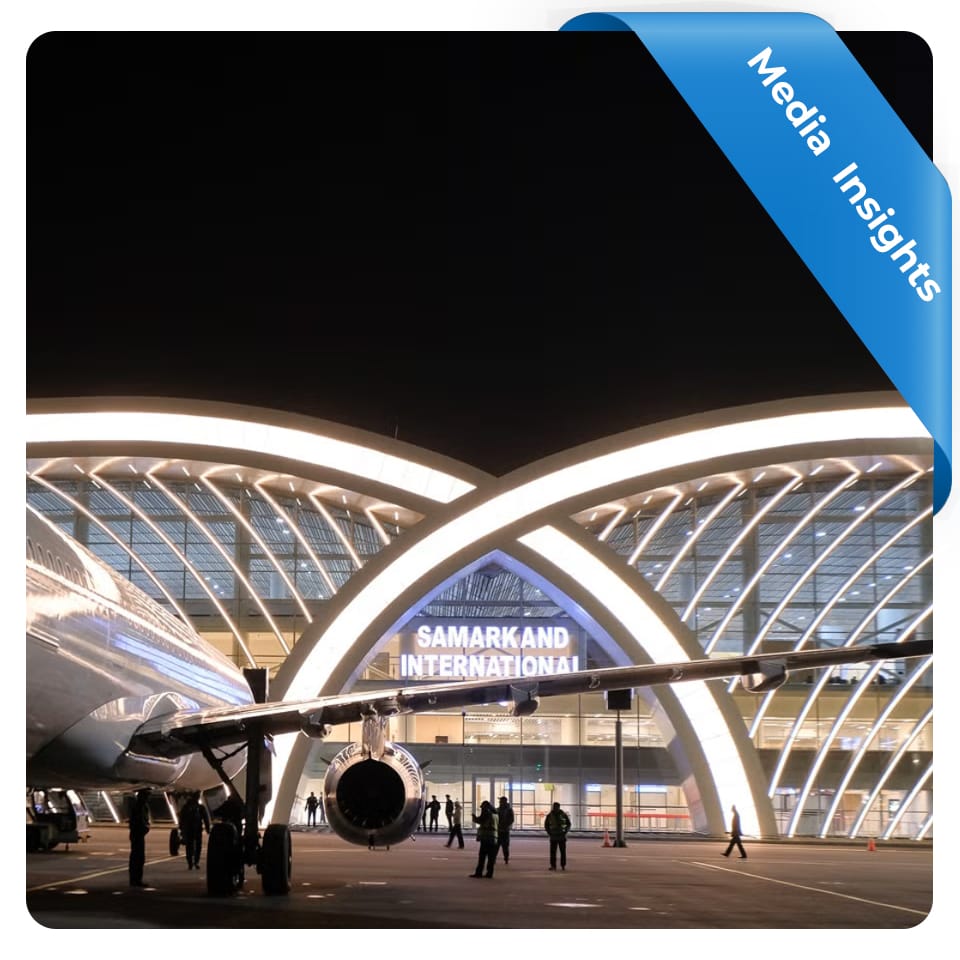
Bukhara International Airport (BHK)
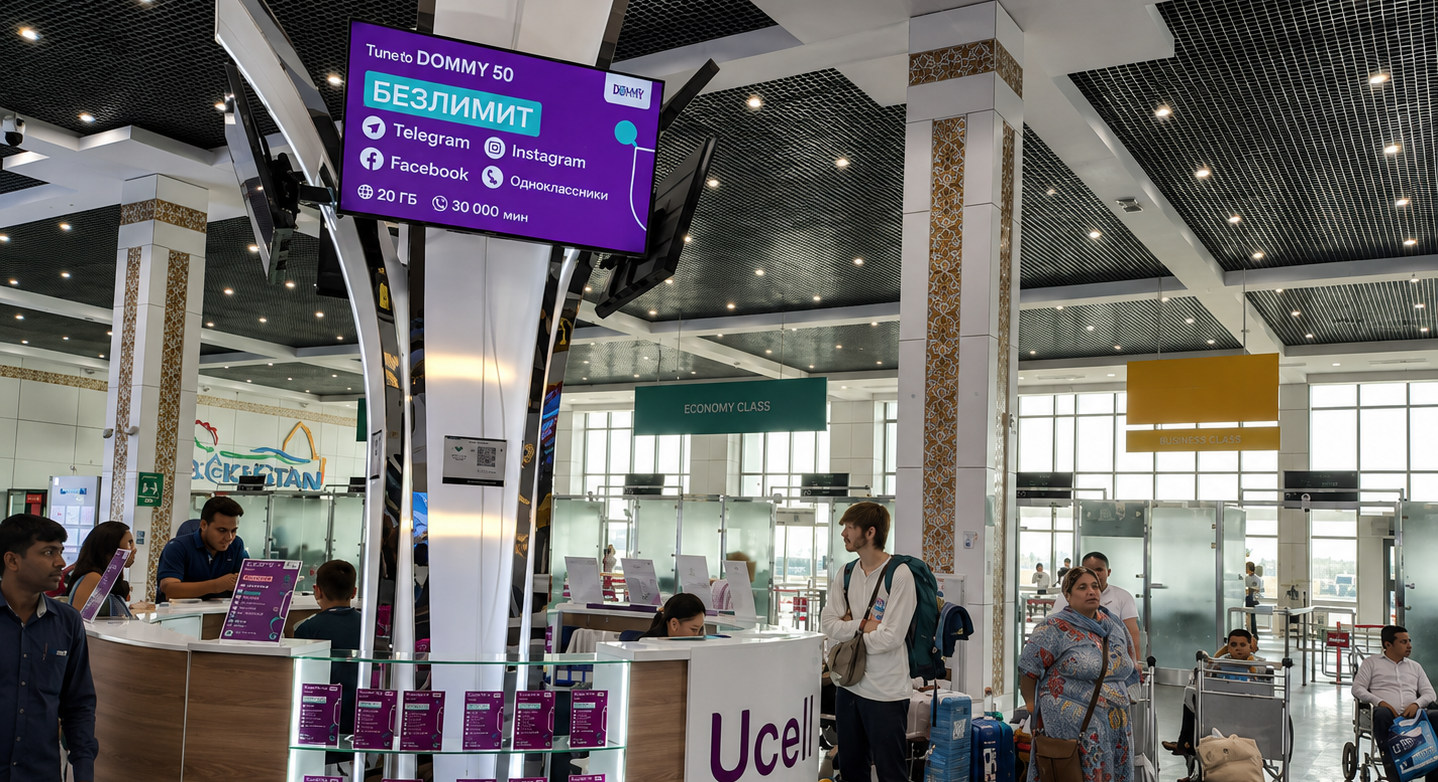
Bukhara is the second pillar of the Silk Road triangle and, with Samarkand and Khiva, one of the three sites busiest in the October peak. Its airport serves a compact historic centre where dwell time runs to days rather than hours.
Inventory Highlights
- Arrivals and departures positions inside a single-terminal environment with a short, controlled path
- Landside placements on the approach to the old city
Advantages for Advertisers
- Very low clutter: a few placements cover almost the whole passenger journey
- Multi-day dwell ahead supports considered messages, not instant-response creative
- Efficient complement to Samarkand for advertisers buying the circuit as a set
 Wealth in motion intelligence.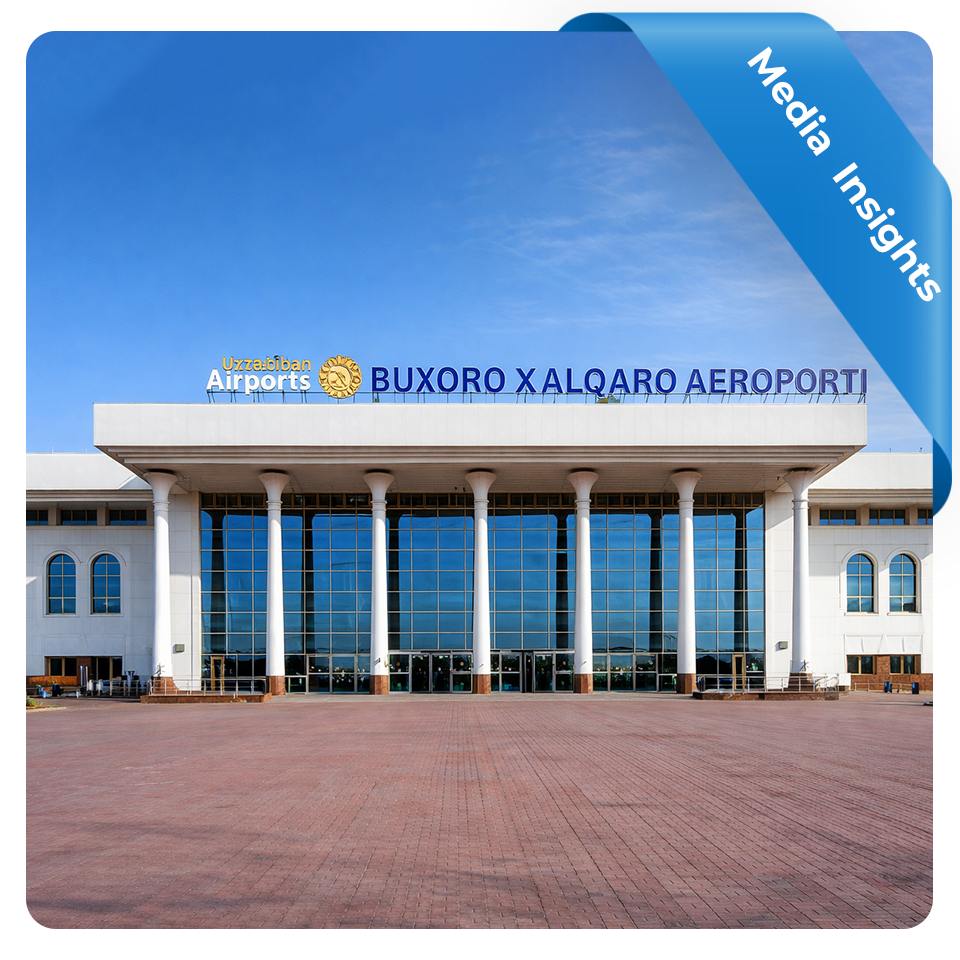
Urgench International Airport (UGC)
Urgench handles approximately 1.2 million passengers annually (2023) from a single terminal, and is the gateway to Khiva, 35 kilometres away: whose Ichan Kala inner city is widely considered the most completely preserved medieval Islamic urban environment on earth. It also serves Khanki (~15 km), Gurlen (~30 km), Hazorasp (~65 km) and Nukus (~120 km). The surrounding Khorezm Region holds approximately 1.9 million people, of whom roughly 95 to 97% are Sunni Hanafi Muslim.
Inventory Highlights
- Arrivals and departures across a single-terminal flow, serving cultural visitors and returning labour migrants
- Landside placements on the Khiva road: the only inbound route
Advantages for Advertisers
- Dual audience in one buy: UNESCO-circuit visitors and a large remittance-driven regional population
- Confirmed scale, 1.2 million annual passengers through one terminal concentrates impressions
- Strong fit for financial services, telecoms, money transfer and halal-certified FMCG in Khorezm
 Wealth in motion intelligence.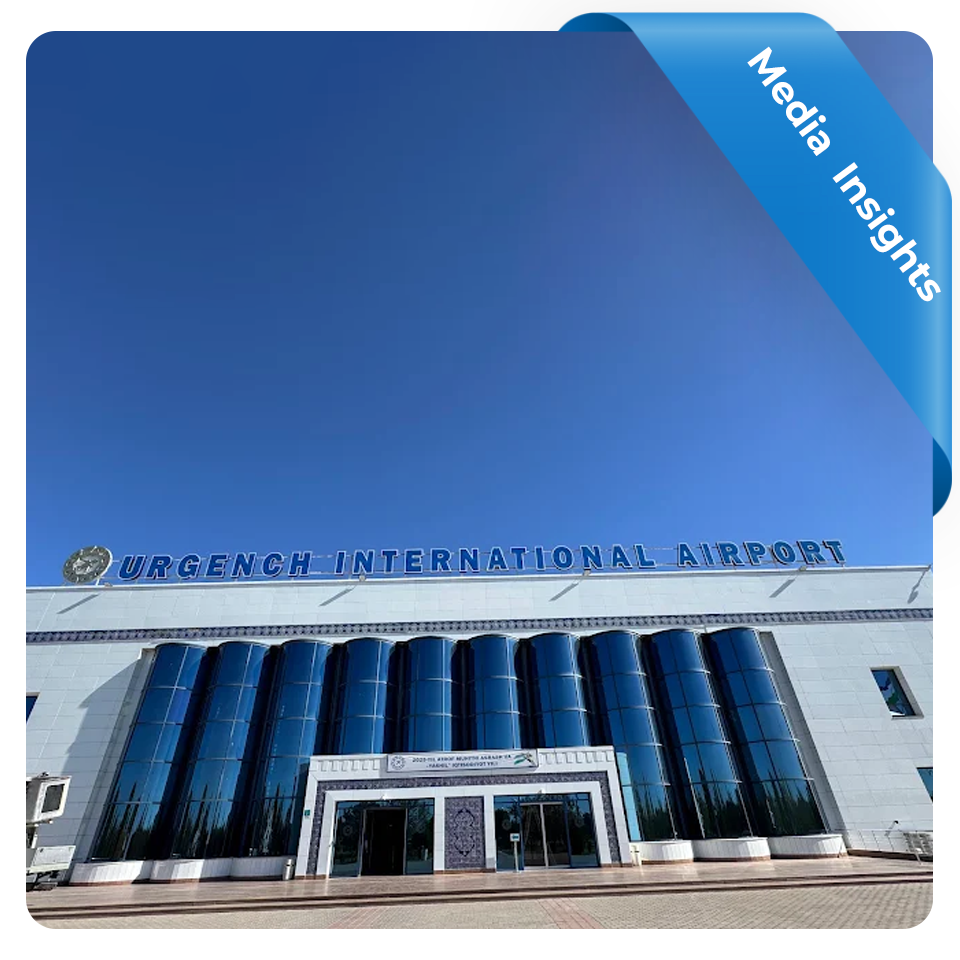
Fergana International Airport (FEG)
Fergana handled 0.4 million passengers in FY2022-23 from one terminal serving domestic and international routes, with services to Moscow, Dubai, Istanbul and Seoul alongside domestic Tashkent and Samarkand connections. It sits at the centre of a densely populated valley with over three millennia of continuous civilisation: Margilan is ~12 km away, Rishtan ~65 km west and Kokand ~80 km west. An estimated 400,000 to 600,000 Fergana Oblast residents work abroad at any given time.
Inventory Highlights
- Arrivals and departures placements across a short, unavoidable single-terminal path
- Positions aligned to the Moscow, Dubai, Istanbul and Seoul diaspora services
Advantages for Advertisers
- The strongest diaspora-remittance audience on the network: high-value purchases are decided on these return visits
- Minimal media competition, so even a modest buy dominates
- Access to the artisanal valley economy (Margilan silk, Rishtan ceramics), relevant to craft and luxury-goods briefs
 Wealth in motion intelligence.
National Network Coverage
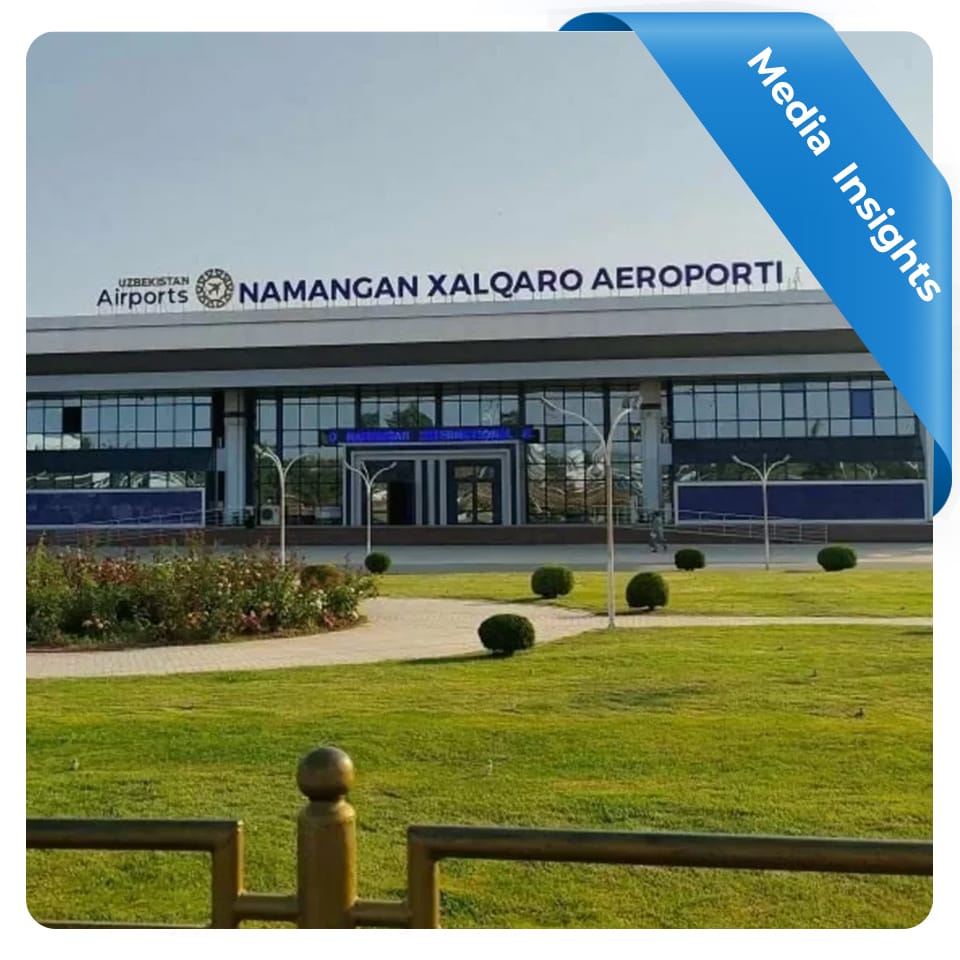
The sixth airport in this network is Namangan Airport, serving the northern Fergana Valley and a further tranche of the same diaspora and domestic-business traffic. Bought as a set, the six (Tashkent, Samarkand, Bukhara, Urgench, Namangan and Fergana) cover the national picture rather than a single city: the long-haul entry point, the two headline cultural destinations, the Khiva gateway and both principal Fergana Valley airports. Audited passenger figures are published for some of these airports and not others; where none exists we plan qualitatively and price against verified availability rather than estimates.
Why Brands Choose Airport & City Advertising for Uzbekistan Autumn
Exclusive audience access. A high-spend cultural-tourism audience and a large remittance-driven diaspora arrive through the same six airports in the same twelve weeks.
A prestigious environment. The Silk Road cities carry an internationally recognised cultural register, and the visitors travelling to see them expect a comparable standard from the brands they meet.
End-to-end campaign support. Masscom Global plans, negotiates and executes across all six airports and Uzbek city inventory from a single brief.
Strategic planning assistance. We advise on airport weighting and phasing: Tashkent for delegation briefs, Samarkand and Bukhara for luxury travel, Fergana and Urgench for diaspora and financial services.
The Masscom Global Standard Behind Every Uzbekistan autumn window Placement
- Verified inventory and audience data: screen counts and terminal data across all six airports, Tashkent, Samarkand, Bukhara, Urgench, Fergana and Namangan, come from live operator data at proposal stage, not published estimates.
- Transparent delivery reporting: campaign monitoring and reporting across the six-airport network and Uzbek city inventory, so you see exactly where your creative ran.
- Benchmarked recommendations: airport weighting, Tashkent for delegation briefs, Samarkand and Bukhara for luxury travel, Fergana and Urgench for diaspora and financial services, set against comparable campaigns across our network.
- We absorb the complexity: one brief covers negotiation, booking and reporting across all six gateways.
Request Your Customised Uzbekistan autumn UHNWI peak Advertising Plan
Tell us your audience, category and budget. Our planners will return a costed plan across airport and prime city inventory, with availability confirmed.
Book NowFrequently Asked Questions
What are the exact dates of Uzbekistan's autumn peak?
There is no single date. The optimal autumn travel window runs September to November, and April and October are the two busiest tourist months of the year. Plan against the window, not a fixed event.
Who travels to Uzbekistan in the autumn?
International cultural travellers on itineraries costing USD 3,000 to 8,000 per package, business and investment delegations, and a large returning diaspora: more than two million Uzbek nationals work abroad at any time.
Can I reach visitors across their whole journey, not just at one airport?
Yes. A six-airport network buy plus city OOH covers Tashkent arrival, the Samarkand and Bukhara approaches, the Khiva road and the Fergana Valley.
How far in advance should an autumn campaign be booked?
October is the peak month and the regional airports carry limited premium inventory, so choice narrows quickly. Confirm availability well ahead of the September opening, particularly for Tashkent arrivals and Samarkand positions.
Which brand categories perform best in this window?
Luxury and cultural travel operators, premium hospitality, airlines, financial services, money transfer and telecoms addressing the diaspora, watches and jewellery, halal-certified FMCG, and infrastructure and industrial B2B brands tracking Uzbekistan's investment programme.
Related Airport Advertising Guides
Detailed inventory, audience and planning notes for the airports covered above:
Wealth in motion intelligence.Wealth in motion intelligence.Wealth in motion intelligence.Wealth in motion intelligence. Wealth in motion intelligence.
 Wealth in motion intelligence.
Uzbekistan autumn window Won't Wait. Neither Should You.
- Fixed peak, narrow window: October is one of the two busiest tourist months of the year, and the regional airports carry limited premium inventory that narrows quickly as the month approaches.
- Competitors are already moving: every week without a plan is a week a travel, hospitality or financial services brand gets closer to locking the same Tashkent arrivals and Samarkand positions.
- The window is exact, not approximate: confirming availability well ahead of the September opening is what keeps Tashkent arrivals and Samarkand positions available at all.
- The alternative can't reach six gateways at once: reaching the same combined cultural traveller and diaspora audience without one network buy would mean negotiating six separate campaigns.
Get Free Expert Assistance Now
Tell us your audience, category and budget, and our planners will return a costed six-airport autumn media plan.
Request Availability
Premium stock across the six airports is limited in the September-to-November window. Ask what is still open.
Uzbekistan's autumn window is three months long, not three days, which is what makes a six-airport national buy worth planning properly: the same affluent cultural travellers and diaspora returners move through Tashkent, Samarkand, Bukhara, Urgench and Fergana in a pattern that repeats all season. Reaching them once at arrival and again along the Samarkand and Bukhara approach corridors builds real frequency rather than a single impression. For travel, hospitality and financial brands, the window closes with November and does not reopen until spring.