

Airport at a Glance
| Field | Detail |
|---|---|
| Airport | Islam Karimov Tashkent International Airport |
| IATA Code | TAS |
| Country | Uzbekistan |
| City | Tashkent |
| Annual Passengers | 8.7 million (2024) |
| Primary Audience | Business travellers, labour diaspora returnees, Silk Road tourists |
| Peak Advertising Season | March to May, September to November |
| Audience Tier | Tier 2 |
| Best Fit Categories | Financial Services, Real Estate, Telecom, Education, Consumer Electronics |
Islam Karimov Tashkent International Airport is the primary and busiest air gateway in Uzbekistan, the most populous country in Central Asia with over 37 million people. In 2024, the airport served 8.7 million passengers, a 28% increase over the prior year, making it the second busiest airport in Central Asia and among the eight busiest in the former Soviet states. For advertisers, this growth curve signals not just volume, but urgency: this is a market in rapid commercial transformation with a captive audience whose travel behaviour is shifting in ways that create new spending windows.
What makes TAS commercially distinctive is the layered nature of its audience. The airport simultaneously handles returning labour migrants with cash in hand, business executives riding Uzbekistan's ongoing economic liberalisation wave, outbound investors moving capital into Dubai and Istanbul, and an inbound tourism segment that treats Tashkent as the central hub for the entire Silk Road circuit. Few airports in the emerging world serve this breadth of commercially motivated passenger types under one roof.
Advertising Value Snapshot
- Passenger scale: 8.7 million in 2024, up 28% year-on-year, on a sustained multi-year growth trajectory
- Traveller type: Labour diaspora returnees with remittance income, SME and corporate business travellers, inbound Silk Road tourists
- Airport classification: Tier 2 — the dominant hub of a 37-million-person nation undergoing rapid economic reform and foreign investment acceleration
- Commercial positioning: Central Asia's principal international transit and connectivity hub, sitting at the intersection of Europe-to-Asia air corridors
- Wealth corridor signal: Tashkent sits on the Shymkent-Tashkent-Khujand economic corridor, one of the region's most commercially active transnational trade routes
- Advertising opportunity: Masscom Global provides advertisers direct access to TAS's diverse, high-intent audience at the precise moment of maximum dwell and receptivity. With 39 airlines, 104 non-stop destinations across 38 countries, and a terminal currently being expanded, the window to secure premium positions at competitive rates before capacity intensifies is open now.
Airport Advertising is Complex to Get Right
We help you execute faster, with proven results and local insight most planners lack starting now.
Talk to an ExpertCatchment Area and Economic Drivers
Top 10 Cities within 150 km — Marketer Intelligence
- Tashkent (city proper): Home to approximately 3 million people and over a quarter of all national retail spending — an urban consumer base with accelerating modern consumption habits and significant appetite for financial services, consumer electronics, and real estate investment products.
- Nurafshon (~20 km north): A fast-growing residential satellite city absorbing Tashkent's urban spillover — a young, aspirational household market with rising incomes and high responsiveness to lifestyle, telecom, and FMCG brands.
- Yangiyul (~25 km south): A textile and food processing hub within the Tashkent SEZ ecosystem, producing a working professional and SME owner audience with access to increasing disposable income through export earnings.
- Chirchiq (~35 km north): An industrial city anchored in chemicals, electronics, and engineering — its workforce population travels regularly through TAS for business and family reasons, presenting a stable, repeat-visit audience for financial and consumer product advertisers.
- Gazalkent (~50 km northeast): The gateway to the Charvak Reservoir and mountain resort belt — a recreation and wellness destination that attracts upper-middle-class Tashkent residents, making it a feeder of premium domestic leisure travellers.
- Olmaliq (~60 km southeast): Uzbekistan's premier mining and metallurgy city, home to copper, gold, zinc, and molybdenum extraction — the executive and engineering class here represents a high-earning, technically literate B2B audience relevant for financial services, automotive, and insurance brands.
- Angren (~90 km southeast): The site of the Angren Free Economic Zone, housing advanced manufacturing projects worth hundreds of millions of dollars — a growing base of industrial investors and foreign business representatives who transit regularly through TAS.
- Bekabad (~100 km southeast): Uzbekistan's steel production centre on the Syrdarya River, generating a concentrated audience of heavy industry managers and trade-linked business travellers with procurement and investment responsibilities.
- Shymkent, Kazakhstan (~120 km north): The third-largest city in Kazakhstan and a key node on the CAREC economic corridor — cross-border trade and business travel between Shymkent and Tashkent creates a binational audience of commercially active decision-makers using TAS as their primary international gateway.
- Khujand, Tajikistan (~120 km east): The second-largest city in Tajikistan and a significant industrial and commercial centre — Khujand-based business and diaspora travellers rely heavily on TAS for access to international routes, adding a cross-border dimension to the airport's catchment value.
NRI and Diaspora Intelligence
Uzbekistan's diaspora is one of the largest in Central Asia, with approximately two million Uzbek citizens working abroad at any given time. Russia hosts the largest share, followed by Kazakhstan, Turkey, South Korea, Germany, and the United Kingdom. In 2024, total remittances to Uzbekistan reached USD 14.8 billion, representing approximately 13% of the country's GDP. These returning workers — seasonal, annual, and permanent returnees — pass through TAS carrying disposable income earned in higher-wage economies. They arrive primed to spend on electronics, home furnishings, vehicles, financial products, and real estate. The diaspora segment is not a passive audience; it is a high-intent buyer at the airport at the precise moment of return.
Economic Importance
Uzbekistan's economy has been in active liberalisation since 2017, with FDI growing by 53.6% in 2024 to reach USD 11.9 billion. The government's ambition to double GDP to USD 200 billion by 2030 is anchored in manufacturing expansion, tourism development, and the rollout of 24 special economic zones across the country. Tashkent city alone accounts for over 27% of national retail spending, and with the Tashkent City Mall opening in 2024 as a 245,000 sqm premium retail hub, the capital's consumption infrastructure is rapidly upgrading. For advertisers, this means a catchment that is spending more, upgrading its lifestyle choices, and increasingly looking outward for investment, education, and residency options.
Business and Industrial Ecosystem
- Mining and metallurgy: Olmaliq, Angren, and Bekabad collectively produce Uzbekistan's most significant industrial output in copper, gold, coal, and steel — generating a senior executive and technical professional audience for B2B advertisers in finance, equipment, and logistics services
- Free economic zones: The Angren SEZ and over 20 active FEZs across Uzbekistan are attracting hundreds of millions in foreign industrial investment, bringing international executives and their domestic counterparts regularly through TAS
- Cotton, textiles, and agri-processing: Yangiyul and the wider Tashkent region host textile manufacturing and food processing operations exporting to Russia, China, and Europe — producing a growing owner-operator class with cross-border trade ties
- IT and services sector: President Mirziyoyev's liberalisation reforms have catalysed a significant uptick in tech startups, consulting firms, and international business services in Tashkent, producing a younger, digitally fluent, higher-income professional segment
Passenger Intent — Business Segment: Business travellers at TAS are a mix of domestic industry leaders, foreign investors conducting due diligence, and procurement executives managing supply chains across the Russia-China-Middle East triangle. They are most receptive to financial services, telecommunications, B2B software, automotive, and premium consumer brands. The Istanbul and Dubai corridors in particular carry senior decision-makers who are simultaneously managing business and personal investment activities.
Strategic Insight: The business audience at TAS is commercially valuable precisely because Uzbekistan is at an inflection point. Its economy is opening, its capital markets are deepening, and its connectivity to global financial centres is expanding rapidly. Advertisers reaching business travellers at this airport are speaking to people who are actively allocating capital, forming partnerships, and making purchasing decisions of significant scale. This is not a mature, saturated market — it is an emerging wealth corridor with first-mover advertising value still intact.
Tourism and Premium Travel Drivers
- Silk Road circuit gateway: Tashkent functions as the universal entry and exit point for all Uzbekistan tourism, with travellers then dispersing to Samarkand, Bukhara, and Khiva — seven UNESCO World Heritage Sites across these destinations create a high-value inbound tourism flow that was growing toward seven million annual visitors by 2023
- Charvak Reservoir and Chimgan mountains: Located within 80 km of the airport, this mountain and alpine resort zone attracts regional leisure travellers from across Central Asia and Russia, particularly during summer and winter seasons
- New Tashkent development zone: A government-led 20,000-hectare capital expansion project is underway immediately east of the city, including a USD 250 million integrated resort and water park planned to open in 2027 — this is already attracting international hospitality, retail, and entertainment investment into the Tashkent market
- Tashkent City Mall and urban premium retail: The 2024 launch of Central Asia's most modern mall, directly connected to the metro system and featuring luxury automotive displays, signals Tashkent's repositioning as a premium consumption destination for the regional middle and upper class
Passenger Intent — Tourism Segment: Inbound tourists entering through TAS have already committed to significant pre-trip expenditure on packages, accommodation, and guided tours of the Silk Road circuit. At the airport, they are primed for last-mile purchases — currency exchange services, travel insurance, luxury goods, and international real estate marketing that positions Uzbekistan as an investable market. South Korean, Turkish, Chinese, and European visitors form the premium leisure segment, while CIS diaspora visitors represent the highest-volume inbound flow. Both groups respond to clear, visually striking advertising in well-positioned terminal environments.
Travel Patterns and Seasonality
Peak seasons:
- Spring (March to May): The most popular travel window in the region — mild temperatures, Navruz (spring equinox festival) in late March, and the start of the inbound tourism season coincide to produce the airport's highest sustained traffic volumes
- Autumn (September to November): A second peak driven by post-summer business travel recovery, the Tashkent International Tourism Fair in November, and diaspora returns ahead of winter
- Summer (June to August): High outbound leisure travel to Turkey, UAE, and resort destinations, plus strong inbound Silk Road tourism from Europe, Korea, and Japan
- Winter (December to January): Holiday diaspora travel peak, with significant remittance-carrying returnees from Russia and Kazakhstan
Event-Driven Movement
- Navruz / Nowruz (March 21): The Persian and Turkic new year is a national public holiday across Uzbekistan and the entire Central Asian and broader Islamic cultural sphere — it generates a multi-day travel surge as families reunite and diaspora workers return, creating a high-volume, emotionally charged spending window receptive to gifting, jewellery, apparel, and FMCG brands
- Tashkent International Tourism Fair (November): An UNWTO-supported annual trade event drawing tourism industry professionals from dozens of countries — the airport experiences a concentrated inflow of international business and hospitality sector delegates in this window
- Eid al-Fitr / Eid al-Adha (variable): Both major Islamic celebrations produce significant family reunification travel, outbound pilgrimage movement toward Saudi Arabia and the Gulf, and high consumer spending in the days immediately surrounding each festival
- Korean National Holidays (May, October): South Korea has become Uzbekistan's most significant non-CIS tourism and labour migration partner, and Korean national holiday windows drive measurable traffic spikes on the TAS-ICN corridor
- Russian New Year (January 1 to January 10): Russia's extended public holiday generates the single largest return migration wave of the calendar year, with hundreds of thousands of Uzbek workers returning through TAS carrying earned income
It’s Not Just Where You Advertise - It’s How Fast You Execute
We combine local insight with fast rollout to deliver results for you, now.
Talk to an ExpertAudience and Cultural Intelligence
Top 2 Languages
- Uzbek: The official state language and mother tongue of the dominant ethnic majority — brand communications in Uzbek carry credibility and cultural respect signals that significantly increase receptivity, particularly among domestic travellers and diaspora returnees who identify strongly with national identity post-independence
- Russian: Remains the dominant language of inter-ethnic communication, commerce, and professional discourse in Tashkent, widely used in business, government, and media — essential for reaching the educated professional class, returnees from Russia, and the cross-CIS business travel segment that transits heavily through TAS
Major Traveller Nationalities
The dominant passenger nationality at TAS is Uzbek — domestic travellers, outbound workers, and diaspora returnees who collectively drive the majority of traffic volume. Russian nationals represent the most significant inbound foreign nationality, travelling for business, investment, and cultural ties. Turkish nationals are a growing segment, reflecting deepening economic and educational linkages. South Korean visitors are the leading non-CIS foreign tourism segment, with South Korea also being Uzbekistan's third-largest remittance source country. Chinese business travellers are an increasing presence on expanding bilateral trade routes, while European leisure tourists arrive primarily on the Istanbul and Frankfurt connection corridors.
Religion — Advertiser Intelligence
- Islam, Sunni (approximately 93%): The dominant faith with a culturally rich calendar of observance — Ramadan, Eid al-Fitr, Eid al-Adha, and Navruz create clearly defined, high-spending consumer windows. During Ramadan, outbound travel to Mecca and Medina generates strong pilgrimage-related purchasing behaviour, while Eid windows drive gifting, apparel, jewellery, and food spending at elevated levels. Halal travel services, Islamic financial products, and Gulf real estate advertisers all find a directly responsive audience here
- Russian Orthodox Christianity (approximately 4%): Concentrated among the ethnic Russian and Slavic population in Tashkent, this community drives Christmas and Easter travel windows and represents a significant portion of the professional-class audience using TAS for European business routes
- Small Jewish community: Historically present in Tashkent's Bukharian Jewish community — now largely migrated to Israel and the United States — but generating meaningful traffic on the TAS-TLV corridor through visiting diaspora and family connections
Behavioral Insight: The Tashkent traveller is a pragmatic, value-conscious decision-maker who combines strong family loyalty with an increasingly aspirational economic mindset. The liberalisation of Uzbekistan's economy since 2017 has created a new generation of entrepreneurs and professionals who are simultaneously managing domestic ambitions and international opportunity. They respond most powerfully to advertising that speaks to security, family advancement, investment returns, and access to global standards — not luxury for its own sake, but demonstrable value at the premium end of their emerging range.
Outbound Wealth and Investment Intelligence
The outbound passenger at TAS is undergoing a fundamental shift in profile. As Uzbekistan's economic liberalisation matures and a new class of business owners, executives, and investment-minded professionals emerges, the outbound audience increasingly includes people who are not just travelling for work or family — they are moving capital, exploring residency options, and investing in their children's international futures. Remittance flows of USD 14.8 billion in 2024 are the headline figure, but behind that volume lies a growing upper segment deploying earnings into real assets abroad.
Outbound Real Estate Investment: Dubai is the primary international real estate destination for Uzbekistan's HNI audience, driven by direct daily flights, UAE Golden Visa eligibility on property purchases above AED 2 million, zero capital gains and income tax, and the presence of a well-established Uzbek business community in the Emirates. Istanbul is the second key market, with direct multi-daily flight connectivity and a Turkish citizenship-by-investment programme available from USD 400,000 in qualifying real estate. Both markets offer the combination of lifestyle access, residency rights, and yield potential that Uzbekistan's emerging wealthy class is actively seeking. International developers marketing in both corridors have a direct and receptive audience at TAS.
Outbound Education Investment: South Korea, Germany, the United Kingdom, and Turkey are the primary higher education destinations for Uzbek students, supported by active bilateral government agreements on academic exchange and labour integration. South Korea's quota of 37,000 annual Uzbek workers and the Uzbek diaspora of nearly 90,000 in-country have made Korean university pathways a realistic and aspirational option for upwardly mobile Uzbek families. UK universities attract the highest-earning professional class, with family remittances from the UK growing 49% in one year. International universities and education consultancies marketing at TAS are reaching families who have already demonstrated the financial capacity and intent to invest substantially in overseas education.
Outbound Wealth Migration and Residency: UAE Golden Visa programmes are the primary residency pathway for Uzbekistan's top-tier investors. Turkey's citizenship-by-investment scheme is the most accessible European-adjacent option, and the Turkish passport's access to 110-plus countries makes it commercially appealing to Uzbek businesspeople who travel extensively. Germany's labour migration agreement with Uzbekistan is generating growing interest among the skilled professional class in Tashkent, with the UK and Poland adding to the European residency migration pipeline. Second-passport and residency advisory firms marketing at TAS are addressing a growing and financially capable audience.
Strategic Implication for Advertisers: TAS sits at the intersection of two powerful wealth flows: outbound Uzbek capital moving toward Dubai, Istanbul, Seoul, and European cities, and inbound remittances and foreign investment returning to Uzbekistan's fast-growing domestic economy. International brands operating on both sides of this corridor — real estate developers, financial institutions, education providers, and residency advisors — should treat TAS as a two-directional investment. Masscom Global is positioned to activate campaigns on both sides simultaneously, reaching the right audience at the right moment of financial decision-making.
Airport Infrastructure and Premium Indicators
Terminals:
- Terminal 2 (International): The primary international terminal, rebuilt in 2001 and renovated in 2018, with a capacity of 1,000 passengers per hour. It handles all international departures and arrivals, with waiting lounges, duty-free retail, currency exchange, CIP and VIP halls, cafes, and restaurants. Advertising in Terminal 2 directly reaches the international business and outbound leisure traveller at peak dwell periods.
- Terminal 3 (Domestic): The domestic terminal serving all regional Uzbekistan cities including Samarkand, Bukhara, Khiva, Fergana, and Namangan, with a capacity of 400 passengers per hour. It is the primary feed point for Silk Road inbound tourism redistribution, making it commercially valuable for hospitality, tour operators, and domestic consumer brands.
- Terminal merger: A planned project to merge Terminals 2 and 3 into a unified complex capable of handling 2,400 passengers per hour is underway, with construction advancing through 2025 and 2026. This unified complex will significantly elevate the airport's capacity, passenger experience quality, and advertising environment value.
Premium Indicators:
- CIP and VIP halls within the international terminal signal a segment of high-spending business travellers and government-linked executives for whom premium product advertising is directly relevant
- The airport-adjacent hotel inventory includes the Courtyard by Marriott Tashkent, and the 24-room on-airport hotel opened in 2024, with premium accommodation demand across the city supplied by InterContinental, Hilton, and Radisson brands
- TAS's two long-runway configuration (4,000m and 3,905m) enables wide-body operations including Boeing 787 and Airbus A380 aircraft, supporting both high-volume charter flows and premium long-haul connectivity
- Biometric passenger monitoring (Pax Track system deployed in 2024) and energy-efficient terminal upgrades signal sustained operational investment and a commitment to international airport standards
Forward-Looking Signal: New Tashkent — a 20,000-hectare capital expansion project immediately east of the city — is drawing international investment at a pace that will fundamentally change Tashkent's global commercial profile over the next five years. A USD 250 million integrated resort and water park anchored by a Silk Road heritage theme is scheduled to open in 2027, designed by a Hollywood-based destination firm. The terminal merger, new route openings, and the broader economic reform programme are converging to make this airport a significantly more competitive advertising environment within 24 to 36 months. Masscom Global advises clients to act now, while inventory access and rates reflect the current market, not the emerging one.
Airline and Route Intelligence
Top Airlines: Uzbekistan Airways (national carrier and dominant operator), Turkish Airlines, Centrum Air, Qanot Sharq, flydubai, Qatar Airways, Air Astana, Aeroflot, IndiGo, AirAsia X, Batik Air Malaysia, LOT Polish Airlines, Etihad Airways, Asiana Airlines, China Southern, China Eastern, Belavia, S7 Airlines, AZAL, Oman Air, and 19 additional carriers — 39 airlines in total operating approximately 120 daily departures across 104 non-stop destinations in 38 countries.
Key International Routes: Istanbul (multiple daily, 4 operators), Dubai (daily, multiple operators), Moscow (daily, multiple operators), New Delhi (daily, multiple operators), Doha (daily), Seoul (regular), Beijing (seasonal and year-round), Frankfurt (regular), London (regular via Uzbekistan Airways), New York JFK (direct, Uzbekistan Airways), Warsaw, Baku, Almaty, Bishkek, Dushanbe, Kuala Lumpur, Bangkok, Phuket, and 25 Russian city destinations.
Domestic Connectivity: Samarkand, Bukhara, Namangan, Fergana, Andijan, Urgench (Khiva gateway), Nukus, Termez, and all major Uzbekistan regional centres served regularly by Uzbekistan Airways and domestic carriers — positioning TAS as the national aviation hub that all premium domestic travellers pass through.
Wealth Corridor Signal: The Istanbul and Dubai corridors are the clearest wealth transfer signals at TAS — both routes carry outbound Uzbek investors, property buyers, and residency seekers alongside inbound business and investment visitors. The Moscow route, while carrying a significant volume of labour migrants, also includes returning diaspora with remittance income primed for domestic spending. The Seoul route represents the knowledge economy corridor, carrying students, skilled workers, and Korean investors in Uzbek industry. The Frankfurt and London routes carry the highest-income professional and executive segment, including Uzbekistan's new class of internationally educated entrepreneurs.
Media Environment at the Airport
- Terminal 2's international passenger flow of over two million per year through a single terminal creates concentrated brand exposure in a lower-clutter environment than comparable hub airports — a premium advertising position relative to cost
- Dwell time in the international terminal is elevated by lengthy check-in procedures, security processing, and currency exchange activity common to emerging market airports — passengers spend 60 to 90 minutes in the terminal prior to boarding, creating extended brand exposure windows that outperform equivalent OOH formats in urban environments
- The CIP and VIP hall infrastructure, combined with the premium nationality mix on Gulf and European routes, means a portion of every campaign reaches a high-net-worth segment without the need for separate premium placement
- Masscom Global brings established relationships, strategic placement expertise, and full-service campaign execution to TAS, ensuring brands access the most impactful positions in both the international and domestic terminals with the shortest possible lead times
Strategic Advertising Fit
Best Fit:
- Financial Services and Banking: A digitally active, remittance-receiving, outbound-investing population that is actively managing cross-border money and looking for better financial products — consumer banking, digital wallets, money transfer services, and investment platforms all find a primary audience here
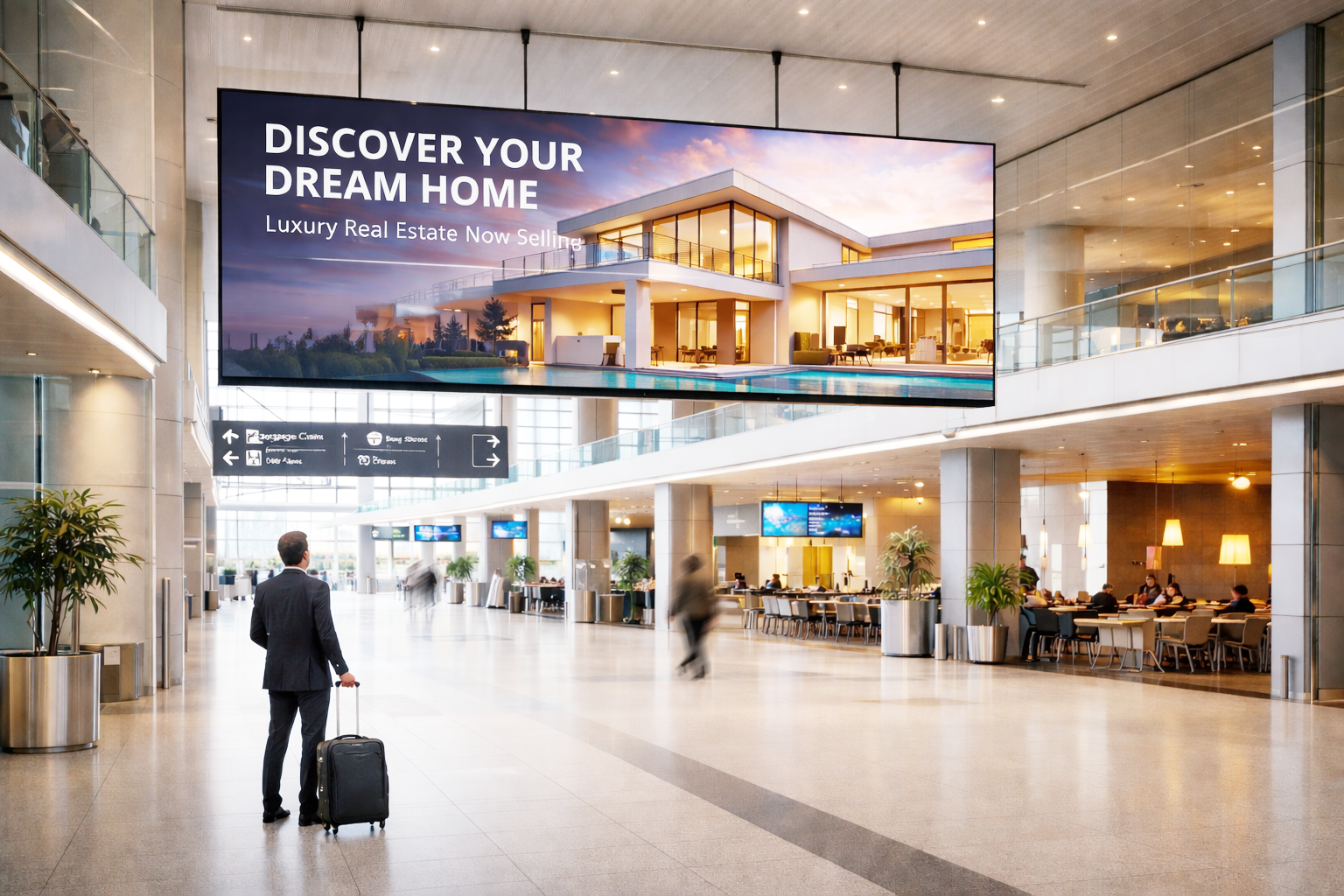
- International Real Estate (Dubai and Istanbul focus): The outbound HNI and aspiring investor segment on TAS is actively buying in Dubai and Istanbul — property developers from both markets have a direct, intent-ready audience transiting through this airport daily
- Education and International Universities: Families investing in Korean, German, UK, and Turkish higher education are making high-value decisions — education consultancies and international universities advertising here reach decision-makers at the start of their pathway
- Telecommunications: Uzbekistan's rapidly digitising economy and mobile-first population make telecom and data service brands immediately relevant to both domestic travellers and returning diaspora looking to reconnect
- Consumer Electronics: Returning diaspora workers with earned income, combined with a young urban professional class upgrading devices, make electronics brands highly relevant at TAS
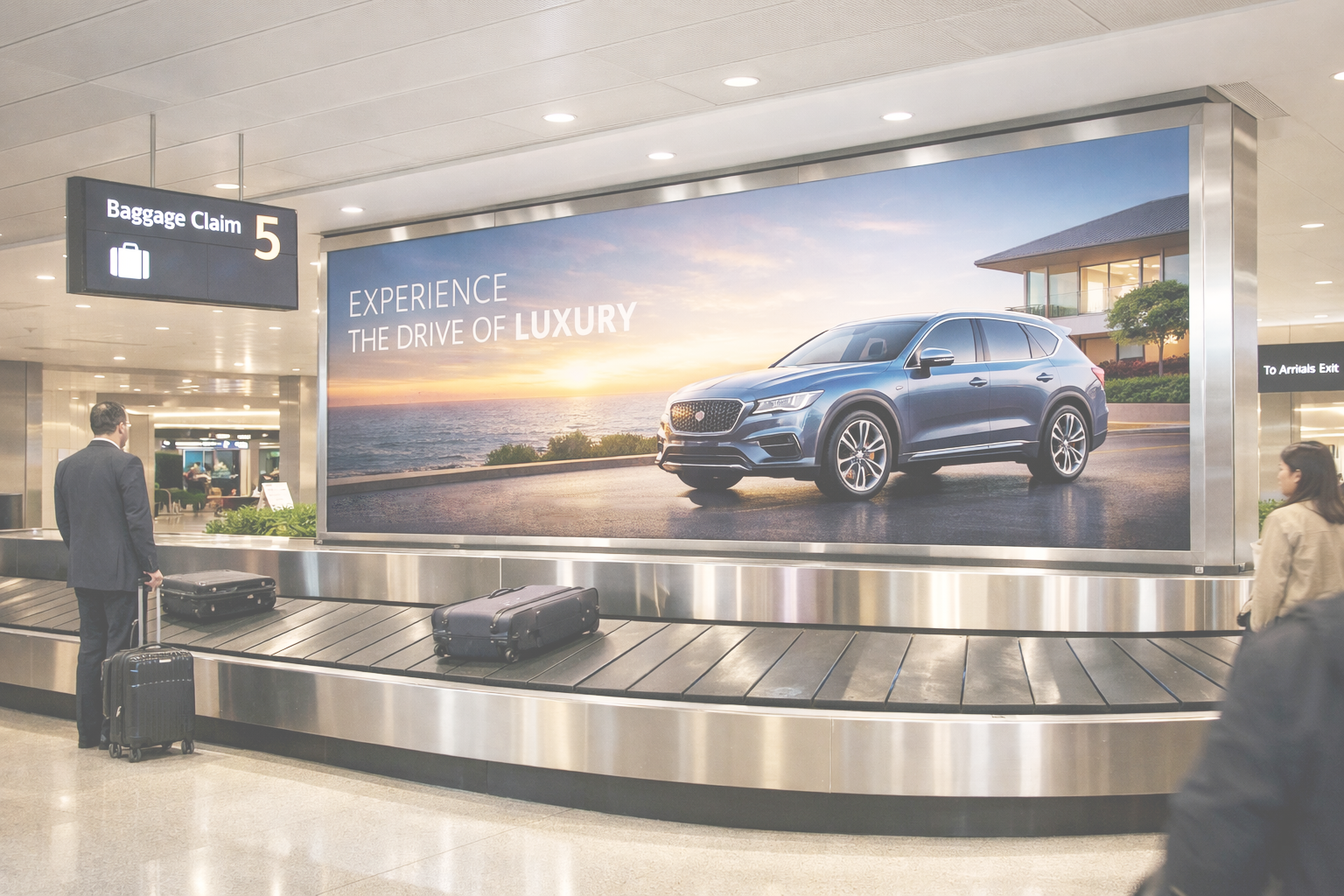
- Automotive: Uzbekistan's growing middle class and improving road infrastructure have made vehicle ownership an aspirational and achievable goal — automotive brands reaching TAS's business traveller and domestic premium audience find genuine purchase intent
- Luxury and Premium FMCG: The Gulf and European route travellers represent a genuinely premium consumer segment for fragrances, watches, fashion accessories, and premium food and beverage brands
- Travel Insurance and Assistance Services: A travelling population with significant cross-border movement and growing awareness of travel risks represents a strong market for travel protection products
Brand Alignment at a Glance:
| Category | Fit |
|---|---|
| Financial Services | Exceptional |
| International Real Estate | Exceptional |
| Education and Universities | Exceptional |
| Telecommunications | Strong |
| Consumer Electronics | Strong |
| Automotive | Strong |
| Luxury FMCG | Moderate |
| Mass Market FMCG | Poor fit |
Who Should Not Advertise Here:
- Ultra-luxury fashion and jewellery brands (Tier 1 flagship): While a premium segment exists at TAS, the airport's audience profile is not yet at the luxury spending threshold that justifies flagship luxury brand investment — a more appropriate entry point than a primary market
- Hyper-local domestic consumer brands with no cross-border relevance: Brands with no Uzbekistan market presence or regional export strategy will not find the audience conversion they need at this airport
- Premium cruise and high-end experiential travel brands: The catchment's outbound travel behaviour is principally driven by work, family, and investment — not aspirational leisure travel at the luxury tier that these brands require
Event and Seasonality Analysis
- Event Strength: High
- Seasonality Strength: High
- Traffic Pattern: Dual-Peak
Strategic Implication: Advertisers at TAS should structure campaigns around the two primary travel peaks — spring (March to May) anchored by Navruz and inbound tourism season, and autumn (September to November) anchored by business travel recovery and the tourism fair. The Eid windows, which shift annually across the calendar, require advance planning and flexible creative deployment. Masscom Global structures campaigns around this rhythm, ensuring creative goes live in the highest-traffic windows and that budget is concentrated in the periods where cost-per-impression and cost-per-engagement deliver maximum return. Brands entering TAS ahead of the spring Navruz peak, in particular, benefit from the highest emotional spending intensity of the Uzbek calendar year.

Poor Placement and Delays Affect Airport Campaigns
We help you move faster, access better inventory, and get it right now.
Talk to an ExpertFinal Strategic Verdict
Islam Karimov Tashkent International Airport is a commercially underrated asset in global airport advertising. It carries 8.7 million passengers a year through a single primary international terminal — a growth rate of 28% year-on-year — representing a nation of 37 million people at the sharpest economic inflection point in its post-independence history. The audience is simultaneously a mass-volume labour diaspora with disposable remittance income, a growing entrepreneurial class actively deploying capital into Dubai and Istanbul, a family-oriented market with strong education investment intent, and a gateway for Silk Road tourism receiving visitors from South Korea, Europe, and across Asia. No other airport in Central Asia combines this breadth of commercially motivated passenger types at this growth rate and this stage of market development. For financial services brands, international real estate developers, education institutions, and telecommunications providers, TAS offers the rare combination of a high-intent audience and a relatively uncontested advertising environment. Partnering with Masscom Global means accessing that environment with the intelligence, relationships, and execution speed to convert opportunity into results — before the market catches up.
About Masscom Global
Masscom Global is a premium international airport advertising and media buying agency operating across 140 countries. With deep expertise in airport OOH, premium publications, and high-net-worth audience targeting, Masscom helps brands reach the world's most valuable travellers at the moments that matter most. For advertising packages, media rates, and campaign planning at Islam Karimov Tashkent International Airport and airports across the globe, contact Masscom Global today.
Frequently Asked Questions
How much does airport advertising cost at Islam Karimov Tashkent International Airport? Advertising costs at TAS vary based on format type, placement zone (international versus domestic terminal), campaign duration, and seasonal demand periods. Navruz, Eid, and the autumn travel peak command premium rates due to concentrated audience volume. Masscom Global provides current rate cards, format recommendations, and full campaign costings tailored to your budget and objectives. Contact us directly for a detailed proposal.
Who are the passengers at Islam Karimov Tashkent International Airport? TAS serves a genuinely diverse passenger mix: Uzbek labour diaspora returning from Russia, Kazakhstan, Turkey, South Korea, and Western Europe with earned income; domestic business executives and SME owners managing cross-border trade on Gulf and European routes; inbound Silk Road tourists from Korea, China, Turkey, and Europe; foreign investors and executives visiting Uzbekistan as part of the country's FDI acceleration; and outbound Uzbek HNI investors deploying capital in Dubai and Istanbul property markets.
Is Islam Karimov Tashkent International Airport good for luxury brand advertising? TAS is appropriate for accessible premium and aspirational luxury brands rather than ultra-luxury flagship campaigns. The airport's CIP and VIP hall infrastructure, its connectivity to Dubai, Istanbul, and European capitals, and its growing HNI investor segment all support premium brand advertising. Fragrances, watches, premium automotive, financial services, and lifestyle brands find a genuine and growing audience here. Truly ultra-luxury labels requiring a consistent ultra-high-net-worth audience may find COK, DXB, or IST more immediately aligned.
What is the best airport in Central Asia to reach HNWI audiences? For pure HNWI concentration, Almaty (ALA) in Kazakhstan has historically held a slight edge due to Kazakhstan's higher per-capita income. However, Tashkent TAS is the faster-growing market and the larger population gateway — with 37 million Uzbeks and an economy expanding at pace, the emerging HNI class transiting TAS is both larger and more commercially accessible than at any previous point. For brands that want volume alongside wealth intent, TAS is currently the most compelling Central Asian buy.
What is the best time to advertise at Islam Karimov Tashkent International Airport? The two highest-impact windows are the Navruz spring peak (mid-March through April) and the autumn travel and business recovery window (September through November). Eid al-Fitr, which shifts annually, reliably produces a concentrated high-spending travel window of three to five days. January, coinciding with Russian New Year diaspora returns, is a secondary but commercially potent window for financial services and consumer product brands. Masscom Global recommends year-round presence with budget concentration in these key periods.
Can international real estate developers advertise at Islam Karimov Tashkent International Airport? Yes — and this is one of the highest-priority use cases at TAS. Uzbekistan's outbound investor class is actively purchasing property in Dubai, Istanbul, and several European markets. Direct flight connectivity to Dubai, Abu Dhabi, Doha, and Istanbul means the real estate purchase journey passes through TAS on both the outbound and inbound leg. Developers from the UAE and Turkey in particular find a pre-qualified, financially capable, investment-intent audience at this airport. Masscom Global can structure campaigns to reach this segment at the exact moments of departure and return, when purchase motivation is highest.
Which brands should not advertise at Islam Karimov Tashkent International Airport? Flagship ultra-luxury fashion houses requiring consistent ultra-HNWI volume will find TAS an early-stage rather than primary market. Mass-market FMCG brands with no Uzbekistan or CIS regional distribution strategy will struggle to convert the reach into measurable market action. Niche hyper-local service brands with no cross-border or digital product will also find the audience too broad to target efficiently.
How does Masscom Global help brands advertise at Islam Karimov Tashkent International Airport? Masscom Global provides end-to-end airport advertising services at TAS, from audience intelligence and format selection to creative guidance, placement confirmation, and campaign performance review. We bring direct market relationships, regional expertise across Central Asia, and the ability to activate campaigns quickly and at competitive rates. For brands running multi-market campaigns, we coordinate TAS with complementary Central Asian and Gulf airport buys to extend reach across the full wealth corridor. Contact us to begin your campaign planning.