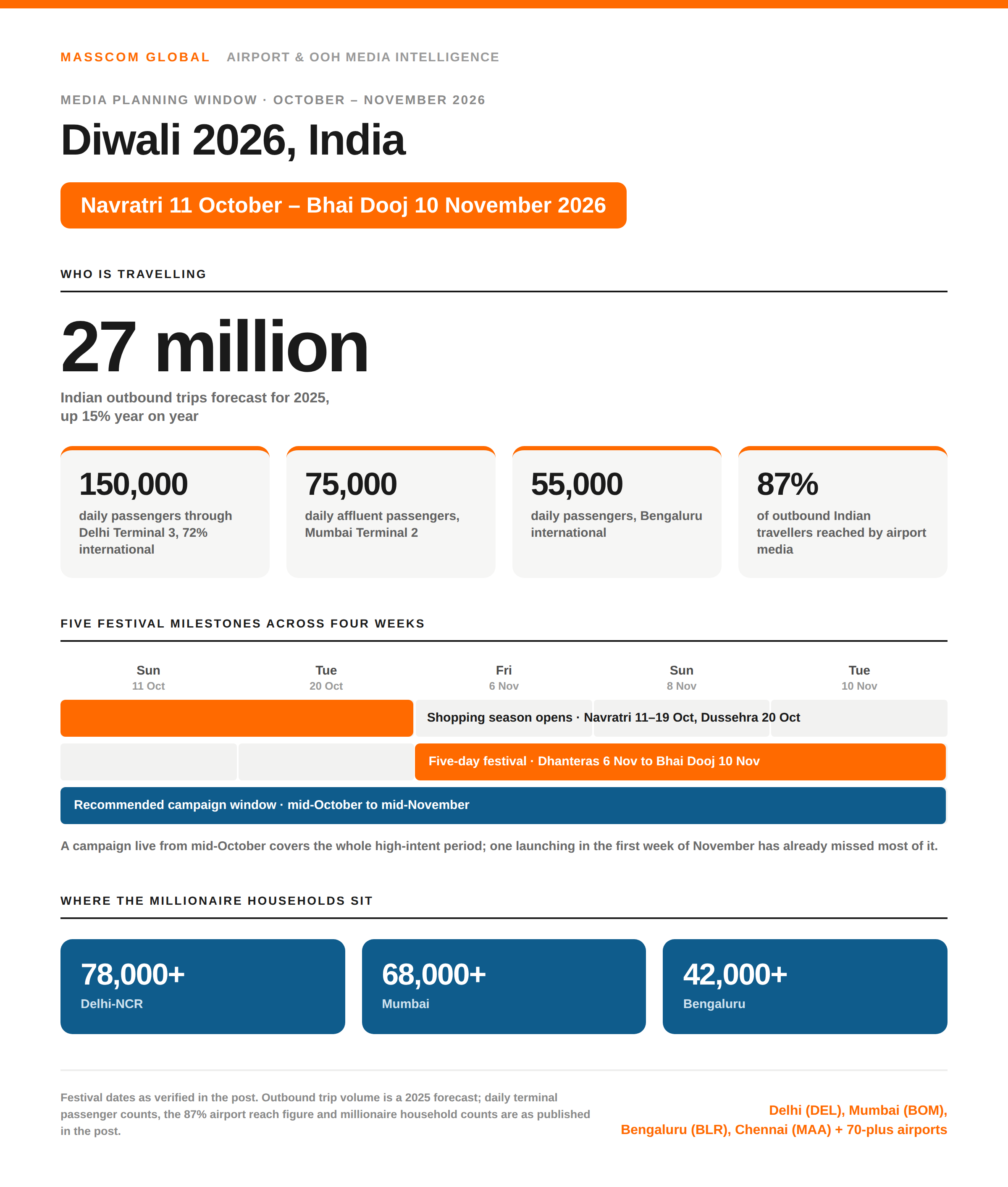
Diwali is not a date on a media plan. It is a season. The principal day, Lakshmi Puja, falls on Sunday 8 November 2026, and the five-day observance runs Dhanteras 6 November to Bhai Dooj 10 November. The commercial cycle begins earlier: Sharad Navratri runs 11 – 19 October 2026 and Dussehra falls on 20 October 2026.
That gives Indian consumer categories a continuous, culturally sanctioned buying window of roughly four weeks. Dhanteras is the most auspicious purchase day in the Indian calendar for gold, jewellery, vehicles and property: decisions otherwise spread across the year are deliberately concentrated into it.
For planners the consequence is straightforward. A campaign live from mid-October to mid-November covers the whole high-intent period; one launching in the first week of November has already missed most of it.
Why Airport & City Advertising Works During Diwali in India
The Diwali window compounds three audiences usually addressed separately: resident affluent households making their largest annual purchases; the non-resident Indian diaspora returning home; and international business travellers on Q4 India schedules.
India's premium travel base has expanded sharply. Outbound trips were forecast at 27 million in 2025, a 15% year-on-year increase, with average trip duration rising to 12 days from nine in 2022. Spend per trip is roughly US$2,850 for the standard traveller and US$8,500 or more for the premium segment, 22% above pre-pandemic levels. Luxury bookings rose 32% in 2025 and average travel budgets 18%. The 35 to 50 cohort accounts for 42% of premium travel spending.
The wealth is concentrated in ways that make airport and city media efficient rather than scattershot: Delhi-NCR holds more than 78,000 millionaire households, Mumbai more than 68,000, Bengaluru more than 42,000, Chennai more than 32,000 and Hyderabad more than 28,000.
Airport media carries unusual weight here: airport visibility reaches 87% of outbound Indian travellers, against 65% for connected TV and OTT. And because 60% of international travellers book three to six months ahead, the traveller reached now is already in a spending frame of mind.
Key Benefits of Airport & City Advertising During Diwali in India
Reach a qualified, high-spend audience
Diwali does not require you to identify intent: the calendar does it for you. Every high-value category from gold to automotive to real estate sees its annual peak inside this window, so placements land at the moment budget is already allocated.
Elevate your brand positioning
Festive advertising in India is expected and discussed. Presence across premium terminals and India's most prestigious retail corridors places a brand in the same visual register as the established luxury houses, without a category-wide national buy.
Generate real business opportunity
Dhanteras and Diwali are transaction days, not awareness days. Sustained visibility from Navratri through Bhai Dooj keeps a brand present across the full consideration-to-purchase arc.
Indira Gandhi International Airport, New Delhi (DEL)
Delhi is India's primary international gateway and the anchor of its largest concentration of millionaire households. Terminal 3 alone handles more than 150,000 passengers daily, 72% of them international.

Inventory Highlights
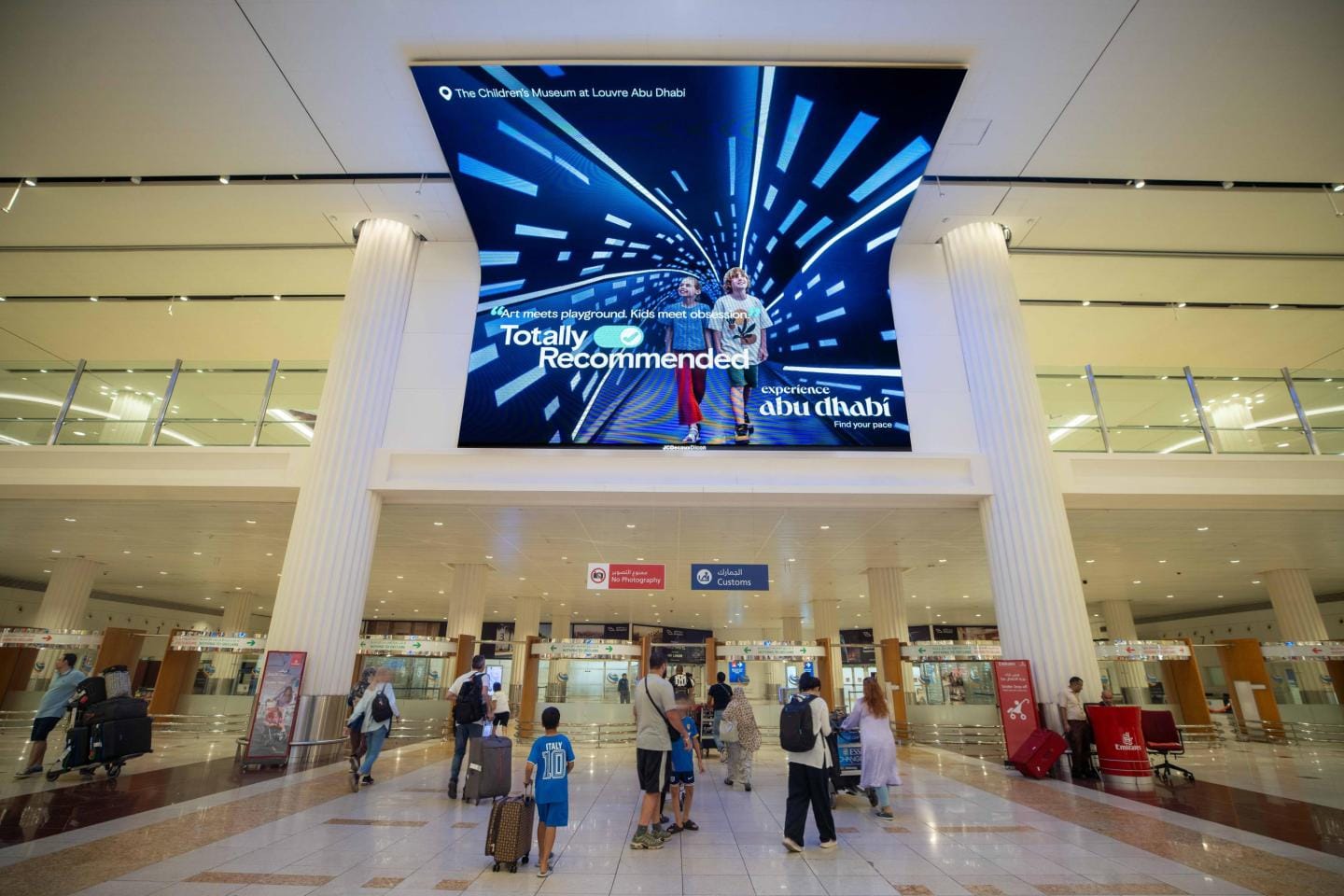
- Terminal 3 arrivals and immigration approach positions, capturing returning diaspora and inbound international visitors
- Departure concourse and premium check-in environments serving business and first-class traffic
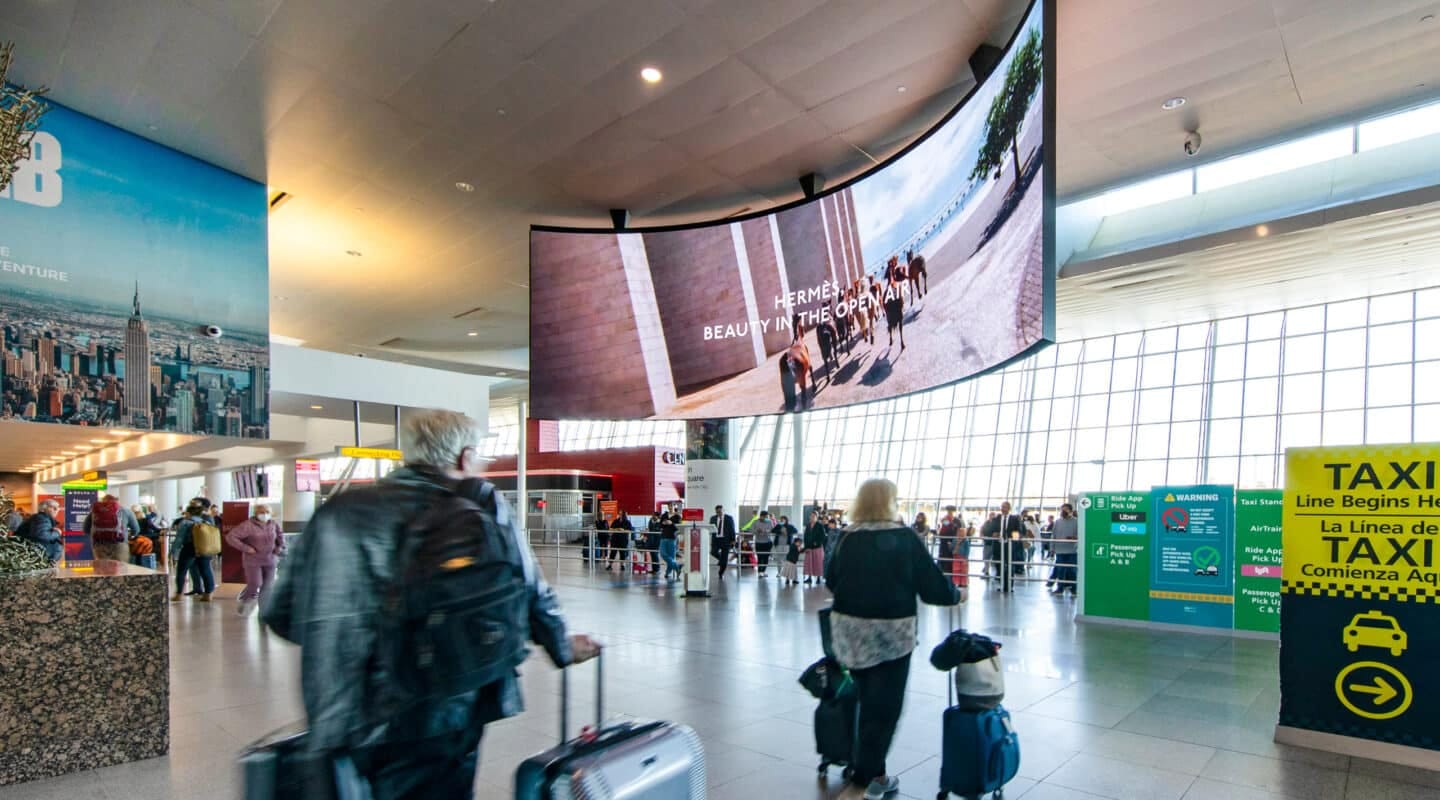
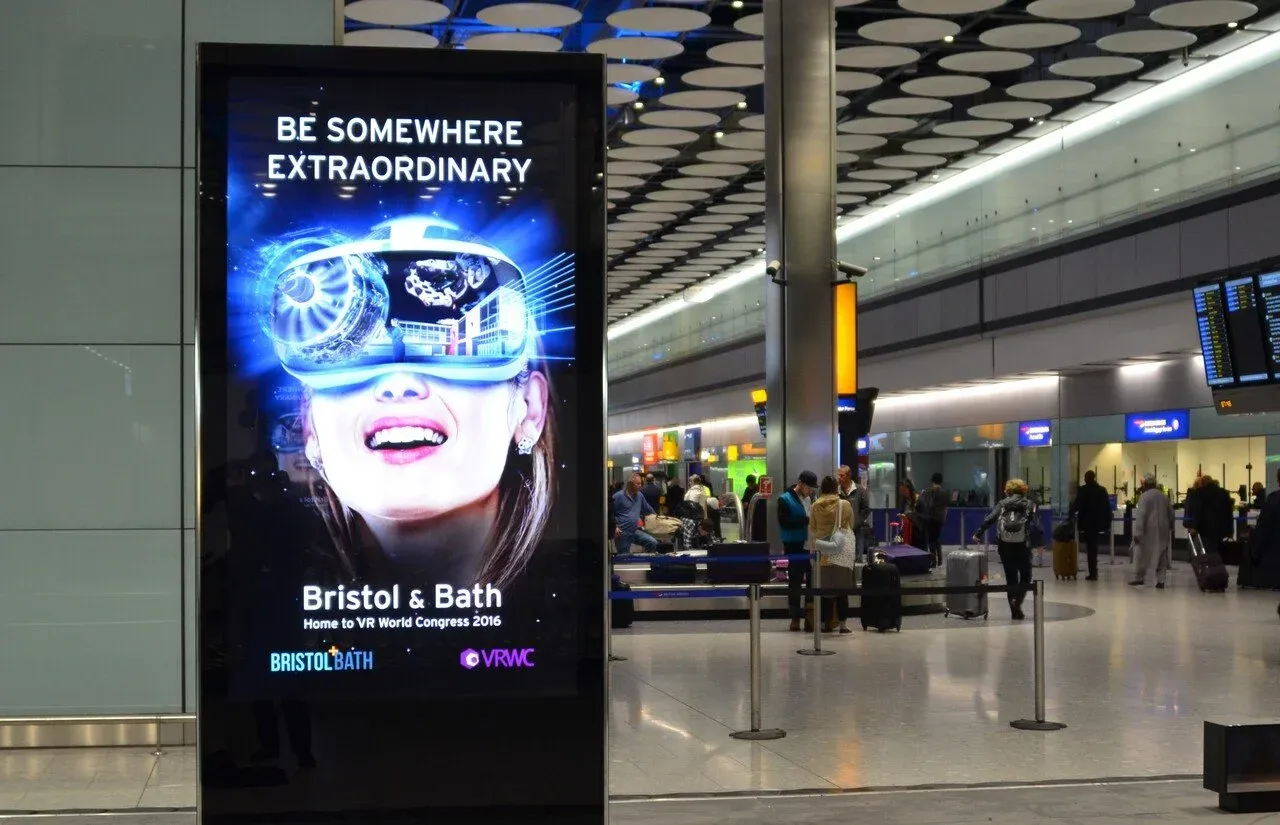
- Baggage reclaim and arrivals hall placements with extended captive dwell
- Programmatic DOOH inventory, with campaigns capable of going live in as little as two days
- Domestic terminal positions reaching the metro-to-metro business traveller flow
Advantages for Advertisers
- The highest international share of any major Indian terminal
- Direct alignment with Delhi-NCR's 78,000-plus millionaire households
- Long processing and reclaim dwell supports considered creative
- Short programmatic lead times allow tactical layering on a static campaign

Chhatrapati Shivaji Maharaj International Airport, Mumbai (BOM)
Mumbai is India's financial capital, with more than 68,000 millionaire households. Terminal 2 handles more than 75,000 affluent passengers daily.

Inventory Highlights
- Terminal 2 international arrivals and departures, the primary route for Gulf, European and North American premium traffic
- Arrivals corridor and reclaim positions with high dwell
- Premium lounge-adjacent and business-class check-in environments
- Domestic terminal inventory serving the Mumbai–Delhi–Bengaluru corporate shuttle
Advantages for Advertisers
- Highest density of financial-sector and family-office decision-makers in India
- Strong Gulf diaspora traffic returning for the festival, with elevated gold and jewellery spend
- Terminal 2's scale supports large-format placements, pairing naturally with South Mumbai and Bandra-Kurla city media

Kempegowda International Airport, Bengaluru (BLR)
Bengaluru is India's technology capital, with more than 42,000 millionaire households and more than 55,000 daily passengers through the international airport.

Inventory Highlights
- Terminal 2 premium environments, with extended pre-security dwell
- International arrivals positions serving Gulf, Singapore and European corridors
- Domestic departure concourse inventory reaching the tech-executive commuter base
Advantages for Advertisers
- A younger, high-earning audience: founders, senior executives and newly liquid equity holders
- Strong performance for premium automotive, watches, private banking and residential real estate
- Terminal 2's design creates unusually long, low-clutter dwell zones

Chennai International Airport (MAA)
Chennai anchors South India with more than 32,000 millionaire households and the strongest Deepavali retail tradition in the country.

Inventory Highlights
- New integrated terminal arrivals and departures placements
- International corridor inventory serving Singapore, Colombo, Gulf and Malaysian routes
- Domestic terminal positions reaching the Chennai–Bengaluru–Hyderabad business triangle
Advantages for Advertisers
- Deepavali carries greater retail weight in Tamil Nadu than in almost any other Indian market
- Dense Southeast Asian diaspora traffic returning for the festival
- Effective for textiles, jewellery, automotive and financial services in the regional-language market

National Network Coverage
Diwali is celebrated across the whole country, and the shopping peak is not confined to the metros. Beyond the four hubs above, the Indian network reaches a further seventy-plus airports, supporting either a national festive campaign or a targeted regional buy where a category over-indexes.
Coverage includes Hyderabad Rajiv Gandhi International, Kolkata Netaji Subhash Chandra Bose International, Ahmedabad Sardar Vallabhbhai Patel International, Cochin, Goa Mopa and Dabolim, Calicut, Pune, Trivandrum, Coimbatore, Kannur, Jaipur, Mangalore, Chandigarh, Navi Mumbai, Lucknow Chaudhary Charan Singh, Amritsar Sri Guru Ram Dass Jee, Indore Devi Ahilya Bai Holkar, Guwahati Lokpriya Gopinath Bordoloi, Srinagar Sheikh ul-Alam, Dehradun Jolly Grant, Udaipur Maharana Pratap, Leh Kushok Bakula Rimpochee, Port Blair Veer Savarkar, Varanasi Lal Bahadur Shastri, Patna Jai Prakash Narayan, Bhubaneswar Biju Patnaik, Nagpur Dr Babasaheb Ambedkar, Raipur Swami Vivekananda, Ranchi Birsa Munda, Agartala Maharaja Bir Bikram, Agra Kheria, Aurangabad Chikkalthana, Allahabad Bamrauli, Aizawl Lengpui, Sikkim Pakyong, Surat, Bagdogra, Jodhpur, Ratnagiri, Mysore, Madurai, Tiruchirappalli, Visakhapatnam, Vijayawada, Tirupati, Rajkot, Ayodhya, Jammu, Nashik, Shirdi, Kolhapur, Belgaum, Hubli, Salem, Tuticorin, Rajahmundry, Nanded, Pantnagar, Gorakhpur, Gwalior, Jabalpur, Bareilly, Dibrugarh, Jorhat, Imphal, Dimapur, Shillong, Bhavnagar, Jamnagar, Bhuj, Porbandar and Deoghar.
Two patterns are worth planning around. Pilgrimage airports (Varanasi, Ayodhya, Tirupati, Shirdi, Amritsar, Deoghar) see pronounced festive traffic uplifts and reach an audience in an occasion-led frame of mind. Gujarat's cluster of Ahmedabad, Surat, Rajkot, Jamnagar, Bhavnagar, Bhuj and Porbandar covers the state where Diwali also marks the new business year: the strongest regional market for gold, corporate gifting and vehicles.
Destination India: Full Visitor Journey Coverage
The strength of a Diwali campaign is that the audience does not disperse after landing. Festive activity concentrates in identifiable retail corridors, making an Airport → City → Retail Venue sequence unusually efficient.
Delhi-NCR illustrates the model. The region holds over 30 million residents, and the Delhi Metro carries more than 6 million passengers daily: reachable through station domination, train wraps and in-train panels. Above ground the large-format corridors run through Connaught Place, South Extension, Ring Road, Gurgaon and the Noida Expressway, while festive footfall concentrates in Select Citywalk, Ambience Mall and DLF Promenade. A brand moves from a Terminal 3 arrivals placement, to a Gurgaon expressway site, to a mall panel metres from the till.
The same logic applies in South Mumbai and Bandra-Kurla, Bengaluru's central mall districts, Hyderabad's Banjara Hills, and Chennai's T Nagar and Anna Salai spine. Sequenced rather than scattered placement produces three effects:
- Increased brand recall: repeated exposure at arrival, in the city and at the point of purchase
- Consistent presence: your brand becomes part of the festive visual environment rather than an interruption to it
- Enhanced campaign effectiveness: coordinated placements across one journey outperform equivalent spend split across disconnected markets
Why Brands Choose Diwali Advertising in India
Exclusive audience access. No other four-week window in India concentrates this volume of high-value purchase decisions across jewellery, automotive, real estate and premium consumer categories.
A prestigious environment. Premium terminals at Delhi, Mumbai, Bengaluru and Chennai, paired with India's leading retail corridors, place a brand alongside the established luxury names.
End-to-end campaign support. Masscom Global plans, negotiates and executes across airport, metro, large-format and mall inventory in a single brief, with one point of accountability nationwide.
Strategic planning assistance. Our planners advise on hub selection, regional weighting and format mix so spend lands where your category actually converts.
The Masscom Global Standard Behind Every Diwali Placement
- Verified inventory and audience data: screen counts and traffic figures across Indian airports come from live operator data at proposal stage, not published estimates.
- Transparent delivery reporting: campaign monitoring and reporting across airport and city inventory, so you see exactly where your creative ran.
- Benchmarked recommendations: format mix set against comparable campaigns across our network.
- We absorb the complexity: one point of accountability from negotiation through execution.
Frequently Asked Questions
When exactly is Diwali 2026, and when should a campaign run?
Diwali (Lakshmi Puja) falls on Sunday 8 November 2026, with the five-day festival running Dhanteras 6 November to Bhai Dooj 10 November. The shopping season opens earlier: Sharad Navratri 11 – 19 October and Dussehra on 20 October 2026. We recommend a campaign window from early October to mid-November.
Who is the audience during the Diwali window?
Resident affluent households making their largest annual purchases, returning non-resident Indian diaspora travellers (particularly from the Gulf, Singapore, the UK and North America) and international business travellers.
Can I reach travellers across their whole journey, not just at the airport?
Yes. A combined buy across terminal inventory, metro networks, city large-format and mall environments means the same household meets your brand several times between landing and purchasing.
How far in advance should a Diwali campaign be booked?
Festive inventory across Indian airports and premium city sites is the most contested of the year; confirm availability by August or early September. Programmatic DOOH at Delhi airport can go live in as little as two days for late briefs, with reduced format choice.
Which brand categories perform best during Diwali?
Gold and fine jewellery, premium automotive, watches, residential real estate, private banking, consumer electronics, premium apparel, corporate gifting, and international travel and hospitality.
Related Airport Advertising Guides
Detailed inventory, audience and planning notes for the airports covered above:


Masscom Global publishes detailed advertising guides for a further 57 airports across this network. Ask us for the full list.
Diwali Won't Wait. Neither Should You.
- Once a year, then gone: festive inventory across Indian airports and premium city sites is the most contested of the year, and confirmation is recommended by August or early September.
- Competitors are already moving: every week without a plan is a week a jewellery, automotive or real estate brand gets closer to locking the same positions.
- The window is exact, not approximate: a campaign that isn't live for the shopping season misses the exact weeks purchase intent peaks.
- The alternative reaches nobody specific: no other single buy places one message in front of premium travellers across India's festive season the way airport and city media can.
Get Free Expert Assistance Now
Tell us your category, target states and budget, and our planners will return a costed Diwali 2026 media plan across airport, metro and city inventory.
Request Availability
The October–November window is India's most heavily booked media period. Ask us which terminal and city positions are still open.
Diwali's advertising case is the calendar itself: a four-week window in which resident millionaire households, a returning diaspora and international business travellers all make their largest annual purchase decisions at once. Airport visibility reaches 87% of outbound Indian travellers, ahead of connected TV and OTT, and a booking window that opens three to six months out means the traveller reached today is already primed to spend. Masscom Global plans and executes across India's airport and city network under one brief, so a brand is present from Navratri through Bhai Dooj rather than for the single day of Lakshmi Puja.