

Airport at a Glance
| Field | Detail |
|---|---|
| Airport | Sheremetyevo Alexander S. Pushkin International Airport |
| IATA Code | SVO |
| Country | Russia |
| City | Moscow (Khimki, Moscow Oblast) |
| Annual Passengers | Over 43 million (2024), up from 36 million in 2023 |
| Primary Audience | Moscow HNWI and upper-professional travellers, outbound leisure travellers to Turkey, UAE, and Asia, CIS business travellers, inbound Chinese and Middle Eastern visitors |
| Peak Advertising Season | May to September (summer leisure peak), November to January (New Year outbound peak), February to March (school holiday windows) |
| Audience Tier | Tier 1 — Russia's largest airport by volume, with the highest concentration of Moscow's HNWI and professional traveller audience in the country's aviation network |
| Best Fit Categories | Premium financial services, luxury goods and watches, real estate, premium automotive, Turkish and UAE destination marketing, premium travel and hospitality |
Sheremetyevo Alexander S. Pushkin International Airport is the undisputed primary aviation hub of Russia, the busiest airport in the post-Soviet states, and one of the ten busiest airports in Europe by passenger volume. With over 43 million passengers processed in 2024 — a 19 percent increase for Aeroflot Group traffic through the hub year-on-year — SVO serves as the sole commercial aviation entry and exit point for Moscow's enormous and economically dominant catchment. Moscow contributes more than twenty percent of Russia's total GDP, ranks among the largest urban economies in the world by purchasing power parity, and is home to the most concentrated population of high-net-worth individuals of any city in the Russian Federation. The professional, entrepreneurial, and upper-income population that defines this catchment travels through SVO at a rate that makes it, by volume and purchasing authority combined, one of the most commercially significant airport advertising environments available to brands serving the Russian and CIS premium market.
SVO's international route network has undergone a structural transformation since 2022, with Western European connections replaced by a rapidly expanding web of routes to Turkey, the UAE, China, Southeast Asia, Central Asia, the Middle East, Egypt, and beyond. This reorientation has produced an international audience profile at SVO that is commercially distinct from pre-2022: concentrated on outbound leisure travellers heading to Turkey's Mediterranean resorts and Egypt, business and investment travellers commuting to Dubai and Abu Dhabi, growing Chinese inbound tourism and business flows, and the dense CIS professional travel network connecting Moscow to Tashkent, Almaty, Baku, Yerevan, and Minsk. For brands that understand the economic reality of Moscow's consumer market — real disposable incomes grew 8.5 percent in 2024, the Russian luxury goods market reached USD 2.31 billion, and domestic HNWI wealth accumulation has accelerated as capital has concentrated in domestic premium assets — SVO is the primary point of access to the most financially powerful audience in the Russian Federation.
Advertising Value Snapshot
- Passenger scale: Over 43 million passengers in 2024, a record post-pandemic figure, up 19 percent year-on-year for the Aeroflot Group alone, with new Terminal G construction and a 100-million-passenger annual capacity target under the airport's 2030 Master Plan
- Traveller type: Moscow HNWI and upper-professional outbound leisure travellers, CIS-oriented business executives, inbound Chinese and Gulf professional and leisure visitors, domestic Russian professional travellers connecting through Moscow from all regions
- Airport classification: Tier 1 — Russia's largest airport and one of Europe's ten busiest, with infrastructure and commercial environment at full international scale
- Commercial positioning: Russia's dominant aviation gateway and the primary hub for Aeroflot Group operations, connecting Moscow's 21-million-person metropolitan catchment to over 130 destinations across 30 countries, with domestic routes reaching all major Russian cities
- Wealth corridor signal: SVO sits at the intersection of the Moscow-Istanbul premium outbound leisure corridor, the Moscow-Dubai-Abu Dhabi investment and lifestyle axis, the Moscow-Beijing and Moscow-Shanghai business and commerce corridor, and the vast domestic Moscow-to-regional-Russia professional network that covers the country's entire economic geography
- Advertising opportunity: Masscom Global provides brands with strategic access to SVO's premium multi-terminal advertising environment, with campaign structures built around the summer Turkish and Mediterranean leisure peak, the year-round domestic corporate travel calendar, and the inbound CIS and Asian business audience that flows through Moscow's dominant hub daily.
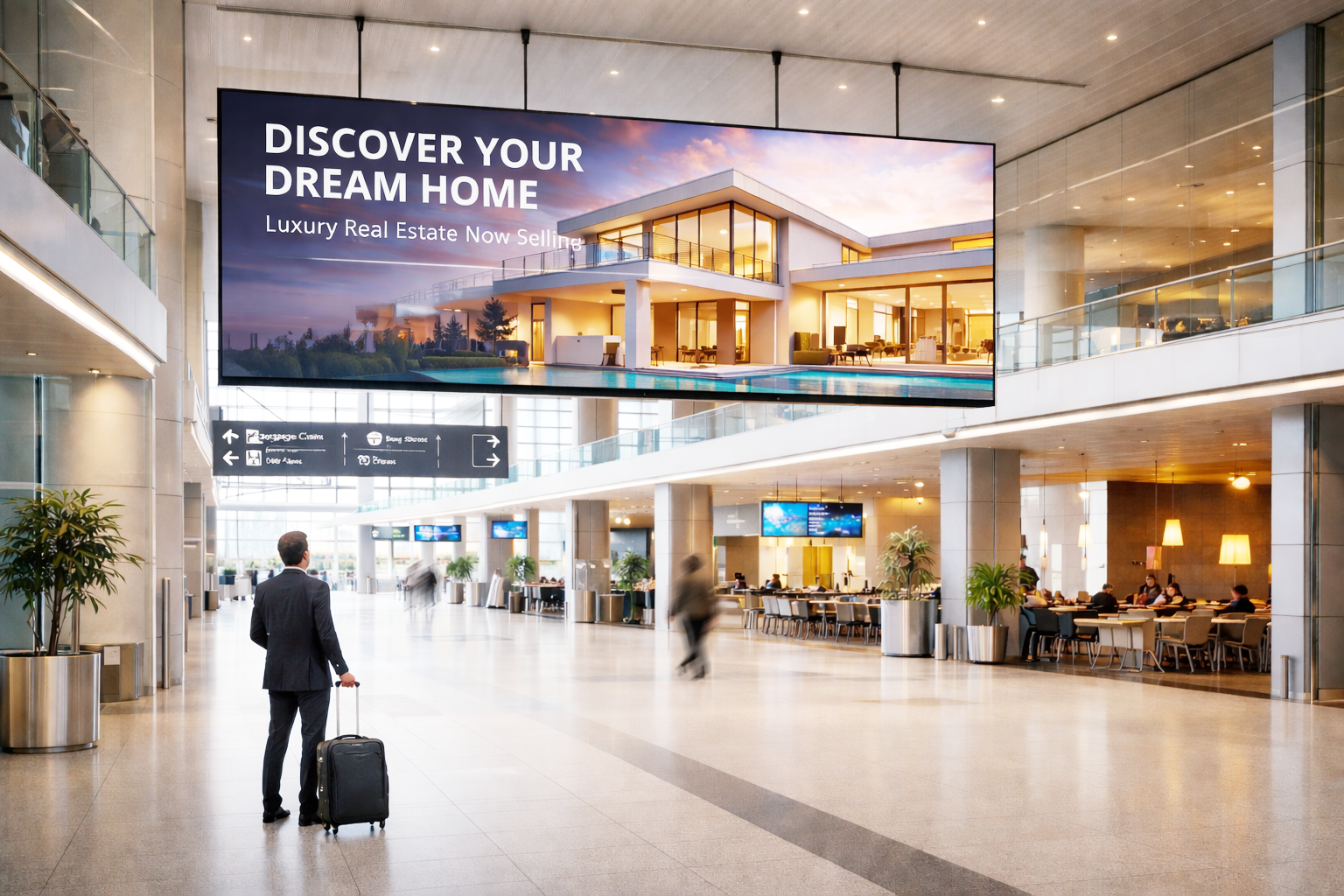
Airport Advertising is Complex to Get Right
We help you execute faster, with proven results and local insight most planners lack starting now.
Talk to an ExpertCatchment Area and Economic Drivers
Top 10 Cities within 150 km — Marketer Intelligence
- Moscow (central and premium districts — Rublyovka, Patriarshy Ponds, Ostozhenka, Arbat, Moscow City, Tverskoy): The financial and cultural capital of Russia and the residence of the country's most concentrated HNWI population. Moscow's premium districts generate the airport's most commercially authoritative outbound audience — business owners, senior executives, and elite professionals whose purchasing behaviour in luxury goods, real estate, premium automotive, and financial services is structurally above any regional Russian catchment. Moscow contributed over twenty percent of Russia's GDP in 2024, and its commercial concentration drives the majority of SVO's premium passenger profile.
- Khimki: The industrial and commercial satellite city immediately surrounding the airport, housing major Russian and international corporate headquarters, logistics operations, and a substantial white-collar professional population. Khimki's proximity to the airport makes it the primary airport-adjacent business catchment, with consistent corporate travel demand and strong alignment to B2B financial and professional services brands.
- Krasnogorsk: A premium western suburban district of Moscow's immediate periphery, known as one of the most desirable and expensive residential addresses in the Moscow metropolitan area. Krasnogorsk's high-income professional and business-owning population generates consistent premium leisure travel through SVO and represents a secondary but commercially authoritative audience for luxury lifestyle and investment product categories.
- Mytishchi: One of Moscow's largest northeastern satellite cities, housing a mix of manufacturing headquarters, technology companies, and a large professional residential population whose consistent business travel through SVO generates strong alignment to corporate financial services, productivity technology, and executive lifestyle brands.
- Korolev: Russia's space and aerospace capital, approximately 40 kilometres northeast of the airport, housing Roscosmos and a dense cluster of defence and aerospace enterprises. The senior engineering and management community here generates high-frequency professional travel through SVO with strong B2B scientific, technology, and corporate services alignment.
- Sergiev Posad: A historic Golden Ring city approximately 75 kilometres northeast of the airport and one of Russia's most spiritually significant Orthodox Christian heritage destinations. Sergiev Posad generates consistent domestic and inbound Orthodox tourism travel through SVO, whose audience carries premium heritage and cultural tourism spending profiles and strong alignment to premium hospitality and lifestyle brands.
- Zelenograd: A designated science and technology satellite city approximately 40 kilometres northwest of central Moscow, home to Russia's primary microelectronics and semiconductor research complex. Zelenograd's highly educated engineering and scientific professional community generates consistent Moscow-hub travel with strong alignment to technology, premium financial, and corporate services categories.
- Dolgoprudny: A science and education city immediately south of the airport, home to the Moscow Institute of Physics and Technology (MIPT) — Russia's equivalent of MIT — whose academic, research, and professional population generates consistent high-frequency travel through SVO with strong alignment to technology, financial, and premium consumer categories.
- Solnechnogorsk: A prosperous town on the Leningradskoye Highway approximately 65 kilometres north of Moscow, home to significant industrial and commercial operations and a growing premium dacha and residential community. Solnechnogorsk's business-owning and professional class generates consistent outbound leisure and business travel through SVO with above-average financial services and premium lifestyle brand receptivity.
- Istra and the Moscow Region premium dacha belt: The western corridor approximately 50 to 70 kilometres from the airport encompasses Russia's most exclusive and historically established dacha and suburban estate communities. The landowners, business families, and HNWI professionals resident in this corridor represent the most financially established stratum of Moscow's suburban catchment, generating consistent outbound leisure and investment travel through SVO with the strongest premium consumer and wealth management brand alignment of any sub-catchment in the Moscow region.
NRI and Diaspora Intelligence
Moscow's international outbound passenger community is commercially defined by four distinct groups whose combined purchasing authority makes SVO one of the most financially consequential outbound travel hubs in Europe. The first is the Moscow HNWI and business class on outbound leisure, currently concentrated on Turkey, the UAE, Thailand, Egypt, Bali, and the Maldives as their primary international leisure destinations. This audience travels with the consumption profile of a global elite whose standard of living has been maintained and in many cases enhanced by domestic income growth. The second group is the Moscow CIS business community — the executives, entrepreneurs, and professionals who manage economic interests across Uzbekistan, Kazakhstan, Azerbaijan, Armenia, and Belarus, generating consistent high-frequency premium business travel on the CIS route network. The third is the emerging Moscow-China business corridor audience, travelling on growing Aeroflot and Chinese carrier routes to Beijing, Shanghai, and Guangzhou as Russia-China bilateral trade, which has grown to record levels, demands increasingly frequent professional engagement. The fourth is the inbound audience flowing into Moscow from across Russia's eleven time zones — regional business leaders, industrial executives, and government officials for whom Sheremetyevo is the gateway to Moscow's dominant financial, legal, and commercial infrastructure.
Economic Importance
Moscow's economic dominance within Russia creates the commercial foundation for SVO's extraordinary passenger profile. The city's contribution of more than twenty percent of national GDP, its position as the headquarters for all major Russian banks, energy companies, media organisations, and technology enterprises, and its function as Russia's sole global financial centre collectively produce a professional workforce whose income levels, travel frequency, and purchasing power are structurally above any comparable regional Russian city. Real disposable incomes across Russia grew 8.5 percent in 2024, with Moscow's growth concentrated in the energy, technology, financial services, and military-industrial sectors that have benefited most from Russia's current economic priorities. The Russian luxury goods market reached USD 2.31 billion in 2024 and is projected to grow to USD 3.02 billion by 2033, driven by Moscow's HNWI concentration, the expansion of premium domestic consumption, and the parallel import channels that continue to supply premium international goods to Russian consumers despite the absence of direct brand operations.
Business and Industrial Ecosystem
- Financial services and banking: Moscow hosts the headquarters of all Russian systemically important banks, the Moscow Exchange, the Central Bank of Russia, and an extensive ecosystem of private equity, investment management, and financial advisory firms. The senior financial professional community generates the highest-frequency and most commercially premium corporate travel through SVO, with strong alignment to wealth management, premium financial products, and corporate insurance categories.
- Energy and natural resources: Gazprom, Rosneft, Lukoil, Novatek, and the broader Russian energy complex are headquartered in Moscow, generating a consistent outbound executive travel audience whose destinations include the UAE, Turkey, China, India, and CIS energy-producing nations. This audience carries corporate purchasing authority for B2B industrial services and personal purchasing power for premium lifestyle, financial, and automotive categories at the elite end of the Russian market.
- Technology and digital economy: Moscow's technology sector — including Yandex, VK Group, Sber tech operations, and a growing ecosystem of domestic software, cybersecurity, and fintech companies — generates a high-frequency, high-income professional travel audience that is younger, more internationally mobile, and more premium-consumer-oriented than Russia's traditional industrial executive base. This audience travels through SVO for CIS, Turkish, and Asian technology partnerships and conferences, and generates strong alignment to premium technology, financial, and lifestyle brands.
- Manufacturing, defence, and industrial complex: Moscow Oblast hosts a dense network of aerospace, defence, and advanced manufacturing enterprises whose engineering management and corporate leadership generate consistent professional travel through SVO. This audience is financially senior, technically expert, and generates consistent premium B2B services and corporate lifestyle brand receptivity at the airport.
Passenger Intent — Business Segment
The business traveller at SVO is a Moscow-based professional operating across Russia's domestic trunk routes — connecting to St. Petersburg, Novosibirsk, Yekaterinburg, Krasnodar, Sochi, and Russia's regional capitals — or commuting internationally to Tashkent, Almaty, Baku, Dubai, Beijing, or Istanbul for bilateral business engagement. Their in-airport dwell is professionally purposeful: they are frequent flyers with high brand familiarity, selective retail engagement, and consistent receptivity to financial services, premium automotive, technology, and executive lifestyle advertising. The categories that intercept the SVO business traveller most effectively are premium Russian and Asian financial products, corporate insurance, business technology, executive travel services, and premium lifestyle brands accessible through the parallel import channels that serve Moscow's premium consumer market.
Strategic Insight
The SVO business audience's defining commercial characteristic in the current period is the acceleration of domestic wealth accumulation and premium consumption in a market where external luxury supply channels have been restructured rather than eliminated. Moscow's HNWI community has not diminished in purchasing ambition or financial capacity — real incomes grew 8.5 percent in 2024, luxury residential housing in Moscow recorded 174 billion roubles in sales in 2024, and the premium consumer market continues to attract brands willing to engage creatively with Russia's evolved distribution landscape. For brands operating within Russia or through CIS and Asian partner networks, SVO provides access to the highest-concentration premium consumer audience in the Russian Federation at a scale — 43 million annual passengers — that has no domestic equivalent.
Tourism and Premium Travel Drivers
- Turkey — Antalya, Istanbul, Bodrum, Dalaman: Russia's dominant outbound leisure destination, with Antalya representing the single highest-volume international leisure route from SVO. Turkish Mediterranean resorts attract an enormous Russian premium leisure audience whose per-trip spend on accommodation, dining, and excursions is consistently high. Istanbul's premium shopping, hospitality, and cultural appeal draws both leisure and investment travel from Moscow's HNWI community.
- Egypt — Sharm el-Sheikh and Hurghada: Russia's second-largest beach leisure destination by outbound volume, generating consistent year-round premium sun-and-sea travel from Moscow. Egypt's Red Sea corridor attracts a high-frequency, return-visitor leisure audience whose destination loyalty creates predictable peak-season audience density at SVO.
- UAE — Dubai and Abu Dhabi: The primary luxury lifestyle, investment, and real estate destination for Moscow's HNWI outbound audience. Dubai's premium retail, hospitality, and property market has been one of the most significant beneficiaries of outbound Moscow HNWI travel and capital deployment in recent years. Abu Dhabi's growing luxury hospitality and investment infrastructure adds a secondary premium UAE audience stream through SVO's Etihad route.
- Southeast Asia — Bali, Bangkok, Phuket, and Vietnam: The premium beach and cultural leisure corridor for Moscow's outbound leisure audience seeking long-haul tropical alternatives. Bali is SVO's longest non-stop route at over 12 hours, signalling the commitment of Moscow's premium leisure market to genuine long-haul premium experiences. Thailand and Vietnam generate consistent premium resort tourism audiences through SVO whose destination spend profiles confirm high discretionary leisure investment.
Passenger Intent — Tourism Segment
The outbound leisure traveller departing SVO is predominantly a Moscow-based professional or HNWI heading to a pre-booked premium resort in Turkey, Egypt, UAE, or Southeast Asia. Their dwell time at the terminal is anticipatory and purchasing-positive — they are in peak holiday mindset with discretionary spend available for retail, premium food and beverage, and in-terminal brand engagement. Inbound leisure visitors arriving at SVO — primarily from China, the UAE, Turkey, and CIS source markets — are entering Moscow for culture, business, medical tourism, or education-related purposes, arriving with committed budgets and strong engagement with premium hospitality and consumer brand advertising.
Travel Patterns and Seasonality
Peak seasons:
- May to September (summer leisure peak): Russia's primary outbound leisure season, driving the year's highest passenger density through SVO's international terminals as Moscow's enormous population activates Mediterranean, Egyptian, and Southeast Asian summer holiday travel. Turkey's peak season aligns precisely with Moscow's summer leisure surge, producing SVO's highest-volume and highest-value advertising window.
- December to January (New Year outbound peak): Russia's most culturally significant holiday period generates SVO's largest single-week passenger concentrations as Moscow's professional and HNWI community deploys luxury leisure travel to the UAE, Maldives, Thailand, and ski destinations in the lead-up to and following New Year's Eve, one of the most commercially powerful consumer moments in the Russian calendar.
- February to March (school holiday windows and corporate travel): February's school holidays and March's pre-spring period generate consistent outbound leisure travel to warm-weather destinations alongside high-frequency corporate travel, creating a productive advertising window between the New Year and summer peaks.
Event-Driven Movement
- New Year (December 31 to January 8): The most commercially significant travel and consumer spending event in the Russian calendar, generating SVO's highest single-week outbound luxury leisure volumes as Moscow's HNWI and professional audience travels to the UAE, Maldives, and premium resort destinations. Advertising in the four weeks preceding New Year intercepts an audience at maximum premium purchase intent and discretionary spend activation.
- May Long Weekend and Victory Day (May 1 to 9): Russia's extended spring holiday window, combining Labour Day and Victory Day into a ten-day period that generates SVO's largest single spring outbound leisure surge, predominantly to Turkey and Mediterranean resorts as the summer season opens.
- Russian Orthodox Christmas (January 7): A significant religious and cultural holiday whose travel patterns add a January family movement layer to the post-New Year period, generating additional domestic and outbound travel through SVO as families mark the Orthodox Christmas with gatherings and short-break leisure travel.
- March 8 International Women's Day: A major cultural holiday in Russia generating significant domestic leisure travel through SVO, with outbound short-break travel to Turkey and UAE destinations for premium couples and family groups who mark the holiday with luxury dining, retail, and hospitality experiences.
- Chinese Golden Week and Lunar New Year (January to February and October): China's extended holiday periods generate SVO's most concentrated inbound Chinese tourism and business travel surges, as Chinese visitors activate Moscow cultural tourism, business meetings, and transit connectivity. These windows produce the year's strongest inbound Chinese audience density at SVO and create strong alignment for brands marketing to Chinese premium consumers.
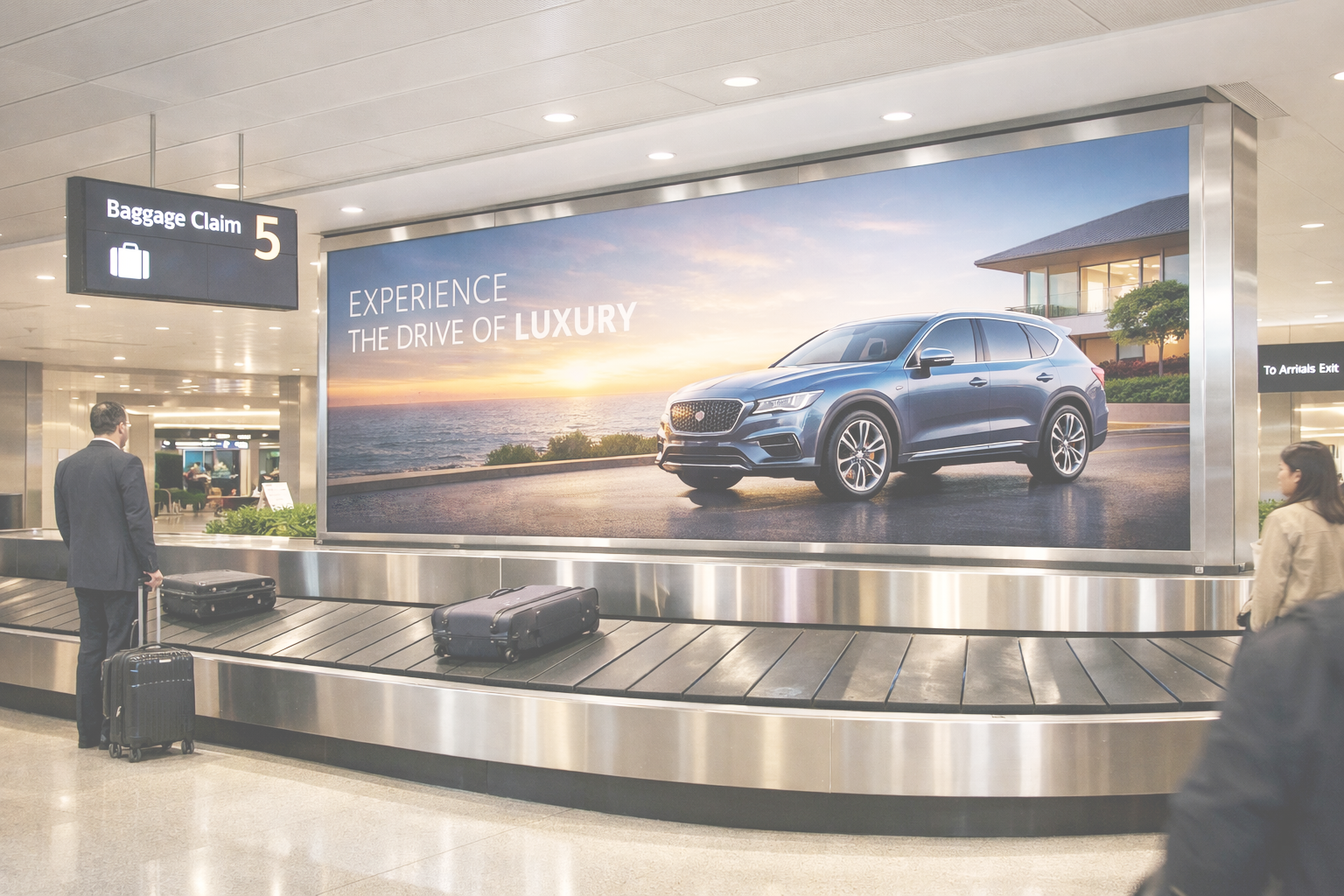
It’s Not Just Where You Advertise - It’s How Fast You Execute
We combine local insight with fast rollout to deliver results for you, now.
Talk to an ExpertAudience and Cultural Intelligence
Top 2 Languages
- Russian: The language of the overwhelming majority of SVO's passenger base, spoken as the primary and often sole language by domestic and CIS travellers, and the operational language of the airport's commercial and administrative environment. Russian-language creative at SVO is not merely linguistically aligned — it carries cultural authority and commercial trust that international-language alternatives cannot replicate for a domestic audience whose consumption psychology is embedded in Russian cultural norms and aspirations.
- Mandarin Chinese: The fastest-growing second language at SVO, reflecting the accelerating bilateral relationship between Russia and China and the growing volume of Chinese business, tourism, and transit passengers moving through Moscow. Chinese-language advertising at SVO reaches an inbound audience that is consistently purchasing-active in luxury goods, cultural experiences, and premium hospitality categories, and whose per-visit spending profile in Moscow has grown materially as China-Russia bilateral travel volumes have increased.
Major Traveller Nationalities
Russian nationals represent the overwhelming majority of SVO's passenger base, accounting for the full domestic route network traffic and the dominant share of outbound international travel. Among international travellers, CIS nationals — from Uzbekistan, Kazakhstan, Belarus, Azerbaijan, Armenia, Kyrgyzstan, and Tajikistan — represent the largest combined inbound segment, arriving in Moscow for business engagement, medical services, education, and family visits. Chinese nationals are the fastest-growing inbound international segment, arriving on Aeroflot and Chinese carrier routes from Beijing, Shanghai, and Guangzhou for business, cultural tourism, and transit. Turkish nationals travelling on Istanbul routes represent a significant business and leisure reciprocal traffic source. Middle Eastern travellers from the UAE and Gulf states generate consistent premium inbound business and cultural tourism traffic through SVO on the Abu Dhabi and Dubai routes.
Religion — Advertiser Intelligence
- Russian Orthodox Christian (approximately 70% of Russia's population): The dominant religious tradition of SVO's passenger base, with the Orthodox calendar governing the two most commercially significant travel and consumption events of the year — Orthodox Christmas on January 7 and Orthodox Easter. New Year's Eve, though not a religious holiday, functions as Russia's primary premium consumer and leisure travel trigger and carries deeply ingrained cultural significance that generates the year's highest single-week premium purchasing activity at SVO. Brands in luxury lifestyle, premium travel, jewellery, and gifting categories benefit most strongly from the December-January window that combines New Year, Orthodox Christmas, and the outbound premium leisure surge to warm-weather destinations.
- Islam (approximately 10% of Russia's population, concentrated in Tatarstan, Bashkortostan, Chechnya, and among CIS migrant communities): A significant and growing religious community within Russia's passenger base, generating travel peaks aligned to Eid al-Fitr and Eid al-Adha. The Muslim professional and business community travelling through SVO — particularly the substantial Tatar and Bashkir professional class from Kazan and Ufa — represents a financially active and brand-engaged audience whose purchasing behaviour in premium Islamic-aligned financial products, halal luxury travel, and premium consumer goods creates commercially relevant advertising opportunities at SVO during the Eid travel windows.
- Other faiths (approximately 20%): A diverse community including Protestant, Catholic, Buddhist, and Jewish populations concentrated within Moscow's cosmopolitan professional and expatriate community, whose travel patterns broadly follow the international calendar and generate year-round purchasing-active audience density for premium consumer and financial services brands at SVO.
Behavioral Insight
The SVO traveller — particularly the Moscow HNWI and professional outbound passenger — embodies a purchasing psychology shaped by three converging forces: the scarcity premium of a luxury market whose Western supply channels have been restructured, an income and wealth growth trajectory that has continued to accelerate through 2024, and a cultural predisposition toward conspicuous quality and status-affirming consumption that has intensified as Russian consumers have oriented their aspirations toward domestically available and Asian-sourced premium alternatives. This audience responds most powerfully to messaging that communicates exclusivity, quality, and the kind of premium lifestyle positioning that Russian consumers have historically associated with the Western luxury canon — now increasingly delivered through Turkish, UAE, Chinese, and domestic premium brand channels. Brands that enter SVO with creative intelligence rooted in Russian cultural values, aspirational premium positioning, and genuine product quality will find an audience whose purchasing appetite is structurally undiminished and whose scale — 43 million annual passengers in Moscow's primary hub — is the largest in the Russian Federation.
Outbound Wealth and Investment Intelligence
The outbound premium traveller at SVO represents one of Europe's most commercially consequential capital-deploying audiences outside the Western financial system. Moscow's approximately 246,000 dollar millionaires, its estimated 3,800 ultra-high-net-worth individuals, and its vastly larger professional upper-income class have reoriented their outbound investment, lifestyle, and asset accumulation activities toward Turkey, the UAE, Asia, and domestic premium markets since 2022. This reorientation has not diminished capital deployment — it has redirected it toward markets that brands operating in the Turkey-UAE-Asia commercial corridor can access directly through SVO's passenger base.
Outbound Real Estate Investment
Moscow's HNWI outbound real estate community has been among the most active investors in Turkish and UAE property markets since 2022. Dubai and the broader UAE have attracted significant Russian HNWI capital into freehold residential property, with Russian buyers consistently ranking among the top five foreign buyer nationalities in the Dubai market. Turkey's coastal and Istanbul property markets have attracted substantial Russian investment driven by proximity, lifestyle appeal, and accessible pricing. Thailand's resort property corridor — particularly Phuket — attracts a consistent Russian premium leisure and investment audience whose long-term resident community generates year-round travel through SVO. Domestic Russian premium real estate in Moscow's elite districts has simultaneously strengthened as an asset class, with luxury housing sales in Moscow recording 174 billion roubles in 2024 as HNWIs consolidate wealth into premium domestic hard assets.
Outbound Education Investment
Moscow's most financially active families invest in international education through CIS, Turkish, UAE, and Asian educational institutions whose proximity and connectivity to Moscow make them operationally viable post-2022. Turkish universities and elite private schools have attracted a growing cohort of Russian students. UAE educational institutions — particularly those in Dubai and Abu Dhabi — have become important secondary destinations. Chinese universities, whose Russia-language programmes have expanded, are an emerging pathway for Moscow families with strong bilateral professional ambitions. Domestic Russian premium education — the Russian International Olympic University, Skoltech, and elite Moscow lycées — has simultaneously strengthened as investment destinations for HNWI families whose international options have become more operationally complex.
Outbound Wealth Migration and Residency
Turkey's long-term residence permit by property investment, the UAE's Golden Visa programme, and the broader UAE residency infrastructure have become the primary international residency frameworks for Moscow's outbound HNWI community seeking formal multi-jurisdictional residency status. Turkish citizenship by investment at USD 400,000 in property attracts a consistent stream of Moscow HNWI applicants through the Istanbul and Antalya routes. UAE residency through property investment in Dubai is the most active second-residency programme for Moscow's professionally mobile HNWI class. CIS countries — particularly Kazakhstan, Armenia, and Georgia — attract a secondary residency interest from Moscow professionals seeking straightforward CIS-framework residency access with minimal compliance complexity.
Strategic Implication for Advertisers
Brands operating in the Turkey, UAE, CIS, and Asian markets whose target customer includes Moscow HNWI and professional outbound travellers should treat SVO as their primary access channel to this audience. The airport's 43-million-passenger volume, combined with the highest concentration of Russian HNWI purchasing power in the country's aviation network, makes SVO a priority buy for any brand seeking scale engagement with Russia's dominant premium consumer base. Masscom Global activates this corridor from both directions — brands reaching outbound Moscow HNWI travellers at departure and inbound premium visitors from the Gulf, China, and CIS markets upon arrival — through placement strategies that maximise audience quality and message relevance at every point in the passenger journey.
Airport Infrastructure and Premium Indicators
Terminals
- Terminal B (Northern Complex — domestic operations): Handles all Aeroflot domestic flights and serves as the primary domestic travel hub for Moscow's enormous professional population connecting to St. Petersburg, Sochi, Novosibirsk, Yekaterinburg, and all major Russian regional cities. Terminal B's massive daily passenger volume makes it the single highest-audience-density terminal at SVO for domestic Russian premium brand advertising.
- Terminal C (Northern Complex — international): The large-capacity international terminal connected directly to Terminal B via the underground transfer rail, handling Aeroflot's international routes to Turkey, UAE, Southeast Asia, CIS, China, and beyond. Terminal C is the primary environment for advertising to SVO's outbound international premium leisure and business traveller, whose purchasing authority and travel motivation make them the most commercially valuable terminal audience at the airport.
- Terminal D (Southern Complex — international): Serving international and select premium routes from the southern campus, Terminal D hosts SVO's premium Aeroflot Business Class lounge environment and handles a significant portion of the airport's premium international traffic.
- Terminal A (Private Aviation): A dedicated facility for business and private jet operations, signalling the consistent presence of an ultra-high-net-worth audience at SVO whose private aviation volumes confirm the depth of the Russian HNWI travel market even at the apex of the wealth spectrum.
Premium Indicators
- Aeroflot's premium Business Class product: Aeroflot's Flagship Business Class cabin is consistently ranked among the world's leading business class products and handles a disproportionate share of Russia's highest-spending long-haul outbound travellers, concentrating the most purchasing-active premium audience in the airport's lounge and check-in environments on every departure.
- Beluga Caviar Bar, Terminal C: One of the most distinctive premium airport dining experiences in Europe, serving Beluga caviar alongside premium Russian spirits and cuisine in a fully branded environment that signals the sophistication of SVO's retail and hospitality offer and elevates brand association for advertisers whose campaigns share the same terminal space.
- Radisson Blu Hotel (five-star, connected to Terminals D, E, F) and Novotel (connected to Terminal C):Premium hotel infrastructure directly integrated with the terminal complex, confirming the presence of a premium transit, early-arrival, and late-departure audience whose brand expectations and purchasing profiles match the highest tiers of the Moscow HNWI market.
- Aeroexpress premium rail link: A direct premium-service rail connection from the airport to Belorussky station in 35 minutes, with business-class coaches and all-premium positioning, whose consistent use by SVO's corporate and HNWI passengers extends the airport's premium audience profile into the journey-to-city window that most other hub airports cannot monetise.
- Duty-free and premium retail across terminals: SVO's duty-free and premium retail footprint across Terminals B, C, and D generates consistent premium consumer purchasing engagement, with parallel import channels ensuring that internationally positioned luxury and premium goods remain accessible to the Moscow HNWI passenger base.
Forward-Looking Signal
SVO's commercial trajectory is structurally growth-oriented for the medium term. New Terminal G construction is underway targeting 2024-2025 commencement, Terminal C Phase 2 expansion will add significant capacity, and the airport's 2030 Master Plan targets 100 million annual passengers. Aeroflot Group's 19 percent traffic growth in 2024 confirms that the hub's volume growth is driven by genuine demand expansion rather than post-COVID recovery alone. The growing Russia-China bilateral trade relationship — which set record volumes in recent years — is generating sustained expansion in the Moscow-Beijing and Moscow-Shanghai route capacity. Long-haul leisure routes to Bali, Cuba, and Vietnam confirm that Moscow's premium outbound leisure appetite continues to diversify. Masscom Global advises brands to commit to SVO placements that capture the current growth trajectory, ensuring that campaign presence scales alongside passenger volume as the airport progresses toward its 100-million-passenger ambition.
Airline and Route Intelligence
Top Airlines
- Aeroflot (dominant hub carrier, domestic and international)
- Rossiya Airlines (Aeroflot Group subsidiary)
- Pobeda (Aeroflot Group LCC)
- Nordwind Airlines
- Smartavia
- Etihad Airways (Abu Dhabi)
- Qatar Airways
- China Southern Airlines
- China Eastern Airlines
- Vietnam Airlines
- Air Cairo
- Air Algerie
- Belavia (Minsk)
- Southwind Airlines (Istanbul, seasonal)
- Corendon Airlines (Antalya, seasonal)
- Cham Wings Airlines (Damascus)
Key International Routes
- Moscow SVO to Istanbul (Aeroflot and Southwind Airlines, high-frequency seasonal): One of SVO's highest-volume international routes, combining premium outbound leisure and Istanbul's own premium shopping, hospitality, and real estate market to create a commercially dense bilateral corridor
- Moscow SVO to Antalya (Aeroflot, Corendon, and Southwind Airlines, peak-season frequency): SVO's primary Mediterranean leisure route and the gateway for Russia's largest outbound leisure market, generating the year's highest-volume international leisure audience at the airport during the April-to-October summer season
- Moscow SVO to Dubai (Aeroflot, seasonal): The primary UAE luxury lifestyle and investment route, connecting Moscow's HNWI outbound travel community to the Gulf's dominant premium real estate and lifestyle destination
- Moscow SVO to Abu Dhabi (Aeroflot and Etihad Airways): The Abu Dhabi corridor supplementing Dubai connectivity and serving the growing bilateral Russia-UAE business and investment relationship through the Etihad hub
- Moscow SVO to Beijing and Shanghai (Aeroflot, China Southern, China Eastern, multiple weekly): The core Russia-China business and investment corridors, serving the rapidly expanding bilateral trade and professional exchange that has made China Russia's most important international commercial partner
- Moscow SVO to Bangkok and Phuket (Aeroflot): The primary Southeast Asian leisure corridors serving Moscow's premium long-haul beach holiday market, with Phuket in particular generating a high-income Russian resort community
- Moscow SVO to Tashkent, Almaty, Baku, Yerevan, Minsk (Aeroflot and national carriers, high-frequency): The CIS business corridor network that generates SVO's most consistent year-round international corporate travel audience, connecting Moscow's economic gravity to the post-Soviet professional business community
- Moscow SVO to Bali/Denpasar (Aeroflot, the airport's longest non-stop route at 12 hours 25 minutes): A signal of Moscow's premium outbound leisure ambition and the willingness of the Russian HNWI travel audience to commit to genuinely long-haul premium experiences
Domestic Connectivity
SVO handles 61 domestic routes connecting Moscow to every major Russian city including St. Petersburg (the highest-frequency route, with up to 47 daily flights on peak days), Sochi, Novosibirsk, Yekaterinburg, Kazan, Krasnodar, Krasnoyarsk, Samara, Ufa, Kaliningrad, Vladivostok, and all regional capitals. The domestic network is the commercial backbone of SVO's passenger volume and generates the largest absolute number of premium corporate travellers connecting between Moscow and Russia's regional economic centres on a daily basis.
Wealth Corridor Signal
The SVO route network maps the precise economic geography of Russia's reoriented international engagement. The Turkey and Egypt routes are Moscow's leisure lifeline, maintaining the premium outbound holiday culture of Russia's upper and professional class with full destination intensity. The UAE routes are the wealth corridor — connecting Moscow's capital-deploying HNWI community to their primary international asset management, real estate, and luxury consumption destination. The China routes are the trade corridor — confirming the deepening Russia-China bilateral commercial relationship at operational travel frequency. The CIS routes are the business and services corridor — connecting Moscow's economic gravity to the post-Soviet professional network across eleven countries. Together, these routes define SVO as the single most comprehensive map of Russia's post-2022 international economic architecture available at any point in the country's aviation network.
Media Environment at the Airport
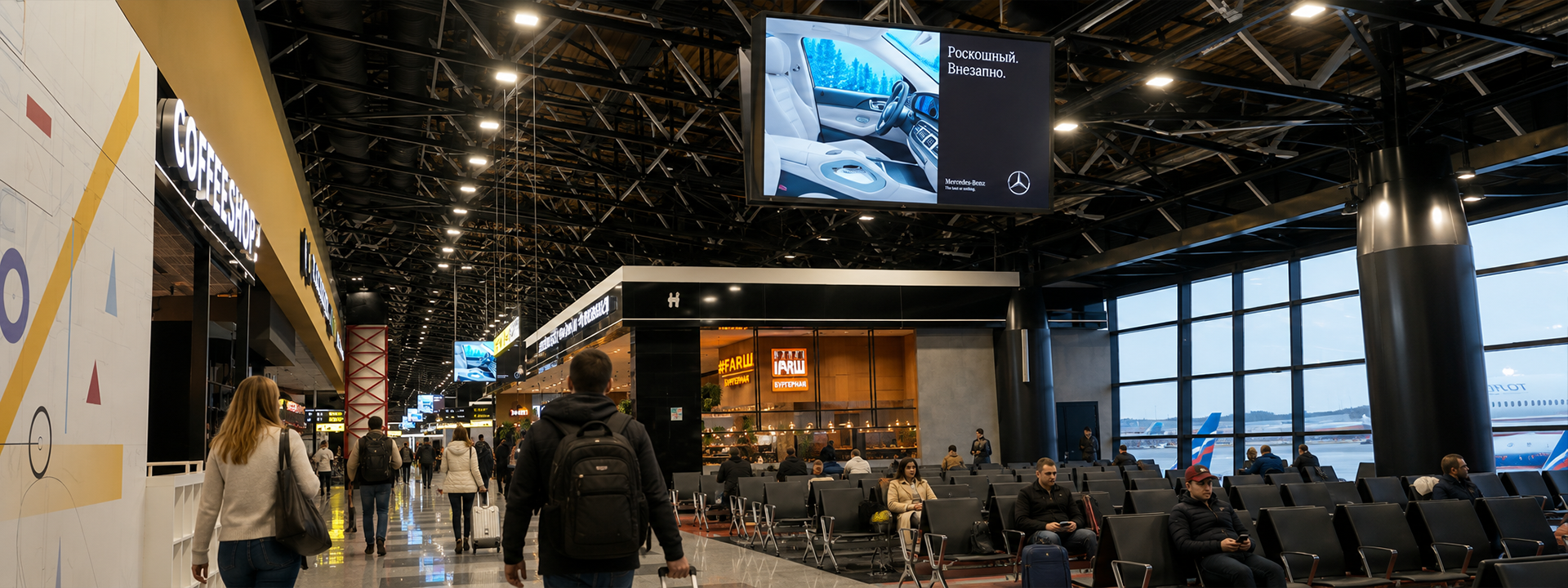
- SVO's scale and multi-terminal complexity creates a high-frequency, high-repetition brand exposure environment across Terminals B, C, and D whose combined daily passenger throughput — over 117,000 per day at the 43-million annual figure — means that premium brand campaigns achieve significant reach within Moscow's core professional and HNWI audience across the weekly advertising cycle.
- The premium positioning of SVO's commercial retail environment, including the Beluga Caviar Bar, extensive duty-free premium retail, Russian premium dining concepts, and the Radisson Blu five-star hotel connection, creates a brand association context that elevates premium and luxury advertiser positioning to match the quality of Moscow's most sophisticated commercial districts.
- Average dwell times at SVO are extended by the scale of the terminal complex, the Aeroexpress rail hub that concentrates passengers in the terminal 35 to 60 minutes before their gate, and the airport's retail and hospitality draw that keeps passengers commercially active throughout the pre-departure window and generates sustained brand exposure well beyond the initial check-in interaction.
- Masscom Global provides brands with strategic inventory access across SVO's terminal network, identifying premium placement positions in Terminal C's international departure environment, Terminal B's high-volume domestic professional audience zones, and the premium pre-departure lounge corridor that intercepts SVO's most purchasing-active audience segment at the moment of maximum brand receptivity.
Strategic Advertising Fit
Best Fit
- Turkish, UAE, and Southeast Asian destination marketing — tourism and real estate: No airport in Russia concentrates outbound leisure travel to Turkey, the UAE, and Southeast Asia at the same density as SVO. Destination marketing organisations, luxury resort brands, and real estate developers operating in Istanbul, Dubai, Antalya, Phuket, and Bali have direct access at SVO to the most engaged and purchasing-active outbound leisure audience in the Russian Federation.
- Premium financial services and domestic wealth management: Russian banks and financial institutions, CIS banking brands, and Asian financial services providers marketing premium products for Moscow's HNWI and upper-professional audience have access at SVO to the most concentrated premium financial services audience in Russia's aviation network.
- Luxury goods, watches, and premium accessories through available channels: The Russian luxury goods market at USD 2.31 billion in 2024 and growing continues to attract premium consumer brand investment. Brands with distribution through CIS, Turkish, UAE, and parallel import channels have access at SVO to an HNWI audience whose appetite for premium watches, jewellery, leather goods, and fashion accessories has not diminished.
- Premium automotive — particularly Asian and Turkish marques: Moscow's HNWI and professional class maintains its premium automotive aspiration through Chinese premium brands, parallel-imported European marques, and domestically available luxury vehicles. Premium automotive advertising at SVO reaches the most qualified premium automotive purchasing audience in Russia.
- CIS and China-Russia bilateral business services: B2B services, logistics, trade finance, and professional services brands serving the Russia-CIS and Russia-China corridors have access at SVO to the most concentrated executive decision-making audience in the Russian aviation network.
- Premium Russian domestic real estate and investment: Moscow's premium residential real estate market recorded record sales in 2024 as HNWI domestic asset allocation accelerated. Real estate developers marketing luxury Moscow, St. Petersburg, and premium regional properties have direct access at SVO to their most qualified domestic buyer audience.
- Premium travel, cruise, and luxury hospitality — non-EU destinations: Luxury cruise lines operating in the Mediterranean, the Maldives, and Southeast Asia, premium hotel chains in Istanbul, Dubai, and Southeast Asian resort markets, and luxury travel agencies serving Russia's outbound HNWI leisure market have direct access at SVO to a purchasing-active audience heading to or returning from their target destinations.
Brand Alignment at a Glance
| Category | Fit |
|---|---|
| Turkish, UAE, and Asian destination marketing | Exceptional |
| Premium financial services | Exceptional |
| Luxury goods through available channels | Strong |
| Premium automotive | Strong |
| CIS and China-Russia business services | Strong |
| Premium domestic real estate | Strong |
| Premium travel and luxury hospitality | Strong |
| EU or US brand campaigns requiring direct brand operations | Not currently applicable |
Who Should Not Advertise Here
- Brands whose campaign strategy requires operating legal entities or direct distribution infrastructure currently unavailable in the Russian market: Advertisers whose commercial model depends on purchasing journeys that require in-Russia brand operations not currently established should plan their SVO investment in conjunction with their distribution and sales infrastructure readiness.
- Products whose primary purchase driver is international mobility to Western European or North American destinations: The reorientation of SVO's international route network means that advertising tied to European or US destination travel has significantly lower audience alignment than advertising tied to Turkey, UAE, Asia, and CIS destinations.
- High-volume, low-margin mass-market categories: SVO's premium audience profile and the cost of premium terminal placements in Russia's largest airport make high-volume, low-margin consumer goods brands a poor commercial fit for the environment. The investment is best justified by high-ticket or high-frequency premium purchase categories whose audience quality at SVO commands the premium placement.
Event and Seasonality Analysis
- Event Strength: High
- Seasonality Strength: High
- Traffic Pattern: Dual-peak (summer leisure and New Year outbound) with a year-round corporate and CIS baseline at exceptional daily volume
Strategic Implication
Advertisers at SVO should structure investment around two primary peaks — the May-to-September summer leisure surge, which delivers the year's highest international terminal audience density across Turkey, Egypt, and Southeast Asian departure concentrations, and the December-to-January New Year outbound premium window, which delivers the year's most commercially intense premium purchasing environment as Moscow's HNWI audience activates its highest-spend leisure and gifting behaviour. Year-round baseline investment in Terminal B's domestic corporate environment is essential for any brand whose target audience is Moscow's professional class, given the 61-route domestic network that generates daily premium corporate passenger density entirely independent of the leisure seasonal calendar. Masscom Global structures SVO campaigns across all three of these audience dimensions simultaneously, ensuring that the airport's scale is fully activated for brands whose commercial objectives span both the leisure and corporate segments of Russia's largest and most commercially authoritative aviation audience.

Poor Placement and Delays Affect Airport Campaigns
We help you move faster, access better inventory, and get it right now.
Talk to an ExpertFinal Strategic Verdict
Sheremetyevo Alexander S. Pushkin International Airport is the single largest and most commercially authoritative airport advertising environment in Russia and one of the most significant in Europe by passenger volume. With over 43 million passengers in 2024, growing at 19 percent year-on-year, a Moscow metropolitan catchment contributing more than twenty percent of Russia's national GDP, and an outbound international route network now comprehensively oriented toward the Turkey, UAE, China, and CIS corridors where the most active Russian HNWI capital deployment is concentrated, SVO provides brands with access to a premium consumer audience whose purchasing power has grown in 2024 even as the broader global economic context has shifted. The Russian luxury goods market is expanding. Real disposable incomes grew 8.5 percent in 2024. Moscow's premium real estate set records. The Aeroflot premium business class product continues to attract Russia's most financially active travellers. For brands operating in the Turkey-UAE-Asia commercial corridor, for domestic Russian premium financial and luxury consumer brands, for CIS-oriented professional services, and for any advertiser whose target customer is the Russian HNWI outbound traveller or the Moscow upper-professional class, SVO is the only airport-scale access point to this audience in the Russian Federation — and Masscom Global has the intelligence, inventory relationships, and campaign architecture to ensure that every placement delivers the precision and premium impact that this extraordinary hub and its 43 million passengers deserves.
About Masscom Global
Masscom Global is a premium international airport advertising and media buying agency operating across 140 countries. With deep expertise in airport OOH, premium publications, and high-net-worth audience targeting, Masscom helps brands reach the world's most valuable travellers at the moments that matter most. For advertising packages, media rates, and campaign planning at Sheremetyevo Alexander S. Pushkin International Airport and airports across the globe, contact Masscom Global today.
Frequently Asked Questions
How much does airport advertising cost at Sheremetyevo International Airport? Advertising costs at SVO vary by format, terminal, placement position, campaign duration, and seasonal demand. The airport's scale across Terminals B, C, and D offers a range of investment levels from large-format digital display campaigns covering international departure corridors to premium domestic professional audience placements in Terminal B's high-frequency environment. Peak-season inventory in the summer and New Year windows commands premium rates reflecting the year's highest audience density. Contact Masscom Global for a current rate card and campaign proposal tailored to your brand's objectives and preferred audience segments at this airport.
Who are the passengers at Sheremetyevo International Airport? SVO's passenger base is built around three commercially distinct segments. The largest by volume is the domestic Russian professional traveller connecting between Moscow and Russia's regional capitals — a high-frequency, above-average-income audience whose corporate travel generates the airport's most consistent year-round premium audience density. The second is the Moscow HNWI and upper-professional outbound international leisure traveller heading to Turkey, Egypt, the UAE, and Southeast Asia — the most purchasing-active and premium-brand-aligned audience in the terminal during the summer and New Year peaks. The third is the CIS, Chinese, and Gulf inbound business and tourism audience arriving in Moscow for professional engagement, cultural tourism, and the premium commercial services that Moscow's status as Russia's dominant economic capital provides to the post-Soviet and Asian business community.
Is Sheremetyevo International Airport good for luxury brand advertising? SVO is a strong environment for luxury brands whose distribution and purchasing journey infrastructure is aligned with the current Russian market — including Turkish, UAE, CIS, and parallel import channels. Moscow's approximately 246,000 dollar millionaires represent one of the largest HNWI concentrations in Europe, and their premium consumption appetite has been confirmed by Russia's luxury goods market growth to USD 2.31 billion in 2024. Real disposable incomes grew 8.5 percent that year. Luxury residential real estate in Moscow set sales records. The SVO terminal's premium hospitality environment — including the Beluga Caviar Bar, Radisson Blu hotel, and Aeroflot Business Class lounges — supports premium brand association at a level consistent with the airport's status as Europe's ninth-busiest hub.
What is the best airport in Russia to reach HNWI audiences? Sheremetyevo International Airport is unambiguously Russia's premier airport for reaching the HNWI and upper-professional audience. SVO handles the majority of Russia's HNWI outbound leisure travel to Turkey, UAE, and Asia, concentrates Moscow's entire professional corporate travel base across its domestic routes, and serves as the hub for Aeroflot's premium Business Class product that attracts Russia's highest-spending frequent flyers. No other Russian airport approaches SVO's combination of passenger scale, HNWI audience concentration, and premium commercial environment for brands seeking access to Russia's most financially active consumer base.
What is the best time to advertise at Sheremetyevo International Airport? The two most commercially productive windows at SVO are the summer leisure peak from May through September, which delivers the year's highest international audience density as Moscow's professional and HNWI class activates Turkish, Egyptian, and Southeast Asian holiday travel, and the New Year outbound premium window in December and January, which delivers the year's most concentrated premium purchasing environment as Moscow's luxury consumer audience activates holiday, gifting, and short-break travel behaviour. Year-round investment in Terminal B's domestic corporate environment is recommended for brands targeting the Moscow professional audience independently of the leisure seasonal calendar.
Can Turkish and UAE destination brands advertise at Sheremetyevo International Airport? SVO is the most commercially productive airport in Russia for Turkish and UAE destination marketing. Turkey's outbound market from Moscow is among the largest bilateral leisure travel relationships in Russian aviation, with Antalya and Istanbul representing two of SVO's highest-volume international routes. The UAE — particularly Dubai — is the primary luxury lifestyle, real estate, and investment destination for Moscow's HNWI outbound audience, generating consistent year-round premium travel through the Dubai and Abu Dhabi routes. Turkish resort developers, Istanbul real estate brands, Dubai luxury hospitality brands, and UAE investment advisory services have direct access at SVO to the most engaged and purchasing-active Russian outbound audience for their respective markets.
Which brands should not advertise at Sheremetyevo International Airport? Brands whose commercial model requires purchasing journeys dependent on operating infrastructure not currently established in Russia should ensure their sales and distribution capabilities are aligned before committing to airport advertising investment. Products tied primarily to Western European or North American destination travel will find limited audience alignment given the current route network reorientation. High-volume, low-margin consumer brands that require mass population reach to justify premium terminal investment costs are a poor structural fit for an airport whose commercial value is defined by audience quality and purchasing authority rather than volume-driven impression delivery.
How does Masscom Global help brands advertise at Sheremetyevo International Airport? Masscom Global provides a fully integrated airport advertising service at SVO, combining deep audience intelligence on the airport's HNWI, corporate, outbound leisure, and inbound CIS and Asian passenger segments with inventory access and placement strategy across the terminal's premium advertising environments. We build campaigns around SVO's summer leisure and New Year premium peaks, the year-round domestic corporate audience, and the inbound CIS and Chinese business visitor calendar, ensuring that your brand reaches the right passenger in the right terminal environment at the exact moment their purchasing intent and brand receptivity are highest. For advertising packages, media rates, and campaign planning at Sheremetyevo Alexander S. Pushkin International Airport, contact Masscom Global today.