

Airport at a Glance
| Field | Detail |
|---|---|
| Airport | Baghdad International Airport |
| IATA Code | BGW |
| Country | Iraq |
| City | Baghdad |
| Annual Passengers | 5.8 million international (2023) |
| Primary Audience | Oil sector HNWIs, reconstruction economy decision-makers, Iraqi diaspora returnees |
| Peak Advertising Season | May to September, Eid periods, Arbaeen season |
| Audience Tier | Tier 1 |
| Best Fit Categories | International real estate, B2B infrastructure, financial services, luxury goods, premium automotive |
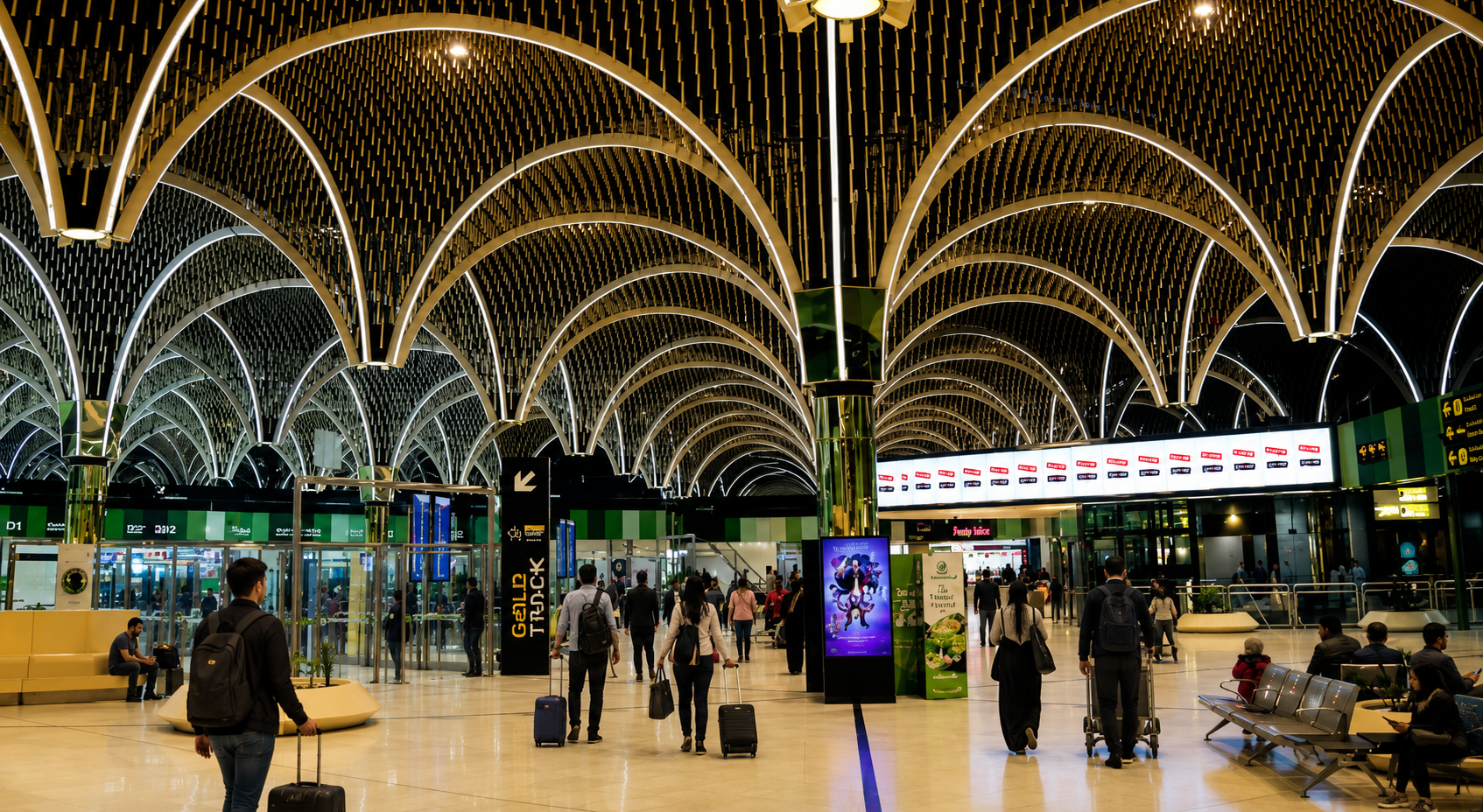
Baghdad International Airport is the commercial and logistical entry point to the Middle East's most rapidly transforming economy. With 5.8 million international passengers annually and a HNWI Score of High, BGW serves an audience unlike any other in the region: oil sector executives making billion-dollar procurement decisions, reconstruction entrepreneurs deploying capital across Iraq's largest infrastructure build-out in a generation, diaspora returnees arriving with European and Gulf spending standards, and international business professionals engaging with a sovereign market that now attracts serious foreign investment from Turkey, the UAE, China, and beyond. For advertisers willing to engage Iraq at this specific commercial moment, BGW is not a frontier bet. It is the point of entry to one of the largest emerging consumer economies in the Arab world.
Iraq's economic transformation since the stabilisation of 2017 to 2018 has accelerated with oil revenues sustaining government spending at scale, reconstruction contracts being awarded across every province, and a growing private sector whose consumer standards are rising in direct proportion to the capital flowing through the economy. Baghdad, as the country's dominant commercial, political, and population centre with eight to nine million residents, absorbs and redistributes this wealth through a business class whose international travel patterns, investment activity, and consumer behaviour increasingly mirror those of Amman, Dubai, and Istanbul. The airport that processes this audience is BGW, and the advertisers who understand Iraq's commercial moment first will claim the most valuable positions in this environment.
Advertising Value Snapshot
- Passenger scale: 5.8 million international passengers (2023), growing consistently as Iraq's aviation sector recovers and new international routes are added to serve commercial, diaspora, and religious travel demand
- Traveller type: Oil sector HNWIs and business executives, reconstruction economy contractors and investors, Iraqi diaspora returnees from Europe and Gulf states
- Airport classification: Tier 1 — Iraq's primary international gateway and the commercial aviation headquarters of a sovereign market generating over $90 billion in annual oil export revenue
- Commercial positioning: The entry and exit point for the reconstruction economy, where every major commercial decision affecting Iraq's $17 billion annual construction sector is influenced by travellers passing through this terminal
- Wealth corridor signal: BGW sits at the intersection of Iraq's oil wealth corridor, the Turkey-Iraq trade corridor, the UAE investment corridor, and the Europe-Iraq diaspora capital route simultaneously
- Advertising opportunity: Masscom Global provides inventory access and campaign execution capability at Baghdad International Airport, enabling brands to reach oil sector decision-makers, reconstruction economy HNWIs, and diaspora capital returnees within the single commercial gateway of a forty-million-person market that is deploying capital at scale and actively seeking international brand relationships.
Airport Advertising is Complex to Get Right
We help you execute faster, with proven results and local insight most planners lack starting now.
Talk to an ExpertCatchment Area and Economic Drivers
Top 10 Cities within 150 km — Marketer Intelligence
- Baghdad: Iraq's capital and economic centre, home to eight to nine million residents and the country's highest concentration of HNWIs including oil sector executives, government contractors, real estate developers, and import merchants; Baghdad's affluent districts of Karrada, Mansour, Jadiriyah, and Zayouna contain Iraq's densest premium consumer spending and the fastest-growing luxury retail environment in the country, making the capital itself the dominant advertiser audience and commercial justification for every campaign at BGW.
- Fallujah: A major Sunni Arab city in Anbar province approximately 65 km west of Baghdad, undergoing substantial reconstruction and commercial investment; the merchant class has deeply embedded trade networks connecting to Jordan, Syria, and Gulf markets; real estate development, retail brand entry, and construction materials are the primary commercial demand categories for Fallujah's rebuilding middle class, whose purchasing power is recovering strongly as the reconstruction economy injects capital into the Anbar corridor.
- Baquba: Capital of Diyala province approximately 50 km northeast, serving a mixed Sunni, Shia, and Kurdish demographic that gives the city a commercially diverse and resilient economic base; a strong agricultural economy anchored in pomegranates, citrus, and date production creates a merchant and agribusiness class with consistent commercial activity; government employees, agricultural traders, and small business owners form the primary advertiser audience, and Baquba's proximity to Baghdad makes it a significant residential and commercial satellite of the capital.
- Ramadi: Capital of Anbar province approximately 110 km west and the commercial hub of Iraq's largest provincial economy; oil infrastructure in the western desert generates contractor and energy sector incomes that sustain a professional consumer audience; the Anbar tribal business networks running through Ramadi connect to Jordan, Syria, and the Gulf, creating a cross-border trading class with multi-market commercial reach; reconstruction investment is creating strong B2B demand for construction, infrastructure, and business services brands.
- Karbala: Approximately 108 km south and one of the world's most commercially significant religious cities; the site of Imam Hussein's shrine attracts fifteen to twenty million annual visitors, primarily from Iran, Lebanon, Pakistan, India, and the global Shia diaspora; a rapidly growing luxury hospitality sector is being developed adjacent to the shrine complex to serve premium pilgrims; Karbala's business class holds strong commercial connections to Iran and Lebanon; the Arbaeen pilgrimage alone generates an annual traffic surge through the Baghdad-Karbala corridor that creates commercial volume unmatched by any other single religious event in the Shia world, and the volume of pilgrims transiting through BGW during this period creates a direct advertising opportunity at the airport.
- Hillah (Babylon Province): Capital of Babylon province approximately 100 km south, strategically positioned as the gateway to the ancient Babylon archaeological site that Iraq is developing for international heritage tourism under its reconstruction programme; a significant agricultural economy and a growing university sector create an educated professional class; the convergence of religious tourism from nearby Karbala and international cultural tourism to Babylon creates hospitality and commercial service investment that is expanding Hillah's consumer base rapidly.
- Samarra: Approximately 125 km north and home to the Al-Askari Shrine, one of the most sacred sites in Shia Islam; significant secondary religious tourism from Shia communities worldwide supplements the city's government and oil sector workforce; Saladin province's oil and gas infrastructure creates a contractor and energy sector economy whose professional audience travels through BGW for business and procurement purposes.
- Balad: Approximately 80 km north, a commercial and logistics centre benefiting from its position on Baghdad's main northern corridor; significant industrial and contractor economy activity linked to government infrastructure programmes; a growing civilian residential and commercial development belt serving Baghdad's northward expansion creates fast-rising consumer demand in automotive, home goods, and retail categories.
- Al-Mahmudiyah: Approximately 35 km south of Baghdad and part of the expanding Baghdad metropolitan belt; a significant agricultural centre experiencing rapid residential development as Baghdad's suburban boundary extends southward; a growing middle-class consumer audience with aspirational spending behaviour driven directly by economic spillover from the capital creates demand for consumer electronics, premium FMCG, and automotive brands.
- Taji: Approximately 25 km north of Baghdad, home to a major industrial area and a large government and contractor workforce whose incomes are above the national average; fast-growing residential development serving Baghdad's northern suburban expansion is creating a new consumer audience layer; commercial and light industrial investment is accelerating as Baghdad's economic growth extends outward along the Taji corridor.
NRI and Diaspora Intelligence
The Iraqi diaspora is one of the Arab world's largest and most commercially significant, formed across five decades of conflict, sanctions, and displacement that scattered millions of Iraqi families to the United Kingdom, Sweden, Germany, the Netherlands, Denmark, Australia, the United States, Jordan, and Gulf states. The UK alone hosts an estimated 450,000 to 500,000 Iraqis, with major communities concentrated in London. Sweden has one of the highest per-capita Iraqi immigrant concentrations in Europe. The US hosts approximately 300,000 to 400,000 Iraqi Americans. Annual remittances into Iraq are estimated at approximately two to three billion dollars, a figure that understates the actual capital flow since many diaspora returnees travel with cash, goods, and investment capital that enters the economy outside formal remittance channels. The diaspora returnee arriving through BGW carries Western and Gulf consumption standards acquired over years of living abroad, creating an audience at the airport with internationally calibrated spending expectations, premium brand familiarity, and the purchasing power to match. For advertisers, this means the BGW arrivals hall is as commercially productive as the departures terminal.
Economic Importance
Iraq's economy is driven by oil revenues that now exceed ninety billion dollars annually, placing Iraq among OPEC's top three producers and creating a government spending capacity that funds massive reconstruction, infrastructure, and social investment across every province. The reconstruction economy, worth an estimated seventeen billion dollars in annual construction activity, creates a contractor and supplier class whose procurement decisions are made by executives who travel through BGW regularly. The private sector is accelerating alongside the public investment: Baghdad's real estate market has seen price appreciation comparable to Dubai's growth periods, retail brands are entering the market at scale, and banking sector development is creating a financial services professional class whose consumer and investment behaviour is transforming the airport's commercial audience. For advertisers, this economic context means BGW is not an airport of a developing market with aspirational audiences. It is an airport of a capital economy with serious money moving through it.
Business and Industrial Ecosystem
- Oil and gas sector: Iraq is OPEC's second-largest producer, and the executives, engineers, and commercial managers of state-owned Iraqi oil companies, international joint venture partners, and petroleum service contractors represent a high-income, internationally travelled professional audience that uses BGW as their primary departure and arrival point for global business travel
- Reconstruction and infrastructure contracting: Iraq's ongoing reconstruction programme, funded by oil revenues and international investment, has created an enormous class of construction contractors, project managers, engineering consultants, and procurement officers whose purchasing decisions affect billions in annual commercial value and who travel internationally through BGW to source materials, equipment, and partnerships
- Real estate and commercial development: Baghdad's property market is experiencing a sustained boom driven by returning diaspora investment, government infrastructure spending, and the commercial confidence of Iraq's stabilising business environment; real estate developers, architects, interior designers, and commercial property investors represent an active and growing commercial audience at BGW
- Import and wholesale trade: Iraq imports the vast majority of its consumer goods from Turkey, China, UAE, and Jordan; Baghdad's wholesale merchant class, which controls distribution across Iraq's forty million consumer market, is a commercially powerful B2B audience that travels frequently through BGW for trade fairs, sourcing trips, and supplier meetings
- Banking and financial services: Iraq's banking sector modernisation is creating a new professional class of bankers, fintech entrepreneurs, and financial advisors whose consumer and commercial profiles align with premium advertiser categories; Islamic banking and international correspondent banking relationships are driving the sector's expansion and its international travel requirements
Passenger Intent — Business Segment
The business traveller at BGW is making decisions of significant commercial scale. Oil sector procurement officers are sourcing capital equipment worth tens of millions of dollars. Construction contractors are closing contracts for infrastructure projects worth hundreds of millions. Import merchants are buying for distribution networks that serve forty million consumers. Real estate developers are acquiring land, financing deals, and sourcing international partners. Every one of these professionals travels through BGW with active purchasing decisions in progress, making the airport's business traveller audience not merely a premium consumer target but an active B2B decision-maker audience that is more commercially accessible at the point of travel than at any other touchpoint a brand could choose.
Strategic Insight
BGW's business audience is commercially valuable in a way that goes beyond the airport's current passenger numbers. Iraq's reconstruction economy is in a phase where capital is abundant, investment decisions are being made rapidly, and the business class is actively seeking international brand relationships in real estate, financial services, professional services, and premium consumer goods. An advertiser who positions their brand at BGW today is speaking to the same audience that Dubai advertisers reached in 2005 to 2008, when the Gulf's transformation created a generation of commercially ambitious, internationally aspiring business professionals looking for the right international brands to grow alongside. Masscom's intelligence on this audience and their procurement priorities is structured to help brands seize that positioning now.
Tourism and Premium Travel Drivers
- Karbala and the Arbaeen Pilgrimage: The world's largest annual human gathering, drawing fifteen to twenty million Shia Muslim pilgrims to Karbala each year during the forty days following Ashura; pilgrims arrive through BGW from Iran, Lebanon, Pakistan, India, Australia, and the global Shia diaspora, creating a concentrated inbound premium travel surge that represents one of the most commercially significant religious tourism events on the planet for hospitality, retail, and gift-oriented advertiser categories
- Ancient Mesopotamian Heritage Sites: Babylon, Ur, Ctesiphon, and the broader Mesopotamian archaeological landscape are being developed under Iraq's tourism reconstruction programme as UNESCO and international heritage tourism destinations; the international cultural tourists and heritage professionals arriving through BGW represent a premium, intellectually engaged traveller profile with high accommodation and experiential spending capacity
- Baghdad's Cultural and Historic City Centre: The Abbasid Palace, the Iraqi Museum, Al-Mutanabbi Street, and Baghdad's historic districts are drawing growing cultural tourism interest as the city's security and hospitality infrastructure improve; the international media, diplomacy, and academic professionals visiting Baghdad are commercially sophisticated, internationally mobile travellers whose spending profile aligns with premium hospitality and lifestyle brands
- Najaf and the Shia Religious Tourism Circuit: While Najaf is approximately 160 km from Baghdad, it functions as the southern anchor of a religious tourism circuit with Karbala that generates enormous inbound traffic through BGW; international religious visitors completing both holy cities in a single journey transit through the Baghdad airport environment during their arrival and departure, adding millions of pilgrimage-motivated travellers to BGW's commercial audience annually
Passenger Intent — Tourism Segment
International tourists and pilgrims arriving through BGW have committed significant budgets to their Iraq journeys before departure. The premium Arbaeen pilgrim has often saved for years for this specific journey and arrives with gift-purchasing intent, premium accommodation expectations, and a heightened receptiveness to quality brand messaging at the airport. Cultural heritage tourists to the Mesopotamian sites represent a high-income, internationally experienced traveller profile whose per-day expenditure significantly exceeds average tourist averages. Both segments are highly receptive to premium hospitality, luxury goods, and destination-branded merchandise at the point of departure, making the airside retail environment at BGW commercially productive for the right categories.
Travel Patterns and Seasonality
Peak seasons:
- May to September (Summer Peak): Iraqi families, particularly those in the upper-income bracket, travel during school holidays to Turkey, the UAE, and Europe for leisure; diaspora families based in Europe and Australia return home for extended summer visits, bringing internationally calibrated consumer spending into Baghdad; the summer window is the highest combined volume period for both outbound leisure travel and diaspora arrivals
- Eid al-Fitr (annual, follows Ramadan): The largest single travel event at BGW; families travel to and from Gulf employment destinations, diaspora returnees arrive for Eid celebrations, and consumer spending across luxury gifts, fashion, jewelry, and premium FMCG peaks in the two weeks surrounding the holiday
- Eid al-Adha (annual, Dhul Hijjah): A secondary Eid peak aligned with the Hajj and pilgrimage season; outbound traffic to Saudi Arabia for Hajj is significant from BGW, generating pre-pilgrimage gift and personal care spending at the airport
- Arbaeen Season (annual, Safar): One of the most commercially distinctive traffic patterns of any airport in the region; inbound pilgrim arrivals from Iran, Lebanon, Pakistan, and India surge through BGW in the forty days following Ashura as millions make the Karbala pilgrimage; the arrivals environment at BGW during Arbaeen season is saturated with spiritually motivated, gift-intent international passengers
Event-Driven Movement
- Arbaeen Pilgrimage (annual, Safar): The world's largest human gathering in nearby Karbala brings millions of inbound international travellers through BGW, creating one of the most commercially concentrated single-event audience surges of any airport in the region; hospitality, premium food, gift categories, and health products find maximum audience receptiveness during this window
- Eid al-Fitr (annual): Iraq's highest single departure-and-arrival traffic week; diaspora families visiting from Europe, Australia, and Gulf states arrive with Western and Gulf-calibrated spending standards; outbound Iraqi travellers depart for leisure and family visits with strong gift-purchasing intent; luxury goods and premium FMCG brands achieve peak conversion during the pre-Eid retail window
- Iraq's National Days and Political Milestones: Government delegations, diplomatic missions, and official visitor traffic creates consistent premium business travel through BGW around national events, generating a captive B2B and professional audience for financial services and luxury brands at specific concentrated moments
- Baghdad International Fair (October): Iraq's most significant annual trade exhibition draws international companies across construction, agriculture, technology, and consumer goods categories to Baghdad; the fair generates a concentrated inbound business traveller surge of procurement professionals and commercial decision-makers whose purchasing intent is at its highest point of the year
- Academic Calendar Departures (August to September): Iraqi families sending students to international universities in the UK, USA, Australia, Turkey, and Jordan create a concentrated premium departure wave; parents accompanying students to enrolment are active consumers of financial services, international banking, premium luggage, and technology products at the point of departure
It’s Not Just Where You Advertise - It’s How Fast You Execute
We combine local insight with fast rollout to deliver results for you, now.
Talk to an ExpertAudience and Cultural Intelligence
Top 2 Languages
- Arabic: The primary language of government, commerce, and daily life across the entire Baghdad catchment; Iraqi Arabic dialect is distinctive and campaign creative that uses authentic Iraqi Arabic register demonstrates the cultural proximity that builds commercial trust with this audience; Modern Standard Arabic serves the formal business audience effectively; Arabic-language messaging reaches the entirety of BGW's domestic and regional Arab passenger base without friction
- English: The language of B2B commerce between Iraqi businesses and international suppliers, engineering and oil sector contractors, diplomatic and NGO professionals, and the returning diaspora from the UK, Australia, and North America; English-language messaging reaches the most commercially active decision-making segment at BGW, specifically the oil sector executive, the reconstruction contractor, and the internationally educated business professional who uses English as the working language of their commercial life
Major Traveller Nationalities
Iraqi nationals form the dominant passenger base, traveling primarily to Turkey, UAE, Jordan, and Germany for business, education, and leisure. Iranian nationals represent the most significant non-Iraqi international segment, traveling to and through Baghdad for commerce, family visits, and pilgrimage access to Karbala and Najaf; Iraq-Iran trade is worth over ten billion dollars annually, and the commercial relationship between Tehran and Baghdad produces a consistent high-frequency business traveller flow through BGW. Turkish nationals travel in significant numbers as a reflection of Turkey's role as Iraq's largest trade partner, with bilateral trade exceeding twenty billion dollars annually. European passport holders of Iraqi origin returning for family visits and business represent a commercially powerful segment whose spending standards reflect years of living in Germany, Sweden, the Netherlands, and the UK. Gulf nationals, particularly from Kuwait and the UAE, travel to Baghdad for business investment and commercial activity as Gulf-Iraq economic relations normalise and deepen.
Religion — Advertiser Intelligence
- Islam, Shia (approximately 60 to 65%): The Shia Muslim majority in Baghdad and the broader catchment generates a set of commercially powerful religious observance patterns; Ashura and its forty-day aftermath culminating in Arbaeen create the most commercially distinctive traffic pattern at BGW, as inbound pilgrim arrivals from Iran, Lebanon, Pakistan, and India surge through the airport; Ramadan generates elevated gift and luxury purchasing across the Shia community; Eid al-Fitr and Eid al-Adha drive both the largest outbound departure surges and the most concentrated inbound diaspora arrival windows of the year; for advertisers, the Shia religious calendar at BGW creates layered commercial windows across eight to nine months of the year that a continuous presence strategy can activate systematically
- Islam, Sunni (approximately 35 to 40%): Baghdad's Sunni community, concentrated particularly in the western districts of the city and in the Anbar province catchment, follows the same Eid and Ramadan commercial patterns as the broader Sunni Arab world; Hajj season generates significant outbound travel from Baghdad's Sunni community toward Saudi Arabia, creating pre-pilgrimage gift and personal care spending peaks; the Sunni merchant class of Baghdad and Ramadi, which controls significant import and wholesale trade, represents a high-value B2B audience whose travel and commercial behaviour reflects the broader Levant business community pattern
- Christianity (approximately 1 to 2%): Iraq's Assyrian, Chaldean, and Armenian Christian communities, significantly reduced from their pre-2003 size, are disproportionately well-educated, multilingual, and commercially active; strong diaspora ties to Australia, Sweden, the USA, and Germany mean that returning Iraqi Christians arrive at BGW with internationally calibrated consumption standards and above-average purchasing power; Christmas and Easter create secondary travel peaks for this community with strong family gift and luxury spending intent
Behavioral Insight
The Iraqi traveller, and particularly the Baghdad business professional, combines strong social intelligence and relationship-driven commercial behaviour with an acute sensitivity to brand prestige signals and quality indicators. Decades of exposure to scarcity during sanctions periods have created a consumer psychology in the older wealth generation that prizes abundance, quality, and brand legitimacy with extraordinary intensity. The younger generation of Iraqi HNWIs, educated abroad and commercially active in the reconstruction economy, is converging rapidly on Gulf and European consumption standards, driven by social media, diaspora family influence, and direct international travel experience. Both generations respond to brand messaging that signals exclusivity, durability, and international credibility. Trust in an advertiser brand at this airport is built through premium placement, quality creative, and consistent presence, not through discounting or transactional messaging.
Outbound Wealth and Investment Intelligence
The outbound passenger at Baghdad International Airport is deploying capital at a scale and speed that reflects Iraq's oil economy rather than its GDP per capita. The reconstruction business class, enriched by a decade of infrastructure contracting, oil sector employment, and real estate development, is actively diversifying wealth into international real estate, foreign bank accounts, second residencies, and offshore assets as a hedge against domestic political and currency risk. The Iraqi HNI investor is not merely wealthy. They are urgently seeking international asset diversification, and they are making those decisions while they wait to board at BGW.
Outbound Real Estate Investment
Dubai and Abu Dhabi remain the primary real estate investment destinations for Iraq's HNWI outbound investors, offering AED-denominated stability, Golden Visa qualifying investment thresholds, and a Gulf lifestyle proximity that Iraq's wealthiest families have long preferred for their second-home purchases. Istanbul is the fastest-growing real estate market for Iraqi investors, driven by Turkey's citizenship-by-investment programme, price accessibility relative to the Gulf, and the cultural and linguistic familiarity that Iraq's Turkmen population and Baghdad's Ottoman-era merchant families maintain with Turkey. Amman is deeply embedded in the Iraqi investment psyche: hundreds of thousands of Iraqis have owned property in Jordan for decades as a stability hedge, and the Jordan real estate market remains a core first-step investment for Iraq's middle-upper class. London attracts the upper tier of the HNWI segment, particularly for families placing children in British universities and seeking premium asset-class property in a stable legal framework. Cyprus, Greece, and Portugal represent the EU Golden Visa tier for Iraqi investors seeking European residency exposure and portfolio diversification beyond the Gulf.
Outbound Education Investment
The United Kingdom is the dominant international education destination for Iraqi students from affluent families, with deep historical and cultural ties between the Iraqi professional class and British higher education. The USA and Australia represent the primary alternative destinations, particularly for medicine, engineering, and business programmes at leading research universities. Turkey is growing rapidly as an education destination, offering proximity, lower costs than Western alternatives, and improving university quality that is increasingly recognised across the Arab world. Jordan serves as a regional education hub with multiple internationally affiliated universities that attract a significant middle-income Iraqi student population. Education consulting, university advertising, and student financial services brands that deploy at BGW reach a family audience that is actively comparing international education options and often making final decisions on the academic calendar departure wave from August to September.
Outbound Wealth Migration and Residency
The demand for second residency and citizenship-by-investment programmes among Iraq's HNWI class is driven by a combination of wealth preservation instinct, desire for international mobility, and the practical commercial advantage of holding a second passport for business travel and banking access. UAE Golden Visa through property investment is the most understood and actively pursued programme, given Iraq's deep commercial relationship with Dubai. Turkey's citizenship-by-investment programme, requiring USD 400,000 in qualifying real estate, has attracted significant Iraqi uptake as the most accessible major citizenship programme in the immediate neighbourhood. Caribbean programmes including St Kitts and Nevis, Dominica, and Grenada are growing in awareness among Baghdad's business class through legal and financial advisors who market the mobility benefits of a second passport alongside the investment requirements. Wealth management firms, offshore legal services, residency advisory companies, and international banking brands find a commercially active and urgently motivated audience at BGW, whose outbound investment appetite is among the highest in the Arab world.
Strategic Implication for Advertisers
International brands serving the outbound investment and residency market should treat BGW as a tier-one priority deployment, because Iraq's HNWI class is not merely interested in international investment. They are actively motivated by domestic circumstances to deploy capital offshore as a structural priority, not a lifestyle preference. The urgency of that commercial motivation makes BGW's HNWI outbound audience one of the most high-conversion targets for international real estate, financial services, and residency products in the MENA region. Masscom Global structures BGW campaigns to reach this audience with the creative sophistication and placement precision that converts intent into action at the terminal level.
Airport Infrastructure and Premium Indicators
Terminals
- Baghdad International Airport operates multiple terminal facilities, with the primary international terminal handling the majority of commercial international passenger traffic; terminal capacity and quality have been progressively upgraded since 2018 as Iraq's aviation sector has grown and new international airline partners have demanded improved ground infrastructure
- A dedicated VIP terminal and protocol facility handles government, diplomatic, and VVIP travel separately from commercial operations, reflecting the airport's role as the entry and exit point for a sovereign government with significant international diplomatic traffic
Premium Indicators
- Multiple airline lounges, including Iraqi Airways' business class facility and pay-access lounges for partner carrier passengers, provide a premium environment confirming a consistent business class and HNWI passenger concentration above the commercial economy baseline
- Private and charter aviation operations serve Iraq's HNWI class, oil sector contractors, and diplomatic missions requiring non-scheduled departure and arrival, adding a high-value VVIP passenger layer to the airport's commercial audience
- A growing duty-free retail zone houses perfumery, electronics, luxury goods, and premium food brands, confirming the airport management's recognition of its passenger base's spending capacity and the commercial case for premium retail investment
- The airport is operating within an active expansion and modernisation programme that includes terminal infrastructure upgrades, retail and hospitality zone development, and airside improvements that are progressively bringing BGW's commercial environment to a standard competitive with regional peers in Amman and Istanbul
Forward-Looking Signal
Baghdad International Airport is at the beginning of a transformation cycle aligned with Iraq's broader economic reconstruction, with expansion plans that include new terminal capacity, enhanced international airline connectivity, and commercial zone development calibrated to a passenger base that is projected to grow significantly as Iraq's consumer economy matures and international business investment accelerates. New direct airline route agreements are being established to European diaspora hubs including Stockholm and Berlin, deepening the airport's reach into the returning diaspora travel market. Saudi-Iraqi economic normalisation is opening commercial aviation corridors that were previously absent, and deepening UAE-Iraq commercial ties are adding frequency on the Gulf routes that carry Iraq's most commercially active business travellers. Masscom advises clients to secure advertising positions at BGW now, before the infrastructure completion and route expansion of the next three to five years drives competitive pressure on the best inventory positions in the terminal.
Airline and Route Intelligence
Top Airlines
Iraqi Airways, Turkish Airlines, flydubai, Air Arabia, Qatar Airways, Gulf Air, Royal Jordanian, EgyptAir, Emirates, Iran Air, Mahan Air, Pegasus Airlines, FlyBaghdad, Air Arabia Abu Dhabi, Kuwait Airways, Middle East Airlines
Key International Routes
- Dubai (DXB/DWC): Multiple daily flights, consistently among the highest-frequency routes at BGW and the primary Gulf wealth corridor for Iraqi HNWI and business travel
- Istanbul (IST): Multiple daily operations reflecting Turkey's dominant bilateral trade relationship with Iraq and the enormous Turkish real estate and commercial investment audience flowing through this route
- Amman (AMM): Multiple daily flights connecting Baghdad's business and diaspora community to Jordan's regional commercial hub and the gateway to European and Western connections via Royal Jordanian
- Doha (DOH): Daily operations serving the Qatar Airways network and the Gulf business travel corridor
- Kuwait City (KWI): Daily operations reflecting the close commercial relationship between Iraq and Kuwait and the significant bilateral business travel
- Tehran (IKA): Multiple weekly operations on Iranian carriers serving the Iraq-Iran trade corridor, one of the most commercially active bilateral trade relationships in the region
- Cairo (CAI): Multiple weekly services connecting BGW to Egypt's commercial and diplomatic network
- Beirut (BEY): Multiple weekly services serving the Lebanese business community with commercial interests in Baghdad's reconstruction economy
- Abu Dhabi (AUH): Daily operations deepening the UAE-Iraq investment and business corridor
- London (LHR): Direct and connecting services serving Iraq's large UK diaspora and the diplomatic-professional travel corridor between Baghdad and London
Domestic Connectivity
Baghdad serves as Iraq's primary domestic aviation hub with frequent connections to Erbil (EBL), Basra (BSR), Sulaymaniyah (ISU), and Najaf (NJF), linking the capital to Iraq's Kurdish region commercial centres, its southern oil hub, and its religious tourism circuit. Domestic connectivity at BGW means the airport functions as the commercial convergence point for passengers originating across Iraq's entire geography, significantly expanding the effective commercial catchment beyond the Baghdad metro area to include Basra's oil sector audience and Erbil's international business community.
Wealth Corridor Signal
BGW's route network encodes the architecture of Iraq's commercial relationships with precision. The Turkey corridor, by far Iraq's largest bilateral trade partner, carries procurement officers, commercial agents, real estate investors, and importers whose combined transaction value is the largest of any single trade corridor passing through the airport. The Gulf corridor (Dubai, Doha, Abu Dhabi, Kuwait) carries Iraq's HNWI investment audience, the oil sector's internationally connected executives, and the diaspora returnees from Gulf employment. The Jordan corridor serves as the bridge to European and Western connections for Iraq's internationally mobile business class. The Iran corridor carries the commercial weight of a bilateral trade relationship worth over ten billion dollars annually, concentrated in goods, energy, and services that flow through Baghdad as the primary commercial gateway. For advertisers, the message of BGW's route map is that this airport connects the world's most commercially active bilateral relationships of the Arab Middle East through a single terminal, making it a high-leverage brand positioning environment well above its current passenger volume.
Media Environment at the Airport
- BGW's terminal infrastructure is operating within a modernisation cycle that is progressively improving the physical quality and commercial attractiveness of its media environment, creating an early-mover advantage for brands that establish premium placement positions before competition for the best inventory intensifies
- The airport's passenger mix of oil sector executives, reconstruction contractors, diaspora returnees, and international business professionals creates an extended average dwell time profile driven by the complexity and volume of check-in and security processing for international routes, giving advertising placements sustained passive exposure across the full passenger journey
- The environment at BGW, while evolving, has already attracted premium duty-free retail, international airline business lounges, and hospitality infrastructure that signals to advertisers an audience whose spending capacity justifies premium placement investment
- Masscom Global has established inventory access and campaign execution capability at Baghdad International Airport, with the local knowledge of terminal flow patterns, seasonal audience variations, and placement positioning that independent planners operating without in-market intelligence consistently lack
Strategic Advertising Fit
Best Fit
- International real estate developers: The Iraqi HNWI outbound audience is among the most urgently investment-motivated in the Arab world; Dubai, Istanbul, Amman, London, and Cyprus developers find a high-intent, decision-ready audience at BGW whose capital deployment instinct has been sharpened by domestic investment constraints, making conversion rates for well-positioned campaigns significantly higher than regional averages
- B2B infrastructure, construction, and engineering brands: Iraq's seventeen-billion-dollar annual construction sector creates a professional audience of procurement directors, project managers, and engineering contractors at BGW who are actively sourcing international suppliers; capital goods, construction materials, engineering software, and infrastructure services brands intercept decision-makers whose annual procurement authority runs into the hundreds of millions
- Financial services, private banking, and wealth management: The combination of oil wealth, reconstruction economy income, and the urgent need for offshore asset diversification creates one of the most commercially receptive private banking audiences in the MENA region at BGW; Islamic finance, international wealth management, correspondent banking, and offshore financial products address a need that is structural and growing
- Luxury goods, fashion, and jewelry: Baghdad's HNWI and upper-middle class are accelerating luxury consumption in direct proportion to the reconstruction economy's capital generation; luxury fashion, jewelry, and premium goods brands that establish early presence at BGW build brand familiarity with a consumer audience that is growing rapidly toward the Gulf consumption standards their diaspora relatives have already reached
- Premium automotive: Iraq has one of the highest rates of luxury vehicle aspiration in the Arab world, driven by oil wealth, reconstruction incomes, and the social signalling importance of premium vehicles in Iraqi business culture; German, Japanese, and American luxury automotive brands with distribution in Iraq find a high-conversion audience at BGW that is both aspirational and capable of immediate purchase
- Healthcare and medical tourism: Iraq lacks world-class medical infrastructure across most specialities, and outbound medical tourism to Jordan, Turkey, UAE, and Germany is a significant commercial activity for the upper-income segment; international hospitals, specialist clinics, and medical travel facilitators find an actively searching, high-urgency audience at BGW that is prepared to commit significant budgets to quality healthcare abroad
- International education and university brands: Iraq's reconstruction economy is driving parental investment in international university education as a class-signalling priority; UK, US, Australian, and Turkish universities and education consultancies reach a family audience at BGW that is simultaneously making final enrolment decisions during the August to September departure wave
- Golden Visa and second citizenship programmes: The structural need for wealth diversification and international mobility among Iraq's HNWI class makes residency-by-investment products one of the highest-intent advertising categories at BGW; UAE, Turkish, Cypriot, and Caribbean programme providers find an audience whose motivation to purchase is driven by practical necessity as much as lifestyle aspiration
Brand Alignment at a Glance
| Category | Fit |
|---|---|
| International Real Estate | Exceptional |
| B2B Infrastructure and Construction | Exceptional |
| Financial Services and Wealth Management | Exceptional |
| Luxury Goods and Jewelry | Strong |
| Premium Automotive | Strong |
| Healthcare and Medical Tourism | Strong |
| International Education | Strong |
| Golden Visa and Residency | Strong |
| Mass-Market Budget Retail | Poor fit |
Who Should Not Advertise Here
- Alcohol brands: While Iraq's regulatory environment on alcohol is less restrictive than Saudi Arabia, the overwhelmingly Muslim audience at BGW and the cultural norms of Iraqi society make alcohol advertising both commercially ineffective and reputationally risky; the brand association with a 97% Muslim audience in an Islamic cultural context creates audience dissonance that undermines brand trust
- Budget value and discount consumer brands: The self-selecting airport audience at BGW skews strongly toward the Iraqi middle class and above, whose aspirational consumption behaviour is oriented toward premium positioning rather than price sensitivity; value messaging fails to resonate with an audience that uses brand prestige as a social signal and considers price-led advertising a signal of poor quality
- Products with no Iraq-relevant commercial context: Hyper-local consumer brands from markets that have no trade, diaspora, or tourism relationship with Iraq's commercial catchment will generate near-zero brand engagement at BGW; the airport audience is commercially sophisticated and internationally aware, and irrelevant advertising wastes both budget and placement quality in a terminal where the right brands find genuine and growing commercial traction
Event and Seasonality Analysis
| Factor | Rating |
|---|---|
| Event Strength | High |
| Seasonality Strength | High |
| Traffic Pattern | Dual-Peak with Event Surges |
Strategic Implication
Advertisers at BGW should structure campaigns around two primary investment windows: the May to September summer peak, which delivers the highest combined volume of outbound Iraqi leisure travellers and inbound diaspora returnees in a single sustained period, and the pre-Eid windows, which generate the year's most intense consumer spending intent for gift, luxury, and premium category purchases. The Arbaeen season represents a third distinct commercial window that brands targeting the premium Shia pilgrim audience, particularly hospitality, gift, and religious lifestyle products, should treat as a standalone activation opportunity within the annual plan. Masscom structures BGW campaigns to maintain continuous brand presence across the summer and pre-Eid peaks while incorporating targeted burst activations aligned to the Arbaeen season and the Baghdad International Fair, maximising both brand recall across the year and conversion efficiency within the highest-intent windows.

Poor Placement and Delays Affect Airport Campaigns
We help you move faster, access better inventory, and get it right now.
Talk to an ExpertFinal Strategic Verdict
Baghdad International Airport is the commercial gateway to a forty-million-person oil economy that is deploying capital at scale across real estate, infrastructure, consumer goods, and financial services simultaneously, and whose HNWI audience is among the most urgently investment-motivated in the Arab world. With 5.8 million international passengers, a HNWI Score of High, and a route network that encodes Iraq's most commercially active bilateral relationships with Turkey, the UAE, Jordan, Iran, and Europe, BGW offers advertisers access to an audience making decisions worth billions in annual commercial value within a single terminal environment. The reconstruction economy is not a background condition at this airport. It is the commercial identity of every executive, contractor, developer, and diaspora professional who passes through it, and the brands that establish credibility and presence at BGW now are positioning themselves as the preferred international partners of a business class that will define Iraq's commercial landscape for the next two decades. Masscom Global has the local intelligence, inventory access, and execution capability to secure that positioning for your brand, starting now.
About Masscom Global
Masscom Global is a premium international airport advertising and media buying agency operating across 140 countries. With deep expertise in airport OOH, premium publications, and high-net-worth audience targeting, Masscom helps brands reach the world's most valuable travellers at the moments that matter most. For advertising packages, media rates, and campaign planning at Baghdad International Airport and airports across the globe, contact Masscom Global today.
Frequently Asked Questions
How much does airport advertising cost at Baghdad International Airport? Advertising costs at Baghdad International Airport vary based on format type, terminal placement, campaign duration, and seasonal demand. Premium placements in the international departures zone, business class check-in corridors, and airside retail areas carry different rate structures, and peak windows around the summer travel season and pre-Eid periods attract the highest demand from competing advertisers. BGW is currently in a phase where premium inventory is available at rates that reflect the market's development stage rather than its commercial potential, creating a significant value opportunity for brands that move early. Contact Masscom Global for current rate cards, available inventory positions, and campaign packages calibrated to your budget and audience objectives.
Who are the passengers at Baghdad International Airport? BGW's 5.8 million annual international passengers are primarily Iraqi nationals and residents traveling for business, education, and leisure, with significant inbound traffic from Turkey, Iran, and Gulf states reflecting Iraq's dominant bilateral commercial relationships. The business traveller segment includes oil sector executives, reconstruction contractors, import merchants, and real estate developers whose purchasing authority and income levels place them firmly in the HNWI and upper-professional tier. The diaspora returnee segment, arriving from the UK, Germany, Sweden, Australia, and Gulf states, carries Western and Gulf consumption standards that significantly elevate the airport's commercial value beyond what domestic income statistics alone would suggest.
Is Baghdad International Airport good for luxury brand advertising? Yes, with important qualification about category alignment. Baghdad's HNWI and upper-middle class are active luxury consumers whose spending on premium goods, vehicles, fashion, and jewelry has grown significantly with the reconstruction economy's capital generation. The diaspora returnee audience carries internationally calibrated luxury brand familiarity. Gulf-standard aspiration drives premium purchase intent among the airport's business professional class. Luxury brands whose identity aligns with quality, durability, and international prestige find a genuinely receptive audience at BGW. The qualification is that luxury brands should lead with premium positioning and quality signals rather than Western secular lifestyle imagery, given the cultural context and the Muslim audience majority.
What is the best airport in Iraq to reach HNWI audiences? Baghdad International Airport is Iraq's primary commercial gateway and the airport serving the country's largest concentration of HNWIs, oil sector wealth, and reconstruction economy capital. Erbil International Airport in the Kurdistan Region serves a commercially sophisticated secondary audience with its own HNWI character and is worth considering for brands targeting the Kurdish business community and northern Iraq's international investor base. For Iraq-wide reach and access to the country's dominant business and wealth audience, BGW is the primary investment priority, with Erbil as a valuable complement for campaigns requiring national breadth.
What is the best time to advertise at Baghdad International Airport? The primary advertising window at BGW is May to September, when the summer travel peak combines outbound Iraqi leisure travel with the highest volume of inbound diaspora returnees carrying European and Gulf spending standards. The pre-Eid al-Fitr window, typically three to four weeks before the holiday, delivers the year's highest concentration of luxury gift and premium goods purchasing intent. The Arbaeen season window provides a distinct secondary opportunity for brands targeting the Shia religious tourism audience. The Baghdad International Fair in October creates a concentrated B2B decision-maker surge. Masscom recommends a year-round presence strategy with intensified activations across these four windows for brands seeking maximum commercial return at BGW.
Can international real estate developers advertise at Baghdad International Airport? International real estate advertising at BGW is one of the highest-fit and highest-conversion advertising categories at this airport. The outbound HNWI audience is actively deploying capital into Dubai, Istanbul, Amman, London, and Cyprus property markets and arrives at the terminal with offshore investment as a structural financial priority rather than an aspirational aspiration. Gulf real estate developers, Turkish citizenship-by-investment platforms, Jordanian property developers, and European Golden Visa programme operators all find an urgently motivated, commercially sophisticated audience at BGW whose purchasing decisions are supported by real capital. Masscom has experience structuring real estate campaigns at BGW and can advise on creative strategy, timing, and placement optimisation for both the outbound Iraqi HNI buyer and the international investor visiting Iraq.
Which brands should not advertise at Baghdad International Airport? Alcohol brands face both regulatory constraints and categorical audience misalignment in a terminal serving a 97% Muslim passenger base. Budget and value-positioning consumer brands have no viable audience overlap with the self-selected upper-income, aspirational passenger base at BGW, where brand prestige is a purchasing trigger rather than price sensitivity. Hyper-local brands from markets without a commercial, diaspora, or tourism relationship to Iraq will register as contextually irrelevant to an internationally aware, commercially sophisticated audience. Any brand messaging that conflicts with Islamic values or Iraqi cultural norms will generate negative brand association rather than recall in this environment.
How does Masscom Global help brands advertise at Baghdad International Airport? Masscom Global provides the audience intelligence, local market knowledge, inventory access, and campaign execution capability that brands need to operate effectively at one of the Arab world's most commercially distinctive and rapidly evolving airport environments. We understand BGW's seasonal intensity patterns, the commercial profile of the reconstruction economy audience, the diaspora returnee spending cycle, and the B2B procurement calendar that drives the airport's business traveller behaviour. We secure high-quality inventory placements with the speed that competitive markets require, execute campaigns with the precision that complex Middle Eastern airport environments demand, and deliver local insight that independent planners operating from outside the market cannot replicate. Contact Masscom Global today to begin planning your campaign at Baghdad International Airport.