




Airport at a Glance
| Field | Detail |
|---|---|
| Airport | Viru Viru International Airport |
| IATA Code | VVI |
| Country | Bolivia |
| City | Santa Cruz de la Sierra |
| Annual Passengers | 2.1 million |
| Primary Audience | Agribusiness executives, gas and energy sector professionals, HNI Bolivian families |
| Peak Advertising Season | June to August, November to February |
| Audience Tier | Tier 2 |
| Best Fit Categories | Financial services, international real estate, luxury consumer goods, international education |
Viru Viru International Airport is the commercial gateway to Santa Cruz de la Sierra, Bolivia's largest city and the engine behind the country's most productive economic sector. While Bolivia's political capital sits at altitude in La Paz, the wealth is concentrated in Santa Cruz, and Viru Viru is where that wealth travels. The airport processes a concentrated, commercially significant audience of agribusiness magnates, natural gas sector executives, financial professionals, and upper-tier Bolivian families who move regularly across South America and beyond. With 2.1 million annual passengers, the volume is selective by design, and the audience quality is correspondingly high.
This is not a transit airport or a mass-market hub. Viru Viru is a purpose-built gateway for a city that has emerged as one of South America's fastest-growing commercial centres over the past four decades. Advertisers operating in financial services, international real estate, premium consumer goods, and international education will find an audience here that carries genuine purchasing power, outbound investment intent, and a demonstrated appetite for global consumption. Understanding who travels through VVI, and why, is the foundation of any intelligent campaign.
Advertising Value Snapshot
- Passenger scale: 2.1 million annual passengers, driven by Bolivia's agribusiness and energy export economy
- Traveller type: Agribusiness executives, gas and mining sector professionals, HNI Bolivian families with regional and international travel patterns
- Airport classification: Tier 2 — Bolivia's primary international commercial gateway, serving the country's wealthiest catchment
- Commercial positioning: The airport of Bolivia's economic capital, connecting the country's productive wealth to regional business corridors and outbound investment destinations
- Wealth corridor signal: VVI anchors a corridor connecting Santa Cruz's commodity wealth to Miami, São Paulo, Buenos Aires, and Panama City — all key financial and investment hubs for this audience
- Advertising opportunity: Masscom Global provides full campaign access across Viru Viru's terminal environment, combining local market intelligence with execution capability that most international planners cannot replicate from outside Bolivia. The concentration of commercial audience at VVI makes this a high-efficiency buy for brands targeting South American commodity wealth.
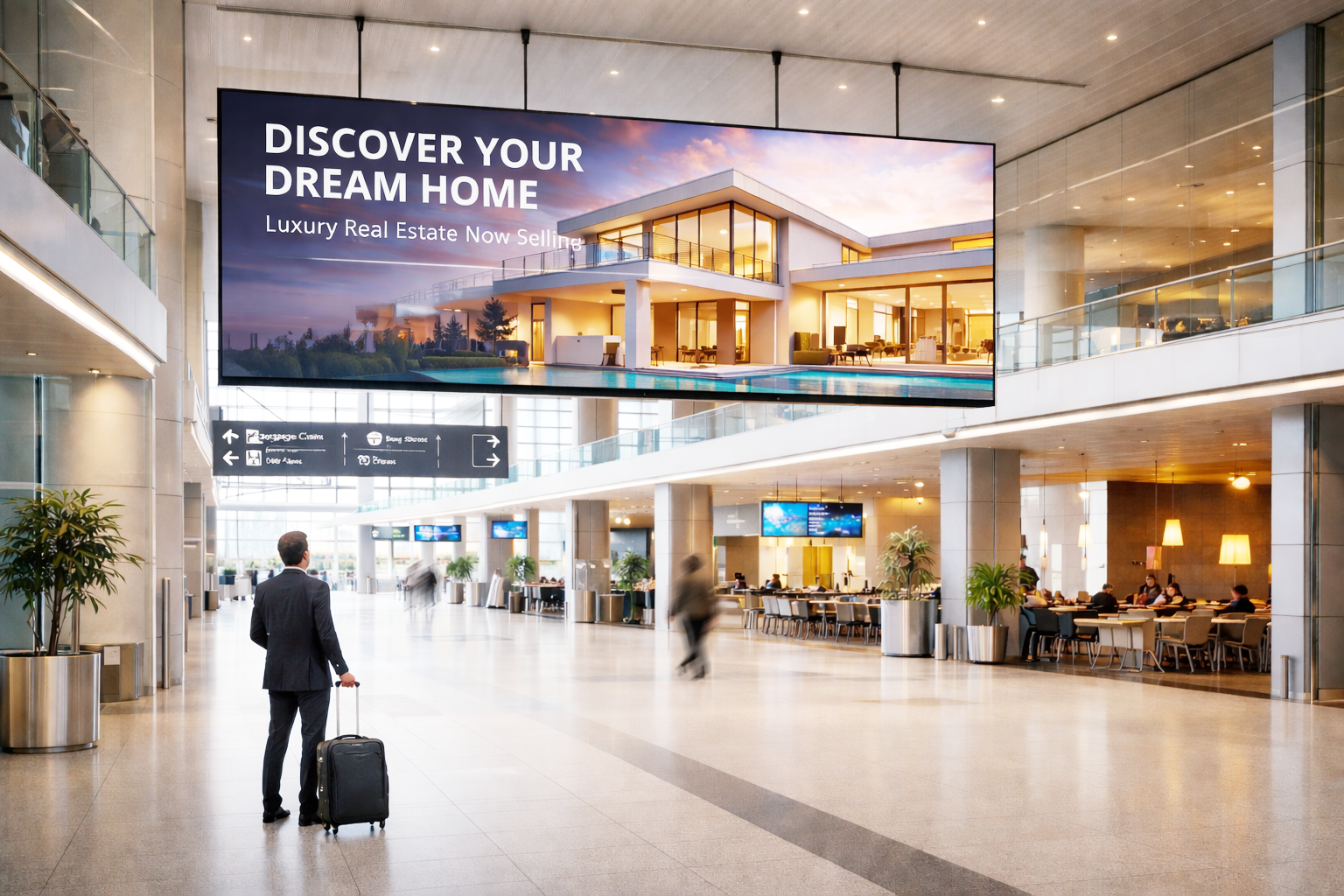
Airport Advertising is Complex to Get Right
We help you execute faster, with proven results and local insight most planners lack starting now.
Talk to an ExpertCatchment Area and Economic Drivers
Top 10 Cities within 150 km — Marketer Intelligence
- Santa Cruz de la Sierra: Bolivia's largest city and commercial nerve centre, home to the country's highest concentration of agribusiness and energy sector executives, financial professionals, and high-spending consumer families. This audience sets the consumption benchmark for the entire country.
- Montero: The sugar capital of Bolivia, producing audiences of agricultural landowners, sugar mill operators, and agribusiness supply chain managers with significant accumulated wealth and a need for financial and real estate products.
- Warnes: Bolivia's fastest-growing industrial municipality, generating audiences of factory owners, logistics operators, and industrial investors who are expanding operations and accessing capital markets for the first time at scale.
- La Guardia: A satellite municipality with dense residential growth and a population of mid-to-upper managers who commute to Santa Cruz's corporate sector, producing an audience of aspirational, brand-aware, credit-active consumers.
- Cotoca: A growing residential and agricultural town east of Santa Cruz with a settled population of landowners and established merchants who travel regularly for trade and family purposes.
- El Torno: A Vallegrande-connected agricultural zone producing agribusiness supply chain travellers and rural landowners who access the airport through Santa Cruz for both domestic and international travel.
- Portachuelo: A commercial agricultural hub with a population of established farming families and cooperative leaders, generating buyers of agricultural inputs, financial services, and premium goods with growing travel frequency.
- Buena Vista: The ecotourism gateway to Amboró National Park, attracting affluent Bolivian and international travellers engaged in nature tourism, generating an audience for premium outdoor brands and travel insurance products.
- Yapacaní: A colonisation zone north of Santa Cruz with a growing population of agricultural settlers who have converted land into productive export operations and are now accessing banking, insurance, and logistics services at scale.
- Samaipata: A high-value second-home destination for wealthy Santa Cruz families, sitting approximately 120 km southwest of the city. The community includes foreign retirees, wealthy weekend residents, and arts patrons whose primary travel hub is VVI.
NRI and Diaspora Intelligence
The Bolivian diaspora is concentrated most heavily in Argentina, Spain, Brazil, Chile, and the United States, with Miami standing as the single most commercially important city for Bolivia's upper tier. Wealthy Santa Cruz families maintain second homes, business interests, and education investments in Miami, and the VVI-MIA corridor is among the most commercially productive wealth-transfer routes in the Andean region. Bolivian residents abroad send remittances that are economically significant at the macro level, but the more commercially relevant diaspora story for advertisers is the inbound flow: Santa Cruz receives return visits from Bolivians who have built assets abroad and are deciding where to deploy capital next. This audience is receptive to international real estate, financial products, and global lifestyle brands at the point of airport contact.
Economic Importance
Santa Cruz de la Sierra accounts for approximately one-third of Bolivia's GDP, driven primarily by soybean production, natural gas exports, sugar, sunflower oil, and an increasingly diversified financial and services sector. The city has transformed from a remote lowland town into Bolivia's commercial capital within a single generation, creating a class of new-money entrepreneurs and established agricultural dynasties simultaneously. For advertisers, this means an audience that is wealth-active rather than wealth-passive: they are making investment decisions, acquiring assets, expanding operations, and seeking financial products that reflect their growing global ambitions. The agribusiness sector in particular has deep connections to Brazilian, Argentine, and European commodity markets, which produces an audience with genuine international commercial exposure.
Business and Industrial Ecosystem
- Agribusiness and commodity exports: Bolivia is among the top global producers of soybeans, producing landowners, cooperative heads, and commodity traders who travel extensively across South America and into global commodity markets
- Natural gas and energy sector: Bolivia holds among the largest natural gas reserves in South America, generating executives and government contractors who move between Santa Cruz, Buenos Aires, São Paulo, and European energy hubs
- Financial services and banking: The growth of Santa Cruz's economy has produced a concentrated banking and microfinance sector, generating compliance officers, investment managers, and fintech founders who travel to regional financial centres
- Import and logistics: Santa Cruz serves as Bolivia's primary inland distribution hub, producing an audience of import agents, logistics directors, and trade finance professionals with high travel frequency and strong brand awareness
Passenger Intent — Business Segment:
Business travellers at VVI are predominantly commodity-sector executives, energy professionals, and financial services leaders who travel for deal-making, trade negotiations, and investment management. They travel primarily to São Paulo, Buenos Aires, Miami, Bogotá, and Lima, and they are receptive to financial products, technology solutions, premium hospitality, and wealth management services at the point of departure. Their dwell time is characterised by deal preparation and productivity rather than leisure browsing, making premium digital and ambient formats the most effective intercept.
Strategic Insight:
Viru Viru operates at the intersection of commodity wealth and financial ambition. The business audience here is not a corporate salary class — it is predominantly an ownership class, with decisions to make about capital allocation, cross-border investment, and asset protection. Advertisers offering products with a clear ROI narrative — international real estate with yield, offshore banking, business insurance, premium B2B software — will find this audience unusually receptive because the underlying motivation for travel is already commercially oriented.
Tourism and Premium Travel Drivers
- Jesuit Missions of the Chiquitania (UNESCO World Heritage): A circuit of six baroque mission churches in Bolivia's eastern lowlands, attracting heritage tourism from Europe, North America, and affluent Bolivian families — audiences with high accommodation and cultural spend
- Amboró National Park: One of South America's most biodiverse protected areas, generating premium ecotourism traffic from international travellers with significant experience spend and a receptivity to outdoor lifestyle and travel insurance brands
- El Fuerte de Samaipata (UNESCO World Heritage): A pre-Columbian archaeological site combined with a colonial-era town that serves as a weekend destination for Santa Cruz's upper class and an international archaeological tourism draw
- Pantanal Gateway: Santa Cruz serves as an access point for Bolivia's section of the Pantanal wetlands, one of the world's largest tropical wetlands, drawing high-spend wildlife tourism from Europe, North America, and Japan
Passenger Intent — Tourism Segment:
Tourists departing through VVI have already committed significant spend to accommodation, guides, and travel logistics. They arrive at the airport in a post-experience mindset, often seeking products that extend or memorialise the experience: premium travel accessories, photographic equipment, outbound travel insurance for the next journey, and luxury goods as souvenirs. International tourists using VVI tend to be mature, high-spend, culturally engaged travellers, making them a strong fit for premium lifestyle, fine spirits, and adventure travel brands.
Travel Patterns and Seasonality
Peak seasons:
- June to August (dry season): Bolivia's most comfortable climate window drives peak domestic and international leisure travel, with high footfall from both outbound Bolivians and inbound heritage and ecotourists
- November to February (summer holidays): School holiday and Carnival season generates the highest family travel volumes of the year, with significant outbound movement to Argentina, Brazil, Chile, and Miami
- March to April (Holy Week): A culturally significant domestic travel period, generating strong movement across Bolivia's regional airports and inbound family visits
Event-Driven Movement:
- Carnival de Santa Cruz (February): One of Bolivia's most celebrated Carnival traditions, generating significant inbound traffic from across South America and the Bolivian diaspora abroad. Brands targeting the affluent local family audience and diaspora returnees will find this the highest-concentration awareness window of the year.
- Feria Exposición de Santa Cruz (September): Bolivia's largest agricultural and industrial trade fair, drawing tens of thousands of domestic and regional business visitors and generating peak B2B audience concentration at VVI. Financial services, agribusiness technology, and logistics brands have a direct interception opportunity at this window.
- Bolivian Independence Day (August 6): A strong domestic travel trigger generating movement across Bolivia's internal route network, with families and government-linked travellers producing additional footfall at VVI.
- Departmental Anniversary of Santa Cruz (September 24): A locally significant celebration that drives inbound visits from Bolivians living in other cities and abroad, producing an audience of returning high-value consumers with retail and dining intent.
- Christmas and New Year (December to January): Peak outbound family travel to Miami, Buenos Aires, and São Paulo, producing the year's highest concentration of HNWI departing passengers with luxury goods and international financial product receptivity.

It’s Not Just Where You Advertise - It’s How Fast You Execute
We combine local insight with fast rollout to deliver results for you, now.
Talk to an ExpertAudience and Cultural Intelligence
Top 2 Languages
- Spanish: The primary commercial language of Santa Cruz and the broader VVI audience. All campaign creative targeting the Bolivian business class, HNI families, and domestic travellers must operate in Spanish with a register that reflects educated, commercially sophisticated consumers rather than mass-market communication.
- Portuguese: Commercially relevant due to the significant Brazilian business community operating in Santa Cruz's agribusiness sector. Brazilian investors, commodity traders, and corporate travellers use VVI regularly for the São Paulo corridor, making Portuguese-language creative a viable secondary format for campaigns targeting this bilateral business community.
Major Traveller Nationalities
The dominant nationality at VVI is Bolivian, concentrated from Santa Cruz's agribusiness and energy sectors. The second-largest nationality group is Brazilian, reflecting the deep commercial integration between Santa Cruz's soy belt and Brazil's agricultural export infrastructure. Argentine business and leisure travellers form a consistent third tier, followed by executives and professionals from Colombia, Peru, and Chile who access Bolivia's resource sector. American business and tourism travellers use the Miami route consistently, making this corridor significant for luxury, financial, and real estate categories targeting both sides of the journey.
Religion — Advertiser Intelligence
- Roman Catholicism (approximately 75%): The dominant faith and cultural framework for Santa Cruz's established families and the rural agricultural communities of the catchment. Key advertising windows include the lead-up to Holy Week (March to April), Corpus Christi (June), and the Christmas period. Family travel, gifting, charitable giving, and property investment tend to spike in these windows, creating strong timing opportunities for real estate, financial services, and premium retail brands.
- Evangelical and Protestant Christianity (approximately 18%): A rapidly growing community across Santa Cruz and its satellite municipalities, particularly within entrepreneurial and upwardly mobile business-owner families. This audience is characterized by high financial discipline, aspirational consumer behaviour, and a strong orientation toward education investment for their children. International schools, education consultancies, and financial planning services have a natural fit with this audience profile.
- Japanese Bolivian community (less than 1% but commercially significant): The Japanese-Bolivian community, concentrated in the Okinawa and San Juan de Yapacaní colonisation zones, represents one of Bolivia's most economically successful agricultural minorities. Japanese Bolivians are among the highest agricultural landowners per capita in the region, and their travel behaviour includes regular visits to Japan as well as South American agricultural trade events. Brands operating in precision agriculture, luxury goods, and financial services will find this community a high-yield microaudience.
Behavioral Insight:
The Santa Cruz business class operates with an entrepreneurial rather than a salaried mindset. Wealth here was built through land, commodity cycles, and trade rather than inherited institutions, which produces a consumer who is commercially aggressive, reward-oriented, and responsive to exclusivity signals. They make decisions quickly when the value proposition is clear, and they are accustomed to operating across multiple currencies and regulatory environments simultaneously. Campaigns that lead with outcome, status confirmation, and access to curated global networks will consistently outperform generic aspirational messaging at this airport.
Outbound Wealth and Investment Intelligence
The outbound passenger at Viru Viru International Airport represents one of the most commercially underserved HNWI audiences in South America. Bolivia's agribusiness boom has created significant new wealth in Santa Cruz over the past two decades, but the domestic financial infrastructure has not kept pace with the appetite for diversification. The result is a class of high-net-worth individuals and families who are actively seeking outbound real estate, education, residency options, and wealth management products — and who travel through an airport where international advertisers in these categories have relatively low competitive presence. For brands in real estate, private banking, education, and immigration services, VVI represents a high-yield, low-clutter channel.
Outbound Real Estate Investment:
Miami, Florida is the single most important international real estate market for Santa Cruz's HNI audience. The combination of dollarised assets, rental yield potential, proximity via the direct VVI-MIA route, and established Bolivian community presence in South Florida makes Miami a consistent investment destination. Buenos Aires has historically attracted Bolivian real estate investment due to cultural proximity and price accessibility, though Argentine macroeconomic volatility has moderated this flow. Panama City is a growing destination for Bolivian buyers seeking a dollar-denominated legal environment, international banking access, and low barriers to purchase. Dubai has begun to emerge as an aspirational market for younger Santa Cruz entrepreneurs attracted by the tax-free environment and yield potential.
Outbound Education Investment:
Families in Santa Cruz's upper tier are among the most education-focused in South America, and the trajectory strongly favours international tertiary education. The United States — particularly universities in Florida, Texas, and California — receives the highest number of students from Santa Cruz's HNI families, with the VVI-MIA corridor serving as the primary academic pathway. Argentina and Chile attract a secondary tier of students, driven by cost accessibility and cultural familiarity. Spain receives a growing share of postgraduate and MBA-track students from Bolivia's professional class. International universities, foundation year programmes, and education consultancies operating in these markets will find VVI's departing family audience consistently receptive, particularly in the June to August pre-academic window.
Outbound Wealth Migration and Residency:
Demand for alternative residency and second citizenship among Santa Cruz's business class is growing, driven by a desire for asset diversification, travel document flexibility, and education access for children. Portugal's Golden Visa programme has attracted interest from Bolivian HNWIs despite recent adjustments to its terms. The United States EB-5 investor visa remains a long-term goal for the most ambitious tier of the Santa Cruz business community. Paraguay's straightforward residency process and proximity have made it a tactical option for those seeking regional flexibility. Panama and the UAE have emerged as interest markets for Bolivian entrepreneurs seeking operational bases outside Bolivia's regulatory environment.
Strategic Implication for Advertisers:
International brands operating in real estate, wealth management, immigration services, and private education are operating at a structural advantage at VVI because competition for the attention of this specific audience is relatively sparse at the airport itself. Masscom Global can activate inventory at Viru Viru and simultaneously extend campaigns to the destination airports — Miami, Bogotá, São Paulo, Panama City — where this same audience arrives. A coordinated corridor strategy across VVI and its key connecting airports delivers a frequency and impact combination that no individual airport buy can replicate.
Airport Infrastructure and Premium Indicators
Terminals:
- Viru Viru International Airport operates a single integrated terminal building designed to serve both domestic and international passengers, with separation occurring post-security at the boarding gate level. The terminal covers approximately 33,000 square metres and has undergone successive expansion phases to accommodate growing passenger volumes from Santa Cruz's economic growth.
- The terminal infrastructure includes a dedicated international departures area with duty-free retail, food and beverage outlets, and airline lounges accessible to premium-class passengers and frequent flyer card holders. This concentration of premium passenger movement in the international zone creates a high-value dwell environment for luxury and financial advertising formats.
Premium Indicators:
- Multiple airline lounges operated by BoA and accessible to premium international airline partners, concentrating Bolivia's highest-spending travellers in a defined, high-dwell-time environment ideal for financial services, luxury goods, and real estate advertising
- Private aviation and executive charter operations are available through separate FBO-style facilities at Viru Viru, serving Bolivia's agribusiness and energy sector principals who prefer discreet, scheduled travel for business purposes
- The airport sits adjacent to Santa Cruz's expanding northern urban corridor, which is home to the city's newest luxury residential developments, gated communities, and premium hotel brands, reinforcing the commercial affluence of the immediate catchment around the terminal
- Viru Viru has consistently served as Bolivia's primary international aviation hub, giving it a status within the country that elevates the airport environment's commercial association for arriving and departing international brands
Forward-Looking Signal:
Bolivia's agribusiness sector is in a structural growth phase driven by expanding soybean cultivation, new export markets in Asia, and infrastructure investment in the Santa Cruz department. Planned road and rail connectivity improvements between Santa Cruz and Pacific ports are expected to intensify the city's role as a regional logistics hub, which will drive executive travel volumes upward. Masscom Global advises brands considering this airport to act on current inventory rates and access conditions before increased commercial interest from regional and international advertisers tightens availability and pricing over the next two to three years.
Airline and Route Intelligence
Top Airlines:
- Boliviana de Aviación (BoA)
- Amaszonas
- LATAM Airlines
- American Airlines
- Avianca
- Copa Airlines
- Flybondi
- JetSMART
Key International Routes:
- Miami (USA) via American Airlines — the primary HNWI wealth transfer corridor
- Bogotá (Colombia) via Avianca — regional business hub connection
- Lima (Peru) via LATAM — Pacific gateway and trade route
- Santiago (Chile) via LATAM — financial services and education corridor
- São Paulo (Brazil) — agribusiness and commodity trade hub
- Buenos Aires (Argentina) — cultural, business, and real estate corridor
- Panama City (Panama) via Copa — banking, financial services, and onward connections
Domestic Connectivity:
- La Paz (seat of government; political, mining, and public sector travel)
- Cochabamba (Bolivia's third city; manufacturing and food processing)
- Sucre (constitutional capital; legal and institutional travel)
- Oruro (mining corridor)
- Trinidad (Beni department; cattle ranching and Amazon resource sector)
Wealth Corridor Signal:
The VVI-MIA route is the single most commercially significant corridor in this route network for advertisers. It carries a disproportionate concentration of Bolivia's HNI outbound movement — families relocating children to US universities, business owners checking on Miami real estate holdings, and executives meeting North American commodity buyers. The Bogotá and São Paulo routes carry the next tier of business intent, while the Buenos Aires corridor serves a dual purpose of business and leisure for Santa Cruz's upper-middle and wealthy families. Domestic routes are predominantly driven by government, mining, and agricultural logistics travel, producing a different but still commercially active audience tier.
Media Environment at the Airport
- Viru Viru's terminal offers a relatively low-clutter advertising environment compared to larger regional hubs, meaning that brand placements achieve stand-out visibility that is difficult to replicate in more saturated markets such as Lima or Bogotá
- Average dwell times at VVI are driven by domestic connection waiting periods and international check-in protocols that routinely produce 90-to-120-minute pre-departure windows, providing sustained brand exposure across digital, ambient, and large-format formats
- The concentration of high-value passengers in the international departures area, combined with the airport's role as Bolivia's primary wealth-transit hub, creates a premium environmental association that elevates brand perception for any category operating in this space
- Masscom Global maintains established inventory access and execution capability at Viru Viru, enabling fast campaign deployment with format selection, positioning, and creative execution optimised for the specific audience concentration patterns of this terminal
Strategic Advertising Fit
Best Fit:
- International real estate developers (Miami, Dubai, Panama, Portugal): The outbound investment intent of VVI's HNI audience is well-documented and structurally driven by Bolivia's dollarisation needs and education migration patterns. Real estate developers advertising at VVI intercept buyers who are already psychologically committed to international property.
- Private banking and wealth management: The agribusiness and energy sector wealth concentrated in Santa Cruz is actively seeking diversification products, cross-border investment management, and offshore account structures. VVI is the primary point of access to this audience.
- International universities and education consultancies: Families departing through VVI for the Miami corridor are often transiting children into US educational institutions. Universities in Florida, Texas, and Spain with scholarship and foundation programmes will find this audience precisely calibrated.
- Luxury consumer goods (watches, jewellery, spirits, leather goods): The established merchant and landowner class of Santa Cruz has significant accumulated wealth and a demonstrated appetite for luxury brand acquisition, particularly in the duty-free environment.
- Premium automotive brands: The Santa Cruz business class has high vehicle acquisition rates and a preference for premium SUV and pickup categories, making both luxury and premium-utility automotive brands a strong contextual fit.
- Immigration and residency services: Demand for second residency and alternative citizenship programmes is rising among Santa Cruz's professional and business-owner class, making this airport a primary interception point for immigration consultancies.
- Business travel and premium hospitality: Regional hotel brands, executive aviation services, and business travel management platforms will find a consistent, repeat-travel audience at VVI.
- Agricultural technology and agribusiness services: A category that is uniquely specific to this airport — the agribusiness executives who make up a significant share of VVI's business audience are active buyers of precision agriculture technology, commodity financial instruments, and export logistics solutions.
Brand Alignment at a Glance
| Category | Fit |
|---|---|
| International Real Estate | Exceptional |
| Private Banking / Wealth Management | Exceptional |
| International Education | Strong |
| Luxury Consumer Goods | Strong |
| Premium Automotive | Strong |
| Immigration / Residency Services | Strong |
| Agricultural Technology | Moderate |
| Mass market FMCG | Poor fit |
Who Should Not Advertise Here
- Budget and discount retail brands: The audience profile at VVI is oriented toward quality, status, and investment return rather than price sensitivity. Low-cost propositions are misaligned with the terminal's commercial environment.
- Mass-market consumer packaged goods: With 2.1 million annual passengers, VVI does not offer the volume required to justify mass-market campaign efficiency, and the audience concentration is too wealth-specific for broad FMCG spend.
- Domestic tourism campaigns for Bolivia: The departing international audience at VVI has already made Bolivia their destination by arriving; inbound domestic tourism messaging has no interception logic at this terminal.
Event and Seasonality Analysis
- Event Strength: High
- Seasonality Strength: High
- Traffic Pattern: Dual-Peak
Strategic Implication:
Advertisers should plan VVI campaigns around two distinct audience peaks: the dry season window of June to August, which delivers the highest concentration of inbound premium tourism and outbound business travel; and the November to February window, which combines family outbound travel, Carnival inbound diaspora, and school holiday departures. Masscom Global structures campaign timing and format selection around these peaks, ensuring that real estate, education, and luxury brands are positioned at maximum concentration windows while B2B campaigns are timed to the September Feria Exposición trade fair cycle.

Poor Placement and Delays Affect Airport Campaigns
We help you move faster, access better inventory, and get it right now.
Talk to an ExpertFinal Strategic Verdict
Viru Viru International Airport is Bolivia's most commercially concentrated advertising environment and one of South America's most underactivated HNWI channels. The airport serves a city that has built serious wealth across a single generation — agribusiness dynasties, energy sector principals, financial operators — and that wealth is now in active outbound deployment across real estate, education, residency, and international investment. The combination of a low-clutter terminal environment, a clearly defined HNI audience, and strong directional travel intent to Miami, São Paulo, Bogotá, and Buenos Aires makes VVI an unusually efficient buy for international brands that understand where Bolivia's money is going and want to intercept it at the point of departure. Masscom Global has the inventory access, local market intelligence, and execution infrastructure to turn this opportunity into a live campaign — and the window to act on current access conditions before broader international advertiser interest closes it.
About Masscom Global
Masscom Global is a premium international airport advertising and media buying agency operating across 140 countries. With deep expertise in airport OOH, premium publications, and high-net-worth audience targeting, Masscom helps brands reach the world's most valuable travellers at the moments that matter most. For advertising packages, media rates, and campaign planning at Viru Viru International Airport and airports across the globe, contact Masscom Global today.
Frequently Asked Questions
How much does airport advertising cost at Viru Viru International Airport?
Airport advertising costs at Viru Viru International Airport vary based on format type, terminal positioning, campaign duration, and seasonal demand cycles. Peak windows around Carnival, the Feria Exposición trade fair, and the June to August dry season typically command premium positioning rates. Masscom Global works with brands to identify the right format mix and timing to achieve maximum impact within their budget parameters. Contact Masscom for current rates, available inventory, and customised package options.
Who are the passengers at Viru Viru International Airport?
The core audience at VVI is Bolivia's agribusiness and energy sector executive class, based in Santa Cruz de la Sierra. This includes soybean and sugar landowners, natural gas sector principals, financial services professionals, and upper-tier Bolivian families with established wealth. The international traveller mix includes Brazilian commodity traders, Argentine business visitors, Colombian and Peruvian executives, and American tourism and business travellers on the Miami route. The audience is commercially active, investment-oriented, and concentrated in a way that is unusual for an airport of this passenger volume.
Is Viru Viru International Airport good for luxury brand advertising?
Yes, for the right categories. Viru Viru carries a HNWI Score of High, reflecting the genuine wealth concentration in Santa Cruz's agribusiness and energy sectors. Luxury consumer goods, premium watches, fine spirits, and investment-oriented luxury products have a well-aligned audience at VVI. The key consideration is format and positioning: the international departures zone and lounge-adjacent placements deliver the highest concentration of premium audience, and Masscom Global can advise on the specific formats and placements that maximise luxury brand impact.
What is the best airport in Bolivia and the Andean region to reach HNWI audiences?
Within Bolivia, Viru Viru International Airport is unequivocally the leading HNWI advertising environment, significantly outperforming La Paz's El Alto Airport in terms of commercial wealth concentration and outbound investment intent. Within the broader Andean region, VVI sits alongside Lima's Jorge Chávez and Bogotá's El Dorado as a core node in the South American wealth corridor, with a distinct advantage in agribusiness-sourced HNI audience that neither Lima nor Bogotá can replicate. For brands targeting commodity-sector wealth specifically, VVI is the primary channel.
What is the best time to advertise at Viru Viru International Airport?
The two highest-impact advertising windows are June to August, when Bolivia's dry season generates peak leisure, business, and inbound tourism travel; and November to February, when family outbound travel peaks alongside Carnival and school holiday movement. The September Feria Exposición trade fair creates an additional high-intensity B2B window concentrated over approximately ten days. For real estate and education campaigns, the pre-academic window of June to July aligns directly with families committing to Miami and US university placements.
Can international real estate developers advertise at Viru Viru International Airport?
Viru Viru is one of the strongest channels in South America for international real estate developers, specifically because the airport's primary HNI audience has demonstrable, structurally driven outbound investment intent. Miami real estate — particularly condominiums and income-generating properties in South Florida — is the top destination for Santa Cruz's HNI outbound capital. Panama, Dubai, and Portugal represent emerging markets for this audience. Developers with projects in these markets will find VVI's international departures environment a high-conversion, low-competition channel. Masscom Global can structure campaigns that run at VVI and simultaneously at the destination airport to deliver corridor-frequency impact.
Which brands should not advertise at Viru Viru International Airport?
Budget and discount retail brands are misaligned with VVI's audience profile, which is concentrated in wealth-active consumers rather than price-sensitive ones. Mass-market FMCG brands requiring high-volume reach to justify campaign spend will find 2.1 million annual passengers insufficient for their distribution economics. Domestic Bolivian tourism campaigns are also a poor fit, as the outbound international audience at VVI has already made Bolivia their destination by virtue of being in the terminal.
How does Masscom Global help brands advertise at Viru Viru International Airport?
Masscom Global delivers end-to-end airport advertising capability at Viru Viru: audience intelligence, inventory access across the terminal's key commercial zones, creative format guidance, campaign execution, and performance reporting. Our in-market expertise in Bolivia and across South America means campaigns are built on verified audience intelligence rather than generic planning assumptions. We also offer corridor campaign structuring — running coordinated placements at VVI and at the key destination airports such as Miami, Bogotá, and São Paulo — to maximise frequency and impact for brands targeting this audience on both sides of the journey. To discuss campaign options, rates, and timing at Viru Viru International Airport, contact Masscom Global today.







