

Airport at a Glance
| Field | Detail |
|---|---|
| Airport | Seattle-Tacoma International Airport |
| IATA Code | SEA |
| Country | United States of America |
| City | Seattle, Washington |
| Annual Passengers | Approximately 50 million (2023, consistent growth trajectory) |
| Primary Audience | Technology sector HNWIs, aerospace executives, Asia-Pacific investors, premium outdoor and lifestyle travellers |
| Peak Advertising Season | June to September, November to December |
| Audience Tier | Tier 1 |
| Best Fit Categories | Luxury real estate, financial services, premium technology, Asia-Pacific investment products, premium automotive, international education |
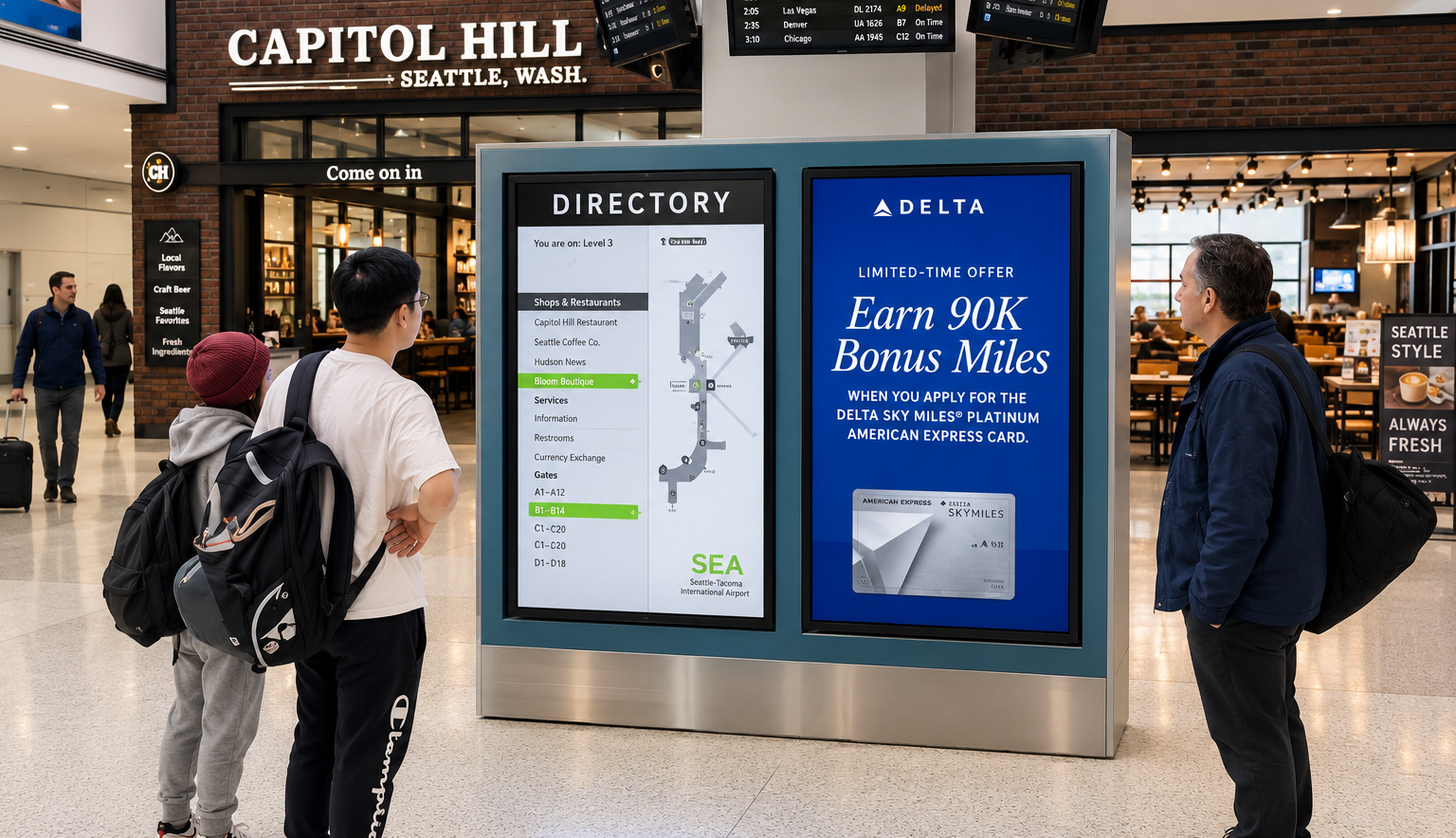
Seattle-Tacoma International Airport is the primary aviation gateway for one of the most economically exceptional metropolitan regions in the world. Greater Seattle is the global headquarters of Amazon and Boeing, the Pacific Northwest base of Microsoft, and home to a technology and aerospace ecosystem that has produced more billionaires and high-net-worth households per capita than any comparable metropolitan area outside Silicon Valley. The 50 million passengers who move through SEA annually are not a representative sample of the American travelling public — they are disproportionately drawn from a workforce and entrepreneurial class whose income levels, global investment activity, and premium consumption behaviour place this airport in an elite tier of advertising environments where every campaign impression carries exceptional commercial weight.
The strategic commercial value of SEA extends well beyond its domestic audience. The airport functions as the United States' primary gateway to Japan, China, South Korea, and the broader Asia-Pacific region — a geographic positioning that makes it the most important single access point in America for the cross-Pacific capital flows, investment decisions, and business relationships that define the technology and trade corridor between the US West Coast and Asia. For brands seeking simultaneous access to America's technology wealth elite, a world-class aerospace industrial executive audience, and the Asia-Pacific investor and business traveller class at a single airport, SEA offers a targeting precision and audience commercial density that no other airport in the Pacific Northwest — and very few in the country — can replicate.
Advertising Value Snapshot
- Passenger scale: Approximately 50 million annually, with a consistent growth trajectory driven by Seattle's expanding technology economy and deepening Asia-Pacific route network
- Traveller type: Technology sector founders and senior executives, aerospace and defence professionals, Asia-Pacific business investors, premium outdoor and adventure lifestyle travellers, returning US technology diaspora from Asian markets
- Airport classification: Tier 1 — America's Pacific gateway, serving the world's highest concentration of technology HNWI wealth outside San Francisco and the primary US access point for trans-Pacific capital and investment flows
- Commercial positioning: The United States' most intellectually and financially concentrated airport audience, defined by the convergence of technology billionaire wealth, aerospace industrial power, and Asia-Pacific investment capital in a single Pacific Northwest gateway
- Wealth corridor signal: SEA sits at the intersection of America's domestic technology wealth network and the US-Japan-China-South Korea capital transfer corridor — the world's highest-value commercial aviation route system by aggregate GDP of connected economies
- Advertising opportunity: Masscom Global provides strategic inventory access and full campaign execution at Seattle-Tacoma International Airport, enabling brands to reach one of the United States' most commercially exceptional airport audiences with the precision and strategic intelligence that a technology-literate, internationally connected HNWI audience demands. Masscom's global network allows advertisers to coordinate SEA placements with campaigns at Tokyo Haneda, Seoul Incheon, Shanghai Pudong, and Vancouver — the four origin corridors that define the airport's highest-value international audience flows.
Airport Advertising is Complex to Get Right
We help you execute faster, with proven results and local insight most planners lack starting now.
Talk to an ExpertCatchment Area and Economic Drivers
Top 10 Cities within 150 km — Marketer Intelligence
- Seattle: The technology and commercial capital of the Pacific Northwest and one of the wealthiest cities in the United States by median household income; home to Amazon's global headquarters, a dense concentration of Microsoft senior employees, and a startup ecosystem that has produced dozens of billion-dollar technology companies; the Seattle professional and entrepreneur class represents one of the most financially sophisticated and globally brand-aware HNWI audiences in American aviation
- Bellevue: The fastest-growing technology city in Washington State and the primary suburban residence of Amazon and Microsoft's senior executive class; Bellevue's household income profile is among the highest of any US suburb by median and its residents are among the most active international real estate buyers, private banking clients, and premium automotive purchasers in the American West
- Redmond: The global headquarters city of Microsoft and a secondary hub for technology startup activity; the Redmond professional audience is dominated by technology engineers and product managers whose stock compensation packages have created significant accumulated wealth and whose international investment and premium consumption activity reflects exposure to global technology markets
- Kirkland: A premium lakeside residential community that has become the preferred address for Amazon and technology executive households; Kirkland's affluent demographic carries above-average private equity and real estate investment activity and is among the most commercially responsive audiences in the Greater Seattle area for international wealth management and luxury property advertising
- Tacoma: Washington State's second-largest city and a major port and logistics hub whose commercial economy anchors the southern reach of the Puget Sound metropolitan area; the Tacoma business owner and logistics executive class contributes a commercially valuable trade and supply chain professional audience to the SEA catchment with strong receptivity for B2B technology, finance, and premium professional services
- Everett: Home to Boeing's largest commercial aircraft assembly facility, the widebody production lines for the 777 and 787; the Everett aerospace professional and engineering management class is one of the highest-income industrial employee bases in the United States and represents a senior technical executive audience with strong international travel frequency and above-average premium brand engagement
- Renton: Boeing's 737 MAX assembly headquarters and a significant aerospace manufacturing concentration; the Renton professional audience mirrors Everett's industrial HNWI profile and collectively with Everett produces an aerospace executive segment of exceptional commercial value for financial services, premium automotive, and international real estate advertisers
- Bothell: An emerging technology and life sciences corridor north of Seattle hosting major operations for biotechnology, medical devices, and health technology companies; produces a high-income life sciences and technology professional audience with growing investment sophistication and strong international education and real estate engagement
- Bellevue-Issaquah Corridor: A rapidly expanding affluent community east of Seattle populated heavily by technology industry relocatees from the Bay Area and East Coast; carries the consumption expectations of San Francisco and New York brand environments and is actively acquiring international real estate, premium financial products, and luxury lifestyle experiences at above-average rates
- Vancouver, Washington: The southernmost commercial city in the Greater Seattle-Portland corridor with a significant technology professional and small business owner population; commercially relevant as a secondary catchment contributor whose residents use SEA for international travel and carry the elevated income profile of the broader Pacific Northwest technology economy
NRI and Diaspora Intelligence: Greater Seattle hosts one of the most economically significant Asian-American diaspora communities in the United States, built on three generations of Chinese, Japanese, Korean, Filipino, and South Asian immigration into the Pacific Northwest's technology and engineering sectors. The Indian-American technology professional community — concentrated in Bellevue, Redmond, and Kirkland through Amazon and Microsoft employment — is one of the largest and most financially exceptional of any US metropolitan area, with household income levels consistently in the top decile of US income distribution and active international investment behaviour spanning real estate acquisition in India, the UAE, and the UK, education investment in elite US and UK institutions, and growing private equity and startup investment activity. The Chinese-American community in Seattle — historically rooted in the city's Chinatown-International District and more recently expanded through technology sector immigration — maintains deep capital ties with mainland China, Taiwan, and Hong Kong, making them a commercially critical audience for any brand targeting the US-China investment corridor. The Korean-American community, concentrated around Microsoft and the broader technology ecosystem, contributes a third high-income diaspora segment with strong brand loyalty to Korean corporate brands and active cross-Pacific financial behaviour. For advertisers, this tri-community Asian-American diaspora at SEA represents one of the highest-income and most internationally investment-active diaspora audiences accessible at any US airport outside Los Angeles.
Economic Importance: Greater Seattle's economy is one of the most structurally exceptional of any US metropolitan area, built on a technology foundation of global dominance that no other US city outside San Francisco can approach in terms of per-capita wealth generation. Amazon's presence alone has created an estimated 50,000 Seattle-based employees with median compensation exceeding $180,000 annually — a workforce concentration whose aggregate financial product, real estate, and premium consumer spending power is staggering in the context of a city of 750,000. Microsoft's Redmond campus and its global workforce network adds a second technology wealth layer of equivalent scale. Boeing's aerospace industrial base — despite its evolving production challenges — continues to anchor a manufacturing and engineering professional economy that generates above-average income and significant retirement and investment wealth through the region's large retired aerospace employee population. The emerging biotechnology and health technology sector in the Bothell-Kirkland corridor is adding a third wealth-generating engine that is producing a new generation of HNWI households distinct from both technology and aerospace in their commercial behaviour but equally significant in their investment and consumption capacity.
Business and Industrial Ecosystem
- Amazon Global Headquarters: The world's most valuable company by certain metrics and Seattle's dominant employer; Amazon's executive, engineering, and product management class represents a workforce of extraordinary financial sophistication, global brand awareness, and active international investment behaviour — the single most commercially valuable corporate employee audience concentrated at any US airport outside San Francisco
- Boeing Commercial Airplanes and Defence Operations: The world's largest aerospace company by revenue, with its commercial aircraft division anchored in Everett and Renton; the Boeing executive and engineering leadership class travels internationally for procurement, partnerships, and sales on a frequency that makes them among the most airport-familiar and advertising-experienced business travellers in the American industrial sector
- Microsoft Redmond Campus: The global headquarters of one of the world's most valuable technology companies; Microsoft's senior employee and executive class mirrors Amazon's income profile and travel behaviour while adding a strong enterprise technology and cloud infrastructure audience dimension that is particularly relevant for B2B technology and financial product advertisers
- Pacific Northwest Biotechnology and Life Sciences: A rapidly expanding ecosystem anchored by companies including Adaptive Biotechnologies, Juno Therapeutics, and dozens of venture-backed biotech startups; produces a senior scientific and commercial executive audience with growing international investment activity and strong receptivity to premium financial services, private equity platforms, and real estate investment products
Passenger Intent — Business Segment: Business travellers at SEA are concentrated in categories of exceptional global commercial relevance: technology executives maintaining relationships with Asia-Pacific development partners, manufacturing suppliers, and cloud infrastructure clients across Japan, South Korea, and China; aerospace executives managing supplier relationships, aircraft delivery programmes, and defence partnerships across Europe and the Pacific; life sciences executives conducting clinical trial partnerships and regulatory affairs business across Japan, Europe, and Canada; and the returning Asia-Pacific diaspora professional class managing cross-Pacific financial, family, and investment interests. All of these segments carry high travel frequency, high average transaction value in both business and personal spending, and a demonstrated premium brand consumption behaviour that reflects their exceptional income levels. Premium financial services, luxury automotive, international real estate, and business class travel advertising all achieve above-average campaign performance with the SEA business audience.
Strategic Insight: The business audience at Seattle-Tacoma International Airport is characterised by a commercial intelligence and brand sophistication that is unique in the American airport advertising landscape. This is an audience of engineers, product builders, and systems thinkers whose professional orientation shapes their consumer behaviour — they evaluate advertising claims with the same analytical rigour they apply to technical specifications, and they respond to campaigns that demonstrate genuine insight, specific value, and credible proof points over those that rely on aesthetic luxury signalling alone. Masscom-structured campaigns at SEA that lead with intelligence, specificity, and demonstrated expertise consistently outperform aspirational lifestyle formats calibrated to less analytically oriented audience profiles. The SEA business audience rewards brands that respect their intelligence and treats them as the sophisticated decision-makers they are.
Tourism and Premium Travel Drivers
- Pike Place Market and Seattle Waterfront: One of the most visited public markets in the United States and the iconic face of Seattle's food, craft, and urban culture tourism offering; draws a diverse domestic and international leisure audience whose per-visit spending on dining, retail, and cultural experiences reflects Seattle's premium consumer market positioning
- Olympic National Park and Pacific Northwest Wilderness: One of the crown jewels of the US National Park system, combining old-growth rainforest, alpine wilderness, and wild Pacific coastline within a two-hour drive of SEA; draws a premium ecotourism and outdoor adventure audience from across the United States and internationally whose environmental consciousness and premium outdoor lifestyle brand alignment makes them a commercially valuable and distinctive audience segment
- Cascade Mountain Range — Ski and Alpine Recreation: World-class skiing at Crystal Mountain, Stevens Pass, and Snoqualmie Pass within 90 minutes of SEA; draws a premium outdoor sports tourism audience from across the Pacific Northwest and increasingly from Japan and South Korea, reinforcing SEA's role as an adventure lifestyle gateway with strong premium outdoor brand relevance
- Puget Sound Maritime Culture — Whale Watching, Island Hopping, Sailing: The San Juan Islands, Puget Sound ferry network, and Pacific coast maritime recreation draw a premium lifestyle and nature tourism audience whose combination of environmental values and high disposable income creates exceptional receptivity for sustainable luxury, outdoor lifestyle, and premium maritime experience brands
Passenger Intent — Tourism Segment: Leisure travellers departing from SEA represent one of the most environmentally and intellectually engaged leisure audiences of any major US airport — a reflection of the Pacific Northwest's distinctive cultural identity as a region that combines high income with strong environmental values, outdoor lifestyle commitment, and a preference for authentic, quality-forward experiences over pure status consumption. This audience is receptive to premium outdoor and adventure lifestyle brands, sustainable luxury products, international real estate in environmentally prestigious locations, premium travel experiences that deliver genuine authenticity, and lifestyle brands that credibly align with Pacific Northwest values. Inbound leisure tourists arriving at SEA are drawn by the region's outdoor reputation, its food and coffee culture, its technology heritage tourism, and increasingly by its position as a gateway for Alaska cruise departures — creating a commercially diverse inbound audience with above-average accommodation and experience spending profiles.
Travel Patterns and Seasonality
Peak seasons:
- June to September: The Pacific Northwest's primary tourism and leisure season, coinciding with optimal weather, peak cruise ship departures from Seattle's port, and the highest-volume outbound leisure travel period; technology sector employees — many of whom accumulate significant vacation time through generous US tech company PTO policies — take their primary international holidays in this window, driving premium Asia-Pacific, European, and domestic leisure route volumes to their annual highs
- November to December: The year's highest-intensity holiday travel period, combining the Thanksgiving domestic travel surge — one of the busiest single travel periods in US aviation — with the Christmas and New Year holiday departure wave; the technology sector's high stock-compensation workforce is particularly active in this window as year-end stock vesting creates liquidity events that accelerate premium travel and gifting expenditure
- March to April: A secondary spring peak driven by the technology sector's conference and corporate travel cycle, spring break family leisure departures, and the cherry blossom travel season that drives one of the strongest Japan tourism flows of the year from Seattle's Japan Airlines and ANA connections
Event-Driven Movement:
- AWS re:Invent Overflow and Amazon Leadership Events (November/December): Amazon's annual leadership summits, all-hands events, and external conference participation create concentrated executive travel windows that produce some of the year's highest corporate HNWI audience density at SEA in the weeks surrounding major Amazon event dates
- Microsoft Build and Ignite Conferences (May/November): Microsoft's flagship global developer and enterprise technology conferences draw tens of thousands of technology professionals through SEA; the weeks surrounding these events produce an exceptional concentration of global technology decision-makers, enterprise buyers, and startup founders passing through the airport
- Seafair Summer Festival (July/August): Seattle's marquee summer festival combining the Blue Angels air show, hydroplane racing, and a city-wide summer celebration; draws a strong domestic leisure tourism inflow and reinforces the summer peak with an entertainment and lifestyle travel dimension
- Alaska Cruise Season Departure Peak (May to September): Seattle is the primary US departure port for Alaska cruises, generating a consistent wave of premium leisure travellers — disproportionately retired high-net-worth couples from across the United States — who connect through SEA before boarding; this audience carries significant disposable income and strong receptivity for luxury goods, financial services, and premium lifestyle advertising in the pre-departure terminal environment
- Sakura Season and Japan Tourism Peak (March/April): Seattle's Japan Airlines and ANA connections drive a significant spring tourism flow between the US Pacific Northwest and Japan's cherry blossom season; the Japan-bound traveller at SEA in March and April is disproportionately drawn from Seattle's high-income professional and academic community, producing one of the year's highest-quality international premium leisure departure audiences
It’s Not Just Where You Advertise - It’s How Fast You Execute
We combine local insight with fast rollout to deliver results for you, now.
Talk to an ExpertAudience and Cultural Intelligence
Top 2 Languages:
- English: The dominant language of the airport's technology, aerospace, and domestic leisure audience; English-language creative at SEA must reflect the analytical sophistication, directness, and quality orientation of the Pacific Northwest professional class — this is not a market that responds to generic luxury positioning or generic aspiration narratives, but one that rewards brands that communicate genuine intelligence and specific value with exceptional brand loyalty
- Mandarin Chinese: The essential second language for reaching SEA's commercially critical Chinese and Chinese-American audience — a segment that spans mainland Chinese business investors, Taiwanese technology executives, Hong Kong financial professionals, and Seattle's large and economically significant Chinese-American community; Mandarin-language creative is non-negotiable for any campaign targeting the trans-Pacific investment and business travel flow that defines SEA's highest-value international corridor
Major Traveller Nationalities: The international audience at SEA is led by Japanese nationals, who represent the single largest inbound and outbound international segment by volume — a function of the Seattle-Tokyo route's historical depth, the deep cultural and commercial ties between Japan and the Pacific Northwest, and the large Japanese-American community that has shaped Seattle's cultural identity for over a century. Chinese nationals form the second-largest international segment, combining technology sector business travel, academic and research exchange, and the significant mainland Chinese investor and student flows that are defining characteristics of West Coast US airports. South Korean nationals are the third most commercially significant international audience, connected to Seattle through Samsung, Hyundai, and LG's US technology and manufacturing operations and through a large Korean-American professional community in the Bellevue-Kirkland corridor. Canadian nationals — primarily from Vancouver and British Columbia — represent a high-frequency cross-border segment whose income profile mirrors Seattle's own and whose travel behaviour blends domestic and international characteristics in commercially useful ways for multi-market campaign planning.
Religion — Advertiser Intelligence:
- Protestant and Non-Denominational Christianity (approximately 35% of Greater Seattle): The Pacific Northwest has one of the lowest formal religious observance rates of any major US metropolitan area, but Christian holiday windows — particularly Christmas and Easter — still drive the year's two largest domestic travel mobilisation events; the non-denominational evangelical community in the suburbs of Bellevue, Kirkland, and Tacoma is more economically active than urban Seattle's more secular professional class, and gifting and family travel behaviour around these holidays creates commercially valuable advertising windows for consumer lifestyle, luxury goods, and travel brands
- Buddhism (approximately 8%, predominantly Asian-American community): The Pacific Northwest's large Japanese, Chinese, Korean, and Southeast Asian communities maintain Buddhist observance traditions whose travel and spending patterns follow the Lunar New Year, Obon, and other festival calendars; Lunar New Year is the single most commercially significant event-driven spending window for Asian-American consumers in Seattle, creating a strong advertising opportunity for luxury goods, financial services, premium food and hospitality, and real estate brands targeting the Asian-American HNWI audience in the weeks surrounding the celebration
- Hinduism (approximately 4%, predominantly Indian-American technology professional community): The rapidly growing Indian-American technology professional community in Redmond, Bellevue, and Kirkland observes Diwali as the year's most commercially significant consumer spending and gifting event; the Diwali window in October and November aligns with the technology sector's year-end stock vesting cycle to produce a particularly powerful luxury consumer spending period for brands targeting the Indian-American HNWI audience at SEA
- Islam (approximately 3%, growing): A growing Muslim community in the Seattle area — including Somali, South Asian, and Arab-American households — observes Ramadan and both Eid holidays with strong travel and consumer spending behaviour; the Eid windows are commercially relevant for halal lifestyle, consumer goods, and financial services advertisers targeting this growing segment
Behavioral Insight: The Seattle-Tacoma airport audience is defined by a consumer psychology that is genuinely unlike any other major US airport catchment. The technology sector's dominance of the regional economy has created a professional class that approaches consumption decisions with analytical rigour, values transparency and product integrity over brand heritage alone, and carries a strong bias toward innovation and quality-forward brands over those whose premium positioning rests primarily on traditional prestige signals. Simultaneously, the Pacific Northwest's outdoor culture — deeply embedded in the regional identity of Amazon employees and Seattle natives alike — creates a consumer orientation toward authentic, experiential, and environmentally credible premium spending that is more sophisticated than the pure status consumption profiles of comparable income audiences in Houston, Dallas, or Miami. Campaigns at SEA that combine genuine intelligence, credible quality proof points, and an authentic alignment with values of innovation, sustainability, or intellectual ambition consistently outperform those that rely on conventional luxury aspiration narratives.
Outbound Wealth and Investment Intelligence
The outbound traveller at Seattle-Tacoma International Airport represents one of the most financially sophisticated and internationally investment-active HNWI audiences in the United States. Seattle's technology wealth generation has been among the most explosive of any US city over the past decade — Amazon's stock price trajectory alone has created thousands of multi-millionaire households in Greater Seattle — and the capital deployment behaviour of this newly wealthy cohort is reshaping international real estate, private equity, and wealth management markets in ways that international advertisers at SEA are only beginning to fully address.
Outbound Real Estate Investment: Seattle's technology HNWI class deploys international real estate capital across a distinctive geography that reflects both lifestyle values and investment sophistication. Hawaii — particularly Maui and Kauai — is the dominant second-home destination by volume, driven by proximity, flight accessibility from SEA, and the Pacific Northwest outdoor lifestyle's natural extension into Pacific island living. Europe — particularly Portugal, Spain, and Italy — attracts the premium acquisition tier of Seattle's technology wealth class, whose combination of intellectual cultural orientation and high accumulated capital makes them among the most active US buyers in European lifestyle real estate markets. Japan and Canada — particularly Vancouver and Whistler — are growing markets reflecting the Asia-Pacific cultural orientation of Seattle's technology diaspora and the strong outdoor lifestyle connection between the Pacific Northwest and British Columbia's mountain communities. Mexico — particularly Los Cabos and the Pacific Coast — is a growing leisure real estate corridor as the Seattle technology class mirrors the broader US West Coast luxury second-home acquisition pattern.
Outbound Education Investment: Greater Seattle's high-income professional class is among the most active investors in international and elite private education in the United States, with a particular orientation toward institutions that deliver genuine intellectual rigour and global career access rather than purely domestic brand prestige. The primary international university destinations for Seattle families are United Kingdom institutions — Oxford, Cambridge, Imperial College London, and Edinburgh — whose combination of academic reputation and international credential resonance aligns precisely with the technology professional class's educational values. Canadian universities — University of British Columbia, University of Toronto, and McGill — attract a large and growing share of Seattle's student migration given geographic proximity and academic quality. European universities in the Netherlands, Germany, and Switzerland attract the engineering and technology professional family whose children are targeting technical careers with European market access. The Asian-American community at SEA generates an additional education migration corridor to elite universities in South Korea, Japan, and Singapore for families maintaining strong cultural and professional ties to Asia.
Outbound Wealth Migration and Residency: Seattle's technology HNWI class has been among the most active in the United States in exploring international residency and asset diversification programmes, motivated less by tax efficiency in most cases than by lifestyle optionality and global access. Portugal's Golden Visa — despite recent programme modifications — attracted significant Seattle technology HNWI interest and has been partially replaced by interest in Spain, Greece, and Italy as European lifestyle residency routes. Canada's provincial nominee and investor immigration programmes attract the significant cohort of Amazon and Microsoft employees on non-immigrant work visas who are seeking permanent residency pathways as an alternative to the US green card queue. New Zealand and Australia — both deeply connected to Seattle's technology sector through cultural and professional ties — are growing lifestyle migration destinations for the Pacific Northwest HNWI class seeking English-speaking alternatives to US residency. Wealth management platforms, international tax advisors, and global mobility service providers targeting the US technology wealth audience will find SEA one of the most financially qualified and structurally motivated access points in the American airport landscape.
Strategic Implication for Advertisers: International brands on both sides of Seattle's wealth corridor — real estate developers in Portugal, Japan, Canada, and Hawaii; UK and European universities; global private banking platforms; sustainability-aligned luxury lifestyle brands — should treat Seattle-Tacoma International Airport as a first-tier priority buy rather than a supporting placement. The technology HNWI audience at SEA is not only financially capable — it is actively seeking international investment and lifestyle products with a sophistication and self-directed research capacity that makes airport advertising a genuine decision-influencing touchpoint rather than a passive awareness medium. Masscom Global offers the capability to coordinate simultaneous campaign placements at SEA and at the destination airports where this audience arrives — Tokyo, London, Vancouver, Lisbon — creating a corridor-wide brand narrative that follows the investment decision from formation to action.
Airport Infrastructure and Premium Indicators
Terminals:
- Seattle-Tacoma International Airport operates through a central terminal building with a North Satellite, South Satellite, and the A and B concourses connected by an underground automated train system; the layout concentrates all passengers through a central check-in and security hub before dispersing them to satellite concourses, creating a high-capture advertising funnel at the central terminal level that gives campaigns near-complete audience reach regardless of which gate or airline the passenger is using
- The International Arrivals Facility — SEA's dedicated international processing building opened in 2020 — is one of the most modern international arrival facilities in the United States and concentrates the Asia-Pacific premium audience in a state-of-the-art environment designed to the aesthetic and service standards of the world's leading international airports; advertising placements in this facility intercept the Japan, China, and South Korea inbound audience at the moment of US market arrival
Premium Indicators:
- SEA hosts Alaska Airlines' flagship Boardroom Lounge network alongside American Express Centurion Lounge, Capital One Lounge, and multiple international carrier business class lounges — a premium lounge ecosystem that rivals any airport of comparable size in the United States and signals a traveller income floor consistent with the technology and aerospace HNWI composition of the passenger base
- The airport's significant investment in premium retail and food and beverage — including the award-winning local Pacific Northwest food and beverage curation that distinguishes SEA's dining from generic US airport retail — reflects an operator philosophy of premium experience delivery that aligns with and reinforces premium brand advertising messaging within the terminal environment
- The proximity of the Seattle Marriott Watertown, Hilton Seattle Airport, and Hyatt properties to the terminal complex provides a premium adjacent hospitality ecosystem whose business guests — corporate travellers staying for meetings — extend the airport's effective advertising audience beyond the departing and arriving passenger base to include a captive accommodation audience with high brand engagement capacity
- SEA's consistent recognition as one of the top-ranked US airports for passenger experience — including its pioneering biometric processing technology and its award-winning art programme that incorporates commissioned works from Pacific Northwest artists throughout the terminal — creates a premium environmental context that reflexively elevates brand association for advertisers placing inventory within it
Forward-Looking Signal: Seattle-Tacoma International Airport is currently executing a multi-billion dollar expansion programme — the Century Agenda capital plan — that will add new gate capacity, expand the international terminal facilities, and significantly upgrade the retail and premium lounge infrastructure across the terminal complex. The continued growth of Amazon, Microsoft, and the broader Seattle technology ecosystem is generating structural passenger demand that will drive SEA toward 60 million annual passengers within the next several years. New direct routes to additional Asian cities, expanded European service from multiple carriers, and the growth of Alaska Airlines' international premium cabin network are all adding commercial depth to the airport's already exceptional international audience. Masscom Global advises clients to secure premium inventory positions at SEA now, ahead of the expansion programme's completion and the rate adjustments that the airport's growing passenger volume and enhanced premium infrastructure will generate.
Airline and Route Intelligence
Top Airlines:
- Alaska Airlines (primary hub carrier — dominant share of domestic operations and growing international network)
- Delta Air Lines (significant domestic and international operations)
- United Airlines
- American Airlines
- Japan Airlines
- ANA (All Nippon Airways)
- Air Canada
- British Airways
- Lufthansa
- Korean Air
- Condor (seasonal European leisure routes)
- Air China and Chinese carriers
- WestJet
- Hawaiian Airlines
Key International Routes:
- Tokyo Narita and Haneda (Japan Airlines and ANA — the single most commercially significant international corridor, carrying the deepest US-Japan technology and business relationship of any US West Coast airport)
- Seoul Incheon (Korean Air — the primary South Korea technology and corporate corridor)
- London Heathrow (British Airways and Alaska Airlines — the transatlantic business and premium leisure corridor)
- Frankfurt and Amsterdam (Lufthansa and KLM — European corporate and aerospace supply chain routes)
- Vancouver and Toronto (Air Canada and WestJet — the high-frequency Canada corridor)
- Beijing and Shanghai (Air China and Chinese carriers — the US-China technology and investment corridor)
- Hong Kong (Cathay Pacific — the financial and trade corridor)
- Sydney (Qantas, seasonal — the Australia lifestyle and technology corridor)
- Reykjavik (Icelandair — the increasingly popular Pacific Northwest to Northern Europe travel bridge)
- Cancún and Mexican resorts (seasonal leisure charters — the leisure second-home corridor)
Domestic Connectivity: Seattle-Tacoma International Airport is Alaska Airlines' primary hub, with connecting domestic service to every major US city and direct routes to over 100 domestic destinations; the domestic network ensures that SEA functions as the Pacific Northwest's definitive connecting hub through which the region's international passengers and the East Coast's Asia-Pacific-bound travellers both flow.
Wealth Corridor Signal: The Tokyo and Seoul route dominance at SEA communicates a commercial reality of exceptional strategic importance for advertisers: Seattle is the US city most deeply integrated into the Asia-Pacific technology economy, and the passengers on these routes are not leisure tourists but technology executives, product managers, venture capital investors, and corporate partnership managers whose international business activity connects the world's two largest technology economies through this airport. The London and Frankfurt routes carry the Boeing and aerospace executive class managing Europe's aviation supply chain alongside the technology sector's European partnership traffic. The Vancouver and Toronto corridor carries a uniquely high-value cross-border audience of Canadian technology professionals and investors who treat Seattle as a second home base and whose consumption behaviour mirrors the Seattle HNWI class almost precisely. Advertisers who build campaign strategy around the specific commercial narrative of the Tokyo, Seoul, and London corridors will intercept the highest-value and most globally consequential segments of SEA's traffic with a precision that volume-only planning cannot achieve.
Media Environment at the Airport
- Seattle-Tacoma International Airport's central terminal hub structure creates a natural advertising capture funnel where every passenger — regardless of airline or destination — passes through a common check-in, security, and central concourse environment before reaching their satellite gate; this architecture gives campaigns placed in the central terminal near-complete audience penetration across the entire 50-million-passenger population in a single investment
- Dwell time at SEA is elevated by the airport's hub structure and its Asia-Pacific route network — trans-Pacific passengers, who represent the airport's highest-value audience tier, consistently arrive early and spend extended periods in the terminal, with international departure dwell windows regularly exceeding two hours and domestic connecting passengers spending 60 to 90 minutes between flights
- The technology sector's dominance of the SEA audience creates a media environment where digital formats — particularly high-resolution, motion-capable digital out-of-home placements — achieve significantly above-average attention and engagement relative to comparable static formats, because this audience is visually sophisticated, digitally calibrated, and responds to creative quality with the discernment of professional product designers
- Masscom Global holds strategic inventory access across Seattle-Tacoma International Airport and executes campaigns with the creative precision and audience intelligence that a technology-literate HNWI audience demands; Masscom's SEA campaigns are structured to achieve simultaneous reach across the domestic technology and aerospace professional audience and the international Asia-Pacific premium audience, with creative and placement strategies calibrated separately to the distinct behavioural profiles of each segment
Strategic Advertising Fit
Best Fit:
- International luxury real estate developers in Japan, Portugal, Canada, and Hawaii: The outbound Seattle technology HNWI class is among the most active second-home and investment property buyers in the United States; the airport's convergence of domestic tech wealth and Asia-Pacific inbound investors creates a bilateral property buyer audience of exceptional commercial concentration
- Private banking, wealth management, and technology-sector financial services: The Amazon and Microsoft stock-compensation wealth cohort is actively seeking sophisticated wealth management, tax planning, and investment diversification solutions that conventional retail banking cannot provide; international private banking platforms and independent wealth management firms that can credibly address technology HNWI financial complexity will find their most qualified US audience at SEA
- Premium and ultra-premium automotive brands: Greater Seattle is one of the highest per-capita luxury vehicle markets in the United States; Tesla has particularly strong penetration reflecting the technology audience's innovation orientation, but German, British, and Japanese premium marques all achieve above-average brand consideration with the SEA business traveller
- Japan and South Korea travel, hospitality, and lifestyle brands: The depth of Seattle's cultural and commercial ties to Japan and South Korea creates an audience at SEA that is more receptive to Japanese and Korean brand advertising than any other US airport outside Los Angeles; Japanese premium hospitality, food, beauty, and lifestyle brands achieve exceptional resonance with both the Japanese-American community and the broader Seattle technology professional class
- International universities and elite boarding schools: The Pacific Northwest HNWI class is among the most active US investors in premium international education; UK, Canadian, and European universities targeting the US technology wealth audience will find a highly qualified, education-committed, and financially prepared family decision-maker audience at SEA
- Sustainable luxury and premium outdoor lifestyle brands: The Pacific Northwest's distinctive outdoor culture and environmental values create a category of premium outdoor, sustainable luxury, and adventure lifestyle brand advertising that achieves engagement rates at SEA that would be impossible to replicate at airports whose audience profile is anchored in conventional status consumption rather than experiential and value-aligned premium spending
- Enterprise technology, cloud, and cybersecurity platforms: The concentration of technology decision-makers and IT budget holders at SEA creates a B2B technology advertising environment of exceptional efficiency; enterprise software, cloud platform, and cybersecurity product campaigns intercept their highest-value decision-maker audience at this airport in the same dwell environment where brand preference and vendor consideration are actively forming
Brand Alignment at a Glance:
| Category | Fit |
|---|---|
| International luxury real estate | Exceptional |
| Private banking and wealth management | Exceptional |
| Premium automotive | Exceptional |
| Enterprise technology and cloud platforms | Exceptional |
| Japan and Korea travel and lifestyle brands | Strong |
| Sustainable luxury and outdoor lifestyle | Strong |
| International education | Strong |
| Premium spirits and luxury hospitality | Strong |
| Mass-market FMCG | Moderate — volume justifies selective consideration |
| Budget travel and economy accommodation | Poor fit |
Who Should Not Advertise Here:
- Budget travel and economy accommodation brands: The SEA audience's income profile and demonstrated premium consumption behaviour make price-minimisation messaging fundamentally misaligned with the audience's consumption orientation; budget positioning actively undermines brand perception with a technology professional audience that associates premium quality with intelligence and budget options with inadequate standards
- Traditional luxury brands relying exclusively on heritage and status signalling without substance: Seattle's technology audience applies analytical scrutiny to brand claims in a way that pure heritage luxury positioning — without genuine quality and innovation proof points — does not survive; brands that lead with legacy status alone without demonstrating product intelligence will achieve poor recall and negative brand associations with this audience
- Brands with no Asia-Pacific market relevance or international proposition: A significant proportion of SEA's most commercially valuable passengers are in transit between North America and Asia-Pacific markets; brands whose entire value proposition is anchored in US domestic market relevance will miss the international premium audience tier that defines the airport's highest advertising yield segments
Event and Seasonality Analysis
- Event Strength: Medium-High
- Seasonality Strength: High
- Traffic Pattern: Dual-Peak with strong baseline (Summer leisure and Asia-Pacific peak June to September; Holiday and year-end technology sector peak November to December; strong spring corporate travel secondary window March to May)
Strategic Implication: Advertisers at Seattle-Tacoma International Airport should structure annual investment around two primary deployment windows and one commercially significant secondary window. The summer peak from June through September captures the year's highest-volume combination of outbound Pacific Northwest leisure travel, peak Asia-Pacific inbound tourism, and Alaska cruise departure traffic — creating the year's broadest and most audience-diverse high-spend travel concentration. The November to December window captures the year's highest-intensity combination of Thanksgiving domestic travel, technology sector year-end stock vesting and gifting behaviour, and the Amazon and Microsoft leadership event cycle — producing the airport's highest-income audience density of the year. The March to May spring window captures the technology conference cycle, the Japan cherry blossom travel peak, and the spring leisure departure surge with a commercially valuable business-to-leisure audience transition that makes this period particularly effective for brands targeting both the corporate and premium leisure segments simultaneously. Masscom Global structures SEA campaigns around these three windows with creative rotation and format sequencing calibrated separately to the technology professional, Asia-Pacific international, and premium leisure audience dimensions of each peak period.
Poor Placement and Delays Affect Airport Campaigns
We help you move faster, access better inventory, and get it right now.
Talk to an ExpertFinal Strategic Verdict
Seattle-Tacoma International Airport is one of the most intellectually and financially exceptional airport advertising environments in the United States — an airport whose audience quality per passenger consistently exceeds what its volume ranking alone would suggest to a media planner who has not studied the economic composition of its catchment. The convergence of Amazon and Microsoft's combined global workforce, Boeing's aerospace industrial executive class, one of the United States' most economically significant Asian-American diaspora communities, and a trans-Pacific business travel corridor connecting the two largest technology economies in the world creates an audience profile of genuine global commercial rarity. Brands in financial services, international real estate, premium technology, sustainable luxury, and Asia-Pacific lifestyle products who partner with Masscom Global to activate at SEA are accessing the commercial gateway of a metropolitan economy that has generated more per-capita millionaire households than almost any US city in the past decade — and whose HNWI class is deploying that capital internationally with a sophistication, scale, and cross-Pacific orientation that no other interior US airport can access with the same precision and audience density. Masscom Global brings the inventory intelligence, Asia-Pacific corridor expertise, and campaign execution capability to ensure that every impression at SEA reaches the right segment at the right moment — and converts audience quality into measurable commercial returns.
About Masscom Global
Masscom Global is a premium international airport advertising and media buying agency operating across 140 countries. With deep expertise in airport OOH, premium publications, and high-net-worth audience targeting, Masscom helps brands reach the world's most valuable travellers at the moments that matter most. For advertising packages, media rates, and campaign planning at Seattle-Tacoma International Airport and airports across the globe, contact Masscom Global today.
Frequently Asked Questions
How much does airport advertising cost at Seattle-Tacoma International Airport? Advertising costs at Seattle-Tacoma International Airport vary based on terminal and concourse location, format type — from large-format digital spectacular displays in the central terminal to static placements in the satellite concourses — campaign duration, and the seasonal demand window selected. The summer peak, November to December holiday and technology sector year-end window, and the International Arrivals Facility all command premium inventory rates reflecting the exceptional audience concentration in those environments and periods. Masscom Global recommends an audience-first planning approach before format and placement selection, given the distinct commercial characteristics of each terminal zone. Contact Masscom Global for a tailored rate card and strategic media plan calibrated to your specific audience objectives and budget.
Who are the passengers at Seattle-Tacoma International Airport? SEA's 50 million annual passengers span a commercially exceptional range anchored by three dominant audience profiles. The domestic audience is defined by Amazon and Microsoft's combined workforce of over 100,000 Seattle-area employees — one of the most financially exceptional corporate employee concentrations in the United States — alongside Boeing's aerospace professional class, the Pacific Northwest technology startup ecosystem's entrepreneurial tier, and a premium outdoor and lifestyle leisure traveller base reflective of Seattle's high household income. The international audience is led by Japanese and South Korean technology and corporate business travellers, Chinese investors and technology professionals, and Canadian cross-border commerce and leisure flows. The Asia-Pacific diaspora — particularly Indian, Chinese, Korean, and Japanese-American technology professionals — adds a commercially exceptional diaspora layer with active cross-Pacific investment behaviour.
Is Seattle-Tacoma International Airport good for luxury brand advertising? SEA is one of the top five airports in the United States for luxury brand advertising effectiveness, with a distinctive advantage over comparable airports in the nature as well as the level of its HNWI audience. The Seattle technology wealth class approaches luxury brand engagement with analytical sophistication and a strong orientation toward innovation-aligned premium spending — meaning that luxury brands which combine genuine quality, authentic values, and intellectual credibility achieve exceptional engagement at SEA that aspirational-only positioning cannot replicate. For brands in luxury real estate, premium automotive, fine watchmaking and jewellery, private banking, and premium technology, SEA delivers a HNWI audience whose income levels, international investment activity, and premium consumption capacity are among the highest of any US airport outside San Francisco and New York.
What is the best airport on the US West Coast to reach Asia-Pacific investors and technology executives? Los Angeles International Airport delivers the highest absolute volume of Asia-Pacific international traffic on the US West Coast. Seattle-Tacoma International Airport delivers the highest concentration of Asia-Pacific technology sector executives and investors relative to total passenger volume — a function of Seattle's unique position as the US city most deeply integrated into the Japan and South Korea technology economies through Amazon, Microsoft, and Boeing's Pacific Rim relationships. For brands specifically targeting the US-Japan and US-Korea technology business corridor, SEA delivers an audience quality and targeting precision that LAX's more diffuse international traffic cannot match.
What is the best time to advertise at Seattle-Tacoma International Airport? The two highest-value advertising windows are the summer peak from June through September — when the combination of Pacific Northwest leisure travel, Asia-Pacific inbound tourism, and Alaska cruise departure traffic creates the year's broadest premium audience concentration — and the November to December window, when the technology sector's year-end stock vesting cycle, the Amazon and Microsoft leadership event calendar, and the holiday gifting and travel surge converge to produce the airport's highest-income audience density of the year. The March to May spring window is the strongest secondary period, capturing the Japan cherry blossom travel peak and the technology corporate conference cycle. Masscom Global recommends booking peak inventory positions a minimum of three months in advance given the consistent demand from technology sector and Asia-Pacific corridor advertisers.
Can international real estate developers advertise at Seattle-Tacoma International Airport? Absolutely — and SEA represents one of the most commercially strategic access points for international real estate advertising in the United States. The outbound Seattle technology HNWI class is actively acquiring real estate in Japan, Portugal, Spain, Canada, and Hawaii simultaneously, with individual transaction values that consistently sit at the premium end of the international second-home and investment property market. The inbound Asia-Pacific investor audience — particularly from Japan, South Korea, and China — includes a significant tier of buyers evaluating Seattle and Pacific Northwest US real estate. International developers who position campaigns at SEA intercept both the departing American buyer and the arriving Asian investor in a single contained advertising environment that no other Pacific Northwest media channel can replicate.
Which brands should not advertise at Seattle-Tacoma International Airport? Budget travel and economy accommodation brands are fundamentally misaligned with SEA's income demographics and will achieve negligible conversion with an audience whose household income profile and demonstrated premium travel spending behaviour places them firmly in the premium and luxury consumption tier. Traditional luxury heritage brands that rely exclusively on status signalling without demonstrating genuine innovation, quality substance, or intellectual credibility will underperform with Seattle's analytically oriented technology audience. Brands with no Asia-Pacific market relevance, no international proposition, or no credible alignment with the Pacific Northwest's values of quality, authenticity, and environmental responsibility will find limited audience resonance with SEA's most commercially valuable passenger segments.
How does Masscom Global help brands advertise at Seattle-Tacoma International Airport? Masscom Global provides comprehensive campaign management at Seattle-Tacoma International Airport, from strategic audience intelligence and terminal selection through to inventory booking, creative placement optimisation across the central terminal and satellite concourses, and performance measurement calibrated to the specific objectives of each campaign. With operational coverage across 140 countries and deep expertise in the Asia-Pacific, transatlantic, and Canadian corridors that define SEA's international audience flows, Masscom ensures that campaigns are timed to the airport's seasonal peaks, placed in the highest-visibility positions for each target audience segment, and coordinated with origin and destination airport placements for maximum corridor-wide impact. To discuss current inventory availability, media packages, and a strategic audience plan for Seattle-Tacoma International Airport, contact Masscom Global today.