

Airport at a Glance
| Field | Detail |
|---|---|
| Airport | Porto Seguro International Airport |
| IATA Code | BPS |
| Country | Brazil |
| City | Porto Seguro, Bahia |
| Annual Passengers | Over 2.3 million (January to November 2025), a record |
| Primary Audience | Brazilian domestic leisure families, São Paulo and Rio affluent and UHNWI Trancoso travellers, regional business and agri-industrial travellers |
| Peak Advertising Season | December to February, plus July |
| Audience Tier | Tier 2 |
| Best Fit Categories | Consumer banking and credit, telecom and mobile data, premium hospitality and Trancoso real estate, beverage and FMCG |
Porto Seguro International Airport handled over 2.3 million passengers across roughly 16,000 commercial flights between January and November 2025, against 2 million and approximately 14,000 operations in the same period of 2024, representing growth of 15.6 percent in passengers and 14.5 percent in flights. Momentum has accelerated further into 2026, with first-quarter movement reaching 400,800 passengers, up 20.76 percent year on year and among the strongest proportional growth rates in northeastern Brazil. This is now the second-busiest airport in Bahia after Salvador.
The commercial reality advertisers need to understand is that this is a volume airport with a concentrated premium layer, not a luxury gateway. Of 1,306,344 passengers who disembarked at Porto Seguro across 2025, 1,277,330 were domestic Brazilian travellers and 29,014 were international, meaning international arrivals accounted for roughly 2 percent of the total even after growing more than 70 percent. The mass audience is Brazilian families and young leisure travellers from São Paulo, Rio, Belo Horizonte, Brasília and Salvador, arriving on Azul, GOL and LATAM for resort, beach and historic-coast holidays. Layered on top, and separately addressable, is one of the most exclusive destination audiences in Latin America: the São Paulo and Rio elite, international villa owners and fashion-world visitors who pass through this terminal on their way to Trancoso, Praia do Espelho and Caraíva. Masscom Global structures placement so advertisers can buy the volume, the premium layer, or both.
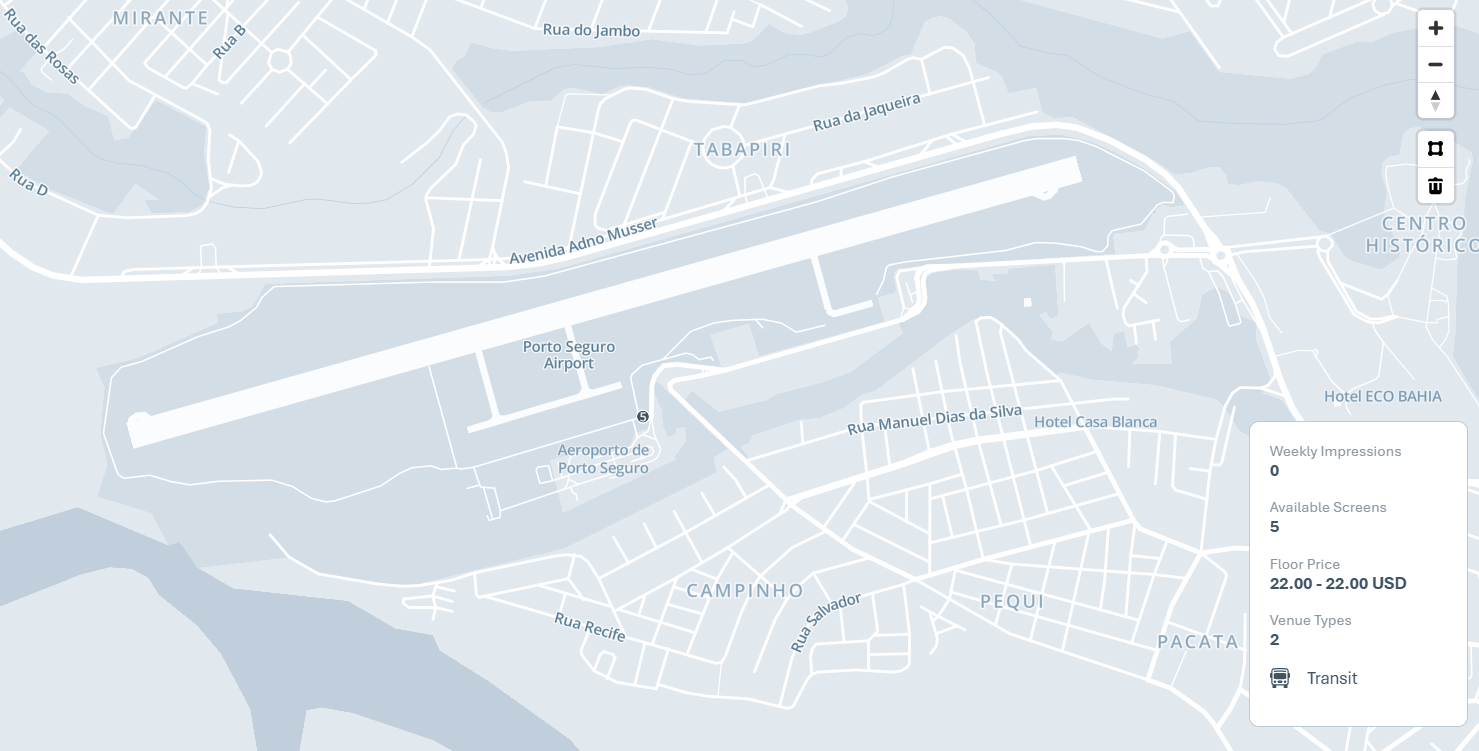
Advertising Value Snapshot
- Passenger scale: Over 2.3 million passengers January to November 2025, up 15.6 percent, with roughly 16,000 commercial flight operations, up 14.5 percent. First-quarter 2026 movement of 400,800 passengers, up 20.76 percent.
- Traveller type: Brazilian domestic leisure families and young travellers, affluent and UHNWI Trancoso and Espelho visitors, regional business and agri-industrial travellers.
- Airport classification: Tier 2. Volume is overwhelmingly domestic mid-market leisure, with a genuinely ultra-premium segment concentrated into roughly ten weeks of the year.
- Commercial positioning: The gateway to the Costa do Descobrimento, where Portugal made landfall in 1500, and the only scheduled air access to Trancoso, Arraial d'Ajuda and Caraíva.
- Wealth corridor signal: The São Paulo and Rio leisure and second-home corridor into southern Bahia, connected onward to the Miami, Lisbon and Punta del Este markets where Brazilian capital concentrates.
Advertising opportunity: Volume at this airport rivals or exceeds far better-known Brazilian terminals while message competition remains substantially lower, and the December to February window delivers both mass reach and concentrated UHNWI presence simultaneously. Masscom Global provides inventory access and placement precision that allows a consumer brand to buy national-scale Brazilian reach and a luxury brand to intercept the Trancoso audience, without either paying for the other.
Airport Advertising is Complex to Get Right
We help you execute faster, with proven results and local insight most planners lack starting now.
Talk to an ExpertCatchment Area and Economic Drivers
Top 10 Cities within 150 km, Marketer Intelligence:
- Porto Seguro: The volume core, 10 kilometres from the terminal. Large-scale resort, all-inclusive and beach club economy serving Brazilian mid-market and young leisure travellers with high on-trip discretionary spend concentrated in beverage, entertainment, mobile data and payments.
- Trancoso: The highest-value audience node in Brazil's northeastern coast. Ultra-premium hotel inventory, private villa ownership by São Paulo, Rio and international buyers, and a New Year and Carnival season that concentrates Brazilian and global elite. Prestige watches, fine jewellery, private banking, fashion and luxury real estate convert here.
- Arraial d'Ajuda: Upper-mid-market and premium village market approximately 25 kilometres away across the river ferry, serving affluent Brazilian families and long-stay international visitors. Strong for premium hospitality, wellness, real estate and family financial products.
- Caraíva: Rustic-luxury destination roughly 70 kilometres south with no vehicle access to the village itself, drawing a design-conscious, high-income, privacy-seeking audience. Aligns with eco-luxury, wellness, sustainable and independent premium brands rather than conventional status positioning.
- Praia do Espelho and Curuípe: Small-scale ultra-premium beach and villa market with limited inventory and correspondingly exclusive guest profile. Among the highest per-visitor spend in the catchment, relevant to private aviation, yachting and bespoke luxury advertisers.
- Santa Cruz Cabrália and Coroa Vermelha: Historic landfall site and Pataxó indigenous cultural centre, drawing heritage and cultural tourism alongside a resident community economy. Relevant to cultural tourism, telecom and consumer categories.
- Eunápolis: The regional industrial and commercial anchor approximately 65 kilometres inland, centred on large-scale eucalyptus plantation and cellulose production. Produces industrial management, forestry and logistics decision-makers relevant to B2B equipment, transport and safety advertisers.
- Teixeira de Freitas: The commercial, healthcare, education and retail hub for the extreme south of Bahia, with a substantial resident middle class. Delivers a year-round regional consumer and professional audience that does not depend on the tourist season.
- Itamaraju: Cattle ranching, papaya, coffee and agricultural production centre. Produces landowner and agribusiness principals with equipment, input and land finance authority, an audience easily overlooked at a beach airport.
- Prado and Cumuruxatiba: Emerging southern coastal market with growing second-home and boutique hospitality development. Buyers here are early-stage and price-sensitive relative to Trancoso, making this the most active real estate consumer segment in the catchment.
NRI and Diaspora Intelligence:
Porto Seguro has no significant resident diaspora community in the conventional sense, and advertisers should not be sold one. The commercially meaningful movement pattern runs in the opposite direction. This airport's wealth is inbound rather than resident: the affluent audience arrives from São Paulo, Rio de Janeiro, Belo Horizonte, Brasília and Salvador, and a large share of Trancoso's premium property stock is owned by non-residents from those cities and from Europe.
The international segment, while small in absolute terms at 29,014 arrivals in 2025, is growing rapidly and is drawn principally from Portugal, Spain, France, Italy, Switzerland, the United States, Argentina and Chile. The Portuguese and Italian connections carry additional commercial weight because large numbers of Brazilians hold or are pursuing Portuguese and Italian citizenship by descent, making this a corridor for family, heritage and residency-linked travel rather than pure tourism. The Argentine and Chilean segments are price-sensitive regional leisure travellers responsive to value and payment-flexibility messaging.
Economic Importance:
Tourism dominates and everything else supports it. Hospitality, food service, transport, construction and real estate development across Porto Seguro, Arraial d'Ajuda and Trancoso form the primary economy, with employment and income highly seasonal. Inland, eucalyptus plantation and cellulose production around Eunápolis provides the region's largest industrial base and its most stable formal employment. Cattle ranching, papaya, coffee and fruit production across Itamaraju and the extreme south supply an agribusiness landowner layer. Teixeira de Freitas anchors regional commerce, healthcare and education. For advertisers, the practical implication is that consumer categories should follow the tourist calendar while B2B and regional consumer categories should not.
Business and Industrial Ecosystem
- Hospitality, resort and villa rental operations: Large-scale resort inventory in Porto Seguro alongside ultra-premium boutique properties in Trancoso and Espelho. Produces hotel and resort management, procurement leads and villa operators with recurring supply, technology and financial services needs.
- Eucalyptus forestry and cellulose production: Large-scale plantation and pulp manufacturing centred on Eunápolis, forming the region's principal industrial employer. Produces engineering, forestry, logistics and procurement decision-makers with long-cycle capital authority.
- Cattle ranching and tropical agriculture: Cattle, papaya, coffee and fruit production across Itamaraju, Itabela and the extreme south. Produces landowner and agribusiness principals whose asset wealth substantially exceeds visible income.
- Coastal real estate development and construction: Sustained villa, condominium and boutique hotel development across Trancoso, Espelho, Prado and Arraial d'Ajuda, increasingly funded by São Paulo, Rio and international capital. Produces developers, brokers and construction principals.
Passenger Intent, Business Segment:
Business travel at BPS is modest relative to leisure but commercially specific. Hospitality and real estate professionals move constantly between southern Bahia and São Paulo and Rio for investment, development and management business, and they are the most efficiently reachable B2B group in this terminal. Forestry, cellulose and agribusiness management travel toward Salvador, Belo Horizonte and São Paulo for supplier, regulatory and financing purposes. Regional professional and healthcare travel serves the Teixeira de Freitas and Eunápolis hubs. Categories that intercept these travellers effectively are commercial banking and credit, construction and industrial equipment, logistics, insurance and business technology.
Strategic Insight:
The business audience here is small but it overlaps almost entirely with the property audience, which is where the commercial value sits. The people flying between São Paulo and Porto Seguro on business are frequently the same people buying or developing in Trancoso, Espelho and Prado, which means a single well-placed proposition can address both a corporate and a personal investment decision. Masscom Global concentrates B2B and real estate placement on the São Paulo and Rio route flows for exactly this reason, rather than spreading it across a terminal dominated by holiday traffic.
Tourism and Premium Travel Drivers
- Trancoso and the Quadrado: One of Latin America's most exclusive destinations, with internationally recognised hotel inventory, a private villa market owned by Brazilian and European elite, and a New Year season that concentrates extraordinary spending power into a few weeks.
- Porto Seguro's resort and beach club belt: Large-scale all-inclusive and mid-market resort inventory plus the Taperapuan beach club and live music economy, driving the airport's volume base with a young, high-energy, high-on-trip-spend Brazilian audience.
- Arraial d'Ajuda, Caraíva and Praia do Espelho: A graduated premium coastline from family-affluent to rustic-luxury, drawing repeat visitors who return annually and increasingly buy property. Strong for hospitality, wellness, real estate and eco-luxury categories.
- Costa do Descobrimento heritage and Pataxó cultural tourism: The site of Portuguese landfall in 1500, with Atlantic Forest reserves and indigenous cultural sites, supporting educational, heritage and cultural travel that skews older and more affluent than the resort segment.
Passenger Intent, Tourism Segment:
Three separate intents share this terminal, and conflating them wastes budget. The mass Brazilian leisure passenger has typically bought a package including flights and accommodation, leaving remaining budget concentrated in beverage, dining, nightlife, excursions, mobile data and payments, and is highly responsive to instalment credit, cashback and connectivity offers. The affluent family and Arraial d'Ajuda visitor arrives with accommodation committed and meaningful discretionary capacity for dining, retail, wellness and increasingly property viewing. The Trancoso and Espelho passenger has committed extraordinary sums before landing and makes discretionary decisions on jewellery, watches, fashion, art and real estate within days of arrival, making arrivals placement a consideration-stage intercept rather than an awareness one.
Travel Patterns and Seasonality
Peak seasons:
- 20 December to early January: The absolute peak in both volume and value. Over 160,000 passengers were expected across 1,108 flights to more than 18 domestic and international cities between 20 December 2025 and 4 January 2026, against 144,000 and 1,050 flights the prior season, increases of 10.7 percent and 5.5 percent. The Trancoso New Year season concentrates the year's densest UHNWI presence.
- January and February, including Carnival: Brazilian summer school holidays and Carnival sustain very high volume. Q1 2026 movement reached 400,800 passengers, up 20.76 percent, and the airport ranked among the six busiest in the Northeast across the 2025/2026 high season from 19 December to 18 February.
- July: Brazilian winter school holidays produce a strong secondary family leisure peak with a more moderate premium component.
- April, Easter and the Discovery anniversary period: Heritage tourism and holiday weekends generate a distinct shoulder peak around the Costa do Descobrimento historical calendar.
Traffic volume data:
Over 2.3 million passengers moved through the terminal between January and November 2025 across roughly 16,000 commercial flights. January to August 2025 accounted for approximately 1.7 million passengers, up around 15 percent, with international passenger movement up almost 137 percent. The airport recorded 8,967 landings in 2025, of which 8,763 were domestic and 204 international, up from 121 international operations the prior year.
Event-Driven Movement:
- Réveillon in Trancoso and Porto Seguro (late December to 1 January): The single most valuable window at this airport. Trancoso's New Year season draws the Brazilian and international elite, while Porto Seguro's mass celebrations drive record volume. Priority window for luxury, premium beverage, banking and property advertisers.
- Carnival (February or March): Nationally significant multi-day movement bringing both mass and premium audiences. Highest volume single event period after New Year, and the strongest window for FMCG, beverage, telecom and payments categories.
- Brazilian summer school holidays (mid-December to February): Not a single event but the structural peak, dominated by family leisure with committed accommodation and open discretionary budgets.
- July winter school holidays: Reliable secondary family peak, valuable for advertisers seeking a second flight without December pricing.
- Discovery of Brazil anniversary and Easter period (April): Heritage and cultural tourism concentrated around the historic landfall sites, drawing an older, more affluent and educationally motivated audience.
It’s Not Just Where You Advertise - It’s How Fast You Execute
We combine local insight with fast rollout to deliver results for you, now.
Talk to an ExpertAudience and Cultural Intelligence
Top 2 Languages:
- Portuguese: The overwhelmingly dominant language, given that domestic travellers accounted for 1,277,330 of 1,306,344 arrivals in 2025. Creative must be Brazilian Portuguese first, with warmth, directness and clear value framing. Brazilian consumers respond strongly to instalment terms, cashback and payment flexibility made explicit rather than implied.
- Spanish: The most commercially relevant second language, driven by the growing Argentine and Chilean segments. These travellers are exchange-rate sensitive and highly responsive to value, payment method and connectivity messaging, and warrant dedicated Spanish creative rather than assumed Portuguese comprehension.
English, French and Italian carry disproportionate weight relative to volume because they map onto the premium European segment travelling to Trancoso, Espelho and Caraíva, and any luxury campaign here should be multilingual.
Major Traveller Nationalities:
The passenger base is overwhelmingly Brazilian, drawn principally from São Paulo, Rio de Janeiro, Belo Horizonte, Brasília and Salvador. International arrivals totalled 29,014 in 2025, roughly 2 percent of disembarkations but growing more than 70 percent year on year, with 204 international flight operations against 121 the prior year. The principal source markets are Portugal, Spain, France, Italy, Switzerland, the United States, Argentina and Chile. Campaign creative should be built for a Brazilian domestic audience as the base case, with a separate multilingual premium layer positioned against the Trancoso and Espelho arrival flow.
Religion, Advertiser Intelligence:
Figures below are directional approximations for Bahia rather than airport-level survey data.
- Roman Catholicism (approximately 50 percent): The historic religious foundation of Bahia and of the Costa do Descobrimento specifically, given the region's role in Brazil's founding. Drives Christmas, Easter and patron saint festival travel, and supports first communion, confirmation and family gifting cycles. Relevant to gifting, jewellery, family travel and consumer credit advertisers.
- Evangelical and Pentecostal Christianity (approximately 30 percent and growing): The fastest-expanding religious segment in Brazil, with strong penetration in working and lower-middle-income households across the region. Drives family and congregational travel, and shapes consumption toward family framing, financial prudence and community endorsement. Advertisers should avoid creative that reads as irreverent to this audience.
- Candomblé, Umbanda and Afro-Brazilian traditions (formally declared at low single digits, practised far more widely in syncretic form): Bahia is the cultural heartland of Afro-Brazilian religion, and its festival calendar, notably the February Iemanjá observances, shapes regional travel and celebration spending. Culturally significant and commercially relevant to beverage, music, fashion and experience categories, and to be treated with respect rather than as decoration.
- Religiously unaffiliated (approximately 10 to 15 percent): Skews younger, urban and higher-income, overlapping heavily with the São Paulo and Rio premium visitor segment. Higher receptivity to design, sustainability, wellness and experience positioning.
Pataxó indigenous communities maintain a significant cultural and tourism presence at Coroa Vermelha and the surrounding reserves, and any creative referencing the region's heritage should reflect that presence accurately.
Behavioral Insight:
Two decision-making models occupy this terminal and they behave in almost opposite ways. The mass Brazilian leisure passenger is credit-aware and instalment-driven, having frequently financed the trip itself, and converts on offers that reduce immediate cash outlay: instalment plans, cashback, bundled data, fee waivers. Payment flexibility is not a detail here, it is the proposition. The premium Trancoso passenger is at the opposite extreme, insulated from price and highly attuned to exclusivity, discretion and design credibility, and responds to scarcity and curation rather than to value. Brazilian luxury culture is notably more expressive than European luxury culture, so overt aspiration performs better here than it would in Genoa or Sonoma, but it must be paired with genuine design quality. Masscom sequences creative so these two audiences are addressed separately within the same terminal.
Outbound Wealth and Investment Intelligence
The outbound passenger at BPS requires careful reading, because the airport's wealth is not resident. Southern Bahia is not an affluent region, and the local population's income levels are moderate to low. The high-net-worth audience in this terminal is visiting: São Paulo, Rio, Brasília and Minas Gerais capital arriving to holiday and, increasingly, to buy. The commercially relevant investment intelligence therefore runs in two directions, one inbound to the region and one outbound from Brazil.
Outbound Real Estate Investment:
Inbound to this catchment, Brazilian and European capital is actively acquiring villa, land and boutique hotel assets across Trancoso, Praia do Espelho, Caraíva and, at earlier-stage pricing, Prado and Cumuruxatiba. This is the most immediately actionable property proposition at this airport, and it is best addressed to the São Paulo and Rio arrival flow. Outbound from Brazil, this same class of buyer deploys capital principally into Miami and South Florida, which functions as the default offshore market for Brazilian wealth, alongside Orlando, New York, Lisbon and the Algarve, Madrid, Italy, Punta del Este in Uruguay and, more recently, Dubai. International developers marketing Florida, Portuguese or Uruguayan inventory will find qualified intent among the premium segment here.
Outbound Education Investment:
Brazilian families in the premium segment send children principally to the United States, Portugal, the United Kingdom and Canada, with Portugal holding a distinctive advantage on language, cost and the citizenship pathways many Brazilian families already hold. Domestic demand concentrates on São Paulo and Rio private institutions. Because the resident population of the catchment has limited capacity for international education spend, education advertisers should target the visiting premium flow rather than the local audience, and should time campaigns to the December to February window.
Outbound Wealth Migration and Residency:
Brazil is one of the world's most active sources of wealth migration, and this is directly relevant to the premium audience at BPS. Portugal is the dominant destination, driven by language, residency pathways and the large number of Brazilians eligible for Portuguese citizenship by descent. Italy is significant for the same reason, with citizenship by descent widely pursued among Brazilians of Italian ancestry. The United States, principally Florida, absorbs the largest share of relocating Brazilian capital, with Spain, Uruguay and the United Arab Emirates growing. Residency and citizenship advisory, second-passport services and international private banking all have genuine demand here, provided they are addressed to the visiting premium segment and not to the mass leisure flow.
Strategic Implication for Advertisers:
The corridor at this airport runs São Paulo and Rio into southern Bahia, and Brazil into Miami and Lisbon. Wealth managers, residency advisers, international private banks and property developers on either leg are addressing the same households, and the December to February window puts them all in one compact terminal simultaneously. Masscom Global can activate at BPS alongside São Paulo, Rio, Miami and Lisbon, reaching the same family at holiday, at home and at destination inside one campaign structure.
Airport Infrastructure and Premium Indicators
Terminals:
- A single consolidated passenger terminal located approximately 10 kilometres from central Porto Seguro, handling all domestic and international scheduled and charter traffic. Single-terminal configuration means every arriving and departing passenger passes through the same circulation spine, delivering near-complete coverage from a compact footprint.
- The airport operated under a temporary private management arrangement from February 2025, with acknowledged infrastructure constraints relative to current demand. Advertisers should treat this candidly: the terminal is handling volumes well above what its current footprint was designed for, which increases congestion and dwell but limits the range of available premium positions. Verified terminal area and capacity figures are not available.
Premium Indicators:
- Business and general aviation activity is significant during the high season, with private aircraft and charter movement serving the Trancoso, Espelho and Caraíva villa audience. The top of this catchment's visitor wealth curve is present in volumes that scheduled passenger counts understate.
- Ultra-premium hospitality within transfer range is exceptional rather than adjacent. Internationally recognised boutique and design-led hotel inventory in Trancoso, alongside villa rental at the highest tier of the Brazilian market, sits within 60 to 80 kilometres of the terminal.
- The onward journey itself is a distinctive commercial feature. Access to Arraial d'Ajuda, Trancoso and Caraíva requires a river ferry crossing and, for Caraíva, a canoe transfer, which makes ground transport, private transfer and vehicle rental unusually high-consideration purchases decided at or near the terminal.
- Recent management investment has focused on passenger environment, comfort and operational efficiency, which improves the quality of the setting in which brand messaging appears without yet resolving the underlying capacity constraint.
Forward-Looking Signal:
Growth here is structural rather than seasonal noise. Passenger volume rose 15.6 percent through November 2025 and a further 20.76 percent in the first quarter of 2026, international operations nearly doubled from 121 to 204 landings, and international passenger movement grew by triple digits before the base effect faded. Porto Seguro ranked seventh among Brazilian destinations for hotel sector performance in the first half of 2025 and among the six busiest northeastern airports across the 2025/2026 high season. Terminal capacity is now the binding constraint, which means audience volume is rising against a fixed footprint and available positions are becoming scarcer rather than more plentiful. Masscom Global advises advertisers to secure position and multi-season rates now, before capacity investment and continued growth reset the commercial baseline.
Airline and Route Intelligence
Top Airlines:
Azul, GOL and LATAM operate the scheduled network, supplemented by seasonal charter operations during the December to February and July peaks.
Key International Routes:
International service is limited and largely seasonal or charter-based, accounting for 204 landings and 29,014 arriving passengers in 2025 against 121 landings the prior year. Source markets are Portugal, Spain, France, Italy, Switzerland, the United States, Argentina and Chile, with most international travellers connecting via São Paulo, Salvador or Rio. Verified scheduled international frequencies are not available.
Domestic Connectivity:
The domestic network is the airport's foundation, accounting for 8,763 of 8,967 landings in 2025, with São Paulo, Rio de Janeiro, Belo Horizonte, Brasília, Salvador, Campinas and Confins forming the core corridors. High season brings daily direct service from most major origins, while low season frequently requires connection through São Paulo or Salvador. More than 18 domestic and international cities were served during the 2025/2026 year-end period.
Wealth Corridor Signal:
The route map divides into two commercial functions and reading it correctly determines campaign success. São Paulo and Rio de Janeiro are the wealth corridors: they carry the Trancoso, Espelho and Caraíva audience, the property buyers, the developers and the internationally mobile premium households, and they are where luxury, real estate, private banking and residency advisory spend belongs. Belo Horizonte, Brasília, Salvador and Campinas are volume corridors carrying middle-class family leisure, and they are where consumer credit, telecom, beverage, FMCG and payments spend belongs. The near-absence of scheduled long-haul international service confirms that this is a domestic Brazilian airport with an elite domestic overlay, not an international luxury gateway.
Media Environment at the Airport
- Single-terminal configuration means full-journey coverage is achievable across a passenger base exceeding 2.3 million, at a cost far below what comparable Brazilian volume commands at Salvador, Recife or the São Paulo airports.
- Advertising clutter is materially lower than at the Brazilian capital airports. A well-placed campaign at BPS achieves standout at a level that would require premium spectacular positioning at Guarulhos or Galeão.
- Dwell time is exceptional and rising, driven by capacity constraints relative to demand, concentrated high-season peaks, and the onward transfer decision that many arriving passengers resolve at or near the terminal. This last point is commercially unusual: ground transport, rental and transfer choices are genuinely made in the arrivals environment here.
- Masscom Global provides advertisers with inventory access, placement precision mapped to individual route flows, and execution capability at an airport where local relationship depth determines availability, particularly with capacity tight. We separate the São Paulo and Rio premium arrival positions from the wider domestic volume flows, so luxury and mass consumer creative each reach their intended audience rather than a blended average.
Strategic Advertising Fit
Best Fit:
- Consumer banking, credit cards and instalment payment products: The single strongest category at this airport. Brazilian leisure travel is credit-financed, and instalment, cashback and fee-waiver propositions convert at volume.
- Telecom, mobile data and connectivity: High-volume leisure travellers with heavy data consumption, roaming needs for international segments and constrained connectivity across the coastal villages.
- Beverage, FMCG and quick-service brands: Over 2.3 million passengers in a leisure mindset with committed accommodation and open discretionary spend, at costs well below comparable Brazilian reach.
- Premium hospitality, boutique hotels and villa rental: Repeat annual visitors who upgrade over time, moving from Porto Seguro resorts to Arraial d'Ajuda to Trancoso across successive trips.
- Trancoso, Espelho and southern coast real estate: Active buyer demand from São Paulo, Rio and European purchasers, with earlier-stage pricing available in Prado and Cumuruxatiba.
- Ground transport, vehicle rental and private transfer: The ferry and transfer requirement makes this a genuine at-terminal purchase decision rather than a pre-booked afterthought.
- Prestige watches, fine jewellery and fashion, high season only: The Trancoso New Year and Carnival window concentrates Brazilian and international elite with immediate discretionary capacity.
- Residency, citizenship and international private banking, premium segment only: Brazil is a major source of wealth migration toward Portugal, Italy, Florida and Uruguay, and this audience is reachable on the São Paulo and Rio flows.
Brand Alignment at a Glance:
| Category | Fit |
|---|---|
| Consumer banking, credit and instalment products | Exceptional |
| Telecom, mobile data and connectivity | Exceptional |
| Beverage, FMCG and quick-service brands | Strong |
| Premium hospitality and villa rental | Strong |
| Trancoso and southern coast real estate | Strong |
| Ground transport, rental and private transfer | Strong |
| Prestige watches, jewellery and fashion | Moderate, high season only |
| B2B industrial, energy and heavy equipment | Poor fit |
Who Should Not Advertise Here:
- B2B industrial, energy and heavy equipment: The catchment's industrial base is narrow, and decision-maker density is far too low to justify spend. These budgets belong at Salvador, Belo Horizonte or the São Paulo airports.
- Year-round luxury campaigns at flat weight: The premium audience is real but compressed into roughly ten weeks. A twelve-month luxury flight here pays for nine months of mass-market impressions that will not convert. Buy the window, not the year.
- Long-haul international property outside the established Brazilian corridors: This audience buys in Florida, Portugal, Spain, Italy and Uruguay. Inventory in London, Dubai's mid-market or Southeast Asia faces weak intent regardless of exposure quality, with Dubai the one emerging exception worth testing.
Event and Seasonality Analysis
- Event Strength: High
- Seasonality Strength: Very High
- Traffic Pattern: Sharply seasonal with a dominant summer peak
Strategic Implication:
This is among the most seasonally concentrated airports in Brazil, and budget allocation must reflect that rather than spreading evenly. The core campaign runs from mid-December to the end of Carnival, capturing Réveillon, summer school holidays and Carnival in a single continuous flight, with creative live before 15 December. Luxury, jewellery, watch and premium property advertisers should confine spend almost entirely to this window, where the Trancoso audience is present. Consumer credit, telecom, beverage and FMCG advertisers should add a second flight in July for the winter holiday peak and a shorter presence around Easter and the April heritage period. Masscom structures campaigns around this rhythm and secures position during the low season, when rates are negotiable and prime inventory is uncontested.

Poor Placement and Delays Affect Airport Campaigns
We help you move faster, access better inventory, and get it right now.
Talk to an ExpertFinal Strategic Verdict
Porto Seguro International is Brazil's most efficiently priced high-volume leisure terminal, and it hides a genuinely elite audience inside a mass-market passenger profile. Over 2.3 million passengers moved through a single constrained terminal between January and November 2025, up 15.6 percent, with first-quarter 2026 growth of 20.76 percent making it one of the fastest-expanding airports in northeastern Brazil and second in Bahia only to Salvador. Consumer banking and instalment credit providers, telecom operators, beverage and FMCG brands, ground transport and rental companies, and premium hospitality and southern-coast property developers will all find scale and intent here that their budgets could not buy at Guarulhos or Galeão. Separately, from mid-December through Carnival, the São Paulo and Rio flows carry the Trancoso and Praia do Espelho elite, making that ten-week window a legitimate buy for watch, jewellery, private banking and residency advisers who confine spend to it. Industrial B2B and flat-weight annual luxury campaigns should look elsewhere. With volume rising against a fixed footprint and international operations nearly doubling, current pricing reflects the airport that was rather than the one arriving, and Masscom Global is the partner positioned to secure inventory, timing and placement precision before that gap closes.
About Masscom Global
Masscom Global is a premium international airport advertising and media buying agency operating across 140 countries. With deep expertise in airport OOH, premium publications, and high-net-worth audience targeting, Masscom helps brands reach the world's most valuable travellers at the moments that matter most. For advertising packages, media rates, and campaign planning at Porto Seguro International Airport and airports across the globe, contact Masscom Global today.
Frequently Asked Questions
How much does airport advertising cost at Porto Seguro International Airport?
Cost at BPS varies by format, terminal position, campaign duration and seasonal demand. Positions covering the arrivals and departures flow between mid-December and Carnival command substantial premiums, while April to November offers materially more efficient pricing. Because the terminal is compact and currently handling volumes above its designed footprint, availability rather than budget is frequently the binding constraint in high season. Contact Masscom Global for current rates and availability.
Who are the passengers at Porto Seguro International Airport?
Overwhelmingly Brazilian domestic leisure travellers. Of 1,306,344 arrivals in 2025, 1,277,330 were domestic and 29,014 international. The base audience is families and young travellers from São Paulo, Rio, Belo Horizonte, Brasília and Salvador on resort and beach holidays. Layered on top is a genuinely elite segment travelling to Trancoso, Praia do Espelho and Caraíva, drawn from the São Paulo and Rio wealth base and from Europe, concentrated in the December to February window.
Is Porto Seguro International Airport good for luxury brand advertising?
Yes, but only if the flight is timed rather than annual. Trancoso and Praia do Espelho concentrate one of Latin America's most exclusive audiences, and the Réveillon and Carnival window puts them through this terminal in volume. Outside that window the passenger mix reverts to mid-market domestic leisure, and a year-round luxury campaign would pay for nine months of non-converting impressions. Buy December to Carnival and buy the São Paulo and Rio flows specifically.
What is the best airport in Brazil to reach HNWI audiences?
São Paulo Guarulhos delivers the greatest concentration of Brazilian wealth traffic and remains the anchor buy for a national campaign, with Rio Galeão and Congonhas strong complements. Fernando de Noronha delivers the purest ultra-premium leisure audience at very low volume. Porto Seguro delivers the Trancoso audience specifically, in a defined seasonal window, at a fraction of capital-airport pricing. Masscom recommends Guarulhos for reach and BPS for the Bahian premium window.
What is the best time to advertise at Porto Seguro International Airport?
Mid-December through the end of Carnival is the dominant window, capturing Réveillon, Brazilian summer school holidays and Carnival in one continuous flight, with creative live before 15 December. Over 160,000 passengers moved through the terminal in the 20 December to 4 January period alone. July delivers a strong secondary family peak, and April brings a heritage tourism shoulder around Easter and the Discovery anniversary.
Can international real estate developers advertise at Porto Seguro International Airport?
Yes, in both directions. Inbound, São Paulo, Rio and European buyers are actively acquiring villa and land assets in Trancoso, Praia do Espelho, Caraíva, Prado and Cumuruxatiba. Outbound, this same premium segment buys in Miami and South Florida, Orlando, Lisbon and the Algarve, Madrid, Italy and Punta del Este. Developers with inventory in those markets will find qualified intent among the São Paulo and Rio arrival flows.
Which brands should not advertise at Porto Seguro International Airport?
Industrial, energy and heavy equipment B2B, because decision-maker density in this catchment is too low to justify spend. Flat-weight year-round luxury campaigns, because the premium audience is compressed into roughly ten weeks. And long-haul property outside the Florida, Portuguese, Spanish, Italian and Uruguayan corridors where Brazilian capital actually moves.
How does Masscom Global help brands advertise at Porto Seguro International Airport?
Masscom Global delivers the full sequence: audience and catchment intelligence separating the mass domestic leisure flow from the Trancoso premium layer, inventory access and placement precision mapped to individual route flows, campaign timing structured around the December to Carnival peak and the July secondary window, and execution management through to performance reporting. Operating across 140 countries, we can activate BPS alongside São Paulo, Rio, Miami and Lisbon, reaching the same household at holiday, at home and at destination. Book a fifteen-minute planning call to review current availability and rates.