




Airport at a Glance
| Field | Detail |
|---|---|
| Airport | Willow Run Airport (Woodrum note: officially Willow Run Airport) |
| IATA Code | YIP |
| Country | United States |
| City | Van Buren Charter Township and Ypsilanti Township, Michigan (Detroit metropolitan area) |
| Annual Passengers | No scheduled passenger service. Passenger enplanements: Data not available. The airport handles more than 200 million pounds of air cargo annually across 2,600 acres. |
| Primary Audience | Cargo airline and logistics leadership, automotive supply chain executives, corporate and private aviation passengers |
| Peak Advertising Season | March to June, September to November |
| Audience Tier | Tier 2 by audience value, Tier 3 by passenger volume |
| Best Fit Categories | Aviation services and MRO, logistics and supply chain technology, industrial and commercial insurance, automotive B2B |

Willow Run occupies 2,600 acres in Van Buren Charter Township and Ypsilanti Township, roughly seven miles west of Detroit Metropolitan Airport, and is operated by the same authority. It carries no scheduled passenger service. Instead it moves more than 200 million pounds of air cargo a year, operating around the clock with a 24-hour FAA tower and full US Customs facilities, and it is described by its own operator as one of the country's leading airports dedicated to air freight. A globally significant cargo airline is headquartered here, and two further freight and charter operators are based on the field.
The reason this matters commercially is what the freight actually is. Willow Run grew into one of the busiest on-demand cargo airports in North America specifically by serving the automotive industry, moving expedited parts into a manufacturing corridor where a single missing component can halt an assembly line. That means the people passing through this airport are aviation, logistics, and supply chain executives with genuine budget authority, alongside corporate flight department passengers from the automakers themselves. Advertisers here are not buying reach. They are buying proximity to industrial procurement.
Advertising Value Snapshot
- Passenger scale: No scheduled passenger service. More than 200 million pounds of cargo handled annually, with 24-hour tower and US Customs operations supporting continuous around-the-clock activity.
- Traveller type: Cargo airline flight crew and leadership, freight forwarding and logistics executives, automotive supply chain and expediting managers, and corporate and private aviation passengers.
- Airport classification: Tier 2 by audience value, Tier 3 by passenger volume. Decision-making authority per person on the field is exceptionally high.
- Commercial positioning: One of North America's leading on-demand air freight airports and the aviation backbone of the Detroit automotive manufacturing corridor.
- Wealth corridor signal: The airport sits at the centre of the Detroit Region Aerotropolis, a two-county public-private development zone spanning two airports, three major interstates, five Class-A rail lines, and a connected and autonomous vehicle testing facility.
- Advertising opportunity: With no scheduled terminal to fragment attention, brand presence here reaches a defined industrial community repeatedly across FBO, corporate, and operational touchpoints. Masscom Global secures placement that speaks to aviation, logistics, and automotive decision makers in the environment where they work rather than where they holiday. This is account-based industrial advertising, and Masscom structures it accordingly.
Airport Advertising is Complex to Get Right
We help you execute faster, with proven results and local insight most planners lack starting now.
Talk to an Expert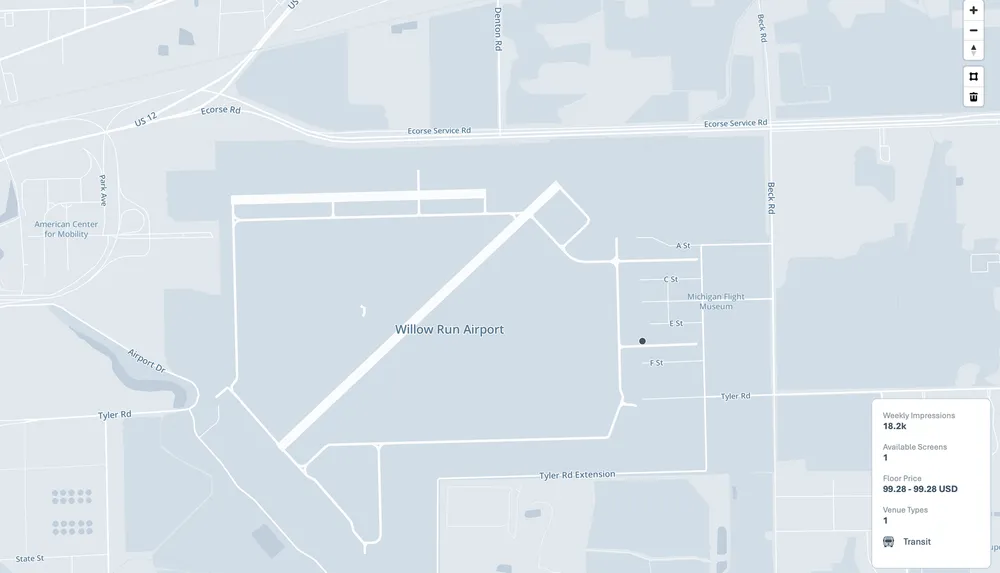
Catchment Area and Economic Drivers
Top 10 Cities within 150 km, Marketer Intelligence:
- Ann Arbor: The most educated and highest-income market in the catchment, anchored by a major research university, a large academic health system, and a venture-backed technology cluster. Produces research, medical, and startup executive audiences.
- Ypsilanti: Immediately adjacent to the airport, home to a large public university and to the region's connected and autonomous vehicle testing infrastructure. Produces engineering, mobility technology, and skilled workforce audiences.
- Dearborn: Home to a global automaker's world headquarters and engineering campus, and to the largest and most established Arab-American community in the United States. Produces both senior automotive decision makers and a culturally distinct, commercially significant consumer market.
- Detroit: Corporate headquarters, finance, and a rapidly redeveloping mobility innovation district. Produces executive, investment, and corporate real estate audiences.
- Canton and Plymouth: Affluent professional suburbs immediately east of the airport, densely populated with automotive engineering and management households. Produces high-income consumer and professional services demand.
- Livonia: A major automotive supplier and logistics base. Produces plant management, warehousing, and distribution decision makers directly relevant to freight and industrial advertisers.
- Auburn Hills: North American headquarters of a global automaker plus a dense supplier engineering cluster. Produces procurement and engineering leadership with substantial contract authority.
- Warren: Home to one of the largest automotive research and development concentrations in North America. Produces the highest density of engineering decision makers in the entire catchment.
- Toledo, Ohio: Vehicle assembly, glass manufacturing, and logistics, functionally integrated with the Michigan automotive corridor. Executives here treat this airport as regional infrastructure.
- Windsor, Ontario: The Canadian side of the same automotive manufacturing and tool-and-die corridor, connected by international crossings. Adds cross-border manufacturing, customs, and logistics decision makers.
NRI and Diaspora Intelligence:
The catchment contains one of the most significant and commercially underserved diaspora markets in the United States. Dearborn and its surrounding communities host the largest concentration of Arab-Americans in the country, principally of Lebanese, Yemeni, Iraqi, and Palestinian heritage, with deep multi-generational business ownership across automotive retail, real estate, food distribution, and professional services. Alongside this, the automotive engineering workforce has drawn substantial Indian, Chinese, and Korean professional communities into the catchment, concentrated in the Canton, Novi, and Ann Arbor corridors. Both groups maintain active financial, property, and family ties abroad. For advertisers, this means the catchment carries far more genuine international investment intent than a Midwest manufacturing region would normally suggest.
Economic Importance:
Three engines drive this catchment. Automotive design, engineering, and manufacturing is the foundation, with the largest concentration of vehicle research and development in North America sitting within the catchment radius. Logistics and expedited freight is the second, and it exists precisely because of the first: just-in-time manufacturing creates demand for on-demand air cargo that this airport was built around. Research, healthcare, and mobility technology forms the third, spanning a major research university, an academic health system, and a connected vehicle testing centre adjacent to the field. Masscom Global maps creative to the engine an advertiser is selling into rather than treating the airport as a generic environment.
Business and Industrial Ecosystem
- On-demand and charter air cargo: More than 200 million pounds annually, with a major international cargo airline headquartered on the field and additional freight and charter operators based here. Produces aviation leadership, fleet, and MRO procurement audiences.
- Automotive assembly, supply chain, and expediting: The airport exists to serve just-in-time manufacturing across Michigan, Ohio, and Ontario. Produces supply chain, logistics, and plant management decision makers under constant time pressure.
- Automotive research, engineering, and mobility technology: A concentration of vehicle R&D unmatched in North America, plus adjacent connected and autonomous vehicle testing infrastructure. Produces engineering leadership and technology procurement audiences.
- Corporate and business aviation: Corporate flight departments and charter operations use the field as a reliever for the region's main commercial airport. Produces executive passengers with company-level authority.
Passenger Intent, Business Segment:
Almost everyone moving through this airport is working. They are cargo airline captains and operations directors, freight forwarders and customs brokers, supply chain managers chasing a line-down situation, MRO and ground handling leadership, and corporate flight department passengers travelling on company business. They are time-pressured, technically literate, and evaluate suppliers on reliability and response time rather than on brand affinity. Aviation services and MRO, aircraft parts and leasing, fuel and lubricants, logistics technology, cargo and commercial insurance, industrial equipment, and workforce recruitment intercept them most effectively.
Strategic Insight:
The commercial logic here is inverted from a passenger airport and advertisers should embrace that. At a conventional terminal, an industrial brand pays to reach thousands of irrelevant travellers in order to find a handful of buyers. At Willow Run, essentially every person on the field belongs to the aviation, logistics, or automotive supply chain. The audience is small in absolute terms but almost entirely qualified, and it recurs continuously because these are people who work here rather than pass through once. For a supplier selling into aviation or automotive logistics, a sustained presence here functions closer to a permanent trade show stand than to conventional out-of-home. Masscom Global builds it as exactly that.
Tourism and Premium Travel Drivers
- Aviation heritage and the wartime bomber plant legacy: Willow Run was the site of one of the most significant aircraft manufacturing efforts in American history, and the associated air museum draws a dedicated heritage and enthusiast audience. Relevant to aviation, heritage, and brand-storytelling advertisers.
- Ann Arbor university and cultural calendar: A nationally recognised college town with a major football programme, arts calendar, and research conference activity that draws visitors into the immediate catchment.
- Detroit automotive and design tourism: Museum, factory tour, and design heritage attractions plus the region's major automotive show calendar bring international industry visitors into the area.
- Great Lakes and Michigan seasonal recreation: Regional lake, boating, and outdoor tourism within easy reach, supporting a second-home and recreational vehicle market among the catchment's affluent professional base.
Passenger Intent, Tourism Segment:
Leisure movement through this specific airport is minimal and advertisers should be honest about it. There is no scheduled service and no tourist arrival flow. The limited leisure-adjacent traffic is corporate hospitality, aviation enthusiasts visiting the museum, and private aircraft passengers arriving for regional events or second-home access. Destination marketing, tourism boards, and consumer travel brands will find no meaningful audience here and should buy the region's main commercial airport instead.
Travel Patterns and Seasonality
Peak seasons:
- March to June: A strong window as automotive production runs at full pace, spring model launches and supplier programme awards occur, and expedited freight demand is elevated.
- September to November: The second and often stronger peak, driven by model year changeover completion, fourth quarter production push, the regional automotive show and supplier conference calendar, and pre-holiday freight volumes.
- Late June to July: Softer, as automotive plants take summer changeover shutdowns and both production freight and business travel drop sharply.
- Late December to early January: The quietest period, with holiday plant shutdowns across the corridor suppressing both cargo and corporate movement.
Cargo and operations data is reported annually rather than monthly in current public form, so granular seasonal figures are not available. Data not available.
Event-Driven Movement:
- Automotive show and supplier conference season (regional calendar): Brings international manufacturer, supplier, and investor delegations into the Detroit corridor, with corporate and charter aviation activity rising accordingly.
- Model launch and programme changeover windows (spring and late summer): The most operationally intense periods for expedited freight, when a single delayed component triggers charter activity. The highest-value timing signal for logistics and aviation services advertisers.
- Plant shutdown periods (July and late December): Predictable troughs across the corridor. Advertisers should reduce spend rather than maintain flat delivery.
- University calendar milestones in the immediate catchment (September and May): Drive corporate and private aviation activity into the field around campus events and graduations.
- Aviation heritage and airshow programming (summer): Draws enthusiast and community audiences to the field, offering a distinct brand-association opportunity for aviation-adjacent advertisers.

It’s Not Just Where You Advertise - It’s How Fast You Execute
We combine local insight with fast rollout to deliver results for you, now.
Talk to an ExpertAudience and Cultural Intelligence
Top 2 Languages:
- English: Dominant and the correct language for all primary creative. This is a technically literate industrial and professional audience, so creative can assume specification-level comprehension and should avoid consumer softness.
- Spanish: The most widely spoken second language across the wider catchment, concentrated in southwest Detroit and in logistics, warehousing, and manufacturing employment. Commercially relevant for workforce recruitment, employer-facing, and financial access advertisers.
Arabic deserves specific attention as the catchment's highest-value distinctive language. The Dearborn corridor holds the largest Arab-American community in the United States with substantial multi-generational business ownership, and Arabic-language creative earns credibility with that market that translated national campaigns do not. Hindi, Mandarin, and Korean carry real relevance within the automotive engineering workforce.
Major Traveller Nationalities:
The base is overwhelmingly American, drawn from southeastern Michigan and northern Ohio. The distinguishing international layer is operational rather than touristic: international cargo crews on global freight rotations, Canadian executives and logistics personnel crossing from the Windsor corridor, and manufacturer and supplier delegations from Japan, South Korea, Germany, and China visiting the automotive engineering cluster. Creative should assume professional English fluency and business-context framing rather than any tourism or leisure register.
Religion, Advertiser Intelligence:
- Christianity, Catholic and Protestant (the largest share of the catchment): Southeastern Michigan carries deep Polish, Italian, Irish, and German Catholic heritage alongside a strong Black church tradition in Detroit. Anchors the Thanksgiving to Christmas block and Easter travel, which coincides with the corridor's holiday plant shutdown and produces a genuine dual dip in industrial activity and spike in family spending.
- Islam (one of the largest and most established Muslim communities in the United States, centred on the Dearborn corridor): Ramadan and Eid drive significant family travel, charitable giving, and concentrated retail and food spending, and Umrah and Hajj movement creates a defined international travel window. Highly relevant to halal-compliant finance, travel, and consumer advertisers, and materially underserved.
- Judaism, Hinduism, and Sikhism (established communities tied to professional and engineering employment): Concentrated in the northern and western suburbs and in the university corridor. Add Lunar New Year, Diwali, and High Holiday travel patterns relevant to travel, financial services, and food advertisers in defined windows.
Behavioral Insight:
This is a hard-nosed, performance-oriented industrial culture in which suppliers are judged on delivery, uptime, and response under pressure rather than on brand narrative. Buyers here have lived through supply chain crises and plant shutdowns, and they discount marketing language quickly in favour of demonstrated capability, references, and total cost of ownership. There is also a strong regional identity and a well-earned scepticism toward brands perceived as extractive rather than committed to the region. The most effective creative is specific, technical, credible on service levels, and visibly invested in Michigan rather than parachuted in.
Outbound Wealth and Investment Intelligence
The wealth picture at this airport is corporate and professional rather than leisure, and the outbound flows follow two distinct paths. The first is the classic American professional pattern of accumulated engineering, medical, and executive income deployed into domestic lifestyle and retirement assets. The second, and far more commercially interesting, is the substantial diaspora wealth held by the catchment's Arab-American business ownership class and its Indian, Chinese, and Korean engineering professionals, all of whom maintain genuine international asset intent.
Outbound Real Estate Investment:
Domestic destinations lead for the general professional base, principally Florida, Arizona, the Carolinas, and northern Michigan lake property for second homes and retirement. The diaspora layer behaves entirely differently and represents the real international opportunity. Arab-American families in the Dearborn corridor maintain active property investment in Lebanon, Jordan, the United Arab Emirates, and increasingly Turkey and Egypt, with Dubai in particular attracting significant capital for its tax position and dollar peg. Indian and Chinese engineering families invest into Bengaluru, Hyderabad, and tier-one Chinese cities. International developers in these markets have a concentrated audience across the catchment.
Outbound Education Investment:
The general professional population educates domestically within Michigan's strong public university system. The international layer is different again: Arab-American and South Asian families in this catchment send children to universities in the United Kingdom, Canada, and the Gulf alongside American institutions, and maintain strong ties to home-country institutions. Study abroad, international graduate programmes, and Gulf and UK university recruiters have a real audience in the wider catchment, though it should be reached through targeted regional media alongside airport presence rather than at this airport alone.
Outbound Wealth Migration and Residency:
Citizenship-by-investment demand from the general population is limited. The relevant activity is diaspora-driven: dual nationality management, Gulf residency and golden visa interest among the Arab-American business community, and cross-border tax and estate planning for families with assets in two jurisdictions. UAE Golden Visa, Turkish citizenship by investment, and Portuguese and Greek residency all carry genuine interest within specific communities. International tax advisory, cross-border banking, and relocation services have a real and underserved audience.
Strategic Implication for Advertisers:
The correct read is that Willow Run itself is an industrial B2B environment and should be bought as one, while the catchment surrounding it contains international investment intent that most media plans miss entirely. Aviation services, MRO, logistics technology, cargo insurance, industrial equipment, and automotive supply chain brands should buy this airport directly. Cross-border banking, international developers, and residency advisers should treat this airport as one component of a regional plan reaching the Dearborn and engineering-corridor communities. Masscom Global can activate both, and can extend into the destination markets on the other side of those corridors.
Airport Infrastructure and Premium Indicators
Terminals:
- There is no scheduled passenger terminal. Activity concentrates around fixed base operations, cargo handling facilities, and corporate hangars distributed across the field, with a complex taxiway system providing access to businesses in all four quadrants of the 2,600 acre site.
- Two active runways under a Class D airspace shelf beneath the region's Class B airspace, supported by a newly completed parallel taxiway stretching more than 7,500 feet alongside the main runway, opened in October 2025.
Premium Indicators:
- A 24-hour FAA control tower and 24-hour US Customs operations, which together allow international freight and corporate aircraft to arrive and clear at any hour. This is the capability that makes on-demand automotive expediting possible.
- Headquarters of a globally significant cargo airline plus an operating base for two further freight and charter carriers, confirming genuine industry anchor status rather than opportunistic tenancy.
- Operation by the same authority that runs Michigan's largest commercial airport, giving Willow Run institutional backing, capital access, and a coordinated regional development strategy.
- Position at the centre of the Detroit Region Aerotropolis, a two-county public-private partnership offering development-ready land connected to two airports, three interstates, five Class-A rail lines, and a connected and autonomous vehicle testing facility.
Forward-Looking Signal:
Investment here is active and documented. A parallel taxiway of more than 7,500 feet was completed in October 2025 after three construction phases beginning in spring 2023, alongside an eight-month FAA equipment relocation project completed in January 2025, both explicitly framed by the airport's leadership as positioning Willow Run to support cargo partners and future development. Combined with the Aerotropolis development zone, the adjacent mobility testing infrastructure, and the continuing reshoring and electrification of North American vehicle manufacturing, the freight and corporate case here is strengthening rather than plateauing. Brand positions at an industrial airport are limited and long-held. Masscom Global is advising clients to secure position now, while the development cycle is still building.
Airline and Route Intelligence
Top Airlines:
There is no scheduled passenger airline service. The field hosts a headquartered international cargo airline, additional freight and charter operators including a based jet operator, corporate flight departments, on-demand charter, and general aviation. Equipment ranges from widebody freighters through business jets to light general aviation aircraft.
Key International Routes:
International cargo operates on demand rather than to published schedules, cleared through the on-site 24-hour US Customs facility. Route patterns follow automotive supply chain need, principally to and from Europe, Mexico, and Asia. Weekly frequency data for on-demand movement is not published. Data not available.
Domestic Connectivity:
Domestic freight movement follows the North American automotive manufacturing map rather than any conventional route network, connecting Michigan and Ohio assembly to supplier plants across the Midwest, the South, Mexico, and Ontario. Corporate aviation activity concentrates on the same corridors plus corporate headquarters cities.
Wealth Corridor Signal:
The movement pattern at this airport is a direct readout of North American industrial capital. Every charter flown is a manufacturer paying a large premium to avoid a production stoppage, which tells an advertiser everything about the cost sensitivity and urgency of the buyers on this field. There is no leisure traffic and no discretionary travel to dilute the audience. Brands addressing anyone here are addressing someone whose decisions carry direct consequences for industrial output, and Masscom Global prices and plans against that reality rather than against passenger counts.
Media Environment at the Airport
- With no scheduled passenger terminal, there is no competing consumer advertising clutter, so an industrial brand can achieve genuine standout in an environment where almost no consumer brands are present.
- Exposure is repetitive rather than transient. The people on this field work here or return regularly, which converts a small absolute audience into sustained frequency against a defined industry account list across an entire campaign period.
- Placement inside an operational cargo and corporate aviation environment carries credibility for aviation, logistics, and industrial brands that the identical creative would not achieve in a consumer terminal.
- Masscom Global holds the access and execution capability to secure precision placement across FBO, corporate, and operational touchpoints, and structures campaigns as long-duration account-based industrial buys rather than short reach bursts.
Strategic Advertising Fit
Best Fit:
- Aviation MRO, ground handling, and technical services: Directly relevant to a field hosting a headquartered cargo airline and multiple freight operators. Perfect audience-product alignment.
- Aircraft parts, leasing, and fleet financing: Reaches fleet and operations leadership with real acquisition and lease authority.
- Fuel, lubricants, and de-icing services: Operationally essential categories evaluated by the exact personnel present on this field.
- Logistics and supply chain technology: Sells into an audience whose entire function is expedited freight and just-in-time reliability.
- Cargo, aviation, and commercial insurance: High-value, high-risk operations with continuous underwriting and broker relationships.
- Industrial equipment and materials handling: Warehousing, ground support, and cargo handling procurement decisions concentrate here.
- Automotive supply chain and expediting services: The reason the airport exists, and the most natural category fit of all.
- Aviation and logistics workforce recruitment: Pilots, mechanics, dispatchers, and logistics managers are in structural short supply across this industry.
Brand Alignment at a Glance:
| Category | Fit |
|---|---|
| Aviation MRO and technical services | Exceptional |
| Logistics and supply chain technology | Exceptional |
| Aircraft parts, leasing, and fleet finance | Strong |
| Cargo, aviation, and commercial insurance | Strong |
| Fuel, lubricants, and ground support | Strong |
| Industrial equipment and materials handling | Moderate |
| Aviation and logistics recruitment | Moderate |
| Consumer retail, FMCG, and tourism boards | Poor fit |
Who Should Not Advertise Here:
- Consumer retail, FMCG, and mass-market brands: There are no scheduled passengers and no consumer footfall. These brands will reach almost nobody and should buy the region's main commercial airport instead.
- Tourism boards, hotels, and destination marketing: There is no arriving visitor flow at this airport. Destination spend belongs at Detroit Metropolitan, seven miles away.
- Luxury fashion, jewellery, and prestige consumer brands: The environment is operational rather than aspirational, and the audience is present in work capacity. The creative context actively undermines the proposition.
Event and Seasonality Analysis
- Event Strength: Low
- Seasonality Strength: Medium
- Traffic Pattern: Production-Cycle Driven and Continuous
Strategic Implication:
This airport should be bought on duration rather than on bursts. Because the audience works here rather than passing through, value accrues from sustained presence across a full production year rather than from concentrated seasonal peaks. Budget should run continuously from March to June and September to November, with reduced weight through the July and late December plant shutdown periods when both cargo and corporate activity fall across the corridor. Model launch and programme changeover windows in spring and late summer deserve additional weight, because that is when expedited freight urgency and supplier evaluation activity are at their highest. Masscom Global structures campaigns for long-duration frequency against a named industry audience rather than as conventional seasonal flighting.

Poor Placement and Delays Affect Airport Campaigns
We help you move faster, access better inventory, and get it right now.
Talk to an ExpertFinal Strategic Verdict
Willow Run is the purest industrial B2B advertising environment in American aviation, and it should be evaluated on qualification rather than volume. There are no scheduled passengers, but more than 200 million pounds of cargo move across 2,600 acres each year under a 24-hour tower and 24-hour US Customs, serving a manufacturing corridor that holds the largest concentration of automotive research and development in North America. A globally significant cargo airline is headquartered on the field, two further freight and charter operators are based here, a 7,500 foot parallel taxiway opened in October 2025, and the airport anchors a two-county development zone linking two airports, three interstates, five Class-A rail lines, and connected vehicle testing infrastructure. Aviation MRO and technical services, logistics and supply chain technology, aircraft parts and fleet finance, cargo and commercial insurance, fuel and ground support, and automotive expediting brands should treat this as a permanent presence rather than a campaign, and Masscom Global has the access, audience intelligence, and execution speed to secure position while the development cycle is still building.
About Masscom Global
Masscom Global is a premium international airport advertising and media buying agency operating across 140 countries. With deep expertise in airport OOH, premium publications, and high-net-worth audience targeting, Masscom helps brands reach the world's most valuable travellers at the moments that matter most. For advertising packages, media rates, and campaign planning at Willow Run Airport and airports across the globe, contact Masscom Global today.
Frequently Asked Questions
How much does airport advertising cost at Willow Run Airport? Cost varies by format, position, and campaign duration. Because Willow Run carries no scheduled passenger service, pricing is structured around a small but almost entirely qualified industrial audience rather than around footfall, which makes cost per qualified impression exceptionally competitive for aviation and logistics categories. Long-duration placements deliver the best value here. Contact Masscom Global for current availability and rate cards.
Who are the passengers at Willow Run Airport? There are no scheduled airline passengers. The people on this field are cargo airline flight crew and operations leadership, freight forwarders and customs brokers, automotive supply chain and expediting managers, MRO and ground handling staff, and corporate flight department passengers travelling on company business. Almost everyone present belongs to the aviation, logistics, or automotive industry.
Is Willow Run Airport good for luxury brand advertising? No. This is an operational cargo and corporate aviation field where people are present in a working capacity, and luxury consumer creative sits poorly in that context. For premium B2B categories such as business jet services, fleet finance, and executive aviation, the corporate aviation layer offers genuine value. Consumer luxury budgets belong at Detroit Metropolitan, seven miles away.
What is the best airport in Michigan to reach HNWI audiences? Detroit Metropolitan leads decisively on volume and on reaching affluent leisure and business travellers. Oakland County's business aviation fields serve the state's densest concentration of private aviation users. Willow Run is not an HNWI airport in the consumer sense, but it reaches corporate aviation passengers and senior industrial decision makers efficiently. Pair Detroit Metropolitan for scale with Willow Run for industrial precision.
What is the best time to advertise at Willow Run Airport? March to June and September to November, which align with full-pace automotive production, model launch cycles, and the regional supplier and show calendar. Reduce weight through July and late December when plant shutdowns across the corridor suppress both cargo and corporate activity. Because the audience is recurring rather than transient, long continuous durations outperform short seasonal bursts here.
Can international real estate developers advertise at Willow Run Airport? At this airport specifically, the audience is industrial and the fit is limited. The genuine regional opportunity sits in the surrounding catchment, which contains the largest Arab-American community in the United States with active property investment in Dubai, Lebanon, Jordan, Turkey, and Egypt, plus engineering communities investing in India and China. Masscom Global recommends a regional plan rather than an airport-only buy for this category.
Which brands should not advertise at Willow Run Airport? Consumer retail and FMCG, tourism boards and destination marketing, hotels targeting leisure travellers, and luxury fashion and jewellery. There is no scheduled passenger flow and no arriving visitor audience, so these categories will reach almost nobody and the operational context undermines aspirational positioning.
How does Masscom Global help brands advertise at Willow Run Airport? Masscom Global delivers the full chain: audience intelligence on exactly which aviation, logistics, and automotive accounts operate on this field, inventory access across FBO, corporate, and operational touchpoints, creative guidance calibrated to a technical and performance-driven industrial buyer, campaign structuring built for long-duration frequency rather than seasonal bursts, and performance reporting. Operating across 140 countries, Masscom can also reach the same supply chain decision makers at cargo and manufacturing airports worldwide.







