


Airport at a Glance
| Field | Detail |
|---|---|
| Airport | Udon Thani International Airport |
| IATA Code | UTH |
| Country | Thailand |
| City | Udon Thani, Isaan (Northeastern Thailand) |
| Annual Passengers | 2,012,155 total passengers in 2025, up 6.96 percent year on year, with 13,737 aircraft movements. All scheduled traffic is currently domestic; international split: Data not available. |
| Primary Audience | Lao cross-border business and elite travellers, Thai regional business owners and traders, resident Western expatriates and long-stay retirees |
| Peak Advertising Season | November to February, October, April |
| Audience Tier | Tier 2 by audience value, Tier 2 by passenger volume |
| Best Fit Categories | Healthcare and hospital groups, banking and cross-border payments, automotive and consumer finance, property and logistics |
Isaan's busiest airport, and in practice the low-cost gateway for a foreign capital city 80 kilometres away.
Udon Thani handled 2,012,155 passengers in 2025, a 6.96 percent year-on-year increase, across 13,737 aircraft movements, making it the largest airport in Northeastern Thailand and reportedly the most profitable in the Department of Airports network. It sits seven kilometres from the city centre and around 450 kilometres northeast of Bangkok, with five carriers operating a dense domestic network in which the Bangkok Don Mueang route alone accounts for roughly 86 weekly flights and 57 percent of all departures. On volume alone it is a solid regional airport.
What makes it commercially distinctive is geography. Vientiane, the capital of Laos, is around 90 minutes away across the Mekong via the Friendship Bridge at Nong Khai, and a substantial share of Lao business, government, and affluent leisure travellers use Udon Thani rather than their own capital's airport because the fares and frequencies are better. That means an advertiser buying this airport reaches a Thai regional audience and a foreign national elite audience through the same placements. Very few provincial airports anywhere deliver a second country's decision makers as standard inventory.
Advertising Value Snapshot
- Passenger scale: 2,012,155 passengers in 2025, up 6.96 percent, with aircraft movements up 9.11 percent to 13,737. Growth is consistent and broad-based across a five-carrier domestic network.
- Traveller type: Lao cross-border business and elite travellers, Thai regional business owners and traders, and a large resident Western expatriate and retiree population.
- Airport classification: Tier 2 on both volume and audience value. It is the only airport in Isaan with genuine scale and the only one carrying a meaningful foreign national audience.
- Commercial positioning: The commercial and medical gateway for upper Isaan and the de facto low-cost air gateway for Vientiane and northern Laos.
- Wealth corridor signal: The airport sits on the Bangkok to Vientiane to Kunming trade and transport corridor, which is being reshaped by rail connectivity through Nong Khai into the Laos to China network.
- Advertising opportunity: A single terminal with concentrated flows means high frequency against a defined regional audience rather than diluted reach. Masscom Global secures placement across check-in, security, and gate touchpoints where domestic low-cost passengers arrive early and dwell long. The Lao audience is the differentiator, and Masscom builds campaigns that address it deliberately rather than treating it as incidental spill.
Airport Advertising is Complex to Get Right
We help you execute faster, with proven results and local insight most planners lack starting now.
Talk to an Expert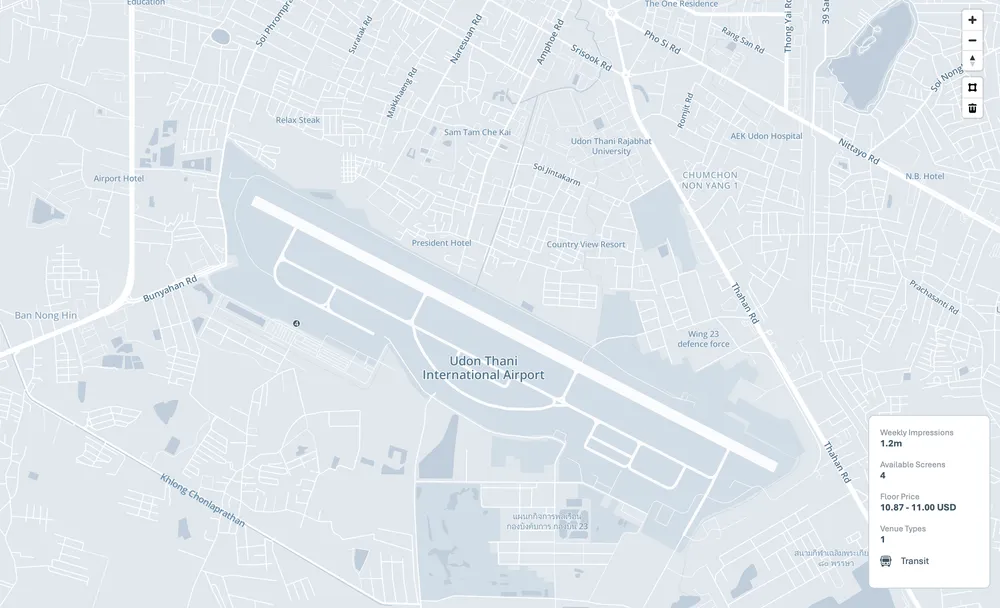
Catchment Area and Economic Drivers
Top 10 Cities within 150 km, Marketer Intelligence:
- Udon Thani: The commercial capital of upper Isaan. Concentrates modern retail, private hospitals, automotive dealerships, and a professional services base, plus one of Thailand's largest resident Western expatriate populations. The province's highest-value consumer market by a wide margin.
- Nong Khai: The Mekong border crossing town and the terminus of Thailand's northern rail corridor toward Laos. Produces logistics, customs brokerage, and cross-border trading audiences with genuine freight decision authority.
- Vientiane, Laos: A foreign capital functionally inside this airport's catchment. Supplies Lao government officials, business owners, and affluent families who fly from Udon Thani for cost and frequency reasons. The single most commercially valuable audience segment here.
- Nong Bua Lamphu: Agricultural and light manufacturing province immediately southwest. Produces farming households and small enterprise owners with equipment and credit requirements.
- Khon Kaen: The medical, education, and research centre of Isaan with a major university and hospital cluster. Produces professional, academic, and healthcare audiences and competes as a regional commercial hub.
- Kumphawapi: Sugar and agro-processing district. Produces agricultural cooperative and processing management with concentrated seasonal purchasing.
- Ban Dung: Rice and rubber belt with strong overseas labour migration history. Remittance-supported household consumption and vehicle finance demand.
- Ban Phue: Gateway to the province's newest UNESCO-listed heritage site. Produces emerging tourism services and small hospitality enterprise.
- Loei: Mountain tourism and agriculture province to the west, known for cool-season domestic visitation and a distinctive festival calendar. Adds leisure travel volume in the peak season.
- Sakon Nakhon: Agricultural and craft production centre with indigo textile export activity. Produces small-enterprise owners with e-commerce and export ambitions.
NRI and Diaspora Intelligence:
Three distinct international populations converge on this catchment and each is commercially relevant. First, Isaan is one of Thailand's largest labour export regions, with workers in South Korea, Taiwan, Israel, Japan, Singapore, and the Gulf sending remittances that materially raise household purchasing power across the province. Second, Udon Thani hosts one of Thailand's largest resident Western expatriate and long-stay retiree communities, a legacy of the province's role as a major allied air base during the Vietnam War, sustained today by favourable long-stay visa pathways. Third, the province has a long-established Vietnamese-Thai community with its own commercial networks and cultural sites. For advertisers, this means the catchment carries far more foreign currency exposure and cross-border financial need than a standard Thai provincial market.
Economic Importance:
Four engines drive this catchment. Agriculture remains the base, principally rice, sugarcane, cassava, and rubber, setting the seasonal rhythm of household spending. Cross-border trade and logistics with Laos is the fastest-growing engine, reshaped by rail connectivity through Nong Khai toward the Laos to China network. Healthcare and retail form the third engine, with Udon Thani serving as the medical and shopping destination for a catchment that extends across the Mekong. Mineral resources, notably significant potash deposits in the province, represent a long-horizon industrial signal. Masscom Global maps creative to the engine an advertiser is selling into rather than treating the terminal as one audience.

Business and Industrial Ecosystem
- Cross-border logistics and freight forwarding: The Nong Khai corridor is Thailand's principal land gateway to Laos and onward to China. Produces logistics operators, customs brokers, and trade finance decision makers with growing volumes.
- Private healthcare and hospital services: Udon Thani's hospitals serve a catchment that includes Lao patients crossing for treatment. Produces both a healthcare provider audience and a patient audience with real willingness to pay.
- Modern retail, property, and hospitality: The province is the shopping and leisure destination for upper Isaan and much of northern Laos. Produces retail development, hospitality, and consumer finance activity at genuine scale.
- Agriculture, agro-processing, and minerals: Rice, sugar, cassava, and rubber processing alongside major potash resources. Produces agricultural machinery, input, and industrial procurement audiences.
Passenger Intent, Business Segment:
Business travellers here divide into three groups. Thai regional business owners fly to Bangkok for supply, finance, and government business. Lao business owners and officials fly from Udon Thani because it is cheaper and better connected than their alternatives, and they are travelling with real capital and procurement authority. Logistics and trade operators move along the Bangkok to Nong Khai corridor. Banking and cross-border payments, healthcare groups, property developers, logistics and freight services, and telecoms intercept them most effectively.
Strategic Insight:
The Lao audience is what elevates this airport above every other provincial airport in Thailand. Lao nationals travelling through Udon Thani skew disproportionately toward the business, official, and affluent segments, because those are the people for whom flying at all is a considered decision. They spend on Thai healthcare, Thai education, Thai retail, and increasingly Thai property, and they are extremely difficult to reach through Lao domestic media at scale. A placement at Udon Thani reaches them inside Thailand, in a controlled environment, at the moment they are already engaged with the Thai market. Masscom Global builds this as a deliberate dual-nationality buy rather than a single-market campaign.
Tourism and Premium Travel Drivers
- Ban Chiang Archaeological Site: A UNESCO World Heritage Bronze Age site and the province's long-standing cultural anchor. Draws domestic and international heritage tourism and supports the province's cultural identity.
- Phu Phra Bat Historical Park: Inscribed as a UNESCO World Heritage Site in 2024, a significant and recent uplift to the province's tourism profile that is still building visitor volume.
- Red Lotus Sea at Nong Han: A seasonal lake bloom drawing heavy domestic visitation between December and February. The province's most photographed attraction and the anchor of cool-season tourism.
- Nong Khai and the Mekong riverfront: Border town tourism, riverside dining, and the Naga fireball phenomenon that draws very large crowds each October. Extends visitor stay across the two provinces.
Passenger Intent, Tourism Segment:
The dominant tourist here is a domestic Thai traveller on a cool-season trip, arriving with a fixed budget and high receptivity to promotions, telecom offers, and consumer finance. A secondary layer of international heritage and Mekong tourists arrives via Bangkok, skewing older and more affluent. A third and often overlooked layer is Lao leisure and shopping visitors, who cross specifically to spend in Udon Thani's malls and hospitals. Retail, hospitality, healthcare, telecom, and consumer finance benefit most.
Travel Patterns and Seasonality
Peak seasons:
- November to February: The strongest window. Thailand's cool dry season coincides with the Red Lotus Sea bloom, Loy Krathong, New Year travel, and the peak of both domestic and international visitation to the province.
- October: A sharp, distinctive peak driven by the Naga fireball observance at Nong Khai on the Mekong, which draws very large domestic crowds and heavy regional travel into the catchment.
- April: Songkran generates the largest domestic return migration of the Thai year as Isaan workers come home from Bangkok and abroad. Volume is high and spending is family-directed.
- May to September: The wet season and the softest period, with agricultural labour demand keeping the local population in place and tourism at its lowest.
Granular monthly passenger data is not published in current public form. Data not available.
Event-Driven Movement:
- Naga Fireball Festival at Nong Khai, Ok Phansa (October): One of Isaan's largest annual gatherings, drawing very substantial domestic crowds along the Mekong. A concentrated high-volume window for consumer, telecom, beverage, and hospitality advertisers.
- Songkran (April): Thai New Year and the peak of return migration. Concentrated family spending on vehicles, home goods, gifts, and telecom services.
- Loy Krathong and the cool-season festival calendar (November): Domestic travel and consumer spending peak alongside the start of the Red Lotus Sea season.
- Red Lotus Sea season (December to February): A sustained multi-month domestic tourism driver rather than a single event, supporting hospitality, transport, and consumer categories through the strongest quarter.
- Bun Bang Fai rocket festivals (May): A distinctive Isaan tradition marking the start of the rainy season, driving village-level gathering and regional movement at the edge of the low season.

It’s Not Just Where You Advertise - It’s How Fast You Execute
We combine local insight with fast rollout to deliver results for you, now.
Talk to an ExpertAudience and Cultural Intelligence
Top 2 Languages:
- Thai (Central): The official and commercial language and the correct default for all creative. Thai script is essential, as English-only execution will fail with the domestic majority.
- Isaan Lao: The household language of the catchment and, critically, closely related to and largely mutually intelligible with the Lao language spoken across the Mekong. This is the single most useful linguistic fact at this airport, because creative built with Isaan Lao sensibility reaches both the Thai regional audience and the Lao cross-border audience without separate production.
English matters as a secondary layer for the resident Western expatriate population and international heritage tourists, particularly for healthcare, property, insurance, and long-stay visa categories.
Major Traveller Nationalities:
The passenger base is majority Thai, drawn from Udon Thani and the surrounding upper Isaan provinces plus the Bangkok working diaspora. Lao nationals form the most significant foreign group and the most commercially valuable, crossing at Nong Khai to use this airport for cost and connectivity reasons. Western nationals, principally from the United Kingdom, Germany, Scandinavia, the Netherlands, the United States, and Australia, are present in unusual numbers as residents rather than tourists. Chinese and Vietnamese travellers appear in connection with the Mekong trade corridor. Creative should assume a Thai-first environment with a deliberate Lao-facing layer and an English layer for the resident foreign community.
Religion, Advertiser Intelligence:
- Theravada Buddhism (approximately 95 percent of the catchment): The dominant framework and the driver of the travel calendar. Ok Phansa in October, which coincides with the Naga observance on the Mekong, and Khao Phansa in July generate major merit-making expenditure and family travel. The temple-centred village structure makes community endorsement a powerful lever for consumer and financial brands.
- Naga and Mekong river veneration (interwoven with Buddhist practice across the border region): A distinctive belief system shared on both sides of the river that produces the province's largest annual gathering and a strong sense of shared Thai-Lao cultural identity. Brands that respect this shared identity earn credibility with both audiences simultaneously.
- Christianity and Vietnamese ancestral practice (small but established minority shares): Concentrated in the historic Vietnamese-Thai community and among the resident Western population. Adds Christmas and Lunar New Year spending patterns relevant to retail, food, and travel advertisers.
Behavioral Insight:
This is a value-conscious, family-centred market where household spending follows the agricultural cycle and the arrival of remittance income rather than a Bangkok-set promotional calendar. Big-ticket purchases such as pickups, motorcycles, smartphones, and home improvements cluster around those inflows, and instalment terms frequently matter more than headline price. The Lao segment behaves differently again: it is smaller, considerably more affluent relative to its home market, and motivated by access to Thai quality in healthcare, education, and retail that is unavailable at home. Effective creative here is warm, family-framed, finance-explicit for the Thai audience, and quality-and-access framed for the Lao audience.
Outbound Wealth and Investment Intelligence
The wealth story at this airport is a cross-border corridor rather than a conventional outbound flow, and advertisers who understand the direction of travel will outperform. Capital moves into Udon Thani from three sources: remittances from Isaan workers abroad, spending by Lao nationals seeking Thai healthcare, education, retail, and property, and pension income from a large resident Western retiree population. Meanwhile, people move outward under structured labour programmes. This is a receiving market with an unusual foreign-currency profile, not an origin market for international capital deployment.
Outbound Real Estate Investment:
Outbound international property investment from the Thai population in this catchment is negligible, and international developers targeting Thai buyers should be in Bangkok instead. The genuine property opportunity here runs the other way. Lao business owners and officials buy Thai residential property in Udon Thani, Khon Kaen, and Bangkok as an asset diversification and family-access strategy, and this airport is one of the most efficient ways to reach them. Alongside this, remittance-funded land purchase and house construction within the province, plus Thai property purchased in family arrangements involving resident foreign retirees, sustains a strong domestic developer market.
Outbound Education Investment:
Thai families in this catchment educate domestically, principally at the regional universities in Udon Thani and Khon Kaen and at Bangkok institutions. The genuinely international education flow is inbound from Laos: Lao families send children to Thai universities and international schools in significant numbers because of language proximity, cost, and quality. Thai universities, international schools, and language institutes recruiting Lao students have a concentrated and highly efficient audience at this airport. Vocational and skilled-worker training programmes for Japan and South Korea also carry real demand among the Thai population.
Outbound Wealth Migration and Residency:
The relevant migration here is labour outbound and residency inbound. Isaan workers move under structured programmes to South Korea, Taiwan, Israel, Japan, Singapore, and the Gulf, supporting employment agencies, training providers, foreign exchange services, and banks. In the opposite direction, Thailand's long-stay, retirement, and long-term resident visa pathways are directly relevant to a province with one of the country's largest Western retiree populations, and to Lao nationals establishing a Thai base. Citizenship-by-investment and European golden visa advertisers will find no market here.
Strategic Implication for Advertisers:
Two categories should treat this airport as a priority. Thai healthcare groups, universities, property developers, and banks should buy it to reach Lao decision makers who are otherwise expensive and difficult to target. Remittance, foreign exchange, consumer finance, telecom, and automotive brands should buy it to reach a Thai household base with more foreign-currency income than provincial wage data suggests. Masscom Global can also activate in Vientiane and in the labour destination markets that feed this catchment, closing the corridor at both ends.
Airport Infrastructure and Premium Indicators
Terminals:
- A single passenger terminal seven kilometres from the city centre, handling just over two million passengers a year through concentrated flows. Every passenger follows an identical path through one check-in and departure environment, so placement coverage is effectively complete from a limited number of positions.
- Runway and apron capacity handling Airbus A320 family and Boeing 737 equipment across five carriers, with 13,737 aircraft movements in 2025, up 9.11 percent year on year.
Premium Indicators:
- Reported profitability of around 100 million baht annually, making this the strongest commercial performer in the Department of Airports network and a facility with genuine reinvestment capacity.
- Full international designation with immigration and customs infrastructure in place, which means international scheduled service can be restored without new capital works when demand justifies it.
- Ownership by the Royal Thai Air Force with civil operation by the Department of Airports, reflecting the field's strategic significance and long-term security of tenure.
- Recent terminal upgrades including improved connectivity, digital flight information systems, and security screening, indicating active investment in passenger experience rather than managed decline.
Forward-Looking Signal:
Two structural developments will reshape this airport's value. The first is the long-planned transfer of the airport to Airports of Thailand, which would bring commercial management, terminal expansion, and materially greater capacity for passengers and cargo. The second is the Bangkok to Nong Khai rail corridor and its connection into the Laos to China network, which is reorienting upper Isaan from a peripheral agricultural region into a transit economy. Passenger numbers grew 6.96 percent and movements 9.11 percent in 2025 before either of these fully lands. Inventory in a single terminal is finite by definition, and rates set against current volumes will not survive an AOT transfer and terminal expansion. Masscom Global is advising clients to secure position now, ahead of the structural repricing.
Airline and Route Intelligence
Top Airlines:
Five carriers operate scheduled service. The largest by departures is a Thai low-cost carrier with around 51 weekly take-offs, followed by a second Thai low-cost operator, with three further carriers including the national flag carrier and a Thai-Vietnamese joint venture airline. Equipment is Airbus A320 family and Boeing 737.
Key International Routes:
There is currently no scheduled international service despite the airport's international designation and immigration facilities. International passengers connect through Bangkok, or cross the land border at Nong Khai to and from Vientiane. Weekly frequency data for any charter or seasonal international activity is not published. Data not available.
Domestic Connectivity:
Bangkok Don Mueang dominates with roughly 86 weekly flights, accounting for around 57 percent of all departures, supplemented by Bangkok Suvarnabhumi service. Secondary routes reach Chiang Mai, Chiang Rai, Phuket, Krabi, Hat Yai, and the Eastern Seaboard, giving the airport genuine multi-destination reach unusual for a provincial Thai field.
Wealth Corridor Signal:
The route map shows a market that is deeply integrated with Bangkok and increasingly connected to Thailand's leisure and industrial regions, but which draws part of its demand from outside Thailand entirely. The absence of scheduled international service is itself the insight: Lao demand is being served by a land crossing feeding a domestic Thai airport, which means those passengers appear in domestic statistics while behaving as international consumers. Advertisers who read the numbers literally will underestimate this audience. Masscom Global prices and plans against the real composition, not the reported one.
Media Environment at the Airport
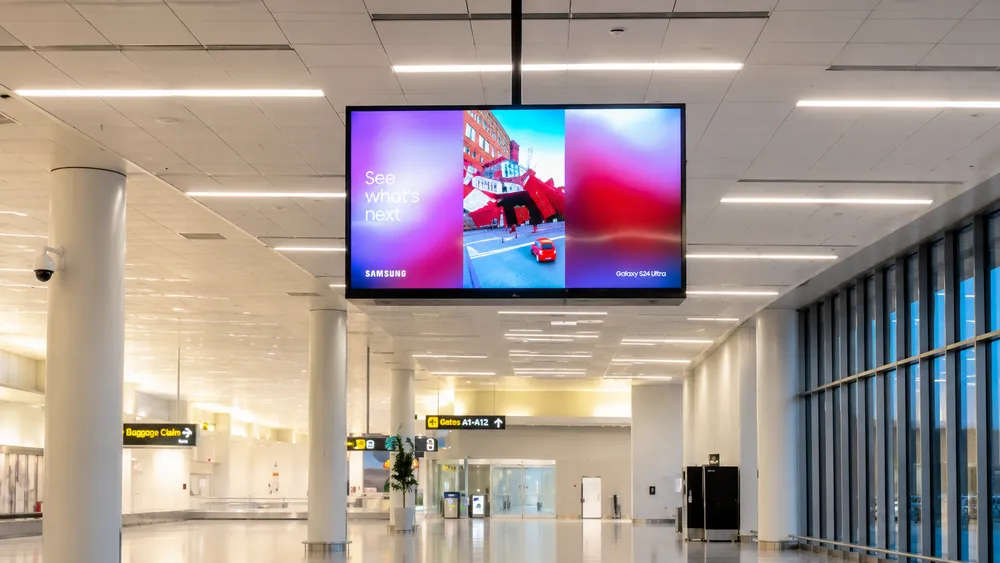
- A single terminal handling concentrated flows with limited existing visual competition, so a well-placed brand achieves high frequency across the entire passenger journey rather than fragmented share at a large hub.
- Dwell is structurally long because low-cost carrier passengers arrive early and the Bangkok route operates at high frequency throughout the day, converting a two-million passenger base into deep repeated exposure.
- The audience composition is uniquely layered for a provincial airport, combining Thai regional consumers, a foreign national elite from across the Mekong, and a resident Western expatriate population, all reachable through the same inventory.
- Masscom Global holds the access and execution capability to secure precision placement across check-in, security, and gate touchpoints, and structures campaigns to address the Thai and Lao audiences with distinct propositions rather than a single averaged message.
Strategic Advertising Fit
Best Fit:
- Private hospitals and healthcare groups: Reaches both Thai patients and Lao cross-border patients at the moment they are engaging with the Thai medical market. The highest-conviction category at this airport.
- Banking, foreign exchange, and cross-border payments: A catchment with remittance income, cross-border trade, Lao customers, and a resident foreign pension population. Unusually strong category fit.
- Property developers and real estate: Serves domestic remittance-funded construction demand and Lao buyers acquiring Thai residential assets.
- Universities, international schools, and education services: Thai institutions recruiting Lao students have an exceptionally efficient channel here.
- Automotive, pickup trucks, and motorcycles: The pickup is the defining household vehicle across Isaan, with strong instalment finance attachment.
- Telecommunications and mobile services: A young, digitally engaged population plus cross-border roaming and dual-SIM demand from Lao travellers.
- Logistics, freight forwarding, and trade services: The Nong Khai corridor into Laos and onward to China is the fastest-growing commercial story in the catchment.
- Long-stay visa, insurance, and retirement services: One of Thailand's largest resident Western retiree populations sits in this province.
Brand Alignment at a Glance:
| Category | Fit |
|---|---|
| Private hospitals and healthcare groups | Exceptional |
| Banking, foreign exchange, and cross-border payments | Exceptional |
| Property developers and real estate | Strong |
| Universities and education services | Strong |
| Automotive, pickups, and consumer finance | Strong |
| Telecommunications | Moderate |
| Logistics and trade services | Moderate |